welcome to our presentation
on
DESIGN AND CONSTRUCTION OF FINFISH HATCHERY
Presented by
Group - 04
Mahtab Uddin ( ASH1602017M)
Md. Hasan Jamil ( ASH1602018M )
Mst. Jannatul Ferdows Setu ( BKH1602019F )
Introduction :
The major input of aquaculture is availability of quality fish seed.
These fish seed comes from natural and hatchery sources.
 In Bangladesh, there are about 985 hatcheries
 873 are private and 112 are govt. hatcheries
Most of them are centralized in Mymenshing, Comilla, Jessore,
and some other places of Bangladesh ( DoF , 2009 )
Fish Hatchery
A fish hatchery is a place for artificial breeding, hatching, and rearing
through the early life stages of animals—finfish and shellfish in particular.
Hatchery provides an optimum environment for fish eggs to develop and
hatch by maintaining proper water temperature and oxygen levels, and
providing adequate food supplies and safety from predators.
Importance of Fish Hatchery:
Hatchery production confers three main benefits to the industry;
1. Out of Season Production
2. Genetic Improvement
3. Reduce Dependence on Wild-Caught Juveniles
Factors to be Considered in Designing
 Budget
 Production target
 Site selection
 Equipment selection
 Developing of floor plan
 Selection of building material
 Water supply
 Water disposal system
 Operation method
 Minimizing of stress Disease prevention
For Finfish Hatchery Site Selection Following Consideration
Should be Maintained:
 Availability of good brood fish.
 Good water supply
 Good water quality and
 Good soil quality.
 Raw material and building material and Elictricity facilities.
 The site is easily accessible by rail and/or road and air.
 Availability of skilled and unskilled manpower for construction and operation.
 Fertilizers and feeds for aquaculture.
 There is a market in the vicinity.
 Protection from high winds or typhoons.
Planning For Hatchery Construction
Water Inlet
 An inlet is to let water into the pond.
 The location of the inlet will depend on the shape of the land in relation to the water source.
 There are various types of inlets that can be used, for example PVC pipe, polyethylene pipe,
galvanized pipe, open earth canal, concrete channel, pump etc.
 An earth channel going direct into the pond is cheapest and easiest to make, but it is
cumbersome to screen and to control the water supply.
Water Outlet
 An outlet is to let water flow out of the pond.
 The outlet should be at the deepest end of the pond so that all the water can be drained out of
the pond by gravity.
 There are several types of outlets that can be used: for example PVC pipe, siphon, or pump. If
the outlet has an up stand pipe mounted on an elbow fitting then it can control the water level in
the pond.
Water Overflow Pipe
 An overflow is an extra pipe to let excess water flow away during heavy rainfall.
 It should be placed towards the outlet side, about 20–30cm below the top of the dyke, about
20cm above normal water level. The overflow pipe should also have screen to prevent the fish
escaping.
Technological Design
Water Supply:
 Surface waters (rivers, lakes, natural beach and artificial beach);
 Subsurface waters (ground water, deep-seated water, cavern water, spring water, filtered at the
riverside water);
 Other water sources, secondary utilization
Water Treatment System:
 Surface waters are for exploitation of a high quantity of water, but they always need
purification.
Connected Facilities
Inside the hatchery besides the operational rooms the
following compartments are needed:
 Store-room
 Laboratory
 Office social activities (dressing-room, shower, toilet).
Outside the hatchery the following facilities must be situated beside the above-
mentioned devices of water intake and water treatment (settling pond, filter-wall)
units:
 Facilities for keeping the breeders (breeder ponds, wintering ponds);
 Technological devices of hatcheries ensure the keeping of larvae only till the beginning
of breathing or beginning of food intake.
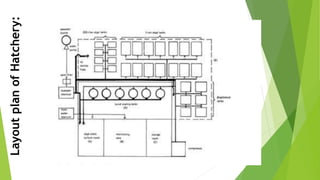
LayoutplanofHatchery:
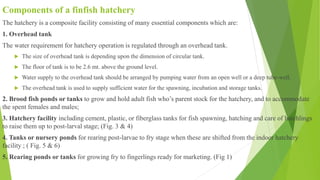
Components of a finfish hatchery
The hatchery is a composite facility consisting of many essential components which are:
1. Overhead tank
The water requirement for hatchery operation is regulated through an overhead tank.
 The size of overhead tank is depending upon the dimension of circular tank.
 The floor of tank is to be 2.6 mt. above the ground level.
 Water supply to the overhead tank should be arranged by pumping water from an open well or a deep tube-well.
 The overhead tank is used to supply sufficient water for the spawning, incubation and storage tanks.
2. Brood fish ponds or tanks to grow and hold adult fish who’s parent stock for the hatchery, and to accommodate
the spent females and males;
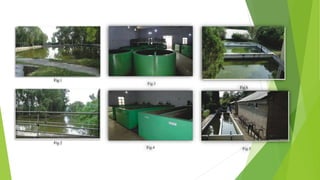
3. Hatchery facility including cement, plastic, or fiberglass tanks for fish spawning, hatching and care of hatchlings
to raise them up to post-larval stage; (Fig. 3 & 4)
4. Tanks or nursery ponds for rearing post-larvae to fry stage when these are shifted from the indoor hatchery
facility ; ( Fig. 5 & 6)
5. Rearing ponds or tanks for growing fry to fingerlings ready for marketing. (Fig 1)
Features of Different Types of Ponds are:
Brood fish Ponds:
 Area from 0.2 ha to 2.5 ha (for the sake of ease of netting operations)
 Rectangular shape
 Water depth may vary from 1.5 m to about 2.5m
 Must be drainable
Nursery Ponds
 Small in size (0.01-0.1 ha)
 Depth around 0.5 to 1.2 m
 Pond bottom should gently slope towards outlet
 Typically rectangular in shape
 Harvesting basin is preferred in front of the drain or outside the pond for safe and convenient collection of fry.
Rearing Ponds
 Larger than nursery ponds and are 0.8 to 2 m deep
 Pond bottom should be gently sloping towards outlet
 Rectangular in shape
 Like nursery ponds, a harvesting basin is maintained for safe collection of fry and fingerlings.
Location of Ponds in a Hatchery
 The area closest to the hatchery building should be planned for water treatment, (filtration,
sedimentation units, aeration tower) laboratory, hatchery office and residential area for the
staff.
 This arrangement will place the nurseries closest to the hatchery proper, which is a logical
arrangement.
Hatchery Proper:
 The main unit of a hatchery. It is a system composed of holding tanks, breeding tanks,
hatching jars and larvae rearing tanks.
a)Holding tanks
 The primary purpose of a holding tank is to hold ripe breeders before hypophysation, and
before spawning.
 The holding-tanks must be at least two in number, one for each sex of a species of fish in
the smallest hatchery.
 A 200 m sq or 450 m sq.(10 m x 20 m or 15 m x 30 m) ante-tank of 1.0 to 1.5 m depth can
hold 25-50 sets of brood fish
b) Breeding tank
 Used to hold injected or otherwise ripe breeders awaiting induced or natural spawning and
fertilization
 The inlet provides uninterrupted flow of oxygenated fresh water.
 A breeding tank may be rectangular in shape, a convenient size being 2.5 m x 1.5 m x 1.0
m for holding 4-6 breeders and 4 m x 2 m x 1 m for 8-10 breeders weighing 3-6 kg.
c ) Circular Spawning, Hatchery and Larvae Rearing Tanks
 Circular spawning tanks create a natural environment and facilitate fish spawning.
 The water flow throughout the tank is uniform and water inlet and outlets can be precisely
controlled.
 These circular tanks can serve as breeding tank, hatching tank as well as larval rearing
tanks simultaneously
 Normal flow rate in these tanks is 18 L / min.
Conclusion
Hatchery is the most important aspect of overall seed production
activities needing utmost care and consideration. Minor fault and
negligence in any of the issues may cause a heavy loss in the hatchery
business. Hatchery operation and management is very sensitive due to
low survibility of fry and fingerlings. By providing proper design and
facilities, we can increase the production of fish.
Any Question?
Thank You

fin fish hatchery

  • 1.
    welcome to ourpresentation on DESIGN AND CONSTRUCTION OF FINFISH HATCHERY
  • 2.
    Presented by Group -04 Mahtab Uddin ( ASH1602017M) Md. Hasan Jamil ( ASH1602018M ) Mst. Jannatul Ferdows Setu ( BKH1602019F )
  • 3.
    Introduction : The majorinput of aquaculture is availability of quality fish seed. These fish seed comes from natural and hatchery sources.  In Bangladesh, there are about 985 hatcheries  873 are private and 112 are govt. hatcheries Most of them are centralized in Mymenshing, Comilla, Jessore, and some other places of Bangladesh ( DoF , 2009 )
  • 4.
    Fish Hatchery A fishhatchery is a place for artificial breeding, hatching, and rearing through the early life stages of animals—finfish and shellfish in particular. Hatchery provides an optimum environment for fish eggs to develop and hatch by maintaining proper water temperature and oxygen levels, and providing adequate food supplies and safety from predators. Importance of Fish Hatchery: Hatchery production confers three main benefits to the industry; 1. Out of Season Production 2. Genetic Improvement 3. Reduce Dependence on Wild-Caught Juveniles
  • 5.
    Factors to beConsidered in Designing  Budget  Production target  Site selection  Equipment selection  Developing of floor plan  Selection of building material  Water supply  Water disposal system  Operation method  Minimizing of stress Disease prevention
  • 6.
    For Finfish HatcherySite Selection Following Consideration Should be Maintained:  Availability of good brood fish.  Good water supply  Good water quality and  Good soil quality.  Raw material and building material and Elictricity facilities.  The site is easily accessible by rail and/or road and air.  Availability of skilled and unskilled manpower for construction and operation.  Fertilizers and feeds for aquaculture.  There is a market in the vicinity.  Protection from high winds or typhoons.
  • 7.
    Planning For HatcheryConstruction Water Inlet  An inlet is to let water into the pond.  The location of the inlet will depend on the shape of the land in relation to the water source.  There are various types of inlets that can be used, for example PVC pipe, polyethylene pipe, galvanized pipe, open earth canal, concrete channel, pump etc.  An earth channel going direct into the pond is cheapest and easiest to make, but it is cumbersome to screen and to control the water supply. Water Outlet  An outlet is to let water flow out of the pond.  The outlet should be at the deepest end of the pond so that all the water can be drained out of the pond by gravity.  There are several types of outlets that can be used: for example PVC pipe, siphon, or pump. If the outlet has an up stand pipe mounted on an elbow fitting then it can control the water level in the pond.
  • 8.
    Water Overflow Pipe An overflow is an extra pipe to let excess water flow away during heavy rainfall.  It should be placed towards the outlet side, about 20–30cm below the top of the dyke, about 20cm above normal water level. The overflow pipe should also have screen to prevent the fish escaping. Technological Design Water Supply:  Surface waters (rivers, lakes, natural beach and artificial beach);  Subsurface waters (ground water, deep-seated water, cavern water, spring water, filtered at the riverside water);  Other water sources, secondary utilization Water Treatment System:  Surface waters are for exploitation of a high quantity of water, but they always need purification.
  • 9.
    Connected Facilities Inside thehatchery besides the operational rooms the following compartments are needed:  Store-room  Laboratory  Office social activities (dressing-room, shower, toilet). Outside the hatchery the following facilities must be situated beside the above- mentioned devices of water intake and water treatment (settling pond, filter-wall) units:  Facilities for keeping the breeders (breeder ponds, wintering ponds);  Technological devices of hatcheries ensure the keeping of larvae only till the beginning of breathing or beginning of food intake.
  • 10.
  • 11.
    Components of afinfish hatchery The hatchery is a composite facility consisting of many essential components which are: 1. Overhead tank The water requirement for hatchery operation is regulated through an overhead tank.  The size of overhead tank is depending upon the dimension of circular tank.  The floor of tank is to be 2.6 mt. above the ground level.  Water supply to the overhead tank should be arranged by pumping water from an open well or a deep tube-well.  The overhead tank is used to supply sufficient water for the spawning, incubation and storage tanks. 2. Brood fish ponds or tanks to grow and hold adult fish who’s parent stock for the hatchery, and to accommodate the spent females and males; 3. Hatchery facility including cement, plastic, or fiberglass tanks for fish spawning, hatching and care of hatchlings to raise them up to post-larval stage; (Fig. 3 & 4) 4. Tanks or nursery ponds for rearing post-larvae to fry stage when these are shifted from the indoor hatchery facility ; ( Fig. 5 & 6) 5. Rearing ponds or tanks for growing fry to fingerlings ready for marketing. (Fig 1)
  • 13.
    Features of DifferentTypes of Ponds are: Brood fish Ponds:  Area from 0.2 ha to 2.5 ha (for the sake of ease of netting operations)  Rectangular shape  Water depth may vary from 1.5 m to about 2.5m  Must be drainable Nursery Ponds  Small in size (0.01-0.1 ha)  Depth around 0.5 to 1.2 m  Pond bottom should gently slope towards outlet  Typically rectangular in shape  Harvesting basin is preferred in front of the drain or outside the pond for safe and convenient collection of fry. Rearing Ponds  Larger than nursery ponds and are 0.8 to 2 m deep  Pond bottom should be gently sloping towards outlet  Rectangular in shape  Like nursery ponds, a harvesting basin is maintained for safe collection of fry and fingerlings.
  • 14.
    Location of Pondsin a Hatchery  The area closest to the hatchery building should be planned for water treatment, (filtration, sedimentation units, aeration tower) laboratory, hatchery office and residential area for the staff.  This arrangement will place the nurseries closest to the hatchery proper, which is a logical arrangement. Hatchery Proper:  The main unit of a hatchery. It is a system composed of holding tanks, breeding tanks, hatching jars and larvae rearing tanks. a)Holding tanks  The primary purpose of a holding tank is to hold ripe breeders before hypophysation, and before spawning.  The holding-tanks must be at least two in number, one for each sex of a species of fish in the smallest hatchery.  A 200 m sq or 450 m sq.(10 m x 20 m or 15 m x 30 m) ante-tank of 1.0 to 1.5 m depth can hold 25-50 sets of brood fish
  • 15.
    b) Breeding tank Used to hold injected or otherwise ripe breeders awaiting induced or natural spawning and fertilization  The inlet provides uninterrupted flow of oxygenated fresh water.  A breeding tank may be rectangular in shape, a convenient size being 2.5 m x 1.5 m x 1.0 m for holding 4-6 breeders and 4 m x 2 m x 1 m for 8-10 breeders weighing 3-6 kg. c ) Circular Spawning, Hatchery and Larvae Rearing Tanks  Circular spawning tanks create a natural environment and facilitate fish spawning.  The water flow throughout the tank is uniform and water inlet and outlets can be precisely controlled.  These circular tanks can serve as breeding tank, hatching tank as well as larval rearing tanks simultaneously  Normal flow rate in these tanks is 18 L / min.
  • 16.
    Conclusion Hatchery is themost important aspect of overall seed production activities needing utmost care and consideration. Minor fault and negligence in any of the issues may cause a heavy loss in the hatchery business. Hatchery operation and management is very sensitive due to low survibility of fry and fingerlings. By providing proper design and facilities, we can increase the production of fish.
  • 17.
  • 18.