KASHMEERA N.A.
II SEM. M.Sc. ZOOLOGY
ROLL No: 37
CHRIST COLLEGE ,IJK
Gerontology (from Greek:  geron, "old man" and-logy, 
"study of") is the study of the social, psychological
 and biological aspect of aging.
 
It is distinguished fromgeriatrics, which is the branch 
of medicine that studies the diseases of the elderly.
Characteristics of aging affect all the individuals of a
species.
Two major topics in research on aging
1) Life span
2) Senescence
These topics are interrelated.
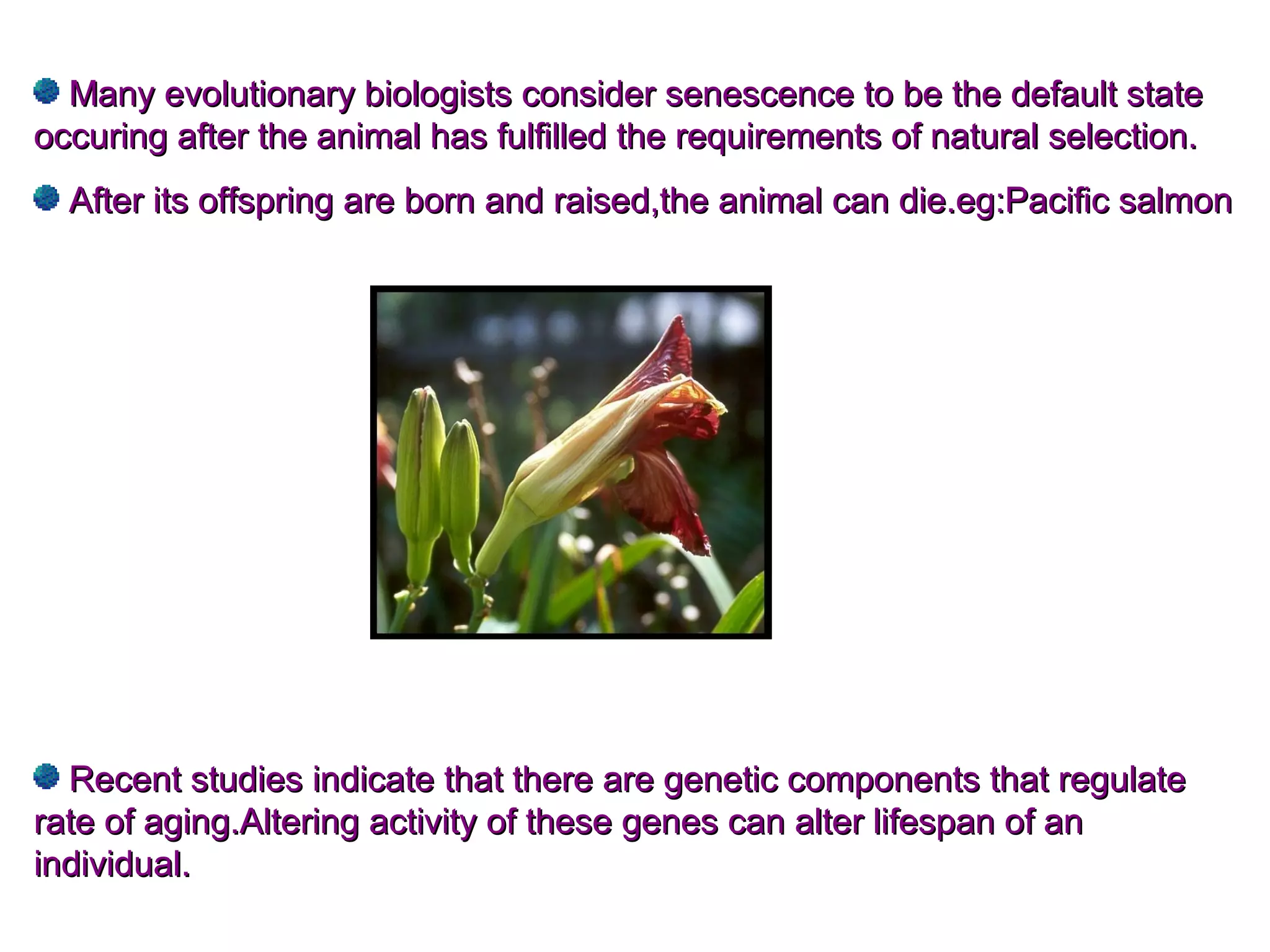
Many evolutionary biologists consider senescence to be the default state
occuring after the animal has fulfilled the requirements of natural selection.
After its offspring are born and raised,the animal can die.eg:Pacific salmon

Recent studies indicate that there are genetic components that regulate
rate of aging.Altering activity of these genes can alter lifespan of an
individual.
The maximum lifespan is a characteristic of
a species;
It is the maximum number of years a
member of species has been known to
survive.

Life expectancy is not a characteristic of
species,but of populations
It is the age at which half the population still
survives.
Life expectancy of Indians 
♂ ♂      -     65.77 years     ;      ♀ ♀      -  67.95 years
Nuclear pyknosis: With advancing age, the nucleus
shrinks and stains deeply. This is due to the
condensation of the nuclear material.

Aging is accelerated by chromosomal aberrations,and
somatic gene mutations

Degeneration of cytoplasmic organelles
Changes in enzymatic proteins
LDH,SDH,AC Pase,Lysosomal enzymes

Catalase,Glutathione peroxidase

Respiratory enzymes,Alkaline
phosphatase,Glucose dehydrogenase
Shortening of telomeres
telomeres -specific DNA sequences found only at the
tips of chromosome.
protect the tips of chromosomes from erosion and from
sticking to one another.
in most normal body cells each cycle of cell division
shortens the telomeres.
Eventually, after many cycles of cell division,
the telomeres can be completely gone and even some of
the functional chromosomal material may be lost.
erosion of DNA from the tips of our chromosomes
contributes greatly to aging and death of cells.
Accumulation of aging pigments
Lipofuscin accumulation
Accumulation
Accumulation of free radicals

of free radicals

Free radicals produce oxidative damage in lipids,
proteins, or
nucleic acids by “stealing” an electron to accompany their
unpaired electrons.
Some effects are wrinkled skin, stiff joints,and hardened
arteries.
Normal metabolism—for example, aerobic cellular
respiration in mitochondria—produces some free radicals.
Others are present in air pollution, radiation, and certain
foods we eat. Naturally occurring enzymes in peroxisomes
and in the cytosol normally dispose of free radicals.
Changes in hormonal levels

Ward Dean M.D.
Weakened immune system
With age the system's ability to produce necessary
antibodies that fight disease declines
the immune system may start to attack the body’s own
cells.
This autoimmune response might be caused by
changes in cell-identity markers at the surface of cells
that cause antibodies to attach to and
mark the cell for destruction.
Decrease in rate of celldivision
The Hayflick Limit Theory of Aging says that the human cells ability
to divide is limited to approximately 50-times, after which they
simply stop dividing (and hence die).

Leonard Hayflick
Glucose, the most abundant sugar in the body,
plays a role in the aging process.
It is haphazardly added to proteins inside and
outside cells, forming irreversible cross-links
between adjacent protein molecules.
With advancing age, more cross-links form,
which contributes to the stiffening and loss of
elasticity that occur in aging tissues.
The changes occuring in the intercellular spaces and in the lumen of blood
vascular system are examples of extracellular changes.

Dementia
Dementia (taken from Latin, originally meaning "madness", from de"without" + ment, the root of mens "mind") is a serious loss of cognitive
ability .
dementia is common in the geriatric population,
Dementia is a non-specific illness syndrome (i.e., set of symptoms) in
which affected areas of cognition may be memory, attention, language,
and problem solving.
one of the most common forms of dementia is Alzheimer's disease
Alzheimer’s disease

In Alzheimer’s disease, a substance called amyloid builds up
and causes the early death of brain cells, which results in a
progressive loss of memory and other brain functions.
Atherosclerosis
Atherosclerosis is a disease in which plaque builds
up inside arteries.
Plaque is made up of fat, cholesterol, calcium, and
other substances found in the blood.
Over time, plaque hardens and narrows arteries.
This limits the flow of oxygen-rich blood to organs
and other parts of body.
Atherosclerosis can lead to serious problems,
including heart attack, stroke, or even death.
Fibrosis
Fibrosis is the formation of excess fibrous connective tissue in an organ or
tissue .
This is as opposed to formation of fibrous tissue as a normal constituent of
an organ or tissue.
Eg: cirrhosis of the liver.

cirrhosis of the liver

fibrosis in heart
Parkinson's disease
Parkinson's disease is a degenerative disorder of
the central nervous system.
The motor symptoms of Parkinson's disease result
from the death of dopamine-generating cells in the
region of the midbrain;
the cause of this cell death is unknown.,
the most obvious symptoms are movement-related;
these include shaking, rigidity, slowness of movement
and difficulty with walking and gait.
dementia commonly occur in the advanced stages of
the disease.
Other symptoms include sensory, sleep and emotional
problems.
PD is more common in the elderly-after the age of 50.
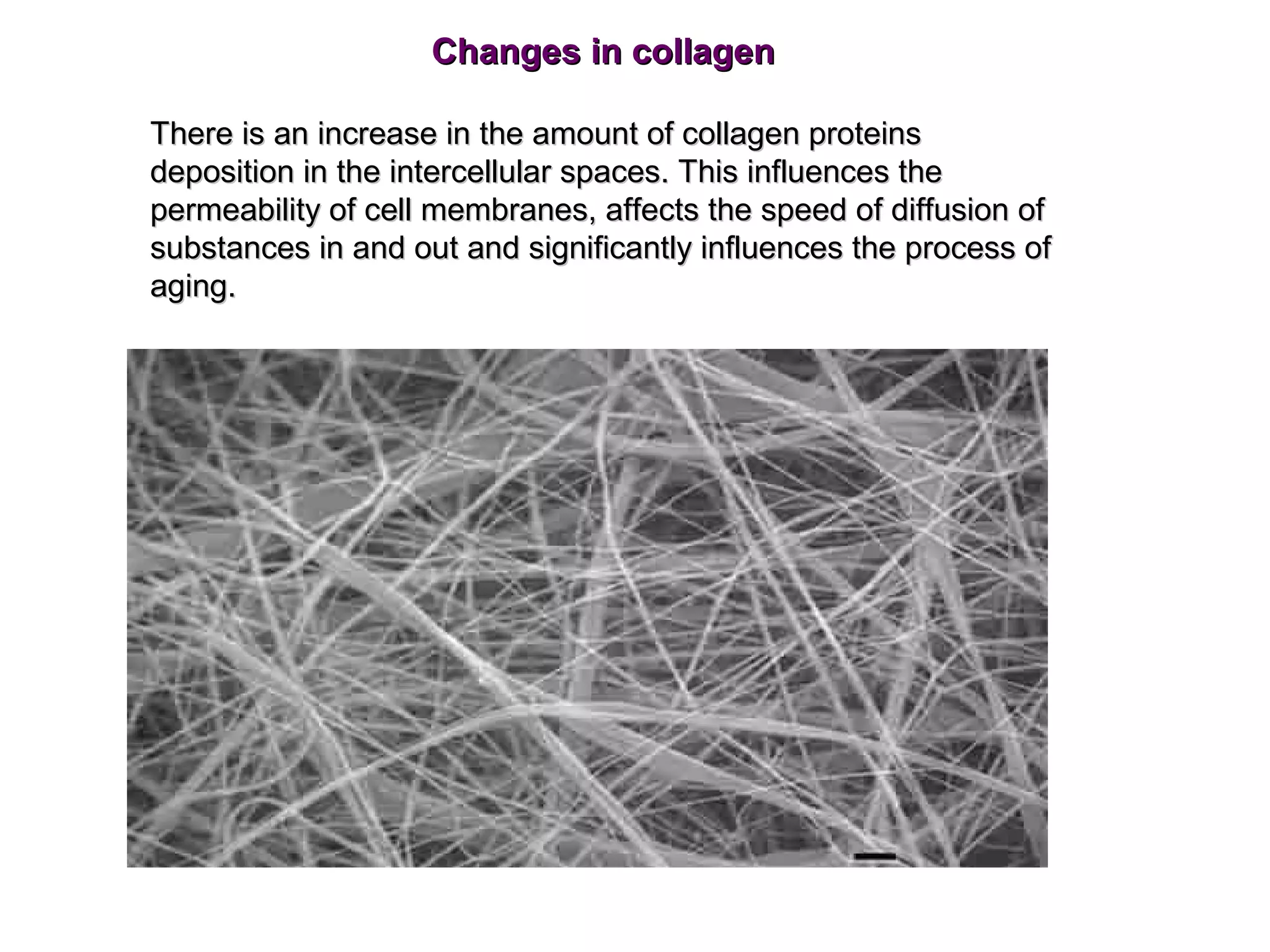
Changes in collagen
There is an increase in the amount of collagen proteins
deposition in the intercellular spaces. This influences the
permeability of cell membranes, affects the speed of diffusion of
substances in and out and significantly influences the process of
aging.
Aging and Wrinkles

Wrinkles are a by-product of the aging process.
With age, skin cells divide more slowly, and the inner layer, called
the dermis, begins to thin.
The network of elastin (the protein which causes skin to stretch)
and collagen fibers (the major structural proteins in the skin),
which support the outer layer, loosen and unravel, causing
depressions on the surface.
With aging, skin also loses its elasticity, is less able to retain
moisture, oil-secreting glands are less efficient and the skin is
slower to heal.
All of these contribute to the development of wrinkles
Oxidative damage
Aging is a by-product of normal metabolism;
About 2- 3% of the oxygen atoms taken up by the mitochondria
are reduced to reactive oxygen species (ROS).
[Reactive oxygen species (ROS) are chemically reactive
molecules containing oxygen ]
These ROS include the superoxide ion, the hydroxyl radical,
and hydrogen peroxide.
ROS can oxidize and damage cell membranes, proteins, and
nucleic acids.
Evidence for this theory includes the observation that
Drosophila that overexpress enzymes that destroy ROS
(catalase and superoxide dismutase) live 30 -40% longer than do
controls .
Moreover, flies with mutations in the methuselah gene live
35% longer than wild-type flies.
The methusaleh mutants have enhanced resistance to
paraquat, a poison that works by generating ROS within cells
. These findings not only suggest that aging is under genetic
control, but also provide evidence for the role of ROS in the
aging process.
In C. elegans, too, individuals with mutations that increase
the synthesis of ROS-degrading enzymes live much longer
than wild-type nematodes .
The evidence for ROS involvement in mammalian aging is
not as clear.
Mitochondrial genome damage.
It is thought that mutations in mitochondria could
(1) lead to defects in energy production,
(2) lead to the production of ROS by faulty electron transport,
(3) induce apoptosis.
A recent report shows that there are "hot spots" for age-related
mutations in the mitochondrial genome,
and that mitochondria with these mutations have a higher
replication frequency than wild-type mitochondria.
Thus, the mutants are able to outcompete the wild-type
mitochondria and eventually dominate the cell and its progeny.
Moreover, the mutations may not only allow more ROS to be
made, but may make the mitochondrial DNA more susceptible
to ROS-mediated damage.
General wear-and-tear and genetic
instability
"Wear-and-tear" theories of aging are among the oldest hypotheses
.As one gets older, small traumas to the body build up.
Point mutations increase in number, and the efficiencies of the
enzymes encoded by our genes decrease.
if a mutation occured in a part of the protein synthetic apparatus,
the cell would make a large percentage of faulty proteins .
If mutations arose in the DNA-synthesizing enzymes, the rate of
mutations would be expected to increase markedly, .
Likewise, DNA repair may be important in preventing senescence,
and species whose members' cells have more efficient DNA repair
enzymes live longer
genetic defects in DNA repair enzymes can produce premature
aging syndromes in humans
Progeria [Hutchinson-Gilford syndrome ]
Progeria is a disease characterized by normal development
in the first year of life followed by rapid aging.
It is caused by a genetic defect in which telomeres are
considerably shorter than normal.
Symptoms include dry and wrinkled skin, total baldness, and
birdlike facial features.
Death usually occurs around age 13.
Werner syndrome
Werner syndrome is a rare, inherited disease that causes a
rapid acceleration of aging, usually while the person is only in his
or her twenties.
It is characterized by wrinkling of the skin,
graying of the hair and baldness, cataracts,
muscular atrophy, and a tendency to develop diabetes mellitus,
cancer, and cardiovascular disease.
Most afflicted individuals die before age 50.
In C. elegans, there appear to be at least two genetic pathways that affect aging.
The first pathway involves the decision to remain a larva or to continue growth.
After hatching, the C. elegans larva proceeds through four instar stages, after which it can
become an adult
or (if the nematodes are overcrowded or if there is insufficient food) can enter a nonfeeding,
metabolically dormant dauer stage.
It can remain a dauer larva for up to 6 months, rather than becoming an adult that lives only
a few weeks.
In the dauer stage, adult development is suppressed, and
extra defenses against ROS are synthesized.
If some of the genes involved in this pathway are mutated, adult
development is allowed, but the ROS defenses are still made.
The resulting adults live twice to four times as long as wild-type
adults
The pathway that regulates dauer formation & longevity –
insulin signalling pathway
Insulin like protein
+
DAF2
TGF –β
Mediated
signal

DAF9

Steroid
hormone

DAF12

Dauer larva

Gene response for
reproductive
growth
Proposed mechanism for extending lifespan
of C.elegans through insulin signalling
pathway
The second pathway involves the gonads.
Germ cells appear to inhibit longevity,
when these cells are removed ,C.elegans live longer.
Germ line stem cells produce a substance that blocks the
effects of a longevity- inducing steroid hormone
The insulin signalling pathway also regulates lifespan in
Drosophila.

Flies with weak loss-of-function mutations of insulin receptor
gene live nearly 85% longer than wild type.

The insulin signalling pathway also regulates lifespan in
mammals.

1] mice with loss-of-function mutations of insulin signalling
pathway live longer than wild type.

2]dog breeds with low levels of insulin-like growth
factor[IGF1] live longer than those breeds with higherlevels of
this factor.

3]mice lacking 1 copy of IGF1 receptor gene live 25% longer
than wild type.
As human life expectancy increases
due to our increased ability to
prevent and cure
disease, we are still left with a
general aging syndrome that is
characteristic of our species.
However our knowledge of
regeneration is being put to use by
medicine,and we may soon be able
to ameliorate some of the
symptoms of aging
Aging

Aging

  • 1.
    KASHMEERA N.A. II SEM.M.Sc. ZOOLOGY ROLL No: 37 CHRIST COLLEGE ,IJK
  • 4.
  • 5.
    Many evolutionary biologistsconsider senescence to be the default state occuring after the animal has fulfilled the requirements of natural selection. After its offspring are born and raised,the animal can die.eg:Pacific salmon Recent studies indicate that there are genetic components that regulate rate of aging.Altering activity of these genes can alter lifespan of an individual.
  • 6.
    The maximum lifespanis a characteristic of a species; It is the maximum number of years a member of species has been known to survive. Life expectancy is not a characteristic of species,but of populations It is the age at which half the population still survives.
  • 7.
  • 10.
    Nuclear pyknosis: Withadvancing age, the nucleus shrinks and stains deeply. This is due to the condensation of the nuclear material. Aging is accelerated by chromosomal aberrations,and somatic gene mutations Degeneration of cytoplasmic organelles
  • 11.
    Changes in enzymaticproteins LDH,SDH,AC Pase,Lysosomal enzymes Catalase,Glutathione peroxidase Respiratory enzymes,Alkaline phosphatase,Glucose dehydrogenase
  • 12.
    Shortening of telomeres telomeres -specific DNA sequencesfound only at the tips of chromosome. protect the tips of chromosomes from erosion and from sticking to one another. in most normal body cells each cycle of cell division shortens the telomeres. Eventually, after many cycles of cell division, the telomeres can be completely gone and even some of the functional chromosomal material may be lost. erosion of DNA from the tips of our chromosomes contributes greatly to aging and death of cells.
  • 13.
    Accumulation of agingpigments Lipofuscin accumulation
  • 14.
    Accumulation Accumulation of freeradicals of free radicals Free radicals produce oxidative damage in lipids, proteins, or nucleic acids by “stealing” an electron to accompany their unpaired electrons. Some effects are wrinkled skin, stiff joints,and hardened arteries. Normal metabolism—for example, aerobic cellular respiration in mitochondria—produces some free radicals. Others are present in air pollution, radiation, and certain foods we eat. Naturally occurring enzymes in peroxisomes and in the cytosol normally dispose of free radicals.
  • 16.
    Changes in hormonallevels Ward Dean M.D.
  • 17.
    Weakened immune system Withage the system's ability to produce necessary antibodies that fight disease declines the immune system may start to attack the body’s own cells. This autoimmune response might be caused by changes in cell-identity markers at the surface of cells that cause antibodies to attach to and mark the cell for destruction.
  • 18.
    Decrease in rateof celldivision The Hayflick Limit Theory of Aging says that the human cells ability to divide is limited to approximately 50-times, after which they simply stop dividing (and hence die). Leonard Hayflick
  • 19.
    Glucose, the mostabundant sugar in the body, plays a role in the aging process. It is haphazardly added to proteins inside and outside cells, forming irreversible cross-links between adjacent protein molecules. With advancing age, more cross-links form, which contributes to the stiffening and loss of elasticity that occur in aging tissues.
  • 21.
    The changes occuringin the intercellular spaces and in the lumen of blood vascular system are examples of extracellular changes. Dementia Dementia (taken from Latin, originally meaning "madness", from de"without" + ment, the root of mens "mind") is a serious loss of cognitive ability . dementia is common in the geriatric population, Dementia is a non-specific illness syndrome (i.e., set of symptoms) in which affected areas of cognition may be memory, attention, language, and problem solving. one of the most common forms of dementia is Alzheimer's disease
  • 22.
    Alzheimer’s disease In Alzheimer’sdisease, a substance called amyloid builds up and causes the early death of brain cells, which results in a progressive loss of memory and other brain functions.
  • 23.
    Atherosclerosis Atherosclerosis is adisease in which plaque builds up inside arteries. Plaque is made up of fat, cholesterol, calcium, and other substances found in the blood. Over time, plaque hardens and narrows arteries. This limits the flow of oxygen-rich blood to organs and other parts of body. Atherosclerosis can lead to serious problems, including heart attack, stroke, or even death.
  • 25.
    Fibrosis Fibrosis is theformation of excess fibrous connective tissue in an organ or tissue . This is as opposed to formation of fibrous tissue as a normal constituent of an organ or tissue. Eg: cirrhosis of the liver. cirrhosis of the liver fibrosis in heart
  • 26.
    Parkinson's disease Parkinson's diseaseis a degenerative disorder of the central nervous system. The motor symptoms of Parkinson's disease result from the death of dopamine-generating cells in the region of the midbrain; the cause of this cell death is unknown., the most obvious symptoms are movement-related; these include shaking, rigidity, slowness of movement and difficulty with walking and gait. dementia commonly occur in the advanced stages of the disease. Other symptoms include sensory, sleep and emotional problems. PD is more common in the elderly-after the age of 50.
  • 29.
    Changes in collagen Thereis an increase in the amount of collagen proteins deposition in the intercellular spaces. This influences the permeability of cell membranes, affects the speed of diffusion of substances in and out and significantly influences the process of aging.
  • 30.
    Aging and Wrinkles Wrinklesare a by-product of the aging process. With age, skin cells divide more slowly, and the inner layer, called the dermis, begins to thin. The network of elastin (the protein which causes skin to stretch) and collagen fibers (the major structural proteins in the skin), which support the outer layer, loosen and unravel, causing depressions on the surface. With aging, skin also loses its elasticity, is less able to retain moisture, oil-secreting glands are less efficient and the skin is slower to heal. All of these contribute to the development of wrinkles
  • 32.
    Oxidative damage Aging isa by-product of normal metabolism; About 2- 3% of the oxygen atoms taken up by the mitochondria are reduced to reactive oxygen species (ROS). [Reactive oxygen species (ROS) are chemically reactive molecules containing oxygen ] These ROS include the superoxide ion, the hydroxyl radical, and hydrogen peroxide. ROS can oxidize and damage cell membranes, proteins, and nucleic acids. Evidence for this theory includes the observation that Drosophila that overexpress enzymes that destroy ROS (catalase and superoxide dismutase) live 30 -40% longer than do controls .
  • 33.
    Moreover, flies withmutations in the methuselah gene live 35% longer than wild-type flies. The methusaleh mutants have enhanced resistance to paraquat, a poison that works by generating ROS within cells . These findings not only suggest that aging is under genetic control, but also provide evidence for the role of ROS in the aging process. In C. elegans, too, individuals with mutations that increase the synthesis of ROS-degrading enzymes live much longer than wild-type nematodes . The evidence for ROS involvement in mammalian aging is not as clear.
  • 34.
    Mitochondrial genome damage. Itis thought that mutations in mitochondria could (1) lead to defects in energy production, (2) lead to the production of ROS by faulty electron transport, (3) induce apoptosis. A recent report shows that there are "hot spots" for age-related mutations in the mitochondrial genome, and that mitochondria with these mutations have a higher replication frequency than wild-type mitochondria. Thus, the mutants are able to outcompete the wild-type mitochondria and eventually dominate the cell and its progeny. Moreover, the mutations may not only allow more ROS to be made, but may make the mitochondrial DNA more susceptible to ROS-mediated damage.
  • 35.
    General wear-and-tear andgenetic instability "Wear-and-tear" theories of aging are among the oldest hypotheses .As one gets older, small traumas to the body build up. Point mutations increase in number, and the efficiencies of the enzymes encoded by our genes decrease. if a mutation occured in a part of the protein synthetic apparatus, the cell would make a large percentage of faulty proteins . If mutations arose in the DNA-synthesizing enzymes, the rate of mutations would be expected to increase markedly, . Likewise, DNA repair may be important in preventing senescence, and species whose members' cells have more efficient DNA repair enzymes live longer genetic defects in DNA repair enzymes can produce premature aging syndromes in humans
  • 38.
    Progeria [Hutchinson-Gilford syndrome] Progeria is a disease characterized by normal development in the first year of life followed by rapid aging. It is caused by a genetic defect in which telomeres are considerably shorter than normal. Symptoms include dry and wrinkled skin, total baldness, and birdlike facial features. Death usually occurs around age 13.
  • 39.
    Werner syndrome Werner syndromeis a rare, inherited disease that causes a rapid acceleration of aging, usually while the person is only in his or her twenties. It is characterized by wrinkling of the skin, graying of the hair and baldness, cataracts, muscular atrophy, and a tendency to develop diabetes mellitus, cancer, and cardiovascular disease. Most afflicted individuals die before age 50.
  • 41.
    In C. elegans,there appear to be at least two genetic pathways that affect aging. The first pathway involves the decision to remain a larva or to continue growth. After hatching, the C. elegans larva proceeds through four instar stages, after which it can become an adult or (if the nematodes are overcrowded or if there is insufficient food) can enter a nonfeeding, metabolically dormant dauer stage. It can remain a dauer larva for up to 6 months, rather than becoming an adult that lives only a few weeks.
  • 42.
    In the dauerstage, adult development is suppressed, and extra defenses against ROS are synthesized. If some of the genes involved in this pathway are mutated, adult development is allowed, but the ROS defenses are still made. The resulting adults live twice to four times as long as wild-type adults The pathway that regulates dauer formation & longevity – insulin signalling pathway
  • 43.
    Insulin like protein + DAF2 TGF–β Mediated signal DAF9 Steroid hormone DAF12 Dauer larva Gene response for reproductive growth
  • 44.
    Proposed mechanism forextending lifespan of C.elegans through insulin signalling pathway
  • 45.
    The second pathwayinvolves the gonads. Germ cells appear to inhibit longevity, when these cells are removed ,C.elegans live longer. Germ line stem cells produce a substance that blocks the effects of a longevity- inducing steroid hormone
  • 46.
    The insulin signallingpathway also regulates lifespan in Drosophila. Flies with weak loss-of-function mutations of insulin receptor gene live nearly 85% longer than wild type. The insulin signalling pathway also regulates lifespan in mammals. 1] mice with loss-of-function mutations of insulin signalling pathway live longer than wild type. 2]dog breeds with low levels of insulin-like growth factor[IGF1] live longer than those breeds with higherlevels of this factor. 3]mice lacking 1 copy of IGF1 receptor gene live 25% longer than wild type.
  • 47.
    As human lifeexpectancy increases due to our increased ability to prevent and cure disease, we are still left with a general aging syndrome that is characteristic of our species. However our knowledge of regeneration is being put to use by medicine,and we may soon be able to ameliorate some of the symptoms of aging