TOPIC: Fish culture
CONTENT
 What is fish culture?
 Aim of fish culture
 Where did fish culture is done firstly?
 Characteristics of cultivatable fish
 Classification of fish culture
 Fingerling production
 Carps
 Reference
What is Fish culture
• Fish culture is the process of raising desirable species of fishes in
captivity and managing them and their environment to improve
growth and reproduction and for domestic and commercial
purposes.
Aim of fish culture
• Is to obtain maximum yield of fish.
• To obtain palatable and highly nutritive fish flesh.
• By product of fishing industry.
Where fish culture is done firstly?
• The earliest evidence of fish farming dates back to before 1000
BCE in China. The Zhou dynasty (1112-221 BCE), then the
politician Fan Li, around 500 BCE, were the first to describe carp,
a symbol of good luck and fortune, as being farmed for food.
Characteristics of cultivable fishes
 The special characteristic features of cultivable fishes
are:
• Fishes should have high growth rate in short period for
culture.
• They should accept supplementary diet.
• They should be hardy enough to resist some common
diseases and infection of parasites.
• Fishes proposed for polyculture should be able to live
together without interfering or attacking other fishes.
• They should have high conversion efficiency so that they
can effectively utilize the food.
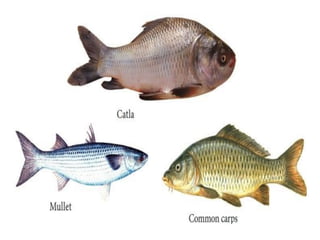
 Major fishes that are cultivate in fish culture:
• Carps, Catla, Labeo, Clarias, Chanos, Mullet, Common
carps
Classification of fish culture
 On the basis of culture
 Monoculture
 Polyculture
 Mono-sex culture
 Poly-sex culture
 On the basis of density
 Intensive fish farming system
 Semi intensive fish farming system
 Extensive fish farming system
Classification of fish culture
 On the basis of enclosure
 Cage fish culture
 Pen fish culture
 On the basis of integration
 Pig cum fish farming
 Duck cum fish farming
 Paddy cum fish farming
On the basis of culture
 Monoculture:
• Raising only one species of fish in available water body.
E.g.: raising of anyone of tilapia, rainbow trout, catfish etc.
 Mono-sex culture:
• Raising of either male or female of single fish species. It is
practiced for maintaining breeding male and female fish.
On the basis of culture
 Advantages:
• Cultivation practice such as feeding, disease diagnosis
and treatment is easer for e.g. feeding is easier for single
species due to uniform feeding habit.
• Typical characteristics of fish can be study more
accurately
 Disadvantages
• Productivity of pond not fully utilized
• Market supply can not be fulfilled and more risky
On the basis of culture
 Polyculture:
• Culturing two or more than two species of fish on same
water body. E.g. rearing of bighead carp and grass carp
 Poly-sex culture:
• Either male or female of two or more species is reared.
E.g. male of rohu, naini (Cirrhinus mrigala) and bhakur
(Labeo catla) on same pond.
On the basis of culture
 Advantages:
• Productivity of pond is fully utilized
• Yield per unit area is higher
• Less risky
 Disadvantages:
• Cultivation practices is difficult
• Selective harvesting is difficult
• Costly and labor intensive
On the basis of density
 Extensive culture system:
• Characterized by low stocking density, no input and
output and yield less than 1000 kg/ha/hear.
 Semi-intensive culture system:
• Characterized by moderately high density, addition of
input (fertilizers and feed) and yield around 10,000
kg/ha/year.
 Intensive culture system:
• Characterized by high stocking density, addition of high
input (fertilizers and nutritionally balanced diet), cost of
production is generally high with yield above
10,000kg/ha/year.
On the basis of enclosure
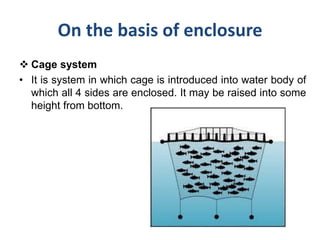
 Cage system
• It is system in which cage is introduced into water body of
which all 4 sides are enclosed. It may be raised into some
height from bottom.
On the basis of enclosure
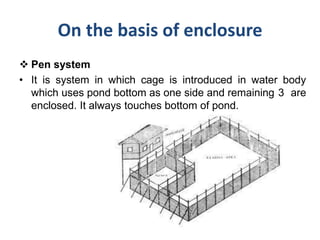
 Pen system
• It is system in which cage is introduced in water body
which uses pond bottom as one side and remaining 3 are
enclosed. It always touches bottom of pond.
On the basis of integration
Paddy cum fish farming
 Site selection:
• About 80 cm rainfall is optimum for this integrated system.
• Fields having an almost uniform contour and high water
retention capacity are preferred.
• Groundwater table and drainage system are important
factors to be taken into consideration for selection of site.
On the basis of integration
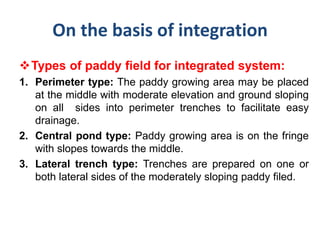
Types of paddy field for integrated system:
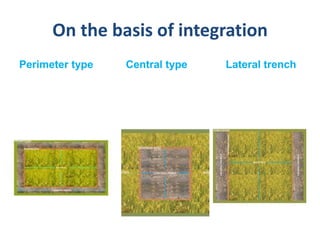
1. Perimeter type: The paddy growing area may be placed
at the middle with moderate elevation and ground sloping
on all sides into perimeter trenches to facilitate easy
drainage.
2. Central pond type: Paddy growing area is on the fringe
with slopes towards the middle.
3. Lateral trench type: Trenches are prepared on one or
both lateral sides of the moderately sloping paddy filed.
On the basis of integration
Perimeter type Central type Lateral trench
On the basis of integration
 Suitable rice varieties for integrated system:
• Radha
• CH-45
• Sabitri
• Ramdhan
• Mansuli
• Janaki
 Cultivable species of fish in rice field:
• The fish species which could be cultured in rice fields must be
capable of tolerating shallow water (>15 cm depth), high
temperature (up to 350 C), low dissolved oxygen and high
turbidity.
• Species such as (Rohu) Labeo rohita, (Catla) Catla catla
(spotted snakehead) Channa punctatus, (bullseye) Channa
marulius
On the basis of integration
Stocking density: the fishes are stocked at the rate of 4000
-6000/ha. Species ratio may be 25% surface feeders,
preferably catla, 30% column feeding, rohu and 45% bottom
feeders mrigal or common carp.
On the basis of integration
Types of Fish culture in rice fields
 Simultaneous cultures:
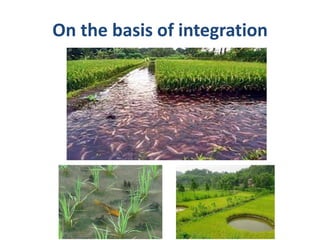
• Rice and fish are cultivated together in rice plots, and this
is known as simultaneous culture.
• Rice fields of 0.1ha area may be economical. Normally
four rice plots of 250 m2 (25 X 10 m) each may be formed
in such an area. In each plot, a ditch of 0.75 m width and
0.5 m depth is dug.
• The dykes enclosing rice plots may be 0.3 m high and 0.3
m wide and strengthened by embedding straw.
• The water depth of the rice plot may vary from 5 - 25 cm
depending on the type of rice and size and species of fish
to be cultured.
On the basis of integration
• Five days after transplantation of rice, fish fry are stocked at
the rate of 5000/ha or fingerlings at the rate of 2000/ha. The
stocking density can be doubled if supplemental feed is
given daily.
 The simultaneous fish–rice culture may have few
limitations:
• Use of agrochemicals is often not feasible
• Maintaining high water level may not be always possible,
considering the size and growth of fish.
• Fish like grass carp may feed on rice seedling, and
• Fish like common carp and tilapia may uproot the rice
seedlings. However, these constraints may be overcome
through judicious management.
On the basis of integration
 Rotational culture of rice and fish:
• In this system fish and rice are cultivated alternately. The
rice field is converted into a temporary fish pond after the
harvest.
• This practice is favored over the simultaneous culture
practice as it permits the use of insecticides and herbicides
for rice production.
• A greater water depth up to 60 cm can be maintained
throughout the fish culture period.
• One or two weeks after rice harvest, the field is prepared for
fish culture.
• The stocking densities of fry or fingerlings for this practice
could be 20,000/ha and 6,000/ha respectively.
On the basis of integration
 Rotational culture of rice and fish:
• The weeds are removed manually in trenches or paddy fields.
• Predatory and weed fishes have to be removed either by netting or by
dewatering.
• Mohua oil cake may be applied at 250 ppm to eradicate the predatory
and weed fishes.
• After clearing the weeds and predators the fertilizers are to be applied.
Cow dung at the rate of 5000 kg/ha, ammonium sulphate at 70kg/ha
and single super phosphate at 50 kg/ha are applied in equal
instalments during the rearing period.
• Stocking density is different in simultaneous and rotational culture
practices.
• The fish yield varies from 700 - 1000 kg/ha in this integrated system.
• Survival rate of fish is less than 60 %. Survival rate is maximum in
renovated paddy plots when compared to fish culture in ordinary paddy
plots.
On the basis of integration
 Advantages:
• Economical utilization of land
• Saving on labor cost towards weeding and supplemental
• Additional income and diversified harvest such as fish and
rice from water
• Tilapia and common carp control the unwanted aquatic
weeds which may otherwise reduce rice yield up to 50 %
• Insect pests of rice like stem borers are controlled by fish
feeding on them mainly by murrels and catfishes
• Fish feed on the aquatic intermediate host such as malaria
causing mosquito larvae, thereby controlling water-born
diseases of human beings.
• Fry and fingerling production
Fingerlings production
 Form of nurseries for fingerling production
• small nursery pond in or near the field;
• small rice-fishpond, well-supplied with water; and
• nursery cage in larger pond
Carps
 Major carps have proved to be best suited for
culture, because the carps
• Feed on zooplanktons and phytoplankton's, decaying
weeds, debris and other aquatic plants.
• They can survive in turbid water with slightly higher
temperature
• Can tolerate O2 variations in water.
• Can be transported from one place to other easily.
• They are highly nutritive and palatable.
Reference
• https://www.brainkart.com/article/Aquaculture_33298/
• http://agropedia.iitk.ac.in/content/paddy-cum-fish-culture

fish culture.pdf

  • 1.
  • 2.
    CONTENT  What isfish culture?  Aim of fish culture  Where did fish culture is done firstly?  Characteristics of cultivatable fish  Classification of fish culture  Fingerling production  Carps  Reference
  • 3.
    What is Fishculture • Fish culture is the process of raising desirable species of fishes in captivity and managing them and their environment to improve growth and reproduction and for domestic and commercial purposes. Aim of fish culture • Is to obtain maximum yield of fish. • To obtain palatable and highly nutritive fish flesh. • By product of fishing industry. Where fish culture is done firstly? • The earliest evidence of fish farming dates back to before 1000 BCE in China. The Zhou dynasty (1112-221 BCE), then the politician Fan Li, around 500 BCE, were the first to describe carp, a symbol of good luck and fortune, as being farmed for food.
  • 4.
    Characteristics of cultivablefishes  The special characteristic features of cultivable fishes are: • Fishes should have high growth rate in short period for culture. • They should accept supplementary diet. • They should be hardy enough to resist some common diseases and infection of parasites. • Fishes proposed for polyculture should be able to live together without interfering or attacking other fishes. • They should have high conversion efficiency so that they can effectively utilize the food.  Major fishes that are cultivate in fish culture: • Carps, Catla, Labeo, Clarias, Chanos, Mullet, Common carps
  • 5.
  • 6.
    Classification of fishculture  On the basis of culture  Monoculture  Polyculture  Mono-sex culture  Poly-sex culture  On the basis of density  Intensive fish farming system  Semi intensive fish farming system  Extensive fish farming system
  • 7.
    Classification of fishculture  On the basis of enclosure  Cage fish culture  Pen fish culture  On the basis of integration  Pig cum fish farming  Duck cum fish farming  Paddy cum fish farming
  • 8.
    On the basisof culture  Monoculture: • Raising only one species of fish in available water body. E.g.: raising of anyone of tilapia, rainbow trout, catfish etc.  Mono-sex culture: • Raising of either male or female of single fish species. It is practiced for maintaining breeding male and female fish.
  • 9.
    On the basisof culture  Advantages: • Cultivation practice such as feeding, disease diagnosis and treatment is easer for e.g. feeding is easier for single species due to uniform feeding habit. • Typical characteristics of fish can be study more accurately  Disadvantages • Productivity of pond not fully utilized • Market supply can not be fulfilled and more risky
  • 10.
    On the basisof culture  Polyculture: • Culturing two or more than two species of fish on same water body. E.g. rearing of bighead carp and grass carp  Poly-sex culture: • Either male or female of two or more species is reared. E.g. male of rohu, naini (Cirrhinus mrigala) and bhakur (Labeo catla) on same pond.
  • 11.
    On the basisof culture  Advantages: • Productivity of pond is fully utilized • Yield per unit area is higher • Less risky  Disadvantages: • Cultivation practices is difficult • Selective harvesting is difficult • Costly and labor intensive
  • 12.
    On the basisof density  Extensive culture system: • Characterized by low stocking density, no input and output and yield less than 1000 kg/ha/hear.  Semi-intensive culture system: • Characterized by moderately high density, addition of input (fertilizers and feed) and yield around 10,000 kg/ha/year.  Intensive culture system: • Characterized by high stocking density, addition of high input (fertilizers and nutritionally balanced diet), cost of production is generally high with yield above 10,000kg/ha/year.
  • 13.
    On the basisof enclosure  Cage system • It is system in which cage is introduced into water body of which all 4 sides are enclosed. It may be raised into some height from bottom.
  • 14.
    On the basisof enclosure  Pen system • It is system in which cage is introduced in water body which uses pond bottom as one side and remaining 3 are enclosed. It always touches bottom of pond.
  • 15.
    On the basisof integration Paddy cum fish farming  Site selection: • About 80 cm rainfall is optimum for this integrated system. • Fields having an almost uniform contour and high water retention capacity are preferred. • Groundwater table and drainage system are important factors to be taken into consideration for selection of site.
  • 16.
    On the basisof integration Types of paddy field for integrated system: 1. Perimeter type: The paddy growing area may be placed at the middle with moderate elevation and ground sloping on all sides into perimeter trenches to facilitate easy drainage. 2. Central pond type: Paddy growing area is on the fringe with slopes towards the middle. 3. Lateral trench type: Trenches are prepared on one or both lateral sides of the moderately sloping paddy filed.
  • 17.
    On the basisof integration Perimeter type Central type Lateral trench
  • 18.
    On the basisof integration  Suitable rice varieties for integrated system: • Radha • CH-45 • Sabitri • Ramdhan • Mansuli • Janaki  Cultivable species of fish in rice field: • The fish species which could be cultured in rice fields must be capable of tolerating shallow water (>15 cm depth), high temperature (up to 350 C), low dissolved oxygen and high turbidity. • Species such as (Rohu) Labeo rohita, (Catla) Catla catla (spotted snakehead) Channa punctatus, (bullseye) Channa marulius
  • 19.
    On the basisof integration Stocking density: the fishes are stocked at the rate of 4000 -6000/ha. Species ratio may be 25% surface feeders, preferably catla, 30% column feeding, rohu and 45% bottom feeders mrigal or common carp.
  • 20.
    On the basisof integration Types of Fish culture in rice fields  Simultaneous cultures: • Rice and fish are cultivated together in rice plots, and this is known as simultaneous culture. • Rice fields of 0.1ha area may be economical. Normally four rice plots of 250 m2 (25 X 10 m) each may be formed in such an area. In each plot, a ditch of 0.75 m width and 0.5 m depth is dug. • The dykes enclosing rice plots may be 0.3 m high and 0.3 m wide and strengthened by embedding straw. • The water depth of the rice plot may vary from 5 - 25 cm depending on the type of rice and size and species of fish to be cultured.
  • 21.
    On the basisof integration • Five days after transplantation of rice, fish fry are stocked at the rate of 5000/ha or fingerlings at the rate of 2000/ha. The stocking density can be doubled if supplemental feed is given daily.  The simultaneous fish–rice culture may have few limitations: • Use of agrochemicals is often not feasible • Maintaining high water level may not be always possible, considering the size and growth of fish. • Fish like grass carp may feed on rice seedling, and • Fish like common carp and tilapia may uproot the rice seedlings. However, these constraints may be overcome through judicious management.
  • 22.
    On the basisof integration
  • 23.
    On the basisof integration  Rotational culture of rice and fish: • In this system fish and rice are cultivated alternately. The rice field is converted into a temporary fish pond after the harvest. • This practice is favored over the simultaneous culture practice as it permits the use of insecticides and herbicides for rice production. • A greater water depth up to 60 cm can be maintained throughout the fish culture period. • One or two weeks after rice harvest, the field is prepared for fish culture. • The stocking densities of fry or fingerlings for this practice could be 20,000/ha and 6,000/ha respectively.
  • 24.
    On the basisof integration  Rotational culture of rice and fish: • The weeds are removed manually in trenches or paddy fields. • Predatory and weed fishes have to be removed either by netting or by dewatering. • Mohua oil cake may be applied at 250 ppm to eradicate the predatory and weed fishes. • After clearing the weeds and predators the fertilizers are to be applied. Cow dung at the rate of 5000 kg/ha, ammonium sulphate at 70kg/ha and single super phosphate at 50 kg/ha are applied in equal instalments during the rearing period. • Stocking density is different in simultaneous and rotational culture practices. • The fish yield varies from 700 - 1000 kg/ha in this integrated system. • Survival rate of fish is less than 60 %. Survival rate is maximum in renovated paddy plots when compared to fish culture in ordinary paddy plots.
  • 25.
    On the basisof integration  Advantages: • Economical utilization of land • Saving on labor cost towards weeding and supplemental • Additional income and diversified harvest such as fish and rice from water • Tilapia and common carp control the unwanted aquatic weeds which may otherwise reduce rice yield up to 50 % • Insect pests of rice like stem borers are controlled by fish feeding on them mainly by murrels and catfishes • Fish feed on the aquatic intermediate host such as malaria causing mosquito larvae, thereby controlling water-born diseases of human beings. • Fry and fingerling production
  • 26.
    Fingerlings production  Formof nurseries for fingerling production • small nursery pond in or near the field; • small rice-fishpond, well-supplied with water; and • nursery cage in larger pond
  • 27.
    Carps  Major carpshave proved to be best suited for culture, because the carps • Feed on zooplanktons and phytoplankton's, decaying weeds, debris and other aquatic plants. • They can survive in turbid water with slightly higher temperature • Can tolerate O2 variations in water. • Can be transported from one place to other easily. • They are highly nutritive and palatable.
  • 28.