KASHMEERA N.A.KASHMEERA N.A.
II SEM MSc.ZOOLOGYII SEM MSc.ZOOLOGY
ROLL NO:37ROLL NO:37
CHRIST COLLEGECHRIST COLLEGE
Term biome was coined by the American
ecologist Frederic Clements.
“Largest land unit which is convinient to
recognize” – Eugene.P.Odum.
The chief character of a biome is
depicted by climax communities with their
dominant life forms.
Biomes are grouping of ecosystems with
similar environment and vegetation
structure.
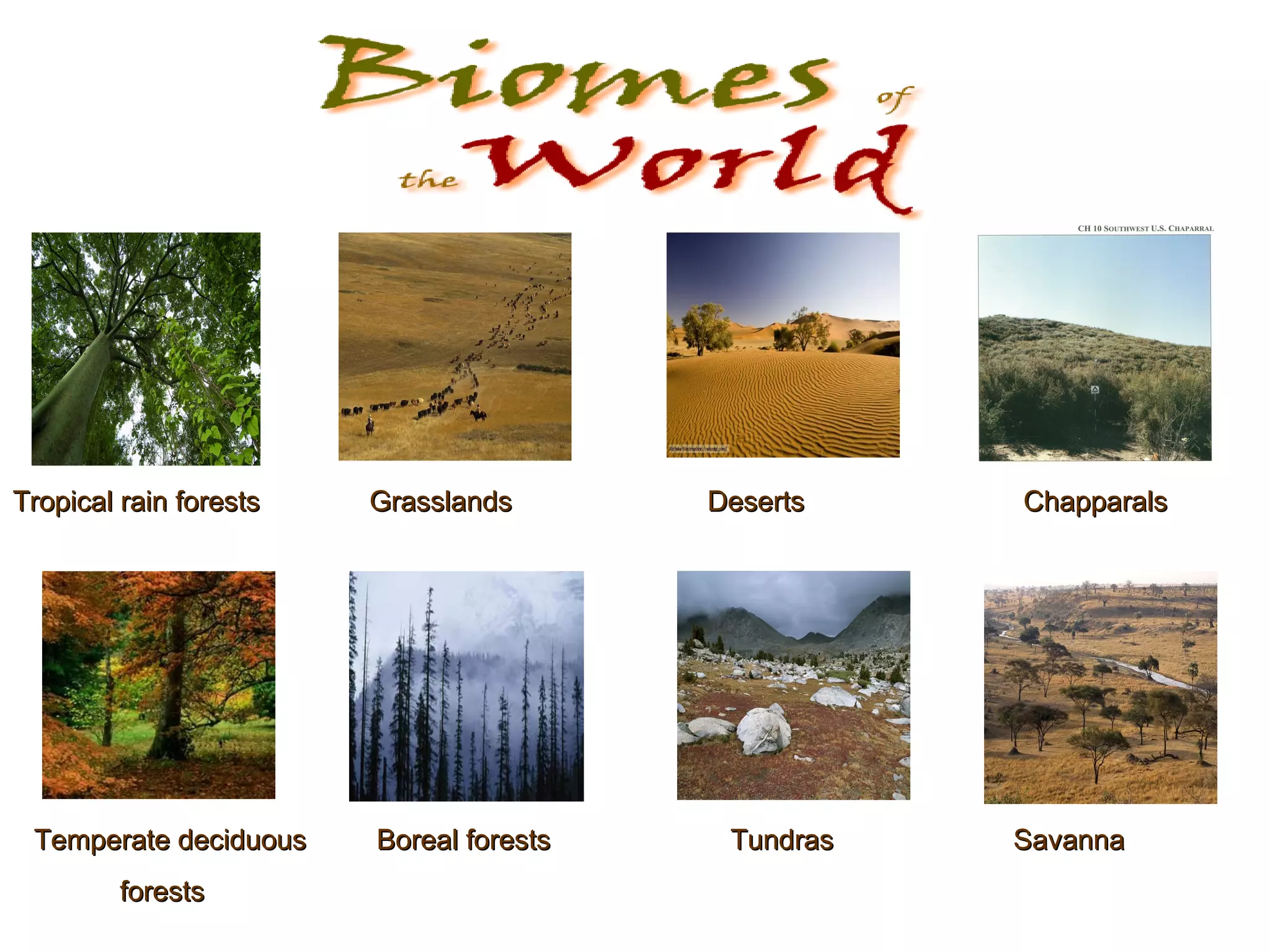
Tropical rain forests Grasslands Deserts ChapparalsTropical rain forests Grasslands Deserts Chapparals
Temperate deciduous Boreal forests Tundras SavannaTemperate deciduous Boreal forests Tundras Savanna
forestsforests
“The planet's lungs.
Home to people and
wildlife. Engines of
green economies.
Forests are essential
to life on Earth ”
 Forest biomes are characterised by the
vegetation with densely growing trees having
a closed ,or nearly so,canopy cover.
It include a complex assemblage of
different kinds of biotic communities.
 The nature of soil,wind and air currents
determines the distribution of forest
vegetation.
Normally ecologists recognize amoung forest
communities such features as their
evergreen nature,
whether deciduous or indeciduous,
whether broad-leaved as in temperate forests
or needle-like as in conifers.
On the basis of these features the forest
biomes of the world have been classified into
following –
coniferous forest
tropical forest
temperate forest
Tropical rain forests occur near the equator in Central and
south America ,central and western Africa
,southeastAsia,Malaya,Borneo,New guinea and Northwest
Australia.
In India the main areas of tropical forest are found in the
Andaman and Nicobar Islands; the Western Ghats, and the
greater Assam region in the north-east.
Tropical rain forests are amoung the most diverse
communities on earth.
One of the major characteristics of tropical forests is their distinctOne of the major characteristics of tropical forests is their distinct
seasonality: winter is absent, and only two seasons are present (rainyseasonality: winter is absent, and only two seasons are present (rainy
and dry).and dry).
The length of daylight is 12 hours and varies little.The length of daylight is 12 hours and varies little.
Canopy in tropical forests is multilayered and continuous, allowing littleCanopy in tropical forests is multilayered and continuous, allowing little
light penetration.light penetration.
Humidity - high and constant.Humidity - high and constant.
Temperature is on average 20-25° C and varies little throughout the year:Temperature is on average 20-25° C and varies little throughout the year:
the average temperatures of the three warmest and three coldest monthsthe average temperatures of the three warmest and three coldest months
do not differ by more than 5 degrees.do not differ by more than 5 degrees.
Annual rainfall – 200 to 225 cm.Annual rainfall – 200 to 225 cm.
High rate of leaching makes soil useless for agricultural purpose.High rate of leaching makes soil useless for agricultural purpose.
Flora is highly diverse: one square kilometer may contain as many as 100 different
tree species.
Trees are 25-35 m tall, with buttressed trunks and shallow roots,
mostly evergreen, moderate size, leathery dark green leaves.
The extremely dense vegetation of the tropical rainforests remains vertically
stratified .
Tall trees are often covered with
vinesvines
lianaslianas
epiphyticepiphytic
orchidsorchids
bromeliadsbromeliads
Under the tall trees is a continuous evergreen carpet, the canopy layer, some 25
to 35 meters tall.
The lowest layer is an understorey of trees, shrubs, herbs like ferns and palms
Palms fernsPalms ferns
Invertebrate density and abundance are very high in tropical rainforests,Invertebrate density and abundance are very high in tropical rainforests,
The common invertebrates of these forests areThe common invertebrates of these forests are
Isopods spiders planarians leeches.Isopods spiders planarians leeches.
Snails millipedes centipedes scorpionsSnails millipedes centipedes scorpions
most common insectsmost common insects
Heteropterans orthopterans blattidsHeteropterans orthopterans blattids
Mantids phasmids bees termitesMantids phasmids bees termites
antsants
common vertebratescommon vertebrates
Rhacophorus malabaricus
chameleons
agamids
geckoes
many species of snakes
many species of birds, social birds being
predominant
Mammals with nocturnalMammals with nocturnal
and arboreal habits areand arboreal habits are
most commonmost common
leopardsleopards
slothssloths
monkeysmonkeys
giant flying squirrelsgiant flying squirrels
anteatersanteaters
jungle catsjungle cats
Major ground dwellingMajor ground dwelling
mammalsmammals
tigertiger
elephantelephant
samber deersamber deer
muntjacmuntjac
gaurgaur
spotted deerspotted deer
swamp deerswamp deer
• The temperate forest biomes are characterized by a moderateThe temperate forest biomes are characterized by a moderate
climate and broad-leaved deciduous trees,climate and broad-leaved deciduous trees,
which shed their leaves in fall, are bare over winter and grow newwhich shed their leaves in fall, are bare over winter and grow new
foliage in the spring.foliage in the spring.
• These forests are the characteristics of North America, Europe,These forests are the characteristics of North America, Europe,
Eastern Asia, Chile, part of Australia and Japan,Eastern Asia, Chile, part of Australia and Japan,
• with an annual rainfall of 75—150 cmwith an annual rainfall of 75—150 cm
• temperature of 10—20°C.temperature of 10—20°C.
• In these biomes the precipitation may be fairly uniformIn these biomes the precipitation may be fairly uniform
throughout the year.throughout the year.
• In India, at elevations of 2743.2m -3655.6m in Himalayas occurIn India, at elevations of 2743.2m -3655.6m in Himalayas occur
temperate vegetationtemperate vegetation
• Soils of temperate forests are podozolic and fairly deep.Soils of temperate forests are podozolic and fairly deep.
Trees are quite tall—about 40—
50m in height and their leaves are
thin and broad. The predominant
genera of this biome are:
Maple CottonwoodMaple Cottonwood
Beech Oak HickoryBeech Oak Hickory
Elm Cedar ChestnutElm Cedar Chestnut
undergrowth ofundergrowth of
scrubby rhododendrons.scrubby rhododendrons.
vinesvines
Lichen,mossLichen,moss
Millipedes Coleoptera OrthopteraMillipedes Coleoptera Orthoptera
SnailsSnails
Cricket frog salamanders snakesCricket frog salamanders snakes
Frill-necked lizardsFrill-necked lizards
Hawks woodpeckersHawks woodpeckers
Horned owlHorned owl
Gray fox Bob catGray fox Bob cat
SkunkSkunk
Racoon Moose Black bearRacoon Moose Black bear
Boreal forestsBoreal forests
Boreal forests or taigaBoreal forests or taiga
• Boreal forests, or taiga, represent the largest terrestial
biome.
• Occur between 50 and 60 degrees north latitudes,
• boreal forests can be found in the broad belt of Eurasia
and North America.
• Seasons are divided into short, moist, and moderately
warm summers and long, cold, and dry winters.
• The length of the growing season in boreal forests is 5
months.
• Temperature - very low.
• Precipitation is primarily in the form of
snow, 40-100 cm annually.
• Soil is thin, nutrient-poor, and acidic.
• Canopy permits low light penetration, and
as a result, understorey is limited.
• Another characteristic feature of this
biome is the presence of numerous lakes
• Flora consist mostly of cold-tolerant
evergreen conifers with needle-like leaves,
such as pine, fir, and spruce.
• Fauna include
woodpeckers, hawks,
owls,moose, bear,
weasel, lynx, fox, wolf,
deer, hares, chipmunks,
shrews, and bats
Mangroves are salt-tolerant plants of tropical and
subtropical intertidal regions of the world.
The specific regions where these plants occur are termed
as 'mangrove ecosystem'.
These are highly productive but extremely sensitive and
fragile.
Besides mangroves, the ecosystem also harbours other
plant and animal species.
The distribution of mangroves on Indian coastlines indicates that
the Sundarban mangroves occupy very large area followed by
Andaman-Nicobar Islands and Gulf of Kachch in Gujarat.
Rest of the mangrove ecosystems is comparatively smaller.
Over 1600 plant and 3700 animal species have been identified
from these areas.
According to a status report of the Government of India
publication, the total area of the mangroves in India, was
reckoned at about 6,740 km2.
This covered about 7% of the world mangroves (Krishnamurthy,
1987).
But a recent Indian Remote Sensing Data (Nayak, 1993) showed
that the total area of the mangroves decreased to 4,474 km2
The floral diversity of mangroves in India is great.
The Indian mangroves are represented by approximately 59 species
(inclusive of some mangrove associates) from 29 families.
Of the 59 species, 34 species belonging to 21 families are present along
the west coast.
The East coast of India and the Andaman and Nicobar islands show a
higher species diversity as well as unique distribution of mangrove flora.
The east coast is represented by 48 species belonging to 32 genera.
Rhizophora apiculata (Red Mangrove):
Rhizophora mucronata (Red Mangrove):
Avicennia marina
Avicennia officinalis:
Acanthus ilicifolius
 Since mangroves are transition ecosystems, they give refuge toSince mangroves are transition ecosystems, they give refuge to
terrestrial, marine/brackish water as well as purely intertidalterrestrial, marine/brackish water as well as purely intertidal
organisms, making itself a richly diversed ecosystem.organisms, making itself a richly diversed ecosystem.
The mangroves may play a special role as nursery habitat forThe mangroves may play a special role as nursery habitat for
juveniles of fish whose adults occupy other habitatsjuveniles of fish whose adults occupy other habitats
the submerged mangroves roots, trunks, and branches providethe submerged mangroves roots, trunks, and branches provide
niche for bacteria, fungi, macroalgae, and invertebrates.niche for bacteria, fungi, macroalgae, and invertebrates.
The aerial roots, trunks, leaves and branches host other groups ofThe aerial roots, trunks, leaves and branches host other groups of
organisms.organisms.
A number of crab species live among the
roots, on the trunks or even forage in the
canopy.
Insects, reptiles, amphibians, birds and
mammals thrive in the habitat and contribute
to its unique character.
The mangrove fauna could also be classified
as a) Aquatic, b) Semi aquatic and c)
Terrestrial.
Zooplankton - mostly includes crustacean larvae
Insects - Apis dorsata (rock bee) and Apis mellifera (European bee).
Butterflies and moths
Salmona butterfly - Salvadora
Hybloea puera -Avicennia marina
Molluscs and Crustaceans
20 species of shellfish and 229 species of Crustaceans have been recorded
Mangrove Crab (Scylla cerata)
Telescopium telescopium - an indicator species for mangroves
• Fish : Mangroves are the breeding and nursery grounds for
several species of fish.
• There are a total of 105 species of fish which are typical
mangrove dwellers in India.
• Besides, many other species visit the mangrove environment
frequently or occasionally.
• Some common species are - scats, milk fish, mudskippers,
mullets, cat fish, perches, etc.
• Mud skippers. well adapted to alternating period of exposure to
air and submersion and is frequently seen hopping along the mud
at the water's edge
Reptiles
•
Estuarine or Saltwater Crocodile (Crocodylus porosus): This is
the largest crocodile found in India or in the world
• Sea Turtles : Olive Ridley (Lepidochelys olivacea) is the most
common sea turtle in Indian waters. Large nesting sites are found in
Odisha.
• the Green Turtle (Chelonia mydas), the Leatherback turtle
(Dermochelys coriacea)
• Water Monitor Lizard (Varanus
salvator) : They are a major predator of
crocodile and turtle eggs. Due to
overkilling and very long periods of
incubation (8-9 months) it has become
endangered in India.
• Both aquatic as well as tree dwelling birds are commonly found in
mangroves and associated areas
• About 177 species of resident and migratory birds are found in the
mangrove forests.
• The most common among these are
BIRDSBIRDS
Kingfishers storksKingfishers storks
herons sea eaglessea eagles
kiteskites
•Flamingoes flock the exposed mud flats, during
the low tides. They use mangrove environs as
breeding and feeding grounds
sand pipers Curlews duckssand pipers Curlews ducks
• Royal Bengal Tiger
(Panthera tigris tigris) :
one of the unique resident
species of mangroves of
the Sunderbans .
• Dugong (Dugong
dugong): the Sea Cow,
though a frequent
mangrove visitor, is not an
exclusive mangrove
dweller.
• Otters : Otters are also
visitors of mangroves and
often frequent them in
search of food and shelter
Crab eating macaqueCrab eating macaque
The crab eating macaque is an endangered species of monkey.The crab eating macaque is an endangered species of monkey.
In India it is found only in the Andaman and Nicobar islands.In India it is found only in the Andaman and Nicobar islands.
This monkey has adapted to the coastal environment and dwellsThis monkey has adapted to the coastal environment and dwells
amongst the mangrove trees.amongst the mangrove trees.
Another adaptation is its skill in catching crabs which helps it to surviveAnother adaptation is its skill in catching crabs which helps it to survive
in the mangrove habitat.in the mangrove habitat.
In 2000, the tropical forests in our world looked something like
this:
© WWF / IAASA
If we did nothing, and carried on depleting our forests at the rate
we do today, then by 2100, here's what we'd be left with:
Forests: What future do we want?Forests: What future do we want?
Forest biomes - Kashmeera

Forest biomes - Kashmeera

  • 1.
    KASHMEERA N.A.KASHMEERA N.A. IISEM MSc.ZOOLOGYII SEM MSc.ZOOLOGY ROLL NO:37ROLL NO:37 CHRIST COLLEGECHRIST COLLEGE
  • 2.
    Term biome wascoined by the American ecologist Frederic Clements. “Largest land unit which is convinient to recognize” – Eugene.P.Odum. The chief character of a biome is depicted by climax communities with their dominant life forms. Biomes are grouping of ecosystems with similar environment and vegetation structure.
  • 3.
    Tropical rain forestsGrasslands Deserts ChapparalsTropical rain forests Grasslands Deserts Chapparals Temperate deciduous Boreal forests Tundras SavannaTemperate deciduous Boreal forests Tundras Savanna forestsforests
  • 4.
    “The planet's lungs. Hometo people and wildlife. Engines of green economies. Forests are essential to life on Earth ”
  • 5.
     Forest biomesare characterised by the vegetation with densely growing trees having a closed ,or nearly so,canopy cover. It include a complex assemblage of different kinds of biotic communities.  The nature of soil,wind and air currents determines the distribution of forest vegetation.
  • 6.
    Normally ecologists recognizeamoung forest communities such features as their evergreen nature, whether deciduous or indeciduous, whether broad-leaved as in temperate forests or needle-like as in conifers. On the basis of these features the forest biomes of the world have been classified into following – coniferous forest tropical forest temperate forest
  • 10.
    Tropical rain forestsoccur near the equator in Central and south America ,central and western Africa ,southeastAsia,Malaya,Borneo,New guinea and Northwest Australia. In India the main areas of tropical forest are found in the Andaman and Nicobar Islands; the Western Ghats, and the greater Assam region in the north-east. Tropical rain forests are amoung the most diverse communities on earth.
  • 11.
    One of themajor characteristics of tropical forests is their distinctOne of the major characteristics of tropical forests is their distinct seasonality: winter is absent, and only two seasons are present (rainyseasonality: winter is absent, and only two seasons are present (rainy and dry).and dry). The length of daylight is 12 hours and varies little.The length of daylight is 12 hours and varies little. Canopy in tropical forests is multilayered and continuous, allowing littleCanopy in tropical forests is multilayered and continuous, allowing little light penetration.light penetration. Humidity - high and constant.Humidity - high and constant. Temperature is on average 20-25° C and varies little throughout the year:Temperature is on average 20-25° C and varies little throughout the year: the average temperatures of the three warmest and three coldest monthsthe average temperatures of the three warmest and three coldest months do not differ by more than 5 degrees.do not differ by more than 5 degrees. Annual rainfall – 200 to 225 cm.Annual rainfall – 200 to 225 cm. High rate of leaching makes soil useless for agricultural purpose.High rate of leaching makes soil useless for agricultural purpose.
  • 12.
    Flora is highlydiverse: one square kilometer may contain as many as 100 different tree species. Trees are 25-35 m tall, with buttressed trunks and shallow roots, mostly evergreen, moderate size, leathery dark green leaves. The extremely dense vegetation of the tropical rainforests remains vertically stratified .
  • 13.
    Tall trees areoften covered with vinesvines lianaslianas epiphyticepiphytic orchidsorchids bromeliadsbromeliads
  • 14.
    Under the talltrees is a continuous evergreen carpet, the canopy layer, some 25 to 35 meters tall. The lowest layer is an understorey of trees, shrubs, herbs like ferns and palms Palms fernsPalms ferns
  • 15.
    Invertebrate density andabundance are very high in tropical rainforests,Invertebrate density and abundance are very high in tropical rainforests, The common invertebrates of these forests areThe common invertebrates of these forests are Isopods spiders planarians leeches.Isopods spiders planarians leeches. Snails millipedes centipedes scorpionsSnails millipedes centipedes scorpions
  • 16.
    most common insectsmostcommon insects Heteropterans orthopterans blattidsHeteropterans orthopterans blattids Mantids phasmids bees termitesMantids phasmids bees termites antsants
  • 17.
    common vertebratescommon vertebrates Rhacophorusmalabaricus chameleons agamids geckoes
  • 18.
    many species ofsnakes many species of birds, social birds being predominant
  • 19.
    Mammals with nocturnalMammalswith nocturnal and arboreal habits areand arboreal habits are most commonmost common leopardsleopards slothssloths monkeysmonkeys giant flying squirrelsgiant flying squirrels anteatersanteaters jungle catsjungle cats
  • 20.
    Major ground dwellingMajorground dwelling mammalsmammals tigertiger elephantelephant samber deersamber deer muntjacmuntjac gaurgaur spotted deerspotted deer swamp deerswamp deer
  • 22.
    • The temperateforest biomes are characterized by a moderateThe temperate forest biomes are characterized by a moderate climate and broad-leaved deciduous trees,climate and broad-leaved deciduous trees, which shed their leaves in fall, are bare over winter and grow newwhich shed their leaves in fall, are bare over winter and grow new foliage in the spring.foliage in the spring. • These forests are the characteristics of North America, Europe,These forests are the characteristics of North America, Europe, Eastern Asia, Chile, part of Australia and Japan,Eastern Asia, Chile, part of Australia and Japan, • with an annual rainfall of 75—150 cmwith an annual rainfall of 75—150 cm • temperature of 10—20°C.temperature of 10—20°C. • In these biomes the precipitation may be fairly uniformIn these biomes the precipitation may be fairly uniform throughout the year.throughout the year. • In India, at elevations of 2743.2m -3655.6m in Himalayas occurIn India, at elevations of 2743.2m -3655.6m in Himalayas occur temperate vegetationtemperate vegetation • Soils of temperate forests are podozolic and fairly deep.Soils of temperate forests are podozolic and fairly deep.
  • 23.
    Trees are quitetall—about 40— 50m in height and their leaves are thin and broad. The predominant genera of this biome are: Maple CottonwoodMaple Cottonwood Beech Oak HickoryBeech Oak Hickory Elm Cedar ChestnutElm Cedar Chestnut
  • 24.
    undergrowth ofundergrowth of scrubbyrhododendrons.scrubby rhododendrons. vinesvines Lichen,mossLichen,moss
  • 25.
    Millipedes Coleoptera OrthopteraMillipedesColeoptera Orthoptera SnailsSnails
  • 26.
    Cricket frog salamanderssnakesCricket frog salamanders snakes Frill-necked lizardsFrill-necked lizards
  • 27.
  • 28.
    Gray fox BobcatGray fox Bob cat SkunkSkunk Racoon Moose Black bearRacoon Moose Black bear
  • 29.
  • 30.
    Boreal forests ortaigaBoreal forests or taiga • Boreal forests, or taiga, represent the largest terrestial biome. • Occur between 50 and 60 degrees north latitudes, • boreal forests can be found in the broad belt of Eurasia and North America. • Seasons are divided into short, moist, and moderately warm summers and long, cold, and dry winters. • The length of the growing season in boreal forests is 5 months. • Temperature - very low.
  • 31.
    • Precipitation isprimarily in the form of snow, 40-100 cm annually. • Soil is thin, nutrient-poor, and acidic. • Canopy permits low light penetration, and as a result, understorey is limited. • Another characteristic feature of this biome is the presence of numerous lakes
  • 32.
    • Flora consistmostly of cold-tolerant evergreen conifers with needle-like leaves, such as pine, fir, and spruce.
  • 33.
    • Fauna include woodpeckers,hawks, owls,moose, bear, weasel, lynx, fox, wolf, deer, hares, chipmunks, shrews, and bats
  • 35.
    Mangroves are salt-tolerantplants of tropical and subtropical intertidal regions of the world. The specific regions where these plants occur are termed as 'mangrove ecosystem'. These are highly productive but extremely sensitive and fragile. Besides mangroves, the ecosystem also harbours other plant and animal species.
  • 36.
    The distribution ofmangroves on Indian coastlines indicates that the Sundarban mangroves occupy very large area followed by Andaman-Nicobar Islands and Gulf of Kachch in Gujarat. Rest of the mangrove ecosystems is comparatively smaller. Over 1600 plant and 3700 animal species have been identified from these areas. According to a status report of the Government of India publication, the total area of the mangroves in India, was reckoned at about 6,740 km2. This covered about 7% of the world mangroves (Krishnamurthy, 1987). But a recent Indian Remote Sensing Data (Nayak, 1993) showed that the total area of the mangroves decreased to 4,474 km2
  • 37.
    The floral diversityof mangroves in India is great. The Indian mangroves are represented by approximately 59 species (inclusive of some mangrove associates) from 29 families. Of the 59 species, 34 species belonging to 21 families are present along the west coast. The East coast of India and the Andaman and Nicobar islands show a higher species diversity as well as unique distribution of mangrove flora. The east coast is represented by 48 species belonging to 32 genera.
  • 38.
  • 39.
  • 40.
  • 41.
  • 42.
     Since mangrovesare transition ecosystems, they give refuge toSince mangroves are transition ecosystems, they give refuge to terrestrial, marine/brackish water as well as purely intertidalterrestrial, marine/brackish water as well as purely intertidal organisms, making itself a richly diversed ecosystem.organisms, making itself a richly diversed ecosystem. The mangroves may play a special role as nursery habitat forThe mangroves may play a special role as nursery habitat for juveniles of fish whose adults occupy other habitatsjuveniles of fish whose adults occupy other habitats the submerged mangroves roots, trunks, and branches providethe submerged mangroves roots, trunks, and branches provide niche for bacteria, fungi, macroalgae, and invertebrates.niche for bacteria, fungi, macroalgae, and invertebrates. The aerial roots, trunks, leaves and branches host other groups ofThe aerial roots, trunks, leaves and branches host other groups of organisms.organisms.
  • 43.
    A number ofcrab species live among the roots, on the trunks or even forage in the canopy. Insects, reptiles, amphibians, birds and mammals thrive in the habitat and contribute to its unique character. The mangrove fauna could also be classified as a) Aquatic, b) Semi aquatic and c) Terrestrial.
  • 44.
    Zooplankton - mostlyincludes crustacean larvae Insects - Apis dorsata (rock bee) and Apis mellifera (European bee). Butterflies and moths Salmona butterfly - Salvadora Hybloea puera -Avicennia marina
  • 45.
    Molluscs and Crustaceans 20species of shellfish and 229 species of Crustaceans have been recorded Mangrove Crab (Scylla cerata) Telescopium telescopium - an indicator species for mangroves
  • 46.
    • Fish :Mangroves are the breeding and nursery grounds for several species of fish. • There are a total of 105 species of fish which are typical mangrove dwellers in India. • Besides, many other species visit the mangrove environment frequently or occasionally. • Some common species are - scats, milk fish, mudskippers, mullets, cat fish, perches, etc. • Mud skippers. well adapted to alternating period of exposure to air and submersion and is frequently seen hopping along the mud at the water's edge
  • 47.
    Reptiles • Estuarine or SaltwaterCrocodile (Crocodylus porosus): This is the largest crocodile found in India or in the world • Sea Turtles : Olive Ridley (Lepidochelys olivacea) is the most common sea turtle in Indian waters. Large nesting sites are found in Odisha. • the Green Turtle (Chelonia mydas), the Leatherback turtle (Dermochelys coriacea)
  • 48.
    • Water MonitorLizard (Varanus salvator) : They are a major predator of crocodile and turtle eggs. Due to overkilling and very long periods of incubation (8-9 months) it has become endangered in India.
  • 49.
    • Both aquaticas well as tree dwelling birds are commonly found in mangroves and associated areas • About 177 species of resident and migratory birds are found in the mangrove forests. • The most common among these are BIRDSBIRDS Kingfishers storksKingfishers storks herons sea eaglessea eagles kiteskites
  • 50.
    •Flamingoes flock theexposed mud flats, during the low tides. They use mangrove environs as breeding and feeding grounds sand pipers Curlews duckssand pipers Curlews ducks
  • 51.
    • Royal BengalTiger (Panthera tigris tigris) : one of the unique resident species of mangroves of the Sunderbans . • Dugong (Dugong dugong): the Sea Cow, though a frequent mangrove visitor, is not an exclusive mangrove dweller. • Otters : Otters are also visitors of mangroves and often frequent them in search of food and shelter
  • 52.
    Crab eating macaqueCrabeating macaque The crab eating macaque is an endangered species of monkey.The crab eating macaque is an endangered species of monkey. In India it is found only in the Andaman and Nicobar islands.In India it is found only in the Andaman and Nicobar islands. This monkey has adapted to the coastal environment and dwellsThis monkey has adapted to the coastal environment and dwells amongst the mangrove trees.amongst the mangrove trees. Another adaptation is its skill in catching crabs which helps it to surviveAnother adaptation is its skill in catching crabs which helps it to survive in the mangrove habitat.in the mangrove habitat.
  • 53.
    In 2000, thetropical forests in our world looked something like this: © WWF / IAASA If we did nothing, and carried on depleting our forests at the rate we do today, then by 2100, here's what we'd be left with: Forests: What future do we want?Forests: What future do we want?