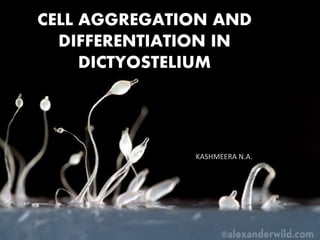
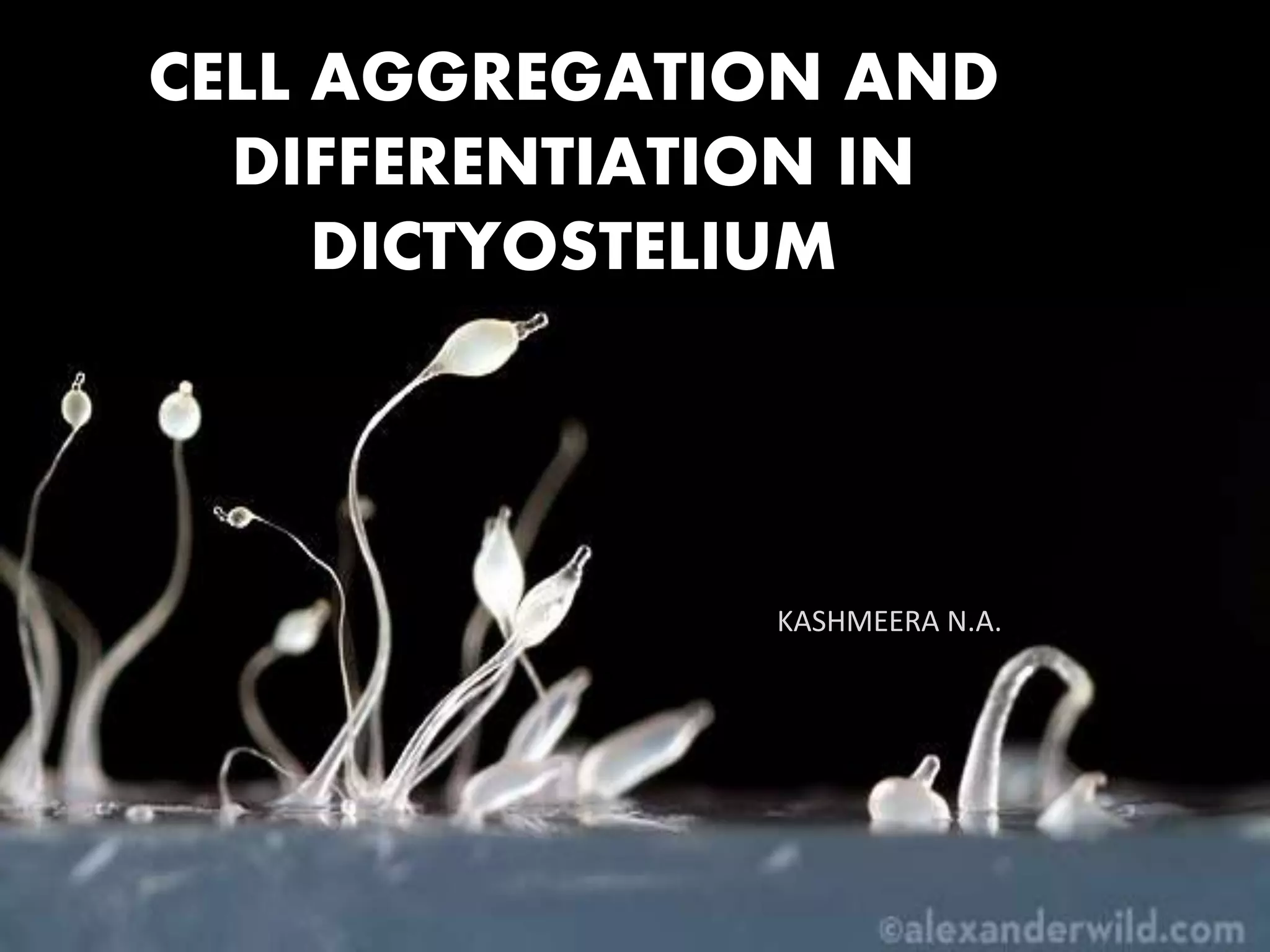
CELL AGGREGATION AND
DIFFERENTIATION IN
DICTYOSTELIUM
KASHMEERA N.A.
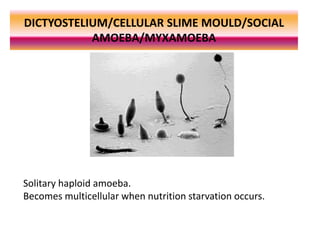
DICTYOSTELIUM/CELLULAR SLIME MOULD/SOCIAL
AMOEBA/MYXAMOEBA
Solitary haploid amoeba.
Becomes multicellular when nutrition starvation occurs.
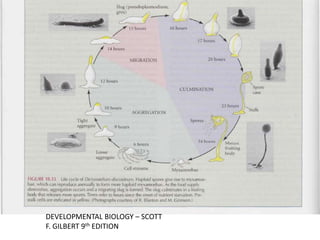
LIFE CYCLE – 3 STAGES
• AGGREGATION.
• MIGRATION.
• CULMINATION
AGGREGATION.
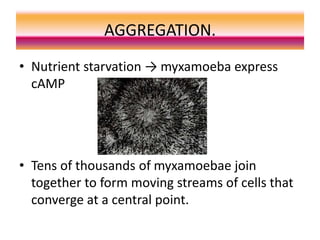
• Nutrient starvation → myxamoeba express
cAMP
• Tens of thousands of myxamoebae join
together to form moving streams of cells that
converge at a central point.
• Each myxamoeba move towards c AMP for a
minute & release c AMP of their own.
• Movement is caused by change in cytoskeletal
polarity brought about by c AMP.
• After movement cell unresponsive for about 4
minutes.
• This time, phosphodiesterase in ECM cleave c
AMP in environment & make receptors free to
receive another c AMP pulse.
• C AMP pulse arrives as spiral waves,cell move
one step towards center.
MIGRATION
• Cells pile atop another→tight aggregate
• Tip arises,bends →migrating
slug/grex/pseudoplasmodium.
• Grex with slimy sheath migrate from dark to
light.
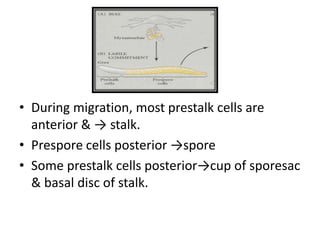
• During migration, most prestalk cells are
anterior & → stalk.
• Prespore cells posterior →spore
• Some prestalk cells posterior→cup of sporesac
& basal disc of stalk.
CULMINATION
• Grex reach illuminated area→culmination
starts.
• Grex differentiate→frutingbody & stalk.
• Fate of each cell depend on stage of cell cycle
they were in while starvation.
• Cell in S&early G2 → ↑Ca2+ →stalk
• Mid/late G2 →↓Ca2+ →spore.
Response to c AMP
• Diff. in prespore & prestalk cells.
• Prespore: c AMP→β catenin→enter nucleus &
express spore specific mRNA.
• Prestalk(anterior): c AMP suppress this
pathway & become stalk.
Proteins and lipids impo. In final
differentiation.
• Lipid: DIF1(chlorinated lipid)
• Proteins: Trishanku, spore differentiation
factors(SDF1&2).
FINALLY…
• Stalk cells die
• Prespore cells→spore
ALTRUISM IN DICTYOSTELIUM
• Prestalk cells act as altruists which die for
dispersion of kin cells - the prestalk cells.
DEVELOPMENTAL BIOLOGY – SCOTT
F. GILBERT 9th EDITION
THANK YOU

Cell aggregation and differentiation in dictyostelium007

  • 1.
    CELL AGGREGATION AND DIFFERENTIATIONIN DICTYOSTELIUM KASHMEERA N.A.
  • 2.
    DICTYOSTELIUM/CELLULAR SLIME MOULD/SOCIAL AMOEBA/MYXAMOEBA Solitaryhaploid amoeba. Becomes multicellular when nutrition starvation occurs.
  • 3.
    LIFE CYCLE –3 STAGES • AGGREGATION. • MIGRATION. • CULMINATION
  • 4.
    AGGREGATION. • Nutrient starvation→ myxamoeba express cAMP • Tens of thousands of myxamoebae join together to form moving streams of cells that converge at a central point.
  • 5.
    • Each myxamoebamove towards c AMP for a minute & release c AMP of their own. • Movement is caused by change in cytoskeletal polarity brought about by c AMP. • After movement cell unresponsive for about 4 minutes. • This time, phosphodiesterase in ECM cleave c AMP in environment & make receptors free to receive another c AMP pulse. • C AMP pulse arrives as spiral waves,cell move one step towards center.
  • 6.
    MIGRATION • Cells pileatop another→tight aggregate • Tip arises,bends →migrating slug/grex/pseudoplasmodium. • Grex with slimy sheath migrate from dark to light.
  • 7.
    • During migration,most prestalk cells are anterior & → stalk. • Prespore cells posterior →spore • Some prestalk cells posterior→cup of sporesac & basal disc of stalk.
  • 8.
    CULMINATION • Grex reachilluminated area→culmination starts. • Grex differentiate→frutingbody & stalk. • Fate of each cell depend on stage of cell cycle they were in while starvation. • Cell in S&early G2 → ↑Ca2+ →stalk • Mid/late G2 →↓Ca2+ →spore.
  • 9.
    Response to cAMP • Diff. in prespore & prestalk cells. • Prespore: c AMP→β catenin→enter nucleus & express spore specific mRNA. • Prestalk(anterior): c AMP suppress this pathway & become stalk.
  • 10.
    Proteins and lipidsimpo. In final differentiation. • Lipid: DIF1(chlorinated lipid) • Proteins: Trishanku, spore differentiation factors(SDF1&2).
  • 11.
    FINALLY… • Stalk cellsdie • Prespore cells→spore
  • 12.
    ALTRUISM IN DICTYOSTELIUM •Prestalk cells act as altruists which die for dispersion of kin cells - the prestalk cells.
  • 13.
    DEVELOPMENTAL BIOLOGY –SCOTT F. GILBERT 9th EDITION
  • 14.