GOOD AQUACULTURE PRACTICES


Introduction


Good Aquaculture Practices (GAP) can be defined as a practice or aquaculture

practices are effective and practical to avoid minimize the impact on the environment

and social. GAP include structures (such as the construction of settling ponds to

remove the materials suspended solid), biological (such as crops to remove Nutrients

in effluents) in order to address the associated problems.


Wikipedia define GAP as Best Aquaculture Practices (BAP), a set of farm raised

seafood standard developed by Global Aquaculture Allience (GAA). BAP standards

address environmental and social responsibility, animal welfare, food safety and

traceability for farms and hatcheries of shrimp, tilapia and catfish as well as seafood

processing plants. The BAP are organized as a tiered ranking system: certified

companies with four-star rating are considered the most strictly compliant.


Site selection


      Proper site selection takes into account environmental resources as well as

access to industrial infrastructure such as roads, reliable electrical power and water

supply. Environmental parameters focus on water resources to supply aquaculture

operations as well as water discharge. Surface water and groundwater sources for

incoming water should be analyzed for water quality and for chemistry parameters

appropriate for the culture species.


      Organized the selection is based on the area that has been designated by the

state authorities as aquaculture development areas. Besides the derelict land and

unproductive but fit can also be used. Choosing an area that will not affect the
activities of other economic sectors is also suitable as an area for aquaculture

activities. In addition, an area with complete basic infrastructure is suitable to be

selected as sites for aquaculture. These areas are areas that are encouraged by the

code of practice for aquaculture. But the risk of problems such as flooding, erosion,

pollution and forest reserve areas are locations which are not recommended to be

used as an area for aquaculture activities.


      Beside topography has a significant effect on surface water, directly impacting

runoff and drainage patterns. If a facility is downhill or downstream from agricultural

or industrial activities, they may become an intermittent source of water

contamination from fertilizers, manure, pesticides, or other chemicals. In addition,

specific to pond site selection is slope, soil composition, and depth. Ponds are

designed to hold water, so unless expensive liners will be utilized, soil clay

composition should be a minimum of 20 percent to ensure water retention.


FARM CONSTRUCTION


Cleaning Area


      Felling of trees in plantations should be minimized to avoid soil erosion.

        Existing tree roots around the farm will be able to hold ground with strong

        structure. This helps to prevent erosion and reduce soil mixed rain water

        (mud) flows into the pool and cause the pond is shallow.

      Prevent erosion and pollution of water resources during the construction of

        the pool.

      Necessary      services   are   available   for   cultivation   zone   vicinity   of

        river or other water body.
 Avoid construction means a negative impact on the environment.


Farm Design


     Have the appropriate retention ponds. Reservoirs must be able to

       accommodate the needs of water for livestock ponds that are on the farm.

     Have a pool or area for sewage treatment in accordance with the farm size.

       Treatment pond is necessary to ensure that the water supplied to the

       livestock ponds are clean and free of negative elements such as chemicals

       and livestock wastes of time.

     Have a water system in and out separately. Management of inlet and outlet

       water is very important for a breeding pond. Water inlet and water outlet

       systems must be installed out of the net. For the installation of the water

       system in the net is to prevent livestock waste time and materials that do not

       have the access to the breeding pond. Meanwhile the net in the water

       system out of hand, is intended to prevent the breeding of fish out of the pool

       when the water flow out. In addition, the installed nets can also prevent

       predators from entering the pond through water channels in and water out.

     Shape and size of the pond should facilitate the management of water and

       livestock. Shape and size of an animal that fits the scale will facilitate

       maintenance work including when to feed livestock, harvesting and post-

       harvest pool clearance.

     Farm shall have operating facilities and skilled workers.             With the

       availability of the facilities available in the farm, maintenance work will be

       able to run smoothly and quickly. Workers skilled in handling farm equipment

       to optimize the allocation of time for maintenance and maximize production.
 Design of a farm should feature safety and hygiene. This is very important in

          ensuring the safety of animals, workers and the facilities are the best in your

          field.


Fish farm design


Fish farm design is very important because it’s needed in a way to develop our safety

aquaculture activity. There are some factors in fish farm design need to considered:


       Suitable pond. Pond design provide for adequate level height and width to

        accommodate required production and harvest equipment.

       Special pond for sewage treatment based on size of fish farm. This is because;

        the soil will have high organic matter. For planting, high organic matter is very

        useful, but in aquaculture, it can create high oxygen demand and finally release

        toxic nitrogen compound that can. Too much nitrogen can damage aquatic

        organism to growth well.

       Water flow (inlet and outlet) are separated. Because it can control the amount of

        water coming in and going out of the pond correctly.

       Design and size of pond must be suitable for facilitate water and fish

        management.

       Complete workers and accommodation operational in farm.

       Farming design must be emphasis all the safety and hygienic.


Livestock Management


        Fish livestock management is an important aspect in determining the progress

of a project run. Livestock management includes preparation of ponds, maintanance

of seeds, water, foods, health and waste product. During the ponds preparation,

clean up base and around the pool area. The use of allowed poisons should be at the
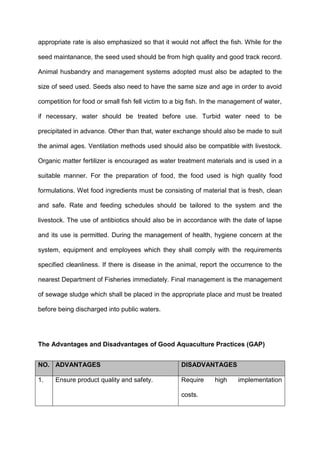
appropriate rate is also emphasized so that it would not affect the fish. While for the

seed maintanance, the seed used should be from high quality and good track record.

Animal husbandry and management systems adopted must also be adapted to the

size of seed used. Seeds also need to have the same size and age in order to avoid

competition for food or small fish fell victim to a big fish. In the management of water,

if necessary, water should be treated before use. Turbid water need to be

precipitated in advance. Other than that, water exchange should also be made to suit

the animal ages. Ventilation methods used should also be compatible with livestock.

Organic matter fertilizer is encouraged as water treatment materials and is used in a

suitable manner. For the preparation of food, the food used is high quality food

formulations. Wet food ingredients must be consisting of material that is fresh, clean

and safe. Rate and feeding schedules should be tailored to the system and the

livestock. The use of antibiotics should also be in accordance with the date of lapse

and its use is permitted. During the management of health, hygiene concern at the

system, equipment and employees which they shall comply with the requirements

specified cleanliness. If there is disease in the animal, report the occurrence to the

nearest Department of Fisheries immediately. Final management is the management

of sewage sludge which shall be placed in the appropriate place and must be treated

before being discharged into public waters.


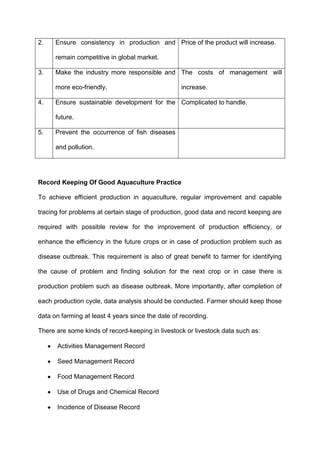
The Advantages and Disadvantages of Good Aquaculture Practices (GAP)


NO. ADVANTAGES                                      DISADVANTAGES

1.    Ensure product quality and safety.            Require     high     implementation

                                                    costs.
2.    Ensure consistency in production and Price of the product will increase.

      remain competitive in global market.

3.    Make the industry more responsible and The costs of management will

      more eco-friendly.                           increase.

4.    Ensure sustainable development for the Complicated to handle.

      future.

5.    Prevent the occurrence of fish diseases

      and pollution.


Record Keeping Of Good Aquaculture Practice

To achieve efficient production in aquaculture, regular improvement and capable

tracing for problems at certain stage of production, good data and record keeping are

required with possible review for the improvement of production efficiency, or

enhance the efficiency in the future crops or in case of production problem such as

disease outbreak. This requirement is also of great benefit to farmer for identifying

the cause of problem and finding solution for the next crop or in case there is

production problem such as disease outbreak. More importantly, after completion of

each production cycle, data analysis should be conducted. Farmer should keep those

data on farming at least 4 years since the date of recording.

There are some kinds of record-keeping in livestock or livestock data such as:

      Activities Management Record

      Seed Management Record

      Food Management Record

      Use of Drugs and Chemical Record

      Incidence of Disease Record
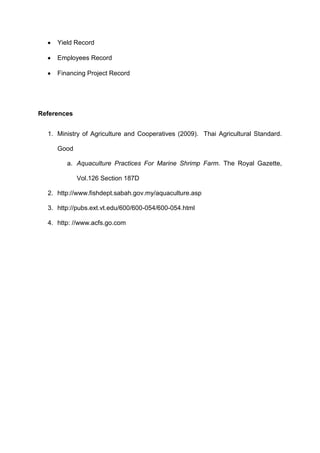
Yield Record

     Employees Record

     Financing Project Record


References


  1. Ministry of Agriculture and Cooperatives (2009). Thai Agricultural Standard.

     Good

        a. Aquaculture Practices For Marine Shrimp Farm. The Royal Gazette,

             Vol.126 Section 187D

  2. http://www.fishdept.sabah.gov.my/aquaculture.asp

  3. http://pubs.ext.vt.edu/600/600-054/600-054.html

  4. http: //www.acfs.go.com

Good aquaculture practices

  • 1.
    GOOD AQUACULTURE PRACTICES Introduction GoodAquaculture Practices (GAP) can be defined as a practice or aquaculture practices are effective and practical to avoid minimize the impact on the environment and social. GAP include structures (such as the construction of settling ponds to remove the materials suspended solid), biological (such as crops to remove Nutrients in effluents) in order to address the associated problems. Wikipedia define GAP as Best Aquaculture Practices (BAP), a set of farm raised seafood standard developed by Global Aquaculture Allience (GAA). BAP standards address environmental and social responsibility, animal welfare, food safety and traceability for farms and hatcheries of shrimp, tilapia and catfish as well as seafood processing plants. The BAP are organized as a tiered ranking system: certified companies with four-star rating are considered the most strictly compliant. Site selection Proper site selection takes into account environmental resources as well as access to industrial infrastructure such as roads, reliable electrical power and water supply. Environmental parameters focus on water resources to supply aquaculture operations as well as water discharge. Surface water and groundwater sources for incoming water should be analyzed for water quality and for chemistry parameters appropriate for the culture species. Organized the selection is based on the area that has been designated by the state authorities as aquaculture development areas. Besides the derelict land and unproductive but fit can also be used. Choosing an area that will not affect the
  • 2.
    activities of othereconomic sectors is also suitable as an area for aquaculture activities. In addition, an area with complete basic infrastructure is suitable to be selected as sites for aquaculture. These areas are areas that are encouraged by the code of practice for aquaculture. But the risk of problems such as flooding, erosion, pollution and forest reserve areas are locations which are not recommended to be used as an area for aquaculture activities. Beside topography has a significant effect on surface water, directly impacting runoff and drainage patterns. If a facility is downhill or downstream from agricultural or industrial activities, they may become an intermittent source of water contamination from fertilizers, manure, pesticides, or other chemicals. In addition, specific to pond site selection is slope, soil composition, and depth. Ponds are designed to hold water, so unless expensive liners will be utilized, soil clay composition should be a minimum of 20 percent to ensure water retention. FARM CONSTRUCTION Cleaning Area  Felling of trees in plantations should be minimized to avoid soil erosion. Existing tree roots around the farm will be able to hold ground with strong structure. This helps to prevent erosion and reduce soil mixed rain water (mud) flows into the pool and cause the pond is shallow.  Prevent erosion and pollution of water resources during the construction of the pool.  Necessary services are available for cultivation zone vicinity of river or other water body.
  • 3.
     Avoid constructionmeans a negative impact on the environment. Farm Design  Have the appropriate retention ponds. Reservoirs must be able to accommodate the needs of water for livestock ponds that are on the farm.  Have a pool or area for sewage treatment in accordance with the farm size. Treatment pond is necessary to ensure that the water supplied to the livestock ponds are clean and free of negative elements such as chemicals and livestock wastes of time.  Have a water system in and out separately. Management of inlet and outlet water is very important for a breeding pond. Water inlet and water outlet systems must be installed out of the net. For the installation of the water system in the net is to prevent livestock waste time and materials that do not have the access to the breeding pond. Meanwhile the net in the water system out of hand, is intended to prevent the breeding of fish out of the pool when the water flow out. In addition, the installed nets can also prevent predators from entering the pond through water channels in and water out.  Shape and size of the pond should facilitate the management of water and livestock. Shape and size of an animal that fits the scale will facilitate maintenance work including when to feed livestock, harvesting and post- harvest pool clearance.  Farm shall have operating facilities and skilled workers. With the availability of the facilities available in the farm, maintenance work will be able to run smoothly and quickly. Workers skilled in handling farm equipment to optimize the allocation of time for maintenance and maximize production.
  • 4.
     Design ofa farm should feature safety and hygiene. This is very important in ensuring the safety of animals, workers and the facilities are the best in your field. Fish farm design Fish farm design is very important because it’s needed in a way to develop our safety aquaculture activity. There are some factors in fish farm design need to considered:  Suitable pond. Pond design provide for adequate level height and width to accommodate required production and harvest equipment.  Special pond for sewage treatment based on size of fish farm. This is because; the soil will have high organic matter. For planting, high organic matter is very useful, but in aquaculture, it can create high oxygen demand and finally release toxic nitrogen compound that can. Too much nitrogen can damage aquatic organism to growth well.  Water flow (inlet and outlet) are separated. Because it can control the amount of water coming in and going out of the pond correctly.  Design and size of pond must be suitable for facilitate water and fish management.  Complete workers and accommodation operational in farm.  Farming design must be emphasis all the safety and hygienic. Livestock Management Fish livestock management is an important aspect in determining the progress of a project run. Livestock management includes preparation of ponds, maintanance of seeds, water, foods, health and waste product. During the ponds preparation, clean up base and around the pool area. The use of allowed poisons should be at the
  • 5.
    appropriate rate isalso emphasized so that it would not affect the fish. While for the seed maintanance, the seed used should be from high quality and good track record. Animal husbandry and management systems adopted must also be adapted to the size of seed used. Seeds also need to have the same size and age in order to avoid competition for food or small fish fell victim to a big fish. In the management of water, if necessary, water should be treated before use. Turbid water need to be precipitated in advance. Other than that, water exchange should also be made to suit the animal ages. Ventilation methods used should also be compatible with livestock. Organic matter fertilizer is encouraged as water treatment materials and is used in a suitable manner. For the preparation of food, the food used is high quality food formulations. Wet food ingredients must be consisting of material that is fresh, clean and safe. Rate and feeding schedules should be tailored to the system and the livestock. The use of antibiotics should also be in accordance with the date of lapse and its use is permitted. During the management of health, hygiene concern at the system, equipment and employees which they shall comply with the requirements specified cleanliness. If there is disease in the animal, report the occurrence to the nearest Department of Fisheries immediately. Final management is the management of sewage sludge which shall be placed in the appropriate place and must be treated before being discharged into public waters. The Advantages and Disadvantages of Good Aquaculture Practices (GAP) NO. ADVANTAGES DISADVANTAGES 1. Ensure product quality and safety. Require high implementation costs.
  • 6.
    2. Ensure consistency in production and Price of the product will increase. remain competitive in global market. 3. Make the industry more responsible and The costs of management will more eco-friendly. increase. 4. Ensure sustainable development for the Complicated to handle. future. 5. Prevent the occurrence of fish diseases and pollution. Record Keeping Of Good Aquaculture Practice To achieve efficient production in aquaculture, regular improvement and capable tracing for problems at certain stage of production, good data and record keeping are required with possible review for the improvement of production efficiency, or enhance the efficiency in the future crops or in case of production problem such as disease outbreak. This requirement is also of great benefit to farmer for identifying the cause of problem and finding solution for the next crop or in case there is production problem such as disease outbreak. More importantly, after completion of each production cycle, data analysis should be conducted. Farmer should keep those data on farming at least 4 years since the date of recording. There are some kinds of record-keeping in livestock or livestock data such as: Activities Management Record Seed Management Record Food Management Record Use of Drugs and Chemical Record Incidence of Disease Record
  • 7.
    Yield Record Employees Record Financing Project Record References 1. Ministry of Agriculture and Cooperatives (2009). Thai Agricultural Standard. Good a. Aquaculture Practices For Marine Shrimp Farm. The Royal Gazette, Vol.126 Section 187D 2. http://www.fishdept.sabah.gov.my/aquaculture.asp 3. http://pubs.ext.vt.edu/600/600-054/600-054.html 4. http: //www.acfs.go.com