Definition of estuary
☼ An estuary is defined as a semi-
 enclosed coastal body of water, which
 has a free connection with the open
 sea and within which the seawater is
 measurably      diluted    with   the
 freshwater of land drainage.
• Estuaries are important & distinct
  component of coastal landscape with highly
  complex ecosystems,varying
  physicochemical properties & highly diverse
  flora & fauna.

• Estuaries are of different shapes & sizes, &
  are known by different names,such as ‘river
  mouth’,’bays’,’lagoons’,’harbours’ or ‘inlets’.
ESTUARINE RESOURCES OF
          INDIA
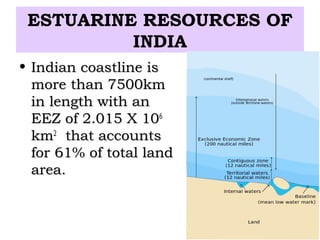
• Indian coastline is
  more than 7500km
  in length with an
  EEZ of 2.015 X 10⁶
  km2 that accounts
  for 61% of total land
  area.
• The country commands a distinct position
  with more than 55 estuaries,located on East
  & west coasts

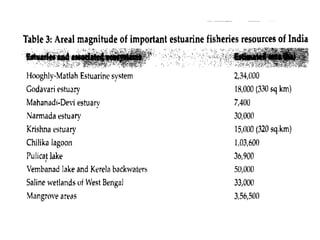
• The estuarine resource,including the
  associated waters,of India has been
  estimated approx. at 30,000,00 ha.

• Amoung the major rivers Ganga, Mahanadi,
  Godavari,Krishna,Cauveri [east coast] &
  Narmada,Tapti,Mandovi,Zuari [west coast]
  forms highly productive esuarine systems
  esp. in relation to fisheries.
PRESENT STATUS OF FISH
 PRODUCTION & PRODUCTIVITY

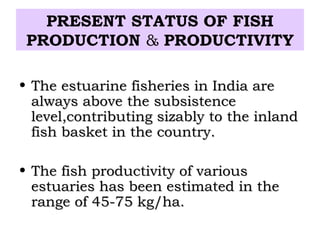
• The estuarine fisheries in India are
  always above the subsistence
  level,contributing sizably to the inland
  fish basket in the country.

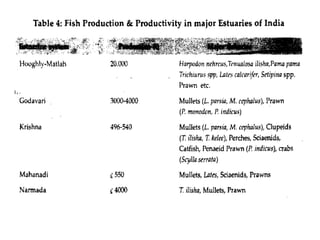
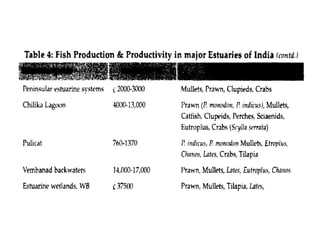
• The fish productivity of various
  estuaries has been estimated in the
  range of 45-75 kg/ha.
ECOLOGY AND FISHERIES OF SELECTED
              ESTUARIES &
           ASSOCIATED WATERS

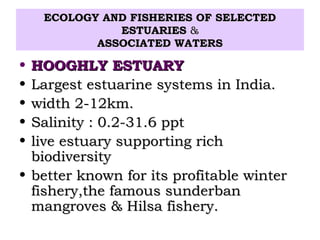
• HOOGHLY ESTUARY
• Largest estuarine systems in India.
• width 2-12km.
• Salinity : 0.2-31.6 ppt
• live estuary supporting rich
  biodiversity
• better known for its profitable winter
  fishery,the famous sunderban
  mangroves & Hilsa fishery.
TRENDS OF FISH CATCH
• The trend of fish catch in Hooghly indicated
  significant increase during recent years
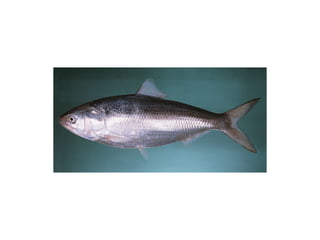
  primarily due to increase in Hilsa catch.

• Between 1998-99 & 2002-2003,the average
  per annum catch of Hilsa has been
  estimated at 10,382.9t with an impressive
  increase of 63.3% from previous 5 years
  [6279.6t]
KRlSHNA ESTUARY
• Salinity : 20-35ppt.
• fishery dependent on marine
  migrants.
• Mullets are hallmark of Krishna
  estuary.
• Other gps. found in catch include
  clupeids,perches,catfish,penaid
  prawns & crabs.
• Annual fish catch during 2004-06 has
  been estimated at 496.1 – 540t with
  productivity ranging from 83-
  90kg/ha.


• Average catch per unit of effort - low &
  depend on season – 13.6kg/boat
  [post-monsoon] & 1.74kg/boat[pre-
  monsoon].
GODAVARI ESTUARY
• Andra Pradesh.
• Two disributaries
 –east flowing Gautami-Godavari estuary
  &
south flowing Vashista –Godavari estuary.
• Extensive mangrove swamps flank
  Gautami – Godavari estuary & supports
  prawn fishery.
• Godavari estuary as a whole supports
  23 prawn sps. Of this Penaeus
  indicus,P.monodon, P.japonicus etc are
  impo. from fishery point of view.

• Palaemonid prawns like
  Macrobrachium
  rosenbergii,M.malcomsonii etc are
  also impo..
MAHANADl
• Comprises 2 impo. estuaries of Odisha viz.
  Mahanadi & Devi.
• Salinity : 0.6-18 ppt.
• Fishery include – mullets,prawn,thread
  fins,perches & others contributed by 96
  sps. of fin fish & 10 sps. of shell fish.
• Sps. diversity differs with depth & salinity.
• However,relatively higher fish catch
  ,coupled with higher diversity, has been
  recorded towards seamouth as compared to
  freshwater stretch
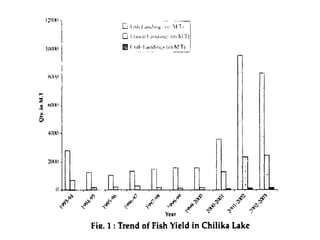
CHILKA
• Largest lagoon in the east coast of India.
• Lagoon has distinct marine,brackish &
  fresh water strands but is primarily an
  estuarine ecosystem.
• Ramsar site.
• Endangered sps. & migratory birds.
• Highly productive with rich fishery
  resources.
• Potential source for high priced prawn &
  mullet fisheries.
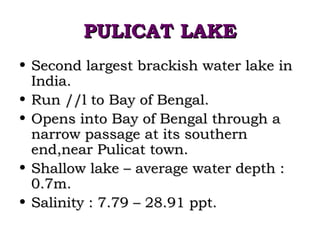
PULICAT LAKE
• Second largest brackish water lake in
  India.
• Run //l to Bay of Bengal.
• Opens into Bay of Bengal through a
  narrow passage at its southern
  end,near Pulicat town.
• Shallow lake – average water depth :
  0.7m.
• Salinity : 7.79 – 28.91 ppt.
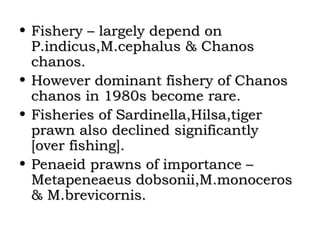
• Fishery – largely depend on
  P.indicus,M.cephalus & Chanos
  chanos.
• However dominant fishery of Chanos
  chanos in 1980s become rare.
• Fisheries of Sardinella,Hilsa,tiger
  prawn also declined significantly
  [over fishing].
• Penaeid prawns of importance –
  Metapeneaeus dobsonii,M.monoceros
  & M.brevicornis.
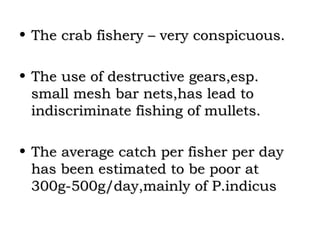
• The crab fishery – very conspicuous.

• The use of destructive gears,esp.
  small mesh bar nets,has lead to
  indiscriminate fishing of mullets.

• The average catch per fisher per day
  has been estimated to be poor at
  300g-500g/day,mainly of P.indicus
KERALA BACKWATERS
• 44 rivers in Kerala,41 flows westwards
  from W.G to Arabian sea through
  backwater.
• Total area : 500 sq.km
• Comprises of vast system –
  interconnected lagoons,bays &
  swamps.
• Fish landing :14000-17000t
• Vembanad is largest backwater.
• Northern part of vembanad – cochin
  backwater.
• River Periyar in north & Pampa in
  south along with many small
  channels,streams,irrigation canals etc
  –freshwater source of cochin
  backwater.
• Salinity : 9-11ppt
ANNUAL LANDING (%)
• Prawn : 60-70%
• P.indicus, Metapeneaeus dobsonii,
  M.monoceros , Macrobrachium rosenbergii.
• Mullets : 11%
• Mugil cephalus,M.macrolepis,M.parsia
• Pearl spot : 10%
• Etroplus suratensis,Etroplus maculatus
• Catfish :9%
• Others :1%
References
• ESTUARINE FISHERIES
  MANAGEMENT
- OPTIONS & STRATEGIES[Central
  Inland Fisheries Research Institute
(Indian Council of Agricultural
  Research)]
• www.fao.org
• www.fishbase.org
• agritech.tnau.ac.in
Estuarine fisheries   n.a.k.