Treatment of
Glenoid and Humeral Head
Bone Defects
in Shoulder Instability
Nikolaos Tzanakakis
Orthopedic Surgeon
2nd
Orthopedic Dept.
Center for Shoulder Arthroscopy
IASO General Hospital
Athens, Greece
Background
There is a well-recognized association between
osseous defects of the glenoid or humerus
and shoulder dislocation, which often leads to
recurrent instability.
Boileau P., J Bone Joint Surg Am. 2006 Aug;88(8):1755-63.
Lynch JR., J Shoulder Elbow Surg. 2009 Mar-Apr;18(2):317-28.
Burkhart SS., Instr Course Lect. 2009;58:323-36.
www.shoulder.gr
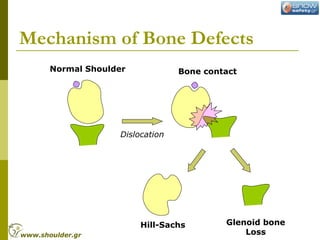
Mechanism of Bone Defects
Hill-Sachs Glenoid bone
Loss
Normal Shoulder Bone contact
Dislocation
www.shoulder.gr
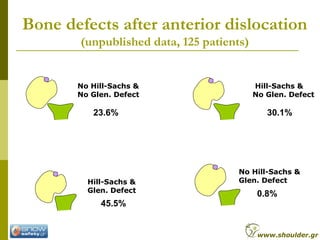
Bone defects after anterior dislocation
(unpublished data, 125 patients)
Hill-Sachs &
Glen. Defect
Hill-Sachs &
No Glen. Defect
No Hill-Sachs &
No Glen. Defect
No Hill-Sachs &
Glen. Defect
23.6%
45.5%
30.1%
0.8%
www.shoulder.gr
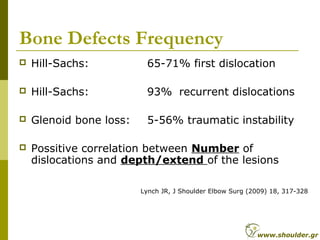
Bone Defects Frequency
 Hill-Sachs: 65-71% first dislocation
 Hill-Sachs: 93% recurrent dislocations
 Glenoid bone loss: 5-56% traumatic instability
 Possitive correlation between Number of
dislocations and depth/extend of the lesions
Lynch JR, J Shoulder Elbow Surg (2009) 18, 317-328
www.shoulder.gr
Humeral Head
Bone Defect
(Hill-Sachs Lesion)
www.shoulder.gr
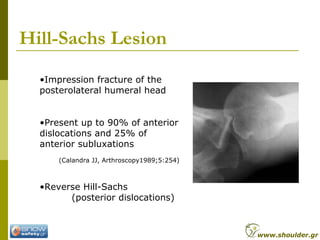
Hill-Sachs Lesion
•Impression fracture of the
posterolateral humeral head
•Present up to 90% of anterior
dislocations and 25% of
anterior subluxations
(Calandra JJ, Arthroscopy1989;5:254)
•Reverse Hill-Sachs
(posterior dislocations)
www.shoulder.gr
Hill-Sachs Arthroscopic Grading
 Grade I: defect in the articular surface
down to subchondral bone
 Grade II: includes the subchondral bone
 Grade III: large subchondral defect
Calandra et. Al, 1989
www.shoulder.gr
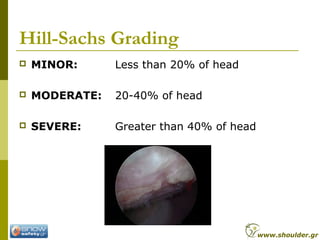
Hill-Sachs Grading
 MINOR: Less than 20% of head
 MODERATE: 20-40% of head
 SEVERE: Greater than 40% of head
www.shoulder.gr
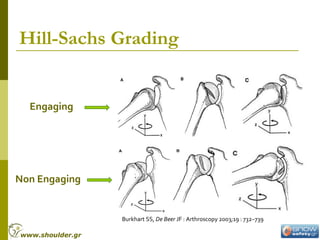
Hill-Sachs Grading
Engaging
Non Engaging
Burkhart SS, De Beer JF : Arthroscopy 2003;19 : 732–739
www.shoulder.gr
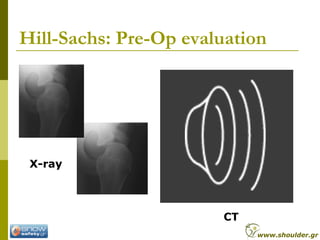
Hill-Sachs: Pre-Op evaluation
X-ray
CT
www.shoulder.gr
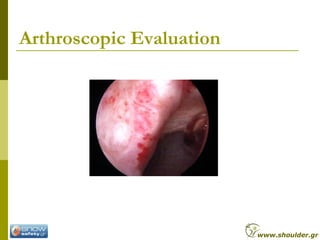
Arthroscopic Evaluation
www.shoulder.gr
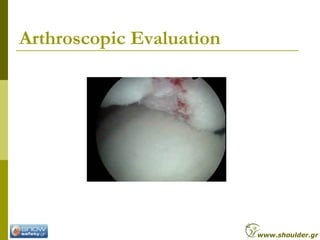
Arthroscopic Evaluation
www.shoulder.gr
Guidelines for Hill-Sachs Treatment
 Most Hill-Sachs lesions are small and don’t
require treatment
 Each lesion should be evaluated during surgery
 Treatment Required for:
- Lesions found to be engaging in a normal ROM
- Lesions representing >30%-40% of the
articular surface
Center for Shoulder
Arthroscopy
IASO GENERAL Hospital
Treatment Options for Hill-Sachs
 Humeral rotation osteotomy
(Weber BG, JBJS 1984;66A:1443)
 Hemiarthroplasty / TSA for patients >50y/o
(Flatow E, JSES 1993;12:1, 29)
 Humeral head grafting
(Gerber C, JBJS 1996;78A:376)
 Remplissage
(Wolf EM, Arthroscopy 2004;20(suppl1) :e14)
www.shoulder.gr
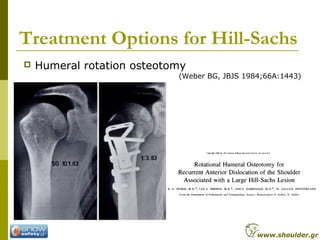
Treatment Options for Hill-Sachs
 Humeral rotation osteotomy
(Weber BG, JBJS 1984;66A:1443)
www.shoulder.gr
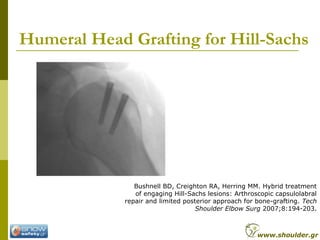
Humeral Head Grafting for Hill-Sachs
Bushnell BD, Creighton RA, Herring MM. Hybrid treatment
of engaging Hill-Sachs lesions: Arthroscopic capsulolabral
repair and limited posterior approach for bone-grafting. Tech
Shoulder Elbow Surg 2007;8:194-203.
www.shoulder.gr
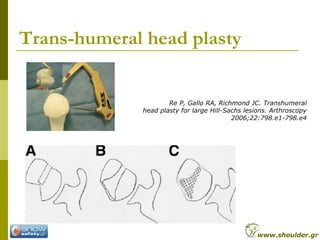
Trans-humeral head plasty
Re P, Gallo RA, Richmond JC. Transhumeral
head plasty for large Hill-Sachs lesions. Arthroscopy
2006;22:798.e1-798.e4
www.shoulder.gr
Hemi-CAP
Raiss P, Aldinger PR, Kasten P, Rickert M, Loew M. Humeral
head resurfacing for fixed anterior glenohumeral dislocation.
Int Orthop 2007 Dec 19 [Epub ahead of print]
www.shoulder.gr
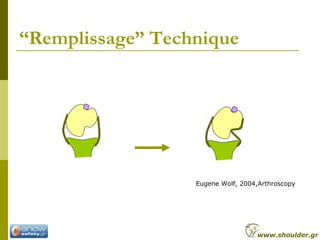
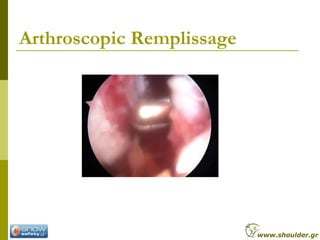
“Remplissage” Technique
Eugene Wolf, 2004,Arthroscopy
www.shoulder.gr
Arthroscopic Remplissage
www.shoulder.gr
Glenoid
Bone Defects
www.shoulder.gr
Background Knowledge
Considerable Glenoid defects
after shoulder dislocation
decrease the intrinsic
stability.
[Burkhart, De Beer, Itoi, Mologne]
In vitro, less forces need to
dislocate the shoulder.
[Burkhart SS. Arthroscopy, 2000]
www.shoulder.gr
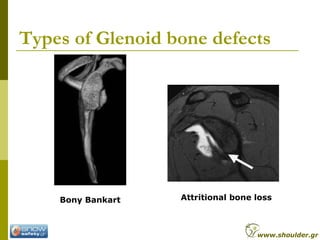
Types of Glenoid bone defects
Bony Bankart Attritional bone loss
www.shoulder.gr
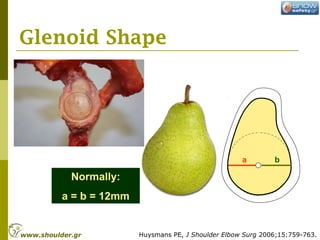
Glenoid Shape
a b
Normally:
a = b = 12mm
Huysmans PE, J Shoulder Elbow Surg 2006;15:759-763.www.shoulder.gr
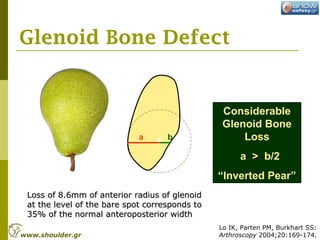
Glenoid Bone Defect
Considerable
Glenoid Bone
Loss
a > b/2
“Inverted Pear”
a b
Loss of 8.6mm of anterior radius of glenoidLoss of 8.6mm of anterior radius of glenoid
at the level of the bare spot corresponds toat the level of the bare spot corresponds to
35% of the normal anteroposterior width35% of the normal anteroposterior width
Lo IK, Parten PM, Burkhart SS:
Arthroscopy 2004;20:169-174.www.shoulder.gr
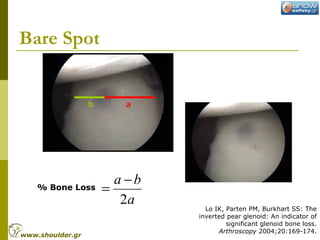
Bare Spot
b a
% Bone Loss
Lo IK, Parten PM, Burkhart SS: The
inverted pear glenoid: An indicator of
significant glenoid bone loss.
Arthroscopy 2004;20:169-174.
a
ba
2
−
=
www.shoulder.gr
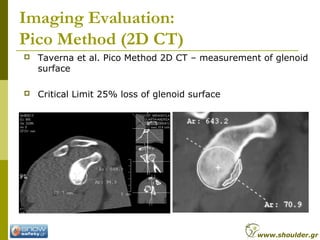
Imaging Evaluation:
Pico Method (2D CT)
 Taverna et al. Pico Method 2D CT – measurement of glenoid
surface
 Critical Limit 25% loss of glenoid surface
www.shoulder.gr
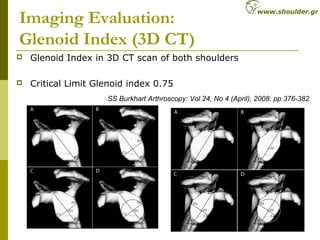
Imaging Evaluation:
Glenoid Index (3D CT)
 Glenoid Index in 3D CT scan of both shoulders
 Critical Limit Glenoid index 0.75
SS Burkhart Arthroscopy: Vol 24, No 4 (April), 2008: pp 376-382
www.shoulder.gr
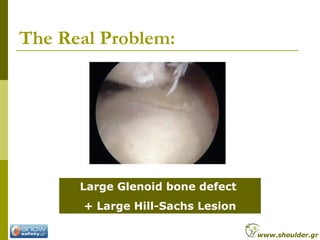
The Real Problem:
Large Glenoid bone defect
+ Large Hill-Sachs Lesion
www.shoulder.gr
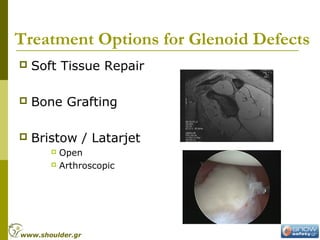
Treatment Options for Glenoid Defects
 Soft Tissue Repair
 Bone Grafting
 Bristow / Latarjet
 Open
 Arthroscopic
www.shoulder.gr
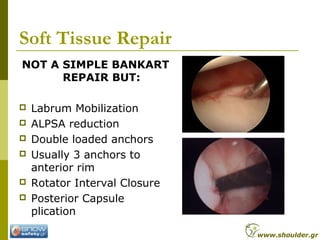
Soft Tissue Repair
NOT A SIMPLE BANKART
REPAIR BUT:
 Labrum Mobilization
 ALPSA reduction
 Double loaded anchors
 Usually 3 anchors to
anterior rim
 Rotator Interval Closure
 Posterior Capsule
plication
www.shoulder.gr
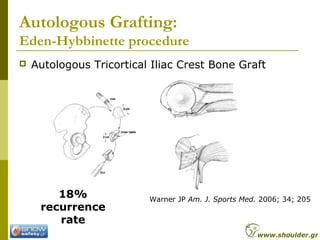
Autologous Grafting:
Eden-Hybbinette procedure
 Autologous Tricortical Iliac Crest Bone Graft
Warner JP Am. J. Sports Med. 2006; 34; 205
18%
recurrence
rate
www.shoulder.gr
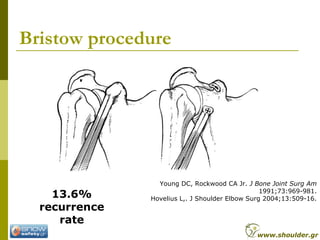
Bristow procedure
Young DC, Rockwood CA Jr. J Bone Joint Surg Am
1991;73:969-981.
Hovelius L,. J Shoulder Elbow Surg 2004;13:509-16.13.6%
recurrence
rate
www.shoulder.gr
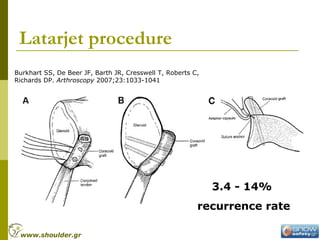
Latarjet procedure
Burkhart SS, De Beer JF, Barth JR, Cresswell T, Roberts C,
Richards DP. Arthroscopy 2007;23:1033-1041
3.4 - 14%
recurrence rate
www.shoulder.gr
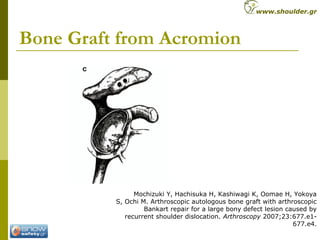
Bone Graft from Acromion
Mochizuki Y, Hachisuka H, Kashiwagi K, Oomae H, Yokoya
S, Ochi M. Arthroscopic autologous bone graft with arthroscopic
Bankart repair for a large bony defect lesion caused by
recurrent shoulder dislocation. Arthroscopy 2007;23:677.e1-
677.e4.
www.shoulder.gr
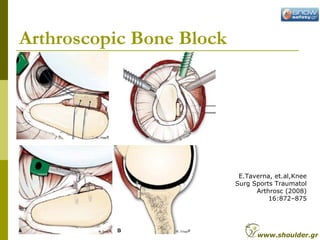
Arthroscopic Bone Block
E.Taverna, et.al,Knee
Surg Sports Traumatol
Arthrosc (2008)
16:872–875
www.shoulder.gr
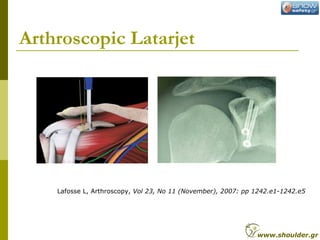
Arthroscopic Latarjet
Lafosse L, Arthroscopy, Vol 23, No 11 (November), 2007: pp 1242.e1-1242.e5
www.shoulder.gr
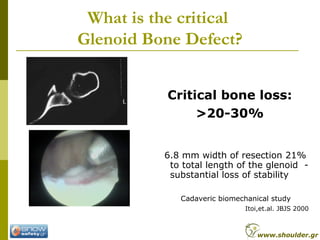
What is the critical
Glenoid Bone Defect?
Critical bone loss:
>20-30%
6.8 mm width of resection 21%
to total length of the glenoid -
substantial loss of stability
Cadaveric biomechanical study
Itoi,et.al. JBJS 2000
www.shoulder.gr
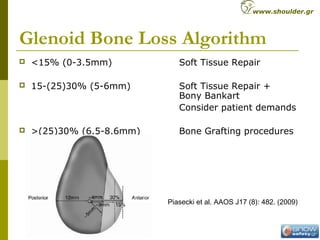
Glenoid Bone Loss Algorithm
 <15% (0-3.5mm) Soft Tissue Repair
 15-(25)30% (5-6mm) Soft Tissue Repair +
Bony Bankart
Consider patient demands
 >(25)30% (6.5-8.6mm) Bone Grafting procedures
Piasecki et al. AAOS J17 (8): 482. (2009)
www.shoulder.gr
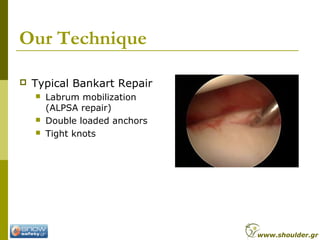
Our Technique
 Typical Bankart Repair
 Labrum mobilization
(ALPSA repair)
 Double loaded anchors
 Tight knots
www.shoulder.gr
Our Technique
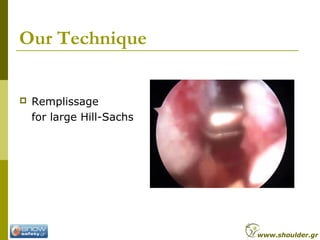
 Remplissage
for large Hill-Sachs
www.shoulder.gr
Our Technique
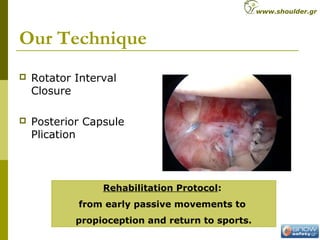
 Rotator Interval
Closure
 Posterior Capsule
Plication
Rehabilitation Protocol:
from early passive movements to
propioception and return to sports.
www.shoulder.gr
Our Results
 Period: 1999-2004
 116 patients with anterior shoulder instability
 Arthroscopic Treatment
 At least 5 years follow-up (range 5-9.75 years)
 Hill-Sachs 78/116 67.2%
 Glenoid defect 36/116 31.0%
 Invetred pear 8/116 6.8%
www.shoulder.gr
Our Results
 Recurrence rate: 7/116 6.03%
(2 MVA, 2 Sports, 1 Fall, 1 No Comply, 1 Minor Trauma)
6/7 re-operated arthroscopicaly – No recurrence yet
 Rowe-Zarins: Pre-Op 33 (15-80),Post-Op:95 (80-100)
 Satisfaction
 109/116 Very Satisfied 93.9%
 6/116 Satisfied 5.2%
 1/116 Did not answer 0.9%
 Return to work: 116/116 100%
 Return to sports: 45/116 38.8%
www.shoulder.gr
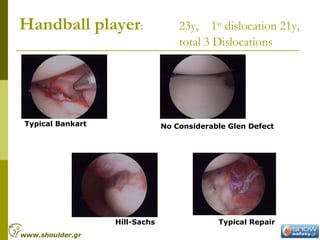
Handball player: 23y, 1st
dislocation 21y,
total 3 Dislocations
Typical Bankart No Considerable Glen Defect
Hill-Sachs Typical Repair
www.shoulder.gr
Typical Rehabilitation Program
…full return to sports 9 months later
…but 15 months after the operation….
Handball player: 23y, 1st
dislocation 21y,
Left shoulder, Total 3 Dislocations
www.shoulder.gr
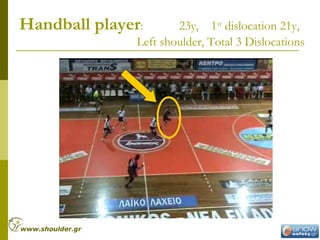
Handball player: 23y, 1st
dislocation 21y,
Left shoulder, Total 3 Dislocations
www.shoulder.gr
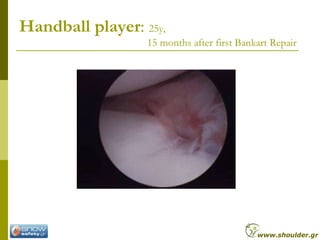
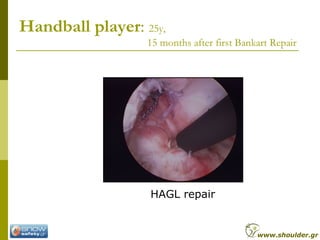
Handball player: 25y,
15 months after first Bankart Repair
www.shoulder.gr
HAGL repair
Handball player: 25y,
15 months after first Bankart Repair
www.shoulder.gr
Conclusions
 Humeral Head bone loss (Hill-Sachs)
 Graft reconstruction
 Prosthetic replacement
 Remplissage
 Glenoid bone loss
 Soft Tissue Repair (more than a simple Bankart
repair)
 Bone Grafting (many methods)
 Bristow or Laterjet
 Open
 Arthroscopic
www.shoulder.gr
Thank you for your attention
www.shoulder.gr

Bone defects thessal2010

  • 1.
    Treatment of Glenoid andHumeral Head Bone Defects in Shoulder Instability Nikolaos Tzanakakis Orthopedic Surgeon 2nd Orthopedic Dept. Center for Shoulder Arthroscopy IASO General Hospital Athens, Greece
  • 2.
    Background There is awell-recognized association between osseous defects of the glenoid or humerus and shoulder dislocation, which often leads to recurrent instability. Boileau P., J Bone Joint Surg Am. 2006 Aug;88(8):1755-63. Lynch JR., J Shoulder Elbow Surg. 2009 Mar-Apr;18(2):317-28. Burkhart SS., Instr Course Lect. 2009;58:323-36. www.shoulder.gr
  • 3.
    Mechanism of BoneDefects Hill-Sachs Glenoid bone Loss Normal Shoulder Bone contact Dislocation www.shoulder.gr
  • 4.
    Bone defects afteranterior dislocation (unpublished data, 125 patients) Hill-Sachs & Glen. Defect Hill-Sachs & No Glen. Defect No Hill-Sachs & No Glen. Defect No Hill-Sachs & Glen. Defect 23.6% 45.5% 30.1% 0.8% www.shoulder.gr
  • 5.
    Bone Defects Frequency Hill-Sachs: 65-71% first dislocation  Hill-Sachs: 93% recurrent dislocations  Glenoid bone loss: 5-56% traumatic instability  Possitive correlation between Number of dislocations and depth/extend of the lesions Lynch JR, J Shoulder Elbow Surg (2009) 18, 317-328 www.shoulder.gr
  • 6.
    Humeral Head Bone Defect (Hill-SachsLesion) www.shoulder.gr
  • 7.
    Hill-Sachs Lesion •Impression fractureof the posterolateral humeral head •Present up to 90% of anterior dislocations and 25% of anterior subluxations (Calandra JJ, Arthroscopy1989;5:254) •Reverse Hill-Sachs (posterior dislocations) www.shoulder.gr
  • 8.
    Hill-Sachs Arthroscopic Grading Grade I: defect in the articular surface down to subchondral bone  Grade II: includes the subchondral bone  Grade III: large subchondral defect Calandra et. Al, 1989 www.shoulder.gr
  • 9.
    Hill-Sachs Grading  MINOR:Less than 20% of head  MODERATE: 20-40% of head  SEVERE: Greater than 40% of head www.shoulder.gr
  • 10.
    Hill-Sachs Grading Engaging Non Engaging BurkhartSS, De Beer JF : Arthroscopy 2003;19 : 732–739 www.shoulder.gr
  • 11.
  • 12.
  • 13.
  • 14.
    Guidelines for Hill-SachsTreatment  Most Hill-Sachs lesions are small and don’t require treatment  Each lesion should be evaluated during surgery  Treatment Required for: - Lesions found to be engaging in a normal ROM - Lesions representing >30%-40% of the articular surface Center for Shoulder Arthroscopy IASO GENERAL Hospital
  • 15.
    Treatment Options forHill-Sachs  Humeral rotation osteotomy (Weber BG, JBJS 1984;66A:1443)  Hemiarthroplasty / TSA for patients >50y/o (Flatow E, JSES 1993;12:1, 29)  Humeral head grafting (Gerber C, JBJS 1996;78A:376)  Remplissage (Wolf EM, Arthroscopy 2004;20(suppl1) :e14) www.shoulder.gr
  • 16.
    Treatment Options forHill-Sachs  Humeral rotation osteotomy (Weber BG, JBJS 1984;66A:1443) www.shoulder.gr
  • 17.
    Humeral Head Graftingfor Hill-Sachs Bushnell BD, Creighton RA, Herring MM. Hybrid treatment of engaging Hill-Sachs lesions: Arthroscopic capsulolabral repair and limited posterior approach for bone-grafting. Tech Shoulder Elbow Surg 2007;8:194-203. www.shoulder.gr
  • 18.
    Trans-humeral head plasty ReP, Gallo RA, Richmond JC. Transhumeral head plasty for large Hill-Sachs lesions. Arthroscopy 2006;22:798.e1-798.e4 www.shoulder.gr
  • 19.
    Hemi-CAP Raiss P, AldingerPR, Kasten P, Rickert M, Loew M. Humeral head resurfacing for fixed anterior glenohumeral dislocation. Int Orthop 2007 Dec 19 [Epub ahead of print] www.shoulder.gr
  • 20.
    “Remplissage” Technique Eugene Wolf,2004,Arthroscopy www.shoulder.gr
  • 21.
  • 22.
  • 23.
    Background Knowledge Considerable Glenoiddefects after shoulder dislocation decrease the intrinsic stability. [Burkhart, De Beer, Itoi, Mologne] In vitro, less forces need to dislocate the shoulder. [Burkhart SS. Arthroscopy, 2000] www.shoulder.gr
  • 24.
    Types of Glenoidbone defects Bony Bankart Attritional bone loss www.shoulder.gr
  • 25.
    Glenoid Shape a b Normally: a= b = 12mm Huysmans PE, J Shoulder Elbow Surg 2006;15:759-763.www.shoulder.gr
  • 26.
    Glenoid Bone Defect Considerable GlenoidBone Loss a > b/2 “Inverted Pear” a b Loss of 8.6mm of anterior radius of glenoidLoss of 8.6mm of anterior radius of glenoid at the level of the bare spot corresponds toat the level of the bare spot corresponds to 35% of the normal anteroposterior width35% of the normal anteroposterior width Lo IK, Parten PM, Burkhart SS: Arthroscopy 2004;20:169-174.www.shoulder.gr
  • 27.
    Bare Spot b a %Bone Loss Lo IK, Parten PM, Burkhart SS: The inverted pear glenoid: An indicator of significant glenoid bone loss. Arthroscopy 2004;20:169-174. a ba 2 − = www.shoulder.gr
  • 28.
    Imaging Evaluation: Pico Method(2D CT)  Taverna et al. Pico Method 2D CT – measurement of glenoid surface  Critical Limit 25% loss of glenoid surface www.shoulder.gr
  • 29.
    Imaging Evaluation: Glenoid Index(3D CT)  Glenoid Index in 3D CT scan of both shoulders  Critical Limit Glenoid index 0.75 SS Burkhart Arthroscopy: Vol 24, No 4 (April), 2008: pp 376-382 www.shoulder.gr
  • 30.
    The Real Problem: LargeGlenoid bone defect + Large Hill-Sachs Lesion www.shoulder.gr
  • 31.
    Treatment Options forGlenoid Defects  Soft Tissue Repair  Bone Grafting  Bristow / Latarjet  Open  Arthroscopic www.shoulder.gr
  • 32.
    Soft Tissue Repair NOTA SIMPLE BANKART REPAIR BUT:  Labrum Mobilization  ALPSA reduction  Double loaded anchors  Usually 3 anchors to anterior rim  Rotator Interval Closure  Posterior Capsule plication www.shoulder.gr
  • 33.
    Autologous Grafting: Eden-Hybbinette procedure Autologous Tricortical Iliac Crest Bone Graft Warner JP Am. J. Sports Med. 2006; 34; 205 18% recurrence rate www.shoulder.gr
  • 34.
    Bristow procedure Young DC,Rockwood CA Jr. J Bone Joint Surg Am 1991;73:969-981. Hovelius L,. J Shoulder Elbow Surg 2004;13:509-16.13.6% recurrence rate www.shoulder.gr
  • 35.
    Latarjet procedure Burkhart SS,De Beer JF, Barth JR, Cresswell T, Roberts C, Richards DP. Arthroscopy 2007;23:1033-1041 3.4 - 14% recurrence rate www.shoulder.gr
  • 36.
    Bone Graft fromAcromion Mochizuki Y, Hachisuka H, Kashiwagi K, Oomae H, Yokoya S, Ochi M. Arthroscopic autologous bone graft with arthroscopic Bankart repair for a large bony defect lesion caused by recurrent shoulder dislocation. Arthroscopy 2007;23:677.e1- 677.e4. www.shoulder.gr
  • 37.
    Arthroscopic Bone Block E.Taverna,et.al,Knee Surg Sports Traumatol Arthrosc (2008) 16:872–875 www.shoulder.gr
  • 38.
    Arthroscopic Latarjet Lafosse L,Arthroscopy, Vol 23, No 11 (November), 2007: pp 1242.e1-1242.e5 www.shoulder.gr
  • 39.
    What is thecritical Glenoid Bone Defect? Critical bone loss: >20-30% 6.8 mm width of resection 21% to total length of the glenoid - substantial loss of stability Cadaveric biomechanical study Itoi,et.al. JBJS 2000 www.shoulder.gr
  • 40.
    Glenoid Bone LossAlgorithm  <15% (0-3.5mm) Soft Tissue Repair  15-(25)30% (5-6mm) Soft Tissue Repair + Bony Bankart Consider patient demands  >(25)30% (6.5-8.6mm) Bone Grafting procedures Piasecki et al. AAOS J17 (8): 482. (2009) www.shoulder.gr
  • 41.
    Our Technique  TypicalBankart Repair  Labrum mobilization (ALPSA repair)  Double loaded anchors  Tight knots www.shoulder.gr
  • 42.
    Our Technique  Remplissage forlarge Hill-Sachs www.shoulder.gr
  • 43.
    Our Technique  RotatorInterval Closure  Posterior Capsule Plication Rehabilitation Protocol: from early passive movements to propioception and return to sports. www.shoulder.gr
  • 44.
    Our Results  Period:1999-2004  116 patients with anterior shoulder instability  Arthroscopic Treatment  At least 5 years follow-up (range 5-9.75 years)  Hill-Sachs 78/116 67.2%  Glenoid defect 36/116 31.0%  Invetred pear 8/116 6.8% www.shoulder.gr
  • 45.
    Our Results  Recurrencerate: 7/116 6.03% (2 MVA, 2 Sports, 1 Fall, 1 No Comply, 1 Minor Trauma) 6/7 re-operated arthroscopicaly – No recurrence yet  Rowe-Zarins: Pre-Op 33 (15-80),Post-Op:95 (80-100)  Satisfaction  109/116 Very Satisfied 93.9%  6/116 Satisfied 5.2%  1/116 Did not answer 0.9%  Return to work: 116/116 100%  Return to sports: 45/116 38.8% www.shoulder.gr
  • 46.
    Handball player: 23y,1st dislocation 21y, total 3 Dislocations Typical Bankart No Considerable Glen Defect Hill-Sachs Typical Repair www.shoulder.gr
  • 47.
    Typical Rehabilitation Program …fullreturn to sports 9 months later …but 15 months after the operation…. Handball player: 23y, 1st dislocation 21y, Left shoulder, Total 3 Dislocations www.shoulder.gr
  • 48.
    Handball player: 23y,1st dislocation 21y, Left shoulder, Total 3 Dislocations www.shoulder.gr
  • 49.
    Handball player: 25y, 15months after first Bankart Repair www.shoulder.gr
  • 50.
    HAGL repair Handball player:25y, 15 months after first Bankart Repair www.shoulder.gr
  • 51.
    Conclusions  Humeral Headbone loss (Hill-Sachs)  Graft reconstruction  Prosthetic replacement  Remplissage  Glenoid bone loss  Soft Tissue Repair (more than a simple Bankart repair)  Bone Grafting (many methods)  Bristow or Laterjet  Open  Arthroscopic www.shoulder.gr
  • 52.
    Thank you foryour attention www.shoulder.gr