ACETABULAR DEFECTS
DR. John E. Benny
Fellow in Arthroplasty
Sunshine Hopsital
Acetabular deficiency
• Dysplasia and protrusio acetabuli.
• Post-traumatic degenerative disease, secondary to acetabular trauma,
& loosening of the acetabular component.
• Hemispherical cementless cups, jumbo cups, bilobed cups, high hip
center, impaction grafting of the acetabulum, bulk structural allograft,
antiprotrusio cages, and highly porous acetabular cups
Goals of reconstruction
• Restore hip mechanics
• Re-establish osseous coverage of new acetabular
component
• Rigid fixation
– Acetabular component
– Graft
Preoperative Planning
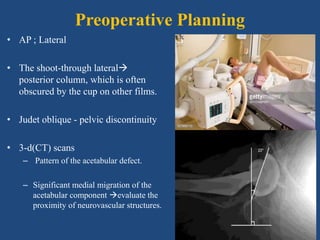
• AP ; Lateral
• The shoot-through lateral
posterior column, which is often
obscured by the cup on other films.
• Judet oblique - pelvic discontinuity
• 3-d(CT) scans
– Pattern of the acetabular defect.
– Significant medial migration of the
acetabular component evaluate the
proximity of neurovascular structures.
Magenetic Resonance Imaging
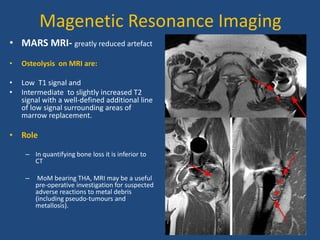
• MARS MRI- greatly reduced artefact
• Osteolysis on MRI are:
• Low T1 signal and
• Intermediate to slightly increased T2
signal with a well-defined additional line
of low signal surrounding areas of
marrow replacement.
• Role
– In quantifying bone loss it is inferior to
CT
– MoM bearing THA, MRI may be a useful
pre-operative investigation for suspected
adverse reactions to metal debris
(including pseudo-tumours and
metallosis).
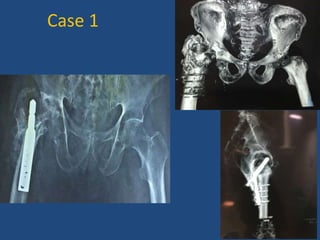
Case 1
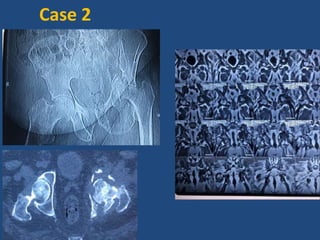
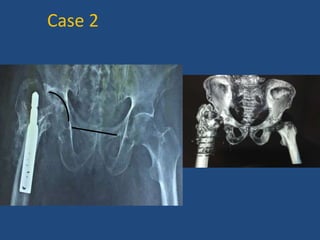
Case 2
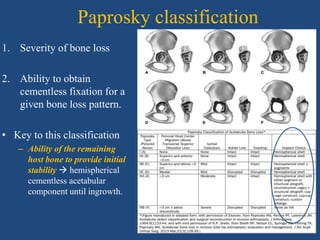
Paprosky classification
1. Severity of bone loss
2. Ability to obtain
cementless fixation for a
given bone loss pattern.
• Key to this classification
– Ability of the remaining
host bone to provide initial
stability  hemispherical
cementless acetabular
component until ingrowth.
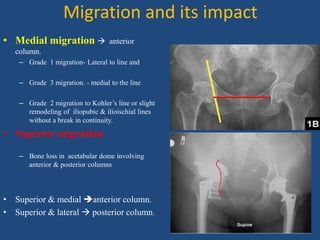
Migration and its impact
• Medial migration  anterior
column.
– Grade 1 migration- Lateral to line and
– Grade 3 migration. - medial to the line
– Grade 2 migration to Kohler’s line or slight
remodeling of iliopubic & ilioischial lines
without a break in continuity.
• Superior migration
– Bone loss in acetabular dome involving
anterior & posterior columns
• Superior & medial anterior column.
• Superior & lateral  posterior column.
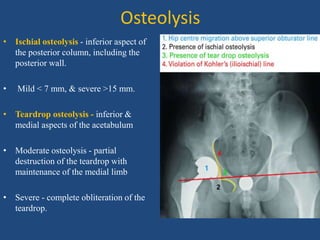
Osteolysis
• Ischial osteolysis - inferior aspect of
the posterior column, including the
posterior wall.
• Mild < 7 mm, & severe >15 mm.
• Teardrop osteolysis - inferior &
medial aspects of the acetabulum
• Moderate osteolysis - partial
destruction of the teardrop with
maintenance of the medial limb
• Severe - complete obliteration of the
teardrop.
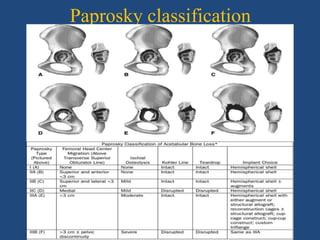
Paprosky classification
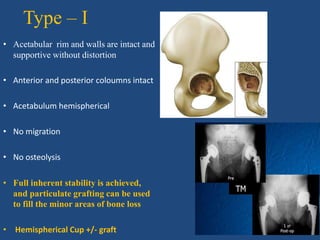
Type – I
• Acetabular rim and walls are intact and
supportive without distortion
• Anterior and posterior coloumns intact
• Acetabulum hemispherical
• No migration
• No osteolysis
• Full inherent stability is achieved,
and particulate grafting can be used
to fill the minor areas of bone loss
• Hemispherical Cup +/- graft
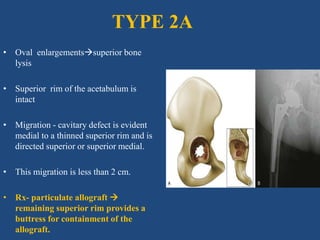
TYPE 2A
• Oval enlargementssuperior bone
lysis
• Superior rim of the acetabulum is
intact
• Migration - cavitary defect is evident
medial to a thinned superior rim and is
directed superior or superior medial.
• This migration is less than 2 cm.
• Rx- particulate allograft 
remaining superior rim provides a
buttress for containment of the
allograft.
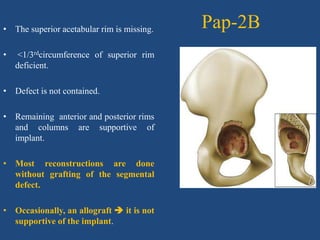
Pap-2B• The superior acetabular rim is missing.
• <1/3rdcircumference of superior rim
deficient.
• Defect is not contained.
• Remaining anterior and posterior rims
and columns are supportive of
implant.
• Most reconstructions are done
without grafting of the segmental
defect.
• Occasionally, an allograft  it is not
supportive of the implant.
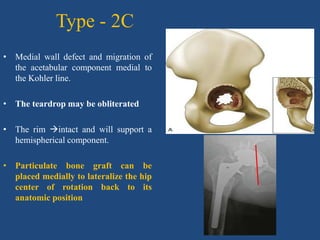
Type - 2C
• Medial wall defect and migration of
the acetabular component medial to
the Kohler line.
• The teardrop may be obliterated
• The rim intact and will support a
hemispherical component.
• Particulate bone graft can be
placed medially to lateralize the hip
center of rotation back to its
anatomic position
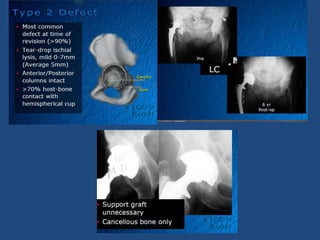
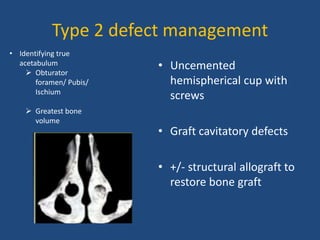
Type 2 defect management
• Uncemented
hemispherical cup with
screws
• Graft cavitatory defects
• +/- structural allograft to
restore bone graft
• Identifying true
acetabulum
 Obturator
foramen/ Pubis/
Ischium
 Greatest bone
volume
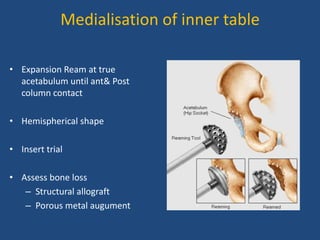
Medialisation of inner table
• Expansion Ream at true
acetabulum until ant& Post
column contact
• Hemispherical shape
• Insert trial
• Assess bone loss
– Structural allograft
– Porous metal augument
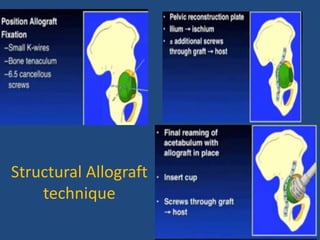
Structural Allograft
technique
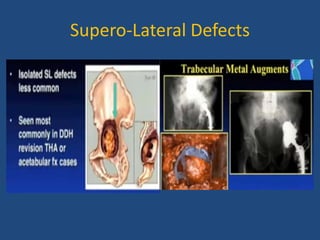
Supero-Lateral Defects
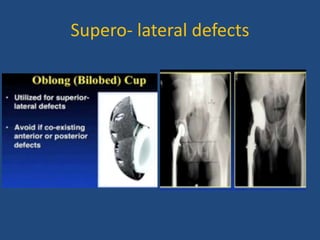
Supero- lateral defects
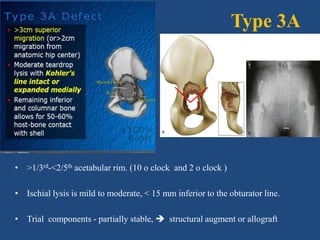
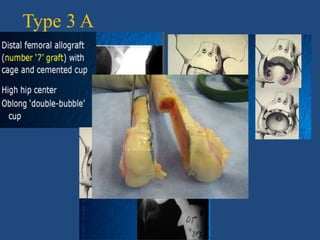
Type 3A
• >1/3rd-<2/5th acetabular rim. (10 o clock and 2 o clock )
• Ischial lysis is mild to moderate, < 15 mm inferior to the obturator line.
• Trial components - partially stable,  structural augment or allograft
Type 3 A
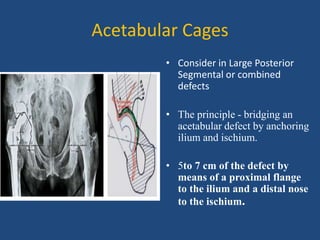
Acetabular Cages
• Consider in Large Posterior
Segmental or combined
defects
• The principle - bridging an
acetabular defect by anchoring
ilium and ischium.
• 5to 7 cm of the defect by
means of a proximal flange
to the ilium and a distal nose
to the ischium.
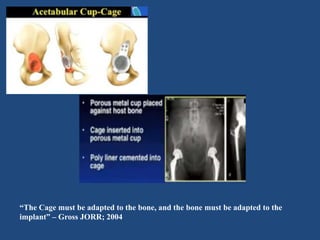
“The Cage must be adapted to the bone, and the bone must be adapted to the
implant” – Gross JORR; 2004
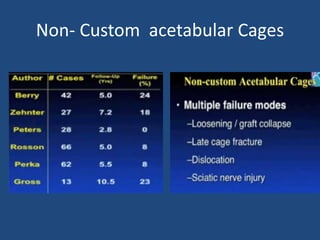
Non- Custom acetabular Cages
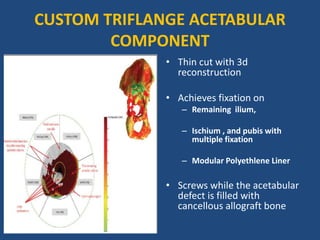
CUSTOM TRIFLANGE ACETABULAR
COMPONENT
• Thin cut with 3d
reconstruction
• Achieves fixation on
– Remaining ilium,
– Ischium , and pubis with
multiple fixation
– Modular Polyethlene Liner
• Screws while the acetabular
defect is filled with
cancellous allograft bone
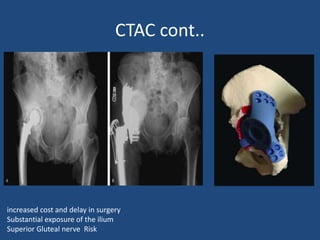
CTAC cont..
increased cost and delay in surgery
Substantial exposure of the ilium
Superior Gluteal nerve Risk
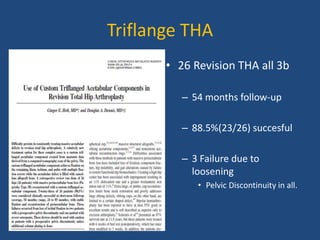
Triflange THA
• 26 Revision THA all 3b
– 54 months follow-up
– 88.5%(23/26) succesful
– 3 Failure due to
loosening
• Pelvic Discontinuity in all.
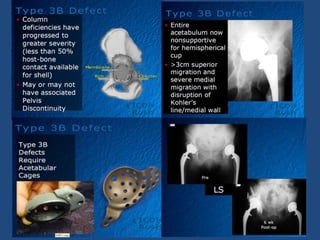
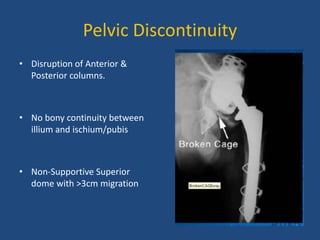
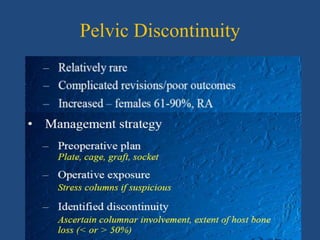
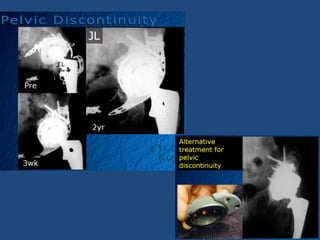
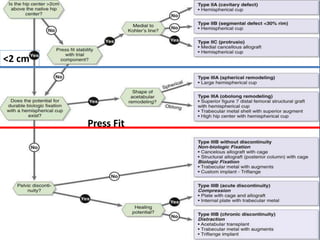
Pelvic Discontinuity
• Disruption of Anterior &
Posterior columns.
• No bony continuity between
illium and ischium/pubis
• Non-Supportive Superior
dome with >3cm migration
Pelvic Discontinuity
<2 cm
Press Fit
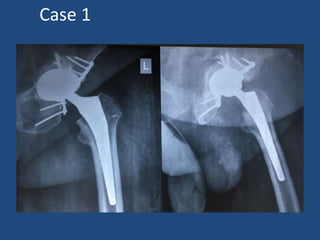
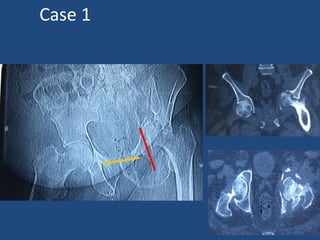
Case 1
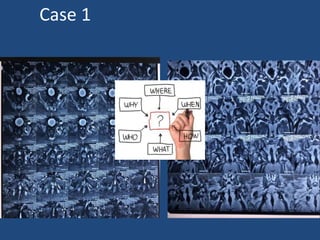
Case 1
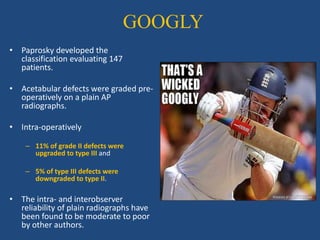
GOOGLY
• Paprosky developed the
classification evaluating 147
patients.
• Acetabular defects were graded pre-
operatively on a plain AP
radiographs.
• Intra-operatively
– 11% of grade II defects were
upgraded to type III and
– 5% of type III defects were
downgraded to type II.
• The intra- and interobserver
reliability of plain radiographs have
been found to be moderate to poor
by other authors.
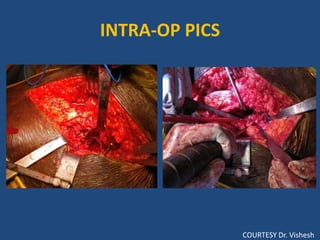
INTRA-OP PICS
COURTESY Dr. Vishesh
Case 1
Case 2
Case 1
Case 1
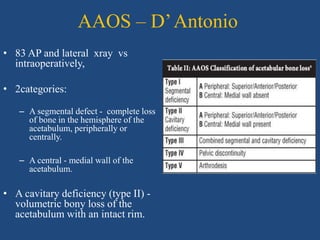
AAOS – D’Antonio
• 83 AP and lateral xray vs
intraoperatively,
• 2categories:
– A segmental defect - complete loss
of bone in the hemisphere of the
acetabulum, peripherally or
centrally.
– A central - medial wall of the
acetabulum.
• A cavitary deficiency (type II) -
volumetric bony loss of the
acetabulum with an intact rim.
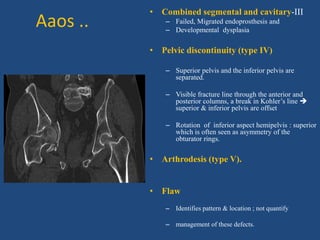
Aaos ..
• Combined segmental and cavitary-III
– Failed, Migrated endoprosthesis and
– Developmental dysplasia
• Pelvic discontinuity (type IV)
– Superior pelvis and the inferior pelvis are
separated.
– Visible fracture line through the anterior and
posterior columns, a break in Kohler’s line 
superior & inferior pelvis are offset
– Rotation of inferior aspect hemipelvis : superior
which is often seen as asymmetry of the
obturator rings.
• Arthrodesis (type V).
• Flaw
– Identifies pattern & location ; not quantify
– management of these defects.
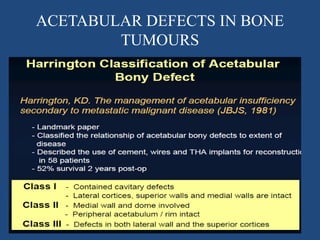
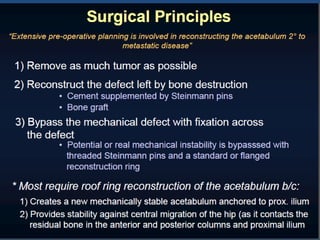
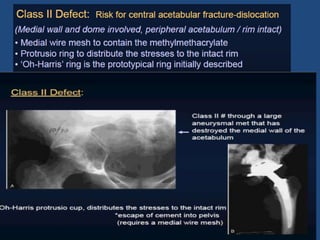
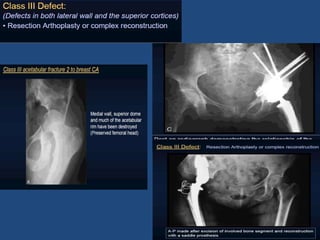
ACETABULAR DEFECTS IN BONE
TUMOURS
When in doubt!!!!!!!

Acetabular defects

  • 1.
    ACETABULAR DEFECTS DR. JohnE. Benny Fellow in Arthroplasty Sunshine Hopsital
  • 2.
    Acetabular deficiency • Dysplasiaand protrusio acetabuli. • Post-traumatic degenerative disease, secondary to acetabular trauma, & loosening of the acetabular component. • Hemispherical cementless cups, jumbo cups, bilobed cups, high hip center, impaction grafting of the acetabulum, bulk structural allograft, antiprotrusio cages, and highly porous acetabular cups
  • 3.
    Goals of reconstruction •Restore hip mechanics • Re-establish osseous coverage of new acetabular component • Rigid fixation – Acetabular component – Graft
  • 4.
    Preoperative Planning • AP; Lateral • The shoot-through lateral posterior column, which is often obscured by the cup on other films. • Judet oblique - pelvic discontinuity • 3-d(CT) scans – Pattern of the acetabular defect. – Significant medial migration of the acetabular component evaluate the proximity of neurovascular structures.
  • 5.
    Magenetic Resonance Imaging •MARS MRI- greatly reduced artefact • Osteolysis on MRI are: • Low T1 signal and • Intermediate to slightly increased T2 signal with a well-defined additional line of low signal surrounding areas of marrow replacement. • Role – In quantifying bone loss it is inferior to CT – MoM bearing THA, MRI may be a useful pre-operative investigation for suspected adverse reactions to metal debris (including pseudo-tumours and metallosis).
  • 6.
  • 7.
  • 8.
    Paprosky classification 1. Severityof bone loss 2. Ability to obtain cementless fixation for a given bone loss pattern. • Key to this classification – Ability of the remaining host bone to provide initial stability  hemispherical cementless acetabular component until ingrowth.
  • 9.
    Migration and itsimpact • Medial migration  anterior column. – Grade 1 migration- Lateral to line and – Grade 3 migration. - medial to the line – Grade 2 migration to Kohler’s line or slight remodeling of iliopubic & ilioischial lines without a break in continuity. • Superior migration – Bone loss in acetabular dome involving anterior & posterior columns • Superior & medial anterior column. • Superior & lateral  posterior column.
  • 10.
    Osteolysis • Ischial osteolysis- inferior aspect of the posterior column, including the posterior wall. • Mild < 7 mm, & severe >15 mm. • Teardrop osteolysis - inferior & medial aspects of the acetabulum • Moderate osteolysis - partial destruction of the teardrop with maintenance of the medial limb • Severe - complete obliteration of the teardrop.
  • 11.
  • 12.
    Type – I •Acetabular rim and walls are intact and supportive without distortion • Anterior and posterior coloumns intact • Acetabulum hemispherical • No migration • No osteolysis • Full inherent stability is achieved, and particulate grafting can be used to fill the minor areas of bone loss • Hemispherical Cup +/- graft
  • 14.
    TYPE 2A • Ovalenlargementssuperior bone lysis • Superior rim of the acetabulum is intact • Migration - cavitary defect is evident medial to a thinned superior rim and is directed superior or superior medial. • This migration is less than 2 cm. • Rx- particulate allograft  remaining superior rim provides a buttress for containment of the allograft.
  • 15.
    Pap-2B• The superioracetabular rim is missing. • <1/3rdcircumference of superior rim deficient. • Defect is not contained. • Remaining anterior and posterior rims and columns are supportive of implant. • Most reconstructions are done without grafting of the segmental defect. • Occasionally, an allograft  it is not supportive of the implant.
  • 16.
    Type - 2C •Medial wall defect and migration of the acetabular component medial to the Kohler line. • The teardrop may be obliterated • The rim intact and will support a hemispherical component. • Particulate bone graft can be placed medially to lateralize the hip center of rotation back to its anatomic position
  • 17.
    Type 2 defectmanagement • Uncemented hemispherical cup with screws • Graft cavitatory defects • +/- structural allograft to restore bone graft • Identifying true acetabulum  Obturator foramen/ Pubis/ Ischium  Greatest bone volume
  • 18.
    Medialisation of innertable • Expansion Ream at true acetabulum until ant& Post column contact • Hemispherical shape • Insert trial • Assess bone loss – Structural allograft – Porous metal augument
  • 19.
  • 21.
  • 22.
  • 23.
    Type 3A • >1/3rd-<2/5thacetabular rim. (10 o clock and 2 o clock ) • Ischial lysis is mild to moderate, < 15 mm inferior to the obturator line. • Trial components - partially stable,  structural augment or allograft
  • 24.
  • 26.
    Acetabular Cages • Considerin Large Posterior Segmental or combined defects • The principle - bridging an acetabular defect by anchoring ilium and ischium. • 5to 7 cm of the defect by means of a proximal flange to the ilium and a distal nose to the ischium.
  • 27.
    “The Cage mustbe adapted to the bone, and the bone must be adapted to the implant” – Gross JORR; 2004
  • 28.
  • 29.
    CUSTOM TRIFLANGE ACETABULAR COMPONENT •Thin cut with 3d reconstruction • Achieves fixation on – Remaining ilium, – Ischium , and pubis with multiple fixation – Modular Polyethlene Liner • Screws while the acetabular defect is filled with cancellous allograft bone
  • 30.
    CTAC cont.. increased costand delay in surgery Substantial exposure of the ilium Superior Gluteal nerve Risk
  • 31.
    Triflange THA • 26Revision THA all 3b – 54 months follow-up – 88.5%(23/26) succesful – 3 Failure due to loosening • Pelvic Discontinuity in all.
  • 32.
    Pelvic Discontinuity • Disruptionof Anterior & Posterior columns. • No bony continuity between illium and ischium/pubis • Non-Supportive Superior dome with >3cm migration
  • 33.
  • 36.
  • 37.
  • 38.
  • 39.
    GOOGLY • Paprosky developedthe classification evaluating 147 patients. • Acetabular defects were graded pre- operatively on a plain AP radiographs. • Intra-operatively – 11% of grade II defects were upgraded to type III and – 5% of type III defects were downgraded to type II. • The intra- and interobserver reliability of plain radiographs have been found to be moderate to poor by other authors.
  • 40.
  • 41.
  • 42.
  • 43.
  • 44.
  • 45.
    AAOS – D’Antonio •83 AP and lateral xray vs intraoperatively, • 2categories: – A segmental defect - complete loss of bone in the hemisphere of the acetabulum, peripherally or centrally. – A central - medial wall of the acetabulum. • A cavitary deficiency (type II) - volumetric bony loss of the acetabulum with an intact rim.
  • 46.
    Aaos .. • Combinedsegmental and cavitary-III – Failed, Migrated endoprosthesis and – Developmental dysplasia • Pelvic discontinuity (type IV) – Superior pelvis and the inferior pelvis are separated. – Visible fracture line through the anterior and posterior columns, a break in Kohler’s line  superior & inferior pelvis are offset – Rotation of inferior aspect hemipelvis : superior which is often seen as asymmetry of the obturator rings. • Arthrodesis (type V). • Flaw – Identifies pattern & location ; not quantify – management of these defects.
  • 47.
  • 51.

Editor's Notes

  • #6 Metal Artifact Reduction Sequence MRI
  • #10 Kohler’s line, or the ilioischial line, is defined as a line connecting the most lateral aspect of the pelvic brim and the most lateral aspect of the obturator foramen on an anteroposterior radiograph of the pelvis.
  • #16 Migration of the component occurs superior and lateral because the acetabular rim is deficient.
  • #17 Reconstruction of these defects is similar to the treatment of protrusio acetabuli in the setting of a primary arthroplasty. Radiograph demonstrating a Type 2C acetabular defect. The teardrop is obliterated and the component has migrated medially past Kohler’s line.
  • #24 Type 3A acetabular defect. Bone loss along the superior rim and dome of the acetabulum. The medial teardrop is still present.   The right hip demonstrates a type 3A defect with superolateral migration of the acetabular component. The acetabular component has eroded superiorly and shifted to a vertical position. The left hip demonstrates placement of the acetabular component with a high hip center.
  • #31 custom triflanged acetabular component achieves fixation on the remaining ilium, ischium, and pubis with multiple fixation screws while the acetabular defect is filled with cancellous allograft bone