Fixation techniques
in rotator cuff repair
Manos Antonogiannakis
Director
Center for shoulder arthroscopy
IASO General Hospital
Athens, Greece
Rotator Cuff Function
1. Dynamic stabilizer of the shoulder
2. Contributes strength to the arm
(50% of the abduction strength is generated by
supraspinatus)
3. Couple forces stabilize and regulate the
motion of the shoulder
www.shoulder.gr
Rotator Cuff disease
Rotator cuff disease is a wide spectrum
of clinical conditions, which range
from asymptomatic partial
thickness tears to symptomatic rotator cuff
arthropathy
www.shoulder.gr
Tears’ Definitions
• Partial Thickness Tears =
absence of communication between the
glenohumeral joint and the subacromial
bursa.
• Full Thickness Tears =
communication between the glenohumeral
joint and the subacromial bursa.
• Massive Tear =
Involving 2 or 3 tendons [Gerber]
or bigger than 5cm [Cofield]
www.shoulder.gr
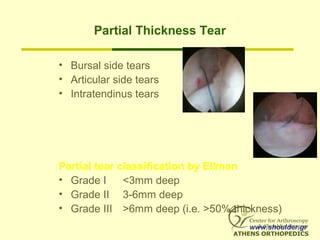
Partial Thickness Tear
• Bursal side tears
• Articular side tears
• Intratendinus tears
Partial tear classification by Ellman
• Grade I <3mm deep
• Grade II 3-6mm deep
• Grade III >6mm deep (i.e. >50% thickness)
www.shoulder.gr
How frequent are RC Tears?
• Rotator Cuff Frequency:
30% of population
• Significant correlation with
age [Sher JS, Arthroscopy 1995]
www.shoulder.gr
Natural History of a Tear
• Tears DO NOT HEAL. Some but NOT ALL of them will
progress
• Rot cuff arthropathy is the end stage (4-20%)
• 50% of newly symptomatic tears will progress in size
• 20% of asymptomatic tears will progress.
• No Tear seem to decrease in size.
• 80% of partial tears progress in size or become full
thickness at 2 years
[Yamaguchi K., 2006, Nice Shoulder Course]
www.shoulder.gr
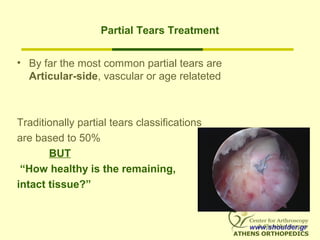
Partial Tears Treatment
• By far the most common partial tears are
Articular-side, vascular or age relateted
Traditionally partial tears classifications
are based to 50%
BUT
“How healthy is the remaining,
intact tissue?”
www.shoulder.gr
Partial Tears Treatment Options
1. Debride partial tear only
2. In-situ Repair
3. Convert to full thickness, Debride, Repair
Etiology makes the decision!!!
• Because most tears are degenerative, option 3
should be the best for most cases
• Trauma or young athletes are candidates for in-situ
repair
• If minimal partial tears cause significant pain then
debridement alone
[Yamaguch K, 2006 Nice Shoulder Course]
www.shoulder.gr
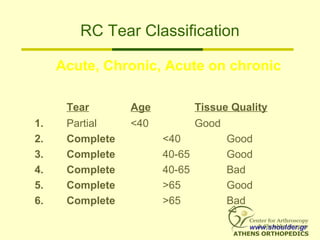
RC Tear Classification
Acute, Chronic, Acute on chronic
Tear Age Tissue Quality
1. Partial <40 Good
2. Complete <40 Good
3. Complete 40-65 Good
4. Complete 40-65 Bad
5. Complete >65 Good
6. Complete >65 Bad
www.shoulder.gr
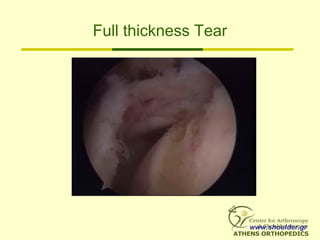
Full thickness Tear
www.shoulder.gr
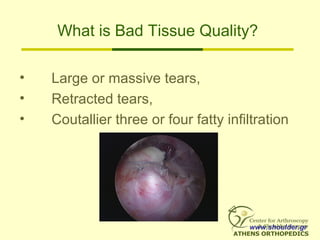
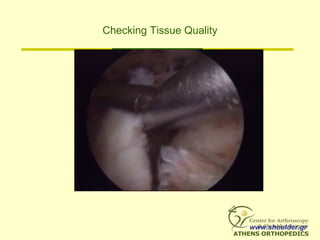
What is Bad Tissue Quality?
• Large or massive tears,
• Retracted tears,
• Coutallier three or four fatty infiltration
www.shoulder.gr
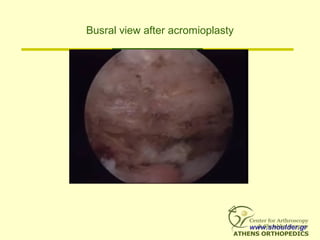
Busral view after acromioplasty
www.shoulder.gr
Checking Tissue Quality
www.shoulder.gr
Today’s Knowledge
• Rot cuff has some degree of reserve that affords
functional use of the arm in cases of limited tendon
deficiency.
• Location rather that size of a tear maybe more important
in the development of symptoms.
• Type of activities plays an important factor in the
development of symptoms
www.shoulder.gr
Goutallier fatty degeneration of muscles
• Stage 0 Normal muscle – no fatty streaming
• Stage 1 Occasional fatty streaming
• Stage 2 Fat<50% of cross sectioned area
Fat < Muscle
• Stage 3 Fat=50% of cross sectioned area
Fat = Muscle
• Stage 4 Fat>50% of cross sectioned area
Fat > Muscle
www.shoulder.gr
What to do???
• Patients with grade 3 or 4 fatty degeneration
DO NOT improve with rot cuff repair
[Goutallier]
Vs.
• Patients with grade 3 or 4 fatty degeneration
improved significant at 86% of cases after
arthroscopic repair
[Burkhart]
www.shoulder.gr
How to convert a Symptomatic tear to an
Asymptomatic re-tear
• Subacromial decompression and
debridmeut
• Biseps tenotomy
• Partial repair and healing of the rot cuff
• Adequate post-op rehabilitation
www.shoulder.gr
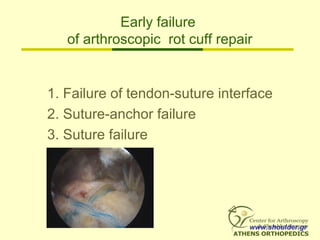
Early failure
of arthroscopic rot cuff repair
1. Failure of tendon-suture interface
2. Suture-anchor failure
3. Suture failure
www.shoulder.gr
RC Repair Results
• The rate of structural failure after open repair varies
from 20% to more 50%, while it is greater for
arthroscopic repairs
• First report of DOUBLE ROW repair:
Fealy S, Kingham TP, Altchek DW, Arthoscopy July 2002
Mini-open Rot cuff repair using a two row fixation technique
www.shoulder.gr
Conclusions
• Rot Cuf is extremely significant for the normal function of
the shoulder
• Rot Cuf tears can be asymptomatic
• Symptoms Produced by a tear depend on:
– Size
– Location
– Functional demands of the patient
www.shoulder.gr
Conclusions
• An anatomically deficient but biomechanical intact cuff is
possible
• Biomechanical intact cuff is the cuff that restores the
equilibrium of the force couples
• A cuff tear does not heal conservative
• A cuff tear after operative repair may yet not heal
• Partial healing may restore sufficient power to the cuff to
equilibrate the force couples
www.shoulder.gr
Conclusions
• Non-operative treatment strives to optimize the function
of the remaining cuff
• Rehabilitation after surgery strives to optimize the
function of the partially or completely healed cuff
www.shoulder.gr
..so when we treat a RC tear…
We must try to:
• Optimize the anatomic integrity of the cuff by a repair
with minimal morbidity to the healthy tissues (mainly
deltoid)
THEN
• Rehabilitate vigorously the patient, to optimize the total
function of the shoulder
THEN
We can expect a majority of
satisfied patients
www.shoulder.gr
Our Results
• 41 pts single row repair
• Small 3 (7.31%)
• Medium 26 (63.41%)
• Large 5 (12.18%)
• Massive 7 (17.7%)
• Mean age 58.8 years
• Mean FU 14 months
• UCLA score
Excellent 10 (24.39%)
Good 20 (48.78%)
Fair 9 (21.95%)
Poor 2 (4.87%)
92% Substantial Improvement
in Pain
[Acta Orthopedica Hellenica, 2007]
www.shoulder.gr
www.shoulder.gr
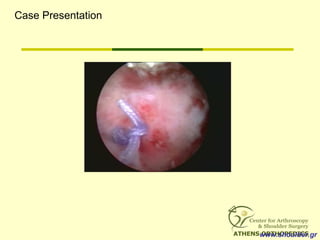
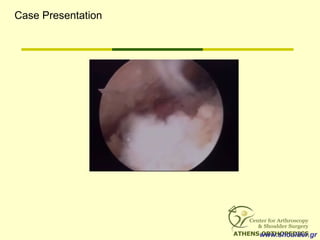
Case Presentation
www.shoulder.gr
Case Presentation
FIRST: Have Good Friends around !
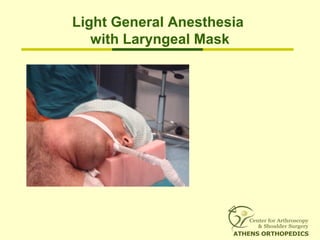
Light General Anesthesia
with Laryngeal Mask
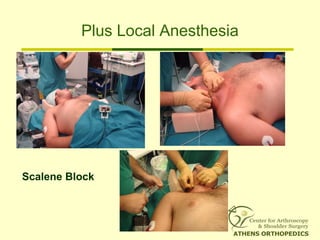
Plus Local Anesthesia
Scalene Block
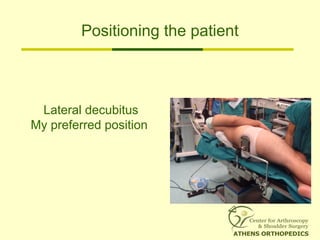
Positioning the patient
Lateral decubitus
My preferred position
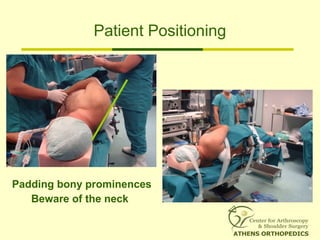
Patient Positioning
Padding bony prominences
Beware of the neck
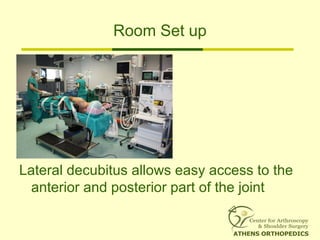
Room Set up
Lateral decubitus allows easy access to the
anterior and posterior part of the joint
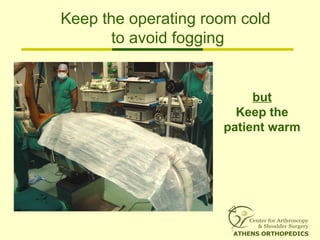
Keep the operating room cold
to avoid fogging
but
Keep the
patient warm
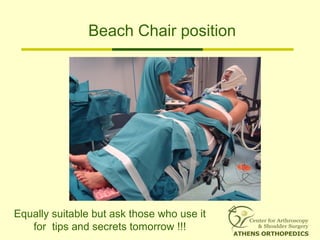
Beach Chair position
Equally suitable but ask those who use it
for tips and secrets tomorrow !!!
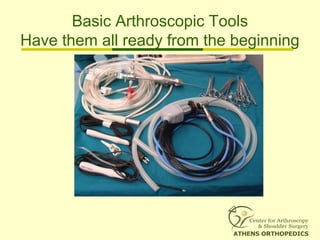
Basic Arthroscopic Tools
Have them all ready from the beginning
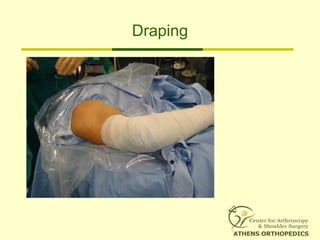
Draping
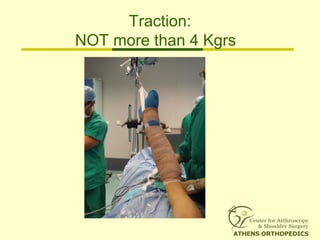
Traction:
NOT more than 4 Kgrs
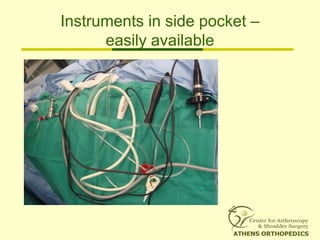
Instruments in side pocket –
easily available
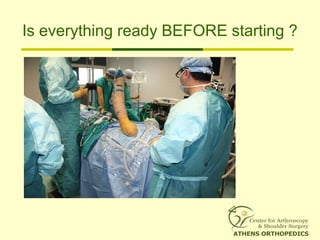
Is everything ready BEFORE starting ?
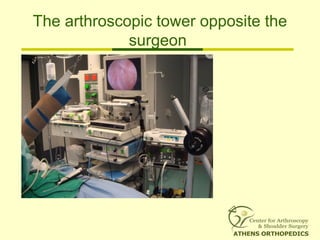
The arthroscopic tower opposite the
surgeon
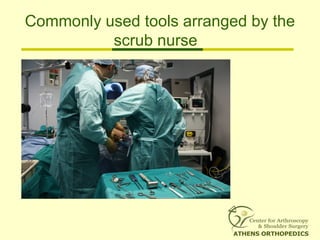
Commonly used tools arranged by the
scrub nurse
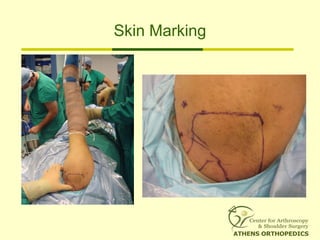
Skin Marking
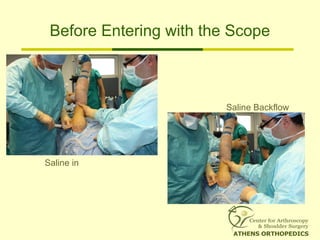
Before Entering with the Scope
Saline Backflow
Saline in
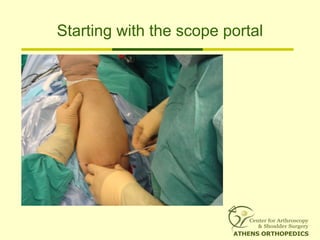
Starting with the scope portal
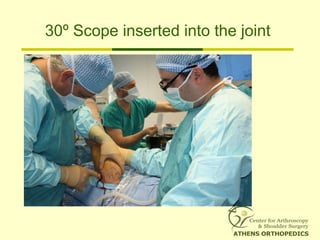
30º Scope inserted into the joint
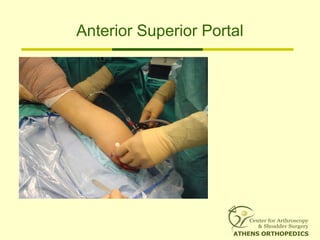
Anterior Superior Portal
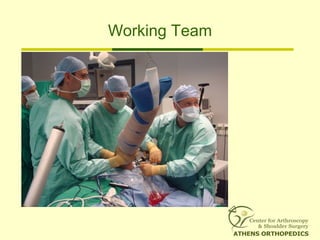
Working Team
Thank you
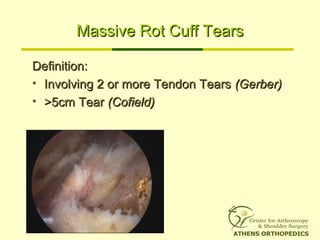
Massive Rot Cuff TearsMassive Rot Cuff Tears
Definition:Definition:
• Involving 2 or more Tendon TearsInvolving 2 or more Tendon Tears (Gerber)(Gerber)
• >5cm Tear>5cm Tear (Cofield)(Cofield)
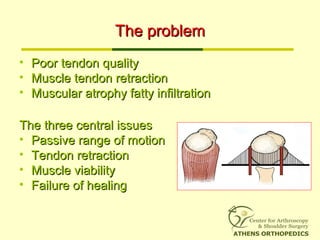
The problemThe problem
• Poor tendon qualityPoor tendon quality
• Muscle tendon retractionMuscle tendon retraction
• Muscular atrophy fatty infiltrationMuscular atrophy fatty infiltration
The three central issuesThe three central issues
• Passive range of motionPassive range of motion
• Tendon retractionTendon retraction
• Muscle viabilityMuscle viability
• Failure of healingFailure of healing
Techniques of releasesTechniques of releases
• The techniques adapted from openThe techniques adapted from open
surgery as described by Codmann,surgery as described by Codmann,
Rockwood, NeerRockwood, Neer
• Refined and modernized by Esch, Snyder,Refined and modernized by Esch, Snyder,
Gartsman, Burkhart and othersGartsman, Burkhart and others
ANY TYPE OF RECONSTRUCTIONANY TYPE OF RECONSTRUCTION
MUST AVOID TENSION OVER-LOADMUST AVOID TENSION OVER-LOAD
OF THE REPAIROF THE REPAIR
The solutionThe solution
• Improve the mechanical strength of theImprove the mechanical strength of the
repairrepair
• Enhance the biological responseEnhance the biological response
• Abandon and replace-muscle transferAbandon and replace-muscle transfer
• Rot cuff arthropathy-reverse or extendedRot cuff arthropathy-reverse or extended
head arthroplastyhead arthroplasty
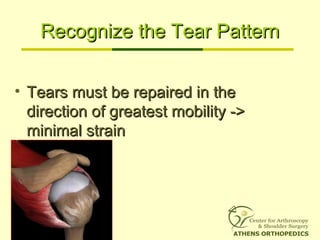
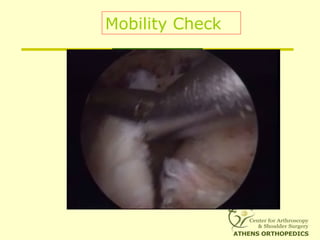
Recognize the Tear PatternRecognize the Tear Pattern
• Tears must be repaired in theTears must be repaired in the
direction of greatest mobility ->direction of greatest mobility ->
minimal strainminimal strain
Mobility Check
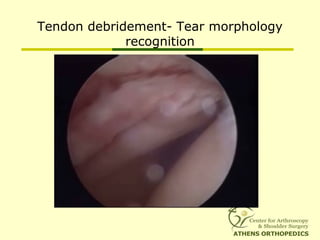
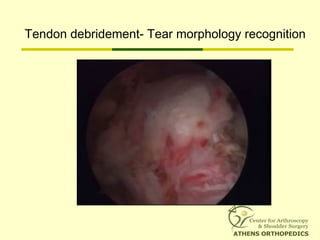
Tendon debridement- Tear morphology
recognition
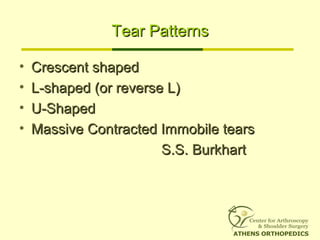
Tear PatternsTear Patterns
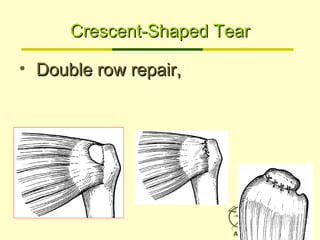
• Crescent shapedCrescent shaped
• L-shaped (or reverse L)L-shaped (or reverse L)
• U-ShapedU-Shaped
• Massive Contracted Immobile tearsMassive Contracted Immobile tears
S.S. BurkhartS.S. Burkhart
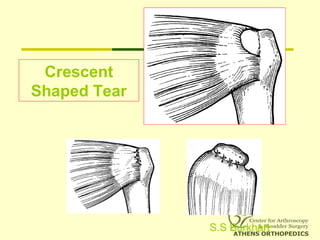
Crescent
Shaped Tear
S.S Burkhart
Crescent-Shaped TearCrescent-Shaped Tear
• Double row repair,Double row repair,
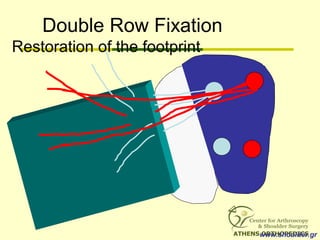
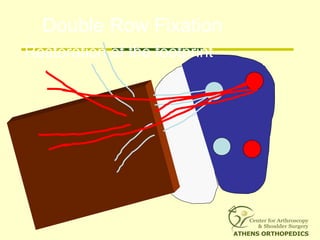
Double Row Fixation
Restoration of the footprint
www.shoulder.gr
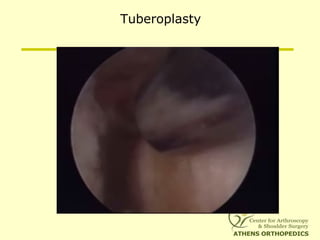
Tuberoplasty
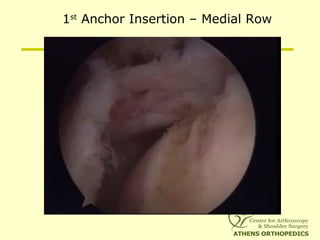
1st
Anchor Insertion – Medial Row
1st
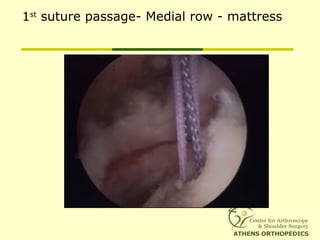
suture passage- Medial row - mattress
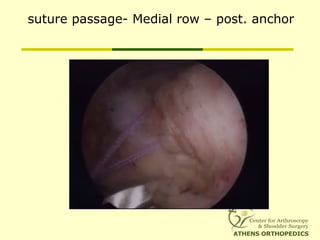
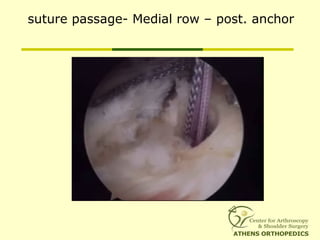
suture passage- Medial row – post. anchor
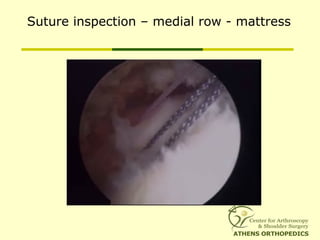
Suture inspection – medial row - mattress
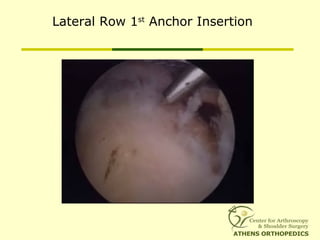
Lateral Row 1st
Anchor Insertion
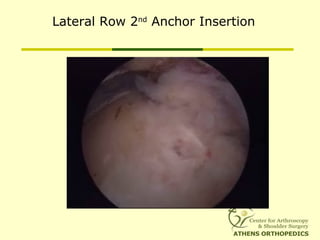
Lateral Row 2nd
Anchor Insertion
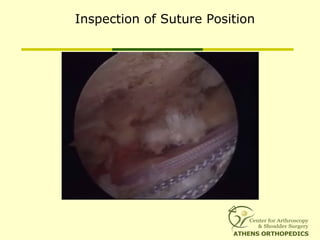
Inspection of Suture Position
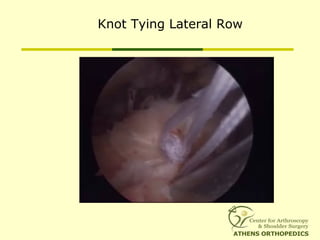
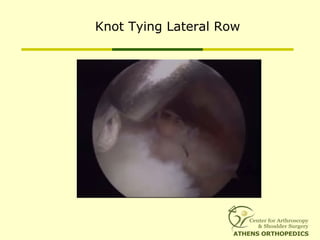
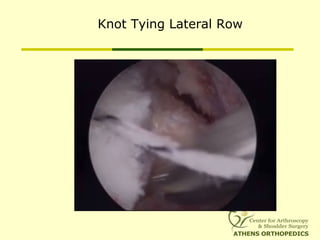
Knot Tying Lateral Row
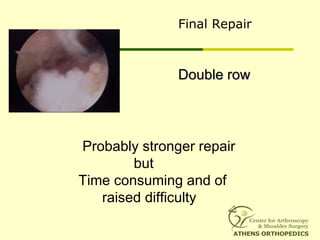
Final Repair
Double rowDouble row
Probably stronger repair
but
Time consuming and of
raised difficulty
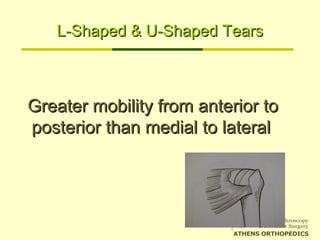
L-Shaped & U-Shaped TearsL-Shaped & U-Shaped Tears
Greater mobility from anterior toGreater mobility from anterior to
posterior than medial to lateralposterior than medial to lateral
L-Shaped & U-Shaped TearsL-Shaped & U-Shaped Tears
• Side to side sutures from medial to lateralSide to side sutures from medial to lateral
• Progressively converge the margin of theProgressively converge the margin of the
tear lateral to bone bedtear lateral to bone bed
• Closing 50% of a U-Shaped tear ->Closing 50% of a U-Shaped tear ->
reduces strain at converge margin by areduces strain at converge margin by a
factor of 6factor of 6
[[S. S .Burkhart]S. S .Burkhart]
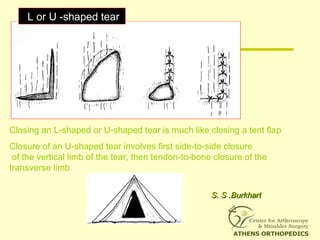
Closing an L-shaped or U-shaped tear is much like closing a tent flap
Closure of an U-shaped tear involves first side-to-side closure
of the vertical limb of the tear, then tendon-to-bone closure of the
transverse limb
L or U -shaped tear
S. S .BurkhartS. S .Burkhart
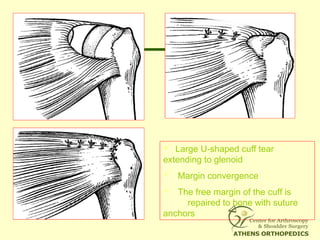
 Large U-shaped cuff tear
extending to glenoid
 Margin convergence
 The free margin of the cuff is
repaired to bone with suture
anchors
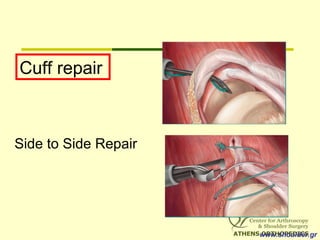
Side to Side Repair
Cuff repair
www.shoulder.gr
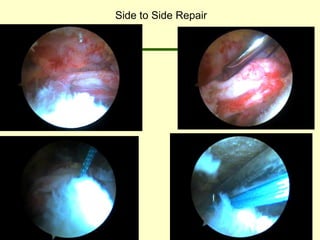
Side to Side Repair
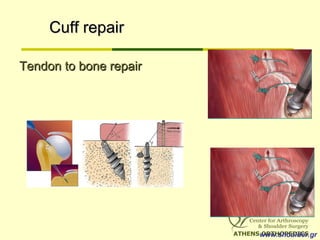
Cuff repairCuff repair
Tendon to bone repairTendon to bone repair
www.shoulder.gr
Massive Contracted Immobile TearsMassive Contracted Immobile Tears
• No mobility from medial to lateral or fromNo mobility from medial to lateral or from
anterior to posterioranterior to posterior
• Subcategories:Subcategories:
– Massive Contracted Longitudinal TearsMassive Contracted Longitudinal Tears
– Massive Contracted Crescent TearsMassive Contracted Crescent Tears
• Represent 9.6% of massive tearsRepresent 9.6% of massive tears
[[S.Burkhart]S.Burkhart]
Massive Contractite TearsMassive Contractite Tears
• Anterior Interval SlideAnterior Interval Slide
and/orand/or
• Posterior Interval SlidePosterior Interval Slide
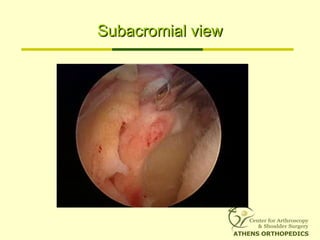
Single and double interval slideSingle and double interval slide
Subacromial viewSubacromial view
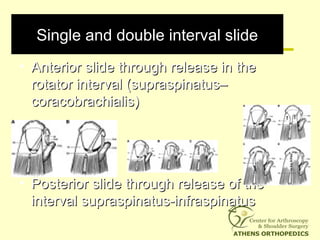
Single and double interval slideSingle and double interval slide
• Anterior slide through release in theAnterior slide through release in the
rotator interval (supraspinatus–rotator interval (supraspinatus–
coracobrachialis)coracobrachialis)
• Posterior slide through release of thePosterior slide through release of the
interval supraspinatus-infraspinatusinterval supraspinatus-infraspinatus
Free sutures to the cuffFree sutures to the cuff
Anterior slide-
supraspinatus
from coracoid –
coracohumeral
ligament
Posterior slide
Infraspinatus-supraspinatus
Posterior slide
Side to side sutures
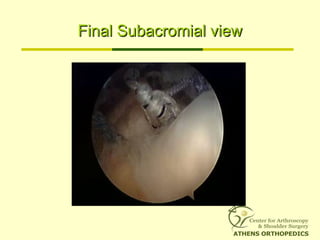
Final Subacromial viewFinal Subacromial view
Massive TearsMassive Tears
associated withassociated with
Subscapularis TearsSubscapularis Tears
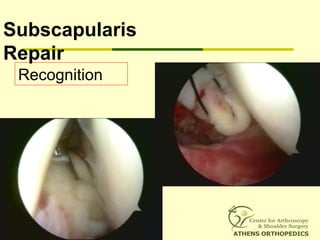
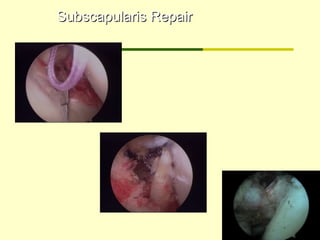
• Subscapularis must be mobilized andSubscapularis must be mobilized and
repaired prior to the rest of the cuffrepaired prior to the rest of the cuff
• Interval slide in continuityInterval slide in continuity
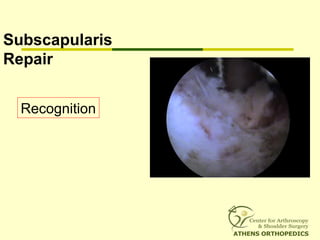
Subscapularis
Repair
Recognition
Subscapularis
Repair
Recognition
Subscapularis RepairSubscapularis Repair
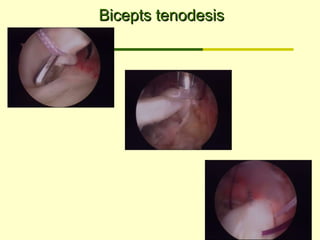
Bicepts tenodesisBicepts tenodesis
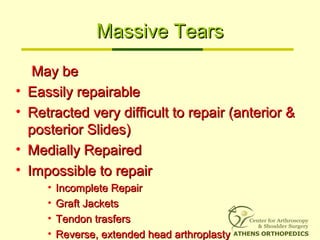
Massive TearsMassive Tears
May beMay be
• Eassily repairableEassily repairable
• Retracted very difficult to repair (anterior &Retracted very difficult to repair (anterior &
posterior Slides)posterior Slides)
• Medially RepairedMedially Repaired
• Impossible to repairImpossible to repair
• Incomplete RepairIncomplete Repair
• Graft JacketsGraft Jackets
• Tendon trasfersTendon trasfers
• Reverse, extended head arthroplastyReverse, extended head arthroplasty
Arthroscopic cuff repairArthroscopic cuff repair
Wolf, Snyder, Gartsman, Esch,
Burkhart, Tauro and others reported
84%-94% excellent and good results
Results for massive tearsResults for massive tears
• 95% Good to Excellent Results95% Good to Excellent Results
independent to tear sizeindependent to tear size [Burkhart, 2001][Burkhart, 2001]
• With interval slideWith interval slide
• Improve UCLA score (10->28.3)Improve UCLA score (10->28.3)
• Improve Active ROM, StrengthImprove Active ROM, Strength
[Burkhart, 2004][Burkhart, 2004]
• Graft Jacket RepairGraft Jacket Repair
• Improve UCLA score (18->32Improve UCLA score (18->32))
[Snyder, 2008][Snyder, 2008]
ConclusionsConclusions
• Acute Crescent TearAcute Crescent Tear
Standard Techniques for tendon to bone fisxationStandard Techniques for tendon to bone fisxation
• U- or L- shaped TearsU- or L- shaped Tears
• Side to side margin convergenceSide to side margin convergence
• Partial mobile tearsPartial mobile tears
• Anterior / Posterior SlideAnterior / Posterior Slide
• Medialized RepairMedialized Repair
• Irreparable TearsIrreparable Tears
• Partial RepairPartial Repair
• GraftsGrafts
• Tendon trasfersTendon trasfers
What to do???What to do???
• Patients with grade 3 or 4 fatty degenerationPatients with grade 3 or 4 fatty degeneration
DO NOTDO NOT improve with rot cuff repairimprove with rot cuff repair
[Goutallier][Goutallier]
Vs.Vs.
• Patients with grade 3 or 4 fatty degenerationPatients with grade 3 or 4 fatty degeneration
improved significant at 86% of cases afterimproved significant at 86% of cases after
arthroscopic repairarthroscopic repair
[Burkhart][Burkhart]
In our experienceIn our experience
Patients withPatients with massivemassive rot cuff tearsrot cuff tears
benefitbenefit from surgeryfrom surgery
but they tend to recover slowlybut they tend to recover slowly
they succeed very good pain reliefthey succeed very good pain relief
but strength deficits remainbut strength deficits remain
In our experienceIn our experience
• Patients with upward migration of thePatients with upward migration of the
femoral head in contact with the acromionfemoral head in contact with the acromion
do not benefit from arthroscopydo not benefit from arthroscopy
• Patients with painless external rotation lagPatients with painless external rotation lag
and inability to keep the arm in externaland inability to keep the arm in external
rotation do not benefit from arthoscopyrotation do not benefit from arthoscopy
• With raised experience more previousWith raised experience more previous
irreparable cuff tears can be repairedirreparable cuff tears can be repaired
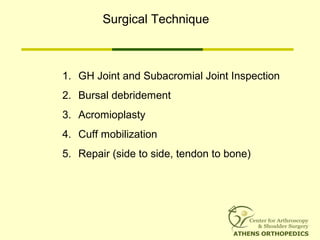
Surgical Technique
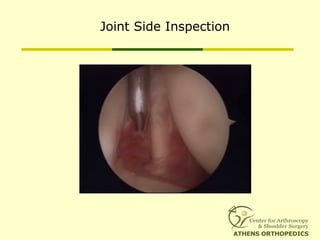
1. GH Joint and Subacromial Joint Inspection
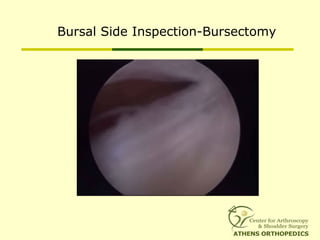
2. Bursal debridement
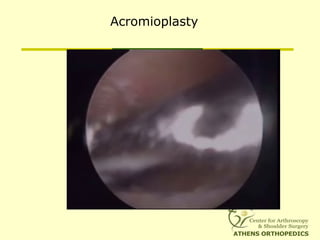
3. Acromioplasty
4. Cuff mobilization
5. Repair (side to side, tendon to bone)
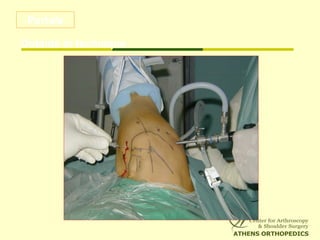
Portals
Outside in technique
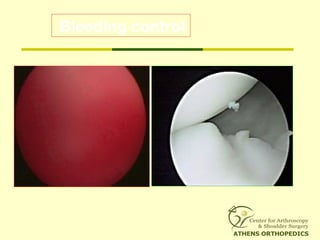
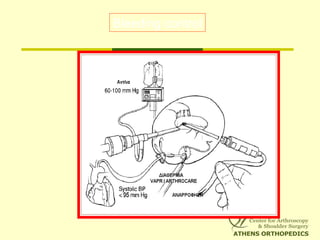
Bleeding control
Bleeding control
Joint Side Inspection
Bursal Side Inspection-Bursectomy
Tendon debridement- Tear morphology recognition
Acromioplasty
Double Row Fixation
Restoration of the footprint
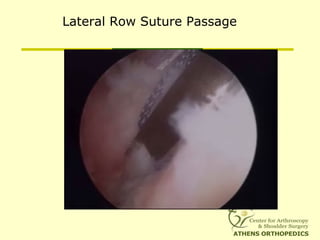
Lateral Row Suture Passage
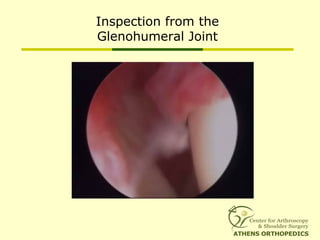
Inspection from the
Glenohumeral Joint
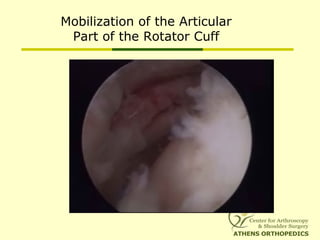
Mobilization of the Articular
Part of the Rotator Cuff
2nd
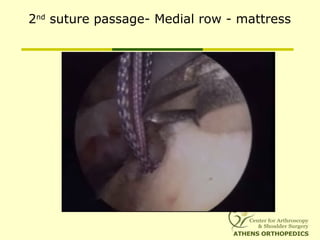
suture passage- Medial row - mattress
Knot Tying Lateral Row
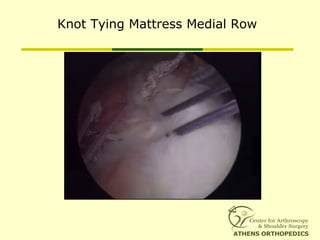
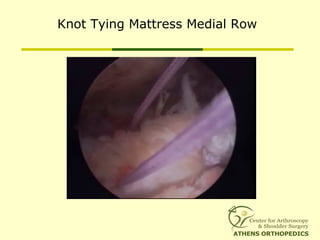
Knot Tying Mattress Medial Row
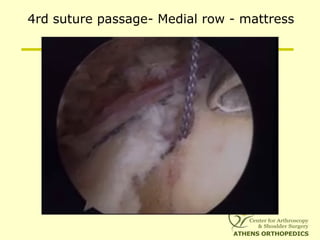
4rd suture passage- Medial row - mattress
suture passage- Medial row – post. anchor
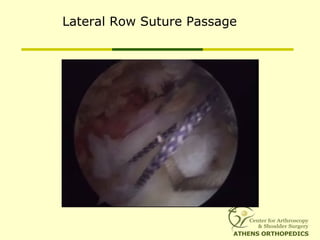
Lateral Row Suture Passage
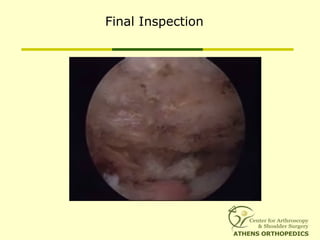
Final Inspection
Fixation techniques in rot cuff repair

Fixation techniques in rot cuff repair

  • 1.
    Fixation techniques in rotatorcuff repair Manos Antonogiannakis Director Center for shoulder arthroscopy IASO General Hospital Athens, Greece
  • 2.
    Rotator Cuff Function 1.Dynamic stabilizer of the shoulder 2. Contributes strength to the arm (50% of the abduction strength is generated by supraspinatus) 3. Couple forces stabilize and regulate the motion of the shoulder www.shoulder.gr
  • 3.
    Rotator Cuff disease Rotatorcuff disease is a wide spectrum of clinical conditions, which range from asymptomatic partial thickness tears to symptomatic rotator cuff arthropathy www.shoulder.gr
  • 4.
    Tears’ Definitions • PartialThickness Tears = absence of communication between the glenohumeral joint and the subacromial bursa. • Full Thickness Tears = communication between the glenohumeral joint and the subacromial bursa. • Massive Tear = Involving 2 or 3 tendons [Gerber] or bigger than 5cm [Cofield] www.shoulder.gr
  • 5.
    Partial Thickness Tear •Bursal side tears • Articular side tears • Intratendinus tears Partial tear classification by Ellman • Grade I <3mm deep • Grade II 3-6mm deep • Grade III >6mm deep (i.e. >50% thickness) www.shoulder.gr
  • 6.
    How frequent areRC Tears? • Rotator Cuff Frequency: 30% of population • Significant correlation with age [Sher JS, Arthroscopy 1995] www.shoulder.gr
  • 7.
    Natural History ofa Tear • Tears DO NOT HEAL. Some but NOT ALL of them will progress • Rot cuff arthropathy is the end stage (4-20%) • 50% of newly symptomatic tears will progress in size • 20% of asymptomatic tears will progress. • No Tear seem to decrease in size. • 80% of partial tears progress in size or become full thickness at 2 years [Yamaguchi K., 2006, Nice Shoulder Course] www.shoulder.gr
  • 8.
    Partial Tears Treatment •By far the most common partial tears are Articular-side, vascular or age relateted Traditionally partial tears classifications are based to 50% BUT “How healthy is the remaining, intact tissue?” www.shoulder.gr
  • 9.
    Partial Tears TreatmentOptions 1. Debride partial tear only 2. In-situ Repair 3. Convert to full thickness, Debride, Repair Etiology makes the decision!!! • Because most tears are degenerative, option 3 should be the best for most cases • Trauma or young athletes are candidates for in-situ repair • If minimal partial tears cause significant pain then debridement alone [Yamaguch K, 2006 Nice Shoulder Course] www.shoulder.gr
  • 10.
    RC Tear Classification Acute,Chronic, Acute on chronic Tear Age Tissue Quality 1. Partial <40 Good 2. Complete <40 Good 3. Complete 40-65 Good 4. Complete 40-65 Bad 5. Complete >65 Good 6. Complete >65 Bad www.shoulder.gr
  • 11.
  • 12.
    What is BadTissue Quality? • Large or massive tears, • Retracted tears, • Coutallier three or four fatty infiltration www.shoulder.gr
  • 13.
    Busral view afteracromioplasty www.shoulder.gr
  • 14.
  • 15.
    Today’s Knowledge • Rotcuff has some degree of reserve that affords functional use of the arm in cases of limited tendon deficiency. • Location rather that size of a tear maybe more important in the development of symptoms. • Type of activities plays an important factor in the development of symptoms www.shoulder.gr
  • 16.
    Goutallier fatty degenerationof muscles • Stage 0 Normal muscle – no fatty streaming • Stage 1 Occasional fatty streaming • Stage 2 Fat<50% of cross sectioned area Fat < Muscle • Stage 3 Fat=50% of cross sectioned area Fat = Muscle • Stage 4 Fat>50% of cross sectioned area Fat > Muscle www.shoulder.gr
  • 17.
    What to do??? •Patients with grade 3 or 4 fatty degeneration DO NOT improve with rot cuff repair [Goutallier] Vs. • Patients with grade 3 or 4 fatty degeneration improved significant at 86% of cases after arthroscopic repair [Burkhart] www.shoulder.gr
  • 18.
    How to converta Symptomatic tear to an Asymptomatic re-tear • Subacromial decompression and debridmeut • Biseps tenotomy • Partial repair and healing of the rot cuff • Adequate post-op rehabilitation www.shoulder.gr
  • 19.
    Early failure of arthroscopicrot cuff repair 1. Failure of tendon-suture interface 2. Suture-anchor failure 3. Suture failure www.shoulder.gr
  • 20.
    RC Repair Results •The rate of structural failure after open repair varies from 20% to more 50%, while it is greater for arthroscopic repairs • First report of DOUBLE ROW repair: Fealy S, Kingham TP, Altchek DW, Arthoscopy July 2002 Mini-open Rot cuff repair using a two row fixation technique www.shoulder.gr
  • 21.
    Conclusions • Rot Cufis extremely significant for the normal function of the shoulder • Rot Cuf tears can be asymptomatic • Symptoms Produced by a tear depend on: – Size – Location – Functional demands of the patient www.shoulder.gr
  • 22.
    Conclusions • An anatomicallydeficient but biomechanical intact cuff is possible • Biomechanical intact cuff is the cuff that restores the equilibrium of the force couples • A cuff tear does not heal conservative • A cuff tear after operative repair may yet not heal • Partial healing may restore sufficient power to the cuff to equilibrate the force couples www.shoulder.gr
  • 23.
    Conclusions • Non-operative treatmentstrives to optimize the function of the remaining cuff • Rehabilitation after surgery strives to optimize the function of the partially or completely healed cuff www.shoulder.gr
  • 24.
    ..so when wetreat a RC tear… We must try to: • Optimize the anatomic integrity of the cuff by a repair with minimal morbidity to the healthy tissues (mainly deltoid) THEN • Rehabilitate vigorously the patient, to optimize the total function of the shoulder THEN We can expect a majority of satisfied patients www.shoulder.gr
  • 25.
    Our Results • 41pts single row repair • Small 3 (7.31%) • Medium 26 (63.41%) • Large 5 (12.18%) • Massive 7 (17.7%) • Mean age 58.8 years • Mean FU 14 months • UCLA score Excellent 10 (24.39%) Good 20 (48.78%) Fair 9 (21.95%) Poor 2 (4.87%) 92% Substantial Improvement in Pain [Acta Orthopedica Hellenica, 2007] www.shoulder.gr
  • 26.
  • 27.
  • 28.
    FIRST: Have GoodFriends around !
  • 29.
  • 30.
  • 31.
    Positioning the patient Lateraldecubitus My preferred position
  • 32.
    Patient Positioning Padding bonyprominences Beware of the neck
  • 33.
    Room Set up Lateraldecubitus allows easy access to the anterior and posterior part of the joint
  • 34.
    Keep the operatingroom cold to avoid fogging but Keep the patient warm
  • 35.
    Beach Chair position Equallysuitable but ask those who use it for tips and secrets tomorrow !!!
  • 36.
    Basic Arthroscopic Tools Havethem all ready from the beginning
  • 37.
  • 38.
  • 39.
    Instruments in sidepocket – easily available
  • 40.
    Is everything readyBEFORE starting ?
  • 41.
    The arthroscopic toweropposite the surgeon
  • 42.
    Commonly used toolsarranged by the scrub nurse
  • 43.
  • 44.
    Before Entering withthe Scope Saline Backflow Saline in
  • 45.
    Starting with thescope portal
  • 46.
    30º Scope insertedinto the joint
  • 47.
  • 48.
  • 49.
  • 50.
    Massive Rot CuffTearsMassive Rot Cuff Tears Definition:Definition: • Involving 2 or more Tendon TearsInvolving 2 or more Tendon Tears (Gerber)(Gerber) • >5cm Tear>5cm Tear (Cofield)(Cofield)
  • 51.
    The problemThe problem •Poor tendon qualityPoor tendon quality • Muscle tendon retractionMuscle tendon retraction • Muscular atrophy fatty infiltrationMuscular atrophy fatty infiltration The three central issuesThe three central issues • Passive range of motionPassive range of motion • Tendon retractionTendon retraction • Muscle viabilityMuscle viability • Failure of healingFailure of healing
  • 52.
    Techniques of releasesTechniquesof releases • The techniques adapted from openThe techniques adapted from open surgery as described by Codmann,surgery as described by Codmann, Rockwood, NeerRockwood, Neer • Refined and modernized by Esch, Snyder,Refined and modernized by Esch, Snyder, Gartsman, Burkhart and othersGartsman, Burkhart and others
  • 53.
    ANY TYPE OFRECONSTRUCTIONANY TYPE OF RECONSTRUCTION MUST AVOID TENSION OVER-LOADMUST AVOID TENSION OVER-LOAD OF THE REPAIROF THE REPAIR
  • 54.
    The solutionThe solution •Improve the mechanical strength of theImprove the mechanical strength of the repairrepair • Enhance the biological responseEnhance the biological response • Abandon and replace-muscle transferAbandon and replace-muscle transfer • Rot cuff arthropathy-reverse or extendedRot cuff arthropathy-reverse or extended head arthroplastyhead arthroplasty
  • 55.
    Recognize the TearPatternRecognize the Tear Pattern • Tears must be repaired in theTears must be repaired in the direction of greatest mobility ->direction of greatest mobility -> minimal strainminimal strain
  • 56.
  • 57.
    Tendon debridement- Tearmorphology recognition
  • 58.
    Tear PatternsTear Patterns •Crescent shapedCrescent shaped • L-shaped (or reverse L)L-shaped (or reverse L) • U-ShapedU-Shaped • Massive Contracted Immobile tearsMassive Contracted Immobile tears S.S. BurkhartS.S. Burkhart
  • 59.
  • 60.
    Crescent-Shaped TearCrescent-Shaped Tear •Double row repair,Double row repair,
  • 61.
    Double Row Fixation Restorationof the footprint www.shoulder.gr
  • 62.
  • 63.
  • 64.
  • 65.
    suture passage- Medialrow – post. anchor
  • 66.
    Suture inspection –medial row - mattress
  • 67.
  • 68.
  • 69.
  • 70.
  • 71.
    Final Repair Double rowDoublerow Probably stronger repair but Time consuming and of raised difficulty
  • 72.
    L-Shaped & U-ShapedTearsL-Shaped & U-Shaped Tears Greater mobility from anterior toGreater mobility from anterior to posterior than medial to lateralposterior than medial to lateral
  • 73.
    L-Shaped & U-ShapedTearsL-Shaped & U-Shaped Tears • Side to side sutures from medial to lateralSide to side sutures from medial to lateral • Progressively converge the margin of theProgressively converge the margin of the tear lateral to bone bedtear lateral to bone bed • Closing 50% of a U-Shaped tear ->Closing 50% of a U-Shaped tear -> reduces strain at converge margin by areduces strain at converge margin by a factor of 6factor of 6 [[S. S .Burkhart]S. S .Burkhart]
  • 74.
    Closing an L-shapedor U-shaped tear is much like closing a tent flap Closure of an U-shaped tear involves first side-to-side closure of the vertical limb of the tear, then tendon-to-bone closure of the transverse limb L or U -shaped tear S. S .BurkhartS. S .Burkhart
  • 75.
     Large U-shapedcuff tear extending to glenoid  Margin convergence  The free margin of the cuff is repaired to bone with suture anchors
  • 76.
    Side to SideRepair Cuff repair www.shoulder.gr
  • 77.
  • 78.
    Cuff repairCuff repair Tendonto bone repairTendon to bone repair www.shoulder.gr
  • 79.
    Massive Contracted ImmobileTearsMassive Contracted Immobile Tears • No mobility from medial to lateral or fromNo mobility from medial to lateral or from anterior to posterioranterior to posterior • Subcategories:Subcategories: – Massive Contracted Longitudinal TearsMassive Contracted Longitudinal Tears – Massive Contracted Crescent TearsMassive Contracted Crescent Tears • Represent 9.6% of massive tearsRepresent 9.6% of massive tears [[S.Burkhart]S.Burkhart]
  • 80.
    Massive Contractite TearsMassiveContractite Tears • Anterior Interval SlideAnterior Interval Slide and/orand/or • Posterior Interval SlidePosterior Interval Slide Single and double interval slideSingle and double interval slide
  • 81.
  • 82.
    Single and doubleinterval slideSingle and double interval slide • Anterior slide through release in theAnterior slide through release in the rotator interval (supraspinatus–rotator interval (supraspinatus– coracobrachialis)coracobrachialis) • Posterior slide through release of thePosterior slide through release of the interval supraspinatus-infraspinatusinterval supraspinatus-infraspinatus
  • 83.
    Free sutures tothe cuffFree sutures to the cuff
  • 84.
  • 85.
  • 86.
  • 87.
    Side to sidesutures
  • 88.
  • 89.
    Massive TearsMassive Tears associatedwithassociated with Subscapularis TearsSubscapularis Tears • Subscapularis must be mobilized andSubscapularis must be mobilized and repaired prior to the rest of the cuffrepaired prior to the rest of the cuff • Interval slide in continuityInterval slide in continuity
  • 90.
  • 91.
  • 92.
  • 93.
  • 94.
    Massive TearsMassive Tears MaybeMay be • Eassily repairableEassily repairable • Retracted very difficult to repair (anterior &Retracted very difficult to repair (anterior & posterior Slides)posterior Slides) • Medially RepairedMedially Repaired • Impossible to repairImpossible to repair • Incomplete RepairIncomplete Repair • Graft JacketsGraft Jackets • Tendon trasfersTendon trasfers • Reverse, extended head arthroplastyReverse, extended head arthroplasty
  • 95.
    Arthroscopic cuff repairArthroscopiccuff repair Wolf, Snyder, Gartsman, Esch, Burkhart, Tauro and others reported 84%-94% excellent and good results
  • 96.
    Results for massivetearsResults for massive tears • 95% Good to Excellent Results95% Good to Excellent Results independent to tear sizeindependent to tear size [Burkhart, 2001][Burkhart, 2001] • With interval slideWith interval slide • Improve UCLA score (10->28.3)Improve UCLA score (10->28.3) • Improve Active ROM, StrengthImprove Active ROM, Strength [Burkhart, 2004][Burkhart, 2004] • Graft Jacket RepairGraft Jacket Repair • Improve UCLA score (18->32Improve UCLA score (18->32)) [Snyder, 2008][Snyder, 2008]
  • 97.
    ConclusionsConclusions • Acute CrescentTearAcute Crescent Tear Standard Techniques for tendon to bone fisxationStandard Techniques for tendon to bone fisxation • U- or L- shaped TearsU- or L- shaped Tears • Side to side margin convergenceSide to side margin convergence • Partial mobile tearsPartial mobile tears • Anterior / Posterior SlideAnterior / Posterior Slide • Medialized RepairMedialized Repair • Irreparable TearsIrreparable Tears • Partial RepairPartial Repair • GraftsGrafts • Tendon trasfersTendon trasfers
  • 98.
    What to do???Whatto do??? • Patients with grade 3 or 4 fatty degenerationPatients with grade 3 or 4 fatty degeneration DO NOTDO NOT improve with rot cuff repairimprove with rot cuff repair [Goutallier][Goutallier] Vs.Vs. • Patients with grade 3 or 4 fatty degenerationPatients with grade 3 or 4 fatty degeneration improved significant at 86% of cases afterimproved significant at 86% of cases after arthroscopic repairarthroscopic repair [Burkhart][Burkhart]
  • 99.
    In our experienceInour experience Patients withPatients with massivemassive rot cuff tearsrot cuff tears benefitbenefit from surgeryfrom surgery but they tend to recover slowlybut they tend to recover slowly they succeed very good pain reliefthey succeed very good pain relief but strength deficits remainbut strength deficits remain
  • 100.
    In our experienceInour experience • Patients with upward migration of thePatients with upward migration of the femoral head in contact with the acromionfemoral head in contact with the acromion do not benefit from arthroscopydo not benefit from arthroscopy • Patients with painless external rotation lagPatients with painless external rotation lag and inability to keep the arm in externaland inability to keep the arm in external rotation do not benefit from arthoscopyrotation do not benefit from arthoscopy • With raised experience more previousWith raised experience more previous irreparable cuff tears can be repairedirreparable cuff tears can be repaired
  • 102.
    Surgical Technique 1. GHJoint and Subacromial Joint Inspection 2. Bursal debridement 3. Acromioplasty 4. Cuff mobilization 5. Repair (side to side, tendon to bone)
  • 103.
  • 104.
  • 105.
  • 106.
  • 107.
  • 108.
    Tendon debridement- Tearmorphology recognition
  • 109.
  • 110.
  • 111.
  • 112.
  • 113.
    Mobilization of theArticular Part of the Rotator Cuff
  • 114.
  • 115.
  • 116.
  • 117.
  • 118.
  • 119.
    4rd suture passage-Medial row - mattress
  • 120.
    suture passage- Medialrow – post. anchor
  • 121.
  • 122.