The treatment of first
shoulder dislocation
Manos Antonogiannakis
Director
center for shoulder arthroscopy
IASO gen hospital
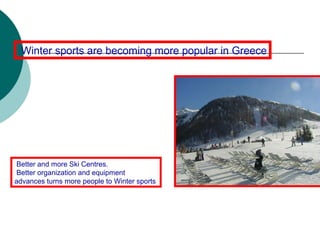
Winter sports are becoming more popular in Greece
Better and more Ski Centres.
Better organization and equipment
advances turns more people to Winter sports
Athletes of every age and level
Athletes of all ages
Ski injuries 3 per 1000 Skier per day
Hunter RE
Am J Sport Med 1999
Ski injuries 4.33 per 1000 skier per day
Shoulder Injuries 0.51 per 1000 skier per day
Kocher MS Feagin JA
Am J Sport Med 1996
The Shoulder
 Greatest Range of Motion in the Body
 Motion in all 3 planes of movement
 Prone to injuries
 8-20% of all sports injuries
Shoulder dislocation
2% of the population
90% anterior dislocation
First shoulder dislocation is a dramatic event
with dare consequences especially in athletic
individuals
17% to 96% (mean 67%)
Redislocation after acute traumatic
anterior dislocation of the shoulder
• Multicenter study
• 245 patients aged 12-40 years
• 10 years follow up
• 52% recurrence rate
• 23% were operated
Prognosis of recurrence after
traumatic first time dislocation
Primary anterior dislocation of the shoulder in
young patients. A 10 year prospective study -
Hovelius 1996 JBJS(A)
The major prognostic factor of
recurrence after acute traumatic
anterior shoulder dislocation is the
age of the patient and the degree of
participation to athletic endeavors
Redislocation rate in patients < 20 years
Larrain
Rowe
Simonet and Cofield
Slaa
•90%
• 94%
• 94.5%
• 90%
Ηovelius, 1996
Athletes hockey on ice
Recurrence rate:
90% in athletes < 20 years old
65% in athletes 20-25 years old
Age and athletic participation
The West Point experience
 
 127 patients
 55 conservative treatment
 Recurrence rate 85%
De Barandino et al. 1996
Is shoulder arthroscopy the
best treatment of the first
shoulder dislocation?
Arthroscopy in the treatment of
first dislocation
What does it offer?
To what kind of patients?
Better understanding of the pathology
Reduction of recurrence rate
Treatment of rotator cuff lesions in older individuals
What does shoulder arthroscopy offers
The patient
Young professional athlete
General population
First dislocation in: Athletically oriented
individual
Loose joint individual
• Bankart lesion
• Tears of the anterior capsule
• Plastic deformation of the posterior capsule
• Hill-Sachs lesion, Bony Bankart
• rotator cuff tears
• SLAP lesions
Lesions after first
shoulder dislocation
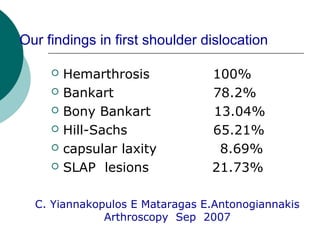
Our findings in first shoulder dislocation
 Hemarthrosis 100%
 Bankart 78.2%
 Bony Bankart 13.04%
 Hill-Sachs 65.21%
 capsular laxity 8.69%
 SLAP lesions 21.73%
C. Yiannakopulos E Mataragas E.Antonogiannakis
Arthroscopy Sep 2007
Arthroscopic Shoulder
Reconstruction
Goal of the Operation: Define the pathology
Restoration of the Labrum to its anatomic attachment
Reestablishment of the appropriate tension
in the IGHL complex and capsule
Repair bony Bankart and large Hill-Sachs lesions
Repair SLAP lesions
Repair rot cuff tears
 EUA
 Arthroscopy
 Suture anchor technique
Treatment of all the lesions
Surgical technique
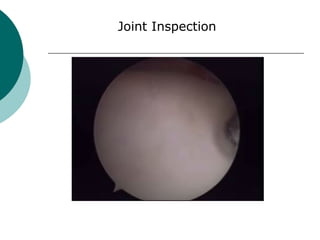
Joint Inspection
Arthroscope in Anterior-Superior Portal
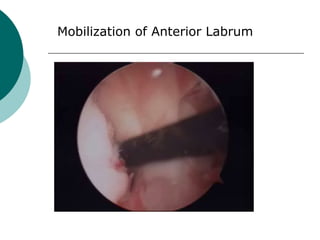
Mobilization of Anterior Labrum
1st
Anchor Placement
suture passage
Knot Tying
Evaluation of Repair
Plication of the posterior capsule
SLAP repair
Arthroscopic success rate
 Savoie 1997 93%
 Burchart, De Bear 2000 96%
 J Tauro 2000 93%
 Kim 2003 96%
 Snyder 2006 93%
 Fabbriciani 2004 100%
Wheeler et al 1989 NO 92% O 22%
Arciero et al 1994 NO 80% O 14%
Arciero et 1995 O 10%
The West Point experience
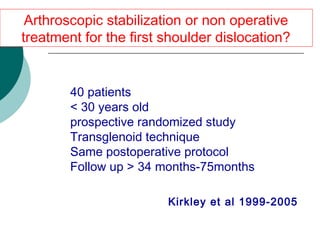
 40 patients
 < 30 years old
 prospective randomized study
 Transglenoid technique
 Same postoperative protocol
 Follow up > 34 months-75months
Arthroscopic stabilization or non operative
treatment for the first shoulder dislocation?
Κirkley et al 1999-2005
Sandy Κirkley 1999
Recurrence rate:
Arthroscopic treatment 16%
Conservative treatment 47%
Quality of life (WOSI)
Better in the arthroscopy group
Range of motion
The same with both methods
Larrain et al. Arthroscopic repair of acute traumatic anterior shoulder
dislocation in young athletes. Arthroscopy,April 2001
First shoulder dislocation
Young athletes
Transglenoid technique
Follow Up 60 months
Arthroscopic treatment 96 %
excellent results
Conservative treatment 5.5
% excellent results
Treatment success
Avoid recurrence
Range of motion
Minor morbidity
Few complication
Return to preinjury activity level
Reproducible results
These are possible with arthroscopic treatment
of the first shoulder dislocation in selected
patients
First traumatic shoulder dislocation in patients older than 40
years
Rotator cuff tears 63%
Ribbans et al
JBJS 1990
Different lesions
Different problems to be solved
Findings after 1st
shoulder dislocation
in skiers older than 40 years
 52 pts follow up more than 2 years
 Redislocation rate 4%
 Rotator cuff tears 35%
T Penvy, R Hunter, J Freeman
Arthroscopy 1998
Conclusions
 The conservative treatment produces a unacceptable
high recurrence rate in young athletic individuals
Arthroscopic treatment has a high success
 Arthroscopy can be performed in an
outpatient setting
 The anatomy can be restored with
minimum morbidity and pain for the
patient
 Careful assessment will allow repair
of all lesions after the first
dislocation
Conclusions
In older patients rotator cuff tears are
common
The arthroscopic treatment of
symptomatic rotator cuff tears is fissible
with minimum morbidity
ConclusionsConclusions
Indications for arthroscopic stabilization of
first shoulder dislocation
• young patients
• professional athletes
• athletically inclined individuals
• dominant shoulder
• avoidance of motion loss
• return to the same activity level
• overhead activity and activity in AB-ER
• rotator cuff tears in older patients
Modern arthroscopic techniques
are probably the treatment of choice
in these patients
Conclusions
πρωτο εξάρθρημα

πρωτο εξάρθρημα

  • 1.
    The treatment offirst shoulder dislocation Manos Antonogiannakis Director center for shoulder arthroscopy IASO gen hospital
  • 2.
    Winter sports arebecoming more popular in Greece Better and more Ski Centres. Better organization and equipment advances turns more people to Winter sports
  • 3.
    Athletes of everyage and level
  • 4.
  • 5.
    Ski injuries 3per 1000 Skier per day Hunter RE Am J Sport Med 1999 Ski injuries 4.33 per 1000 skier per day Shoulder Injuries 0.51 per 1000 skier per day Kocher MS Feagin JA Am J Sport Med 1996
  • 6.
    The Shoulder  GreatestRange of Motion in the Body  Motion in all 3 planes of movement  Prone to injuries  8-20% of all sports injuries
  • 7.
    Shoulder dislocation 2% ofthe population 90% anterior dislocation
  • 8.
    First shoulder dislocationis a dramatic event with dare consequences especially in athletic individuals
  • 9.
    17% to 96%(mean 67%) Redislocation after acute traumatic anterior dislocation of the shoulder
  • 10.
    • Multicenter study •245 patients aged 12-40 years • 10 years follow up • 52% recurrence rate • 23% were operated Prognosis of recurrence after traumatic first time dislocation Primary anterior dislocation of the shoulder in young patients. A 10 year prospective study - Hovelius 1996 JBJS(A)
  • 11.
    The major prognosticfactor of recurrence after acute traumatic anterior shoulder dislocation is the age of the patient and the degree of participation to athletic endeavors
  • 12.
    Redislocation rate inpatients < 20 years Larrain Rowe Simonet and Cofield Slaa •90% • 94% • 94.5% • 90%
  • 13.
    Ηovelius, 1996 Athletes hockeyon ice Recurrence rate: 90% in athletes < 20 years old 65% in athletes 20-25 years old Age and athletic participation
  • 14.
    The West Pointexperience    127 patients  55 conservative treatment  Recurrence rate 85% De Barandino et al. 1996
  • 15.
    Is shoulder arthroscopythe best treatment of the first shoulder dislocation?
  • 16.
    Arthroscopy in thetreatment of first dislocation What does it offer? To what kind of patients?
  • 17.
    Better understanding ofthe pathology Reduction of recurrence rate Treatment of rotator cuff lesions in older individuals What does shoulder arthroscopy offers
  • 18.
    The patient Young professionalathlete General population First dislocation in: Athletically oriented individual Loose joint individual
  • 19.
    • Bankart lesion •Tears of the anterior capsule • Plastic deformation of the posterior capsule • Hill-Sachs lesion, Bony Bankart • rotator cuff tears • SLAP lesions Lesions after first shoulder dislocation
  • 20.
    Our findings infirst shoulder dislocation  Hemarthrosis 100%  Bankart 78.2%  Bony Bankart 13.04%  Hill-Sachs 65.21%  capsular laxity 8.69%  SLAP lesions 21.73% C. Yiannakopulos E Mataragas E.Antonogiannakis Arthroscopy Sep 2007
  • 22.
    Arthroscopic Shoulder Reconstruction Goal ofthe Operation: Define the pathology Restoration of the Labrum to its anatomic attachment Reestablishment of the appropriate tension in the IGHL complex and capsule Repair bony Bankart and large Hill-Sachs lesions Repair SLAP lesions Repair rot cuff tears
  • 23.
     EUA  Arthroscopy Suture anchor technique Treatment of all the lesions Surgical technique
  • 24.
  • 25.
  • 26.
  • 27.
  • 28.
  • 29.
  • 30.
  • 31.
    Plication of theposterior capsule
  • 32.
  • 33.
    Arthroscopic success rate Savoie 1997 93%  Burchart, De Bear 2000 96%  J Tauro 2000 93%  Kim 2003 96%  Snyder 2006 93%  Fabbriciani 2004 100%
  • 34.
    Wheeler et al1989 NO 92% O 22% Arciero et al 1994 NO 80% O 14% Arciero et 1995 O 10% The West Point experience
  • 35.
     40 patients < 30 years old  prospective randomized study  Transglenoid technique  Same postoperative protocol  Follow up > 34 months-75months Arthroscopic stabilization or non operative treatment for the first shoulder dislocation? Κirkley et al 1999-2005
  • 36.
    Sandy Κirkley 1999 Recurrencerate: Arthroscopic treatment 16% Conservative treatment 47% Quality of life (WOSI) Better in the arthroscopy group Range of motion The same with both methods
  • 37.
    Larrain et al.Arthroscopic repair of acute traumatic anterior shoulder dislocation in young athletes. Arthroscopy,April 2001 First shoulder dislocation Young athletes Transglenoid technique Follow Up 60 months Arthroscopic treatment 96 % excellent results Conservative treatment 5.5 % excellent results
  • 38.
    Treatment success Avoid recurrence Rangeof motion Minor morbidity Few complication Return to preinjury activity level Reproducible results These are possible with arthroscopic treatment of the first shoulder dislocation in selected patients
  • 39.
    First traumatic shoulderdislocation in patients older than 40 years Rotator cuff tears 63% Ribbans et al JBJS 1990 Different lesions Different problems to be solved
  • 40.
    Findings after 1st shoulderdislocation in skiers older than 40 years  52 pts follow up more than 2 years  Redislocation rate 4%  Rotator cuff tears 35% T Penvy, R Hunter, J Freeman Arthroscopy 1998
  • 41.
    Conclusions  The conservativetreatment produces a unacceptable high recurrence rate in young athletic individuals Arthroscopic treatment has a high success
  • 42.
     Arthroscopy canbe performed in an outpatient setting  The anatomy can be restored with minimum morbidity and pain for the patient  Careful assessment will allow repair of all lesions after the first dislocation Conclusions
  • 43.
    In older patientsrotator cuff tears are common The arthroscopic treatment of symptomatic rotator cuff tears is fissible with minimum morbidity ConclusionsConclusions
  • 44.
    Indications for arthroscopicstabilization of first shoulder dislocation • young patients • professional athletes • athletically inclined individuals • dominant shoulder • avoidance of motion loss • return to the same activity level • overhead activity and activity in AB-ER • rotator cuff tears in older patients
  • 45.
    Modern arthroscopic techniques areprobably the treatment of choice in these patients Conclusions