Open Reduction of Chronic Shoulder Dislocation
by circumferential capsular release and posterior
cuff mobilization, its technique and early results
Duane Anderson, MD
Lucas Anderson, MD
Stephen Aoki, MD
Segni Bekele, MD
Abebe Chala PT
Soddo Christian Hospital
Soddo Wolaitta Ethiopia
University of Utah Department of Orthopaedics
Open reduction of chronic shoulder dislocations
through an extensile approach,
circumferential capsular release and
mobilization of the rotator cuff muscles
Technique and Early Results
Duane Anderson, MD (1)
Lucas Anderson, MD (2)
Stephen Aoki, MD (2)
Segni Bekele, MD (1)
Abebe Chala, PT (1)
Edit Jan 2024
(1) Soddo Christian Hospital
Soddo Wolaitta Ethiopia
(2) University of Utah Department of
Orthopaedics, Salt Lake City, Utah USA
The problem
• Chronic shoulder dislocation not uncommon
in the third world
• Old literature advocates complete rotator cuff
release.
• As time progresses with chronic dislocation
– larger Hill-Sachs
– more contracted capsule and rotator cuff
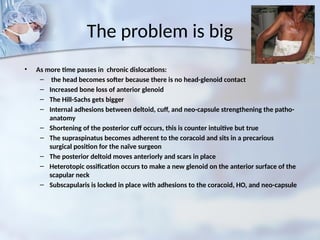
The problem is big
• As more time passes in chronic dislocations:
– the head becomes softer because there is no head-glenoid contact
– Increased bone loss of anterior glenoid
– The Hill-Sachs gets bigger
– Internal adhesions between deltoid, cuff, and neo-capsule strengthening the patho-
anatomy
– Shortening of the posterior cuff occurs, this is counter intuitive but true
– The supraspinatus becomes adherent to the coracoid and sits in a precarious
surgical position for the naïve surgeon
– The posterior deltoid moves anteriorly and scars in place
– Heterotopic ossification occurs to make a new glenoid on the anterior surface of the
scapular neck
– Subscapularis is locked in place with adhesions to the coracoid, HO, and neo-capsule
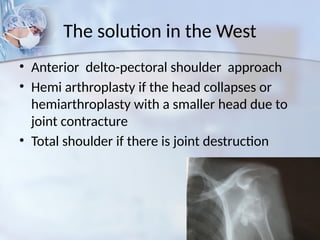
The solution in the West
• Anterior delto-pectoral shoulder approach
• Hemi arthroplasty if the head collapses or
hemiarthroplasty with a smaller head due to
joint contracture
• Total shoulder if there is joint destruction
The solution in Africa
1. An extensile approach to the chronically dislocated head that
allows access globally to the head and glenoid
2. Circumferential capsular release
3. Reduction of the posterior cuff shortening without disruption of
the posterior cuff tendon by stripping the cuff from the scapula
4. Release of supraspinatus adhesions from coracoid and superior
glenoid
5. Release of the subscapularis from corocoid, HO, neo-capsule,
scapular body and brachial plexus
6. Mobilization of the posterior cuff from the attached deltoid by
breaking up dense adhesions
The solution in Africa
7. Release of the posterior deltoid contracture
and scar
8. break adhesions between the deltoid and
rotator cuff muscles
9. Stretching of the rotator cuff
10. avoidance of head collapse
11. Replace significant bony loss of the glenoid
12. reduce the head and keep it there
The solution in Africa
• Options for treatment then are:
1. Hemiarthroplasty for those few who have it
2. Open reduction
3. Do nothing, unfortunately this is what I
believe most of us do
4. Shoulder fusion
Objectives of the rest of this talk
• Cadaver dissection demonstrating the
operative procedure
• Four case presentations
• Conclusions
Materials and Methods
• Hand written and electronic operative logs of
all chronic shoulder dislocations =,> than one
month
• Chart review
• Pts phoned and visited to ask them to come
back
• Oxford and Constant scores, photos
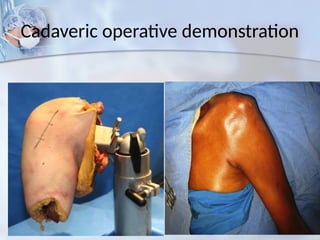
Cadaveric operative demonstration
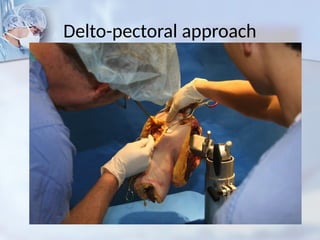
Delto-pectoral approach
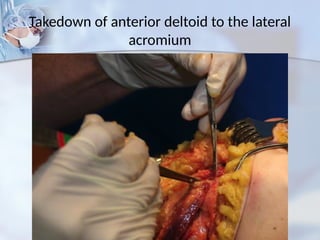
Takedown of anterior deltoid to the lateral
acromium
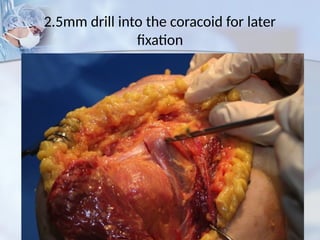
2.5mm drill into the coracoid for later
fixation
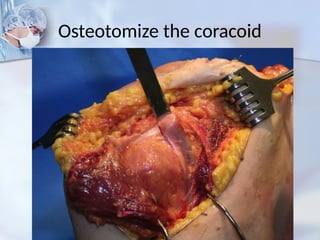
Osteotomize the coracoid
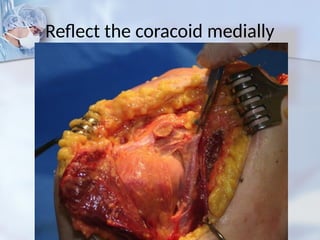
Reflect the coracoid medially
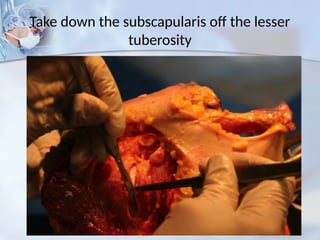
Take down the subscapularis off the lesser
tuberosity
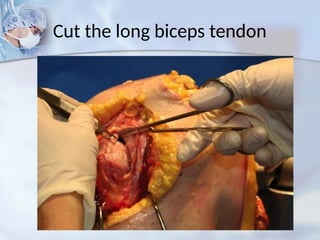
Cut the long biceps tendon
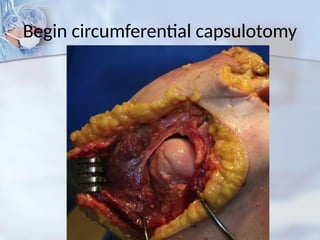
Begin circumferential capsulotomy
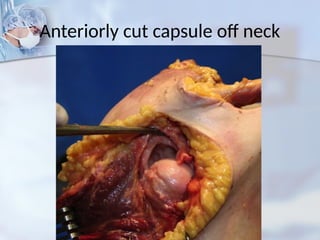
Anteriorly cut capsule off neck
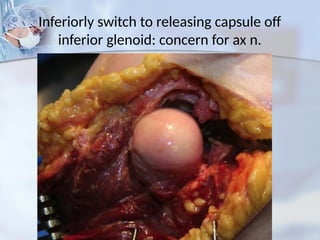
Inferiorly switch to releasing capsule off
inferior glenoid: concern for ax n.
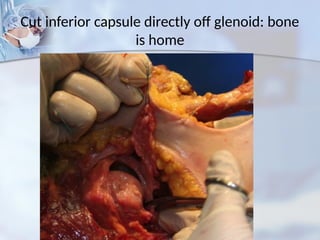
Cut inferior capsule directly off glenoid: bone
is home
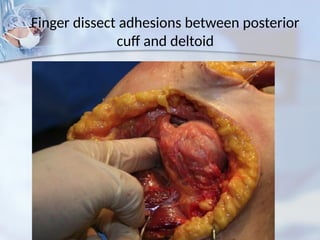
Finger dissect adhesions between posterior
cuff and deltoid
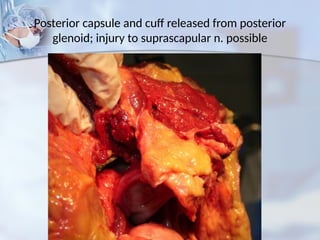
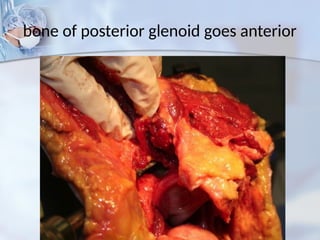
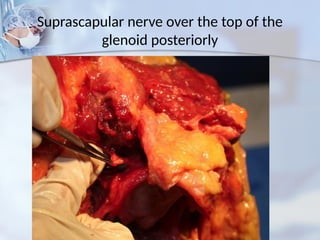
Posterior capsule and cuff released from posterior
glenoid; injury to suprascapular n. possible
bone of posterior glenoid goes anterior
Suprascapular nerve over the top of the
glenoid posteriorly
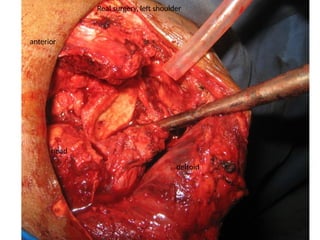
Real surgery, left shoulder
anterior
head
deltoid
Assessments
• Make sure the dissection is circumferential
• Inferiorly is important as there are bands of
scar, Axillary nerve is at risk, stay on inferior
glenoid!
• Mobilize the whole rotator cuff
Mobilization of the rotator cuff
• Subscapularis needs mobilization from the
anterior scapula as far medial as possible, excise
heterotopic ossification that is becoming a neo-
glenoid
• Mobilize the subscapularis off of the base of the
coracoid
• Mobilize the subscapularis off of the posterior
aspect of the coracobrachialis and NV bundle
• The subscapularis need to move!
Mobilize the supraspinatus
• If you are not careful you will cut it as it winds
around the base of the coracoid
• Mobilize it off of the base of the coracoid and
superior glenoid
• There will be dense adhesion between the
subscap and the HO forming on the anterior neck
and body. This needs mobilization
• There will be neo capsule that has formed as well
Mobilize the posterior cuff
• It has adhesions to the posterior glenoid and
also the posterior deltoid
• Dissect with a Cob between the posterior
glenoid and cuff with preservation of the
suprascapular nerve as it winds around the
spine of the scapula
• Finger dissect the adhesions between the
posterior cuff and the deltoid! This is important
Create space posteriorly
• With anterior translation of the head a void was
created posteriorly that is now filled with scar
• The undersurface of the Acromium posterior is
filled with scar and the posterior deltoid is
drawn anteriorly
• Cut this with electrocautery to allow the head
to go superior and posteriorly, This is
important!
Additional steps
• Stretch the posterior cuff by pulling the humeral head
laterally as hard as you can
• Assess the size of the glenoid, add bone anteriorly from the
iliac crest if needed, fix with screws, we have only rarely done
this, DJD is likely if you do this with iliac crest
• Assess the posterior tightness, stretch the cuff again
• IF there is any suggestion of anterior instability pin the head
to the glenoid at this point for one week
• I don’t think the Laterjet is an option in this setting it adds a
level of difficulty and dissection that is not warranted, I have
done it once and will not repeat it.
Closure
• Mobilize the subscapularis and repair it to the
lesser tuberosity, incorporate the long head of
the biceps in the repair
• Fix the coracoid anatomically with a 35 mm
3.5 screw
• Repair the deltoid with interrupted suture to
the clavicle using the trapezius fascia
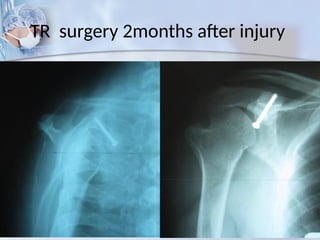
TR surgery 2months after injury
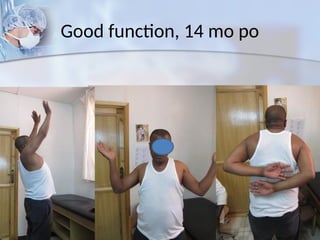
Good function, 14 mo po
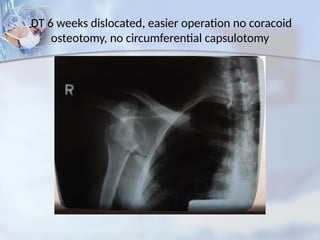
DT 6 weeks dislocated, easier operation no coracoid
osteotomy, no circumferential capsulotomy
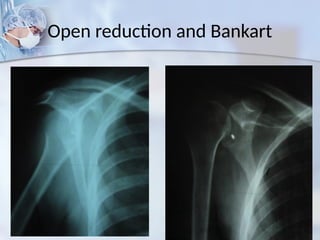
Open reduction and Bankart
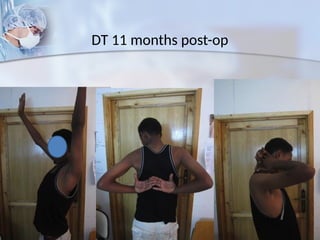
DT 11 months post-op
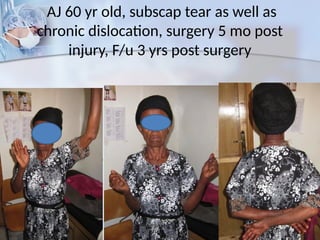
AJ 60 yr old, subscap tear as well as
chronic dislocation, surgery 5 mo post
injury, F/u 3 yrs post surgery
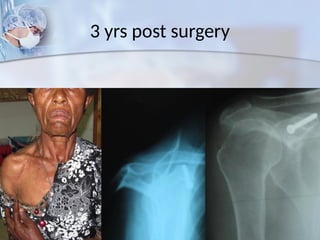
3 yrs post surgery
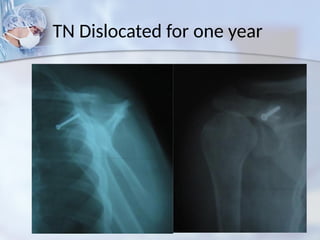
TN Dislocated for one year
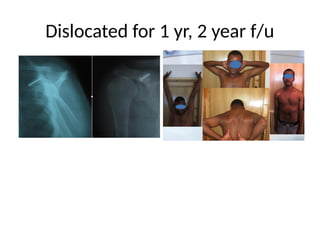
Dislocated for 1 yr, 2 year f/u
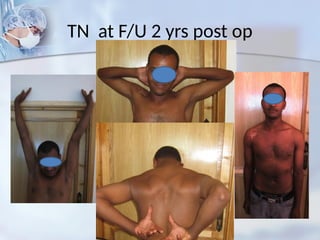
TN at F/U 2 yrs post op
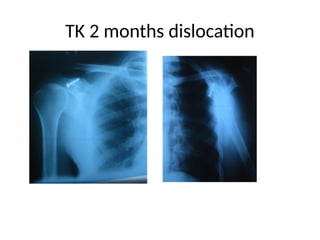
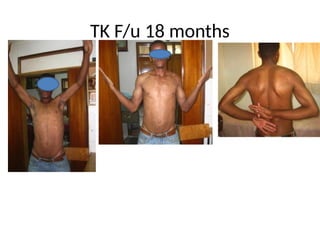
TK 2 months dislocation
TK F/u 18 months
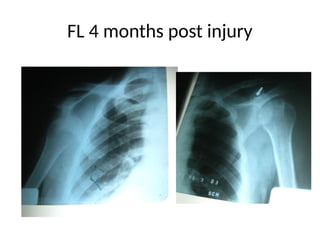
FL 4 months post injury
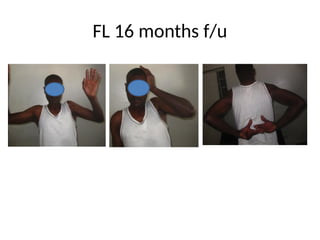
FL 16 months f/u
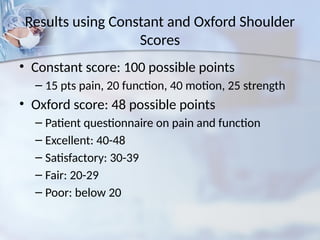
Results using Constant and Oxford Shoulder
Scores
• Constant score: 100 possible points
– 15 pts pain, 20 function, 40 motion, 25 strength
• Oxford score: 48 possible points
– Patient questionnaire on pain and function
– Excellent: 40-48
– Satisfactory: 30-39
– Fair: 20-29
– Poor: below 20
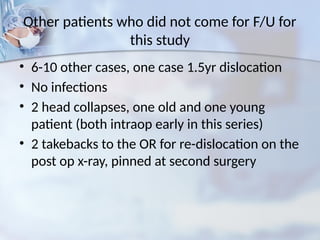
Other patients who did not come for F/U for
this study
• 6-10 other cases, one case 1.5yr dislocation
• No infections
• 2 head collapses, one old and one young
patient (both intraop early in this series)
• 2 takebacks to the OR for re-dislocation on the
post op x-ray, pinned at second surgery
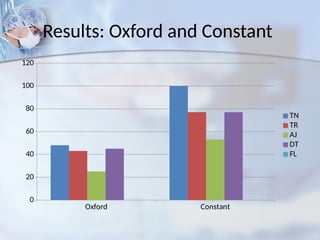
Results: Oxford and Constant
Oxford Constant
0
20
40
60
80
100
120
TN
TR
AJ
DT
FL
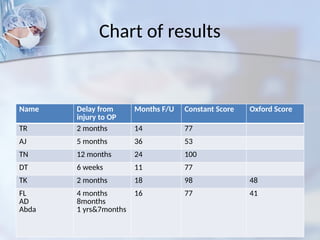
Chart of results
Name Delay from
injury to OP
Months F/U Constant Score Oxford Score
TR 2 months 14 77
AJ 5 months 36 53
TN 12 months 24 100
DT 6 weeks 11 77
TK 2 months 18 98 48
FL
AD
Abda
4 months
8months
1 yrs&7months
16 77 41
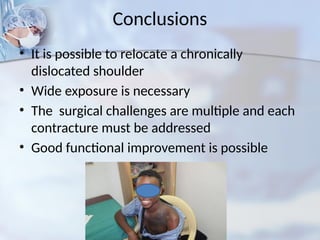
Conclusions
• It is possible to relocate a chronically
dislocated shoulder
• Wide exposure is necessary
• The surgical challenges are multiple and each
contracture must be addressed
• Good functional improvement is possible
See it on Vumedi

Chronic shoulder dislocation,bedru 2020.pptx

  • 1.
    Open Reduction ofChronic Shoulder Dislocation by circumferential capsular release and posterior cuff mobilization, its technique and early results Duane Anderson, MD Lucas Anderson, MD Stephen Aoki, MD Segni Bekele, MD Abebe Chala PT Soddo Christian Hospital Soddo Wolaitta Ethiopia University of Utah Department of Orthopaedics Open reduction of chronic shoulder dislocations through an extensile approach, circumferential capsular release and mobilization of the rotator cuff muscles Technique and Early Results Duane Anderson, MD (1) Lucas Anderson, MD (2) Stephen Aoki, MD (2) Segni Bekele, MD (1) Abebe Chala, PT (1) Edit Jan 2024 (1) Soddo Christian Hospital Soddo Wolaitta Ethiopia (2) University of Utah Department of Orthopaedics, Salt Lake City, Utah USA
  • 3.
    The problem • Chronicshoulder dislocation not uncommon in the third world • Old literature advocates complete rotator cuff release. • As time progresses with chronic dislocation – larger Hill-Sachs – more contracted capsule and rotator cuff
  • 4.
    The problem isbig • As more time passes in chronic dislocations: – the head becomes softer because there is no head-glenoid contact – Increased bone loss of anterior glenoid – The Hill-Sachs gets bigger – Internal adhesions between deltoid, cuff, and neo-capsule strengthening the patho- anatomy – Shortening of the posterior cuff occurs, this is counter intuitive but true – The supraspinatus becomes adherent to the coracoid and sits in a precarious surgical position for the naïve surgeon – The posterior deltoid moves anteriorly and scars in place – Heterotopic ossification occurs to make a new glenoid on the anterior surface of the scapular neck – Subscapularis is locked in place with adhesions to the coracoid, HO, and neo-capsule
  • 5.
    The solution inthe West • Anterior delto-pectoral shoulder approach • Hemi arthroplasty if the head collapses or hemiarthroplasty with a smaller head due to joint contracture • Total shoulder if there is joint destruction
  • 6.
    The solution inAfrica 1. An extensile approach to the chronically dislocated head that allows access globally to the head and glenoid 2. Circumferential capsular release 3. Reduction of the posterior cuff shortening without disruption of the posterior cuff tendon by stripping the cuff from the scapula 4. Release of supraspinatus adhesions from coracoid and superior glenoid 5. Release of the subscapularis from corocoid, HO, neo-capsule, scapular body and brachial plexus 6. Mobilization of the posterior cuff from the attached deltoid by breaking up dense adhesions
  • 7.
    The solution inAfrica 7. Release of the posterior deltoid contracture and scar 8. break adhesions between the deltoid and rotator cuff muscles 9. Stretching of the rotator cuff 10. avoidance of head collapse 11. Replace significant bony loss of the glenoid 12. reduce the head and keep it there
  • 8.
    The solution inAfrica • Options for treatment then are: 1. Hemiarthroplasty for those few who have it 2. Open reduction 3. Do nothing, unfortunately this is what I believe most of us do 4. Shoulder fusion
  • 9.
    Objectives of therest of this talk • Cadaver dissection demonstrating the operative procedure • Four case presentations • Conclusions
  • 10.
    Materials and Methods •Hand written and electronic operative logs of all chronic shoulder dislocations =,> than one month • Chart review • Pts phoned and visited to ask them to come back • Oxford and Constant scores, photos
  • 11.
  • 12.
  • 13.
    Takedown of anteriordeltoid to the lateral acromium
  • 14.
    2.5mm drill intothe coracoid for later fixation
  • 15.
  • 16.
  • 17.
    Take down thesubscapularis off the lesser tuberosity
  • 18.
    Cut the longbiceps tendon
  • 19.
  • 20.
  • 21.
    Inferiorly switch toreleasing capsule off inferior glenoid: concern for ax n.
  • 22.
    Cut inferior capsuledirectly off glenoid: bone is home
  • 23.
    Finger dissect adhesionsbetween posterior cuff and deltoid
  • 24.
    Posterior capsule andcuff released from posterior glenoid; injury to suprascapular n. possible
  • 25.
    bone of posteriorglenoid goes anterior
  • 26.
    Suprascapular nerve overthe top of the glenoid posteriorly
  • 27.
    Real surgery, leftshoulder anterior head deltoid
  • 28.
    Assessments • Make surethe dissection is circumferential • Inferiorly is important as there are bands of scar, Axillary nerve is at risk, stay on inferior glenoid! • Mobilize the whole rotator cuff
  • 29.
    Mobilization of therotator cuff • Subscapularis needs mobilization from the anterior scapula as far medial as possible, excise heterotopic ossification that is becoming a neo- glenoid • Mobilize the subscapularis off of the base of the coracoid • Mobilize the subscapularis off of the posterior aspect of the coracobrachialis and NV bundle • The subscapularis need to move!
  • 30.
    Mobilize the supraspinatus •If you are not careful you will cut it as it winds around the base of the coracoid • Mobilize it off of the base of the coracoid and superior glenoid • There will be dense adhesion between the subscap and the HO forming on the anterior neck and body. This needs mobilization • There will be neo capsule that has formed as well
  • 31.
    Mobilize the posteriorcuff • It has adhesions to the posterior glenoid and also the posterior deltoid • Dissect with a Cob between the posterior glenoid and cuff with preservation of the suprascapular nerve as it winds around the spine of the scapula • Finger dissect the adhesions between the posterior cuff and the deltoid! This is important
  • 32.
    Create space posteriorly •With anterior translation of the head a void was created posteriorly that is now filled with scar • The undersurface of the Acromium posterior is filled with scar and the posterior deltoid is drawn anteriorly • Cut this with electrocautery to allow the head to go superior and posteriorly, This is important!
  • 33.
    Additional steps • Stretchthe posterior cuff by pulling the humeral head laterally as hard as you can • Assess the size of the glenoid, add bone anteriorly from the iliac crest if needed, fix with screws, we have only rarely done this, DJD is likely if you do this with iliac crest • Assess the posterior tightness, stretch the cuff again • IF there is any suggestion of anterior instability pin the head to the glenoid at this point for one week • I don’t think the Laterjet is an option in this setting it adds a level of difficulty and dissection that is not warranted, I have done it once and will not repeat it.
  • 34.
    Closure • Mobilize thesubscapularis and repair it to the lesser tuberosity, incorporate the long head of the biceps in the repair • Fix the coracoid anatomically with a 35 mm 3.5 screw • Repair the deltoid with interrupted suture to the clavicle using the trapezius fascia
  • 35.
    TR surgery 2monthsafter injury
  • 36.
  • 37.
    DT 6 weeksdislocated, easier operation no coracoid osteotomy, no circumferential capsulotomy
  • 38.
  • 39.
    DT 11 monthspost-op
  • 40.
    AJ 60 yrold, subscap tear as well as chronic dislocation, surgery 5 mo post injury, F/u 3 yrs post surgery
  • 41.
    3 yrs postsurgery
  • 42.
  • 43.
    Dislocated for 1yr, 2 year f/u
  • 44.
    TN at F/U2 yrs post op
  • 45.
    TK 2 monthsdislocation
  • 46.
    TK F/u 18months
  • 47.
    FL 4 monthspost injury
  • 48.
  • 49.
    Results using Constantand Oxford Shoulder Scores • Constant score: 100 possible points – 15 pts pain, 20 function, 40 motion, 25 strength • Oxford score: 48 possible points – Patient questionnaire on pain and function – Excellent: 40-48 – Satisfactory: 30-39 – Fair: 20-29 – Poor: below 20
  • 50.
    Other patients whodid not come for F/U for this study • 6-10 other cases, one case 1.5yr dislocation • No infections • 2 head collapses, one old and one young patient (both intraop early in this series) • 2 takebacks to the OR for re-dislocation on the post op x-ray, pinned at second surgery
  • 51.
    Results: Oxford andConstant Oxford Constant 0 20 40 60 80 100 120 TN TR AJ DT FL
  • 52.
    Chart of results NameDelay from injury to OP Months F/U Constant Score Oxford Score TR 2 months 14 77 AJ 5 months 36 53 TN 12 months 24 100 DT 6 weeks 11 77 TK 2 months 18 98 48 FL AD Abda 4 months 8months 1 yrs&7months 16 77 41
  • 53.
    Conclusions • It ispossible to relocate a chronically dislocated shoulder • Wide exposure is necessary • The surgical challenges are multiple and each contracture must be addressed • Good functional improvement is possible
  • 54.
    See it onVumedi