


UNCEMENTED
FEMORAL
COMPONENTS
Dr Sameer Ashar (M.S.)
Assistant professor,
Orthopaedics,
M.p.shah medical
college,
Jamnagar. 1
disclosure
• This presentation is for educational purpose only
• All the copy rights are owned by original authors
2
MATERIAL
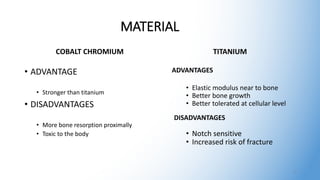
COBALT CHROMIUM
• ADVANTAGE
• Stronger than titanium
• DISADVANTAGES
• More bone resorption proximally
• Toxic to the body
TITANIUM
ADVANTAGES
• Elastic modulus near to bone
• Better bone growth
• Better tolerated at cellular level
DISADVANTAGES
• Notch sensitive
• Increased risk of fracture
3
• For uncemented stem stable fixation is achieve at the time of
implantation depends on
• MACROLOCK- related to implant shape
• MICROLOCK- surface finish
• However ,long term fixation depends on osteointegration
• INGROWTH
• ONGROWTH
4
BONE INGROWTH
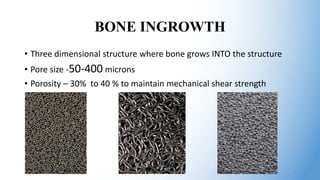
• Three dimensional structure where bone grows INTO the structure
• Pore size -50-400 microns
• Porosity – 30% to 40 % to maintain mechanical shear strength
5
BONE INGROWTH
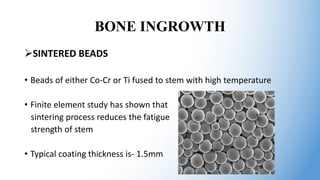
SINTERED BEADS
• Beads of either Co-Cr or Ti fused to stem with high temperature
• Finite element study has shown that
sintering process reduces the fatigue
strength of stem
• Typical coating thickness is- 1.5mm
6
BONE INGROWTH
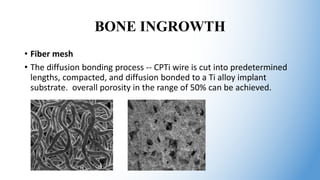
• Fiber mesh
• The diffusion bonding process -- CPTi wire is cut into predetermined
lengths, compacted, and diffusion bonded to a Ti alloy implant
substrate. overall porosity in the range of 50% can be achieved.
7
BONE INGROWTH
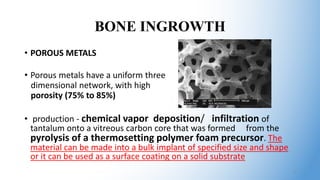
• POROUS METALS
• Porous metals have a uniform three
dimensional network, with high
porosity (75% to 85%)
• production - chemical vapor deposition/ infiltration of
tantalum onto a vitreous carbon core that was formed from the
pyrolysis of a thermosetting polymer foam precursor. The
material can be made into a bulk implant of specified size and shape
or it can be used as a surface coating on a solid substrate
8
BONE ONGROWTH
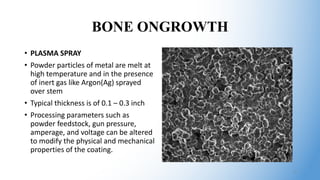
• PLASMA SPRAY
• Powder particles of metal are melt at
high temperature and in the presence
of inert gas like Argon(Ag) sprayed
over stem
• Typical thickness is of 0.1 – 0.3 inch
• Processing parameters such as
powder feedstock, gun pressure,
amperage, and voltage can be altered
to modify the physical and mechanical
properties of the coating.
9
BONE ONGROWTH
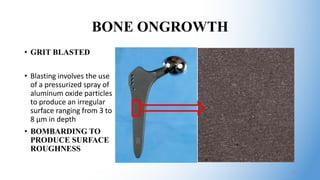
• GRIT BLASTED
• Blasting involves the use
of a pressurized spray of
aluminum oxide particles
to produce an irregular
surface ranging from 3 to
8 μm in depth
• BOMBARDING TO
PRODUCE SURFACE
ROUGHNESS
10
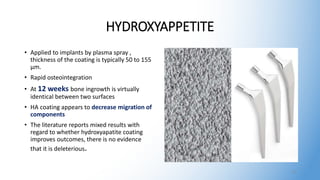
HYDROXYAPPETITE
• Applied to implants by plasma spray ,
thickness of the coating is typically 50 to 155
μm.
• Rapid osteointegration
• At 12 weeks bone ingrowth is virtually
identical between two surfaces
• HA coating appears to decrease migration of
components
• The literature reports mixed results with
regard to whether hydroxyapatite coating
improves outcomes, there is no evidence
that it is deleterious.
11
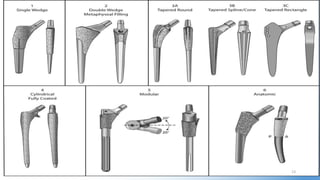
CLASSIFICATION
• Harpal S. Khanuja, Jeffrey J. Vakil, Maria S. Goddard, and Michael A.
Mont
• Classified based on geometry, it excludes short uncemented stems
• Future stems may not fit into this classification but this classification
incorporates majority of available uncemented stems with long follow
ups !
12
13
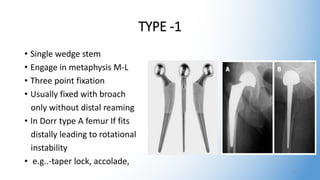
TYPE -1
• Single wedge stem
• Engage in metaphysis M-L
• Three point fixation
• Usually fixed with broach
only without distal reaming
• In Dorr type A femur If fits
distally leading to rotational
instability
• e.g..-taper lock, accolade,
14
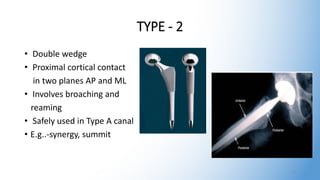
TYPE - 2
• Double wedge
• Proximal cortical contact
in two planes AP and ML
• Involves broaching and
reaming
• Safely used in Type A canal
• E.g..-synergy, summit
15
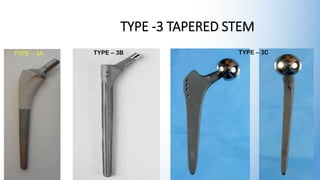
TYPE -3 TAPERED STEM
TYPE – 3A TYPE – 3CTYPE – 3B
16
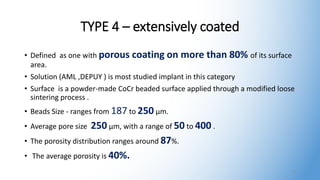
TYPE 4 – extensively coated
• Defined as one with porous coating on more than 80% of its surface
area.
• Solution (AML ,DEPUY ) is most studied implant in this category
• Surface is a powder-made CoCr beaded surface applied through a modified loose
sintering process .
• Beads Size - ranges from 187 to 250 μm.
• Average pore size 250 μm, with a range of 50 to 400 .
• The porosity distribution ranges around 87%.
• The average porosity is 40%.
17
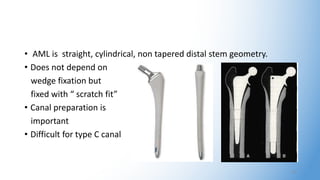
• AML is straight, cylindrical, non tapered distal stem geometry.
• Does not depend on
wedge fixation but
fixed with “ scratch fit”
• Canal preparation is
important
• Difficult for type C canal
18
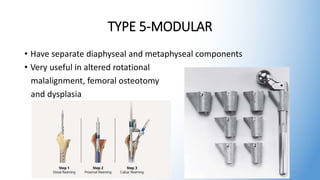
TYPE 5-MODULAR
• Have separate diaphyseal and metaphyseal components
• Very useful in altered rotational
malalignment, femoral osteotomy
and dysplasia
19
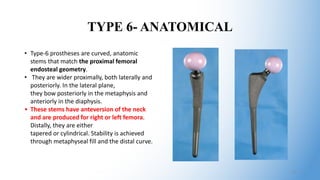
TYPE 6- ANATOMICAL
• Type-6 prostheses are curved, anatomic
stems that match the proximal femoral
endosteal geometry.
• They are wider proximally, both laterally and
posteriorly. In the lateral plane,
they bow posteriorly in the metaphysis and
anteriorly in the diaphysis.
• These stems have anteversion of the neck
and are produced for right or left femora.
Distally, they are either
tapered or cylindrical. Stability is achieved
through metaphyseal fill and the distal curve.
20
RESULTS
• TYPE 1 AND TYPE 2
• This stem has been the subject of more published reports than
any other design.it can be safely used in type c canal.
• McLaughlin JR, Lee KR. Total hip arthroplasty with an uncemented tapered femoral component. J Bone Joint Surg
Am. 2008;90:1290- 99% SURVIVAL AT THE END OF 20 YEARS
• Most common compliations –thigh pain ,loosening
21
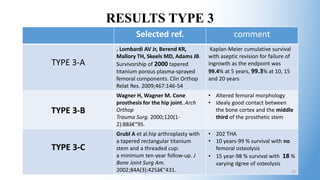
RESULTS TYPE 3
Selected ref. comment
TYPE 3-A
. Lombardi AV Jr, Berend KR,
Mallory TH, Skeels MD, Adams JB.
Survivorship of 2000 tapered
titanium porous plasma-sprayed
femoral components. Clin Orthop
Relat Res. 2009;467:146-54
Kaplan-Meier cumulative survival
with aseptic revision for failure of
ingrowth as the endpoint was
99.4% at 5 years, 99.3% at 10, 15
and 20 years
TYPE 3-B
Wagner H, Wagner M. Cone
prosthesis for the hip joint. Arch
Orthop
Trauma Surg. 2000;120(1-
2):88–95.
• Altered femoral morphology
• idealy good contact between
the bone cortex and the middle
third of the prosthetic stem
TYPE 3-C
Grubl A et al.hip arthroplasty with
a tapered rectangular titanium
stem and a threaded cup:
a minimum ten-year follow-up. J
Bone Joint Surg Am.
2002;84A(3):425–431.
• 202 THA
• 10 years-99 % survival with no
femoral osteolysis
• 15 year-98 % survival with 18 %
varying dgree of osteolysis
22
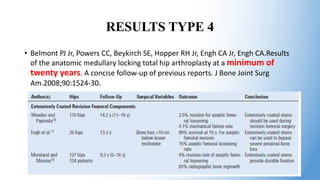
RESULTS TYPE 4
• Belmont PJ Jr, Powers CC, Beykirch SE, Hopper RH Jr, Engh CA Jr, Engh CA.Results
of the anatomic medullary locking total hip arthroplasty at a minimum of
twenty years. A concise follow-up of previous reports. J Bone Joint Surg
Am.2008;90:1524-30.
23
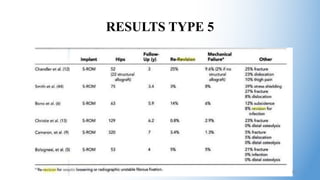
RESULTS TYPE 5
24
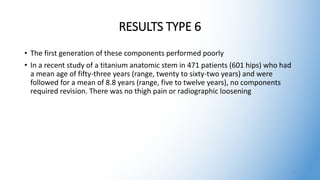
RESULTS TYPE 6
• The first generation of these components performed poorly
• In a recent study of a titanium anatomic stem in 471 patients (601 hips) who had
a mean age of fifty-three years (range, twenty to sixty-two years) and were
followed for a mean of 8.8 years (range, five to twelve years), no components
required revision. There was no thigh pain or radiographic loosening
25
TAKE HOME MESSAGE
• Cement less femoral fixation is generally associated with excellent long-
term results.
• Understand the principles, use the most suitable design for a given case.
• No type is completely free of thigh pain or stress-shielding
• Cement less femoral fixation is durable in young patients and has promising
results in MOST OF THE older patients
26
THANK YOU
27

Uncemented femoral stem

  • 1.
    UNCEMENTED FEMORAL COMPONENTS Dr Sameer Ashar(M.S.) Assistant professor, Orthopaedics, M.p.shah medical college, Jamnagar. 1
  • 2.
    disclosure • This presentationis for educational purpose only • All the copy rights are owned by original authors 2
  • 3.
    MATERIAL COBALT CHROMIUM • ADVANTAGE •Stronger than titanium • DISADVANTAGES • More bone resorption proximally • Toxic to the body TITANIUM ADVANTAGES • Elastic modulus near to bone • Better bone growth • Better tolerated at cellular level DISADVANTAGES • Notch sensitive • Increased risk of fracture 3
  • 4.
    • For uncementedstem stable fixation is achieve at the time of implantation depends on • MACROLOCK- related to implant shape • MICROLOCK- surface finish • However ,long term fixation depends on osteointegration • INGROWTH • ONGROWTH 4
  • 5.
    BONE INGROWTH • Threedimensional structure where bone grows INTO the structure • Pore size -50-400 microns • Porosity – 30% to 40 % to maintain mechanical shear strength 5
  • 6.
    BONE INGROWTH SINTERED BEADS •Beads of either Co-Cr or Ti fused to stem with high temperature • Finite element study has shown that sintering process reduces the fatigue strength of stem • Typical coating thickness is- 1.5mm 6
  • 7.
    BONE INGROWTH • Fibermesh • The diffusion bonding process -- CPTi wire is cut into predetermined lengths, compacted, and diffusion bonded to a Ti alloy implant substrate. overall porosity in the range of 50% can be achieved. 7
  • 8.
    BONE INGROWTH • POROUSMETALS • Porous metals have a uniform three dimensional network, with high porosity (75% to 85%) • production - chemical vapor deposition/ infiltration of tantalum onto a vitreous carbon core that was formed from the pyrolysis of a thermosetting polymer foam precursor. The material can be made into a bulk implant of specified size and shape or it can be used as a surface coating on a solid substrate 8
  • 9.
    BONE ONGROWTH • PLASMASPRAY • Powder particles of metal are melt at high temperature and in the presence of inert gas like Argon(Ag) sprayed over stem • Typical thickness is of 0.1 – 0.3 inch • Processing parameters such as powder feedstock, gun pressure, amperage, and voltage can be altered to modify the physical and mechanical properties of the coating. 9
  • 10.
    BONE ONGROWTH • GRITBLASTED • Blasting involves the use of a pressurized spray of aluminum oxide particles to produce an irregular surface ranging from 3 to 8 μm in depth • BOMBARDING TO PRODUCE SURFACE ROUGHNESS 10
  • 11.
    HYDROXYAPPETITE • Applied toimplants by plasma spray , thickness of the coating is typically 50 to 155 μm. • Rapid osteointegration • At 12 weeks bone ingrowth is virtually identical between two surfaces • HA coating appears to decrease migration of components • The literature reports mixed results with regard to whether hydroxyapatite coating improves outcomes, there is no evidence that it is deleterious. 11
  • 12.
    CLASSIFICATION • Harpal S.Khanuja, Jeffrey J. Vakil, Maria S. Goddard, and Michael A. Mont • Classified based on geometry, it excludes short uncemented stems • Future stems may not fit into this classification but this classification incorporates majority of available uncemented stems with long follow ups ! 12
  • 13.
  • 14.
    TYPE -1 • Singlewedge stem • Engage in metaphysis M-L • Three point fixation • Usually fixed with broach only without distal reaming • In Dorr type A femur If fits distally leading to rotational instability • e.g..-taper lock, accolade, 14
  • 15.
    TYPE - 2 •Double wedge • Proximal cortical contact in two planes AP and ML • Involves broaching and reaming • Safely used in Type A canal • E.g..-synergy, summit 15
  • 16.
    TYPE -3 TAPEREDSTEM TYPE – 3A TYPE – 3CTYPE – 3B 16
  • 17.
    TYPE 4 –extensively coated • Defined as one with porous coating on more than 80% of its surface area. • Solution (AML ,DEPUY ) is most studied implant in this category • Surface is a powder-made CoCr beaded surface applied through a modified loose sintering process . • Beads Size - ranges from 187 to 250 μm. • Average pore size 250 μm, with a range of 50 to 400 . • The porosity distribution ranges around 87%. • The average porosity is 40%. 17
  • 18.
    • AML isstraight, cylindrical, non tapered distal stem geometry. • Does not depend on wedge fixation but fixed with “ scratch fit” • Canal preparation is important • Difficult for type C canal 18
  • 19.
    TYPE 5-MODULAR • Haveseparate diaphyseal and metaphyseal components • Very useful in altered rotational malalignment, femoral osteotomy and dysplasia 19
  • 20.
    TYPE 6- ANATOMICAL •Type-6 prostheses are curved, anatomic stems that match the proximal femoral endosteal geometry. • They are wider proximally, both laterally and posteriorly. In the lateral plane, they bow posteriorly in the metaphysis and anteriorly in the diaphysis. • These stems have anteversion of the neck and are produced for right or left femora. Distally, they are either tapered or cylindrical. Stability is achieved through metaphyseal fill and the distal curve. 20
  • 21.
    RESULTS • TYPE 1AND TYPE 2 • This stem has been the subject of more published reports than any other design.it can be safely used in type c canal. • McLaughlin JR, Lee KR. Total hip arthroplasty with an uncemented tapered femoral component. J Bone Joint Surg Am. 2008;90:1290- 99% SURVIVAL AT THE END OF 20 YEARS • Most common compliations –thigh pain ,loosening 21
  • 22.
    RESULTS TYPE 3 Selectedref. comment TYPE 3-A . Lombardi AV Jr, Berend KR, Mallory TH, Skeels MD, Adams JB. Survivorship of 2000 tapered titanium porous plasma-sprayed femoral components. Clin Orthop Relat Res. 2009;467:146-54 Kaplan-Meier cumulative survival with aseptic revision for failure of ingrowth as the endpoint was 99.4% at 5 years, 99.3% at 10, 15 and 20 years TYPE 3-B Wagner H, Wagner M. Cone prosthesis for the hip joint. Arch Orthop Trauma Surg. 2000;120(1- 2):88–95. • Altered femoral morphology • idealy good contact between the bone cortex and the middle third of the prosthetic stem TYPE 3-C Grubl A et al.hip arthroplasty with a tapered rectangular titanium stem and a threaded cup: a minimum ten-year follow-up. J Bone Joint Surg Am. 2002;84A(3):425–431. • 202 THA • 10 years-99 % survival with no femoral osteolysis • 15 year-98 % survival with 18 % varying dgree of osteolysis 22
  • 23.
    RESULTS TYPE 4 •Belmont PJ Jr, Powers CC, Beykirch SE, Hopper RH Jr, Engh CA Jr, Engh CA.Results of the anatomic medullary locking total hip arthroplasty at a minimum of twenty years. A concise follow-up of previous reports. J Bone Joint Surg Am.2008;90:1524-30. 23
  • 24.
  • 25.
    RESULTS TYPE 6 •The first generation of these components performed poorly • In a recent study of a titanium anatomic stem in 471 patients (601 hips) who had a mean age of fifty-three years (range, twenty to sixty-two years) and were followed for a mean of 8.8 years (range, five to twelve years), no components required revision. There was no thigh pain or radiographic loosening 25
  • 26.
    TAKE HOME MESSAGE •Cement less femoral fixation is generally associated with excellent long- term results. • Understand the principles, use the most suitable design for a given case. • No type is completely free of thigh pain or stress-shielding • Cement less femoral fixation is durable in young patients and has promising results in MOST OF THE older patients 26
  • 27.