M. AntonogiannakisM. Antonogiannakis
DirectorDirector
Center for Shoulder arthroscopyCenter for Shoulder arthroscopy
IASO Gen. HospitalIASO Gen. Hospital
Athens GreeceAthens Greece
Arthroscopic repair ofArthroscopic repair of
massive rot cuff tearsmassive rot cuff tears
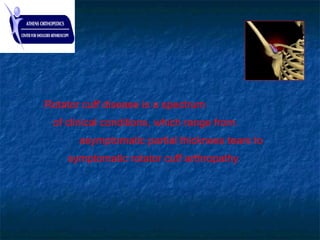
Rotator cuff disease is a spectrum
of clinical conditions, which range from
asymptomatic partial thickness tears to
symptomatic rotator cuff arthropathy
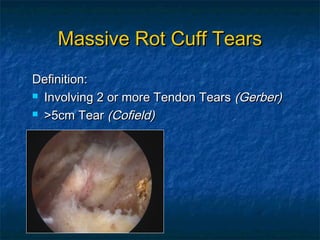
Massive Rot Cuff TearsMassive Rot Cuff Tears
Definition:Definition:
 Involving 2 or more Tendon TearsInvolving 2 or more Tendon Tears (Gerber)(Gerber)
 >5cm Tear>5cm Tear (Cofield)(Cofield)
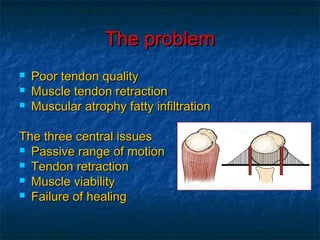
The problemThe problem
 Poor tendon qualityPoor tendon quality
 Muscle tendon retractionMuscle tendon retraction
 Muscular atrophy fatty infiltrationMuscular atrophy fatty infiltration
The three central issuesThe three central issues
 Passive range of motionPassive range of motion
 Tendon retractionTendon retraction
 Muscle viabilityMuscle viability
 Failure of healingFailure of healing
Techniques of releasesTechniques of releases
 The techniques adapted from openThe techniques adapted from open
surgery as described by Codmann,surgery as described by Codmann,
Rockwood, NeerRockwood, Neer
 Refined and modernized by Esch, Snyder,Refined and modernized by Esch, Snyder,
Gartsman, Burkhart and othersGartsman, Burkhart and others
ANY TYPE OF RECONSTRUCTIONANY TYPE OF RECONSTRUCTION
MUST AVOID TENSION OVER-LOADMUST AVOID TENSION OVER-LOAD
OF THE REPAIROF THE REPAIR
The solutionThe solution
 Improve the mechanical strength of theImprove the mechanical strength of the
repairrepair
 Enhance the biological responseEnhance the biological response
 Abandon and replace-muscle transferAbandon and replace-muscle transfer
 Rot cuff arthropathy-reverse or extendedRot cuff arthropathy-reverse or extended
head arthroplastyhead arthroplasty
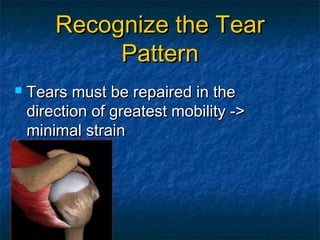
Recognize the TearRecognize the Tear
PatternPattern
 Tears must be repaired in theTears must be repaired in the
direction of greatest mobility ->direction of greatest mobility ->
minimal strainminimal strain
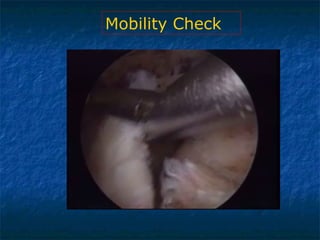
Mobility Check
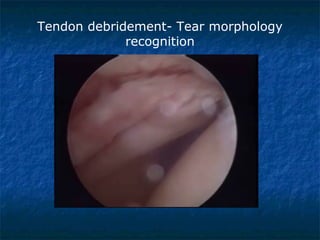
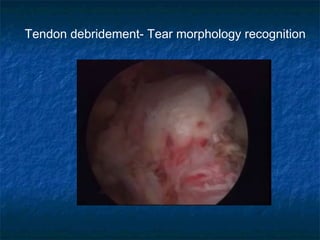
Tendon debridement- Tear morphology
recognition
Tear PatternsTear Patterns
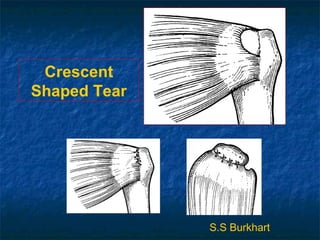
 Crescent shapedCrescent shaped
 L-shaped (or reverse L)L-shaped (or reverse L)
 U-ShapedU-Shaped
 Massive Contracted Immobile tearsMassive Contracted Immobile tears
S.S. BurkhartS.S. Burkhart
Crescent
Shaped Tear
S.S Burkhart
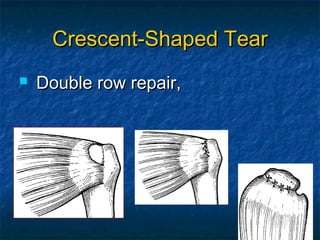
Crescent-Shaped TearCrescent-Shaped Tear
 Double row repair,Double row repair,
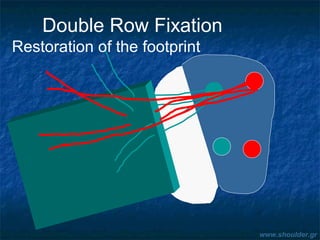
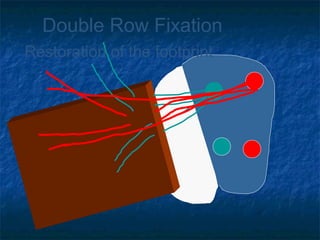
Double Row Fixation
Restoration of the footprint
www.shoulder.gr
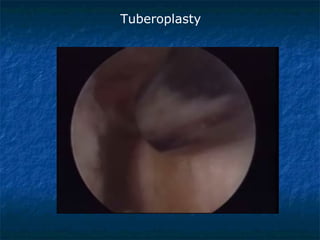
Tuberoplasty
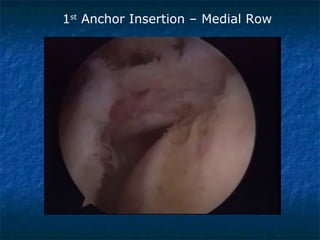
1st
Anchor Insertion – Medial Row
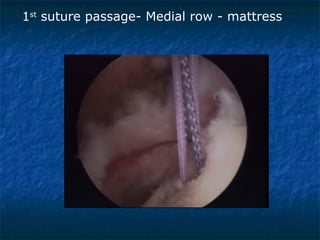
1st
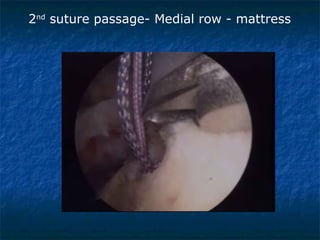
suture passage- Medial row - mattress
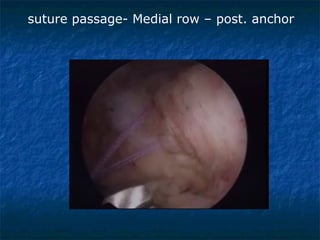
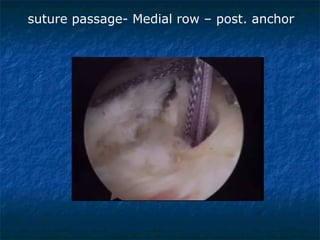
suture passage- Medial row – post. anchor
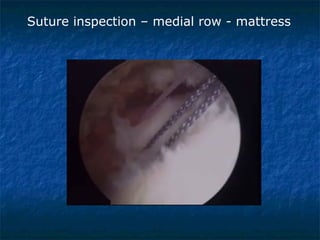
Suture inspection – medial row - mattress
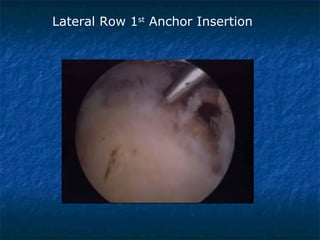
Lateral Row 1st
Anchor Insertion
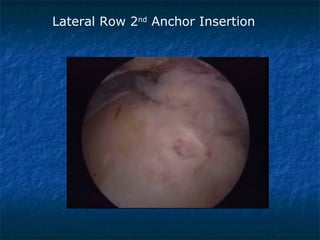
Lateral Row 2nd
Anchor Insertion
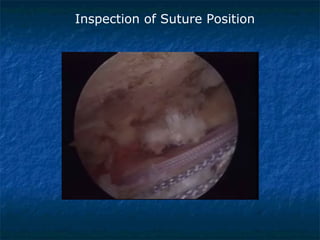
Inspection of Suture Position
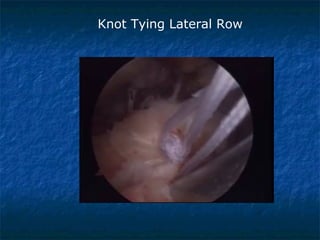
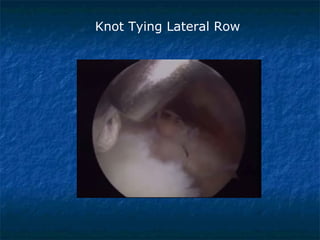
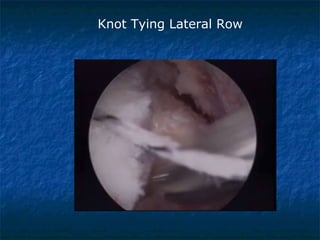
Knot Tying Lateral Row
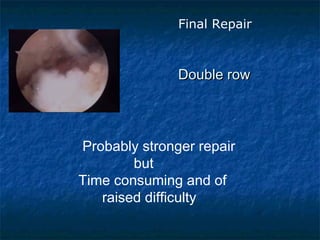
Final Repair
Double rowDouble row
Probably stronger repair
but
Time consuming and of
raised difficulty
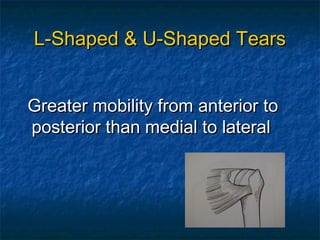
L-Shaped & U-Shaped TearsL-Shaped & U-Shaped Tears
Greater mobility from anterior toGreater mobility from anterior to
posterior than medial to lateralposterior than medial to lateral
L-Shaped & U-Shaped TearsL-Shaped & U-Shaped Tears
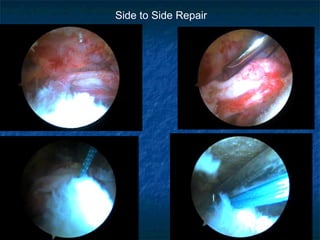
 Side to side sutures from medial to lateralSide to side sutures from medial to lateral
 Progressively converge the margin of theProgressively converge the margin of the
tear lateral to bone bedtear lateral to bone bed
 Closing 50% of a U-Shaped tear ->Closing 50% of a U-Shaped tear ->
reduces strain at converge margin by areduces strain at converge margin by a
factor of 6factor of 6
[[S. S .Burkhart]S. S .Burkhart]
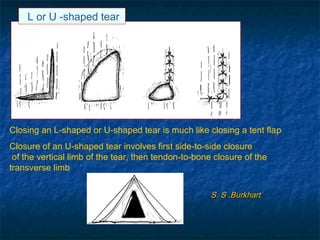
Closing an L-shaped or U-shaped tear is much like closing a tent flap
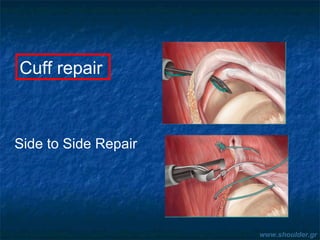
Closure of an U-shaped tear involves first side-to-side closure
of the vertical limb of the tear, then tendon-to-bone closure of the
transverse limb
L or U -shaped tear
S. S .BurkhartS. S .Burkhart
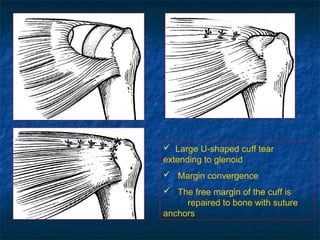
 Large U-shaped cuff tear
extending to glenoid
 Margin convergence
 The free margin of the cuff is
repaired to bone with suture
anchors
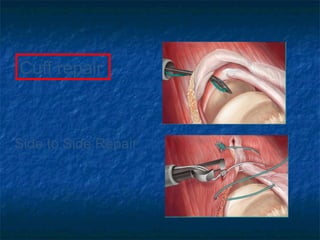
Side to Side Repair
Cuff repair
www.shoulder.gr
Side to Side Repair
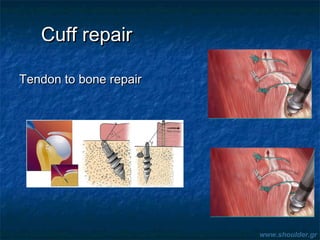
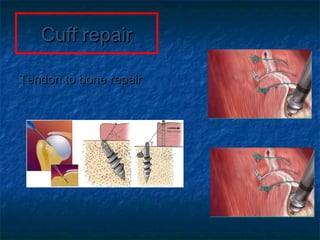
Cuff repairCuff repair
Tendon to bone repairTendon to bone repair
www.shoulder.gr
Massive Contracted ImmobileMassive Contracted Immobile
TearsTears
 No mobility from medial to lateral or fromNo mobility from medial to lateral or from
anterior to posterioranterior to posterior
 Subcategories:Subcategories:
 Massive Contracted Longitudinal TearsMassive Contracted Longitudinal Tears
 Massive Contracted Crescent TearsMassive Contracted Crescent Tears
 Represent 9.6% of massive tearsRepresent 9.6% of massive tears
[[S.Burkhart]S.Burkhart]
Massive Contractite TearsMassive Contractite Tears
 Anterior Interval SlideAnterior Interval Slide
and/orand/or
 Posterior Interval SlidePosterior Interval Slide
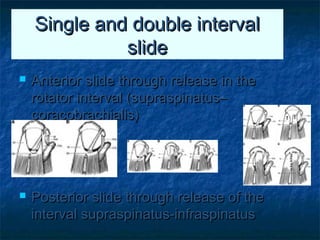
Single and double interval slideSingle and double interval slide
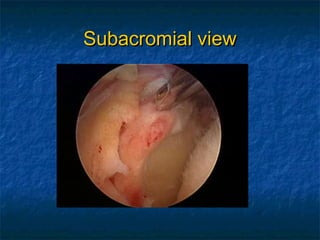
Subacromial viewSubacromial view
Single and double intervalSingle and double interval
slideslide
 Anterior slide through release in theAnterior slide through release in the
rotator interval (supraspinatus–rotator interval (supraspinatus–
coracobrachialis)coracobrachialis)
 Posterior slide through release of thePosterior slide through release of the
interval supraspinatus-infraspinatusinterval supraspinatus-infraspinatus
Free sutures to the cuffFree sutures to the cuff
Anterior slide-
supraspinatus
from coracoid –
coracohumeral
ligament
Posterior slide
Infraspinatus-supraspinatus
Posterior slide
Side to side sutures
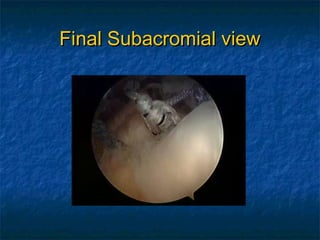
Final Subacromial viewFinal Subacromial view
Massive TearsMassive Tears
associated withassociated with
Subscapularis TearsSubscapularis Tears
 Subscapularis must be mobilized andSubscapularis must be mobilized and
repaired prior to the rest of the cuffrepaired prior to the rest of the cuff
 Interval slide in continuityInterval slide in continuity
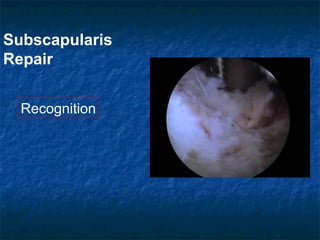
Subscapularis
Repair
Recognition
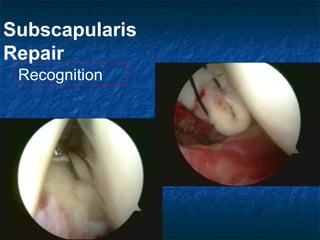
Subscapularis
Repair
Recognition
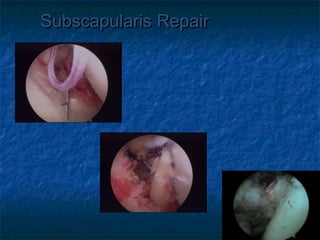
Subscapularis RepairSubscapularis Repair
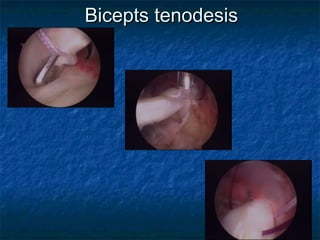
Bicepts tenodesisBicepts tenodesis
Massive TearsMassive Tears
May beMay be
 Eassily repairableEassily repairable
 Retracted very difficult to repair (anterior &Retracted very difficult to repair (anterior &
posterior Slides)posterior Slides)
 Medially RepairedMedially Repaired
 Impossible to repairImpossible to repair
 Incomplete RepairIncomplete Repair
 Graft JacketsGraft Jackets
 Tendon trasfersTendon trasfers
 Reverse, extended head arthroplastyReverse, extended head arthroplasty
Arthroscopic cuff repairArthroscopic cuff repair
Wolf, Snyder, Gartsman, Esch,
Burkhart, Tauro and others reported
84%-94% excellent and good results
Results for massive tearsResults for massive tears
 95% Good to Excellent Results95% Good to Excellent Results
independent to tear sizeindependent to tear size [Burkhart, 2001][Burkhart, 2001]
 With interval slideWith interval slide
 Improve UCLA score (10->28.3)Improve UCLA score (10->28.3)
 Improve Active ROM, StrengthImprove Active ROM, Strength
[Burkhart, 2004][Burkhart, 2004]
 Graft Jacket RepairGraft Jacket Repair
 Improve UCLA score (18->32Improve UCLA score (18->32))
[Snyder, 2008][Snyder, 2008]
ConclusionsConclusions
 Acute Crescent TearAcute Crescent Tear
Standard Techniques for tendon to bone fisxationStandard Techniques for tendon to bone fisxation
 U- or L- shaped TearsU- or L- shaped Tears
 Side to side margin convergenceSide to side margin convergence
 Partial mobile tearsPartial mobile tears
 Anterior / Posterior SlideAnterior / Posterior Slide
 Medialized RepairMedialized Repair
 Irreparable TearsIrreparable Tears
 Partial RepairPartial Repair
 GraftsGrafts
 Tendon trasfersTendon trasfers
What to do???What to do???
 Patients with grade 3 or 4 fatty degenerationPatients with grade 3 or 4 fatty degeneration
DO NOTDO NOT improve with rot cuff repairimprove with rot cuff repair
[Goutallier][Goutallier]
Vs.Vs.
 Patients with grade 3 or 4 fatty degenerationPatients with grade 3 or 4 fatty degeneration
improved significant at 86% of cases afterimproved significant at 86% of cases after
arthroscopic repairarthroscopic repair
[Burkhart][Burkhart]
In our experienceIn our experience
Patients withPatients with massivemassive rot cuff tearsrot cuff tears
benefitbenefit from surgeryfrom surgery
but they tend to recover slowlybut they tend to recover slowly
they succeed very good pain reliefthey succeed very good pain relief
but strength deficits remainbut strength deficits remain
In our experienceIn our experience
 Patients with upward migration of thePatients with upward migration of the
femoral head in contact with the acromionfemoral head in contact with the acromion
do not benefit from arthroscopydo not benefit from arthroscopy
 Patients with painless external rotation lagPatients with painless external rotation lag
and inability to keep the arm in externaland inability to keep the arm in external
rotation do not benefit from arthoscopyrotation do not benefit from arthoscopy
 With raised experience more previousWith raised experience more previous
irreparable cuff tears can be repairedirreparable cuff tears can be repaired
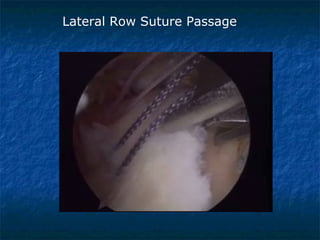
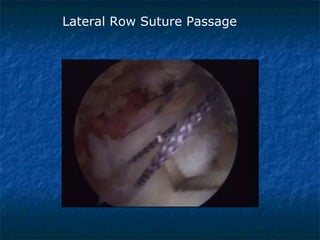
Lateral Row Suture Passage
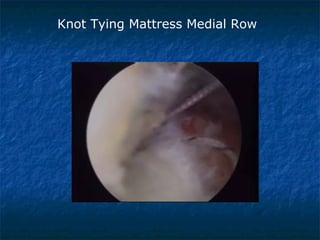
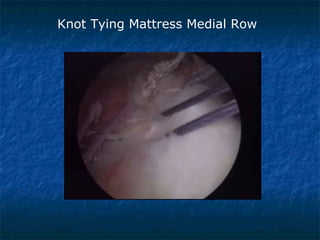
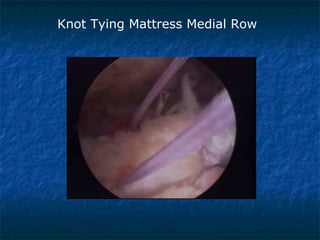
Knot Tying Mattress Medial Row
Surgical Technique
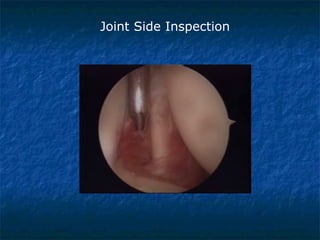
1. GH Joint and Subacromial Joint Inspection
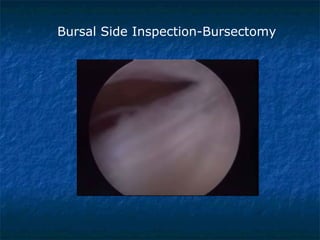
2. Bursal debridement
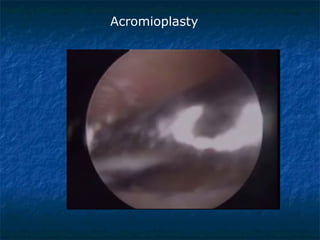
3. Acromioplasty
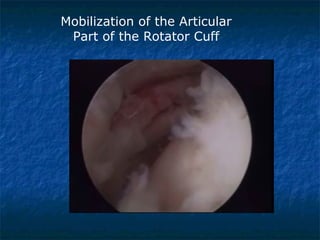
4. Cuff mobilization
5. Repair (side to side, tendon to bone)
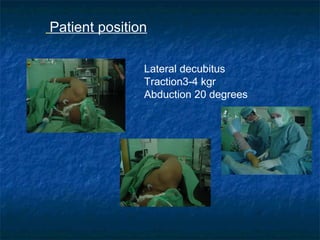
Patient position
Lateral decubitus
Traction3-4 kgr
Abduction 20 degrees
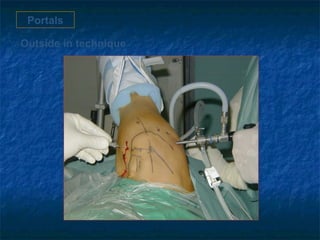
Portals
Outside in technique
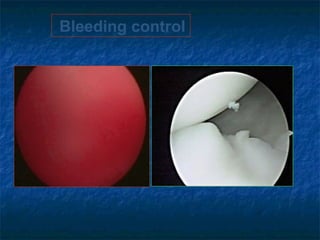
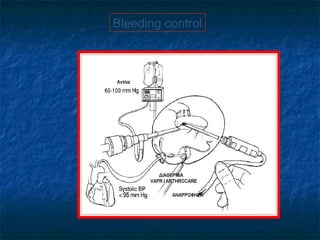
Bleeding control
Bleeding control
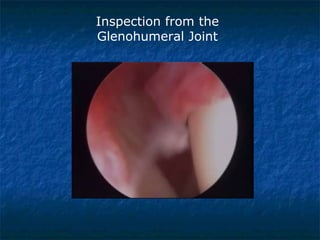
Joint Side Inspection
Bursal Side Inspection-Bursectomy
Tendon debridement- Tear morphology recognition
Acromioplasty
Side to Side Repair
Cuff repair
Cuff repairCuff repair
Tendon to bone repairTendon to bone repair
Double Row Fixation
Restoration of the footprint
Arthroscopic repairs do not heal faster
Knowledge of biomechanical principles is
mandatory in choosing repair type
Cuff repair is feasible but technically demanding
Indications of arthroscopic cuffIndications of arthroscopic cuff
repairrepair
 Every repairable cuff tear can be repairedEvery repairable cuff tear can be repaired
arthroscopic or a cuff that can be repairedarthroscopic or a cuff that can be repaired
open can be repaired and arthroscopicopen can be repaired and arthroscopic
 The decision to repair a cuff tear open orThe decision to repair a cuff tear open or
arhtroscopic depends in the expertise of thearhtroscopic depends in the expertise of the
surgeonsurgeon
 In the long run there is no discernibleIn the long run there is no discernible
difference between mini-open anddifference between mini-open and
arthroscopic cuff repairsarthroscopic cuff repairs
Advantages of Arthroscopic Cuff Repair
• Atraumatic
• Deltoid sparing
• Tissue mobilization
• Cosmetic incisions
• Secure repair
• Address accompanying pathology
• No iatrogenic injury to healthy tissues
• Cost-effective on an outpatient basis
Disadvantages of Arthroscopic Cuff Repair
• Technically demanding
• Equipment dependent
• Steep learning curve
Know when to keep dealing
or when to pack the cards
in and go home
 Bennett WF. Arthroscopic repair of massive rotator cuff tears: aBennett WF. Arthroscopic repair of massive rotator cuff tears: a
prospective cohort with 2- to 4-year follow-up.prospective cohort with 2- to 4-year follow-up. Arthroscopy.Arthroscopy.
20032003
 Boileau P., Brassart N., Watkinson D.J., Carles M., HatzidakisBoileau P., Brassart N., Watkinson D.J., Carles M., Hatzidakis
A.M., Krishnan S.G. Arthroscopic repair of full-thickness tears ofA.M., Krishnan S.G. Arthroscopic repair of full-thickness tears of
the supraspinatus: does the tendon really heal? J Bone Jointthe supraspinatus: does the tendon really heal? J Bone Joint
Surg Am. 2005Surg Am. 2005
 Buess E., Steuber K.U., Waibl B. Open versus arthroscopicBuess E., Steuber K.U., Waibl B. Open versus arthroscopic
rotator cuff repair: a comparative view of 96 cases.rotator cuff repair: a comparative view of 96 cases.
Arthroscopy. 2005Arthroscopy. 2005
 Gartsman G.M., Khan M., Hammerman S.M. ArthroscopicGartsman G.M., Khan M., Hammerman S.M. Arthroscopic
repair of full-thickness tears of the rotator cuff.repair of full-thickness tears of the rotator cuff. J Bone JointJ Bone Joint
Surg. 1998 Surg. 1998 
 Rebuzzi E, Coletti N, Schiavetti S, Giusto F. ArthroscopicRebuzzi E, Coletti N, Schiavetti S, Giusto F. Arthroscopic
rotator cuff repair in patients older than 60 years.rotator cuff repair in patients older than 60 years.
Arthroscopy. 2005Arthroscopy. 2005
 Tauro JC. Arthroscopic rotator cuff repair: analysis of techniqueTauro JC. Arthroscopic rotator cuff repair: analysis of technique
and results at 2- and 3-year follow-up. Arthroscopy 1998and results at 2- and 3-year follow-up. Arthroscopy 1998
 Warner JJ, Tetreault P, Lehtinen J, Zurakowski D. ArthroscopicWarner JJ, Tetreault P, Lehtinen J, Zurakowski D. Arthroscopic
versus mini-open rotator cuff repair: a cohort comparisonversus mini-open rotator cuff repair: a cohort comparison
Results of atrhroscopic rc repair
When to ReleaseWhen to Release
andand
When NOT to ReleaseWhen NOT to Release
 According to Tear Pattern andAccording to Tear Pattern and
MobilityMobility
 Test mobility with grasperTest mobility with grasper
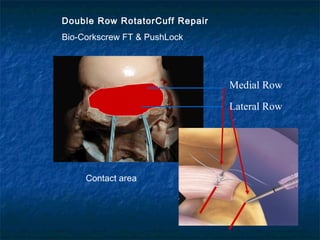
Double Row RotatorCuff Repair
Bio-Corkscrew FT & PushLock
Medial Row
Lateral Row
Contact area
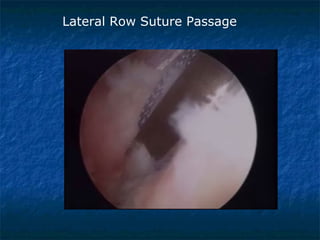
Lateral Row Suture Passage
Inspection from the
Glenohumeral Joint
Mobilization of the Articular
Part of the Rotator Cuff
2nd
suture passage- Medial row - mattress
Knot Tying Lateral Row
Knot Tying Mattress Medial Row
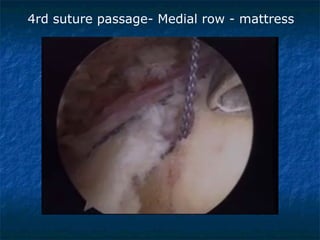
4rd suture passage- Medial row - mattress
suture passage- Medial row – post. anchor
Lateral Row Suture Passage
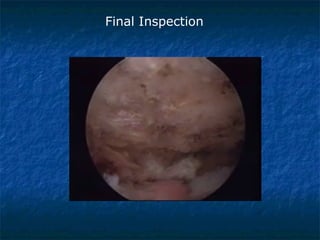
Final Inspection
New ideasNew ideas
Knotless double row repairKnotless double row repair
Double Row RotatorCuff Repair
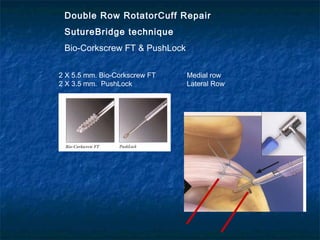
SutureBridge technique
Bio-Corkscrew FT & PushLock
2 X 5.5 mm. Bio-Corkscrew FT Medial row
2 X 3.5 mm. PushLock Lateral Row
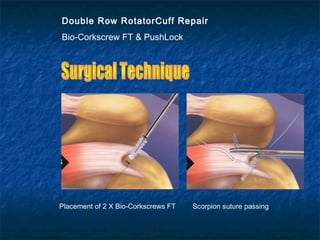
Double Row RotatorCuff Repair
Bio-Corkscrew FT & PushLock
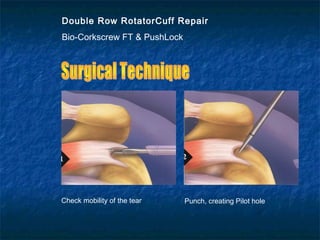
Check mobility of the tear Punch, creating Pilot hole
Double Row RotatorCuff Repair
Bio-Corkscrew FT & PushLock
Placement of 2 X Bio-Corkscrews FT Scorpion suture passing
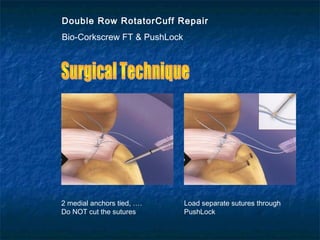
Double Row RotatorCuff Repair
Bio-Corkscrew FT & PushLock
2 medial anchors tied, ….
Do NOT cut the sutures
Load separate sutures through
PushLock
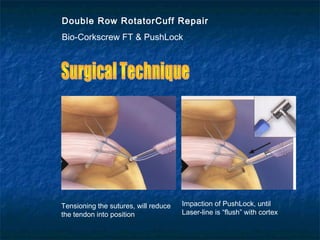
Double Row RotatorCuff Repair
Bio-Corkscrew FT & PushLock
Tensioning the sutures, will reduce
the tendon into position
Impaction of PushLock, until
Laser-line is “flush” with cortex
Double Row RotatorCuff Repair
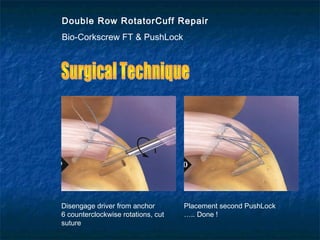
Bio-Corkscrew FT & PushLock
Disengage driver from anchor
6 counterclockwise rotations, cut
suture
Placement second PushLock
….. Done !
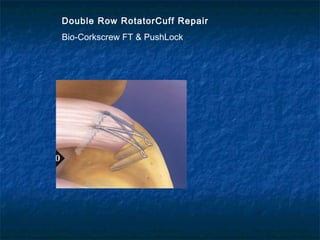
Double Row RotatorCuff Repair
Bio-Corkscrew FT & PushLock
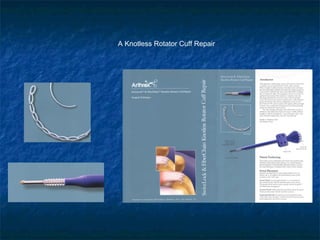
A Knotless Rotator Cuff Repair
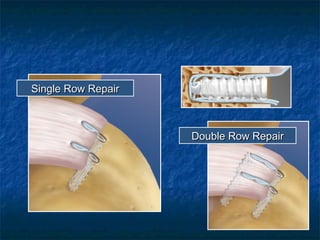
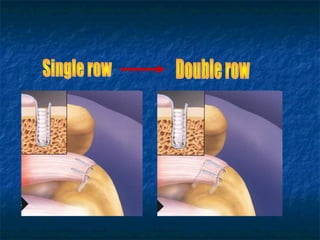
Double Row RepairDouble Row Repair
Single Row RepairSingle Row Repair
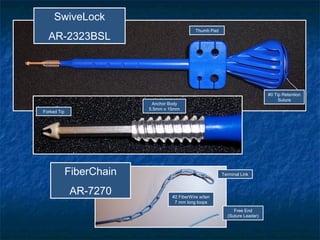
SwiveLock
AR-2323BSL
FiberChain
AR-7270
Thumb Pad
#0 Tip Retention
Suture
Forked Tip
Anchor Body
5.5mm x 15mm
Terminal Link
Free End
(Suture Leader)
#2 FiberWire w/ten
7 mm long loops
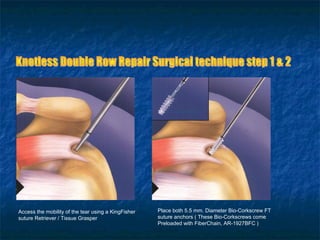
Access the mobility of the tear using a KingFisher
suture Retriever / Tissue Grasper
Place both 5.5 mm. Diameter Bio-Corkscrew FT
suture anchors ( These Bio-Corkscrews come
Preloaded with FiberChain, AR-1927BFC )
AR-1927BFC
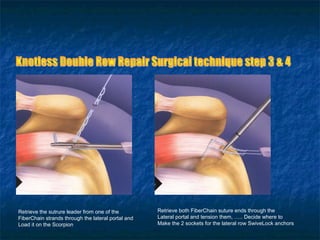
Retrieve the sutrure leader from one of the
FiberChain strands through the lateral portal and
Load it on the Scorpion
Retrieve both FiberChain suture ends through the
Lateral portal and tension them, ….. Decide where to
Make the 2 sockets for the lateral row SwiveLock anchors
Introduce the SwiveLock through the percutanious
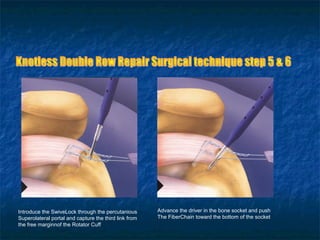
Superolateral portal and capture the third link from
the free marginnof the Rotator Cuff
Advance the driver in the bone socket and push
The FiberChain toward the bottom of the socket
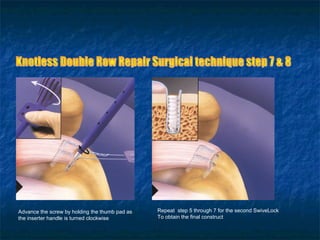
Advance the screw by holding the thumb pad as
the inserter handle is turned clockwise
Repeat step 5 through 7 for the second SwiveLock
To obtain the final construct
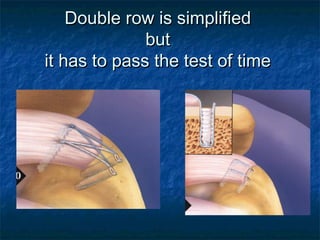
Double row is simplifiedDouble row is simplified
butbut
it has to pass the test of timeit has to pass the test of time
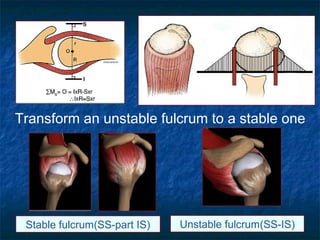
Stable fulcrum(SS-part IS) Unstable fulcrum(SS-IS)
Transform an unstable fulcrum to a stable one
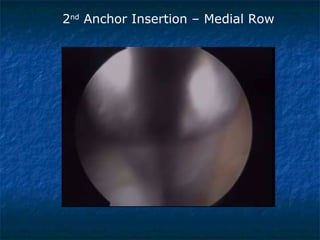
2nd
Anchor Insertion – Medial Row

Massive rot cuf

  • 1.
    M. AntonogiannakisM. Antonogiannakis DirectorDirector Centerfor Shoulder arthroscopyCenter for Shoulder arthroscopy IASO Gen. HospitalIASO Gen. Hospital Athens GreeceAthens Greece Arthroscopic repair ofArthroscopic repair of massive rot cuff tearsmassive rot cuff tears
  • 2.
    Rotator cuff diseaseis a spectrum of clinical conditions, which range from asymptomatic partial thickness tears to symptomatic rotator cuff arthropathy
  • 3.
    Massive Rot CuffTearsMassive Rot Cuff Tears Definition:Definition:  Involving 2 or more Tendon TearsInvolving 2 or more Tendon Tears (Gerber)(Gerber)  >5cm Tear>5cm Tear (Cofield)(Cofield)
  • 4.
    The problemThe problem Poor tendon qualityPoor tendon quality  Muscle tendon retractionMuscle tendon retraction  Muscular atrophy fatty infiltrationMuscular atrophy fatty infiltration The three central issuesThe three central issues  Passive range of motionPassive range of motion  Tendon retractionTendon retraction  Muscle viabilityMuscle viability  Failure of healingFailure of healing
  • 5.
    Techniques of releasesTechniquesof releases  The techniques adapted from openThe techniques adapted from open surgery as described by Codmann,surgery as described by Codmann, Rockwood, NeerRockwood, Neer  Refined and modernized by Esch, Snyder,Refined and modernized by Esch, Snyder, Gartsman, Burkhart and othersGartsman, Burkhart and others
  • 6.
    ANY TYPE OFRECONSTRUCTIONANY TYPE OF RECONSTRUCTION MUST AVOID TENSION OVER-LOADMUST AVOID TENSION OVER-LOAD OF THE REPAIROF THE REPAIR
  • 7.
    The solutionThe solution Improve the mechanical strength of theImprove the mechanical strength of the repairrepair  Enhance the biological responseEnhance the biological response  Abandon and replace-muscle transferAbandon and replace-muscle transfer  Rot cuff arthropathy-reverse or extendedRot cuff arthropathy-reverse or extended head arthroplastyhead arthroplasty
  • 8.
    Recognize the TearRecognizethe Tear PatternPattern  Tears must be repaired in theTears must be repaired in the direction of greatest mobility ->direction of greatest mobility -> minimal strainminimal strain
  • 9.
  • 10.
    Tendon debridement- Tearmorphology recognition
  • 11.
    Tear PatternsTear Patterns Crescent shapedCrescent shaped  L-shaped (or reverse L)L-shaped (or reverse L)  U-ShapedU-Shaped  Massive Contracted Immobile tearsMassive Contracted Immobile tears S.S. BurkhartS.S. Burkhart
  • 12.
  • 13.
    Crescent-Shaped TearCrescent-Shaped Tear Double row repair,Double row repair,
  • 14.
    Double Row Fixation Restorationof the footprint www.shoulder.gr
  • 15.
  • 16.
  • 17.
  • 18.
    suture passage- Medialrow – post. anchor
  • 19.
    Suture inspection –medial row - mattress
  • 20.
  • 21.
  • 22.
  • 23.
  • 24.
    Final Repair Double rowDoublerow Probably stronger repair but Time consuming and of raised difficulty
  • 25.
    L-Shaped & U-ShapedTearsL-Shaped & U-Shaped Tears Greater mobility from anterior toGreater mobility from anterior to posterior than medial to lateralposterior than medial to lateral
  • 26.
    L-Shaped & U-ShapedTearsL-Shaped & U-Shaped Tears  Side to side sutures from medial to lateralSide to side sutures from medial to lateral  Progressively converge the margin of theProgressively converge the margin of the tear lateral to bone bedtear lateral to bone bed  Closing 50% of a U-Shaped tear ->Closing 50% of a U-Shaped tear -> reduces strain at converge margin by areduces strain at converge margin by a factor of 6factor of 6 [[S. S .Burkhart]S. S .Burkhart]
  • 27.
    Closing an L-shapedor U-shaped tear is much like closing a tent flap Closure of an U-shaped tear involves first side-to-side closure of the vertical limb of the tear, then tendon-to-bone closure of the transverse limb L or U -shaped tear S. S .BurkhartS. S .Burkhart
  • 28.
     Large U-shapedcuff tear extending to glenoid  Margin convergence  The free margin of the cuff is repaired to bone with suture anchors
  • 29.
    Side to SideRepair Cuff repair www.shoulder.gr
  • 30.
  • 31.
    Cuff repairCuff repair Tendonto bone repairTendon to bone repair www.shoulder.gr
  • 32.
    Massive Contracted ImmobileMassiveContracted Immobile TearsTears  No mobility from medial to lateral or fromNo mobility from medial to lateral or from anterior to posterioranterior to posterior  Subcategories:Subcategories:  Massive Contracted Longitudinal TearsMassive Contracted Longitudinal Tears  Massive Contracted Crescent TearsMassive Contracted Crescent Tears  Represent 9.6% of massive tearsRepresent 9.6% of massive tears [[S.Burkhart]S.Burkhart]
  • 33.
    Massive Contractite TearsMassiveContractite Tears  Anterior Interval SlideAnterior Interval Slide and/orand/or  Posterior Interval SlidePosterior Interval Slide Single and double interval slideSingle and double interval slide
  • 34.
  • 35.
    Single and doubleintervalSingle and double interval slideslide  Anterior slide through release in theAnterior slide through release in the rotator interval (supraspinatus–rotator interval (supraspinatus– coracobrachialis)coracobrachialis)  Posterior slide through release of thePosterior slide through release of the interval supraspinatus-infraspinatusinterval supraspinatus-infraspinatus
  • 36.
    Free sutures tothe cuffFree sutures to the cuff
  • 37.
  • 38.
  • 39.
  • 40.
    Side to sidesutures
  • 41.
  • 42.
    Massive TearsMassive Tears associatedwithassociated with Subscapularis TearsSubscapularis Tears  Subscapularis must be mobilized andSubscapularis must be mobilized and repaired prior to the rest of the cuffrepaired prior to the rest of the cuff  Interval slide in continuityInterval slide in continuity
  • 43.
  • 44.
  • 45.
  • 46.
  • 47.
    Massive TearsMassive Tears MaybeMay be  Eassily repairableEassily repairable  Retracted very difficult to repair (anterior &Retracted very difficult to repair (anterior & posterior Slides)posterior Slides)  Medially RepairedMedially Repaired  Impossible to repairImpossible to repair  Incomplete RepairIncomplete Repair  Graft JacketsGraft Jackets  Tendon trasfersTendon trasfers  Reverse, extended head arthroplastyReverse, extended head arthroplasty
  • 48.
    Arthroscopic cuff repairArthroscopiccuff repair Wolf, Snyder, Gartsman, Esch, Burkhart, Tauro and others reported 84%-94% excellent and good results
  • 49.
    Results for massivetearsResults for massive tears  95% Good to Excellent Results95% Good to Excellent Results independent to tear sizeindependent to tear size [Burkhart, 2001][Burkhart, 2001]  With interval slideWith interval slide  Improve UCLA score (10->28.3)Improve UCLA score (10->28.3)  Improve Active ROM, StrengthImprove Active ROM, Strength [Burkhart, 2004][Burkhart, 2004]  Graft Jacket RepairGraft Jacket Repair  Improve UCLA score (18->32Improve UCLA score (18->32)) [Snyder, 2008][Snyder, 2008]
  • 50.
    ConclusionsConclusions  Acute CrescentTearAcute Crescent Tear Standard Techniques for tendon to bone fisxationStandard Techniques for tendon to bone fisxation  U- or L- shaped TearsU- or L- shaped Tears  Side to side margin convergenceSide to side margin convergence  Partial mobile tearsPartial mobile tears  Anterior / Posterior SlideAnterior / Posterior Slide  Medialized RepairMedialized Repair  Irreparable TearsIrreparable Tears  Partial RepairPartial Repair  GraftsGrafts  Tendon trasfersTendon trasfers
  • 51.
    What to do???Whatto do???  Patients with grade 3 or 4 fatty degenerationPatients with grade 3 or 4 fatty degeneration DO NOTDO NOT improve with rot cuff repairimprove with rot cuff repair [Goutallier][Goutallier] Vs.Vs.  Patients with grade 3 or 4 fatty degenerationPatients with grade 3 or 4 fatty degeneration improved significant at 86% of cases afterimproved significant at 86% of cases after arthroscopic repairarthroscopic repair [Burkhart][Burkhart]
  • 52.
    In our experienceInour experience Patients withPatients with massivemassive rot cuff tearsrot cuff tears benefitbenefit from surgeryfrom surgery but they tend to recover slowlybut they tend to recover slowly they succeed very good pain reliefthey succeed very good pain relief but strength deficits remainbut strength deficits remain
  • 53.
    In our experienceInour experience  Patients with upward migration of thePatients with upward migration of the femoral head in contact with the acromionfemoral head in contact with the acromion do not benefit from arthroscopydo not benefit from arthroscopy  Patients with painless external rotation lagPatients with painless external rotation lag and inability to keep the arm in externaland inability to keep the arm in external rotation do not benefit from arthoscopyrotation do not benefit from arthoscopy  With raised experience more previousWith raised experience more previous irreparable cuff tears can be repairedirreparable cuff tears can be repaired
  • 55.
  • 56.
  • 57.
    Surgical Technique 1. GHJoint and Subacromial Joint Inspection 2. Bursal debridement 3. Acromioplasty 4. Cuff mobilization 5. Repair (side to side, tendon to bone)
  • 58.
  • 59.
  • 60.
  • 61.
  • 62.
  • 63.
  • 64.
    Tendon debridement- Tearmorphology recognition
  • 65.
  • 66.
    Side to SideRepair Cuff repair
  • 67.
    Cuff repairCuff repair Tendonto bone repairTendon to bone repair
  • 68.
  • 69.
    Arthroscopic repairs donot heal faster Knowledge of biomechanical principles is mandatory in choosing repair type Cuff repair is feasible but technically demanding
  • 70.
    Indications of arthroscopiccuffIndications of arthroscopic cuff repairrepair  Every repairable cuff tear can be repairedEvery repairable cuff tear can be repaired arthroscopic or a cuff that can be repairedarthroscopic or a cuff that can be repaired open can be repaired and arthroscopicopen can be repaired and arthroscopic  The decision to repair a cuff tear open orThe decision to repair a cuff tear open or arhtroscopic depends in the expertise of thearhtroscopic depends in the expertise of the surgeonsurgeon  In the long run there is no discernibleIn the long run there is no discernible difference between mini-open anddifference between mini-open and arthroscopic cuff repairsarthroscopic cuff repairs
  • 71.
    Advantages of ArthroscopicCuff Repair • Atraumatic • Deltoid sparing • Tissue mobilization • Cosmetic incisions • Secure repair • Address accompanying pathology • No iatrogenic injury to healthy tissues • Cost-effective on an outpatient basis
  • 72.
    Disadvantages of ArthroscopicCuff Repair • Technically demanding • Equipment dependent • Steep learning curve Know when to keep dealing or when to pack the cards in and go home
  • 73.
     Bennett WF.Arthroscopic repair of massive rotator cuff tears: aBennett WF. Arthroscopic repair of massive rotator cuff tears: a prospective cohort with 2- to 4-year follow-up.prospective cohort with 2- to 4-year follow-up. Arthroscopy.Arthroscopy. 20032003  Boileau P., Brassart N., Watkinson D.J., Carles M., HatzidakisBoileau P., Brassart N., Watkinson D.J., Carles M., Hatzidakis A.M., Krishnan S.G. Arthroscopic repair of full-thickness tears ofA.M., Krishnan S.G. Arthroscopic repair of full-thickness tears of the supraspinatus: does the tendon really heal? J Bone Jointthe supraspinatus: does the tendon really heal? J Bone Joint Surg Am. 2005Surg Am. 2005  Buess E., Steuber K.U., Waibl B. Open versus arthroscopicBuess E., Steuber K.U., Waibl B. Open versus arthroscopic rotator cuff repair: a comparative view of 96 cases.rotator cuff repair: a comparative view of 96 cases. Arthroscopy. 2005Arthroscopy. 2005  Gartsman G.M., Khan M., Hammerman S.M. ArthroscopicGartsman G.M., Khan M., Hammerman S.M. Arthroscopic repair of full-thickness tears of the rotator cuff.repair of full-thickness tears of the rotator cuff. J Bone JointJ Bone Joint Surg. 1998 Surg. 1998   Rebuzzi E, Coletti N, Schiavetti S, Giusto F. ArthroscopicRebuzzi E, Coletti N, Schiavetti S, Giusto F. Arthroscopic rotator cuff repair in patients older than 60 years.rotator cuff repair in patients older than 60 years. Arthroscopy. 2005Arthroscopy. 2005  Tauro JC. Arthroscopic rotator cuff repair: analysis of techniqueTauro JC. Arthroscopic rotator cuff repair: analysis of technique and results at 2- and 3-year follow-up. Arthroscopy 1998and results at 2- and 3-year follow-up. Arthroscopy 1998  Warner JJ, Tetreault P, Lehtinen J, Zurakowski D. ArthroscopicWarner JJ, Tetreault P, Lehtinen J, Zurakowski D. Arthroscopic versus mini-open rotator cuff repair: a cohort comparisonversus mini-open rotator cuff repair: a cohort comparison Results of atrhroscopic rc repair
  • 74.
    When to ReleaseWhento Release andand When NOT to ReleaseWhen NOT to Release  According to Tear Pattern andAccording to Tear Pattern and MobilityMobility  Test mobility with grasperTest mobility with grasper
  • 75.
    Double Row RotatorCuffRepair Bio-Corkscrew FT & PushLock Medial Row Lateral Row Contact area
  • 76.
  • 77.
  • 78.
    Mobilization of theArticular Part of the Rotator Cuff
  • 79.
  • 80.
  • 81.
  • 82.
  • 83.
  • 84.
    4rd suture passage-Medial row - mattress
  • 85.
    suture passage- Medialrow – post. anchor
  • 86.
  • 87.
  • 88.
    New ideasNew ideas Knotlessdouble row repairKnotless double row repair
  • 89.
    Double Row RotatorCuffRepair SutureBridge technique Bio-Corkscrew FT & PushLock 2 X 5.5 mm. Bio-Corkscrew FT Medial row 2 X 3.5 mm. PushLock Lateral Row
  • 90.
    Double Row RotatorCuffRepair Bio-Corkscrew FT & PushLock Check mobility of the tear Punch, creating Pilot hole
  • 91.
    Double Row RotatorCuffRepair Bio-Corkscrew FT & PushLock Placement of 2 X Bio-Corkscrews FT Scorpion suture passing
  • 92.
    Double Row RotatorCuffRepair Bio-Corkscrew FT & PushLock 2 medial anchors tied, …. Do NOT cut the sutures Load separate sutures through PushLock
  • 93.
    Double Row RotatorCuffRepair Bio-Corkscrew FT & PushLock Tensioning the sutures, will reduce the tendon into position Impaction of PushLock, until Laser-line is “flush” with cortex
  • 94.
    Double Row RotatorCuffRepair Bio-Corkscrew FT & PushLock Disengage driver from anchor 6 counterclockwise rotations, cut suture Placement second PushLock ….. Done !
  • 95.
    Double Row RotatorCuffRepair Bio-Corkscrew FT & PushLock
  • 96.
    A Knotless RotatorCuff Repair
  • 97.
    Double Row RepairDoubleRow Repair Single Row RepairSingle Row Repair
  • 98.
    SwiveLock AR-2323BSL FiberChain AR-7270 Thumb Pad #0 TipRetention Suture Forked Tip Anchor Body 5.5mm x 15mm Terminal Link Free End (Suture Leader) #2 FiberWire w/ten 7 mm long loops
  • 100.
    Access the mobilityof the tear using a KingFisher suture Retriever / Tissue Grasper Place both 5.5 mm. Diameter Bio-Corkscrew FT suture anchors ( These Bio-Corkscrews come Preloaded with FiberChain, AR-1927BFC ) AR-1927BFC
  • 101.
    Retrieve the sutrureleader from one of the FiberChain strands through the lateral portal and Load it on the Scorpion Retrieve both FiberChain suture ends through the Lateral portal and tension them, ….. Decide where to Make the 2 sockets for the lateral row SwiveLock anchors
  • 102.
    Introduce the SwiveLockthrough the percutanious Superolateral portal and capture the third link from the free marginnof the Rotator Cuff Advance the driver in the bone socket and push The FiberChain toward the bottom of the socket
  • 103.
    Advance the screwby holding the thumb pad as the inserter handle is turned clockwise Repeat step 5 through 7 for the second SwiveLock To obtain the final construct
  • 104.
    Double row issimplifiedDouble row is simplified butbut it has to pass the test of timeit has to pass the test of time
  • 105.
    Stable fulcrum(SS-part IS)Unstable fulcrum(SS-IS) Transform an unstable fulcrum to a stable one
  • 106.