PREOP PLANNING DISCUSSION
Old unreduced anterior shoulder
dislocation
Dr ARJUN K
Resident dept of orthopaedics
Unit C
LHMC
60 yr old lady with right hand dominant ,house maker
by occupation resident of delhi came to Ortho opd
with c/o
pain left shoulder and decrease in left shoulder
movement X 25 DAYS
A/H/o fall from stairs at her residence and
sustained injury to left shoulder 25 days prior
to the presentation.
• c/o pain left shoulder + since then
• Acute onset
• Initially progressively increased in intensity
then gradually reduced but still persisting in
mild severity
• Non radiating
• Aggrevated by shoulder movements
• Relieved partially by rest and analgesics
• Limitation of movement of left arm and swelling in
the axilla and front of the shoulder.
• Not able to lift the weight
• Not able to lift the hand above the head level
No ho numbness / weakness in the upperlimb
No ho any breathlessness or cough
No ho LOC,vomitting, seizure , ENT bleed
No ho any other joint pain or trauma to any other
part of the body
Past history
• No previous episodes of shoulder dislocation
or # around the shoulder
• No ho DM ,HTN, TB, ASTMA or any chronic
drug use
Examination
• Gc fair
• Afebrile
• Vitals stable
• No signs of generalised ligamentous laxity
• Beighton score joint hypermobility
• Swelling :
bulge + anterior and lateral edge of acromion
• Tenderness
#GT (33%)
Rotator cuff tear( 40% in less than 60 yrs
80% in more than 60 yrs of age)
Prox humerus #
• Crepitus
• Neurovascular deficits(13- 65%)
Axillary N more then Musculocutaneous N
• Deformity
RESTRICTED
• ABD+ IR : ANTERIOR DISLOCATION
• ADD+ ER: POSTERIOR DISLOCATION
• Dugas test
• Hamilton ruler test
Posterior dislocation
(< 5% all shoulder dislocations)
• Comcomittant fracture/ multiple injury
• Unresponsive
• Intubated/ sedated/ alcohol
• Shock/ seizure
STABILITY
INVESTIGATIONS
• XRAY
• CT SCAN
• MRI
X ray views
• Ap
• True ap ,Grashey view( 35- 40 oblique to sagital)
• Valpeau axillary
• Trauma axillary
• West point view( for glenoid rim #- in prone
positon)
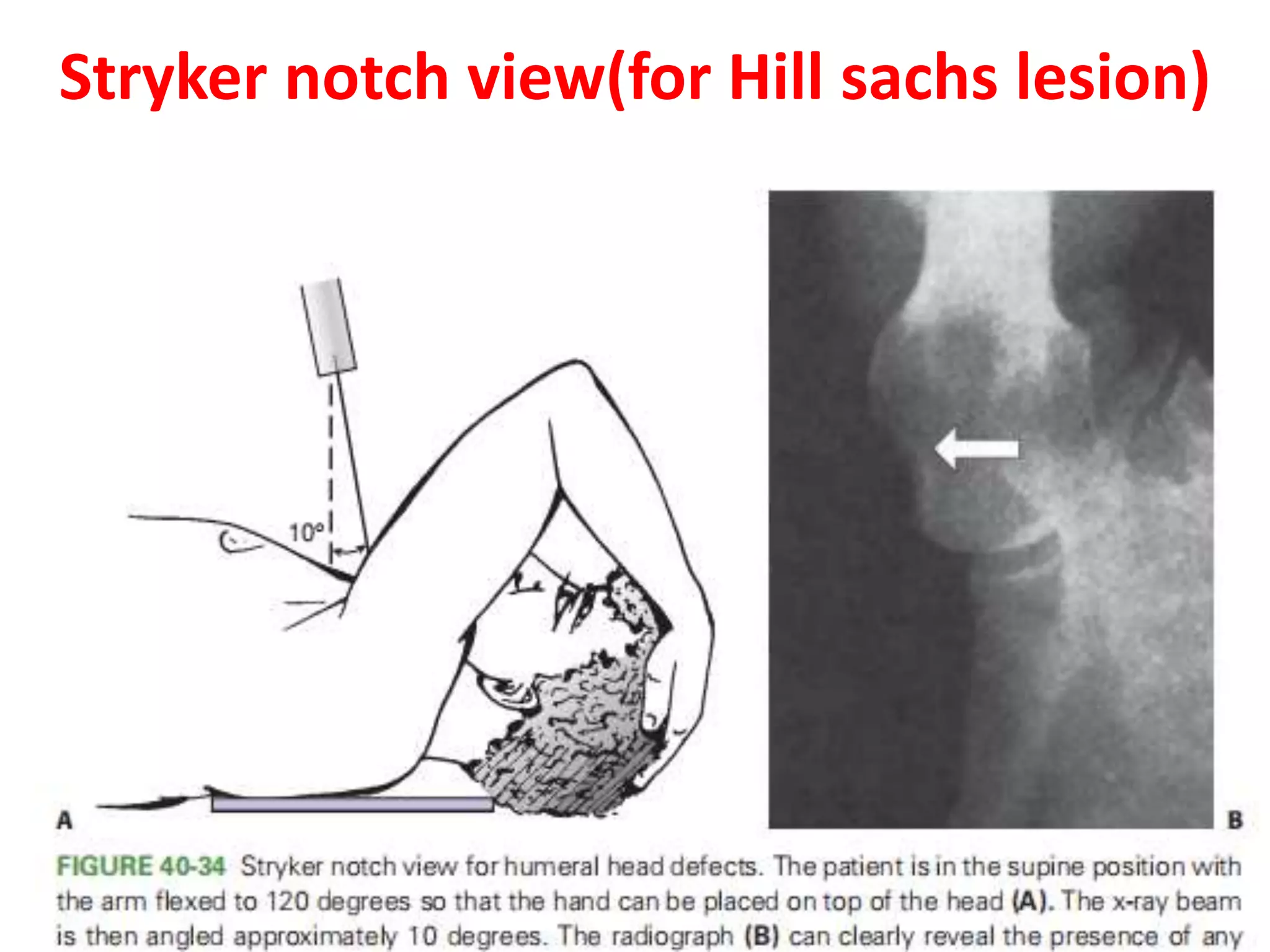
• Stryker notch view(for Hill sachs lesion)
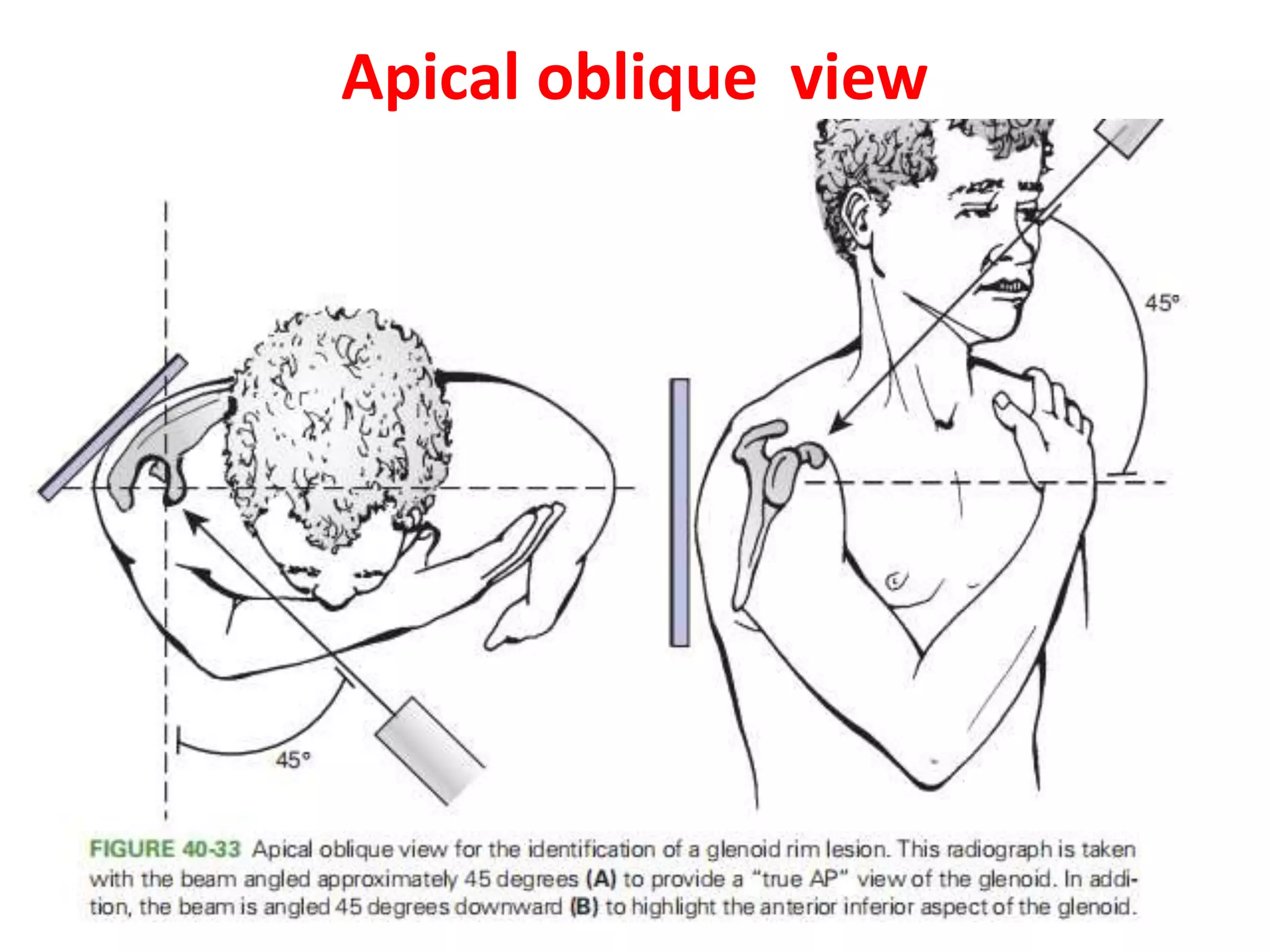
• Apical oblique view
AXILLARY LATERAL
AXILLARY LATERAL
Valpeau axillary
V –Y VIEW
Scapular y view
Stryker notch view(for Hill sachs lesion)
Apical oblique view
CT SCAN ( ideal for bony lesion)
• 3D reconstruction
• Size of gelnoid # segment
• # proximal humerous
• Hill sach lesion
GLENOID BONE LOSS
GOLD STANDARD TEST CT 3D RECONSTRUCTION
% BONE LOSS
=
RADIUS OF BEST FIT CIRCLE - DISTANCE FROM CEMNTER TO ANTERIOR DEFECT
DIAMETER OF THE BEST FIT CIRCLE
MRI
• Rotator cuff tear
• Humeral avulsions of gleno humeral ligament.
• MRI ARTHROGRAM ( IOC)
TREATMENT OPTIONS
• NO TREATMENT
• CLOSED REDUCTION(+/- ARTHROSCOPY ASSISTED)
• ORIF
• HEMIARTHROPLASTY
• SHOULDER TOTAL ARTHROPLASTY
No treatment
• Dementia
• Very old age( too sick for surgery)
• Low demand
• Good shoulder function and no pain
CLOSED REDUCTION
ASESS
• AGE
• OSTEOPOROSIS (disuse osteopenia)
• VASCULAR STATUS ( axillary artery)
• DURATION OF TRAUMA (3- 4 weeks)
Closed reduction should be considered carefully
after 4 weeks because
• Fibrous tissue in the glenoid cavity
• Retracted rotator cuff muscle
• Soft tissue contractures
Not indicated in
• Impression defect involving more than 20% of
articular surface
• dislocated for more than 4 weeks
• If at all done do under GA
Chance of axillary artery repture+
• Immobilise for 3-4 weeks
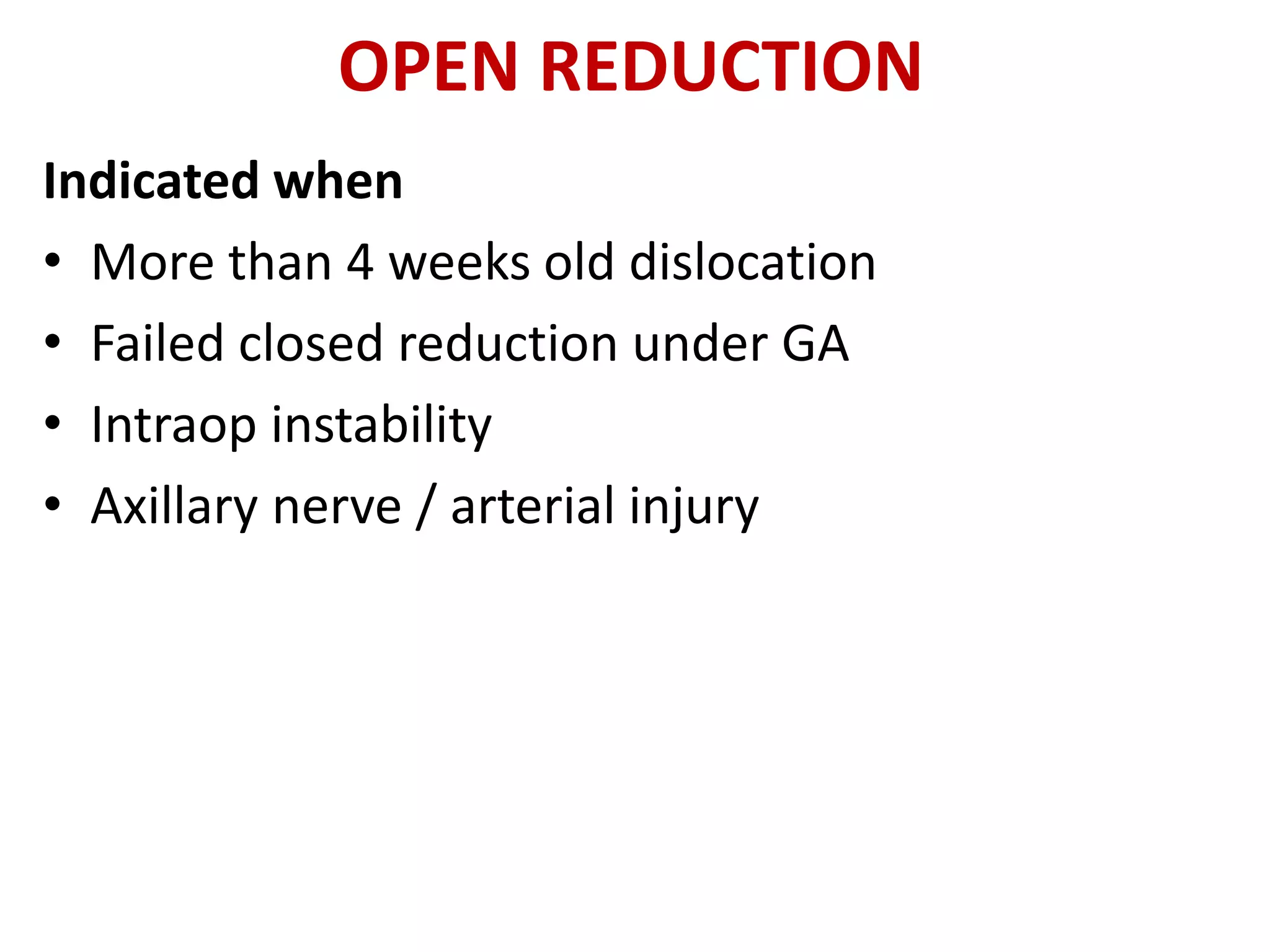
OPEN REDUCTION
Indicated when
• More than 4 weeks old dislocation
• Failed closed reduction under GA
• Intraop instability
• Axillary nerve / arterial injury
OPEN REDUCTION
 Difficulty Encountered due to
• Replacing humeral head because of fibrosis
• Shortening of muscles
• Contracture
• Bowstringing of capsule across the glenoid
• Defect in humeral head
 Difficulty in maintaing the reduction because
of instability
• Subscapularis tenotomy
• Extensive posterior capsular release
• Excision of intra articular portion of long head of
biceps and tenodese with P . MAJOR
Bony / soft tissue recontruction procedure may be
needed for managing intra op instability
• Bankart procedure
• Latarjet procedure
• Iliac crest BG
• Allograft BG
How to treat the humeral head defect in
old unreduced dislocations
1 . Filling the defect using sub scapularis tendon
2. Elevation + bone grafting( cab be used in defects
upto 40%)
3. Hill sachs defect more than 45% -complete
humeral head replacement
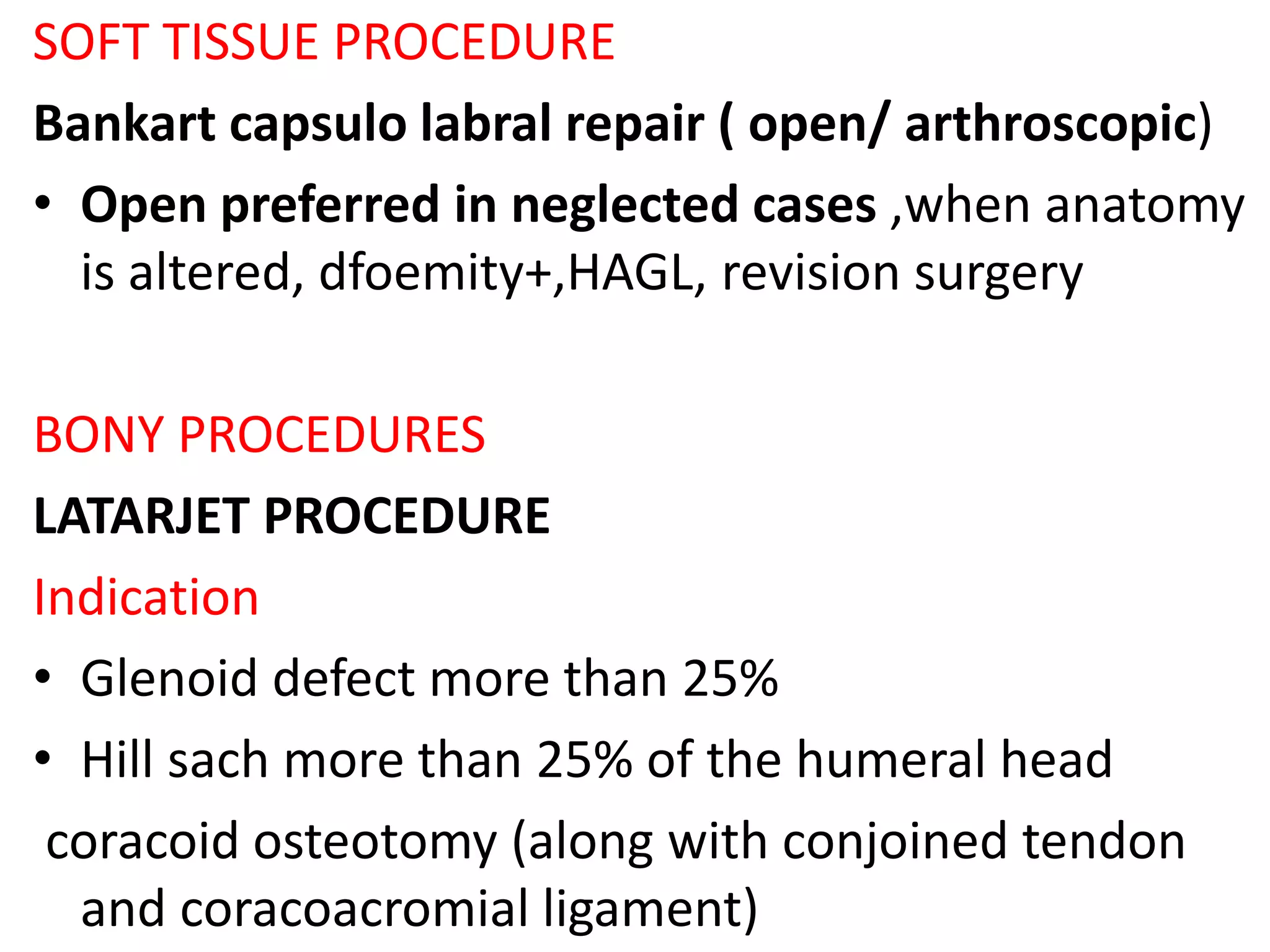
SOFT TISSUE PROCEDURE
Bankart capsulo labral repair ( open/ arthroscopic)
• Open preferred in neglected cases ,when anatomy
is altered, dfoemity+,HAGL, revision surgery
BONY PROCEDURES
LATARJET PROCEDURE
Indication
• Glenoid defect more than 25%
• Hill sach more than 25% of the humeral head
coracoid osteotomy (along with conjoined tendon
and coracoacromial ligament)
Internal fixation
SWISS SCREW K WIRES
ACROMIAN TO HUMERAL HEAD
(WILSON AND McKEEVER)
Post op management after ORIF
PROTECTED ORTHOSIS X 6 WEEKS
• ROM STARTS AT 6 WEEKS
SHOULDER STRENGTHENING AT 3 MONTHS
ONWARDS
Hemiarthroplasty
• Less than 50 yrs with good glenoid cartilage
• If the duration is more than 6 months
• Large defect more than 45%
TOTAL SHOULDER ARTHROPLASTY
• Old patients with significant glenoid changes
• bone graft may be necessary if extensive
erosion of the posterior margin of the glenoid fossa
REVERSE SHOULDER ARTHROPLASTY
ELDERLY PATIENTS IF
A) rotator cuff defieciency
B) persistent instability
• Rouhani and Nawali
• Anterior capsular repair for chr. Ant. D/L (mean
1 yr follow up – 8 patients)
1 fair, 3 good, 4 excellent
avg Rowe & Zarin score :86
J Shoulder Elbow Surg 2003;12:446-50.)
No recurrent
dislocations
2 fair
5 good
3 excellent results
Neglected shoulder  dislocation management

Neglected shoulder dislocation management

  • 1.
    PREOP PLANNING DISCUSSION Oldunreduced anterior shoulder dislocation Dr ARJUN K Resident dept of orthopaedics Unit C LHMC
  • 2.
    60 yr oldlady with right hand dominant ,house maker by occupation resident of delhi came to Ortho opd with c/o pain left shoulder and decrease in left shoulder movement X 25 DAYS
  • 3.
    A/H/o fall fromstairs at her residence and sustained injury to left shoulder 25 days prior to the presentation. • c/o pain left shoulder + since then • Acute onset • Initially progressively increased in intensity then gradually reduced but still persisting in mild severity • Non radiating • Aggrevated by shoulder movements • Relieved partially by rest and analgesics
  • 4.
    • Limitation ofmovement of left arm and swelling in the axilla and front of the shoulder. • Not able to lift the weight • Not able to lift the hand above the head level No ho numbness / weakness in the upperlimb No ho any breathlessness or cough No ho LOC,vomitting, seizure , ENT bleed No ho any other joint pain or trauma to any other part of the body
  • 5.
    Past history • Noprevious episodes of shoulder dislocation or # around the shoulder • No ho DM ,HTN, TB, ASTMA or any chronic drug use
  • 6.
    Examination • Gc fair •Afebrile • Vitals stable • No signs of generalised ligamentous laxity • Beighton score joint hypermobility
  • 8.
    • Swelling : bulge+ anterior and lateral edge of acromion • Tenderness #GT (33%) Rotator cuff tear( 40% in less than 60 yrs 80% in more than 60 yrs of age) Prox humerus # • Crepitus
  • 9.
    • Neurovascular deficits(13-65%) Axillary N more then Musculocutaneous N • Deformity RESTRICTED • ABD+ IR : ANTERIOR DISLOCATION • ADD+ ER: POSTERIOR DISLOCATION • Dugas test • Hamilton ruler test
  • 11.
    Posterior dislocation (< 5%all shoulder dislocations) • Comcomittant fracture/ multiple injury • Unresponsive • Intubated/ sedated/ alcohol • Shock/ seizure
  • 12.
  • 13.
  • 14.
    X ray views •Ap • True ap ,Grashey view( 35- 40 oblique to sagital) • Valpeau axillary • Trauma axillary • West point view( for glenoid rim #- in prone positon) • Stryker notch view(for Hill sachs lesion) • Apical oblique view
  • 17.
  • 18.
  • 19.
  • 20.
  • 21.
  • 22.
    Stryker notch view(forHill sachs lesion)
  • 23.
  • 24.
    CT SCAN (ideal for bony lesion) • 3D reconstruction • Size of gelnoid # segment • # proximal humerous • Hill sach lesion GLENOID BONE LOSS GOLD STANDARD TEST CT 3D RECONSTRUCTION
  • 25.
    % BONE LOSS = RADIUSOF BEST FIT CIRCLE - DISTANCE FROM CEMNTER TO ANTERIOR DEFECT DIAMETER OF THE BEST FIT CIRCLE
  • 27.
    MRI • Rotator cufftear • Humeral avulsions of gleno humeral ligament. • MRI ARTHROGRAM ( IOC)
  • 28.
    TREATMENT OPTIONS • NOTREATMENT • CLOSED REDUCTION(+/- ARTHROSCOPY ASSISTED) • ORIF • HEMIARTHROPLASTY • SHOULDER TOTAL ARTHROPLASTY
  • 29.
    No treatment • Dementia •Very old age( too sick for surgery) • Low demand • Good shoulder function and no pain
  • 30.
    CLOSED REDUCTION ASESS • AGE •OSTEOPOROSIS (disuse osteopenia) • VASCULAR STATUS ( axillary artery) • DURATION OF TRAUMA (3- 4 weeks) Closed reduction should be considered carefully after 4 weeks because • Fibrous tissue in the glenoid cavity • Retracted rotator cuff muscle • Soft tissue contractures
  • 31.
    Not indicated in •Impression defect involving more than 20% of articular surface • dislocated for more than 4 weeks • If at all done do under GA Chance of axillary artery repture+ • Immobilise for 3-4 weeks
  • 32.
    OPEN REDUCTION Indicated when •More than 4 weeks old dislocation • Failed closed reduction under GA • Intraop instability • Axillary nerve / arterial injury
  • 33.
    OPEN REDUCTION  DifficultyEncountered due to • Replacing humeral head because of fibrosis • Shortening of muscles • Contracture • Bowstringing of capsule across the glenoid • Defect in humeral head  Difficulty in maintaing the reduction because of instability
  • 34.
    • Subscapularis tenotomy •Extensive posterior capsular release • Excision of intra articular portion of long head of biceps and tenodese with P . MAJOR Bony / soft tissue recontruction procedure may be needed for managing intra op instability • Bankart procedure • Latarjet procedure • Iliac crest BG • Allograft BG
  • 35.
    How to treatthe humeral head defect in old unreduced dislocations 1 . Filling the defect using sub scapularis tendon 2. Elevation + bone grafting( cab be used in defects upto 40%) 3. Hill sachs defect more than 45% -complete humeral head replacement
  • 36.
    SOFT TISSUE PROCEDURE Bankartcapsulo labral repair ( open/ arthroscopic) • Open preferred in neglected cases ,when anatomy is altered, dfoemity+,HAGL, revision surgery BONY PROCEDURES LATARJET PROCEDURE Indication • Glenoid defect more than 25% • Hill sach more than 25% of the humeral head coracoid osteotomy (along with conjoined tendon and coracoacromial ligament)
  • 37.
    Internal fixation SWISS SCREWK WIRES ACROMIAN TO HUMERAL HEAD (WILSON AND McKEEVER)
  • 38.
    Post op managementafter ORIF PROTECTED ORTHOSIS X 6 WEEKS • ROM STARTS AT 6 WEEKS SHOULDER STRENGTHENING AT 3 MONTHS ONWARDS
  • 39.
    Hemiarthroplasty • Less than50 yrs with good glenoid cartilage • If the duration is more than 6 months • Large defect more than 45%
  • 40.
    TOTAL SHOULDER ARTHROPLASTY •Old patients with significant glenoid changes • bone graft may be necessary if extensive erosion of the posterior margin of the glenoid fossa REVERSE SHOULDER ARTHROPLASTY ELDERLY PATIENTS IF A) rotator cuff defieciency B) persistent instability
  • 41.
    • Rouhani andNawali • Anterior capsular repair for chr. Ant. D/L (mean 1 yr follow up – 8 patients) 1 fair, 3 good, 4 excellent avg Rowe & Zarin score :86
  • 42.
    J Shoulder ElbowSurg 2003;12:446-50.) No recurrent dislocations 2 fair 5 good 3 excellent results