Shoulder 
Instability 
DR MANDEEP SINGH 
Moderators 
Dr. A Pathak 
Dr. A Ganvir
WHAT IS INSTABILITY? 
During the use of normal shoulder,humeral head is 
centered within the glenoid and coracoacromial arch 
When the shoulder cannot maintain this centered 
position it is said to be unstable 
It is not the same as joint laxity allows the shoulder to 
attain its full range of functional positions while an 
unstable shoulder prevents normal function of that 
upper extremity
Factors contributing to shoulder 
stability 
1. STATIC FACTORS 
2. DYNAMIC FACTORS
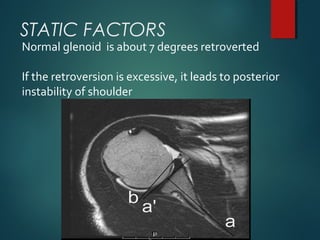
STATIC FACTORS 
Normal glenoid is about 7 degrees retroverted 
If the retroversion is excessive, it leads to posterior 
instability of shoulder
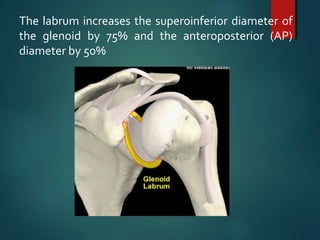
The labrum increases the superoinferior diameter of 
the glenoid by 75% and the anteroposterior (AP) 
diameter by 50%
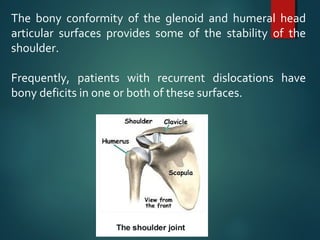
The bony conformity of the glenoid and humeral head 
articular surfaces provides some of the stability of the 
shoulder. 
Frequently, patients with recurrent dislocations have 
bony deficits in one or both of these surfaces.
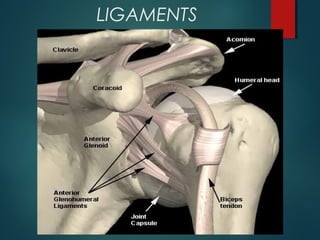
LIGAMENTS
• Superior Glenohumeral ligament : Most important 
check at zero degrees of abduction 
• Middle Glenohumeral Ligament : Most important 
check at middle ranges of abduction 
•Inferior Glenohumeral ligament : Most important 
check at more than 45 degrees of abduction
DYNAMIC FACTORS 
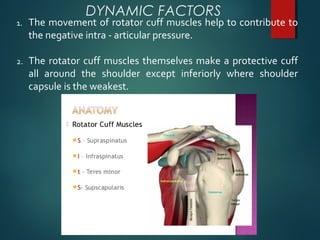
1. The movement of rotator cuff muscles help to contribute to 
the negative intra - articular pressure. 
2. The rotator cuff muscles themselves make a protective cuff 
all around the shoulder except inferiorly where shoulder 
capsule is the weakest.
Other factors : 
1.Muscles around the shoulder 
- Levator scapulae 
- Rhomboids 
-Trapezius 
2. Biceps Brachii 
3. Proprioceptors
PATHOLOGICAL 
ANATOMY 
LABRAL LESIONS : 
1.Bankart lesion 
2.Reverse Bankart 
lesion 
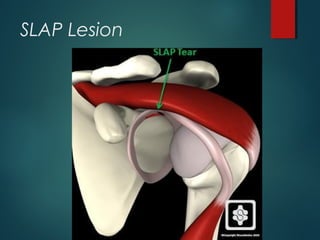
3.SLAP Lesion 

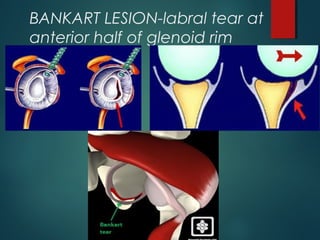
BANKART LESION-labral tear at 
anterior half of glenoid rim
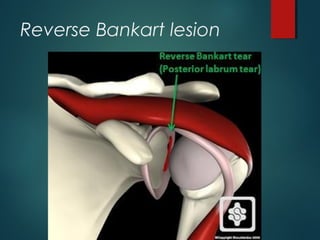
Reverse Bankart lesion
SLAP Lesion
CAPSULAR LESIONS: 
1. Intra Substance Tear 
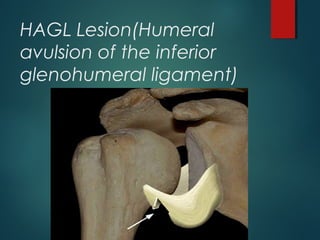
2. HAGL Lesion 
3. Repetitive Micro Trauma 
4. Excessive capsular laxity
HAGL Lesion(Humeral 
avulsion of the inferior 
glenohumeral ligament)
Repetitive Micro trauma
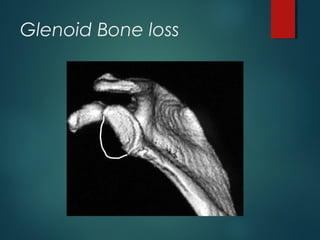
Glenoid Bone loss
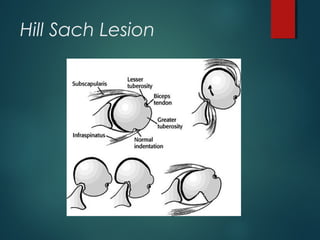
Hill Sach Lesion
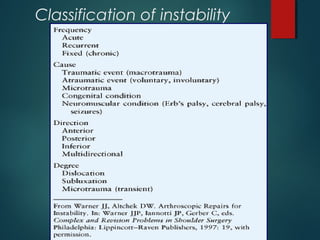
Classification of instability
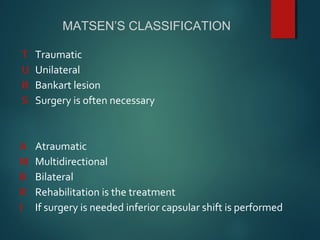
MATSEN’S CLASSIFICATION 
T Traumatic 
U Unilateral 
B Bankart lesion 
S Surgery is often necessary 
A Atraumatic 
M Multidirectional 
B Bilateral 
R Rehabilitation is the treatment 
I If surgery is needed inferior capsular shift is performed
History 
Define mechanism 
 Position of arm 
 Point of force 
 Amount of force 
Electric Shock /Seizure
CLINICAL EXAMINATION 
LOOK 
FEEL 
MOVE 
SPECIAL TESTS
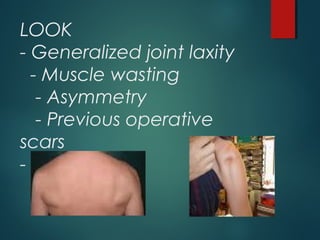
LOOK 
- Generalized joint laxity 
- Muscle wasting 
- Asymmetry 
- Previous operative 
scars 
- Ecchymosis
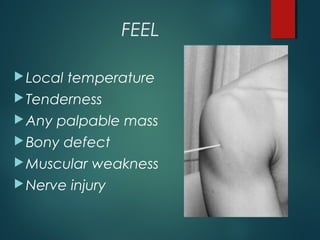
FEEL 
Local temperature 
Tenderness 
Any palpable mass 
Bony defect 
Muscular weakness 
Nerve injury
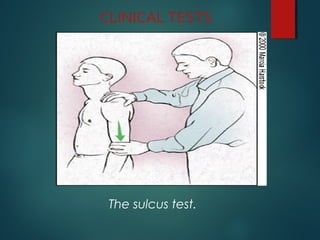
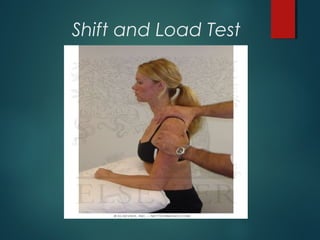
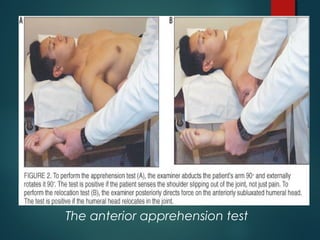
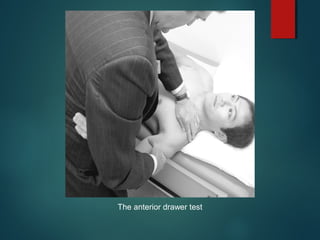
CLINICAL TESTS 
The sulcus test.
Shift and Load Test
The anterior apprehension test
The anterior drawer test
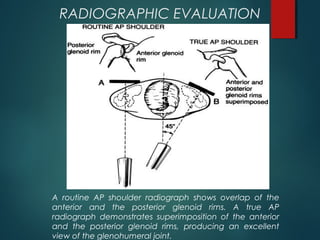
RADIOGRAPHIC EVALUATION 
A routine AP shoulder radiograph shows overlap of the 
anterior and the posterior glenoid rims. A true AP 
radiograph demonstrates superimposition of the anterior 
and the posterior glenoid rims, producing an excellent 
view of the glenohumeral joint.
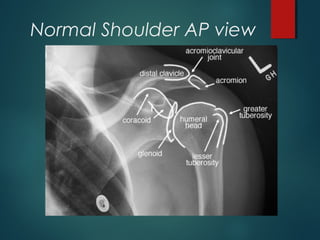
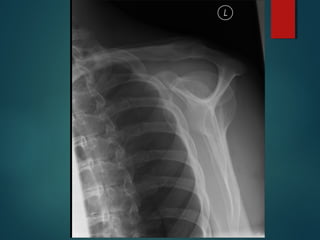
Normal Shoulder AP view
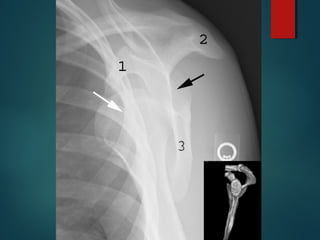
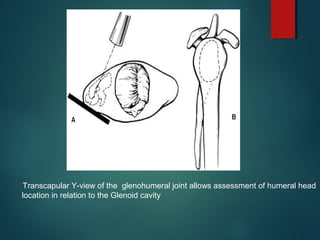
Transcapular Y-view of the glenohumeral joint allows assessment of humeral head 
location in relation to the Glenoid cavity
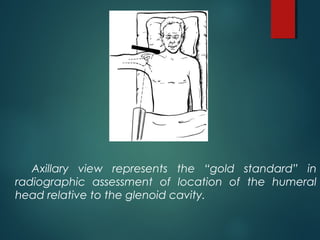
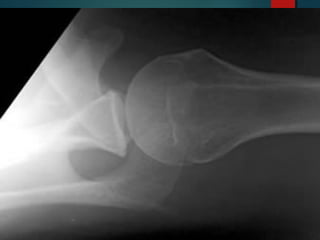
Axillary view represents the “gold standard” in 
radiographic assessment of location of the humeral 
head relative to the glenoid cavity.
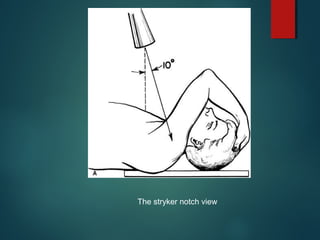
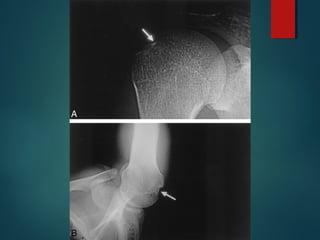
The stryker notch view
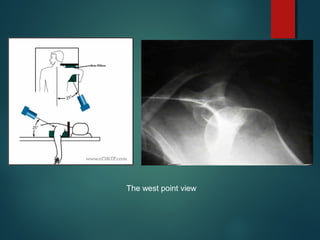
The west point view
QUESTIONS TO BE ANSWERED WHILE 
EVALUATING A PATIENT 
 Is the problem in the glenohumeral joint ? 
 Is the problem one of failure to maintain the humeral head in its 
centered position ? 
 What mechanical factors are contributing to the instability ? 
 Are these factors amenable to surgical repair or reconstruction ?
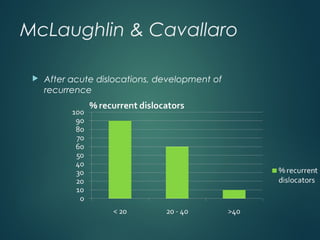
McLaughlin & Cavallaro 
 After acute dislocations, development of 
recurrence
Rowe and Sakellarides 
 Frequent dislocations in young athletes 
 Duration of immobilization does not affect 
recurrence rates
Burkhart and Debeer; 
Sugaya et al; Itoi et al 
 Glenoid bone loss more than 20% leads to shoulder 
instability
RATIONALE FOR TREATMENT 
2 important factors favoring surgical treatment 
YOUNG AGE 
HIGH ACTIVITY LEVEL
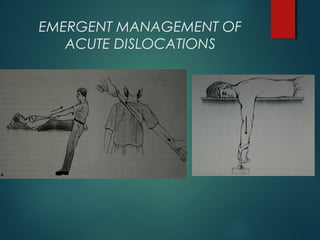
EMERGENT MANAGEMENT OF 
ACUTE DISLOCATIONS
NON-OPEREATIVE TREATMENT 
 A trial of non-operative treatment is recommended for the following 
group of patients-a) 
All patients who sustained a traumatic first time dislocation regardless 
of age 
b) Patients > 40 yrs with recurrent instability 
c) All patients with atraumatic instability
NON-OPERATIVE TREATMENT PROTOCOL 
 All patients< 30 yrs shoulder immobilized for 3 wks 
 Patients 30-40yrs shoulder immobilized for 1-2 wks 
 Patients >40 yrs the shoulder immobilized for 1 
wks 
 Atraumatic instability- immobilization not 
required 
 Patients with anterior instability-limit ext. rotation 
to 30 deg. and abd. to < 60 deg. 
Patients with posterior instability- avoid flex.>60 
deg. and int. rotation > 30 deg.
INDICATIONS FOR OPERATIVE TREATMENT IN 
INSTABILITY 
 Failure of non operative therapy 
 Young adult with high functional demands 
 Irreducible dislocation 
 Open dislocation
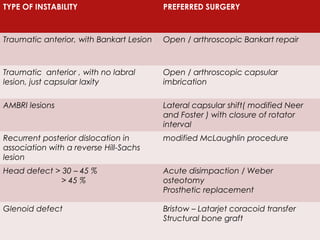
TREATMENT OPTIONS TYPE OF INSTABILITY PREFERRED SURGERY 
Traumatic anterior, with Bankart Lesion Open / arthroscopic Bankart repair 
Traumatic anterior , with no labral 
lesion, just capsular laxity 
Open / arthroscopic capsular 
imbrication 
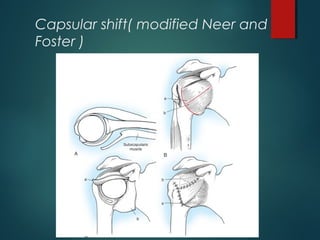
AMBRI lesions Lateral capsular shift( modified Neer 
and Foster ) with closure of rotator 
interval 
Recurrent posterior dislocation in 
association with a reverse Hill-Sachs 
lesion 
modified McLaughlin procedure 
Head defect > 30 – 45 % 
> 45 % 
Acute disimpaction / Weber 
osteotomy 
Prosthetic replacement 
Glenoid defect Bristow – Latarjet coracoid transfer 
Structural bone graft
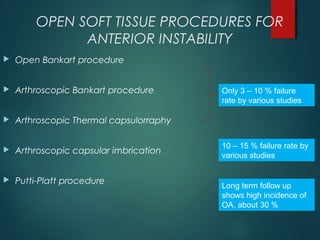
OPEN SOFT TISSUE PROCEDURES FOR 
ANTERIOR INSTABILITY 
 Open Bankart procedure 
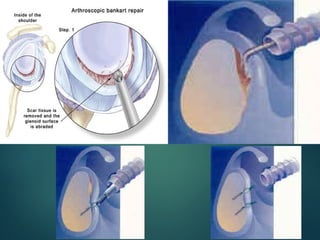
 Arthroscopic Bankart procedure 
 Arthroscopic Thermal capsulorraphy 
 Arthroscopic capsular imbrication 
 Putti-Platt procedure 
Only 3 – 10 % failure 
rate by various studies 
10 – 15 % failure rate by 
various studies 
Long term follow up 
shows high incidence of 
OA, about 30 %
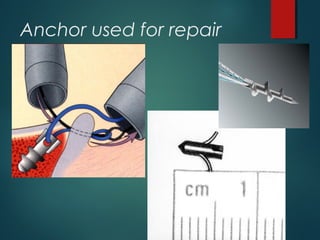
Anchor used for repair
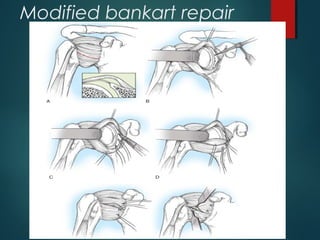
Modified bankart repair
OPEN BONY PROCEDURES FOR ANTERIOR 
INSTABILITY 
Bristow procedure 
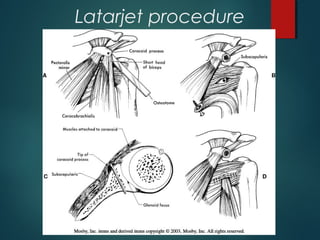
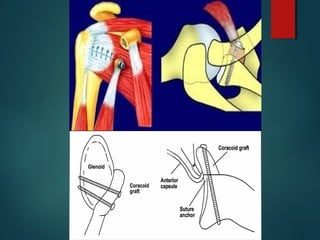
Latarjet procedure
Latarjet procedure
AMBRII Lesions-Idea of 
management 
 Primary treatment nonoperative 
 Operative management recommended for 
patients who have continued pain or 
disability despite an adequate rehabilitation 
 The gold standard is open stabilization
Capsular shift( modified Neer and 
Foster )
POSTERIOR INSTABILITY-A 
general overview 
 Rare 
 Often missed 
 Often has a component of muscle 
imbalance 
 Indication for operative treatment is 
generally continued problems despite 
rehab.
Procedures 
Procedure Description Results 
Neer’s Capsulorrraphy Posterior capsular 
tightening 
Generally unsatisfactory, 
upto 50 % recurrence 
Staple capsulorraphy Tightening done with 
staples 
Small study group 
Tieborne and bradley 
procedure 
Capsular Imbrication with 
a horizontal T approach 
Upto 20 % recurrence 
Hawkins and Janda 
procedure 
Subscapularis 
advancement and 
shortening 
0 – 5 % recurrence 
Rockwood Glenloid 
Plasty with Biceps 
Tenodesis to the posterior 
capsule 
Combined bony and soft 
tissue procedure 
Not often done
ARTHROSCOPIC PROCEDURES FOR 
POSTERIOR INSTABILITY 
 Posterior capsulolabral 
reattachment with the help of 
suture anchors 
 Arthroscopic posterior 
capsulorrhaphy
OPEN ANTERIOR PROCEDURES FOR 
POSTERIOR INSTABILITY 
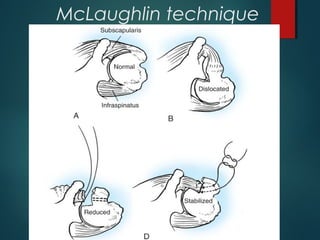
McLaughlin procedure 
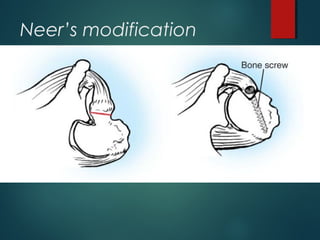
 Neers modification of McLaughlin procedure
McLaughlin technique 
 subscapularis
Neer’s modification
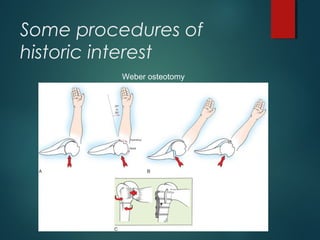
Some procedures of 
historic interest 
Weber osteotomy
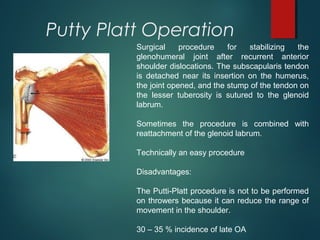
Putty Platt Operation 
Surgical procedure for stabilizing the 
glenohumeral joint after recurrent anterior 
shoulder dislocations. The subscapularis tendon 
is detached near its insertion on the humerus, 
the joint opened, and the stump of the tendon on 
the lesser tuberosity is sutured to the glenoid 
labrum. 
Sometimes the procedure is combined with 
reattachment of the glenoid labrum. 
Technically an easy procedure 
Disadvantages: 
The Putti-Platt procedure is not to be performed 
on throwers because it can reduce the range of 
movement in the shoulder. 
30 – 35 % incidence of late OA
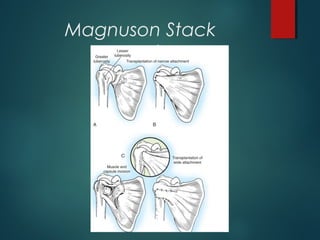
Magnuson Stack 
procedure
ADVANTAGES AND DISADVANTAGES OF 
ARTHROSCOPIC STABILIZATION 
 ADVANTAGES DISADVANTAGES 
-Improved cosmesis -Technically demanding 
-Shorter operative time -Difficult in revision case 
-Short hospital stay -Difficult in altered anatomy 
-Decreased morbidity -Cannot address bony 
defect 
-Decreased complication 
-Lower cost
PHASES OF REHABILITATION 
 Phase I Rest and immobilization. Pain control with 
nonsteroidal anti-inflammatory drugs and ice 
applied to the shoulder 
 Phase II Isometric strengthening Isotonic 
strengthening. Begin exercises with shoulder in 
adducted, forward- flexed position, progressing to 
abducted position 
 Phase III Endurance building along with 
strengthening exercises. Goal: the patient reaches 
90% strength in the injured shoulder compared 
with the uninjured shoulder 
 Phase IV Increase activity to sport- or job-specific 
activities
THANK YOU

Shoulder instability

  • 1.
    Shoulder Instability DRMANDEEP SINGH Moderators Dr. A Pathak Dr. A Ganvir
  • 2.
    WHAT IS INSTABILITY? During the use of normal shoulder,humeral head is centered within the glenoid and coracoacromial arch When the shoulder cannot maintain this centered position it is said to be unstable It is not the same as joint laxity allows the shoulder to attain its full range of functional positions while an unstable shoulder prevents normal function of that upper extremity
  • 4.
    Factors contributing toshoulder stability 1. STATIC FACTORS 2. DYNAMIC FACTORS
  • 5.
    STATIC FACTORS Normalglenoid is about 7 degrees retroverted If the retroversion is excessive, it leads to posterior instability of shoulder
  • 6.
    The labrum increasesthe superoinferior diameter of the glenoid by 75% and the anteroposterior (AP) diameter by 50%
  • 7.
    The bony conformityof the glenoid and humeral head articular surfaces provides some of the stability of the shoulder. Frequently, patients with recurrent dislocations have bony deficits in one or both of these surfaces.
  • 8.
  • 9.
    • Superior Glenohumeralligament : Most important check at zero degrees of abduction • Middle Glenohumeral Ligament : Most important check at middle ranges of abduction •Inferior Glenohumeral ligament : Most important check at more than 45 degrees of abduction
  • 10.
    DYNAMIC FACTORS 1.The movement of rotator cuff muscles help to contribute to the negative intra - articular pressure. 2. The rotator cuff muscles themselves make a protective cuff all around the shoulder except inferiorly where shoulder capsule is the weakest.
  • 11.
    Other factors : 1.Muscles around the shoulder - Levator scapulae - Rhomboids -Trapezius 2. Biceps Brachii 3. Proprioceptors
  • 12.
    PATHOLOGICAL ANATOMY LABRALLESIONS : 1.Bankart lesion 2.Reverse Bankart lesion 3.SLAP Lesion 
  • 13.
    BANKART LESION-labral tearat anterior half of glenoid rim
  • 14.
  • 15.
  • 16.
    CAPSULAR LESIONS: 1.Intra Substance Tear 2. HAGL Lesion 3. Repetitive Micro Trauma 4. Excessive capsular laxity
  • 17.
    HAGL Lesion(Humeral avulsionof the inferior glenohumeral ligament)
  • 18.
  • 19.
  • 20.
  • 21.
  • 22.
    MATSEN’S CLASSIFICATION TTraumatic U Unilateral B Bankart lesion S Surgery is often necessary A Atraumatic M Multidirectional B Bilateral R Rehabilitation is the treatment I If surgery is needed inferior capsular shift is performed
  • 23.
    History Define mechanism  Position of arm  Point of force  Amount of force Electric Shock /Seizure
  • 24.
    CLINICAL EXAMINATION LOOK FEEL MOVE SPECIAL TESTS
  • 26.
    LOOK - Generalizedjoint laxity - Muscle wasting - Asymmetry - Previous operative scars - Ecchymosis
  • 27.
    FEEL Local temperature Tenderness Any palpable mass Bony defect Muscular weakness Nerve injury
  • 28.
    CLINICAL TESTS Thesulcus test.
  • 29.
  • 30.
  • 31.
  • 32.
    RADIOGRAPHIC EVALUATION Aroutine AP shoulder radiograph shows overlap of the anterior and the posterior glenoid rims. A true AP radiograph demonstrates superimposition of the anterior and the posterior glenoid rims, producing an excellent view of the glenohumeral joint.
  • 33.
  • 34.
    Transcapular Y-view ofthe glenohumeral joint allows assessment of humeral head location in relation to the Glenoid cavity
  • 37.
    Axillary view representsthe “gold standard” in radiographic assessment of location of the humeral head relative to the glenoid cavity.
  • 39.
  • 41.
  • 42.
    QUESTIONS TO BEANSWERED WHILE EVALUATING A PATIENT  Is the problem in the glenohumeral joint ?  Is the problem one of failure to maintain the humeral head in its centered position ?  What mechanical factors are contributing to the instability ?  Are these factors amenable to surgical repair or reconstruction ?
  • 43.
    McLaughlin & Cavallaro  After acute dislocations, development of recurrence
  • 44.
    Rowe and Sakellarides  Frequent dislocations in young athletes  Duration of immobilization does not affect recurrence rates
  • 45.
    Burkhart and Debeer; Sugaya et al; Itoi et al  Glenoid bone loss more than 20% leads to shoulder instability
  • 46.
    RATIONALE FOR TREATMENT 2 important factors favoring surgical treatment YOUNG AGE HIGH ACTIVITY LEVEL
  • 47.
    EMERGENT MANAGEMENT OF ACUTE DISLOCATIONS
  • 48.
    NON-OPEREATIVE TREATMENT A trial of non-operative treatment is recommended for the following group of patients-a) All patients who sustained a traumatic first time dislocation regardless of age b) Patients > 40 yrs with recurrent instability c) All patients with atraumatic instability
  • 49.
    NON-OPERATIVE TREATMENT PROTOCOL  All patients< 30 yrs shoulder immobilized for 3 wks  Patients 30-40yrs shoulder immobilized for 1-2 wks  Patients >40 yrs the shoulder immobilized for 1 wks  Atraumatic instability- immobilization not required  Patients with anterior instability-limit ext. rotation to 30 deg. and abd. to < 60 deg. Patients with posterior instability- avoid flex.>60 deg. and int. rotation > 30 deg.
  • 50.
    INDICATIONS FOR OPERATIVETREATMENT IN INSTABILITY  Failure of non operative therapy  Young adult with high functional demands  Irreducible dislocation  Open dislocation
  • 51.
    TREATMENT OPTIONS TYPEOF INSTABILITY PREFERRED SURGERY Traumatic anterior, with Bankart Lesion Open / arthroscopic Bankart repair Traumatic anterior , with no labral lesion, just capsular laxity Open / arthroscopic capsular imbrication AMBRI lesions Lateral capsular shift( modified Neer and Foster ) with closure of rotator interval Recurrent posterior dislocation in association with a reverse Hill-Sachs lesion modified McLaughlin procedure Head defect > 30 – 45 % > 45 % Acute disimpaction / Weber osteotomy Prosthetic replacement Glenoid defect Bristow – Latarjet coracoid transfer Structural bone graft
  • 52.
    OPEN SOFT TISSUEPROCEDURES FOR ANTERIOR INSTABILITY  Open Bankart procedure  Arthroscopic Bankart procedure  Arthroscopic Thermal capsulorraphy  Arthroscopic capsular imbrication  Putti-Platt procedure Only 3 – 10 % failure rate by various studies 10 – 15 % failure rate by various studies Long term follow up shows high incidence of OA, about 30 %
  • 54.
  • 55.
  • 56.
    OPEN BONY PROCEDURESFOR ANTERIOR INSTABILITY Bristow procedure Latarjet procedure
  • 57.
  • 59.
    AMBRII Lesions-Idea of management  Primary treatment nonoperative  Operative management recommended for patients who have continued pain or disability despite an adequate rehabilitation  The gold standard is open stabilization
  • 60.
    Capsular shift( modifiedNeer and Foster )
  • 61.
    POSTERIOR INSTABILITY-A generaloverview  Rare  Often missed  Often has a component of muscle imbalance  Indication for operative treatment is generally continued problems despite rehab.
  • 62.
    Procedures Procedure DescriptionResults Neer’s Capsulorrraphy Posterior capsular tightening Generally unsatisfactory, upto 50 % recurrence Staple capsulorraphy Tightening done with staples Small study group Tieborne and bradley procedure Capsular Imbrication with a horizontal T approach Upto 20 % recurrence Hawkins and Janda procedure Subscapularis advancement and shortening 0 – 5 % recurrence Rockwood Glenloid Plasty with Biceps Tenodesis to the posterior capsule Combined bony and soft tissue procedure Not often done
  • 63.
    ARTHROSCOPIC PROCEDURES FOR POSTERIOR INSTABILITY  Posterior capsulolabral reattachment with the help of suture anchors  Arthroscopic posterior capsulorrhaphy
  • 64.
    OPEN ANTERIOR PROCEDURESFOR POSTERIOR INSTABILITY McLaughlin procedure  Neers modification of McLaughlin procedure
  • 65.
  • 66.
  • 67.
    Some procedures of historic interest Weber osteotomy
  • 68.
    Putty Platt Operation Surgical procedure for stabilizing the glenohumeral joint after recurrent anterior shoulder dislocations. The subscapularis tendon is detached near its insertion on the humerus, the joint opened, and the stump of the tendon on the lesser tuberosity is sutured to the glenoid labrum. Sometimes the procedure is combined with reattachment of the glenoid labrum. Technically an easy procedure Disadvantages: The Putti-Platt procedure is not to be performed on throwers because it can reduce the range of movement in the shoulder. 30 – 35 % incidence of late OA
  • 69.
  • 70.
    ADVANTAGES AND DISADVANTAGESOF ARTHROSCOPIC STABILIZATION  ADVANTAGES DISADVANTAGES -Improved cosmesis -Technically demanding -Shorter operative time -Difficult in revision case -Short hospital stay -Difficult in altered anatomy -Decreased morbidity -Cannot address bony defect -Decreased complication -Lower cost
  • 71.
    PHASES OF REHABILITATION  Phase I Rest and immobilization. Pain control with nonsteroidal anti-inflammatory drugs and ice applied to the shoulder  Phase II Isometric strengthening Isotonic strengthening. Begin exercises with shoulder in adducted, forward- flexed position, progressing to abducted position  Phase III Endurance building along with strengthening exercises. Goal: the patient reaches 90% strength in the injured shoulder compared with the uninjured shoulder  Phase IV Increase activity to sport- or job-specific activities
  • 72.