www.shoulder.grwww.shoulder.gr
Traumatic anterior shoulder
dislocation
Changing concepts of
management
Manos Antonogiannakis
O r t h o p a e d i c S u r g e o n
Director 3rd Orthopaedic department
Centre of Shoulder Arthroscopy & Surgery
Hygeia Hospital
Athens Seminar, Scapular Dyskinesis related to shoulder pathology
Athens, 9&10 June 2017 .
www.shoulder.grwww.shoulder.gr
The Shoulder
 Greatest Range of Motion in the Body
 Motion in all 3 planes of movement
 Prone to instability
Sacrifices stability for mobility
www.shoulder.grwww.shoulder.gr
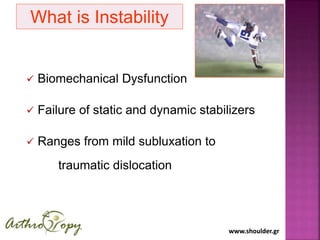
What is Instability
 Biomechanical Dysfunction
 Failure of static and dynamic stabilizers
 Ranges from mild subluxation to
traumatic dislocation
www.shoulder.gr
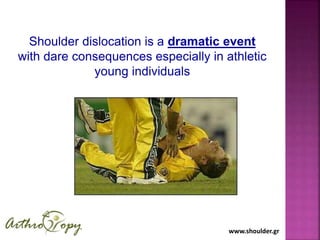
Shoulder dislocation is a dramatic event
with dare consequences especially in athletic
young individuals
www.shoulder.gr
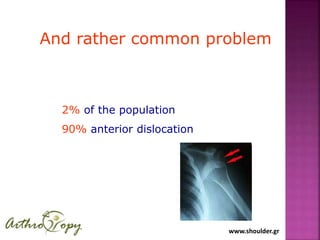
And rather common problem
2% of the population
90% anterior dislocation
www.shoulder.grwww.shoulder.gr
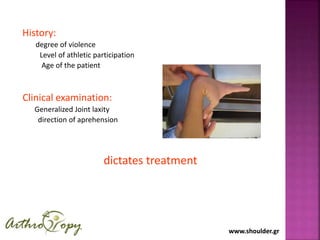
History:
degree of violence
Level of athletic participation
Age of the patient
Clinical examination:
Generalized Joint laxity
direction of aprehension
dictates treatment
www.shoulder.gr
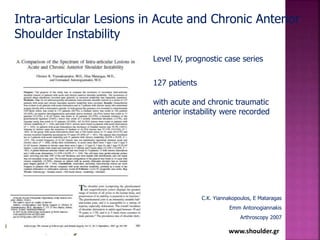
Intra-articular Lesions in Acute and Chronic Anterior
Shoulder Instability
C.K. Yiannakopoulos, E Mataragas
Emm Antonogiannakis
Arthroscopy 2007
Level IV, prognostic case series
127 patients
with acute and chronic traumatic
anterior instability were recorded
www.shoulder.grwww.shoulder.gr
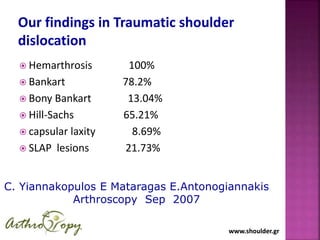
Our findings in Traumatic shoulder
dislocation
 Hemarthrosis 100%
 Bankart 78.2%
 Bony Bankart 13.04%
 Hill-Sachs 65.21%
 capsular laxity 8.69%
 SLAP lesions 21.73%
C. Yiannakopulos E Mataragas E.Antonogiannakis
Arthroscopy Sep 2007
www.shoulder.grwww.shoulder.gr
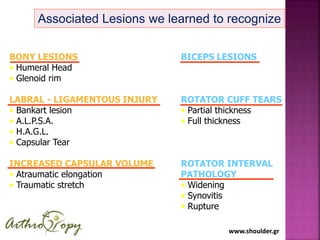
BONY LESIONS
• Humeral Head
• Glenoid rim
LABRAL - LIGAMENTOUS INJURY
• Bankart lesion
• A.L.P.S.A.
• H.A.G.L.
• Capsular Tear
INCREASED CAPSULAR VOLUME
• Atraumatic elongation
• Traumatic stretch
Associated Lesions we learned to recognize
BICEPS LESIONS
ROTATOR CUFF TEARS
• Partial thickness
• Full thickness
ROTATOR INTERVAL
PATHOLOGY
• Widening
• Synovitis
• Rupture
www.shoulder.gr
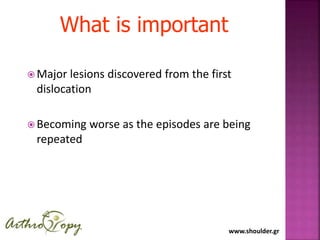
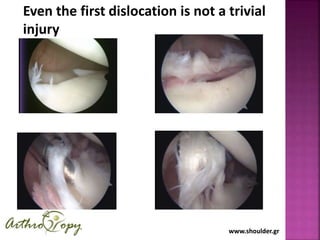
 Major lesions discovered from the first
dislocation
 Becoming worse as the episodes are being
repeated
What is important
www.shoulder.grwww.shoulder.gr
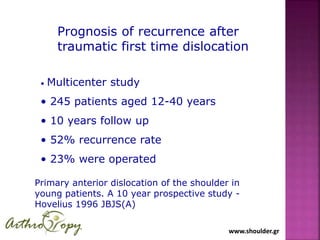
• Multicenter study
• 245 patients aged 12-40 years
• 10 years follow up
• 52% recurrence rate
• 23% were operated
Prognosis of recurrence after
traumatic first time dislocation
Primary anterior dislocation of the shoulder in
young patients. A 10 year prospective study -
Hovelius 1996 JBJS(A)
www.shoulder.grwww.shoulder.gr
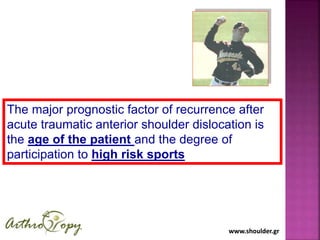
The major prognostic factor of recurrence after
acute traumatic anterior shoulder dislocation is
the age of the patient and the degree of
participation to high risk sports
www.shoulder.grwww.shoulder.gr
Redislocation rate in patients<20
years
Larrain
Rowe
Simonet and Cofield
Slaa
•90%
• 94%
• 94.5%
• 90%
www.shoulder.grwww.shoulder.gr
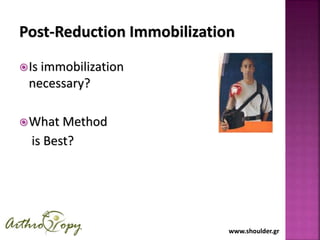
Post-Reduction Immobilization
Is immobilization
necessary?
What Method
is Best?
www.shoulder.grwww.shoulder.gr
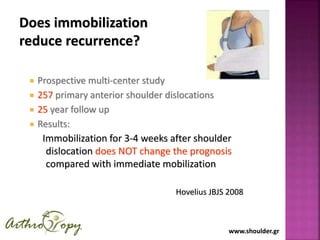
Does immobilization
reduce recurrence?
 Prospective multi-center study
 257 primary anterior shoulder dislocations
 25 year follow up
 Results:
Immobilization for 3-4 weeks after shoulder
dislocation does NOT change the prognosis
compared with immediate mobilization
Hovelius JBJS 2008
www.shoulder.grwww.shoulder.gr
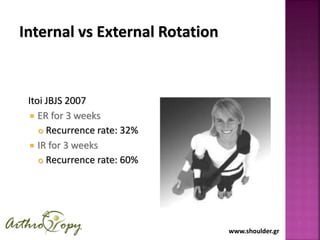
Internal vs External Rotation
Itoi JBJS 2007
 ER for 3 weeks
 Recurrence rate: 32%
 IR for 3 weeks
 Recurrence rate: 60%
www.shoulder.grwww.shoulder.gr
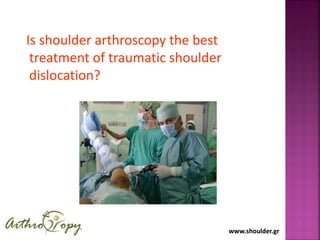
Is shoulder arthroscopy the best
treatment of traumatic shoulder
dislocation?
www.shoulder.grwww.shoulder.gr
Better understanding of the pathology
Reduction of recurrence rate
Treatment of rotator cuff lesions in older individuals
Easier rehabilitation
Why arthroscopy?
www.shoulder.grwww.shoulder.gr
Even the first dislocation is not a trivial
injury
www.shoulder.grwww.shoulder.gr
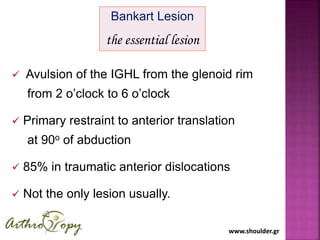
Bankart Lesion
the essential lesion
 Avulsion of the IGHL from the glenoid rim
from 2 o’clock to 6 o’clock
 Primary restraint to anterior translation
at 90o of abduction
 85% in traumatic anterior dislocations
 Not the only lesion usually.
www.shoulder.grwww.shoulder.gr
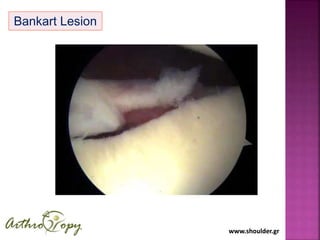
Bankart Lesion
www.shoulder.grwww.shoulder.gr
What is successful Treatment
Avoid recurrence
No limitations in Range of motion
Minor morbidity
Few complication
Return to preinjury activity level
Reproducible results
These are possible with arthroscopic treatment
of traumatic shoulder dislocation in selected
patients
www.shoulder.grwww.shoulder.gr
Treatment: Address all factors
 Dynamic stabilizers: rotator cuff and scapula muscles
 Static stabilizers: repair of capsuloligamentous structures
www.shoulder.gr
Arthroscopic Shoulder Reconstruction
Goal of the Operation:
 Restoration of the Labrum to
its anatomic attachment
 Reestablishment of the appropriate tension
in the GH ligaments and capsule
Address bone deficiencies
www.shoulder.gr
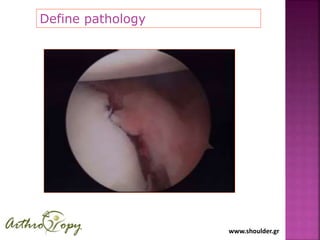
Define pathology
www.shoulder.gr
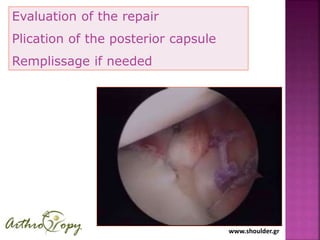
Evaluation of the repair
Plication of the posterior capsule
Remplissage if needed
www.shoulder.gr
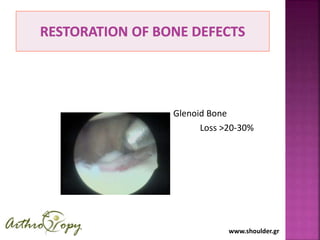
Glenoid Bone
Loss >20-30%
www.shoulder.gr
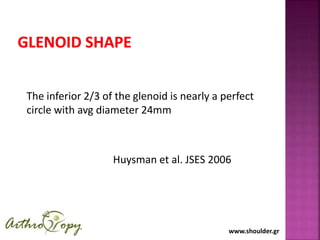
The inferior 2/3 of the glenoid is nearly a perfect
circle with avg diameter 24mm
Huysman et al. JSES 2006
www.shoulder.gr
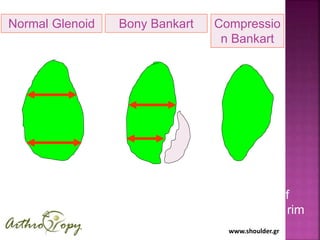
Normal Glenoid
inverted
pear
Bony Bankart
pear
Compressio
n Bankart
loss of
anterior rim
www.shoulder.gr
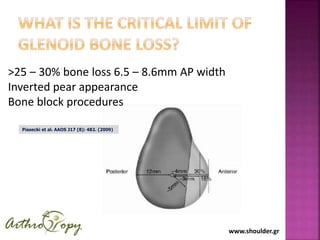
>25 – 30% bone loss 6.5 – 8.6mm AP width
Inverted pear appearance
Bone block procedures
Piasecki et al. AAOS J17 (8): 482. (2009)
www.shoulder.gr
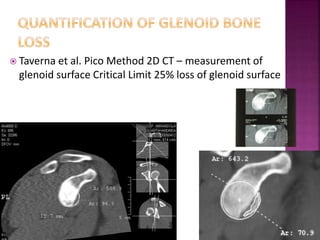
 Taverna et al. Pico Method 2D CT – measurement of
glenoid surface Critical Limit 25% loss of glenoid surface
www.shoulder.gr
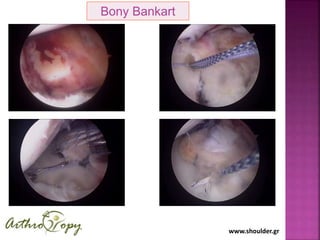
Bony Bankart
www.shoulder.gr
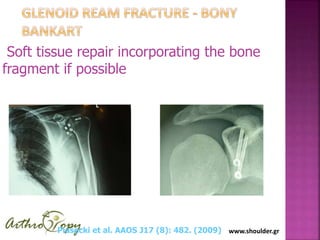
Soft tissue repair incorporating the bone
fragment if possible
Piasecki et al. AAOS J17 (8): 482. (2009)
www.shoulder.gr
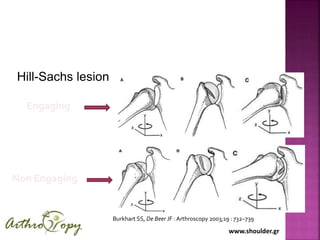
Engaging
Non Engaging
Burkhart SS, De Beer JF : Arthroscopy 2003;19 : 732–739
Hill-Sachs lesion
www.shoulder.grwww.shoulder.gr
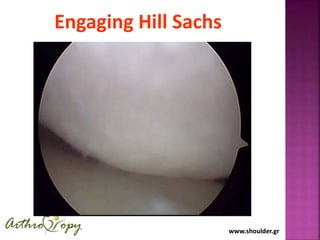
Engaging Hill Sachs
www.shoulder.gr
 Engaging Hill-Sachs-glenoid bone loss
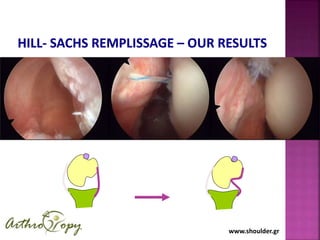
Hill- Sachs Remplisage: An arthroscopic surgical
solution for the engaging Hill-Sachs
E.M. Wolf
www.shoulder.gr
www.shoulder.gr
www.shoulder.gr
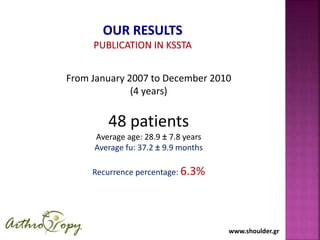
From January 2007 to December 2010
(4 years)
48 patients
Average age: 28.9 ± 7.8 years
Average fu: 37.2 ± 9.9 months
Recurrence percentage: 6.3%
www.shoulder.grwww.shoulder.gr
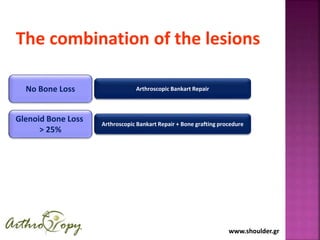
The combination of the lesions
No Bone Loss Arthroscopic Bankart Repair
Glenoid Bone Loss
> 25%
Arthroscopic Bankart Repair + Bone grafting procedure
www.shoulder.grwww.shoulder.gr
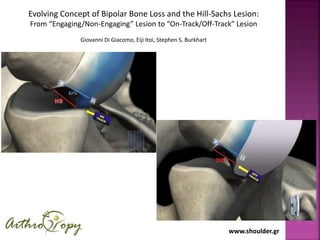
Evolving Concept of Bipolar Bone Loss and the Hill-Sachs Lesion:
From “Engaging/Non-Engaging” Lesion to “On-Track/Off-Track” Lesion
Giovanni Di Giacomo, Eiji Itoi, Stephen S. Burkhart
www.shoulder.gr
Glenoid Bone Loss >25%
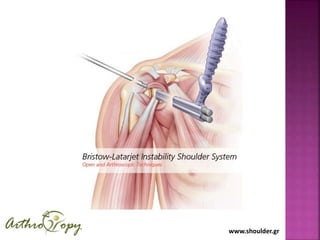
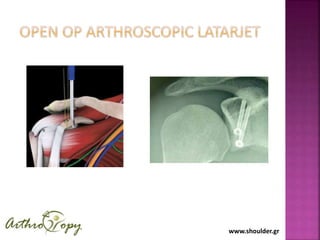
Arthroscopic Latarjet procedure
L. Lafosse
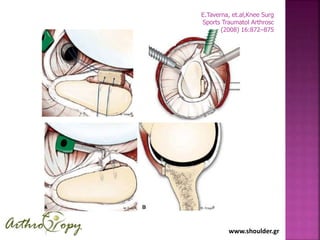
Arthroscopic shoulder stabilization with a bone block
E. Taverna
www.shoulder.gr
www.shoulder.gr
www.shoulder.gr
E.Taverna, et.al,Knee Surg
Sports Traumatol Arthrosc
(2008) 16:872–875
www.shoulder.gr
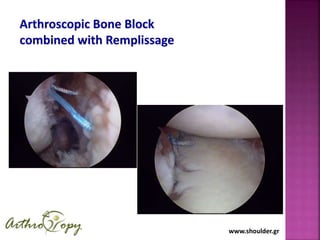
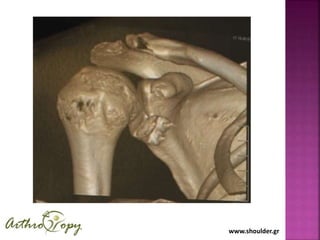
Arthroscopic Bone Block
combined with Remplissage
www.shoulder.gr
www.shoulder.gr
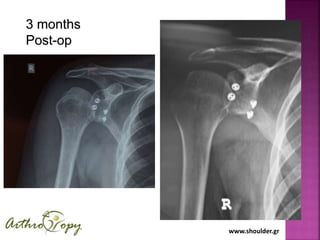
3 months
Post-op
www.shoulder.gr
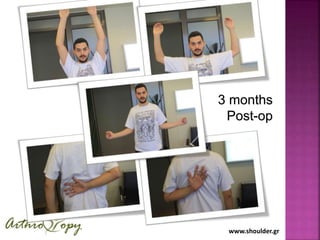
3 months
Post-op
www.shoulder.gr
Our Results
25 cases
Impressive early outcomes
www.shoulder.gr
www.shoulder.gr
Postoperative Rehabilitation
 Sling for comfort
 Isometrics and pendulum exercises immediately
 Active forward elevation may begin after 3/52
 External rotation to 30° to 40° at 4/52
 Progressive strengthening at 8/52
 Return to sport at 18 to 36 weeks
supervised and individualized
www.shoulder.grwww.shoulder.gr
Findings after shoulder dislocation in
patients older than 40 years
 52 pts follow up more than 2 years
 Redislocation rate 4%
 Rotator cuff tears 35%
T Penvy, R Hunter, J Freeman
Arthroscopy 1998
www.shoulder.grwww.shoulder.gr
In older patients rotator cuff tears are
common
The arthroscopic treatment of acute
rotator cuff tears is easy with minimum
morbidity
Conclusions
www.shoulder.grwww.shoulder.gr
Modern arthroscopic techniques
are probably the treatment of choice
in traumatic shoulder dislocation
Conclusions
www.shoulder.grwww.shoulder.gr
 Arthroscopy can be performed in an outpatient
setting
 The anatomy can be restored with minimum
morbidity and pain for the patient
 Careful assessment will allow repair of all lesions
 The patient can resume most of his every day
activities early in the rehabilitation program
Conclusions
www.shoulder.grwww.shoulder.gr
Thank you for your attention!!!
Save the date: 1-3 February 2018

Traumatic shoulder dislocation 2017 kat