Dr. Shyam Nadange.
 The term ‘robot’ originates from the Czech word ‘ROBOTA’, which
means forced labour or activity.
 Karel Capek first used the term in his 1921 play
‘ Rossum’s Universal Robots’
In which robots were a series of factory-manufactured artificial people
made from synthetic material that undertook mundane tasks for their
human masters.
 The robots eventually became frustrated with their roles and masterminded a robotic
rebellion, leading to the extinction of the human race.
 Since then, robotics has evolved to describe an array of computer machines that
perform preprogrammed, precise, and repetitive procedures.
 The first robotic surgical procedure was performed by Kwoh et al in
1985 using the PUMA 560 robotic system (Westinghouse Electric,
Pittsburgh, Pennsylvania) to undertake neurosurgical biopsies with
improved precision.
The same robotic platform was used by Davies et al in 1991 to undertake
transurethral resections of the prostate with greater accuracy and
reduced iatrogenic soft-tissue injury.
 Over the following two decades, several other surgical robotic devices were developed,
including the Zeus (Computer Motion, Inc., Goleta, California) and Da Vinci (Intuitive
Surgical, Sunnyvale, California) robotic platforms.
 This enabled a variety of surgical procedures to be performed remotely using
robotically controlled arms and a 3D camera to improve the visual field.
 These robotic devices have been used to perform cholecystectomy, hysterectomy,
lobectomy, mitral valve replacement, coronary artery bypass grafting, and
prostatectomy.
 Total knee arthroplasty (TKA) is an effective and cost-efficient procedure
that is performed in over 90000 patients per year in the United Kingdom.
 Implant survivorship, assessed with revision as the primary endpoint, is
greater than 90% at ten years’ follow-up.
 However, patient satisfaction and functional outcomes remain inferior to
total hip arthroplasty, with up to 20% of patients remaining dissatisfied
following TKA.
Ref: Robotic total knee arthroplasty clinical outcomes and directions for future research. BJR-2019-0175 vol. 8,
NO. 10, OCTOBER 2019
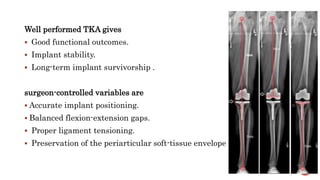
Well performed TKA gives
 Good functional outcomes.
 Implant stability.
 Long-term implant survivorship .
surgeon-controlled variables are
 Accurate implant positioning.
 Balanced flexion-extension gaps.
 Proper ligament tensioning.
 Preservation of the periarticular soft-tissue envelope .
Conventional jig-based TKA
 Uses preoperative radiographic films.
 Intraoperative anatomical landmarks.
 Manually positioned alignment jigs to guide bone resection.
 Implant positioning.
These handheld techniques are associated with
 Poor reproducibility of alignment-guide positioning.
 Inadvertent sawblade injury to the periarticular soft-tissue envelope.
 Limited intraoperative data on gap measurements or ligamentous
tensioning to fine-tune implant positioning.
 Poor functional recovery.
 Reduced clinical outcomes.
 Increased instability.
 Reduced implant survivorship.
 Robotic tools development and investigated since the 1980s.
 The first to see clinical use in joint replacement was ROBODOC
(THINK Surgical Inc, Fremont, CA), originally developed by the
IBM T.J.Watson Research Center (Yorktown Heights, NY)in
collaboration with the University of California, Davis.
 Developed in 1986, Robodoc (Curexo Technology, Sacramento, CA,
USA) was the first system with ORTHODOC (robotic arm and
software) to be used for knee joint replacement surgery
 It was introduced clinically for total hip replacement in 1992 at
Sutter General Hospital (Sacramento, CA).
 Robotic TKA uses computer software to convert anatomical
information into a virtual patient-specific 3D reconstruction of the
knee joint.
 The anatomical information may be obtained using preoperative CT
(image based) or a combination of preoperative radiographs and
intraoperative osseous mapping (imageless).
 The surgeon uses this virtual model to plan optimal bone resection,
implant positioning, bone coverage, and limb alignment based on the
patient’s unique anatomy.
 An intraoperative robotic device helps to execute this pre-operative
patient-specific plan with a high level of accuracy.
 Improved component position and alignment.
 Soft tissue balancing.
 Avoidance of bony and soft tissue injury.
 Better functional outcomes.
Several controlled and non-controlled studies have shown
 Increase the accuracy of mechanical axis restoration, without significantly
increasing the operating time relative to conventional procedures .
 The outcomes of patients who underwent robot-assisted TKA may be
better in terms of the physical and emotional items of the SF-36 .
 However, other studies have found no difference Significant long-term
improvements in joint range of motion, function and quality of life still need
to be demonstrated .
The current state of robotics in total knee arthroplasty. article: EFORT Open Rev 2021;6:270-279. DOI:
10.1302/2058-5241.6.200052
Earlier robotic systems were associated with significant complications.
Park et al reported a complication rate of 19%, including
 Superficial infection .
 Patellar tendon rupture and dislocation.
 Supracondylar fracture .
 Peroneal nerve injury.
These appeared to be restricted to their earlier cases and attributed to a smaller
incision used during the learning phase.
Technical complications
Incidence of intra-operative conversion to conventional TKA arthroplasty due to
ROBODOC technical failure has been reported in up to 30% of cases.
Complication rates associated with newer systems appear to be low.
 In their study of Mako-assisted TKAs, Marchand et al reported no complications or
conversions to manual TKA.
 Similarly, no complications were noted by Naziri et al in their Mako-assisted group of 40
cases.
 Kayani et al observed similar complication rates for their Mako and conventional TKAs.
(Marchand RC, Sodhi N, Bhowmik-Stoker M, Scholl L, Condrey C, Khlopas A, et al. Does the robotic arm and preoperative CT planning help with
3D intraoperative total knee arthroplasty planning? J Knee Surg 2019;32:742–749.)
(Kayani B, Konan S, Tahmassebi J, Pietrzak JRT, Haddad FS. Robotic-arm assisted total knee arthroplasty is associated with improved early
functional recovery and reduced time to hospital discharge compared with conventional jig-based total knee arthroplasty: a prospective cohort
study. Bone Jt J 2018;100-B:930–937.)
1. Image based / Imageless
2. Passive , Semiactive and Active system
3. Open / Close source.
The most well-known is the one proposed by Schneider and Troccaz in
2001.
It places robotic systems in four categories:
I] Passive
II] Active
III] Interactive
IV] Tele-operated
 Consist of an articulated arm that holds an instrument moved manually
by the surgeon, with the instrument's position being recognized by the
navigation system.
 They do not directly participate in carrying out the procedure, which
remains completely under the surgeon's control.
 The OMNI® robot fits in this group.
 Conventional navigation systems used for TKA are often integrated into
this type of system
 Uses preoperative and intraoperative planning data to perform
multiplanar surgical manipulations autonomously (without the surgeon's
participation).
 The Robodoc® , CUVIS fits into this group.
INTERACTIVE SYSTEM
 Require an interaction between the robot and the surgeon who constrains the
robot.
 There are two types of strategies in this group:
semi-active
synergistic systems
 Semi-active systems -This mechanical constraint can be summarized as a
movement without feedback to the surgeon. Eg. Rosa , Valys
 Synergistic systems- The mechanical constraints are programmable.
 These newer systems are based on the principle of haptic models (i.e.
information feedback) with the robot generating forces where the amplitude
and frequency reproduce true sensations (touch, vision). Eg. Navio, Cori
TELEOPERATED
SYSTEM
 Correspond to robots that are controlled remotely by a surgeon.
 The most well-known example is the DaVINCI® robot.
1. Mako (Stryker)
2. Navio/ Cori (smith & nephew)
3. Rosa (zimmer)
4. Cuvis (max)
5. Velys (J&J)
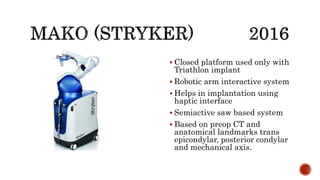
 Closed platform used only with
Triathlon implant
 Robotic arm interactive system
 Helps in implantation using
haptic interface
 Semiactive saw based system
 Based on preop CT and
anatomical landmarks trans
epicondylar, posterior condylar
and mechanical axis.
 Semiactive system
 Imageless
 Follows reamers (bur) trajectory
in navigation field.
 Uses anatomical landmarks bony
anatomy of distal femur ,
proximal tibia and mechanical
axis.
 Precise bone resection accordance
with preop plan.
 Coming up with revision TKA
and THA software.
 Interactive system
 Imageless
 Closed platform
 Can be supplemented with
xray to create a 3D model(X –
Atlas)
 Active robotic arm assisted
system
 Use of milling cutter
 Various cutting options with
intraop. gap check
(pre/intra/post)
 Plan changing feasibility
 Need 3D CT
 Suppose to be open system in
India its with Meril
 Interactive system
 Saw based
 Closed platform with Attune
knee
 Imageless system
 Table mounted design
Comparison of synergistic robotic
systems
Robotic
system
Preoperativ
e imaging
Kinematics Planning Function
Application
s
MAKO CT scan Yes Yes
Robotic
arm: saw,
reamer
THA, Uni,
TKA
NAVIO None Yes No
Navigated
reamer
Uni, TKA
ROSA
Standard
X-rays
Yes Yes
Robotic
arm:
cutting
guide
TKA
.
THA: total hip arthroplasty, Uni: unicompartmental knee
arthroplasty, TKA: total knee arthroplasty
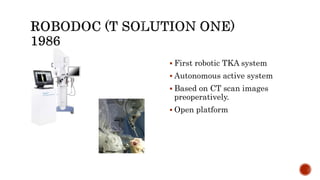
 First robotic TKA system
 Autonomous active system
 Based on CT scan images
preoperatively.
 Open platform
IBLOCK®, ©OMNILIFE SCIENCE
 Previously called Praxieles
 Motorised cutting guide only
helps in femoral bone cuts.
 CT scan needed
 Closed plantform
 Not provide gap balanceing
 Improving patient satisfaction following primary TKA poses an important
challenge that may be addressed with robotic-assisted technology.
 While early robotic systems have failed to confer any meaningful clinical benefit
and justify the excess costs
 Newer robotic systems have demonstrated promise by minimizing soft tissue
damage, reducing hospital stay and improving short-term functional outcomes.
 However, the economic impact of introducing this technology with
significant upfront and maintenance costs requires closer examination.
 This is especially important as conventional TKA is already considered
a reasonably successful and already expensive procedure.
 Thus, while early results from the latest generation of robotic TKA
hopefully justify the ongoing investment in such technology.
 Long-term functional outcomes and survivorship should be fully
appraised to support its continued use.
1. Total knee arthroplasty: Latest robotics implantation techniques. Service de chirurgie de
l’arthrose et du sport, urgences traumatiques des membres, hôpital Sud, CHU de Grenoble-
Alpes, avenue de Kimberley, BP 338, 38434 Échirolles, France
2. The current state of robotics in total knee arthroplasty. article: EFORT Open Rev 2021;6:270-
279.DOI: 10.1302/2058-5241.6.200052 Review article (adult orthopedics)
3. Total knee arthroplasty: latest robotics implantation techniques.
https://doi.org/doi:10.1016/j.otsr.2020.102780. Orthopaedics & Traumatology: Surgery &
Research
4.Robotic total knee arthroplasty clinical outcomes and directions for future research. doi:
10.1302/2046-3758.810.BJR-2019-0175Bone Joint Res 2019;8:438–442.B. Kayani,F. S.
Haddad
5. Robotic technology in total knee arthroplasty: a systematic review Cite this article: EFORT
Open Rev 2019;4:611-617. DOI: 10.1302/2058-5241.4.190022.
6. Available Robotic Platforms in Partial and Total Knee Arthroplasty
http://dx.doi.org/10.1053/j.oto.2015.03.002 85 .1048-6666//& 2015 Elsevier Inc.
7. Internet
ROBOTICS IN TKR.pptx

ROBOTICS IN TKR.pptx

  • 1.
  • 2.
     The term‘robot’ originates from the Czech word ‘ROBOTA’, which means forced labour or activity.  Karel Capek first used the term in his 1921 play ‘ Rossum’s Universal Robots’ In which robots were a series of factory-manufactured artificial people made from synthetic material that undertook mundane tasks for their human masters.
  • 3.
     The robotseventually became frustrated with their roles and masterminded a robotic rebellion, leading to the extinction of the human race.  Since then, robotics has evolved to describe an array of computer machines that perform preprogrammed, precise, and repetitive procedures.
  • 4.
     The firstrobotic surgical procedure was performed by Kwoh et al in 1985 using the PUMA 560 robotic system (Westinghouse Electric, Pittsburgh, Pennsylvania) to undertake neurosurgical biopsies with improved precision. The same robotic platform was used by Davies et al in 1991 to undertake transurethral resections of the prostate with greater accuracy and reduced iatrogenic soft-tissue injury.
  • 5.
     Over thefollowing two decades, several other surgical robotic devices were developed, including the Zeus (Computer Motion, Inc., Goleta, California) and Da Vinci (Intuitive Surgical, Sunnyvale, California) robotic platforms.  This enabled a variety of surgical procedures to be performed remotely using robotically controlled arms and a 3D camera to improve the visual field.  These robotic devices have been used to perform cholecystectomy, hysterectomy, lobectomy, mitral valve replacement, coronary artery bypass grafting, and prostatectomy.
  • 6.
     Total kneearthroplasty (TKA) is an effective and cost-efficient procedure that is performed in over 90000 patients per year in the United Kingdom.  Implant survivorship, assessed with revision as the primary endpoint, is greater than 90% at ten years’ follow-up.  However, patient satisfaction and functional outcomes remain inferior to total hip arthroplasty, with up to 20% of patients remaining dissatisfied following TKA. Ref: Robotic total knee arthroplasty clinical outcomes and directions for future research. BJR-2019-0175 vol. 8, NO. 10, OCTOBER 2019
  • 7.
    Well performed TKAgives  Good functional outcomes.  Implant stability.  Long-term implant survivorship . surgeon-controlled variables are  Accurate implant positioning.  Balanced flexion-extension gaps.  Proper ligament tensioning.  Preservation of the periarticular soft-tissue envelope .
  • 8.
    Conventional jig-based TKA Uses preoperative radiographic films.  Intraoperative anatomical landmarks.  Manually positioned alignment jigs to guide bone resection.  Implant positioning. These handheld techniques are associated with  Poor reproducibility of alignment-guide positioning.  Inadvertent sawblade injury to the periarticular soft-tissue envelope.  Limited intraoperative data on gap measurements or ligamentous tensioning to fine-tune implant positioning.
  • 9.
     Poor functionalrecovery.  Reduced clinical outcomes.  Increased instability.  Reduced implant survivorship.
  • 10.
     Robotic toolsdevelopment and investigated since the 1980s.  The first to see clinical use in joint replacement was ROBODOC (THINK Surgical Inc, Fremont, CA), originally developed by the IBM T.J.Watson Research Center (Yorktown Heights, NY)in collaboration with the University of California, Davis.  Developed in 1986, Robodoc (Curexo Technology, Sacramento, CA, USA) was the first system with ORTHODOC (robotic arm and software) to be used for knee joint replacement surgery  It was introduced clinically for total hip replacement in 1992 at Sutter General Hospital (Sacramento, CA).
  • 11.
     Robotic TKAuses computer software to convert anatomical information into a virtual patient-specific 3D reconstruction of the knee joint.  The anatomical information may be obtained using preoperative CT (image based) or a combination of preoperative radiographs and intraoperative osseous mapping (imageless).  The surgeon uses this virtual model to plan optimal bone resection, implant positioning, bone coverage, and limb alignment based on the patient’s unique anatomy.  An intraoperative robotic device helps to execute this pre-operative patient-specific plan with a high level of accuracy.
  • 12.
     Improved componentposition and alignment.  Soft tissue balancing.  Avoidance of bony and soft tissue injury.  Better functional outcomes.
  • 13.
    Several controlled andnon-controlled studies have shown  Increase the accuracy of mechanical axis restoration, without significantly increasing the operating time relative to conventional procedures .  The outcomes of patients who underwent robot-assisted TKA may be better in terms of the physical and emotional items of the SF-36 .  However, other studies have found no difference Significant long-term improvements in joint range of motion, function and quality of life still need to be demonstrated . The current state of robotics in total knee arthroplasty. article: EFORT Open Rev 2021;6:270-279. DOI: 10.1302/2058-5241.6.200052
  • 14.
    Earlier robotic systemswere associated with significant complications. Park et al reported a complication rate of 19%, including  Superficial infection .  Patellar tendon rupture and dislocation.  Supracondylar fracture .  Peroneal nerve injury. These appeared to be restricted to their earlier cases and attributed to a smaller incision used during the learning phase. Technical complications Incidence of intra-operative conversion to conventional TKA arthroplasty due to ROBODOC technical failure has been reported in up to 30% of cases.
  • 15.
    Complication rates associatedwith newer systems appear to be low.  In their study of Mako-assisted TKAs, Marchand et al reported no complications or conversions to manual TKA.  Similarly, no complications were noted by Naziri et al in their Mako-assisted group of 40 cases.  Kayani et al observed similar complication rates for their Mako and conventional TKAs. (Marchand RC, Sodhi N, Bhowmik-Stoker M, Scholl L, Condrey C, Khlopas A, et al. Does the robotic arm and preoperative CT planning help with 3D intraoperative total knee arthroplasty planning? J Knee Surg 2019;32:742–749.) (Kayani B, Konan S, Tahmassebi J, Pietrzak JRT, Haddad FS. Robotic-arm assisted total knee arthroplasty is associated with improved early functional recovery and reduced time to hospital discharge compared with conventional jig-based total knee arthroplasty: a prospective cohort study. Bone Jt J 2018;100-B:930–937.)
  • 16.
    1. Image based/ Imageless 2. Passive , Semiactive and Active system 3. Open / Close source.
  • 17.
    The most well-knownis the one proposed by Schneider and Troccaz in 2001. It places robotic systems in four categories: I] Passive II] Active III] Interactive IV] Tele-operated
  • 18.
     Consist ofan articulated arm that holds an instrument moved manually by the surgeon, with the instrument's position being recognized by the navigation system.  They do not directly participate in carrying out the procedure, which remains completely under the surgeon's control.  The OMNI® robot fits in this group.  Conventional navigation systems used for TKA are often integrated into this type of system
  • 19.
     Uses preoperativeand intraoperative planning data to perform multiplanar surgical manipulations autonomously (without the surgeon's participation).  The Robodoc® , CUVIS fits into this group.
  • 20.
    INTERACTIVE SYSTEM  Requirean interaction between the robot and the surgeon who constrains the robot.  There are two types of strategies in this group: semi-active synergistic systems  Semi-active systems -This mechanical constraint can be summarized as a movement without feedback to the surgeon. Eg. Rosa , Valys  Synergistic systems- The mechanical constraints are programmable.  These newer systems are based on the principle of haptic models (i.e. information feedback) with the robot generating forces where the amplitude and frequency reproduce true sensations (touch, vision). Eg. Navio, Cori
  • 21.
    TELEOPERATED SYSTEM  Correspond torobots that are controlled remotely by a surgeon.  The most well-known example is the DaVINCI® robot.
  • 22.
    1. Mako (Stryker) 2.Navio/ Cori (smith & nephew) 3. Rosa (zimmer) 4. Cuvis (max) 5. Velys (J&J)
  • 23.
     Closed platformused only with Triathlon implant  Robotic arm interactive system  Helps in implantation using haptic interface  Semiactive saw based system  Based on preop CT and anatomical landmarks trans epicondylar, posterior condylar and mechanical axis.
  • 24.
     Semiactive system Imageless  Follows reamers (bur) trajectory in navigation field.  Uses anatomical landmarks bony anatomy of distal femur , proximal tibia and mechanical axis.  Precise bone resection accordance with preop plan.  Coming up with revision TKA and THA software.
  • 25.
     Interactive system Imageless  Closed platform  Can be supplemented with xray to create a 3D model(X – Atlas)
  • 26.
     Active roboticarm assisted system  Use of milling cutter  Various cutting options with intraop. gap check (pre/intra/post)  Plan changing feasibility  Need 3D CT  Suppose to be open system in India its with Meril
  • 27.
     Interactive system Saw based  Closed platform with Attune knee  Imageless system  Table mounted design
  • 28.
    Comparison of synergisticrobotic systems Robotic system Preoperativ e imaging Kinematics Planning Function Application s MAKO CT scan Yes Yes Robotic arm: saw, reamer THA, Uni, TKA NAVIO None Yes No Navigated reamer Uni, TKA ROSA Standard X-rays Yes Yes Robotic arm: cutting guide TKA . THA: total hip arthroplasty, Uni: unicompartmental knee arthroplasty, TKA: total knee arthroplasty
  • 29.
     First roboticTKA system  Autonomous active system  Based on CT scan images preoperatively.  Open platform
  • 30.
    IBLOCK®, ©OMNILIFE SCIENCE Previously called Praxieles  Motorised cutting guide only helps in femoral bone cuts.  CT scan needed  Closed plantform  Not provide gap balanceing
  • 31.
     Improving patientsatisfaction following primary TKA poses an important challenge that may be addressed with robotic-assisted technology.  While early robotic systems have failed to confer any meaningful clinical benefit and justify the excess costs  Newer robotic systems have demonstrated promise by minimizing soft tissue damage, reducing hospital stay and improving short-term functional outcomes.
  • 32.
     However, theeconomic impact of introducing this technology with significant upfront and maintenance costs requires closer examination.  This is especially important as conventional TKA is already considered a reasonably successful and already expensive procedure.  Thus, while early results from the latest generation of robotic TKA hopefully justify the ongoing investment in such technology.  Long-term functional outcomes and survivorship should be fully appraised to support its continued use.
  • 33.
    1. Total kneearthroplasty: Latest robotics implantation techniques. Service de chirurgie de l’arthrose et du sport, urgences traumatiques des membres, hôpital Sud, CHU de Grenoble- Alpes, avenue de Kimberley, BP 338, 38434 Échirolles, France 2. The current state of robotics in total knee arthroplasty. article: EFORT Open Rev 2021;6:270- 279.DOI: 10.1302/2058-5241.6.200052 Review article (adult orthopedics) 3. Total knee arthroplasty: latest robotics implantation techniques. https://doi.org/doi:10.1016/j.otsr.2020.102780. Orthopaedics & Traumatology: Surgery & Research 4.Robotic total knee arthroplasty clinical outcomes and directions for future research. doi: 10.1302/2046-3758.810.BJR-2019-0175Bone Joint Res 2019;8:438–442.B. Kayani,F. S. Haddad 5. Robotic technology in total knee arthroplasty: a systematic review Cite this article: EFORT Open Rev 2019;4:611-617. DOI: 10.1302/2058-5241.4.190022. 6. Available Robotic Platforms in Partial and Total Knee Arthroplasty http://dx.doi.org/10.1053/j.oto.2015.03.002 85 .1048-6666//& 2015 Elsevier Inc. 7. Internet