Osteotomy around elbow
Dr Sushil Sharma
Introduction
• Ostetomy around elbow performed commonly
for the correction of cubitus varus & cubitus
valgus deformity
Cubitus Varus
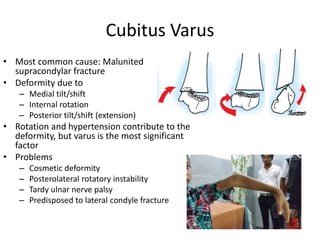
• Most common cause: Malunited
supracondylar fracture
• Deformity due to
– Medial tilt/shift
– Internal rotation
– Posterior tilt/shift (extension)
• Rotation and hypertension contribute to the
deformity, but varus is the most significant
factor
• Problems
– Cosmetic deformity
– Posterolateral rotatory instability
– Tardy ulnar nerve palsy
– Predisposed to lateral condyle fracture
Osteotomy – Cubitus Varus
• Three basic types
– Lateral closing wedge osteotomy
– Oblique osteotomy with derotation
– Medial opening wedge osteotomy with a bone
graft
Pre-requisite for Osteotomy
• Duration : At least 1 year after the fracture
• Counselling to the patient regarding the
procedure
Rules of Osteotomy
• Center of Rotation of
Angulation (CORA)
Lateral closing wedge osteotmy
• Easiest, the safest, and the most stable osteotomy.
• Lateral closing wedge osteotomy with a medial hinge will
correct the varus deformity, with some minor correction of
hyperextension
• Types
– Lateral closing wedge osteotomy (Voss et al)
– French osteotomy
– Modified french osteotomy
• Different methods of fixation
– Two screws and a wire attached between them
– Plate fixation
– Crossed Kirschner wires
– Staples
French Osteotomy
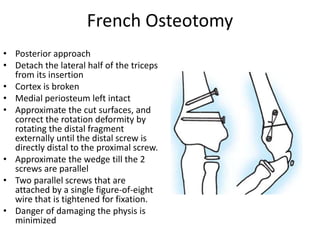
• Posterior approach
• Detach the lateral half of the triceps
from its insertion
• Cortex is broken
• Medial periosteum left intact
• Approximate the cut surfaces, and
correct the rotation deformity by
rotating the distal fragment
externally until the distal screw is
directly distal to the proximal screw.
• Approximate the wedge till the 2
screws are parallel
• Two parallel screws that are
attached by a single figure-of-eight
wire that is tightened for fixation.
• Danger of damaging the physis is
minimized
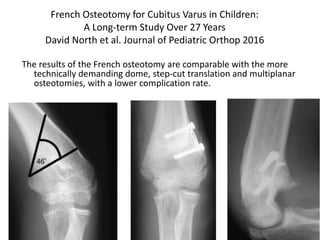
French Osteotomy for Cubitus Varus in Children:
A Long-term Study Over 27 Years
David North et al. Journal of Pediatric Orthop 2016
The results of the French osteotomy are comparable with the more
technically demanding dome, step-cut translation and multiplanar
osteotomies, with a lower complication rate.
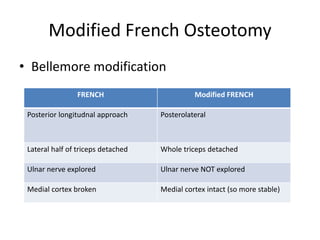
Modified French Osteotomy
• Bellemore modification
FRENCH Modified FRENCH
Posterior longitudnal approach Posterolateral
Lateral half of triceps detached Whole triceps detached
Ulnar nerve explored Ulnar nerve NOT explored
Medial cortex broken Medial cortex intact (so more stable)
Step Cut Osteotomy (DeRosa and Graziano)
• A modification of lateral closing
wedge osteotomy
• Posterior approach to the distal
humerus
• Place the apex of the template
(angle to be corrected) medially
• Using a template constructed
preoperatively, make a lateral
closing wedge osteotomy in the
metaphyseal region superior to
the olecranon fossa.
• Fixed with single cortical screw
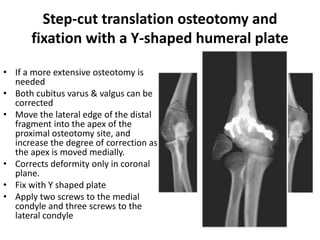
Step-cut translation osteotomy and
fixation with a Y-shaped humeral plate
• If a more extensive osteotomy is
needed
• Both cubitus varus & valgus can be
corrected
• Move the lateral edge of the distal
fragment into the apex of the
proximal osteotomy site, and
increase the degree of correction as
the apex is moved medially.
• Corrects deformity only in coronal
plane.
• Fix with Y shaped plate
• Apply two screws to the medial
condyle and three screws to the
lateral condyle
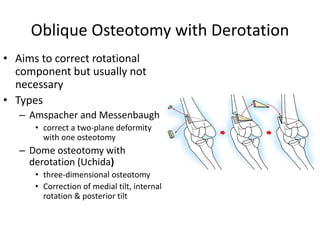
Oblique Osteotomy with Derotation
• Aims to correct rotational
component but usually not
necessary
• Types
– Amspacher and Messenbaugh
• correct a two-plane deformity
with one osteotomy
– Dome osteotomy with
derotation (Uchida)
• three-dimensional osteotomy
• Correction of medial tilt, internal
rotation & posterior tilt
Amspacher and Messenbaugh
• Expose the elbow posteriorly
• Expose subperiosteally the supracondylar part of the
humerus
• Oblique osteotomy about 3.8 cm proximal to the distal
end of the humerus, directing it from posteriorly above
to anteriorly below
• Tilt and rotate the distal fragment until the internal
rotation and cubitus varus have been corrected.
• With the fragments in proper position, fix them with a
screw inserted across the middle of the osteotomy
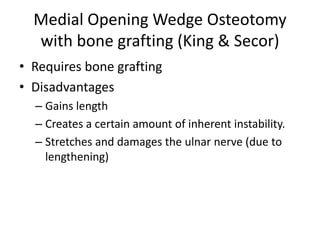
Medial Opening Wedge Osteotomy
with bone grafting (King & Secor)
• Requires bone grafting
• Disadvantages
– Gains length
– Creates a certain amount of inherent instability.
– Stretches and damages the ulnar nerve (due to
lengthening)
Cubitus valgus
• Causes
– Non union of lateral condyle
fracture
• proximal migration of the lateral
condyle
• the cartilaginous articular surface of
the distal fragment comes in contact
with the bony surface of the proximal
fragment
– Malunited supracondylar fracture
humerus
– Osteonecrosis of lateral trochlea
• Progressive deformity that alters
elbow mechanics & causes
neurological involvement
• Effects
– Tardy ulnar nerve palsy
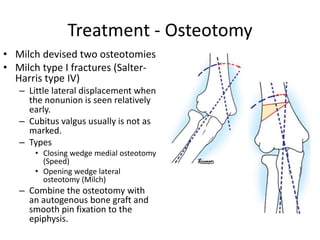
Treatment - Osteotomy
• Milch devised two osteotomies
• Milch type I fractures (Salter-
Harris type IV)
– Little lateral displacement when
the nonunion is seen relatively
early.
– Cubitus valgus usually is not as
marked.
– Types
• Closing wedge medial osteotomy
(Speed)
• Opening wedge lateral
osteotomy (Milch)
– Combine the osteotomy with
an autogenous bone graft and
smooth pin fixation to the
epiphysis.
Milch Opening Wedge Displacement Osteotomy
• In Milch type II fractures, there is significant
lateral displacement of the fragment and some
rotation.
• Posterior muscle-splitting incision
• Simple transverse osteotomy at the level of the
intersection of the forearm axis with the lateral
cortex of the humerus
• Notch the inferior surface of the proximal
fragment to receive the apex of the superior
surface of the distal fragment, which is moved
laterally
• Adduct the distal fragment until the excessive
angle of abduction (valgus) has been reduced to
the normal carrying angle
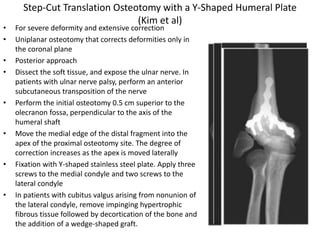
Step-Cut Translation Osteotomy with a Y-Shaped Humeral Plate
(Kim et al)
• For severe deformity and extensive correction
• Uniplanar osteotomy that corrects deformities only in
the coronal plane
• Posterior approach
• Dissect the soft tissue, and expose the ulnar nerve. In
patients with ulnar nerve palsy, perform an anterior
subcutaneous transposition of the nerve
• Perform the initial osteotomy 0.5 cm superior to the
olecranon fossa, perpendicular to the axis of the
humeral shaft
• Move the medial edge of the distal fragment into the
apex of the proximal osteotomy site. The degree of
correction increases as the apex is moved laterally
• Fixation with Y-shaped stainless steel plate. Apply three
screws to the medial condyle and two screws to the
lateral condyle
• In patients with cubitus valgus arising from nonunion of
the lateral condyle, remove impinging hypertrophic
fibrous tissue followed by decortication of the bone and
the addition of a wedge-shaped graft.
Complications
• Stiffness
• Persistence of deformity
– Over correction
– Under correction
• Myositis ossificans
• Loss of fixation
• Neurovascular injury
Thank You

Osteotomy around elbow

  • 1.
  • 2.
    Introduction • Ostetomy aroundelbow performed commonly for the correction of cubitus varus & cubitus valgus deformity
  • 3.
    Cubitus Varus • Mostcommon cause: Malunited supracondylar fracture • Deformity due to – Medial tilt/shift – Internal rotation – Posterior tilt/shift (extension) • Rotation and hypertension contribute to the deformity, but varus is the most significant factor • Problems – Cosmetic deformity – Posterolateral rotatory instability – Tardy ulnar nerve palsy – Predisposed to lateral condyle fracture
  • 4.
    Osteotomy – CubitusVarus • Three basic types – Lateral closing wedge osteotomy – Oblique osteotomy with derotation – Medial opening wedge osteotomy with a bone graft
  • 5.
    Pre-requisite for Osteotomy •Duration : At least 1 year after the fracture • Counselling to the patient regarding the procedure
  • 6.
    Rules of Osteotomy •Center of Rotation of Angulation (CORA)
  • 7.
    Lateral closing wedgeosteotmy • Easiest, the safest, and the most stable osteotomy. • Lateral closing wedge osteotomy with a medial hinge will correct the varus deformity, with some minor correction of hyperextension • Types – Lateral closing wedge osteotomy (Voss et al) – French osteotomy – Modified french osteotomy • Different methods of fixation – Two screws and a wire attached between them – Plate fixation – Crossed Kirschner wires – Staples
  • 8.
    French Osteotomy • Posteriorapproach • Detach the lateral half of the triceps from its insertion • Cortex is broken • Medial periosteum left intact • Approximate the cut surfaces, and correct the rotation deformity by rotating the distal fragment externally until the distal screw is directly distal to the proximal screw. • Approximate the wedge till the 2 screws are parallel • Two parallel screws that are attached by a single figure-of-eight wire that is tightened for fixation. • Danger of damaging the physis is minimized
  • 9.
    French Osteotomy forCubitus Varus in Children: A Long-term Study Over 27 Years David North et al. Journal of Pediatric Orthop 2016 The results of the French osteotomy are comparable with the more technically demanding dome, step-cut translation and multiplanar osteotomies, with a lower complication rate.
  • 10.
    Modified French Osteotomy •Bellemore modification FRENCH Modified FRENCH Posterior longitudnal approach Posterolateral Lateral half of triceps detached Whole triceps detached Ulnar nerve explored Ulnar nerve NOT explored Medial cortex broken Medial cortex intact (so more stable)
  • 11.
    Step Cut Osteotomy(DeRosa and Graziano) • A modification of lateral closing wedge osteotomy • Posterior approach to the distal humerus • Place the apex of the template (angle to be corrected) medially • Using a template constructed preoperatively, make a lateral closing wedge osteotomy in the metaphyseal region superior to the olecranon fossa. • Fixed with single cortical screw
  • 12.
    Step-cut translation osteotomyand fixation with a Y-shaped humeral plate • If a more extensive osteotomy is needed • Both cubitus varus & valgus can be corrected • Move the lateral edge of the distal fragment into the apex of the proximal osteotomy site, and increase the degree of correction as the apex is moved medially. • Corrects deformity only in coronal plane. • Fix with Y shaped plate • Apply two screws to the medial condyle and three screws to the lateral condyle
  • 13.
    Oblique Osteotomy withDerotation • Aims to correct rotational component but usually not necessary • Types – Amspacher and Messenbaugh • correct a two-plane deformity with one osteotomy – Dome osteotomy with derotation (Uchida) • three-dimensional osteotomy • Correction of medial tilt, internal rotation & posterior tilt
  • 14.
    Amspacher and Messenbaugh •Expose the elbow posteriorly • Expose subperiosteally the supracondylar part of the humerus • Oblique osteotomy about 3.8 cm proximal to the distal end of the humerus, directing it from posteriorly above to anteriorly below • Tilt and rotate the distal fragment until the internal rotation and cubitus varus have been corrected. • With the fragments in proper position, fix them with a screw inserted across the middle of the osteotomy
  • 15.
    Medial Opening WedgeOsteotomy with bone grafting (King & Secor) • Requires bone grafting • Disadvantages – Gains length – Creates a certain amount of inherent instability. – Stretches and damages the ulnar nerve (due to lengthening)
  • 16.
    Cubitus valgus • Causes –Non union of lateral condyle fracture • proximal migration of the lateral condyle • the cartilaginous articular surface of the distal fragment comes in contact with the bony surface of the proximal fragment – Malunited supracondylar fracture humerus – Osteonecrosis of lateral trochlea • Progressive deformity that alters elbow mechanics & causes neurological involvement • Effects – Tardy ulnar nerve palsy
  • 17.
    Treatment - Osteotomy •Milch devised two osteotomies • Milch type I fractures (Salter- Harris type IV) – Little lateral displacement when the nonunion is seen relatively early. – Cubitus valgus usually is not as marked. – Types • Closing wedge medial osteotomy (Speed) • Opening wedge lateral osteotomy (Milch) – Combine the osteotomy with an autogenous bone graft and smooth pin fixation to the epiphysis.
  • 18.
    Milch Opening WedgeDisplacement Osteotomy • In Milch type II fractures, there is significant lateral displacement of the fragment and some rotation. • Posterior muscle-splitting incision • Simple transverse osteotomy at the level of the intersection of the forearm axis with the lateral cortex of the humerus • Notch the inferior surface of the proximal fragment to receive the apex of the superior surface of the distal fragment, which is moved laterally • Adduct the distal fragment until the excessive angle of abduction (valgus) has been reduced to the normal carrying angle
  • 19.
    Step-Cut Translation Osteotomywith a Y-Shaped Humeral Plate (Kim et al) • For severe deformity and extensive correction • Uniplanar osteotomy that corrects deformities only in the coronal plane • Posterior approach • Dissect the soft tissue, and expose the ulnar nerve. In patients with ulnar nerve palsy, perform an anterior subcutaneous transposition of the nerve • Perform the initial osteotomy 0.5 cm superior to the olecranon fossa, perpendicular to the axis of the humeral shaft • Move the medial edge of the distal fragment into the apex of the proximal osteotomy site. The degree of correction increases as the apex is moved laterally • Fixation with Y-shaped stainless steel plate. Apply three screws to the medial condyle and two screws to the lateral condyle • In patients with cubitus valgus arising from nonunion of the lateral condyle, remove impinging hypertrophic fibrous tissue followed by decortication of the bone and the addition of a wedge-shaped graft.
  • 20.
    Complications • Stiffness • Persistenceof deformity – Over correction – Under correction • Myositis ossificans • Loss of fixation • Neurovascular injury
  • 21.

Editor's Notes

  • #4 Rotational component in cubitus varus deformities is of little consequence, as it gets corrected by rotation in shoulder joint. Rotation factor leading to medial tilt Extension gets corrected over time. Tardy ulnar nerve palsy occurs due to medial shift of triceps and it narrows cubital tunnel
  • #9 Most simple yet very good results axis of correction of angulation of the French osteotomy is proximal to the center of rotation of angulation of the varus deformity (which is situated in the supracondylar fossae), a lateral translation deformity results.
  • #12 with the superior margin perpendicular to the humeral shaft. Join the inferior margin to the superior margin to outline the osteotomy Correct the medial tilt, rotational malalignment, hyperextension and fix with crossed K-wires Then, use a lag screw from lateral portion of distal fragment to proximal fragment Close the wound and apply posterior splint for 4 weeks.
  • #15 , protecting the radial and ulnar nerves in the periphery of the wound.
  • #19 In Simple opening wedge lateral osteotomy results in an unacceptable medial prominence and places the distal humerus and forearm in unacceptable alignment Fix the fragments by inserting two smooth crossed Kirschner wires, carefully flex the elbow, and immobilize it in plaster at 90 degrees.