DR RASHIK ISMAIL
20/11/17
CARPUS DISLOCATIONS
INCLUDES
1) PERILUNATE DISLOCATIONS & # - DISLOCATIONS
2) SCAPHOLUNATE DISSOCIATION
3) LUNOTRIQUETRAL DISSOCIATION
4) ULNOCARPAL DISSOCIATION
ANATOMY
The wrist is composed of two rows of bones that provide motion and transfer forces.
C, capitate; H, hamate; L, lunate;
S, scaphoid; T, triquetrum; P, pisiform; Td, trapezoid; Tm, trapezium.
Gilula arcs outline proximal and distal surfaces of the proximal carpal row and
the proximal cortical margins of capitate and hamate.
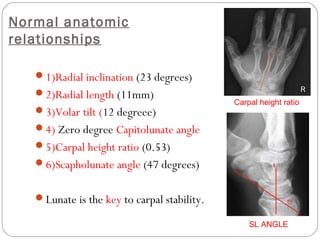
Normal anatomic
relationships
1)Radial inclination (23 degrees)
2)Radial length (11mm)
3)Volar tilt (12 degreee)
4) Zero degree Capitolunate angle
5)Carpal height ratio (0.53)
6)Scapholunate angle (47 degrees)
Lunate is the key to carpal stability.
Carpal height ratio
SL ANGLE
Wrist Ligaments
Extrinsic
Connect radius to carpus & carpus to metacarpals
Intrinsic
Connect carpal to carpal bone.
o Space of Poirier: ligament free area btw
radioscapholunate lig & long radiolunate ligament- at
level of midcarpal joint;an area of potential weakness.
Extrinsic ligaments
EXTRINSIC : Palmar aspect EXTRINSIC : Dorsal
Pathomechanics
Classically, the radius, lunate, and capitate have
been described as a central “link” that is colinear in
the sagittal plane.
 Scaphoid serves as a connecting strut. Any flexion
moment transmitted across the scaphoid is balanced
by an extension moment at the triquetrum.
DISI
 When the scaphoid is
destabilized by fracture or
scapholunate ligament
disruption, the lunate and
triquetrum assume a position
of excessive dorsiflexion
(dorsal intercalated segmental
instability [DISI] ) and the
scapholunate angle becomes
abnormally high (>70
degrees).
VISI
When the triquetrum is
destabilized (usually by
disruption of the
lunotriquetral ligament
complex), the opposite
pattern (volar intercalated
segmental instability [VISI] )
is seen as the lunate
(intercalated segment) volar
flexes.
MECHANISM OF INJURY
FOOSH; axial compressive force
wrist hyperextension,
ulnar deviation, and
intercarpal supination
PERILUNATE DISLOCATION &
FRACTURE -DISLOCATIONS
Introduction
High energy injury with poor functional outcomes.
Commonly missed (~25%) on initial presentation.
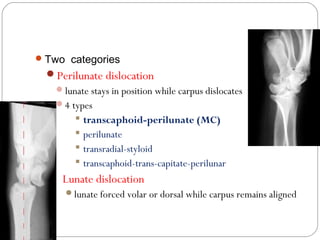
Two categories
Perilunate dislocation 
lunate stays in position while carpus dislocates
4 types
 transcaphoid-perilunate (MC)
 perilunate
 transradial-styloid
 transcaphoid-trans-capitate-perilunar
 Lunate dislocation   
lunate forced volar or dorsal while carpus remains aligned
Mechanism
traumatic, high energy
occurs when wrist extended and ulnarly deviated
leads to intercarpal supination
Pathoanatomy
Sequence of events (Mayfield)
  scapholunate ligament disrupted -->
 disruption of capitolunate articulation --> 
 disruption of lunotriquetral articulation --> 
 failure of dorsal radiocarpal ligament --> 
 lunate rotates and dislocates, usually into carpal tunnel.
Dislocation can course through
Greater arc
 ligamentous disruptions with associated fractures of
the radius, ulnar, or carpal bones.  
Lesser arc
 purely ligamentous. 
Greater
Lesser
 Mayfield Classification
STAGE
1 Scapholunate dissociation
2  + Lunocapitate disruption
3  + Lunotriquetral disruption, "perilunate"
4 Lunate dislocated from lunate fossa (usually volar)
 •associated with median nerve compression
1.SCAPHOLUNATE
DISSOCIATION
2. LUNOCAPITATE
DISRUPTION
3.  LUNOTRIQUETRAL DISRUPTION,
“PERILUNATE"
4.LUNATE DISLOCATION
CLINICAL FEATURES
Symptoms
acute wrist swelling and pain
Median nerve symptoms may occur in ~25% of patients
MC in Mayfield stage IV where the lunate dislocates into
the carpal tunnel
IMAGING
Radiographs
PA/lateral wrist radiographs
 AP 
 break in Gilula's arc
 Lunate and capitate overlap
 Lunate appears triangular "piece-of-pie“ sign 
 Lateral 
 loss of colinearity of radius, lunate, and capitate
 SL angle >70 degrees
MRI
usually not required for diagnosis
MANAGEMENT
NON OPERATIVE
Closed reduction and casting
 Indications
o no indications when used as definitive
management
 Outcomes
o universally poor functional outcomes with non-
operative management
o recurrent dislocation is common
Closed Reduction technique of Tavernier
finger traps, elbow at 90 degrees of flexion
hand 5-10 lbs traction for 15 minutes
dorsal dislocations are reduced through wrist extension,
traction, and flexion of wrist.
apply sugar tong splint
follow with surgery.
OPERATIVE
1) Emergent closed reduction/splinting followed
by open reduction, ligament repair, fixation, possible
carpal tunnel release.
2) Proximal row carpectomy
3) Total wrist arthrodesis
1) Emergent closed reduction/splinting
followed by open reduction,ligament
repair, fixation,
Indications
 all acute injuries <8 weeks old
Outcomes
Emergent closed reduction leads to 
Decreased risk of median nerve damage
Decreased risk of cartilage damage
Return to full function unlikely
Decreased grip strength and stiffness are common
Approaches – Dorsal, Volar, Combined.
Dorsal approach
longitudinal incision centered at Lister's tubercle
excellent exposure of proximal carpal row and
midcarpal joints
does not allow for carpal tunnel release
Volar approach
extended carpal tunnel incision just proximal to
volar wrist crease
Combined dorsal/volar approach
Pros
added exposure
easier reduction
access to distal scaphoid fractures
ability to repair volar ligaments
carpal tunnel decompression
Cons
some believe volar ligament repair not necessary
increased swelling
potential carpal devascularization
difficulty regaining digital flexion and grip
Technique
Fix associated fractures
Repair scapholunate ligament
Protect scapholunate ligament repair
Repair of lunotriquetral interosseous ligament
Post-op
Short arm thumb spica splint converted to short arm
cast at first post-op visit
Duration of casting varies, but at least 6 weeks
2) Proximal row carpectomy
 Technique
Dorsal and volar incisions if median nerve compression is present
Volar approach allows median nerve decompression with excision
of lunate
Dorsal approach facilitates excision of the scaphoid and
triquetrum
Complications
 Median N neuropathy.
Chronic perilunate injury.
Post traumatic arthritis.
SCAPHOLUNATE
DISSOCIATION
INTRODUCTION
Scapholunate ligament is important for carpal stability
chronic scapholunate deficiency DISI
Ligamentous analog of scaphoid #
Acute/ Degenerative injury.
3components: Dorsal, Proximal & Volar
Associated injuries
DISI
Scaphoid flexes palmar and the lunate dorsiflexes
if untreated, progress into a SLAC 
ANATOMY
Scapholunate interosseous ligament
Location
C-shaped structure connecting the dorsal, proximal and
volar surfaces of the scaphoid and lunate bones
dorsal fiber thickened (2-3mm) compared to volar
Biomechanics
Dorsal component provides the greatest constraint
to translation between the scaphoid and lunate bones
CLINICAL EXAMINATION
ASB tenderness
Pain increased with extreme wrist extension and radial deviation
Watson test +ve
When deviating from ulnar to radial, pressure over volar aspect of
scaphoid produces a clunk secondary to dorsal subluxation of the
scaphoid over the dorsal rim of the radius.
IMAGING
o Additional radial and ulnar deviation views & clenched fist
Findings
PA radiographs
SL gap > 3mm  (Terry Thomas sign)  
cortical ring sign (caused by scaphoid malalignment)  
scaphoid shortening
Lateral radiographs
dorsal tilt of lunate leads to SL angle > 70° 
capitolunate angle > 20°
Terry Thomas sign
Cortical
ring
Imaging (Contd…)
Arthrography
as screening tool
always assess the contralateral wrist for comparison
demonstrate the presence of a tear.
Arthroscopy
gold standard for diagnosis
MANAGEMENT
Nonoperative
 NSAIDS, rest +/- immobilization
 Indications
 acute, undisplaced SLIL injuries
 chronic, asymptomatic tears
Operative
SURGERY INDICATION
SL Ligament repair acute scapholunate ligament injury
without carpal malalignment
SL reconstruction Acute, SL lig not ammenable to repair
Scaphoid ORIF vs. CRPP SL ligament injury is d/t scaphoid #
Stabilization with wrist fusion
(STT/SLC)
rigid and unreducible DISI deformity
Complications
Disease progression (e.g. SLAC wrist)
Arthritis
Post-operative pain, stiffness, fatigue
Reduced grip strength
THANK YOU

Perilunate dislocations

  • 1.
  • 2.
    INCLUDES 1) PERILUNATE DISLOCATIONS& # - DISLOCATIONS 2) SCAPHOLUNATE DISSOCIATION 3) LUNOTRIQUETRAL DISSOCIATION 4) ULNOCARPAL DISSOCIATION
  • 3.
    ANATOMY The wrist iscomposed of two rows of bones that provide motion and transfer forces. C, capitate; H, hamate; L, lunate; S, scaphoid; T, triquetrum; P, pisiform; Td, trapezoid; Tm, trapezium.
  • 5.
    Gilula arcs outlineproximal and distal surfaces of the proximal carpal row and the proximal cortical margins of capitate and hamate.
  • 6.
    Normal anatomic relationships 1)Radial inclination(23 degrees) 2)Radial length (11mm) 3)Volar tilt (12 degreee) 4) Zero degree Capitolunate angle 5)Carpal height ratio (0.53) 6)Scapholunate angle (47 degrees) Lunate is the key to carpal stability. Carpal height ratio SL ANGLE
  • 7.
    Wrist Ligaments Extrinsic Connect radiusto carpus & carpus to metacarpals Intrinsic Connect carpal to carpal bone. o Space of Poirier: ligament free area btw radioscapholunate lig & long radiolunate ligament- at level of midcarpal joint;an area of potential weakness.
  • 8.
    Extrinsic ligaments EXTRINSIC :Palmar aspect EXTRINSIC : Dorsal
  • 9.
    Pathomechanics Classically, the radius,lunate, and capitate have been described as a central “link” that is colinear in the sagittal plane.  Scaphoid serves as a connecting strut. Any flexion moment transmitted across the scaphoid is balanced by an extension moment at the triquetrum.
  • 10.
    DISI  When thescaphoid is destabilized by fracture or scapholunate ligament disruption, the lunate and triquetrum assume a position of excessive dorsiflexion (dorsal intercalated segmental instability [DISI] ) and the scapholunate angle becomes abnormally high (>70 degrees).
  • 11.
    VISI When the triquetrumis destabilized (usually by disruption of the lunotriquetral ligament complex), the opposite pattern (volar intercalated segmental instability [VISI] ) is seen as the lunate (intercalated segment) volar flexes.
  • 12.
    MECHANISM OF INJURY FOOSH;axial compressive force wrist hyperextension, ulnar deviation, and intercarpal supination
  • 13.
  • 14.
    Introduction High energy injurywith poor functional outcomes. Commonly missed (~25%) on initial presentation.
  • 15.
    Two categories Perilunate dislocation  lunatestays in position while carpus dislocates 4 types  transcaphoid-perilunate (MC)  perilunate  transradial-styloid  transcaphoid-trans-capitate-perilunar  Lunate dislocation    lunate forced volar or dorsal while carpus remains aligned
  • 16.
    Mechanism traumatic, high energy occurswhen wrist extended and ulnarly deviated leads to intercarpal supination
  • 17.
    Pathoanatomy Sequence of events(Mayfield)   scapholunate ligament disrupted -->  disruption of capitolunate articulation -->   disruption of lunotriquetral articulation -->   failure of dorsal radiocarpal ligament -->   lunate rotates and dislocates, usually into carpal tunnel.
  • 18.
    Dislocation can coursethrough Greater arc  ligamentous disruptions with associated fractures of the radius, ulnar, or carpal bones.   Lesser arc  purely ligamentous.  Greater Lesser
  • 19.
     Mayfield Classification STAGE 1 Scapholunatedissociation 2  + Lunocapitate disruption 3  + Lunotriquetral disruption, "perilunate" 4 Lunate dislocated from lunate fossa (usually volar)  •associated with median nerve compression
  • 20.
  • 21.
  • 22.
    CLINICAL FEATURES Symptoms acute wristswelling and pain Median nerve symptoms may occur in ~25% of patients MC in Mayfield stage IV where the lunate dislocates into the carpal tunnel
  • 23.
    IMAGING Radiographs PA/lateral wrist radiographs AP   break in Gilula's arc  Lunate and capitate overlap  Lunate appears triangular "piece-of-pie“ sign   Lateral   loss of colinearity of radius, lunate, and capitate  SL angle >70 degrees MRI usually not required for diagnosis
  • 24.
    MANAGEMENT NON OPERATIVE Closed reductionand casting  Indications o no indications when used as definitive management  Outcomes o universally poor functional outcomes with non- operative management o recurrent dislocation is common
  • 25.
    Closed Reduction technique ofTavernier finger traps, elbow at 90 degrees of flexion hand 5-10 lbs traction for 15 minutes dorsal dislocations are reduced through wrist extension, traction, and flexion of wrist. apply sugar tong splint follow with surgery.
  • 26.
    OPERATIVE 1) Emergent closedreduction/splinting followed by open reduction, ligament repair, fixation, possible carpal tunnel release. 2) Proximal row carpectomy 3) Total wrist arthrodesis
  • 27.
    1) Emergent closedreduction/splinting followed by open reduction,ligament repair, fixation, Indications  all acute injuries <8 weeks old Outcomes Emergent closed reduction leads to  Decreased risk of median nerve damage Decreased risk of cartilage damage Return to full function unlikely Decreased grip strength and stiffness are common
  • 28.
    Approaches – Dorsal,Volar, Combined. Dorsal approach longitudinal incision centered at Lister's tubercle excellent exposure of proximal carpal row and midcarpal joints does not allow for carpal tunnel release Volar approach extended carpal tunnel incision just proximal to volar wrist crease
  • 29.
    Combined dorsal/volar approach Pros addedexposure easier reduction access to distal scaphoid fractures ability to repair volar ligaments carpal tunnel decompression Cons some believe volar ligament repair not necessary increased swelling potential carpal devascularization difficulty regaining digital flexion and grip
  • 30.
    Technique Fix associated fractures Repairscapholunate ligament Protect scapholunate ligament repair Repair of lunotriquetral interosseous ligament Post-op Short arm thumb spica splint converted to short arm cast at first post-op visit Duration of casting varies, but at least 6 weeks
  • 31.
    2) Proximal rowcarpectomy  Technique Dorsal and volar incisions if median nerve compression is present Volar approach allows median nerve decompression with excision of lunate Dorsal approach facilitates excision of the scaphoid and triquetrum
  • 32.
    Complications  Median Nneuropathy. Chronic perilunate injury. Post traumatic arthritis.
  • 33.
  • 34.
    INTRODUCTION Scapholunate ligament isimportant for carpal stability chronic scapholunate deficiency DISI Ligamentous analog of scaphoid # Acute/ Degenerative injury. 3components: Dorsal, Proximal & Volar Associated injuries DISI Scaphoid flexes palmar and the lunate dorsiflexes if untreated, progress into a SLAC 
  • 35.
    ANATOMY Scapholunate interosseous ligament Location C-shapedstructure connecting the dorsal, proximal and volar surfaces of the scaphoid and lunate bones dorsal fiber thickened (2-3mm) compared to volar Biomechanics Dorsal component provides the greatest constraint to translation between the scaphoid and lunate bones
  • 36.
    CLINICAL EXAMINATION ASB tenderness Painincreased with extreme wrist extension and radial deviation Watson test +ve When deviating from ulnar to radial, pressure over volar aspect of scaphoid produces a clunk secondary to dorsal subluxation of the scaphoid over the dorsal rim of the radius.
  • 37.
    IMAGING o Additional radialand ulnar deviation views & clenched fist Findings PA radiographs SL gap > 3mm  (Terry Thomas sign)   cortical ring sign (caused by scaphoid malalignment)   scaphoid shortening Lateral radiographs dorsal tilt of lunate leads to SL angle > 70°  capitolunate angle > 20°
  • 38.
  • 39.
    Imaging (Contd…) Arthrography as screening tool alwaysassess the contralateral wrist for comparison demonstrate the presence of a tear. Arthroscopy gold standard for diagnosis
  • 40.
    MANAGEMENT Nonoperative  NSAIDS, rest+/- immobilization  Indications  acute, undisplaced SLIL injuries  chronic, asymptomatic tears
  • 41.
    Operative SURGERY INDICATION SL Ligamentrepair acute scapholunate ligament injury without carpal malalignment SL reconstruction Acute, SL lig not ammenable to repair Scaphoid ORIF vs. CRPP SL ligament injury is d/t scaphoid # Stabilization with wrist fusion (STT/SLC) rigid and unreducible DISI deformity
  • 42.
    Complications Disease progression (e.g.SLAC wrist) Arthritis Post-operative pain, stiffness, fatigue Reduced grip strength
  • 43.