Gross Profit, Net Profit
per Capital Investment
Dr. K. Shahzad Baig
Memorial University of Newfoundland (MUN)
Canada
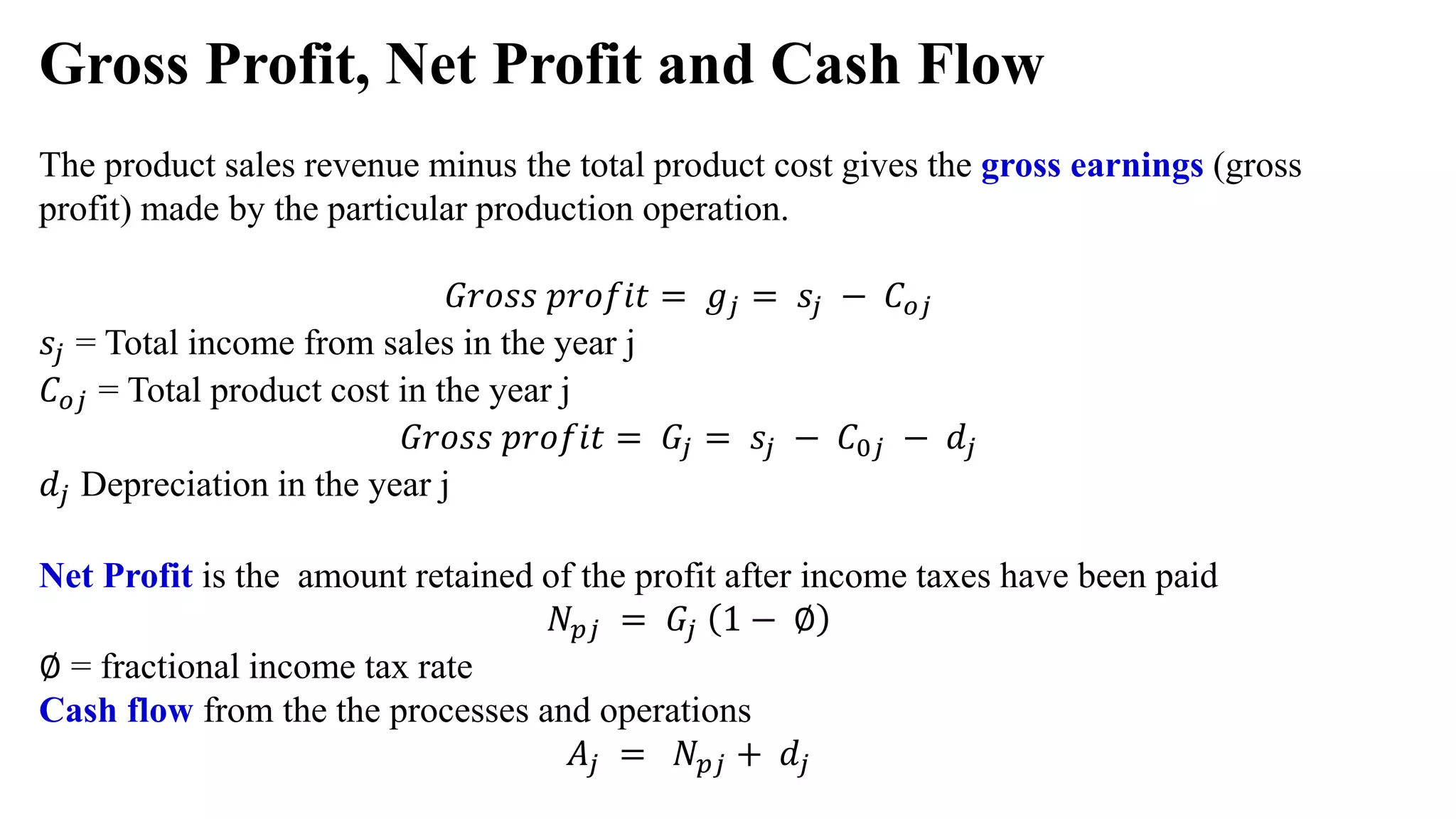
Gross Profit, Net Profit and Cash Flow
The product sales revenue minus the total product cost gives the gross earnings (gross
profit) made by the particular production operation.
𝐺𝑟𝑜𝑠𝑠 𝑝𝑟𝑜𝑓𝑖𝑡 = 𝑔𝑗 = 𝑠𝑗 − 𝐶 𝑜𝑗
𝑠𝑗 = Total income from sales in the year j
𝐶 𝑜𝑗 = Total product cost in the year j
𝐺𝑟𝑜𝑠𝑠 𝑝𝑟𝑜𝑓𝑖𝑡 = 𝐺𝑗 = 𝑠𝑗 − 𝐶0𝑗 − 𝑑𝑗
𝑑𝑗 Depreciation in the year j
Net Profit is the amount retained of the profit after income taxes have been paid
𝑁𝑝𝑗 = 𝐺𝑗 1 − ∅
∅ = fractional income tax rate
Cash flow from the the processes and operations
𝐴𝑗 = 𝑁𝑝𝑗 + 𝑑𝑗
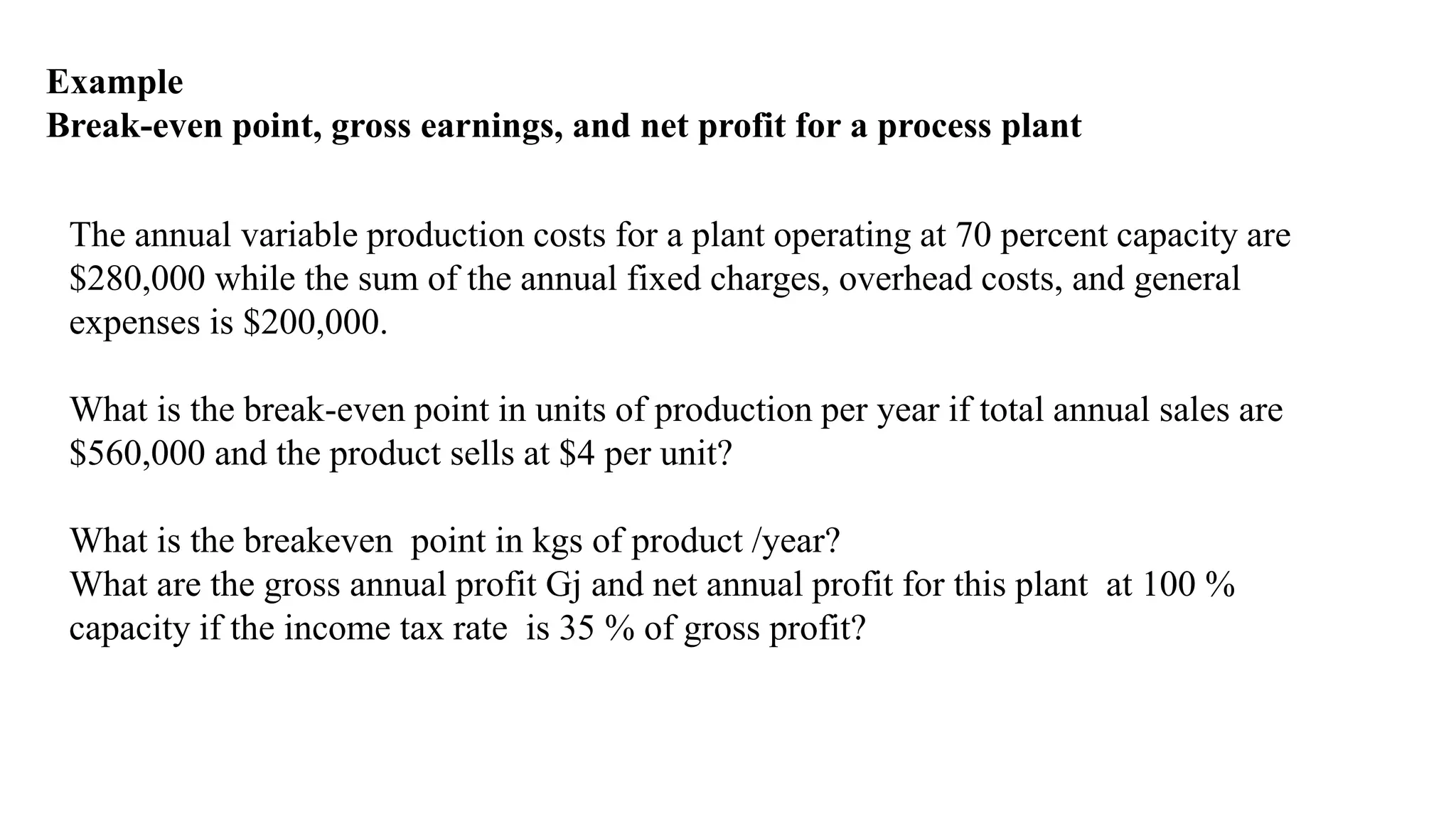
Example
Break-even point, gross earnings, and net profit for a process plant
The annual variable production costs for a plant operating at 70 percent capacity are
$280,000 while the sum of the annual fixed charges, overhead costs, and general
expenses is $200,000.
What is the break-even point in units of production per year if total annual sales are
$560,000 and the product sells at $4 per unit?
What is the breakeven point in kgs of product /year?
What are the gross annual profit Gj and net annual profit for this plant at 100 %
capacity if the income tax rate is 35 % of gross profit?
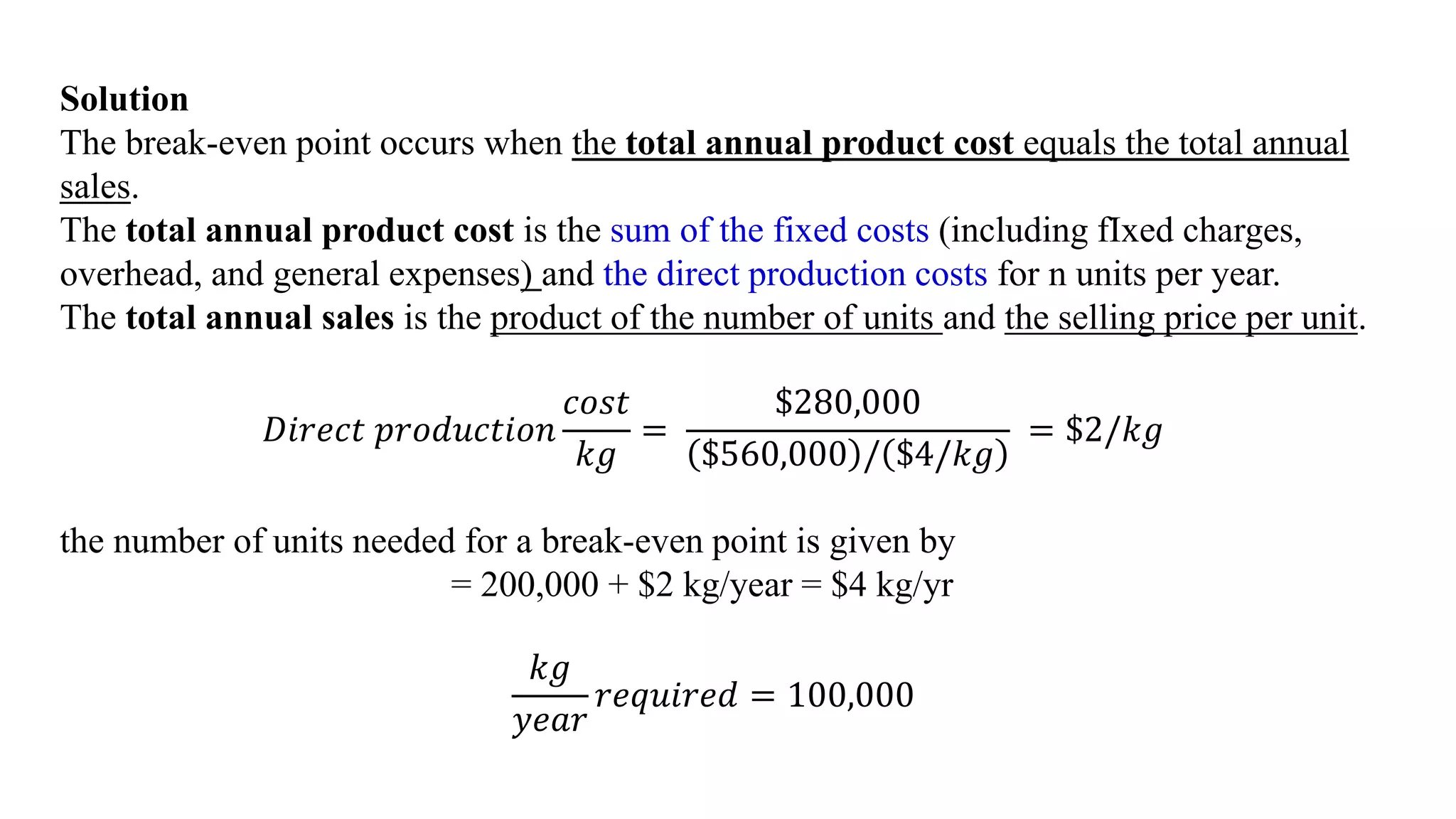
Solution
The break-even point occurs when the total annual product cost equals the total annual
sales.
The total annual product cost is the sum of the fixed costs (including fIxed charges,
overhead, and general expenses) and the direct production costs for n units per year.
The total annual sales is the product of the number of units and the selling price per unit.
𝐷𝑖𝑟𝑒𝑐𝑡 𝑝𝑟𝑜𝑑𝑢𝑐𝑡𝑖𝑜𝑛
𝑐𝑜𝑠𝑡
𝑘𝑔
=
$280,000
$560,000 / $4/𝑘𝑔
= $2/𝑘𝑔
the number of units needed for a break-even point is given by
= 200,000 + $2 kg/year = $4 kg/yr
𝑘𝑔
𝑦𝑒𝑎𝑟
𝑟𝑒𝑞𝑢𝑖𝑟𝑒𝑑 = 100,000
Gross annual earnings = total annual sales - total annual product cost
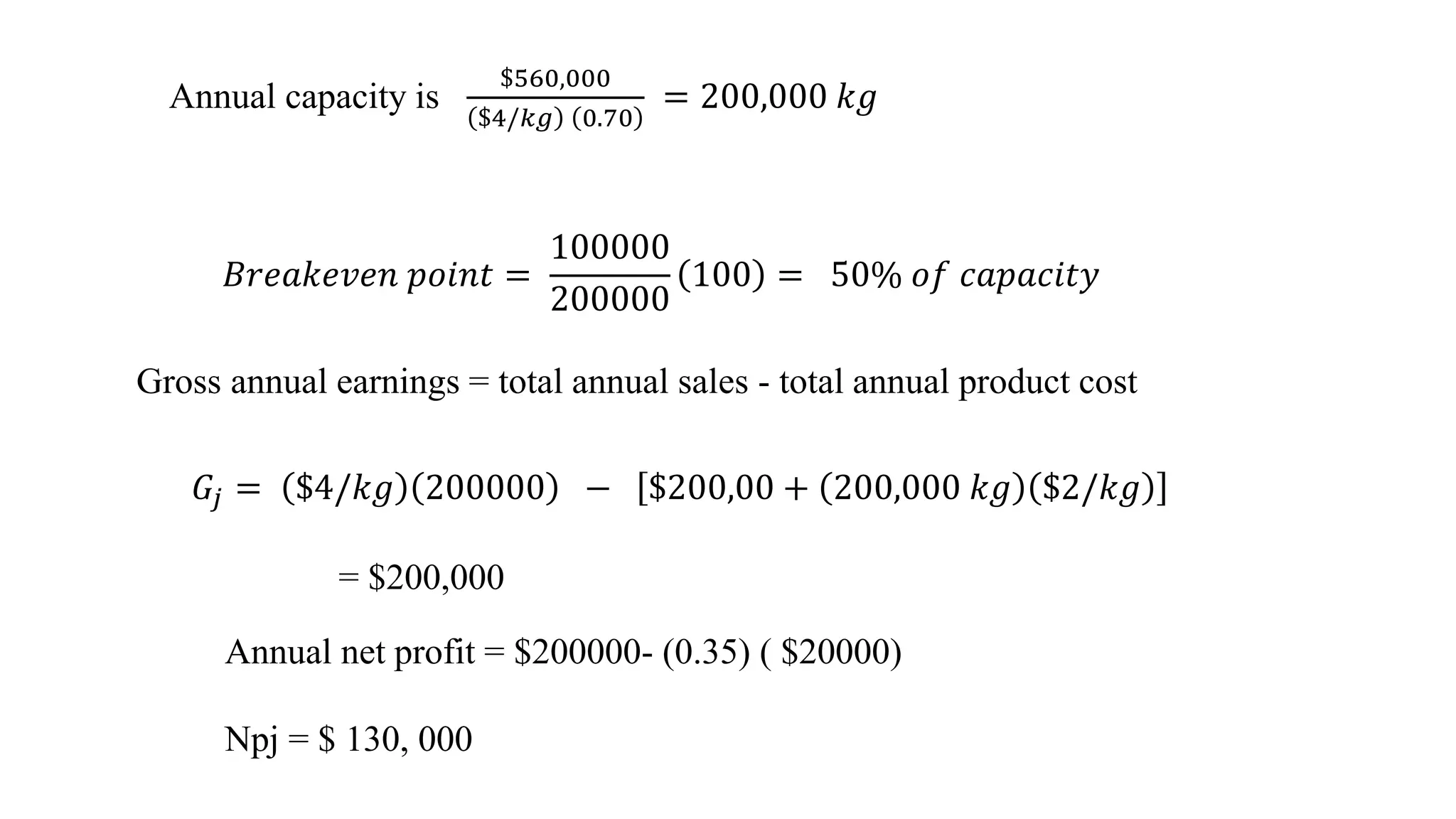
Annual capacity is
$560,000
$4/𝑘𝑔 0.70
= 200,000 𝑘𝑔
𝐵𝑟𝑒𝑎𝑘𝑒𝑣𝑒𝑛 𝑝𝑜𝑖𝑛𝑡 =
100000
200000
100 = 50% 𝑜𝑓 𝑐𝑎𝑝𝑎𝑐𝑖𝑡𝑦
𝐺𝑗 = $4/𝑘𝑔 200000 − $200,00 + 200,000 𝑘𝑔 $2/𝑘𝑔
= $200,000
Annual net profit = $200000- (0.35) ( $20000)
Npj = $ 130, 000
Following books were used in preparation of notes
 Blank, L., Tarquin. A. 2005. Engineering Economy. 6th Edition, McGraw-Hill.
 Eschenbach, T. G. 2003. Engineering Economy”, 2nd Edition, Oxford University Press
 Riggs, J. L., Bedworth, D. D., Randhawa, S. U. 1996. Engineering Economics”, 4th Edition, Tata McGraw-Hill.
 Riggs, J. L., West. T. M. 1986. Essentials of Engineering Economics”, 2nd Edition, McGraw-Hill.
 Peter, M. S., Timmerhaus, K. D. 1991. Plant Design and Economics for Chemical Engineers. 4th Edition,

Gross Profit, Net Profit

  • 1.
    Gross Profit, NetProfit per Capital Investment Dr. K. Shahzad Baig Memorial University of Newfoundland (MUN) Canada
  • 2.
    Gross Profit, NetProfit and Cash Flow The product sales revenue minus the total product cost gives the gross earnings (gross profit) made by the particular production operation. 𝐺𝑟𝑜𝑠𝑠 𝑝𝑟𝑜𝑓𝑖𝑡 = 𝑔𝑗 = 𝑠𝑗 − 𝐶 𝑜𝑗 𝑠𝑗 = Total income from sales in the year j 𝐶 𝑜𝑗 = Total product cost in the year j 𝐺𝑟𝑜𝑠𝑠 𝑝𝑟𝑜𝑓𝑖𝑡 = 𝐺𝑗 = 𝑠𝑗 − 𝐶0𝑗 − 𝑑𝑗 𝑑𝑗 Depreciation in the year j Net Profit is the amount retained of the profit after income taxes have been paid 𝑁𝑝𝑗 = 𝐺𝑗 1 − ∅ ∅ = fractional income tax rate Cash flow from the the processes and operations 𝐴𝑗 = 𝑁𝑝𝑗 + 𝑑𝑗
  • 3.
    Example Break-even point, grossearnings, and net profit for a process plant The annual variable production costs for a plant operating at 70 percent capacity are $280,000 while the sum of the annual fixed charges, overhead costs, and general expenses is $200,000. What is the break-even point in units of production per year if total annual sales are $560,000 and the product sells at $4 per unit? What is the breakeven point in kgs of product /year? What are the gross annual profit Gj and net annual profit for this plant at 100 % capacity if the income tax rate is 35 % of gross profit?
  • 4.
    Solution The break-even pointoccurs when the total annual product cost equals the total annual sales. The total annual product cost is the sum of the fixed costs (including fIxed charges, overhead, and general expenses) and the direct production costs for n units per year. The total annual sales is the product of the number of units and the selling price per unit. 𝐷𝑖𝑟𝑒𝑐𝑡 𝑝𝑟𝑜𝑑𝑢𝑐𝑡𝑖𝑜𝑛 𝑐𝑜𝑠𝑡 𝑘𝑔 = $280,000 $560,000 / $4/𝑘𝑔 = $2/𝑘𝑔 the number of units needed for a break-even point is given by = 200,000 + $2 kg/year = $4 kg/yr 𝑘𝑔 𝑦𝑒𝑎𝑟 𝑟𝑒𝑞𝑢𝑖𝑟𝑒𝑑 = 100,000
  • 5.
    Gross annual earnings= total annual sales - total annual product cost Annual capacity is $560,000 $4/𝑘𝑔 0.70 = 200,000 𝑘𝑔 𝐵𝑟𝑒𝑎𝑘𝑒𝑣𝑒𝑛 𝑝𝑜𝑖𝑛𝑡 = 100000 200000 100 = 50% 𝑜𝑓 𝑐𝑎𝑝𝑎𝑐𝑖𝑡𝑦 𝐺𝑗 = $4/𝑘𝑔 200000 − $200,00 + 200,000 𝑘𝑔 $2/𝑘𝑔 = $200,000 Annual net profit = $200000- (0.35) ( $20000) Npj = $ 130, 000
  • 6.
    Following books wereused in preparation of notes  Blank, L., Tarquin. A. 2005. Engineering Economy. 6th Edition, McGraw-Hill.  Eschenbach, T. G. 2003. Engineering Economy”, 2nd Edition, Oxford University Press  Riggs, J. L., Bedworth, D. D., Randhawa, S. U. 1996. Engineering Economics”, 4th Edition, Tata McGraw-Hill.  Riggs, J. L., West. T. M. 1986. Essentials of Engineering Economics”, 2nd Edition, McGraw-Hill.  Peter, M. S., Timmerhaus, K. D. 1991. Plant Design and Economics for Chemical Engineers. 4th Edition,