Projects, Investment,
Profitability
Dr. K. Shahzad Baig
Memorial University of Newfoundland (MUN) Canada
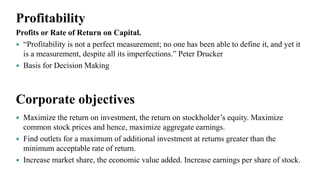
Profitability
Profits or Rate of Return on Capital.
 “Profitability is not a perfect measurement; no one has been able to define it, and yet it
is a measurement, despite all its imperfections.” Peter Drucker
 Basis for Decision Making
Corporate objectives
 Maximize the return on investment, the return on stockholder’s equity. Maximize
common stock prices and hence, maximize aggregate earnings.
 Find outlets for a maximum of additional investment at returns greater than the
minimum acceptable rate of return.
 Increase market share, the economic value added. Increase earnings per share of stock.
Project Classification for New Investments
 Necessity projects: Environmental, health and safety regulations, legal
requirements or possibly to accomplish intangible but essential needs
 Product improvement projects: Require capital to improve the quality of a
product, like clarity, stability, odor, or purity to meet customer needs
 Process improvement projects: Concerned with the reduction of operating
expenses, for example, improvement in reaction yields, reduction of utilities, and
labor expenses
 Expansion projects: To meet increased sales demand for a product. These
projects may require the retrofitting of an existing facility with associated high
expenses and/or the building of a new facility.
 New ventures: New ventures require capital expenditures to introduce new
products to the market. These might also involve joint ventures or alliances with
another company or companies and are the riskiest projects.
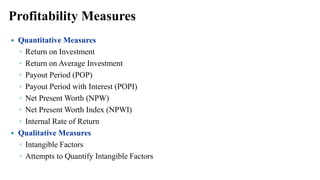
Profitability Measures
 Quantitative Measures
◦ Return on Investment
◦ Return on Average Investment
◦ Payout Period (POP)
◦ Payout Period with Interest (POPI)
◦ Net Present Worth (NPW)
◦ Net Present Worth Index (NPWI)
◦ Internal Rate of Return
 Qualitative Measures
◦ Intangible Factors
◦ Attempts to Quantify Intangible Factors
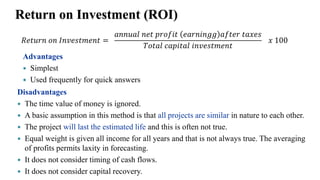
Return on Investment (ROI)
𝑅𝑒𝑡𝑢𝑟𝑛 𝑜𝑛 𝐼𝑛𝑣𝑒𝑠𝑡𝑚𝑒𝑛𝑡 =
𝑎𝑛𝑛𝑢𝑎𝑙 𝑛𝑒𝑡 𝑝𝑟𝑜𝑓𝑖𝑡 𝑒𝑎𝑟𝑛𝑖𝑛𝑔𝑔 𝑎𝑓𝑡𝑒𝑟 𝑡𝑎𝑥𝑒𝑠
𝑇𝑜𝑡𝑎𝑙 𝑐𝑎𝑝𝑖𝑡𝑎𝑙 𝑖𝑛𝑣𝑒𝑠𝑡𝑚𝑒𝑛𝑡
𝑥 100
Advantages
 Simplest
 Used frequently for quick answers
Disadvantages
 The time value of money is ignored.
 A basic assumption in this method is that all projects are similar in nature to each other.
 The project will last the estimated life and this is often not true.
 Equal weight is given all income for all years and that is not always true. The averaging
of profits permits laxity in forecasting.
 It does not consider timing of cash flows.
 It does not consider capital recovery.
Return on Average Investment (POAI)
 Measuring the profitability of investments utilizing accounting data and are based on
averaging methods.
𝑅𝑂𝐴𝐼 =
𝑎𝑛𝑛𝑢𝑎𝑙 𝑛𝑒𝑡 𝑝𝑟𝑜𝑓𝑖𝑡 𝑒𝑎𝑟𝑛𝑖𝑛𝑔𝑔 𝑎𝑓𝑡𝑒𝑟 𝑡𝑎𝑥𝑒𝑠
𝐿𝑎𝑛𝑑 + 𝑊𝑜𝑟𝑘𝑖𝑛𝑔 𝑐𝑎𝑝𝑖𝑡𝑎𝑙 + (𝐹𝑖𝑥𝑒𝑑 𝐶𝑎𝑝𝑖𝑡𝑎𝑙 𝐼𝑛𝑣𝑒𝑠𝑡𝑚𝑒𝑛𝑡)/2
𝑥 100
This method has all the inherent disadvantages of the previous method
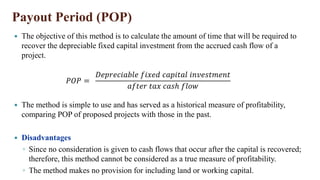
Payout Period (POP)
 The method is simple to use and has served as a historical measure of profitability,
comparing POP of proposed projects with those in the past.
 Disadvantages
◦ Since no consideration is given to cash flows that occur after the capital is recovered;
therefore, this method cannot be considered as a true measure of profitability.
◦ The method makes no provision for including land or working capital.
𝑃𝑂𝑃 =
𝐷𝑒𝑝𝑟𝑒𝑐𝑖𝑎𝑏𝑙𝑒 𝑓𝑖𝑥𝑒𝑑 𝑐𝑎𝑝𝑖𝑡𝑎𝑙 𝑖𝑛𝑣𝑒𝑠𝑡𝑚𝑒𝑛𝑡
𝑎𝑓𝑡𝑒𝑟 𝑡𝑎𝑥 𝑐𝑎𝑠ℎ 𝑓𝑙𝑜𝑤
 The objective of this method is to calculate the amount of time that will be required to
recover the depreciable fixed capital investment from the accrued cash flow of a
project.
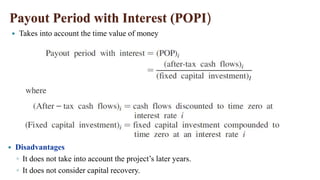
Payout Period with Interest (POPI)
 Disadvantages
◦ It does not take into account the project’s later years.
◦ It does not consider capital recovery.
 Takes into account the time value of money
Net Present Worth (NPW)
 Algebraic sum of the discounted values of the cash flows each year for the life of a project
 It has none of the disadvantages of other methods and treats the time value of money and
its effect on project profitability properly
 An arbitrary time frame, i.e., time zero, is selected as the basis of calculation
Net Present Worth Index (NPWI)
 Also known as the profitability index. The ratio of the present value of the after-tax cash
inflows to the present value of the cash outflows or capital items.
 An index greater than 1 indicates that a project has a yield greater than the discount
(interest) rate.
 When more than one project is considered, that project with the highest net present
worth index is to be preferred, provided it is greater than 1.
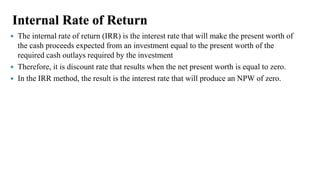
Internal Rate of Return
 The internal rate of return (IRR) is the interest rate that will make the present worth of
the cash proceeds expected from an investment equal to the present worth of the
required cash outlays required by the investment
 Therefore, it is discount rate that results when the net present worth is equal to zero.
 In the IRR method, the result is the interest rate that will produce an NPW of zero.
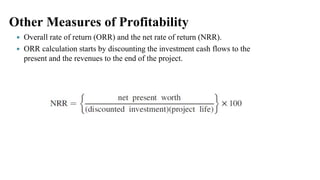
Other Measures of Profitability
 Overall rate of return (ORR) and the net rate of return (NRR).
 ORR calculation starts by discounting the investment cash flows to the
present and the revenues to the end of the project.
Limitations of IRR Method
Multiple rates for return
 Unusual cash flow forecasts can lead to more than one answer for the IRR
Reinvestment rate
 Inherent in the IRR calculation is the assumption that funds received during the project
can immediately be reinvested at the same interest rate as the IRR.
◦ The higher the return, the lower the probability that additional projects are available
for reinvestment at that rate.
 Comparison of two are more projects.
When comparing two or more mutually exclusive projects will not necessarily lead to
the correct choice, thus by elimination the best project will be selected.
 Size of the investment.
◦ The IRR method can’t differentiate between differences in the size of the
investment.
 Timing of cash flows
◦ Because of the uncertainty in forecasts, the nature of the cash flow and
timing, there is the possibility that the discounted value of the net cash flows
can equal zero at more than one interest rate. This causes problems in
analyzing the meaning of the results.
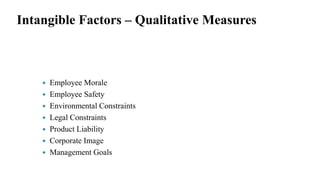
Intangible Factors – Qualitative Measures
 Employee Morale
 Employee Safety
 Environmental Constraints
 Legal Constraints
 Product Liability
 Corporate Image
 Management Goals
Following books were used in preparation of notes
 Blank, L., Tarquin. A. 2005. Engineering Economy. 6th Edition, McGraw-Hill.
 Eschenbach, T. G. 2003. Engineering Economy”, 2nd Edition, Oxford University Press
 Riggs, J. L., Bedworth, D. D., Randhawa, S. U. 1996. Engineering Economics”, 4th Edition, Tata McGraw-Hill.
 Riggs, J. L., West. T. M. 1986. Essentials of Engineering Economics”, 2nd Edition, McGraw-Hill.
 Peter, M. S., Timmerhaus, K. D. 1991. Plant Design and Economics for Chemical Engineers. 4th Edition, McGraw-Hill.

Projects, Investment, Profitability

  • 1.
    Projects, Investment, Profitability Dr. K.Shahzad Baig Memorial University of Newfoundland (MUN) Canada
  • 2.
    Profitability Profits or Rateof Return on Capital.  “Profitability is not a perfect measurement; no one has been able to define it, and yet it is a measurement, despite all its imperfections.” Peter Drucker  Basis for Decision Making Corporate objectives  Maximize the return on investment, the return on stockholder’s equity. Maximize common stock prices and hence, maximize aggregate earnings.  Find outlets for a maximum of additional investment at returns greater than the minimum acceptable rate of return.  Increase market share, the economic value added. Increase earnings per share of stock.
  • 3.
    Project Classification forNew Investments  Necessity projects: Environmental, health and safety regulations, legal requirements or possibly to accomplish intangible but essential needs  Product improvement projects: Require capital to improve the quality of a product, like clarity, stability, odor, or purity to meet customer needs  Process improvement projects: Concerned with the reduction of operating expenses, for example, improvement in reaction yields, reduction of utilities, and labor expenses  Expansion projects: To meet increased sales demand for a product. These projects may require the retrofitting of an existing facility with associated high expenses and/or the building of a new facility.  New ventures: New ventures require capital expenditures to introduce new products to the market. These might also involve joint ventures or alliances with another company or companies and are the riskiest projects.
  • 4.
    Profitability Measures  QuantitativeMeasures ◦ Return on Investment ◦ Return on Average Investment ◦ Payout Period (POP) ◦ Payout Period with Interest (POPI) ◦ Net Present Worth (NPW) ◦ Net Present Worth Index (NPWI) ◦ Internal Rate of Return  Qualitative Measures ◦ Intangible Factors ◦ Attempts to Quantify Intangible Factors
  • 5.
    Return on Investment(ROI) 𝑅𝑒𝑡𝑢𝑟𝑛 𝑜𝑛 𝐼𝑛𝑣𝑒𝑠𝑡𝑚𝑒𝑛𝑡 = 𝑎𝑛𝑛𝑢𝑎𝑙 𝑛𝑒𝑡 𝑝𝑟𝑜𝑓𝑖𝑡 𝑒𝑎𝑟𝑛𝑖𝑛𝑔𝑔 𝑎𝑓𝑡𝑒𝑟 𝑡𝑎𝑥𝑒𝑠 𝑇𝑜𝑡𝑎𝑙 𝑐𝑎𝑝𝑖𝑡𝑎𝑙 𝑖𝑛𝑣𝑒𝑠𝑡𝑚𝑒𝑛𝑡 𝑥 100 Advantages  Simplest  Used frequently for quick answers Disadvantages  The time value of money is ignored.  A basic assumption in this method is that all projects are similar in nature to each other.  The project will last the estimated life and this is often not true.  Equal weight is given all income for all years and that is not always true. The averaging of profits permits laxity in forecasting.  It does not consider timing of cash flows.  It does not consider capital recovery.
  • 6.
    Return on AverageInvestment (POAI)  Measuring the profitability of investments utilizing accounting data and are based on averaging methods. 𝑅𝑂𝐴𝐼 = 𝑎𝑛𝑛𝑢𝑎𝑙 𝑛𝑒𝑡 𝑝𝑟𝑜𝑓𝑖𝑡 𝑒𝑎𝑟𝑛𝑖𝑛𝑔𝑔 𝑎𝑓𝑡𝑒𝑟 𝑡𝑎𝑥𝑒𝑠 𝐿𝑎𝑛𝑑 + 𝑊𝑜𝑟𝑘𝑖𝑛𝑔 𝑐𝑎𝑝𝑖𝑡𝑎𝑙 + (𝐹𝑖𝑥𝑒𝑑 𝐶𝑎𝑝𝑖𝑡𝑎𝑙 𝐼𝑛𝑣𝑒𝑠𝑡𝑚𝑒𝑛𝑡)/2 𝑥 100 This method has all the inherent disadvantages of the previous method
  • 7.
    Payout Period (POP) The method is simple to use and has served as a historical measure of profitability, comparing POP of proposed projects with those in the past.  Disadvantages ◦ Since no consideration is given to cash flows that occur after the capital is recovered; therefore, this method cannot be considered as a true measure of profitability. ◦ The method makes no provision for including land or working capital. 𝑃𝑂𝑃 = 𝐷𝑒𝑝𝑟𝑒𝑐𝑖𝑎𝑏𝑙𝑒 𝑓𝑖𝑥𝑒𝑑 𝑐𝑎𝑝𝑖𝑡𝑎𝑙 𝑖𝑛𝑣𝑒𝑠𝑡𝑚𝑒𝑛𝑡 𝑎𝑓𝑡𝑒𝑟 𝑡𝑎𝑥 𝑐𝑎𝑠ℎ 𝑓𝑙𝑜𝑤  The objective of this method is to calculate the amount of time that will be required to recover the depreciable fixed capital investment from the accrued cash flow of a project.
  • 8.
    Payout Period withInterest (POPI)  Disadvantages ◦ It does not take into account the project’s later years. ◦ It does not consider capital recovery.  Takes into account the time value of money
  • 9.
    Net Present Worth(NPW)  Algebraic sum of the discounted values of the cash flows each year for the life of a project  It has none of the disadvantages of other methods and treats the time value of money and its effect on project profitability properly  An arbitrary time frame, i.e., time zero, is selected as the basis of calculation Net Present Worth Index (NPWI)  Also known as the profitability index. The ratio of the present value of the after-tax cash inflows to the present value of the cash outflows or capital items.  An index greater than 1 indicates that a project has a yield greater than the discount (interest) rate.  When more than one project is considered, that project with the highest net present worth index is to be preferred, provided it is greater than 1.
  • 10.
    Internal Rate ofReturn  The internal rate of return (IRR) is the interest rate that will make the present worth of the cash proceeds expected from an investment equal to the present worth of the required cash outlays required by the investment  Therefore, it is discount rate that results when the net present worth is equal to zero.  In the IRR method, the result is the interest rate that will produce an NPW of zero.
  • 11.
    Other Measures ofProfitability  Overall rate of return (ORR) and the net rate of return (NRR).  ORR calculation starts by discounting the investment cash flows to the present and the revenues to the end of the project.
  • 12.
    Limitations of IRRMethod Multiple rates for return  Unusual cash flow forecasts can lead to more than one answer for the IRR Reinvestment rate  Inherent in the IRR calculation is the assumption that funds received during the project can immediately be reinvested at the same interest rate as the IRR. ◦ The higher the return, the lower the probability that additional projects are available for reinvestment at that rate.  Comparison of two are more projects. When comparing two or more mutually exclusive projects will not necessarily lead to the correct choice, thus by elimination the best project will be selected.
  • 13.
     Size ofthe investment. ◦ The IRR method can’t differentiate between differences in the size of the investment.  Timing of cash flows ◦ Because of the uncertainty in forecasts, the nature of the cash flow and timing, there is the possibility that the discounted value of the net cash flows can equal zero at more than one interest rate. This causes problems in analyzing the meaning of the results.
  • 14.
    Intangible Factors –Qualitative Measures  Employee Morale  Employee Safety  Environmental Constraints  Legal Constraints  Product Liability  Corporate Image  Management Goals
  • 15.
    Following books wereused in preparation of notes  Blank, L., Tarquin. A. 2005. Engineering Economy. 6th Edition, McGraw-Hill.  Eschenbach, T. G. 2003. Engineering Economy”, 2nd Edition, Oxford University Press  Riggs, J. L., Bedworth, D. D., Randhawa, S. U. 1996. Engineering Economics”, 4th Edition, Tata McGraw-Hill.  Riggs, J. L., West. T. M. 1986. Essentials of Engineering Economics”, 2nd Edition, McGraw-Hill.  Peter, M. S., Timmerhaus, K. D. 1991. Plant Design and Economics for Chemical Engineers. 4th Edition, McGraw-Hill.