Behaviour of real gases :
deviation from ideal behaviour
Presented by,
Vidya K C
Roll No. :36
Reg.No. :DD16EDPS06
Physical Science
Presented on 25-10-2017 1
CONTENTS
Introduction
Reasons for deviation from ideal behaviour
van der Waal’s equation
Significance of van der Waal’s constants
Compressibility factor
2
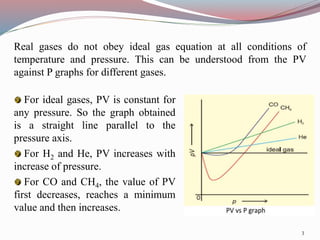
Real gases do not obey ideal gas equation at all conditions of
temperature and pressure. This can be understood from the PV
against P graphs for different gases.
For ideal gases, PV is constant for
any pressure. So the graph obtained
is a straight line parallel to the
pressure axis.
For H2 and He, PV increases with
increase of pressure.
For CO and CH4, the value of PV
first decreases, reaches a minimum
value and then increases.
3
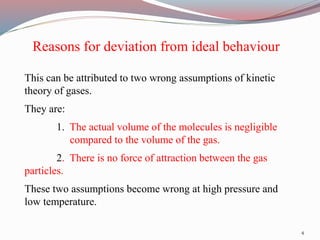
Reasons for deviation from ideal behaviour
This can be attributed to two wrong assumptions of kinetic
theory of gases.
They are:
1. The actual volume of the molecules is negligible
compared to the volume of the gas.
2. There is no force of attraction between the gas
particles.
These two assumptions become wrong at high pressure and
low temperature.
4
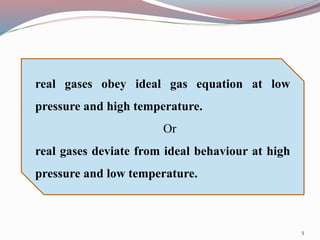
real gases obey ideal gas equation at low
pressure and high temperature.
Or
real gases deviate from ideal behaviour at high
pressure and low temperature.
5
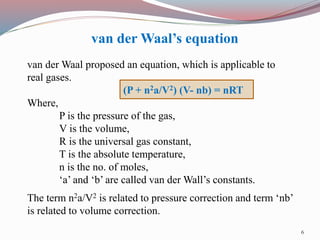
van der Waal proposed an equation, which is applicable to
real gases.
(P + n2a/V2) (V- nb) = nRT
Where,
P is the pressure of the gas,
V is the volume,
R is the universal gas constant,
T is the absolute temperature,
n is the no. of moles,
‘a’ and ‘b’ are called van der Wall’s constants.
The term n2a/V2 is related to pressure correction and term ‘nb’
is related to volume correction.
van der Waal’s equation
6
Significance of van der Waal’s constants
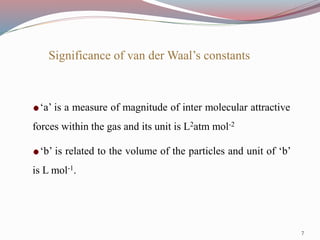
‘a’ is a measure of magnitude of inter molecular attractive
forces within the gas and its unit is L2atm mol-2
‘b’ is related to the volume of the particles and unit of ‘b’
is L mol-1.
7
Compressibility factor Z
The deviation from ideal behaviour can be measured in terms
of compressibility factor Z, which is the ratio of product PV
and nRT.
Mathematically,
Z = PV/nRT
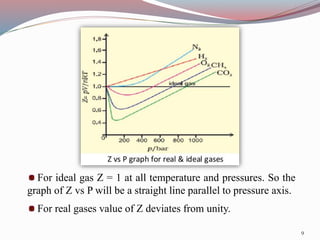
For ideal gas Z = 1 at all temperature and pressures. So the
graph of Z vs P will be a straight line parallel to pressure axis.
For real gases value of Z deviates from unity.
8
For ideal gas Z = 1 at all temperature and pressures. So the
graph of Z vs P will be a straight line parallel to pressure axis.
For real gases value of Z deviates from unity.
9
THANK YOU
10

Deviation of real gas from ideal behaviour

  • 1.
    Behaviour of realgases : deviation from ideal behaviour Presented by, Vidya K C Roll No. :36 Reg.No. :DD16EDPS06 Physical Science Presented on 25-10-2017 1
  • 2.
    CONTENTS Introduction Reasons for deviationfrom ideal behaviour van der Waal’s equation Significance of van der Waal’s constants Compressibility factor 2
  • 3.
    Real gases donot obey ideal gas equation at all conditions of temperature and pressure. This can be understood from the PV against P graphs for different gases. For ideal gases, PV is constant for any pressure. So the graph obtained is a straight line parallel to the pressure axis. For H2 and He, PV increases with increase of pressure. For CO and CH4, the value of PV first decreases, reaches a minimum value and then increases. 3
  • 4.
    Reasons for deviationfrom ideal behaviour This can be attributed to two wrong assumptions of kinetic theory of gases. They are: 1. The actual volume of the molecules is negligible compared to the volume of the gas. 2. There is no force of attraction between the gas particles. These two assumptions become wrong at high pressure and low temperature. 4
  • 5.
    real gases obeyideal gas equation at low pressure and high temperature. Or real gases deviate from ideal behaviour at high pressure and low temperature. 5
  • 6.
    van der Waalproposed an equation, which is applicable to real gases. (P + n2a/V2) (V- nb) = nRT Where, P is the pressure of the gas, V is the volume, R is the universal gas constant, T is the absolute temperature, n is the no. of moles, ‘a’ and ‘b’ are called van der Wall’s constants. The term n2a/V2 is related to pressure correction and term ‘nb’ is related to volume correction. van der Waal’s equation 6
  • 7.
    Significance of vander Waal’s constants ‘a’ is a measure of magnitude of inter molecular attractive forces within the gas and its unit is L2atm mol-2 ‘b’ is related to the volume of the particles and unit of ‘b’ is L mol-1. 7
  • 8.
    Compressibility factor Z Thedeviation from ideal behaviour can be measured in terms of compressibility factor Z, which is the ratio of product PV and nRT. Mathematically, Z = PV/nRT For ideal gas Z = 1 at all temperature and pressures. So the graph of Z vs P will be a straight line parallel to pressure axis. For real gases value of Z deviates from unity. 8
  • 9.
    For ideal gasZ = 1 at all temperature and pressures. So the graph of Z vs P will be a straight line parallel to pressure axis. For real gases value of Z deviates from unity. 9
  • 10.