Nominal and Effective
Interest Rate
Dr. K. Shahzad Baig
Memorial University of Newfoundland (MUN) Canada
Nominal and effective interest rate
Nominal means, “in name only”,
not the real rate in this case.
A Nominal Interest Rate,
is an interest Rate that does not include any consideration of
compound interest
r = (interest rate per period) (No. of Periods)
In common industrial practice, the length of the discrete interest period is assumed to be
1 year and the fixed interest rate i is based on 1 year.
There are cases where other time units are employed. Even though the actual interest
period is not 1 year, the interest rate is often expressed on an annual basis.
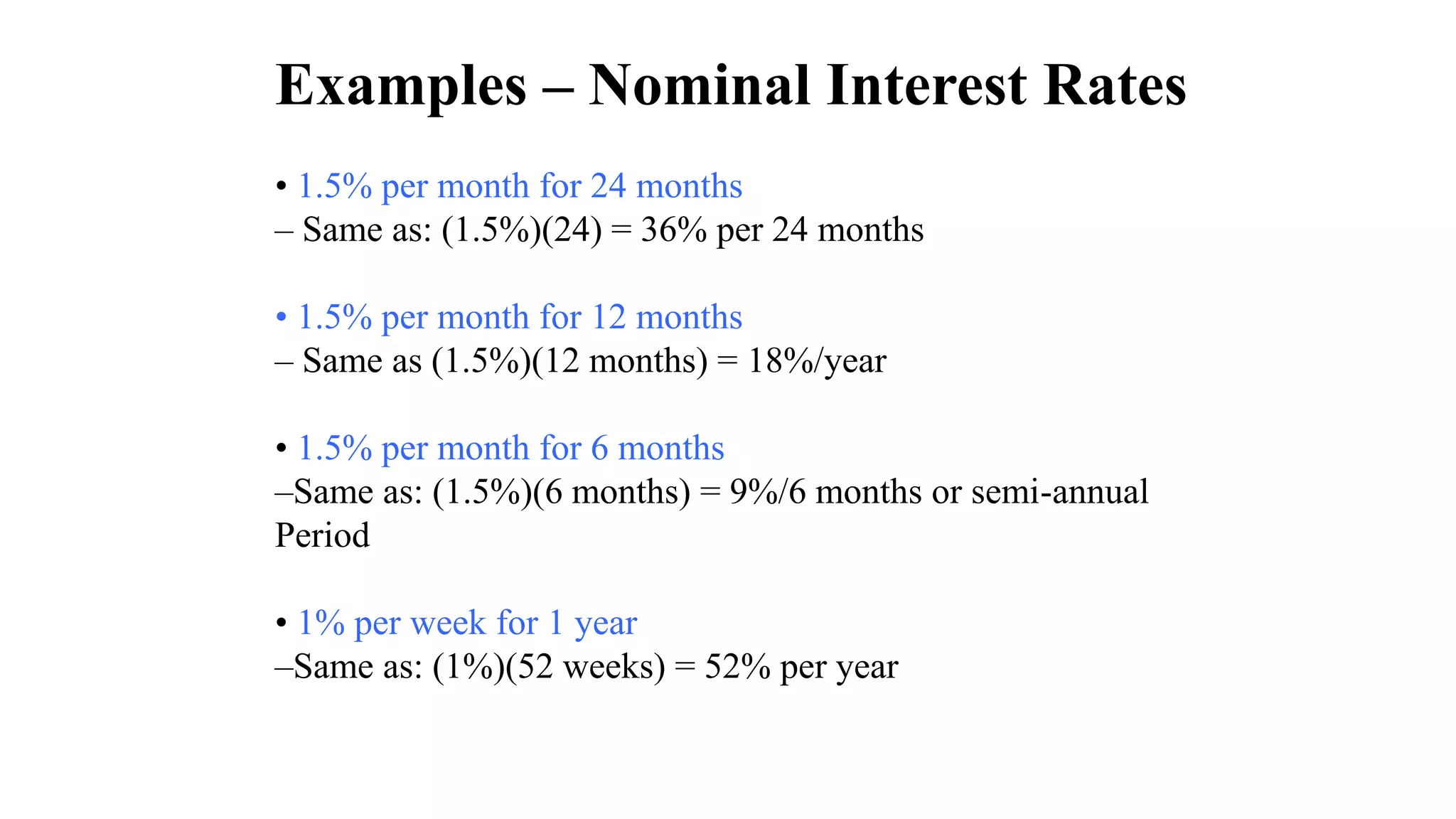
Examples – Nominal Interest Rates
• 1.5% per month for 24 months
– Same as: (1.5%)(24) = 36% per 24 months
• 1.5% per month for 12 months
– Same as (1.5%)(12 months) = 18%/year
• 1.5% per month for 6 months
–Same as: (1.5%)(6 months) = 9%/6 months or semi-annual
Period
• 1% per week for 1 year
–Same as: (1%)(52 weeks) = 52% per year
A nominal rate (so quoted) do not reference the frequency
of compounding. They all have the format “ r% per time period”
• Nominal rates can be misleading
• We need an alternative way to quote interest rates....
• The true Effective Interest Rate is then applied
The Effective Interest Rate (EIR)
• It is a rate that applies for a stated period of time
• It is conventional to use the year as the time standard
• So, the EIR is often referred to as the Effective Annual Interest
Rate (EAIR)
Nominal Rates:– Format: “r% per time period, t”
– Ex: 5% per 6-months”
• Effective Interest Rates:– Format: “r% per time period,
compounded ‘m’times a year.– ‘m’ denotes or infers the number
of times per year that interest is compounded.
– Ex: 18% per year, compounded monthly
The Differences
• The Effective interest Rate per compounding
period, CP is:
𝑖 𝑒𝑓𝑓𝑒𝑐𝑡𝑖𝑣𝑒 𝑝𝑒𝑟 𝐶𝑃 =
𝑟% / 𝑡𝑖𝑚𝑒 𝑝𝑒𝑟𝑖𝑜𝑑 𝑡
𝑚 𝑐𝑜𝑚𝑝𝑜𝑢𝑛𝑑𝑖𝑛𝑔 𝑝𝑒𝑟𝑖𝑜𝑑𝑠/𝑡
Deriving the EAIR
Invest $1 of principal at time t = 0 at interest rate i per year
.$P = $1.00
$F=$P(1+ia)
1One year later, F = P(1+ia)1
Assume the one year is now divided into “m” compounding
periods.
Replace “i” with “ia” since m now > 1
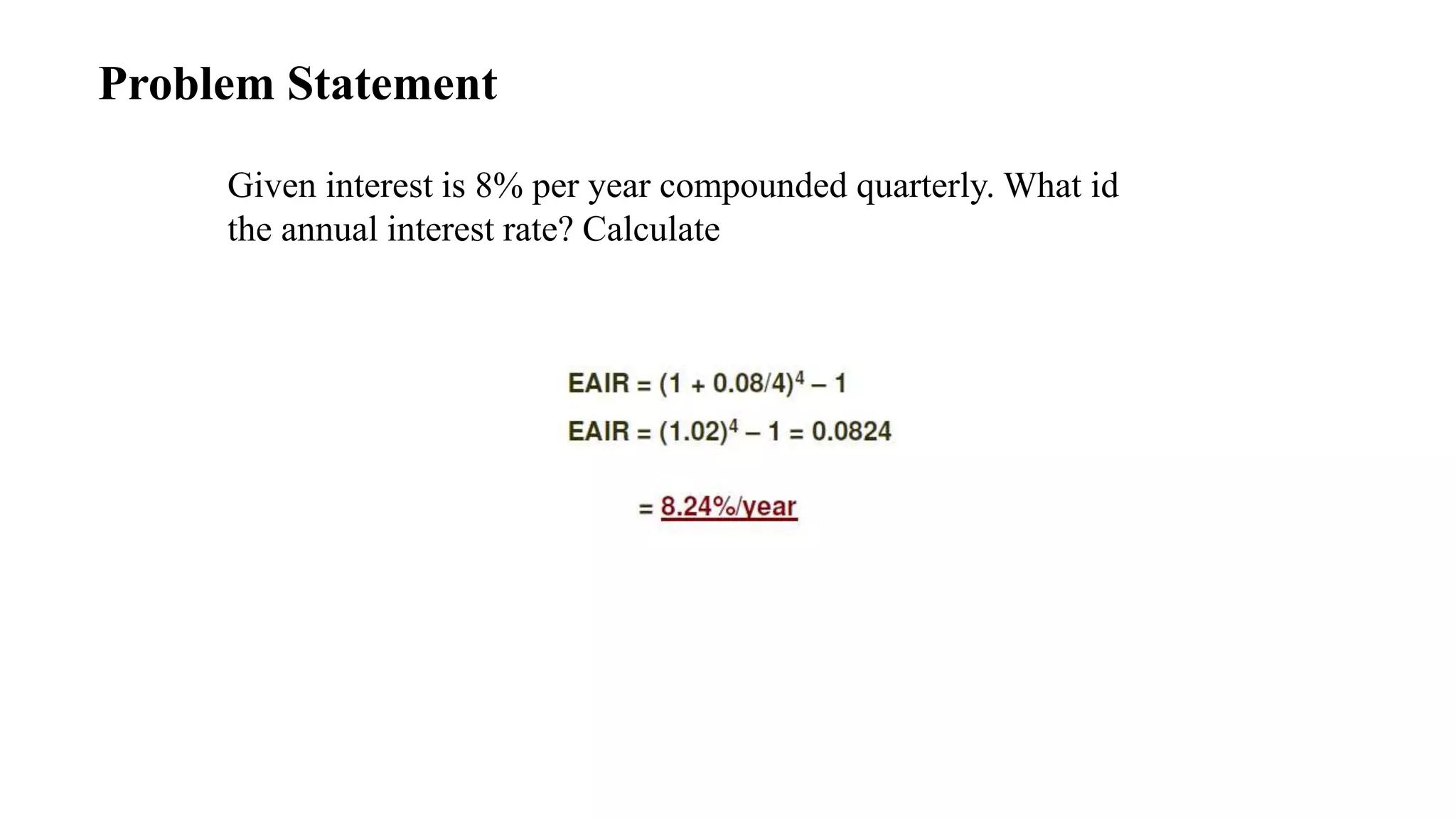
Problem Statement
Given interest is 8% per year compounded quarterly. What id
the annual interest rate? Calculate
Problem Statement
18% per year compound monthly. What is true, effective annual interest rate
Two similar expressions for F
•F = P(1 + ia);
•F = P( 1 + i )m
•Equate the two expressions;
Solving ‘ia’ in terms of ‘I’
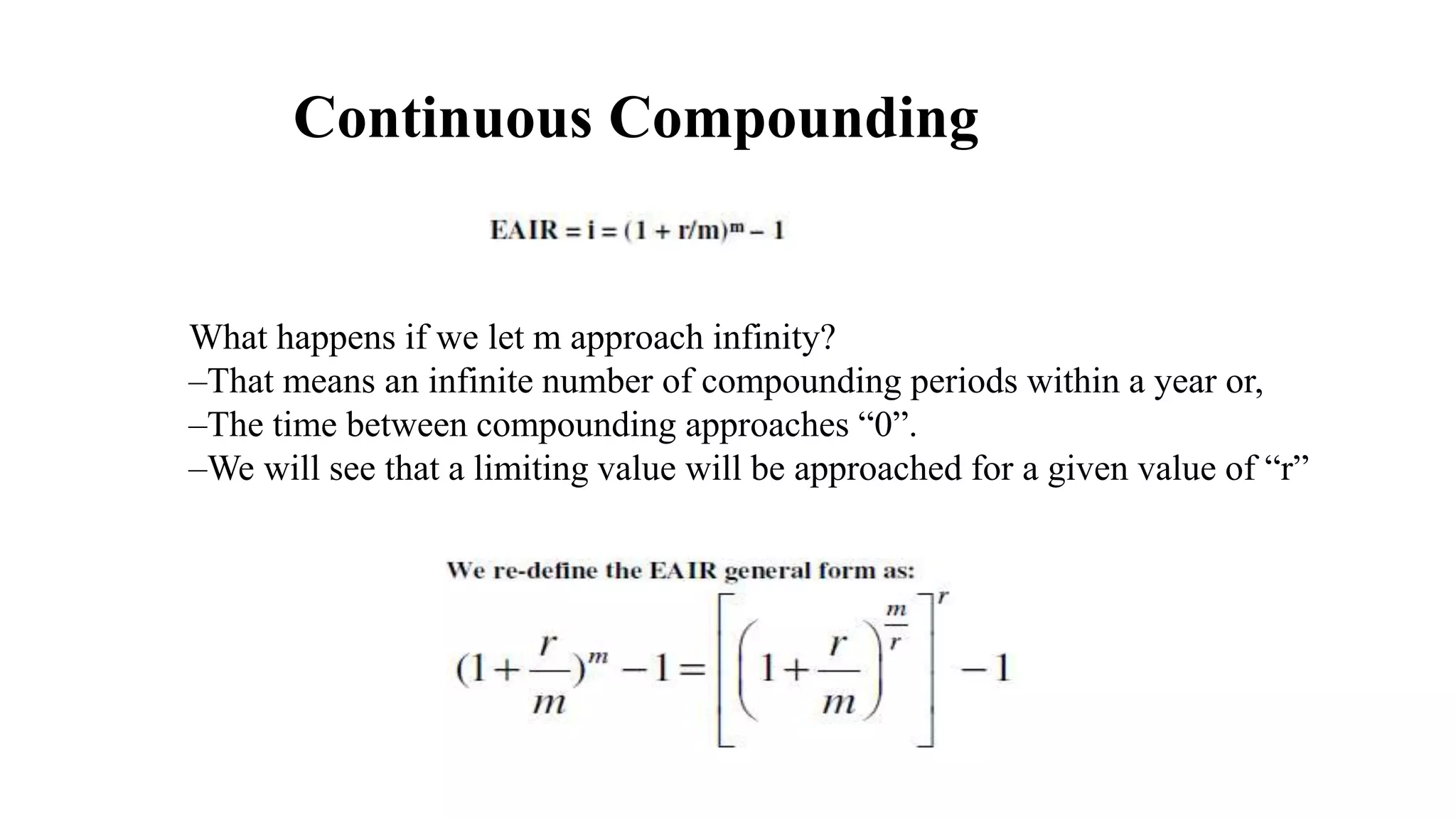
Continuous Compounding
What happens if we let m approach infinity?
–That means an infinite number of compounding periods within a year or,
–The time between compounding approaches “0”.
–We will see that a limiting value will be approached for a given value of “r”
From the calculus of limits there is an important limit
To find the equivalent nominal rate given the EAIR
when interest is compounded continuously, apply:
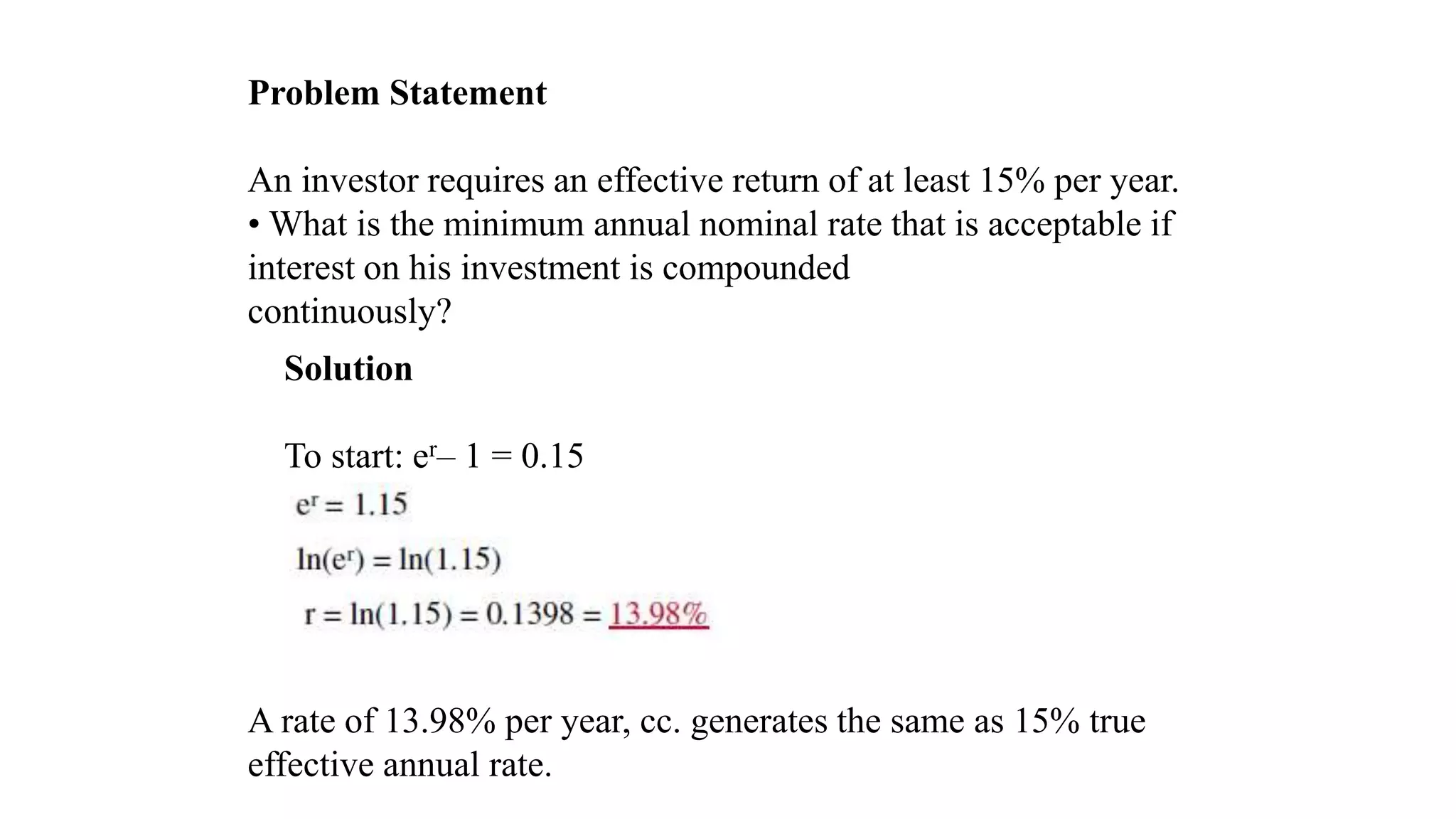
Problem Statement
An investor requires an effective return of at least 15% per year.
• What is the minimum annual nominal rate that is acceptable if
interest on his investment is compounded
continuously?
A rate of 13.98% per year, cc. generates the same as 15% true
effective annual rate.
Solution
To start: er– 1 = 0.15
Following books were used in preparation of notes
 Blank, L., Tarquin. A. 2005. Engineering Economy. 6th Edition, McGraw-Hill.
 Eschenbach, T. G. 2003. Engineering Economy”, 2nd Edition, Oxford University Press
 Riggs, J. L., Bedworth, D. D., Randhawa, S. U. 1996. Engineering Economics”, 4th Edition, Tata McGraw-Hill.
 Riggs, J. L., West. T. M. 1986. Essentials of Engineering Economics”, 2nd Edition, McGraw-Hill.
 Peter, M. S., Timmerhaus, K. D. 1991. Plant Design and Economics for Chemical Engineers. 4th Edition, McGraw-Hill.

Nominal and Effective Interest Rate

  • 1.
    Nominal and Effective InterestRate Dr. K. Shahzad Baig Memorial University of Newfoundland (MUN) Canada
  • 2.
    Nominal and effectiveinterest rate Nominal means, “in name only”, not the real rate in this case. A Nominal Interest Rate, is an interest Rate that does not include any consideration of compound interest r = (interest rate per period) (No. of Periods) In common industrial practice, the length of the discrete interest period is assumed to be 1 year and the fixed interest rate i is based on 1 year. There are cases where other time units are employed. Even though the actual interest period is not 1 year, the interest rate is often expressed on an annual basis.
  • 3.
    Examples – NominalInterest Rates • 1.5% per month for 24 months – Same as: (1.5%)(24) = 36% per 24 months • 1.5% per month for 12 months – Same as (1.5%)(12 months) = 18%/year • 1.5% per month for 6 months –Same as: (1.5%)(6 months) = 9%/6 months or semi-annual Period • 1% per week for 1 year –Same as: (1%)(52 weeks) = 52% per year
  • 4.
    A nominal rate(so quoted) do not reference the frequency of compounding. They all have the format “ r% per time period” • Nominal rates can be misleading • We need an alternative way to quote interest rates.... • The true Effective Interest Rate is then applied The Effective Interest Rate (EIR) • It is a rate that applies for a stated period of time • It is conventional to use the year as the time standard • So, the EIR is often referred to as the Effective Annual Interest Rate (EAIR)
  • 5.
    Nominal Rates:– Format:“r% per time period, t” – Ex: 5% per 6-months” • Effective Interest Rates:– Format: “r% per time period, compounded ‘m’times a year.– ‘m’ denotes or infers the number of times per year that interest is compounded. – Ex: 18% per year, compounded monthly The Differences • The Effective interest Rate per compounding period, CP is: 𝑖 𝑒𝑓𝑓𝑒𝑐𝑡𝑖𝑣𝑒 𝑝𝑒𝑟 𝐶𝑃 = 𝑟% / 𝑡𝑖𝑚𝑒 𝑝𝑒𝑟𝑖𝑜𝑑 𝑡 𝑚 𝑐𝑜𝑚𝑝𝑜𝑢𝑛𝑑𝑖𝑛𝑔 𝑝𝑒𝑟𝑖𝑜𝑑𝑠/𝑡
  • 6.
    Deriving the EAIR Invest$1 of principal at time t = 0 at interest rate i per year .$P = $1.00 $F=$P(1+ia) 1One year later, F = P(1+ia)1 Assume the one year is now divided into “m” compounding periods. Replace “i” with “ia” since m now > 1
  • 8.
    Problem Statement Given interestis 8% per year compounded quarterly. What id the annual interest rate? Calculate
  • 9.
    Problem Statement 18% peryear compound monthly. What is true, effective annual interest rate
  • 10.
    Two similar expressionsfor F •F = P(1 + ia); •F = P( 1 + i )m •Equate the two expressions; Solving ‘ia’ in terms of ‘I’
  • 11.
    Continuous Compounding What happensif we let m approach infinity? –That means an infinite number of compounding periods within a year or, –The time between compounding approaches “0”. –We will see that a limiting value will be approached for a given value of “r”
  • 12.
    From the calculusof limits there is an important limit
  • 13.
    To find theequivalent nominal rate given the EAIR when interest is compounded continuously, apply:
  • 14.
    Problem Statement An investorrequires an effective return of at least 15% per year. • What is the minimum annual nominal rate that is acceptable if interest on his investment is compounded continuously? A rate of 13.98% per year, cc. generates the same as 15% true effective annual rate. Solution To start: er– 1 = 0.15
  • 15.
    Following books wereused in preparation of notes  Blank, L., Tarquin. A. 2005. Engineering Economy. 6th Edition, McGraw-Hill.  Eschenbach, T. G. 2003. Engineering Economy”, 2nd Edition, Oxford University Press  Riggs, J. L., Bedworth, D. D., Randhawa, S. U. 1996. Engineering Economics”, 4th Edition, Tata McGraw-Hill.  Riggs, J. L., West. T. M. 1986. Essentials of Engineering Economics”, 2nd Edition, McGraw-Hill.  Peter, M. S., Timmerhaus, K. D. 1991. Plant Design and Economics for Chemical Engineers. 4th Edition, McGraw-Hill.

Editor's Notes

  • #12 Now, examine the impact of letting “m” approach infinity.