
Lymphocyte Production and Maturation
PRINCESS ALEN I. AGUILAR
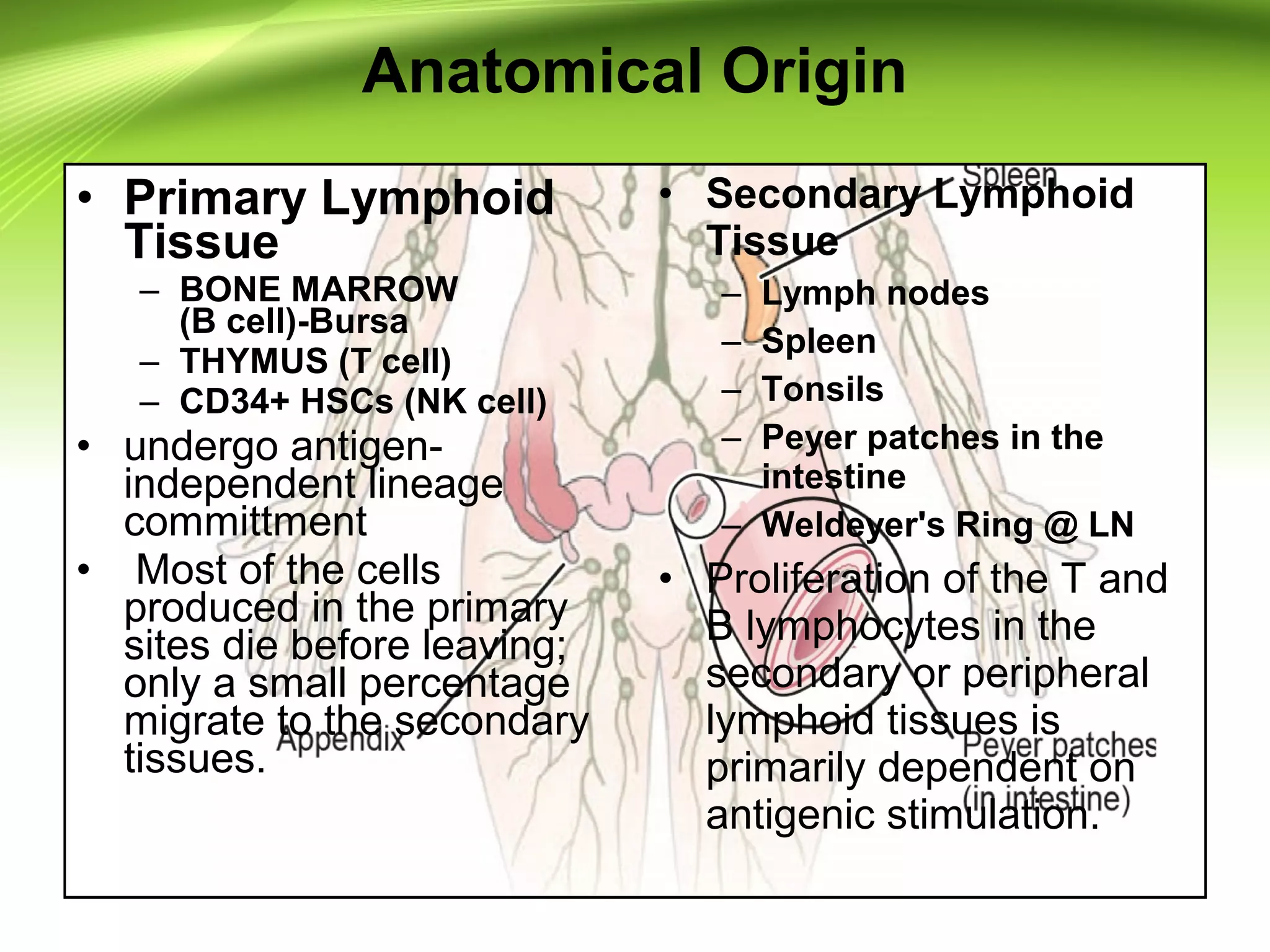
Anatomical Origin
• Primary Lymphoid
Tissue
– BONE MARROW
(B cell)-Bursa
– THYMUS (T cell)
– CD34+ HSCs (NK cell)

• undergo antigenindependent lineage
committment
• Most of the cells
produced in the primary
sites die before leaving;
only a small percentage
migrate to the secondary
tissues.

• Secondary Lymphoid
Tissue
–
–
–
–

Lymph nodes
Spleen
Tonsils
Peyer patches in the
intestine
– Weldeyer's Ring @ LN

• Proliferation of the T and
B lymphocytes in the
secondary or peripheral
lymphoid tissues is
primarily dependent on
antigenic stimulation.
General Stages of Lymphocyte Maturation

THEY ARE CHARACTERIZED
WITH THE USE OF
ROMANOWSKY-STAINED
FILMS: LIGHT MICROSCOPY
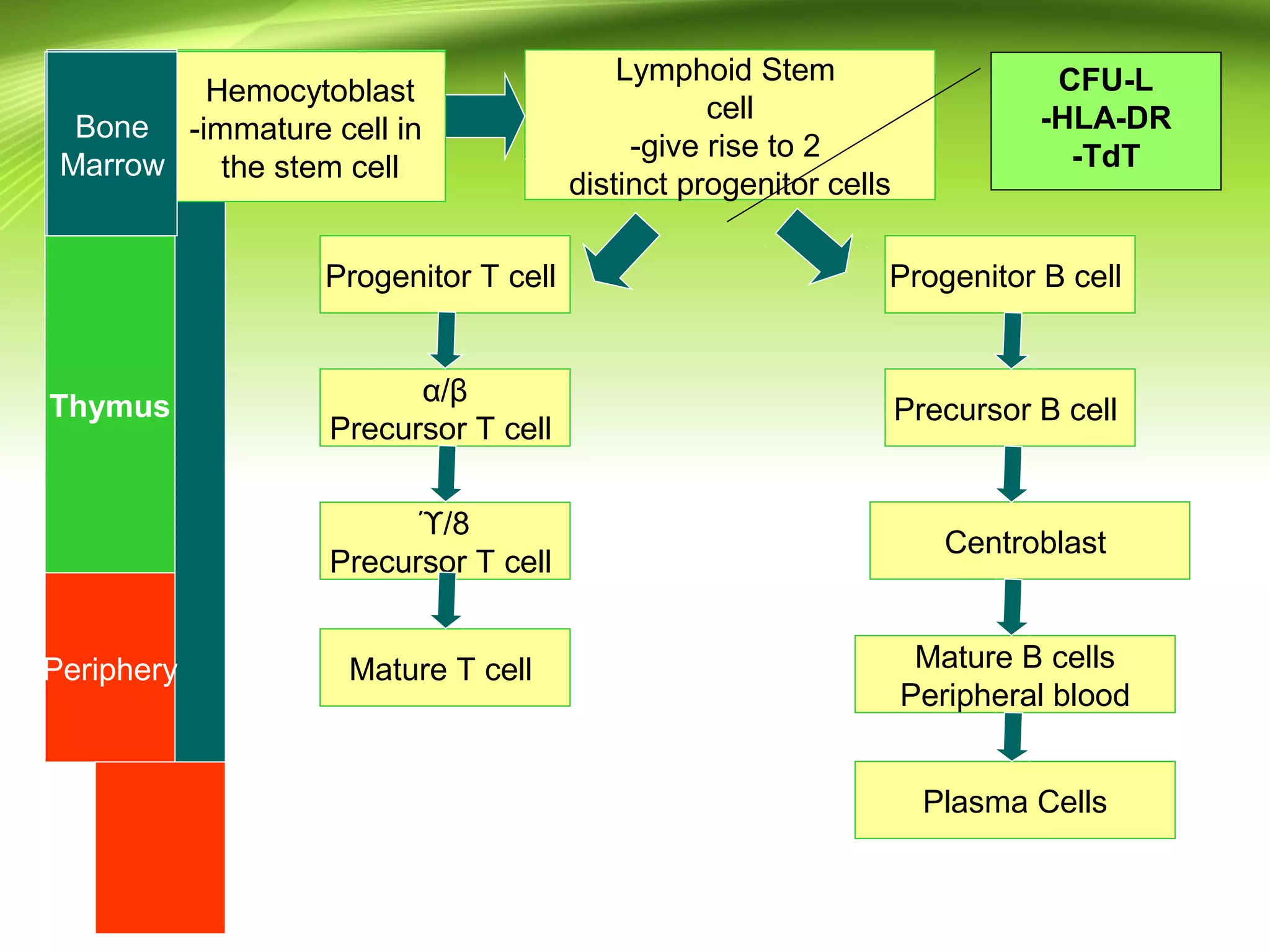
Hemocytoblast
Bone -immature cell in
Marrow
the stem cell

Lymphoid Stem
cell
-give rise to 2
distinct progenitor cells

CFU-L
-HLA-DR
-TdT

Progenitor T cell

Thymus

Progenitor B cell

α/β
Precursor T cell

Precursor B cell

ϓ/8
Precursor T cell
Periphery

Mature T cell

Centroblast
Mature B cells
Peripheral blood
Plasma Cells
T cell
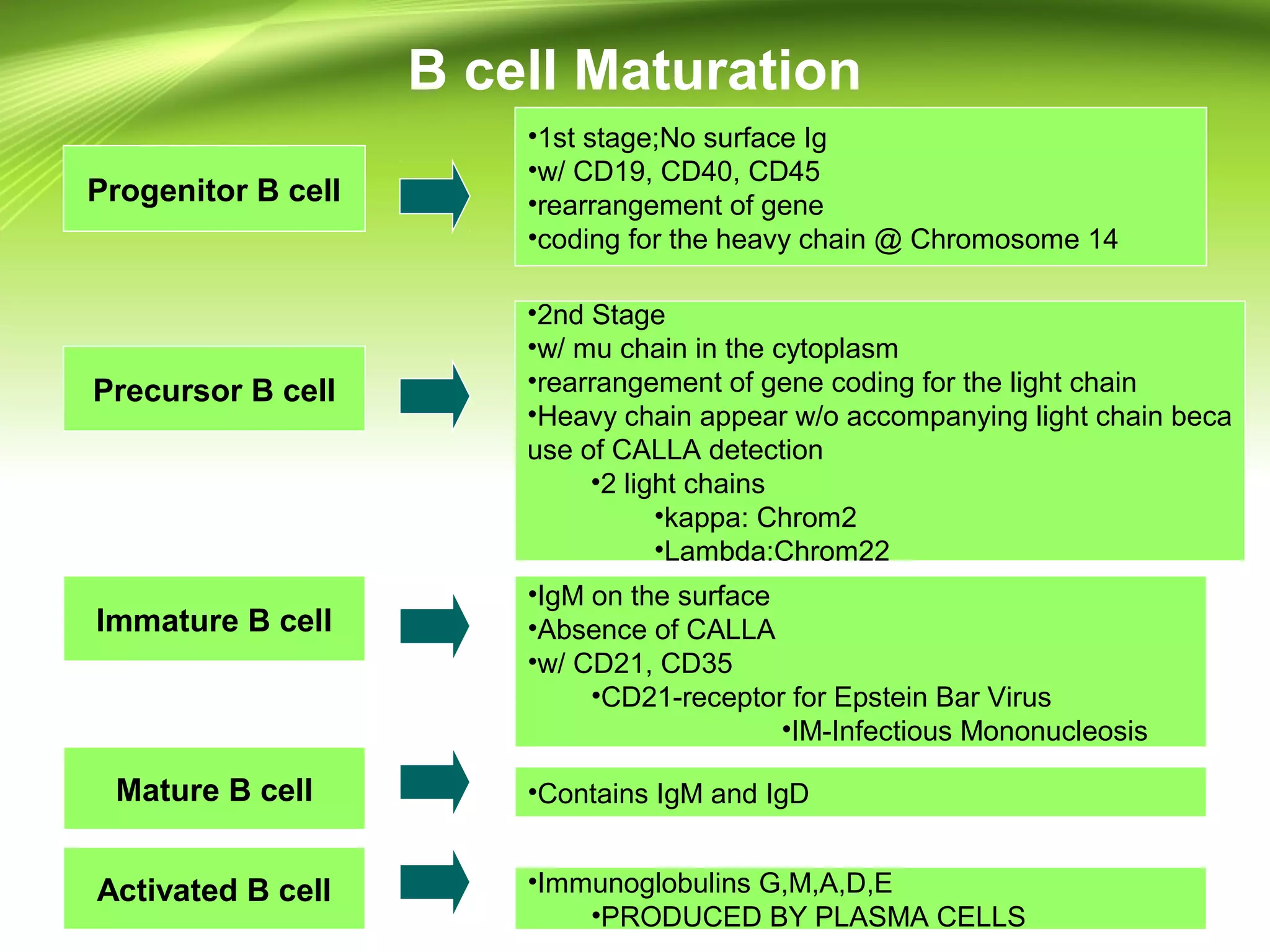
B cell Maturation
Progenitor B cell

Precursor B cell

Immature B cell

Mature B cell
Activated B cell

•1st stage;No surface Ig
•w/ CD19, CD40, CD45
•rearrangement of gene
•coding for the heavy chain @ Chromosome 14
•2nd Stage
•w/ mu chain in the cytoplasm
•rearrangement of gene coding for the light chain
•Heavy chain appear w/o accompanying light chain beca
use of CALLA detection
•2 light chains
•kappa: Chrom2
•Lambda:Chrom22
•IgM on the surface
•Absence of CALLA
•w/ CD21, CD35
•CD21-receptor for Epstein Bar Virus
•IM-Infectious Mononucleosis
•Contains IgM and IgD
•Immunoglobulins G,M,A,D,E
•PRODUCED BY PLASMA CELLS
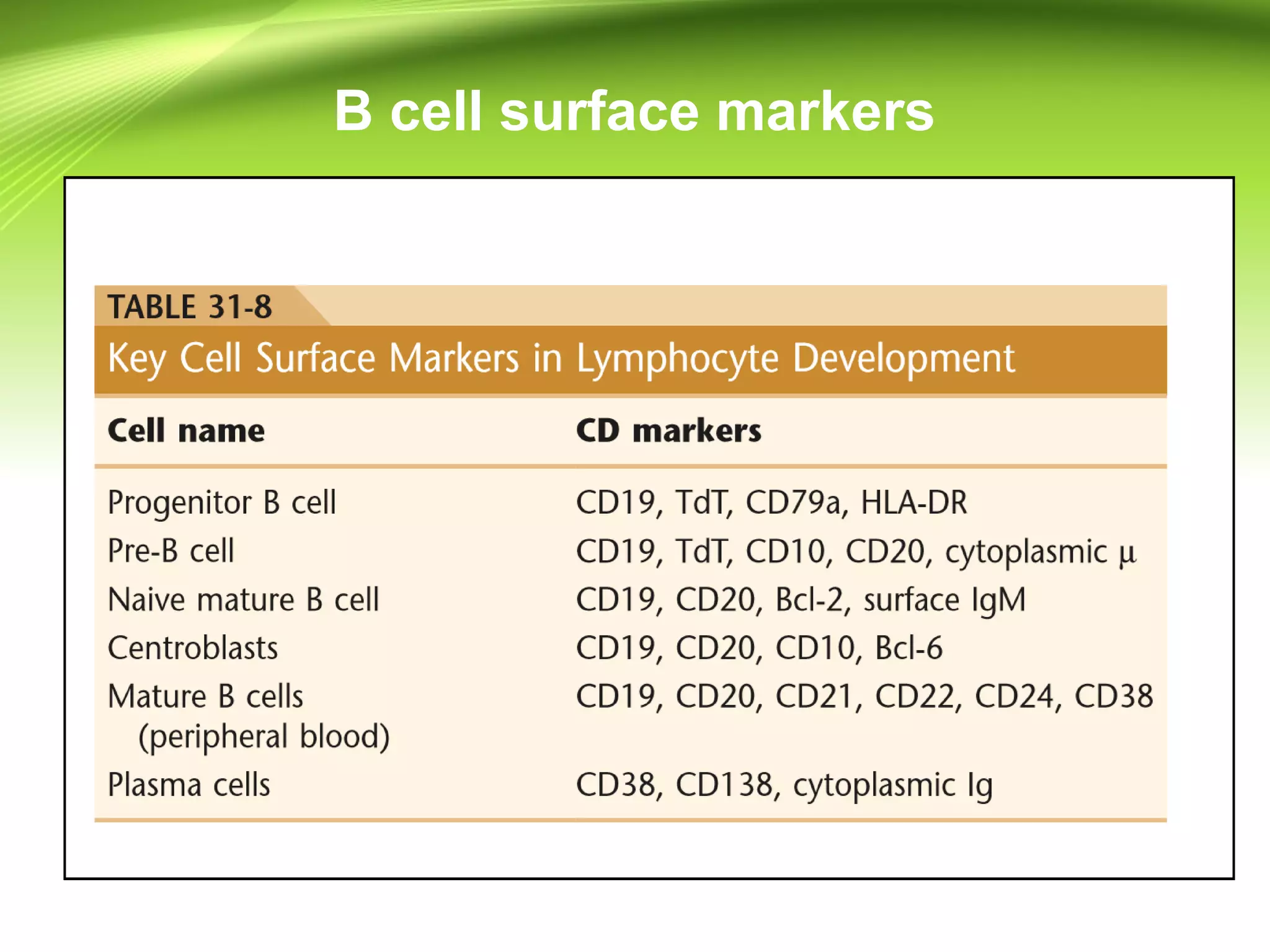
B cell surface markers
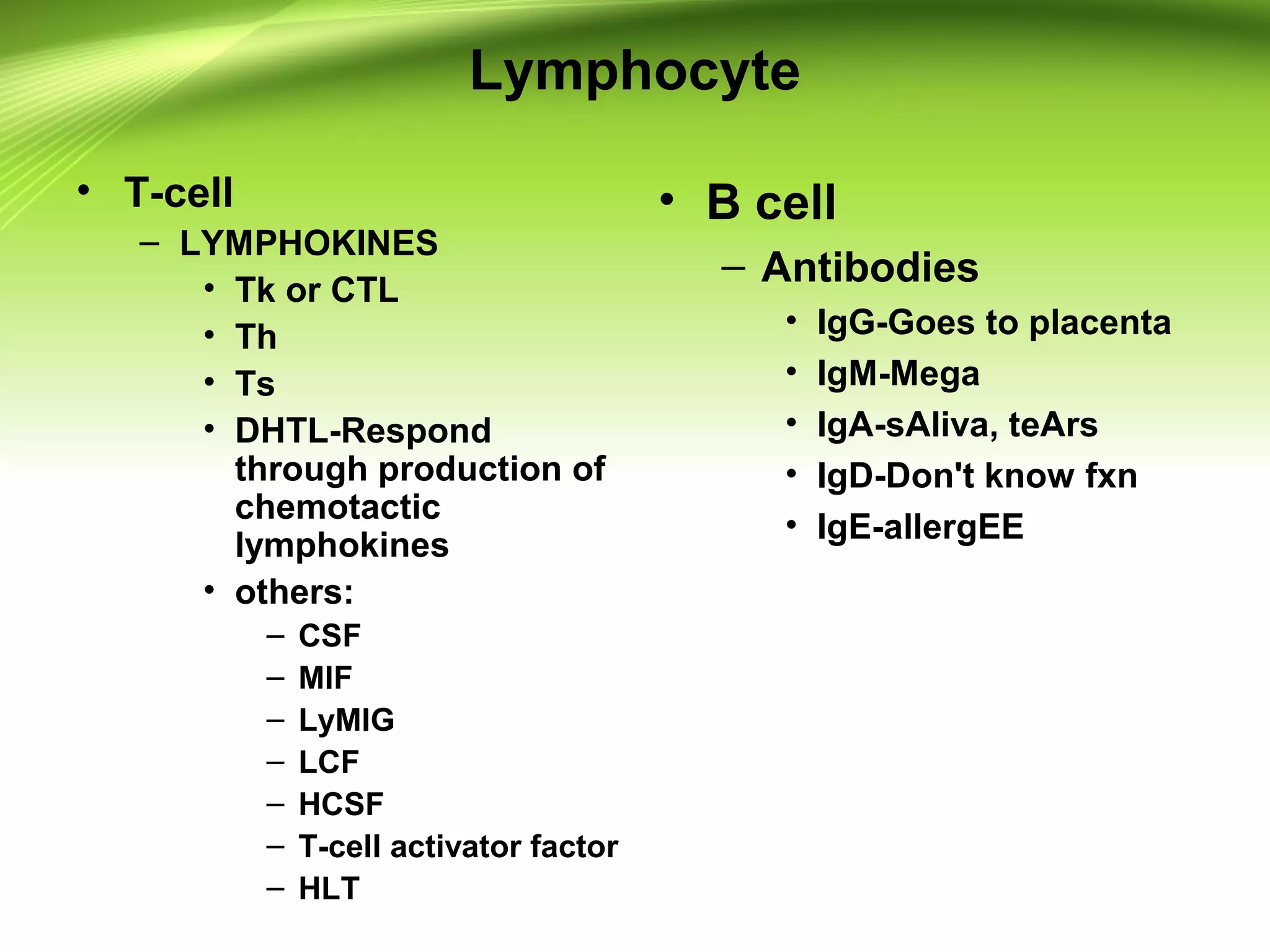
Lymphocyte
• T-cell
– LYMPHOKINES
• Tk or CTL
• Th
• Ts
• DHTL-Respond
through production of
chemotactic
lymphokines
• others:
–
–
–
–
–
–
–

CSF
MIF
LyMIG
LCF
HCSF
T-cell activator factor
HLT

• B cell
– Antibodies
•
•
•
•
•

IgG-Goes to placenta
IgM-Mega
IgA-sAliva, teArs
IgD-Don't know fxn
IgE-allergEE
LYMPHOKINETICS

• Is the process of the lymphocyte
maturation, multiplication, storage
and migration to tissues, including
sites of infeection or cell damage.
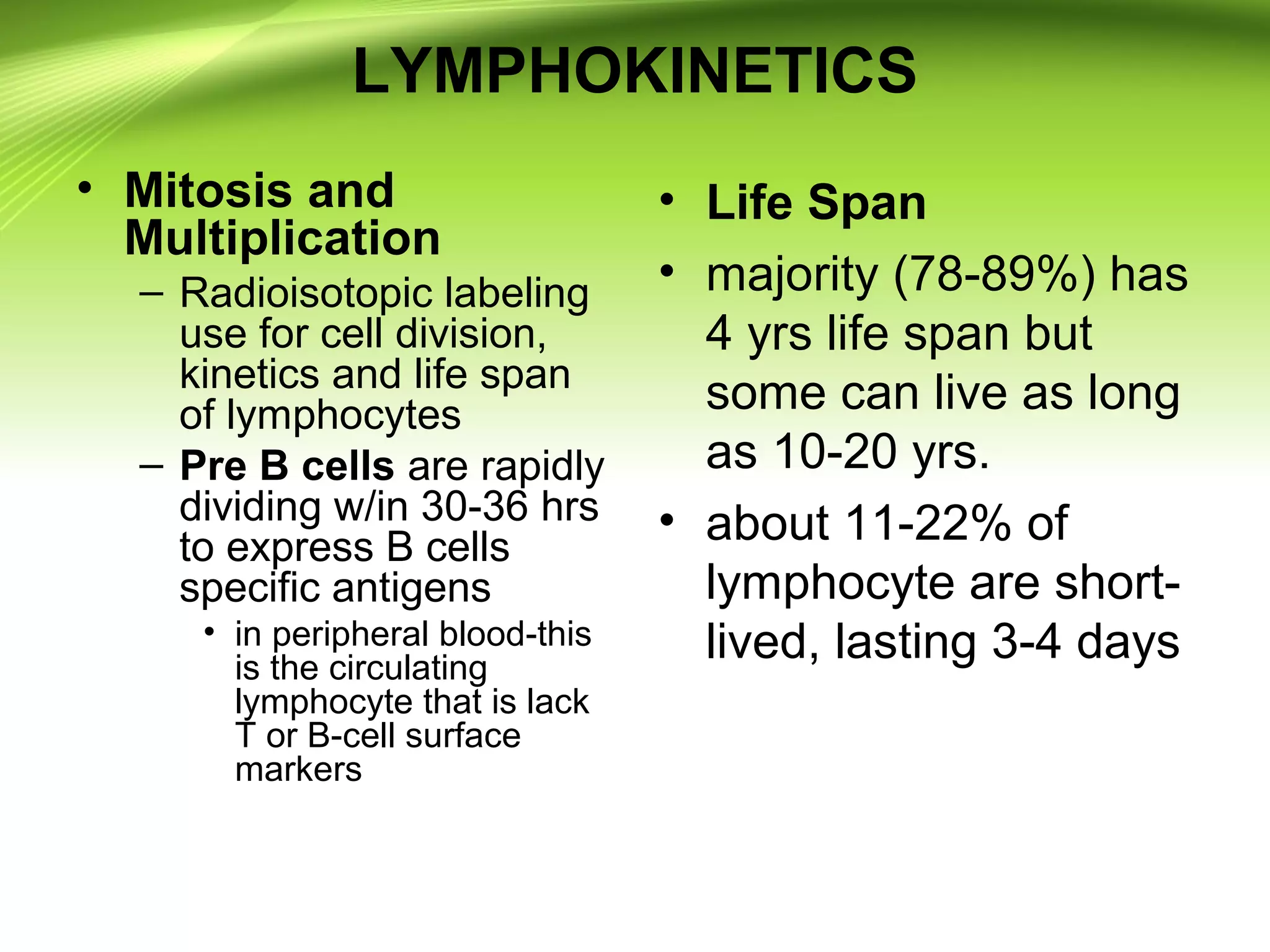
LYMPHOKINETICS
• Mitosis and
Multiplication
– Radioisotopic labeling
use for cell division,
kinetics and life span
of lymphocytes
– Pre B cells are rapidly
dividing w/in 30-36 hrs
to express B cells
specific antigens
• in peripheral blood-this
is the circulating
lymphocyte that is lack
T or B-cell surface
markers

• Life Span
• majority (78-89%) has
4 yrs life span but
some can live as long
as 10-20 yrs.
• about 11-22% of
lymphocyte are shortlived, lasting 3-4 days
Lymphocyte Life Span and Circulation
• When unimpeded, they are generally moves in a
characteristic manner- The nucleus is displaced forward
by an elongated tail (uropod) of cyto plasm.
– Uropod is the most adherent part of the cell

• Have to basic patterns of circulation:
– (1) recirculation of the mature, differentiated lymphocyte
continually moving from one area of lymphatic system into
another
– (2) Immature lymphocytes will travel from the BM to
Thymus and from there to the peripheral and eventually to
20 lymphoid tissue that will migrate to thymus again via
lymphatic vessels which is the long-lived T-lymphocytes.THEY MAKE UP MOST OF THE RECIRCULATING
POOL
– However it is thought that T lymphocytes has its own
pathway-it is only some @ the Lymph nodes and gut
areas
NORMAL REFERENCE VALUE
•

Approximately 5% of the total body lymphocyte mass is present in the circulating blood.
• 60-80% of the blood lymphocyte pool in adults is
composed of T lymphocytes and approximately
20% is composed of B lymphocytes.
•
Lymphocytes represent 31% of the total
leukocytes present at birth; within a few days of
birth, lymphocytes are the dominant type of
leukocyte in the circulation. Most of the cells are
T lymphocytes.
• In adults, lymphocytes represent approximately
34% of the total circulation of leukocytes, or 2.5
× 109/L.
Accdg. to Turgeon

Accdg. to Turgeon
Lymphocyte production and maturation

Lymphocyte production and maturation

  • 1.
    Lymphocyte Production andMaturation PRINCESS ALEN I. AGUILAR
  • 2.
    Anatomical Origin • PrimaryLymphoid Tissue – BONE MARROW (B cell)-Bursa – THYMUS (T cell) – CD34+ HSCs (NK cell) • undergo antigenindependent lineage committment • Most of the cells produced in the primary sites die before leaving; only a small percentage migrate to the secondary tissues. • Secondary Lymphoid Tissue – – – – Lymph nodes Spleen Tonsils Peyer patches in the intestine – Weldeyer's Ring @ LN • Proliferation of the T and B lymphocytes in the secondary or peripheral lymphoid tissues is primarily dependent on antigenic stimulation.
  • 3.
    General Stages ofLymphocyte Maturation THEY ARE CHARACTERIZED WITH THE USE OF ROMANOWSKY-STAINED FILMS: LIGHT MICROSCOPY
  • 4.
    Hemocytoblast Bone -immature cellin Marrow the stem cell Lymphoid Stem cell -give rise to 2 distinct progenitor cells CFU-L -HLA-DR -TdT Progenitor T cell Thymus Progenitor B cell α/β Precursor T cell Precursor B cell ϓ/8 Precursor T cell Periphery Mature T cell Centroblast Mature B cells Peripheral blood Plasma Cells
  • 5.
  • 6.
    B cell Maturation ProgenitorB cell Precursor B cell Immature B cell Mature B cell Activated B cell •1st stage;No surface Ig •w/ CD19, CD40, CD45 •rearrangement of gene •coding for the heavy chain @ Chromosome 14 •2nd Stage •w/ mu chain in the cytoplasm •rearrangement of gene coding for the light chain •Heavy chain appear w/o accompanying light chain beca use of CALLA detection •2 light chains •kappa: Chrom2 •Lambda:Chrom22 •IgM on the surface •Absence of CALLA •w/ CD21, CD35 •CD21-receptor for Epstein Bar Virus •IM-Infectious Mononucleosis •Contains IgM and IgD •Immunoglobulins G,M,A,D,E •PRODUCED BY PLASMA CELLS
  • 7.
  • 8.
    Lymphocyte • T-cell – LYMPHOKINES •Tk or CTL • Th • Ts • DHTL-Respond through production of chemotactic lymphokines • others: – – – – – – – CSF MIF LyMIG LCF HCSF T-cell activator factor HLT • B cell – Antibodies • • • • • IgG-Goes to placenta IgM-Mega IgA-sAliva, teArs IgD-Don't know fxn IgE-allergEE
  • 9.
    LYMPHOKINETICS • Is theprocess of the lymphocyte maturation, multiplication, storage and migration to tissues, including sites of infeection or cell damage.
  • 10.
    LYMPHOKINETICS • Mitosis and Multiplication –Radioisotopic labeling use for cell division, kinetics and life span of lymphocytes – Pre B cells are rapidly dividing w/in 30-36 hrs to express B cells specific antigens • in peripheral blood-this is the circulating lymphocyte that is lack T or B-cell surface markers • Life Span • majority (78-89%) has 4 yrs life span but some can live as long as 10-20 yrs. • about 11-22% of lymphocyte are shortlived, lasting 3-4 days
  • 11.
    Lymphocyte Life Spanand Circulation • When unimpeded, they are generally moves in a characteristic manner- The nucleus is displaced forward by an elongated tail (uropod) of cyto plasm. – Uropod is the most adherent part of the cell • Have to basic patterns of circulation: – (1) recirculation of the mature, differentiated lymphocyte continually moving from one area of lymphatic system into another – (2) Immature lymphocytes will travel from the BM to Thymus and from there to the peripheral and eventually to 20 lymphoid tissue that will migrate to thymus again via lymphatic vessels which is the long-lived T-lymphocytes.THEY MAKE UP MOST OF THE RECIRCULATING POOL – However it is thought that T lymphocytes has its own pathway-it is only some @ the Lymph nodes and gut areas
  • 12.
    NORMAL REFERENCE VALUE • Approximately5% of the total body lymphocyte mass is present in the circulating blood. • 60-80% of the blood lymphocyte pool in adults is composed of T lymphocytes and approximately 20% is composed of B lymphocytes. • Lymphocytes represent 31% of the total leukocytes present at birth; within a few days of birth, lymphocytes are the dominant type of leukocyte in the circulation. Most of the cells are T lymphocytes. • In adults, lymphocytes represent approximately 34% of the total circulation of leukocytes, or 2.5 × 10⁹/L. Accdg. to Turgeon Accdg. to Turgeon