
Immunology
• Immunity and Immunology
• Related lingoes
• Types of Immunity
• Lymphoid organs
• Types of Immune responses
• Cells of Immune System
TopicsTopics
What is Immunity????
( Latin: Immunis = "to make safe“)
The resistance of the host body towards
the pathogenic microbe and its toxin is
called as Immunity!!!!!
Immunology
•It is a broad branch of biomedical science that 
covers the study of all aspects of the immune 
system in all organisms.
• It deals with– 
the physiological functioning of the immune 
system in states of both health and disease; 
malfunctions of the immune system in 
immunological disorders;
the physical, chemical and physiological 
characteristics of the components of the immune 
system in vitro, in situ, and in vivo.  
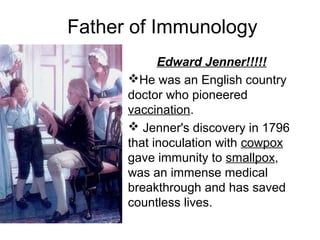
Father of Immunology
Edward Jenner!!!!!
He was an English country 
doctor who pioneered 
vaccination.
 Jenner's discovery in 1796 
that inoculation with cowpox 
gave immunity to smallpox, 
was an immense medical 
breakthrough and has saved 
countless lives.
Related Lingoes
Pathogen vs. Antigen
• Pathogen- Microorganism that can cause 
disease. 
• Antigen- (Foreign substances; Non-self 
materials) It is not an organism, but rather, 
a molecule attached to a foreign organism 
that activates an antibody response.
Organic compounds with high molecular 
weight.
 
• Interferons – Polypeptides synthesized upon 
viral infection of a cell and act as a messengers 
that protect normal cells in the vicinity of infected 
cells from becoming  infected.
    3 major categories- IFN- alpha , beta, gamma.
• Cytokine/Lymphokine/Chemokine – Growth 
factors specialized to control cell division and 
differentiation in the immune system.
• TCR(T cell receptor) – Membrane bound antigen 
receptor on T-cells that can only recognize the 
antigen being presented by a cell membrane 
bound protein called MHC (Major
histocompatibility complex).
• CD- stands for cluster of differentiation, 
which indicates a defined subset of 
cellular surface receptors (epitopes) that 
identify cell type and stage of differentiation, 
and which are recognized by antibodies.
More than 250 identified clusters, coating the 
surface of B lymphocytes and T 
lymphocytes.
• Monoclonal antibodies – are homogenous 
immunological reagents of defined specificity 
,so that these can be utilized for diagnosis 
and screening with ease and certainty .
Complement System
• Paul Ehrlich coined the term and defined it 
as “the activity of blood serum that completes 
the action of the antibody”.                               


• It is a major triggered enzyme plasma 
system. 
• It coats microbes with molecules that make 
them more susceptible to engulfment by 
phagocytes.
• Affects both innate and adaptive immunity.
• Vascular permeability mediators increase the 
permeability of the capillaries to allow more 
plasma and complement fluid to flow to the 
site of infection.
• The principle actors in this system are 11 
proteins designated C1 to C9.
Immune systemImmune system
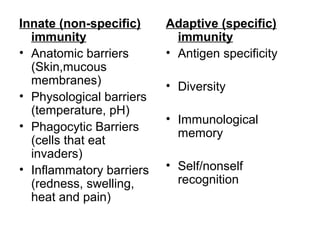
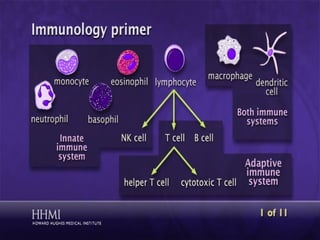
Innate (non-specific)
immunity
• Anatomic barriers 
(Skin,mucous 
membranes) 
• Physological barriers 
(temperature, pH) 
• Phagocytic Barriers 
(cells that eat 
invaders) 
• Inflammatory barriers 
(redness, swelling, 
heat and pain)
Adaptive (specific)
immunity
• Antigen specificity 
• Diversity 
• Immunological 
memory 
• Self/nonself 
recognition 
Fluid systems in body
There are two main fluid systems in
the body:
•blood
•lymph.
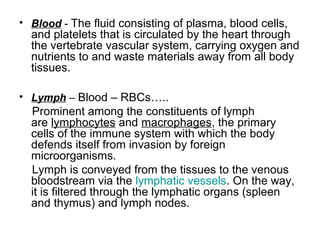
• Blood - The fluid consisting of plasma, blood cells,
and platelets that is circulated by the heart through
the vertebrate vascular system, carrying oxygen and
nutrients to and waste materials away from all body
tissues.
• Lymph – Blood – RBCs…..
Prominent among the constituents of lymph
are lymphocytes and macrophages, the primary
cells of the immune system with which the body
defends itself from invasion by foreign
microorganisms.
Lymph is conveyed from the tissues to the venous
bloodstream via the lymphatic vessels. On the way,
it is filtered through the lymphatic organs (spleen
and thymus) and lymph nodes.
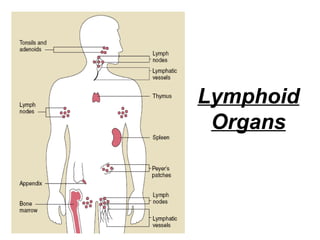
Lymphoid
Organs
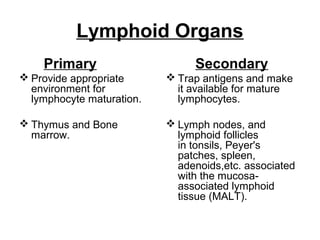
Lymphoid Organs
Primary
 Provide appropriate
environment for
lymphocyte maturation.
 Thymus and Bone
marrow.
Secondary
 Trap antigens and make
it available for mature
lymphocytes.
 Lymph nodes, and
lymphoid follicles
in tonsils, Peyer's
patches, spleen,
adenoids,etc. associated
with the mucosa-
associated lymphoid
tissue (MALT).
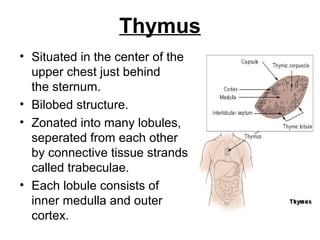
Thymus
• Situated in the center of the
upper chest just behind
the sternum.
• Bilobed structure.
• Zonated into many lobules,
seperated from each other
by connective tissue strands
called trabeculae.
• Each lobule consists of
inner medulla and outer
cortex.
•Develops in embryonic life as an outgrowth
of a structure known as the 3rd
branchial
pouch invaded by lymphoid stem cells.
•Thymocytes (T-cells) mature in medulla.
•The majority of lymphocyte production
happens early in life, so the thymus gland
deteriorates with age. In youth, the thymus
will reach the size of an apple, but it is
reduced to the size of a small marble in the
elderly.
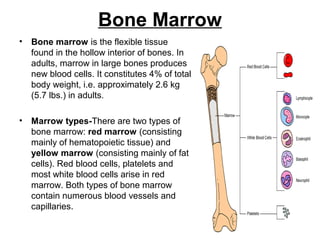
Bone Marrow
• Bone marrow is the flexible tissue
found in the hollow interior of bones. In
adults, marrow in large bones produces
new blood cells. It constitutes 4% of total
body weight, i.e. approximately 2.6 kg
(5.7 lbs.) in adults.
• Marrow types-There are two types of
bone marrow: red marrow (consisting
mainly of hematopoietic tissue) and
yellow marrow (consisting mainly of fat
cells). Red blood cells, platelets and
most white blood cells arise in red
marrow. Both types of bone marrow
contain numerous blood vessels and
capillaries.
• Hematopoietic stem cells give rise to the three
classes of blood cells that are found in the
circulation: white blood cells (leukocytes), red
blood cells (erythrocytes), and platelets
(thrombocytes).
• Mesenchymal stem cells are found arrayed
around the central sinus in the bone marrow.
They have the capability to differentiate into
osteoblasts, chondrocytes, myocytes, and many
other types of cells. They also function as
"gatekeeper" cells of the bone marrow.
Immune systemImmune system
express their specificexpress their specific
activity in two mainactivity in two main
ways………….ways………….
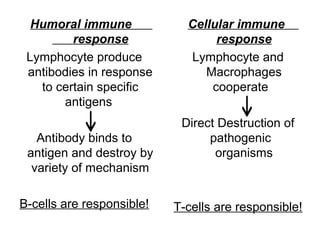
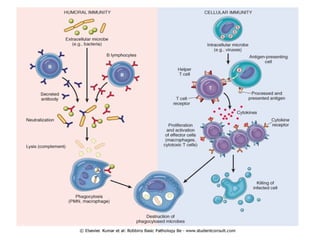
Humoral immune
response
Lymphocyte produce
antibodies in response
to certain specific
antigens
Antibody binds to
antigen and destroy by
variety of mechanism
B-cells are responsible!
Cellular immune
response
Lymphocyte and
Macrophages
cooperate
Direct Destruction of
pathogenic
organisms
T-cells are responsible!
Cells of Immune
system
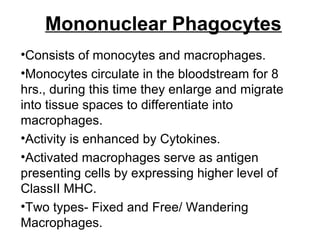
Mononuclear Phagocytes
•Consists of monocytes and macrophages.
•Monocytes circulate in the bloodstream for 8
hrs., during this time they enlarge and migrate
into tissue spaces to differentiate into
macrophages.
•Activity is enhanced by Cytokines.
•Activated macrophages serve as antigen
presenting cells by expressing higher level of
ClassII MHC.
•Two types- Fixed and Free/ Wandering
Macrophages.
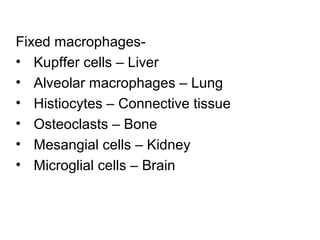
Fixed macrophages-
• Kupffer cells – Liver
• Alveolar macrophages – Lung
• Histiocytes – Connective tissue
• Osteoclasts – Bone
• Mesangial cells – Kidney
• Microglial cells – Brain
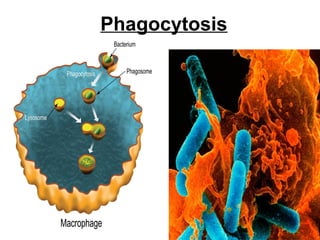
Phagocytosis
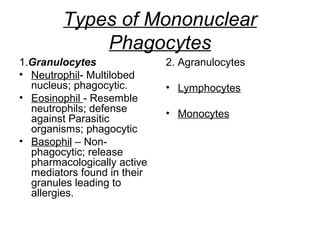
Types of Mononuclear
Phagocytes
1.Granulocytes
• Neutrophil- Multilobed
nucleus; phagocytic.
• Eosinophil - Resemble
neutrophils; defense
against Parasitic
organisms; phagocytic
• Basophil – Non-
phagocytic; release
pharmacologically active
mediators found in their
granules leading to
allergies.
2. Agranulocytes
• Lymphocytes
• Monocytes
Monocytes
• Largest corpuscle of blood.
• There are at least three types of monocytes
in human blood :
• a) the classical monocyte : CD14++ CD16-
monocyte.
• b) the non-classical monocyte :
CD14+CD16++ monocyte.
• c) the intermediate monocyte CD14+
+CD16+ monocytes.
Lymphocytes
• Chief cells of immune system.
• In blood= 20-40% and in lymph=99%.
• Continuously circulate in blood and lymph.
• Capable of migrating into the tissue
spaces and lymphoid organs.
• Non-phagocytic, motile cells.
• Three main forms:- T-cells, B-cells, Null
cells.
B or T cells that have not come in contact with
antigen =Naïve/Resting/Unprunned cells.
Lymphocyte (Naïve cells)
Lymphoblasts
Effector Cells [Plasma (B-cell); TH(T-cells)]
or
Memory Cells
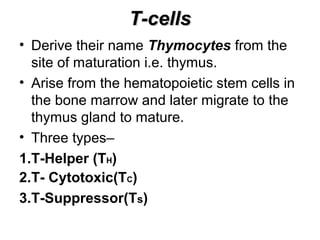
T-cellsT-cells
• Derive their name Thymocytes from the
site of maturation i.e. thymus.
• Arise from the hematopoietic stem cells in
the bone marrow and later migrate to the
thymus gland to mature.
• Three types–
1.T-Helper (TH)
2.T- Cytotoxic(TC)
3.T-Suppressor(Ts)
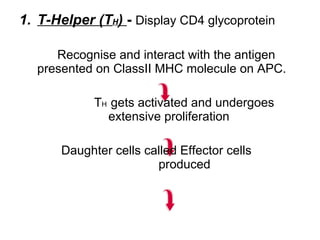
1. T-Helper (TH) - Display CD4 glycoprotein
Recognise and interact with the antigen
presented on ClassII MHC molecule on APC.
TH gets activated and undergoes
extensive proliferation
Daughter cells called Effector cells
produced
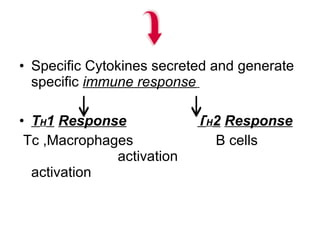
• Specific Cytokines secreted and generate
specific immune response
• TH1 Response TH2 Response
Tc ,Macrophages B cells
activation
activation
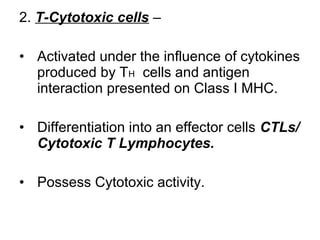
2. T-Cytotoxic cells –
• Activated under the influence of cytokines
produced by TH cells and antigen
interaction presented on Class I MHC.
• Differentiation into an effector cells CTLs/
Cytotoxic T Lymphocytes.
• Possess Cytotoxic activity.
3. T-Suppressor cells –
• Play important role in suppression of
humoral and cell-mediated immune
response
• But not isolated so far.
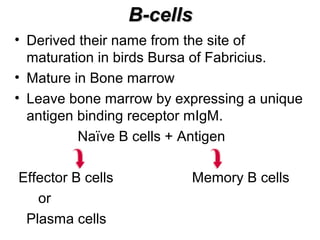
B-cellsB-cells
• Derived their name from the site of
maturation in birds Bursa of Fabricius.
• Mature in Bone marrow
• Leave bone marrow by expressing a unique
antigen binding receptor mIgM.
Naïve B cells + Antigen
Effector B cells Memory B cells
or
Plasma cells
Immunoglobulins (Ig)
• Antibodies, also called immunoglobulins or
Igs constitute the gamma globulin part of the blood
proteins.
• Soluble proteins secreted by the plasma offspring
(clones) B cells.
• The antibodies inactivate antigens by
(a) complement fixation (proteins attach to antigen
surface and cause holes to form, i.e., cell lysis),
(b) neutralization (binding to specific sites to prevent
attachment),
• (c) agglutination (clumping),
• (d) precipitation (forcing insolubility and settling out of
solution).
•The upper part or Fab
(antigen binding) portion
of the antibody molecule
attaches to specific
proteins [called
epitopes] on the antigen.
Thus antibody recognizes
the epitope and not the
entire antigen.
•The Fc region is
crystallizable and is
responsible for effector
functions, i.e., the end to
which immune cells can
attach.
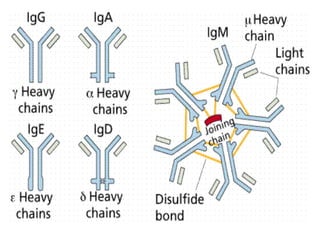
• Constituents of gamma globulin are:
 IgG--76%,
 IgA--15%,
 IgM--8%,
 IgD--1%, and
 IgE--0.002%
-- IgM is the dominant antibody produced in
primary immune responses, First antibody
secreted; promotes agglutination and
precipitation reactions and activates
complement.
-- IgG is the only antibody that can cross the
placental barrier and responsible for the 3-6
month immune protection of infants; Major
antibody secreted during the secondary
response;neutralises antigens and
promotes phagocytosis and Activates
complement.
-- IgD is present only on surface of B cells,
serve as antigen receptor and plays an
important role in lymphocyte
differentiation.
-- IgA Most abundant form in body
secretions; high density in MALT.
-- IgE Fc binds to mast cells and basophils;
allergen binding to V regions promotes the
release of mediators, which triggers
allergic reactions.
Null CellsNull Cells
• Cytotoxic.
• NK cells belong to this group.
• Small granules in their cytoplasm contain
proteins such as perforin and proteases known
as granzymes.
• Upon release in close proximity to a cell slated
for killing, perforin forms pores in the cell
membrane of the target cell, creating an aqueous
channel through which the granzymes and
associated molecules can enter, inducing
either apoptosis or osmotic cell lysis.
• NK cells are activated in response
to interferons or macrophage-derived cytokines.
Dendritic cells
• Dendritic cells are covered with a maze
of membranous processes that look like
nerve cell dendrites.
• Most of them are highly efficient antigen
presenting cells.
• There are four basic types: Langerhans
cells, interstitial dendritic cells,
interdigitating dendritic cells, and
circulating dendritic cells.
Thank youThank you

Immunology

  • 1.
  • 2.
    • Immunity andImmunology • Related lingoes • Types of Immunity • Lymphoid organs • Types of Immune responses • Cells of Immune System TopicsTopics
  • 3.
    What is Immunity???? (Latin: Immunis = "to make safe“) The resistance of the host body towards the pathogenic microbe and its toxin is called as Immunity!!!!!
  • 4.
  • 5.
  • 6.
  • 7.
    Pathogen vs. Antigen •Pathogen- Microorganism that can cause  disease.  • Antigen- (Foreign substances; Non-self  materials) It is not an organism, but rather,  a molecule attached to a foreign organism  that activates an antibody response. Organic compounds with high molecular  weight.  
  • 8.
    • Interferons –Polypeptides synthesized upon  viral infection of a cell and act as a messengers  that protect normal cells in the vicinity of infected  cells from becoming  infected.     3 major categories- IFN- alpha , beta, gamma. • Cytokine/Lymphokine/Chemokine – Growth  factors specialized to control cell division and  differentiation in the immune system. • TCR(T cell receptor) – Membrane bound antigen  receptor on T-cells that can only recognize the  antigen being presented by a cell membrane  bound protein called MHC (Major histocompatibility complex).
  • 9.
    • CD- stands for cluster ofdifferentiation,  which indicates a defined subset of  cellular surface receptors (epitopes) that  identify cell type and stage of differentiation,  and which are recognized by antibodies. More than 250 identified clusters, coating the  surface of B lymphocytes and T  lymphocytes. • Monoclonal antibodies – are homogenous  immunological reagents of defined specificity  ,so that these can be utilized for diagnosis  and screening with ease and certainty .
  • 10.
    Complement System • PaulEhrlich coined the term and defined it  as “the activity of blood serum that completes  the action of the antibody”.                                                                                                                                                                                                                          • It is a major triggered enzyme plasma  system.  • It coats microbes with molecules that make  them more susceptible to engulfment by  phagocytes. • Affects both innate and adaptive immunity.
  • 11.
  • 12.
  • 13.
    Innate (non-specific) immunity • Anatomic barriers  (Skin,mucous  membranes)  •Physological barriers  (temperature, pH)  • Phagocytic Barriers  (cells that eat  invaders)  • Inflammatory barriers  (redness, swelling,  heat and pain) Adaptive (specific) immunity • Antigen specificity  • Diversity  • Immunological  memory  • Self/nonself  recognition 
  • 15.
    Fluid systems inbody There are two main fluid systems in the body: •blood •lymph.
  • 16.
    • Blood -The fluid consisting of plasma, blood cells, and platelets that is circulated by the heart through the vertebrate vascular system, carrying oxygen and nutrients to and waste materials away from all body tissues. • Lymph – Blood – RBCs….. Prominent among the constituents of lymph are lymphocytes and macrophages, the primary cells of the immune system with which the body defends itself from invasion by foreign microorganisms. Lymph is conveyed from the tissues to the venous bloodstream via the lymphatic vessels. On the way, it is filtered through the lymphatic organs (spleen and thymus) and lymph nodes.
  • 17.
  • 18.
    Lymphoid Organs Primary  Provideappropriate environment for lymphocyte maturation.  Thymus and Bone marrow. Secondary  Trap antigens and make it available for mature lymphocytes.  Lymph nodes, and lymphoid follicles in tonsils, Peyer's patches, spleen, adenoids,etc. associated with the mucosa- associated lymphoid tissue (MALT).
  • 19.
    Thymus • Situated inthe center of the upper chest just behind the sternum. • Bilobed structure. • Zonated into many lobules, seperated from each other by connective tissue strands called trabeculae. • Each lobule consists of inner medulla and outer cortex.
  • 20.
    •Develops in embryoniclife as an outgrowth of a structure known as the 3rd branchial pouch invaded by lymphoid stem cells. •Thymocytes (T-cells) mature in medulla. •The majority of lymphocyte production happens early in life, so the thymus gland deteriorates with age. In youth, the thymus will reach the size of an apple, but it is reduced to the size of a small marble in the elderly.
  • 21.
    Bone Marrow • Bonemarrow is the flexible tissue found in the hollow interior of bones. In adults, marrow in large bones produces new blood cells. It constitutes 4% of total body weight, i.e. approximately 2.6 kg (5.7 lbs.) in adults. • Marrow types-There are two types of bone marrow: red marrow (consisting mainly of hematopoietic tissue) and yellow marrow (consisting mainly of fat cells). Red blood cells, platelets and most white blood cells arise in red marrow. Both types of bone marrow contain numerous blood vessels and capillaries.
  • 22.
    • Hematopoietic stemcells give rise to the three classes of blood cells that are found in the circulation: white blood cells (leukocytes), red blood cells (erythrocytes), and platelets (thrombocytes). • Mesenchymal stem cells are found arrayed around the central sinus in the bone marrow. They have the capability to differentiate into osteoblasts, chondrocytes, myocytes, and many other types of cells. They also function as "gatekeeper" cells of the bone marrow.
  • 23.
    Immune systemImmune system expresstheir specificexpress their specific activity in two mainactivity in two main ways………….ways………….
  • 24.
    Humoral immune response Lymphocyte produce antibodiesin response to certain specific antigens Antibody binds to antigen and destroy by variety of mechanism B-cells are responsible! Cellular immune response Lymphocyte and Macrophages cooperate Direct Destruction of pathogenic organisms T-cells are responsible!
  • 26.
  • 28.
    Mononuclear Phagocytes •Consists ofmonocytes and macrophages. •Monocytes circulate in the bloodstream for 8 hrs., during this time they enlarge and migrate into tissue spaces to differentiate into macrophages. •Activity is enhanced by Cytokines. •Activated macrophages serve as antigen presenting cells by expressing higher level of ClassII MHC. •Two types- Fixed and Free/ Wandering Macrophages.
  • 29.
    Fixed macrophages- • Kupffercells – Liver • Alveolar macrophages – Lung • Histiocytes – Connective tissue • Osteoclasts – Bone • Mesangial cells – Kidney • Microglial cells – Brain
  • 30.
  • 31.
    Types of Mononuclear Phagocytes 1.Granulocytes •Neutrophil- Multilobed nucleus; phagocytic. • Eosinophil - Resemble neutrophils; defense against Parasitic organisms; phagocytic • Basophil – Non- phagocytic; release pharmacologically active mediators found in their granules leading to allergies. 2. Agranulocytes • Lymphocytes • Monocytes
  • 32.
    Monocytes • Largest corpuscleof blood. • There are at least three types of monocytes in human blood : • a) the classical monocyte : CD14++ CD16- monocyte. • b) the non-classical monocyte : CD14+CD16++ monocyte. • c) the intermediate monocyte CD14+ +CD16+ monocytes.
  • 33.
    Lymphocytes • Chief cellsof immune system. • In blood= 20-40% and in lymph=99%. • Continuously circulate in blood and lymph. • Capable of migrating into the tissue spaces and lymphoid organs. • Non-phagocytic, motile cells. • Three main forms:- T-cells, B-cells, Null cells.
  • 34.
    B or Tcells that have not come in contact with antigen =Naïve/Resting/Unprunned cells. Lymphocyte (Naïve cells) Lymphoblasts Effector Cells [Plasma (B-cell); TH(T-cells)] or Memory Cells
  • 35.
    T-cellsT-cells • Derive theirname Thymocytes from the site of maturation i.e. thymus. • Arise from the hematopoietic stem cells in the bone marrow and later migrate to the thymus gland to mature. • Three types– 1.T-Helper (TH) 2.T- Cytotoxic(TC) 3.T-Suppressor(Ts)
  • 36.
    1. T-Helper (TH)- Display CD4 glycoprotein Recognise and interact with the antigen presented on ClassII MHC molecule on APC. TH gets activated and undergoes extensive proliferation Daughter cells called Effector cells produced
  • 37.
    • Specific Cytokinessecreted and generate specific immune response • TH1 Response TH2 Response Tc ,Macrophages B cells activation activation
  • 38.
    2. T-Cytotoxic cells– • Activated under the influence of cytokines produced by TH cells and antigen interaction presented on Class I MHC. • Differentiation into an effector cells CTLs/ Cytotoxic T Lymphocytes. • Possess Cytotoxic activity.
  • 39.
    3. T-Suppressor cells– • Play important role in suppression of humoral and cell-mediated immune response • But not isolated so far.
  • 40.
    B-cellsB-cells • Derived theirname from the site of maturation in birds Bursa of Fabricius. • Mature in Bone marrow • Leave bone marrow by expressing a unique antigen binding receptor mIgM. Naïve B cells + Antigen Effector B cells Memory B cells or Plasma cells
  • 41.
    Immunoglobulins (Ig) • Antibodies,also called immunoglobulins or Igs constitute the gamma globulin part of the blood proteins. • Soluble proteins secreted by the plasma offspring (clones) B cells. • The antibodies inactivate antigens by (a) complement fixation (proteins attach to antigen surface and cause holes to form, i.e., cell lysis), (b) neutralization (binding to specific sites to prevent attachment), • (c) agglutination (clumping), • (d) precipitation (forcing insolubility and settling out of solution).
  • 42.
    •The upper partor Fab (antigen binding) portion of the antibody molecule attaches to specific proteins [called epitopes] on the antigen. Thus antibody recognizes the epitope and not the entire antigen. •The Fc region is crystallizable and is responsible for effector functions, i.e., the end to which immune cells can attach.
  • 43.
    • Constituents ofgamma globulin are:  IgG--76%,  IgA--15%,  IgM--8%,  IgD--1%, and  IgE--0.002%
  • 45.
    -- IgM isthe dominant antibody produced in primary immune responses, First antibody secreted; promotes agglutination and precipitation reactions and activates complement. -- IgG is the only antibody that can cross the placental barrier and responsible for the 3-6 month immune protection of infants; Major antibody secreted during the secondary response;neutralises antigens and promotes phagocytosis and Activates complement.
  • 46.
    -- IgD ispresent only on surface of B cells, serve as antigen receptor and plays an important role in lymphocyte differentiation. -- IgA Most abundant form in body secretions; high density in MALT. -- IgE Fc binds to mast cells and basophils; allergen binding to V regions promotes the release of mediators, which triggers allergic reactions.
  • 47.
    Null CellsNull Cells •Cytotoxic. • NK cells belong to this group. • Small granules in their cytoplasm contain proteins such as perforin and proteases known as granzymes. • Upon release in close proximity to a cell slated for killing, perforin forms pores in the cell membrane of the target cell, creating an aqueous channel through which the granzymes and associated molecules can enter, inducing either apoptosis or osmotic cell lysis. • NK cells are activated in response to interferons or macrophage-derived cytokines.
  • 48.
    Dendritic cells • Dendriticcells are covered with a maze of membranous processes that look like nerve cell dendrites. • Most of them are highly efficient antigen presenting cells. • There are four basic types: Langerhans cells, interstitial dendritic cells, interdigitating dendritic cells, and circulating dendritic cells.
  • 49.