Unit -6
Stability Analysis in Frequency
Domain
1
By: Dr.Ankita Malhotra
SVKM'S D J Sanghvi College of Engineering
Control Systems Analysis and Design
by Frequency Response Method
• By the term frequency response, we mean the steady-state response of a system to
a sinusoidal input. In frequency-response methods, we vary the frequency of the
input signal over a certain range and study the resulting response.
• An advantage of the frequency-response approach is that frequency-response tests
are, in general, simple and can be made accurately by use of readily available
sinusoidal signal generators and precise measurement equipment. Often the
transfer functions of complicated components can be determined experimentally
by frequency-response tests.
• In addition, the frequency-response approach has the advantages that a system
may be designed so that the effects of undesirable noise are negligible and that
such analysis and design can be extended to certain nonlinear control systems.
By: Dr.Ankita Malhotra
SVKM'S D J Sanghvi College of Engineering
2
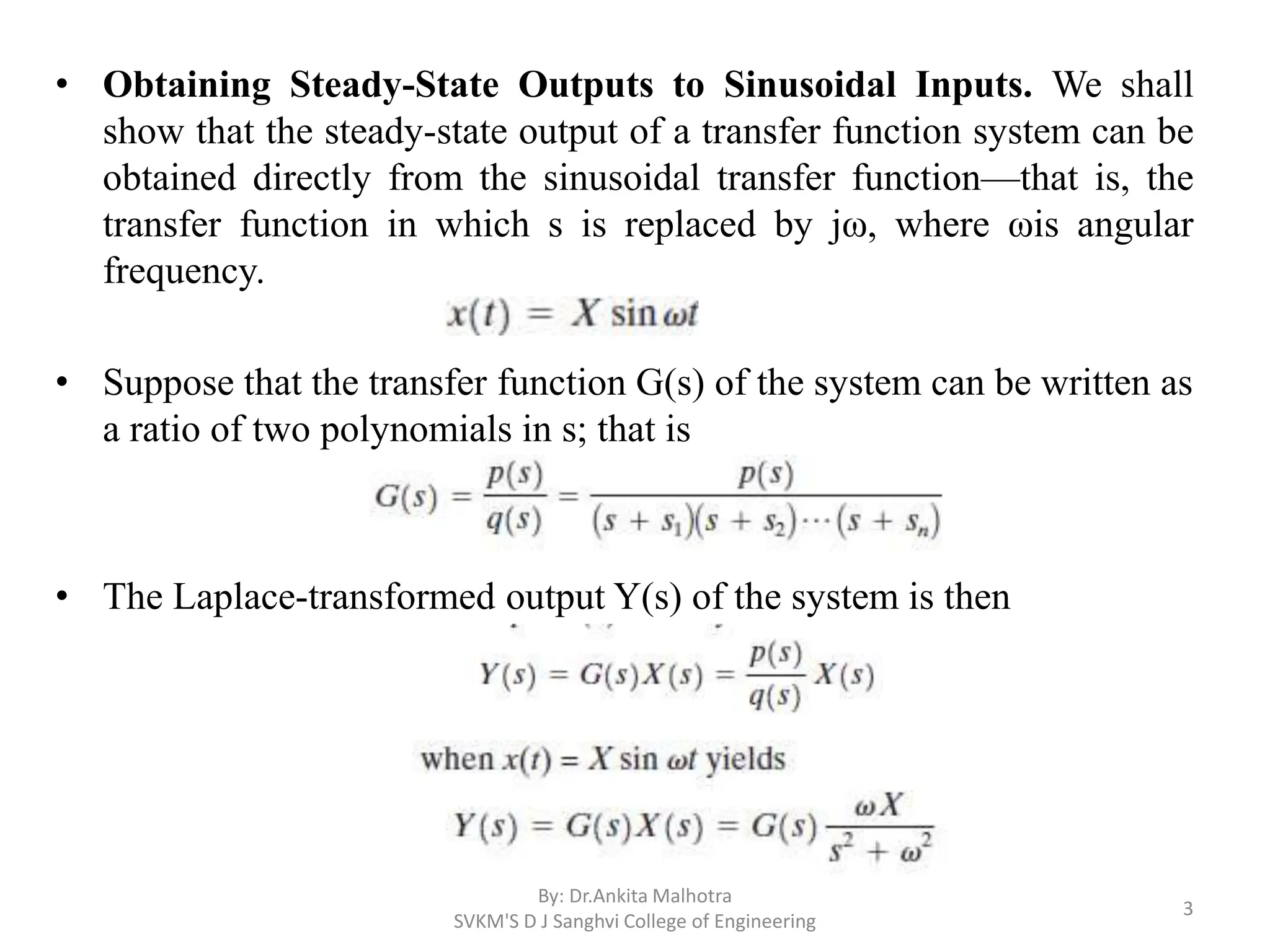
• Obtaining Steady-State Outputs to Sinusoidal Inputs. We shall
show that the steady-state output of a transfer function system can be
obtained directly from the sinusoidal transfer function—that is, the
transfer function in which s is replaced by jω, where ωis angular
frequency.
• Suppose that the transfer function G(s) of the system can be written as
a ratio of two polynomials in s; that is
• The Laplace-transformed output Y(s) of the system is then
By: Dr.Ankita Malhotra
SVKM'S D J Sanghvi College of Engineering
3
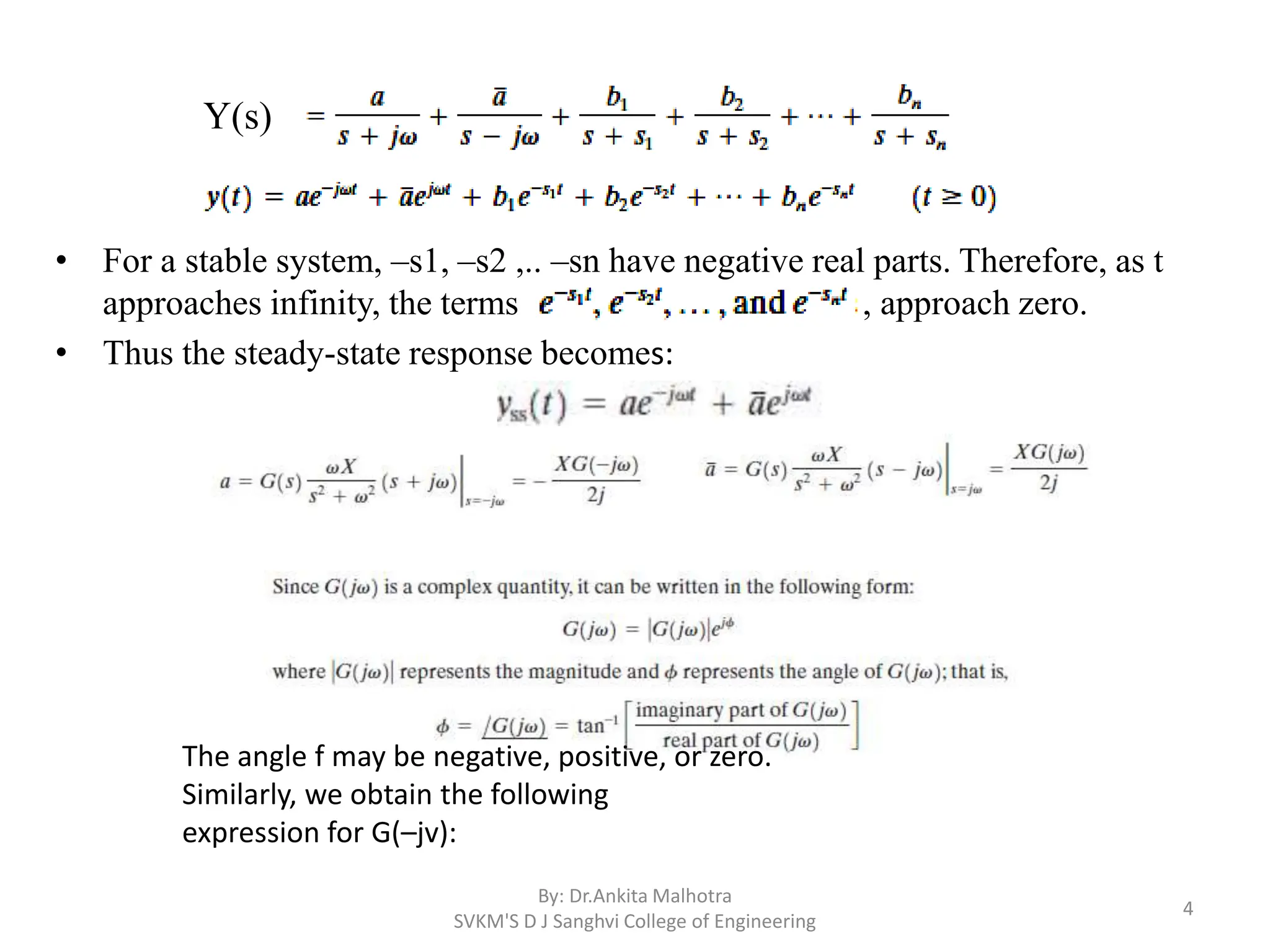
• For a stable system, –s1, –s2 ,.. –sn have negative real parts. Therefore, as t
approaches infinity, the terms , approach zero.
• Thus the steady-state response becomes:
By: Dr.Ankita Malhotra
SVKM'S D J Sanghvi College of Engineering
4
Y(s)
The angle f may be negative, positive, or zero.
Similarly, we obtain the following
expression for G(–jv):
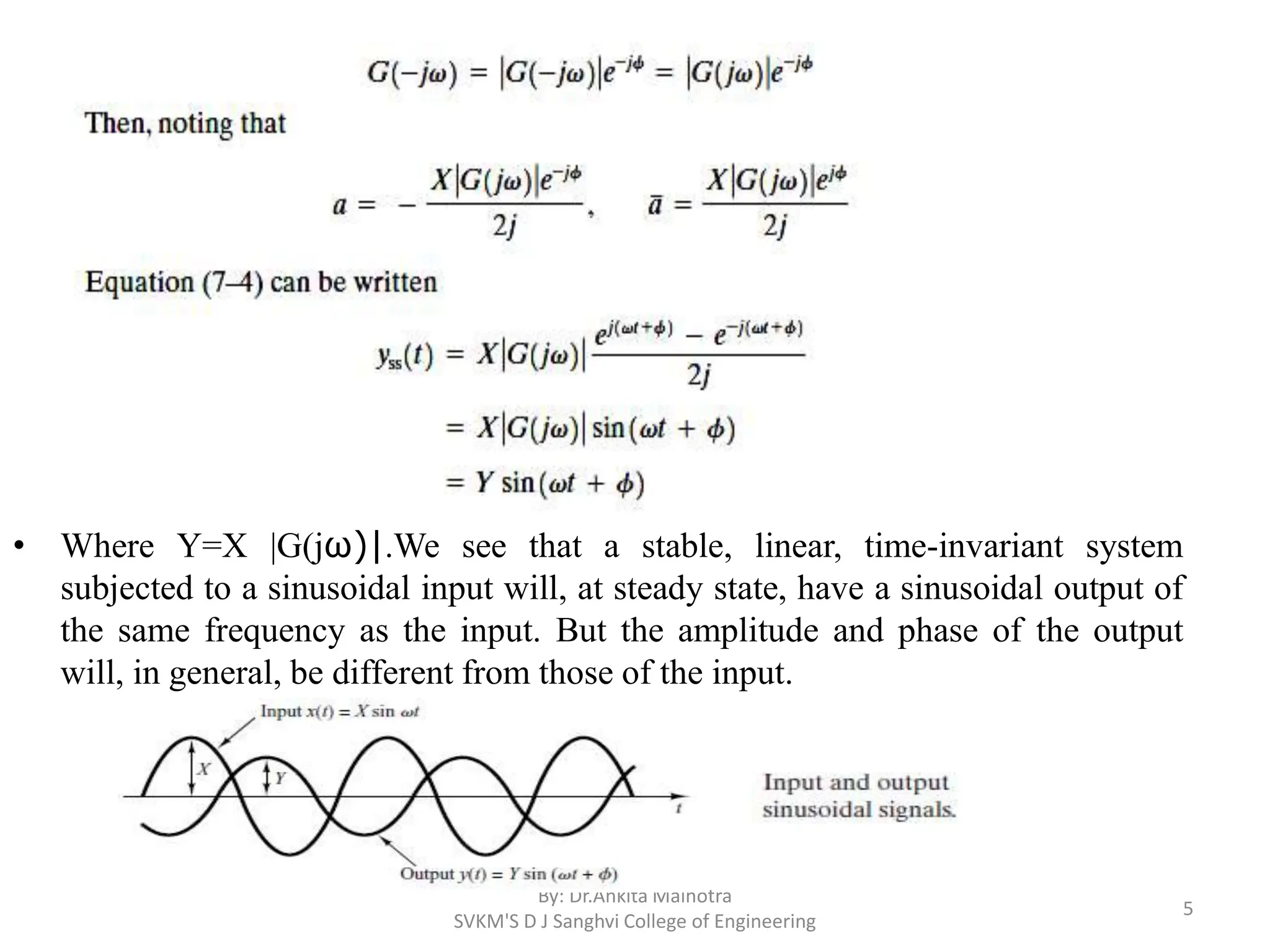
• Where Y=X |G(jω)|.We see that a stable, linear, time-invariant system
subjected to a sinusoidal input will, at steady state, have a sinusoidal output of
the same frequency as the input. But the amplitude and phase of the output
will, in general, be different from those of the input.
By: Dr.Ankita Malhotra
SVKM'S D J Sanghvi College of Engineering
5
By: Dr.Ankita Malhotra
SVKM'S D J Sanghvi College of Engineering
6
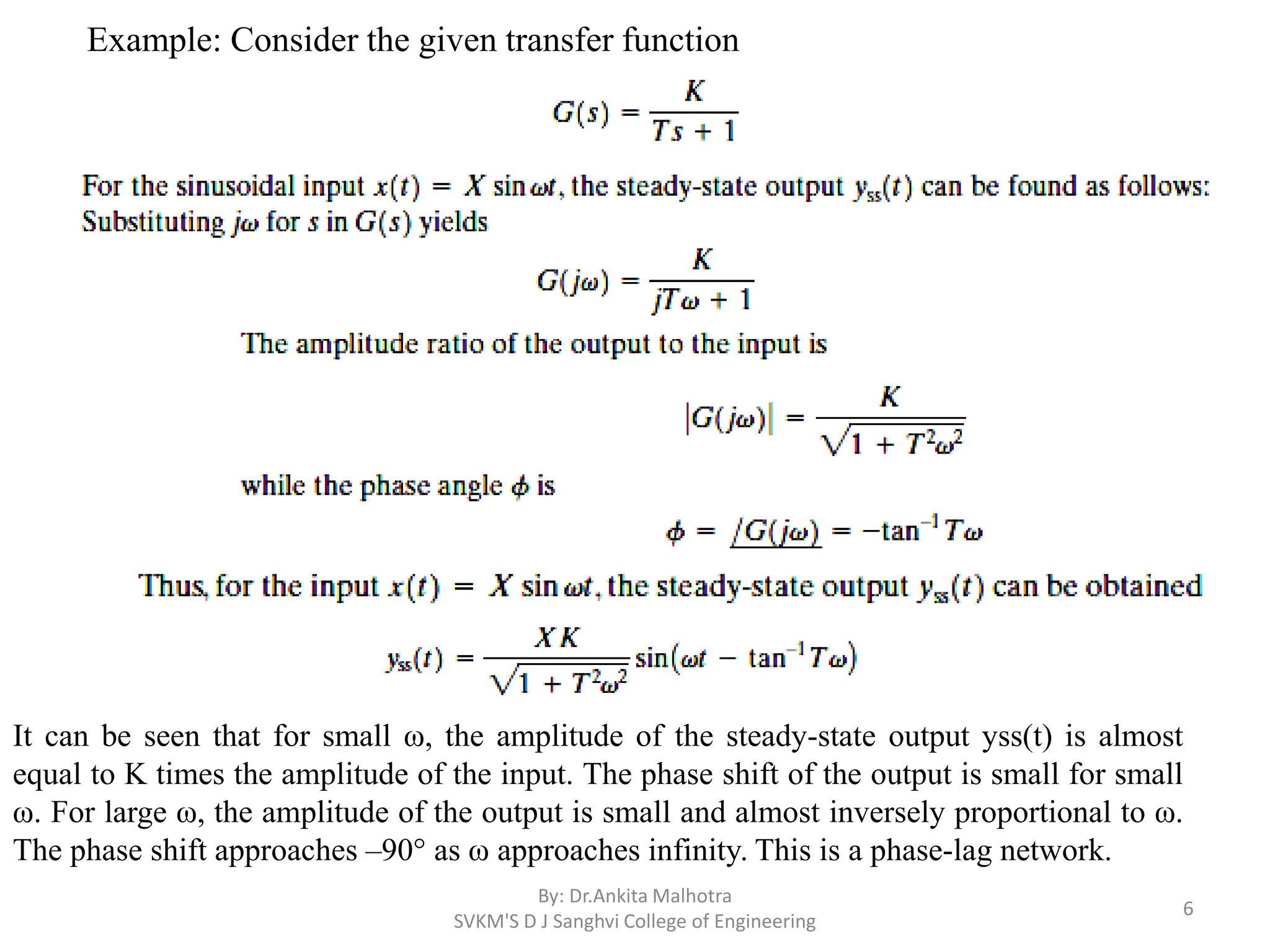
It can be seen that for small ω, the amplitude of the steady-state output yss(t) is almost
equal to K times the amplitude of the input. The phase shift of the output is small for small
ω. For large ω, the amplitude of the output is small and almost inversely proportional to ω.
The phase shift approaches –90° as ω approaches infinity. This is a phase-lag network.
Example: Consider the given transfer function
Bode Plots
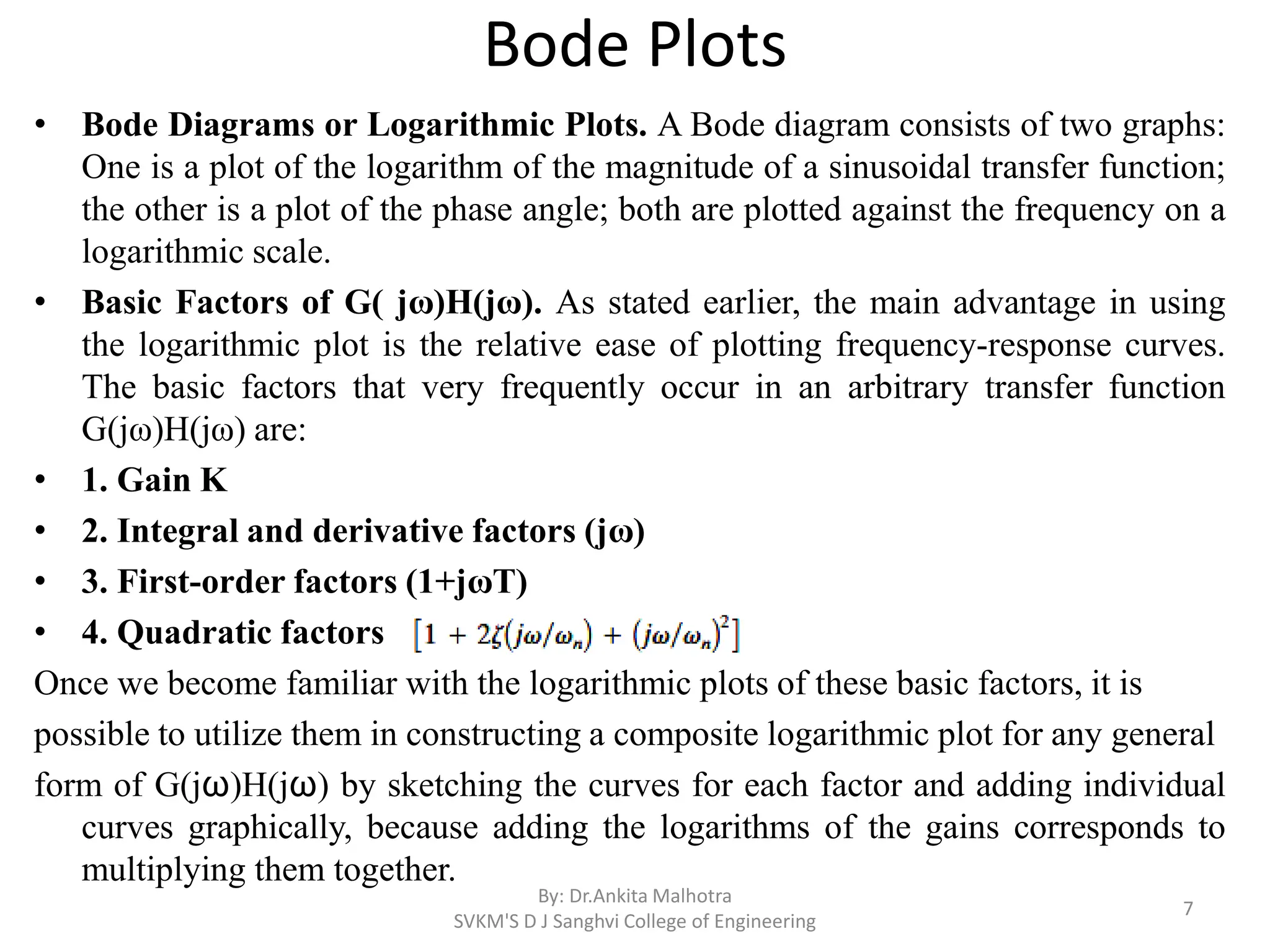
• Bode Diagrams or Logarithmic Plots. A Bode diagram consists of two graphs:
One is a plot of the logarithm of the magnitude of a sinusoidal transfer function;
the other is a plot of the phase angle; both are plotted against the frequency on a
logarithmic scale.
• Basic Factors of G( jω)H(jω). As stated earlier, the main advantage in using
the logarithmic plot is the relative ease of plotting frequency-response curves.
The basic factors that very frequently occur in an arbitrary transfer function
G(jω)H(jω) are:
• 1. Gain K
• 2. Integral and derivative factors (jω)
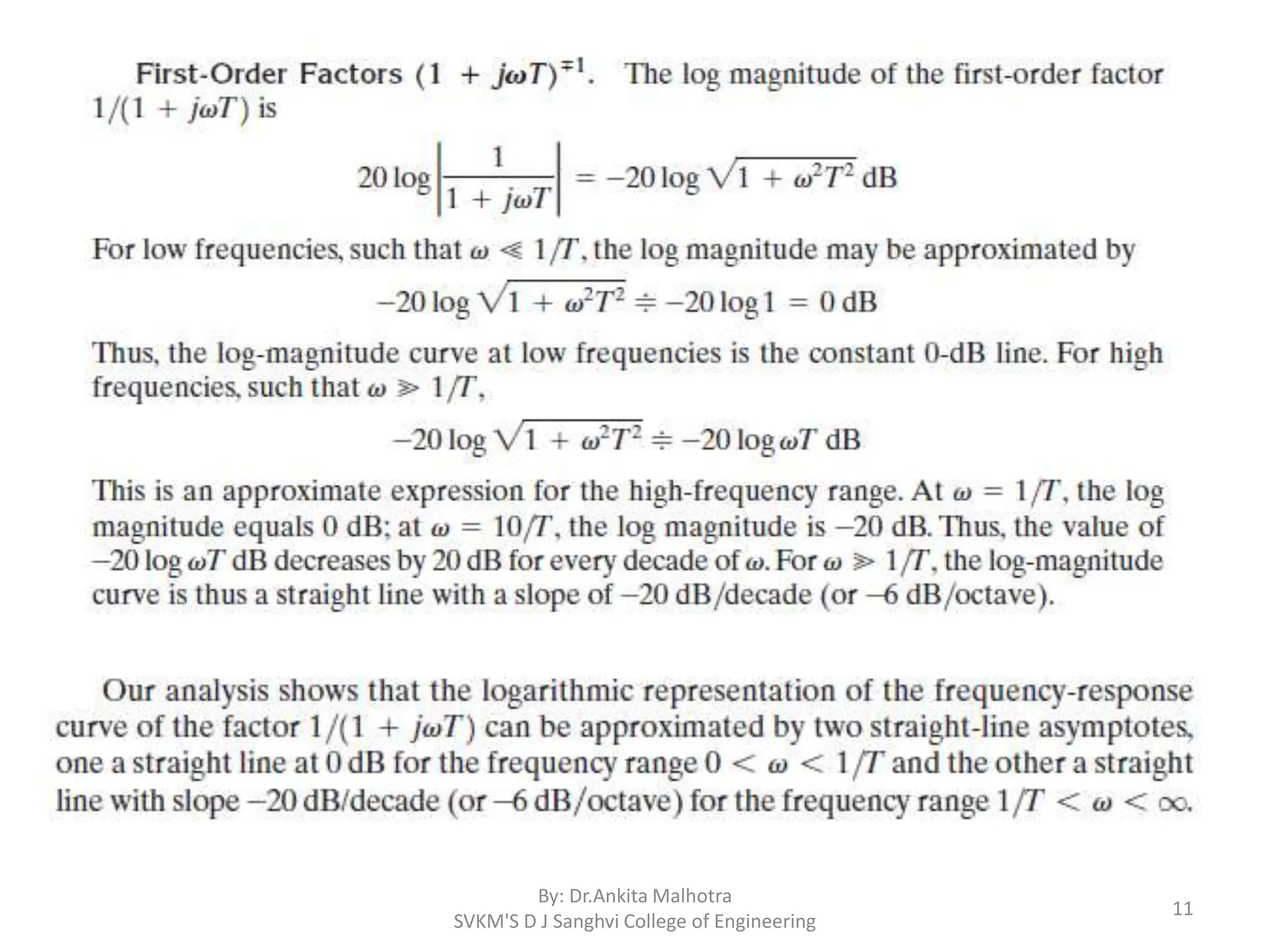
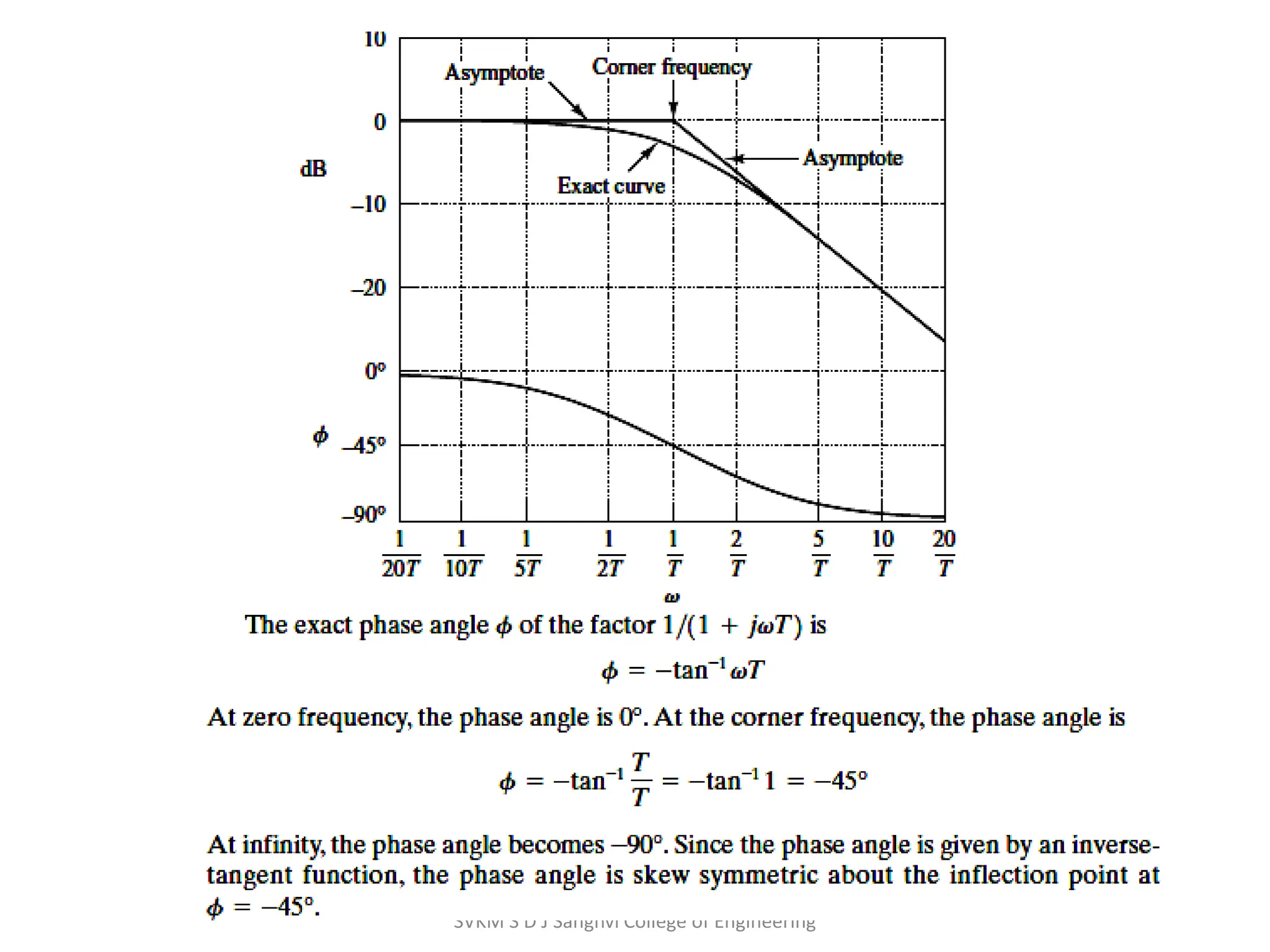
• 3. First-order factors (1+jωT)
• 4. Quadratic factors
Once we become familiar with the logarithmic plots of these basic factors, it is
possible to utilize them in constructing a composite logarithmic plot for any general
form of G(jω)H(jω) by sketching the curves for each factor and adding individual
curves graphically, because adding the logarithms of the gains corresponds to
multiplying them together.
By: Dr.Ankita Malhotra
SVKM'S D J Sanghvi College of Engineering
7
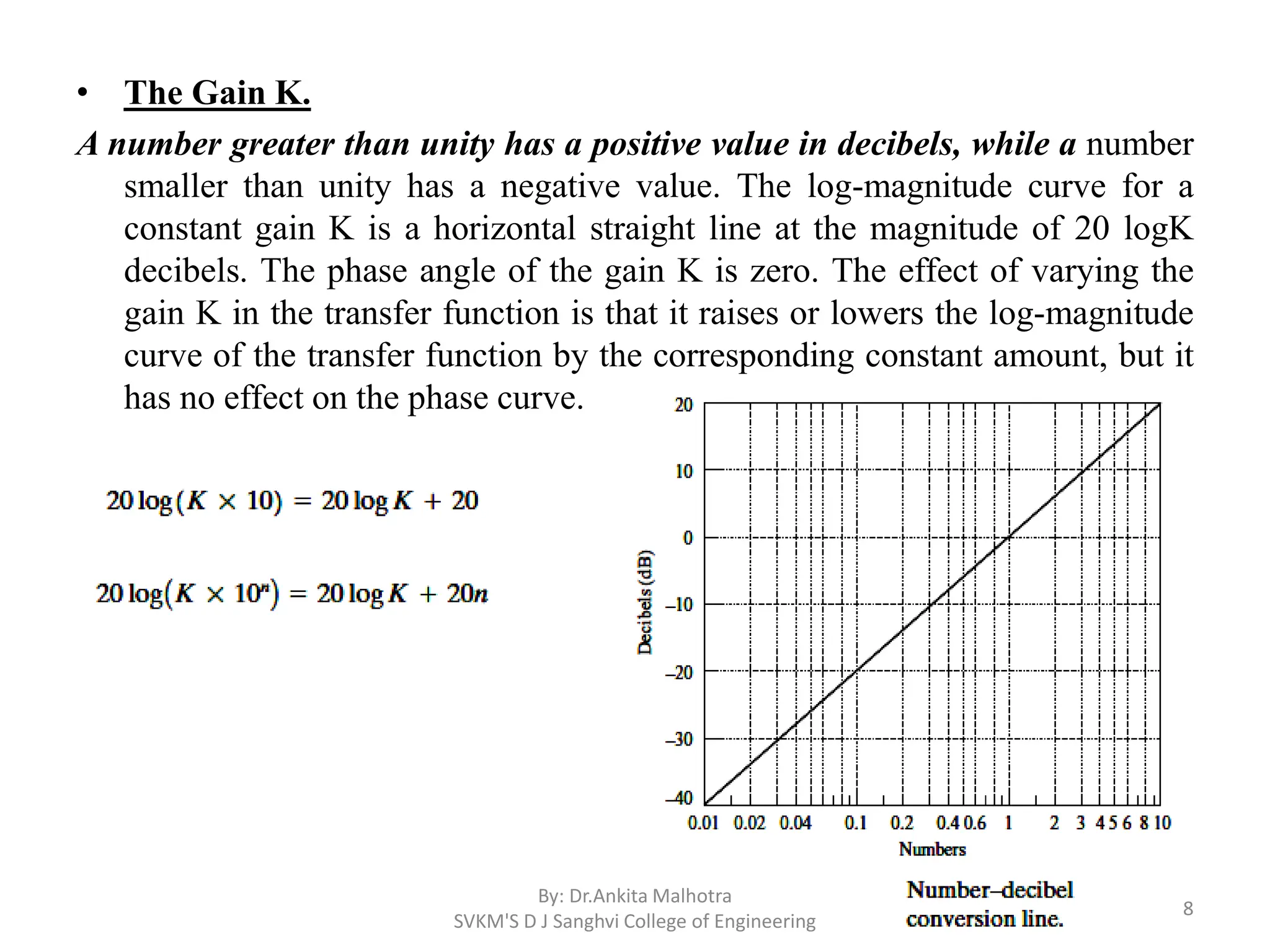
• The Gain K.
A number greater than unity has a positive value in decibels, while a number
smaller than unity has a negative value. The log-magnitude curve for a
constant gain K is a horizontal straight line at the magnitude of 20 logK
decibels. The phase angle of the gain K is zero. The effect of varying the
gain K in the transfer function is that it raises or lowers the log-magnitude
curve of the transfer function by the corresponding constant amount, but it
has no effect on the phase curve.
By: Dr.Ankita Malhotra
SVKM'S D J Sanghvi College of Engineering
8
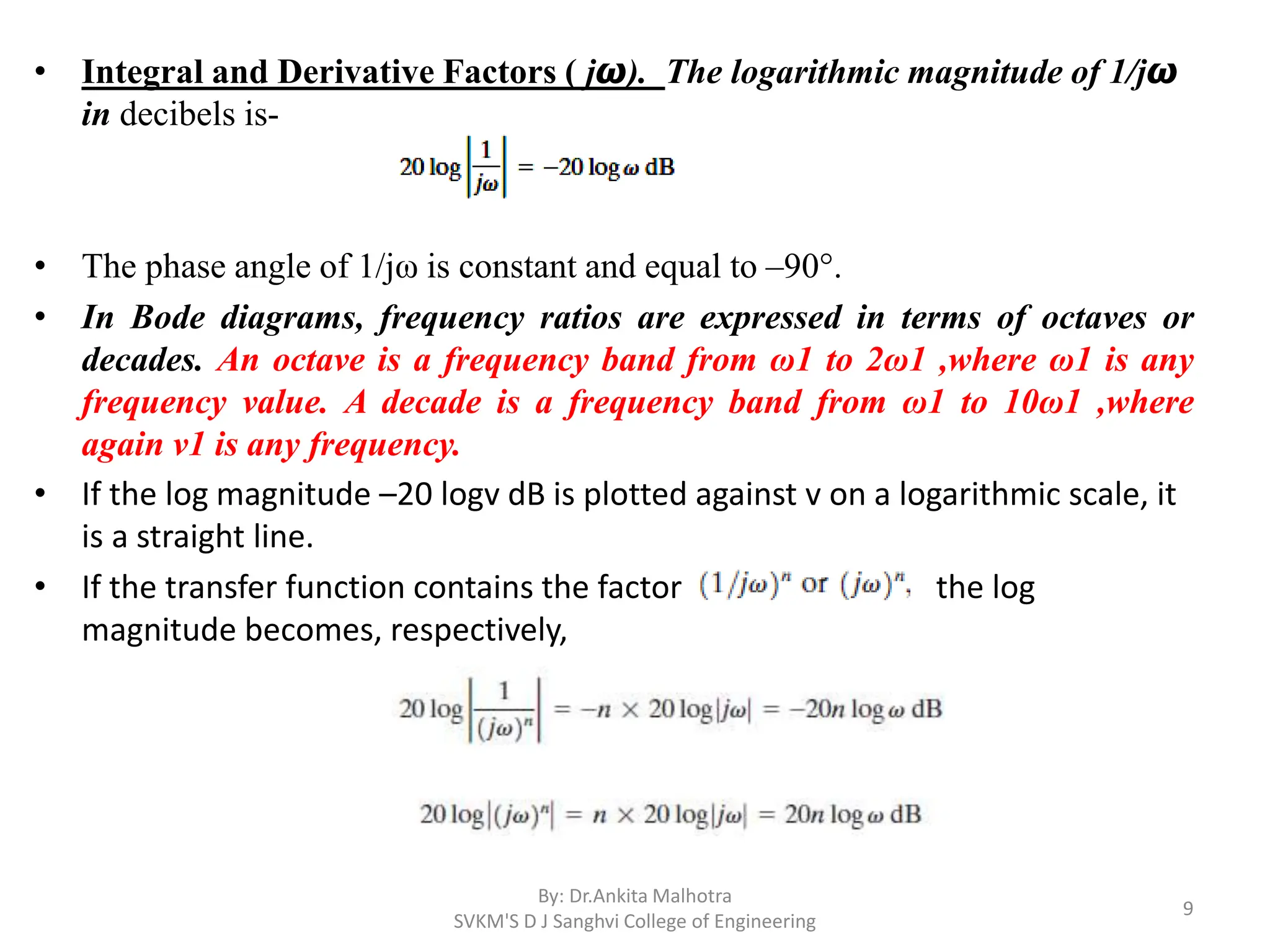
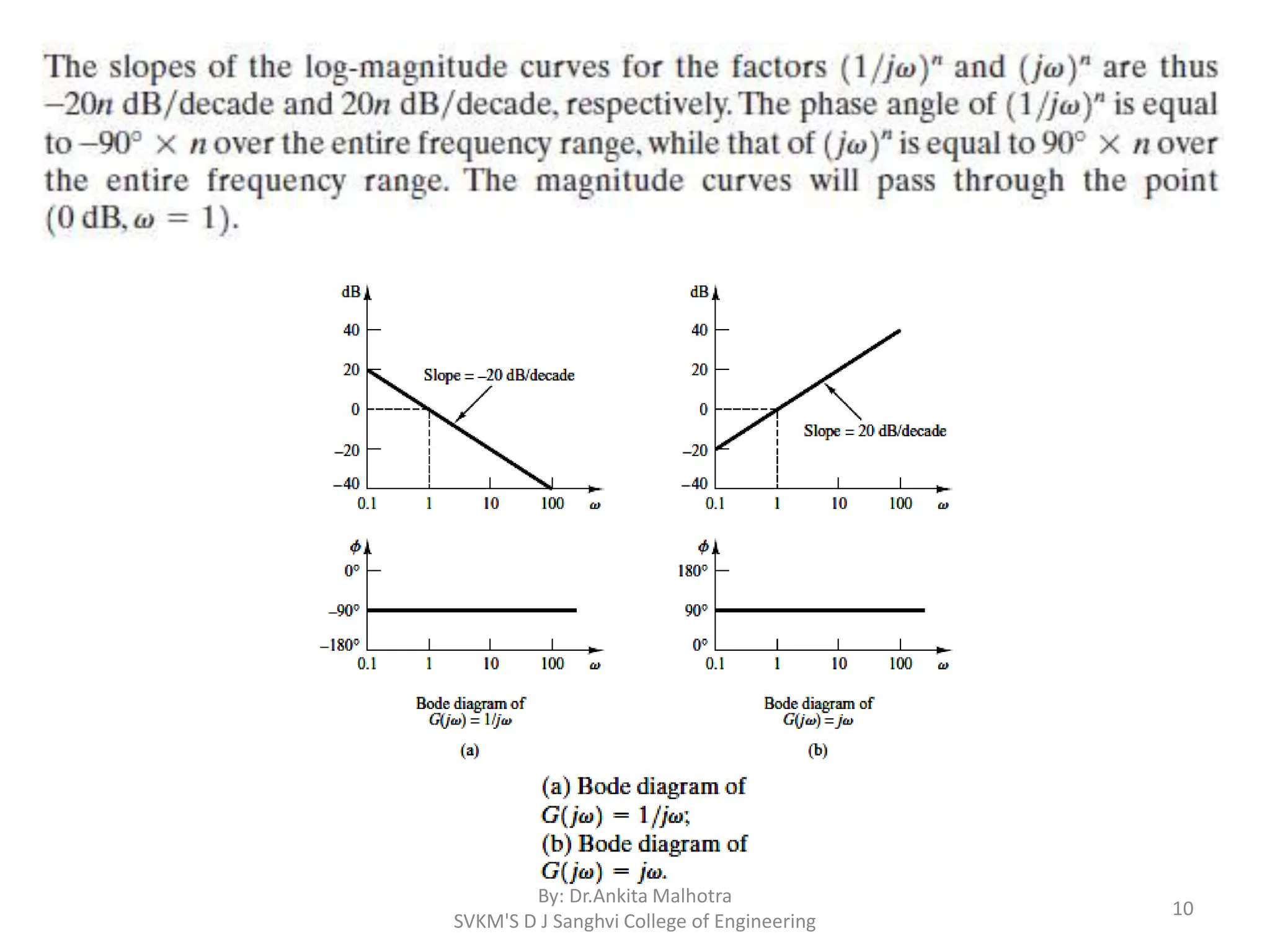
• Integral and Derivative Factors ( jω). The logarithmic magnitude of 1/jω
in decibels is-
• The phase angle of 1/jω is constant and equal to –90°.
• In Bode diagrams, frequency ratios are expressed in terms of octaves or
decades. An octave is a frequency band from ω1 to 2ω1 ,where ω1 is any
frequency value. A decade is a frequency band from ω1 to 10ω1 ,where
again v1 is any frequency.
• If the log magnitude –20 logv dB is plotted against v on a logarithmic scale, it
is a straight line.
• If the transfer function contains the factor the log
magnitude becomes, respectively,
By: Dr.Ankita Malhotra
SVKM'S D J Sanghvi College of Engineering
9
By: Dr.Ankita Malhotra
SVKM'S D J Sanghvi College of Engineering
10
By: Dr.Ankita Malhotra
SVKM'S D J Sanghvi College of Engineering
11
By: Dr.Ankita Malhotra
SVKM'S D J Sanghvi College of Engineering
12
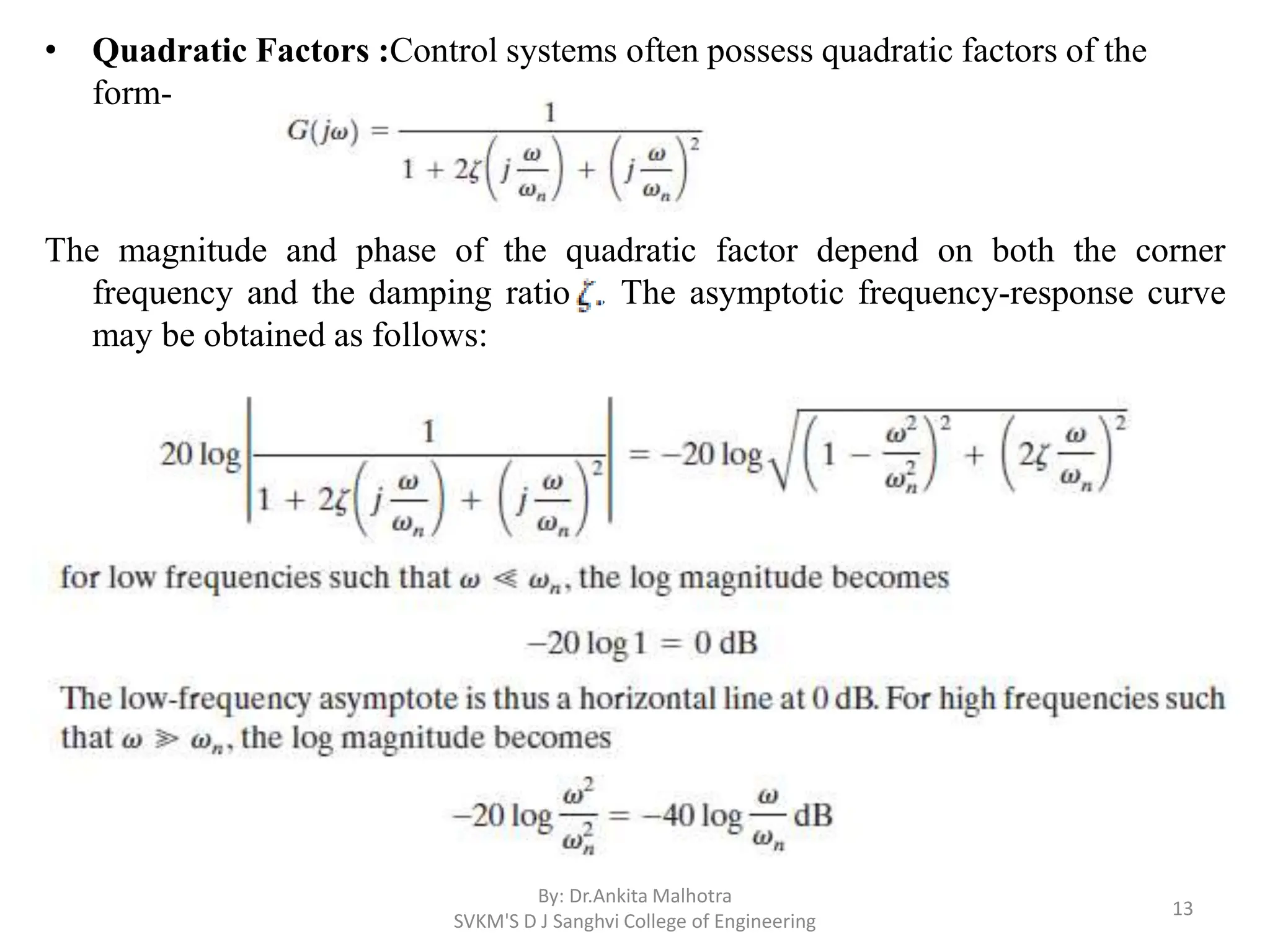
• Quadratic Factors :Control systems often possess quadratic factors of the
form-
The magnitude and phase of the quadratic factor depend on both the corner
frequency and the damping ratio . The asymptotic frequency-response curve
may be obtained as follows:
By: Dr.Ankita Malhotra
SVKM'S D J Sanghvi College of Engineering
13
By: Dr.Ankita Malhotra
SVKM'S D J Sanghvi College of Engineering
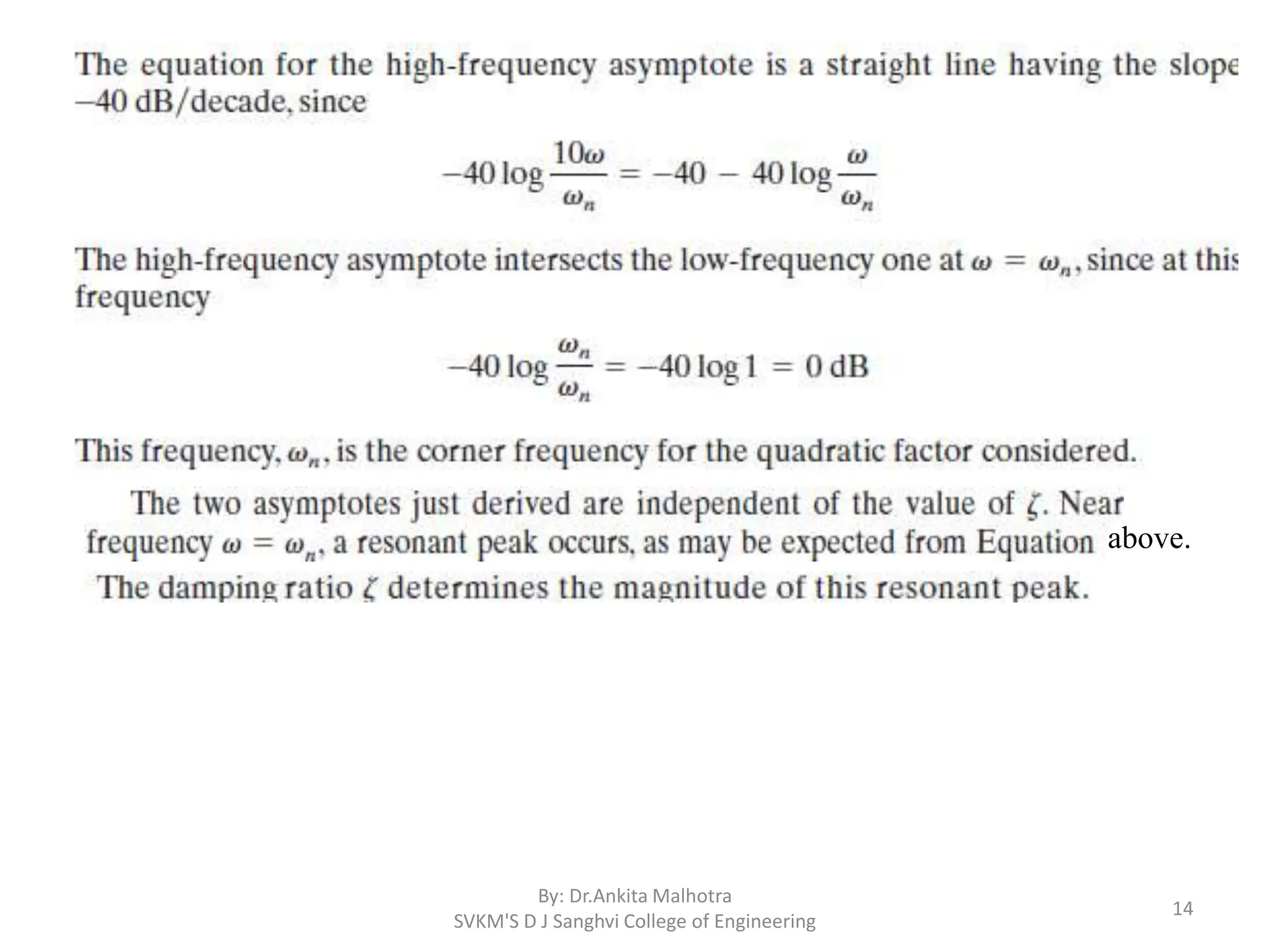
14
above.
By: Dr.Ankita Malhotra
SVKM'S D J Sanghvi College of Engineering
15
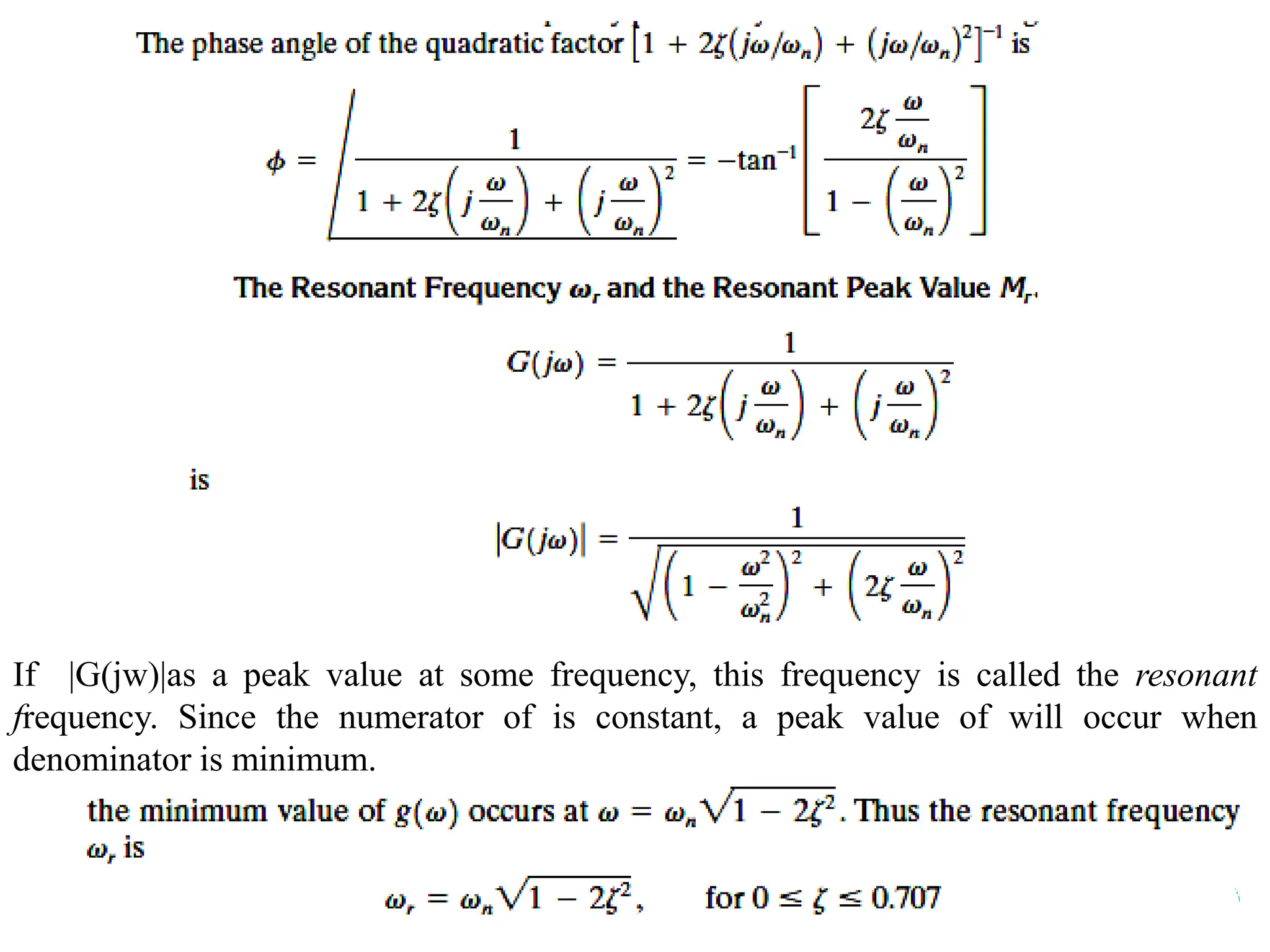
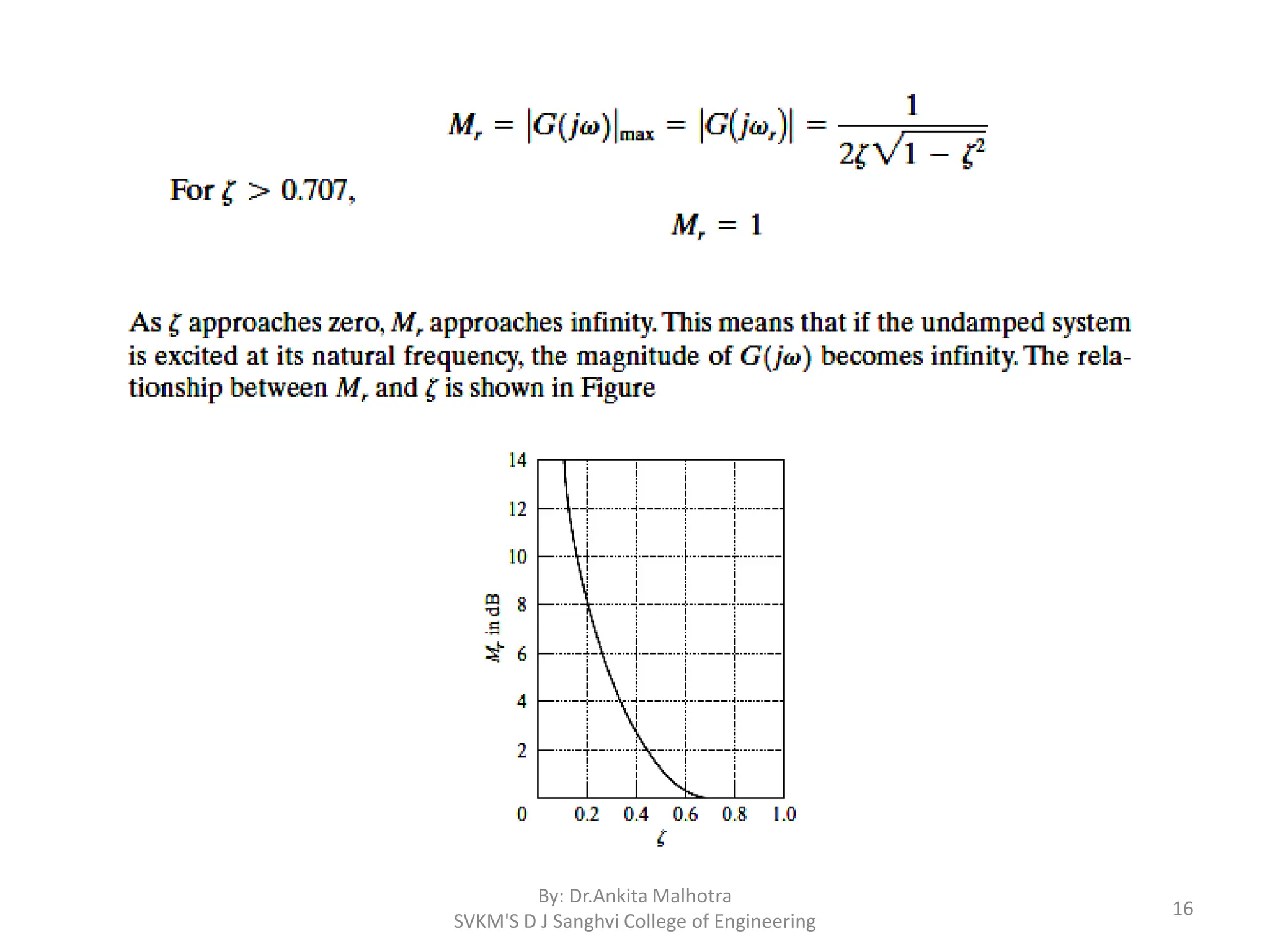
If |G(jw)|as a peak value at some frequency, this frequency is called the resonant
frequency. Since the numerator of is constant, a peak value of will occur when
denominator is minimum.
By: Dr.Ankita Malhotra
SVKM'S D J Sanghvi College of Engineering
16
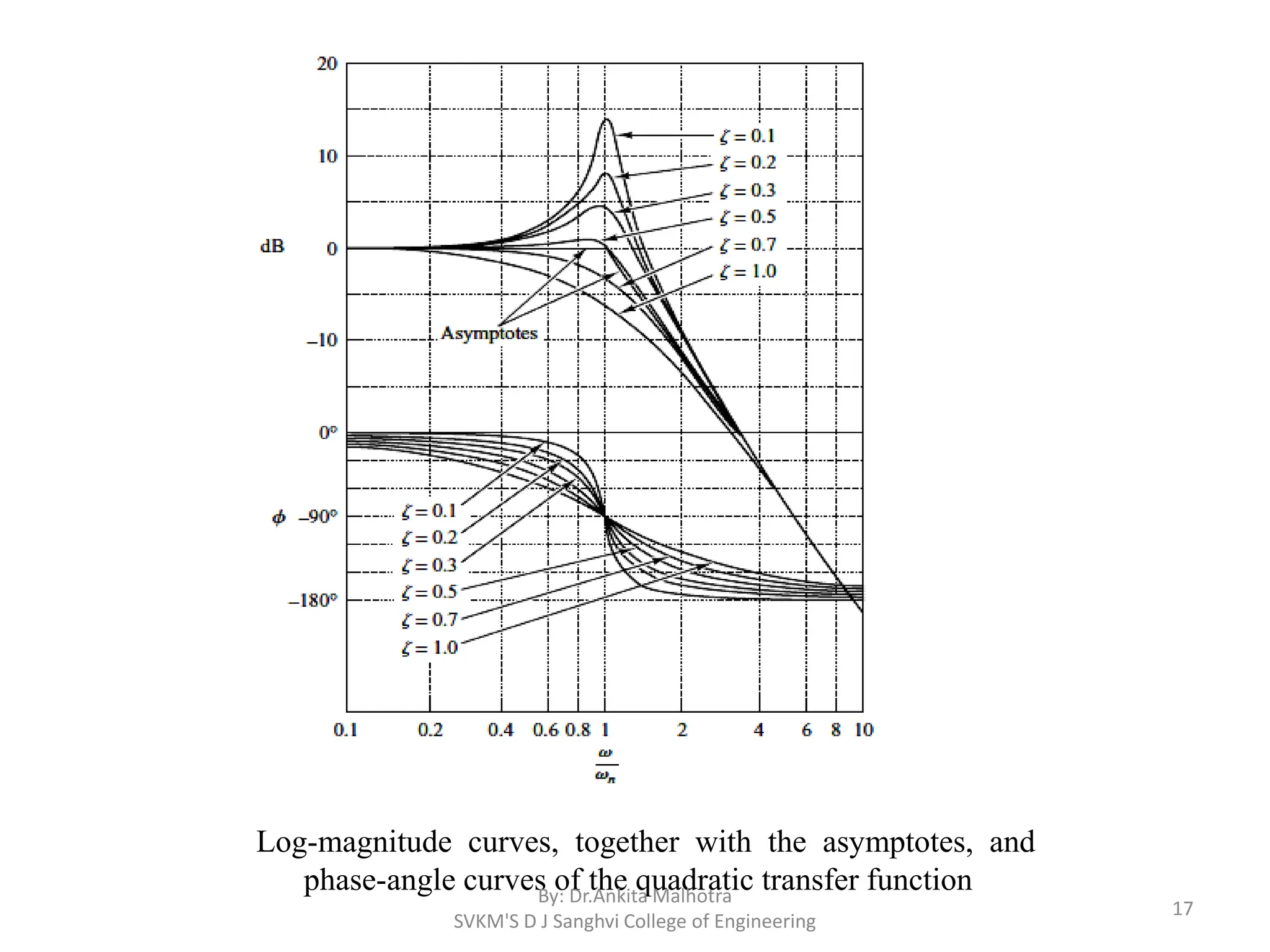
Log-magnitude curves, together with the asymptotes, and
phase-angle curves of the quadratic transfer function
By: Dr.Ankita Malhotra
SVKM'S D J Sanghvi College of Engineering
17
By: Dr.Ankita Malhotra
SVKM'S D J Sanghvi College of Engineering
18
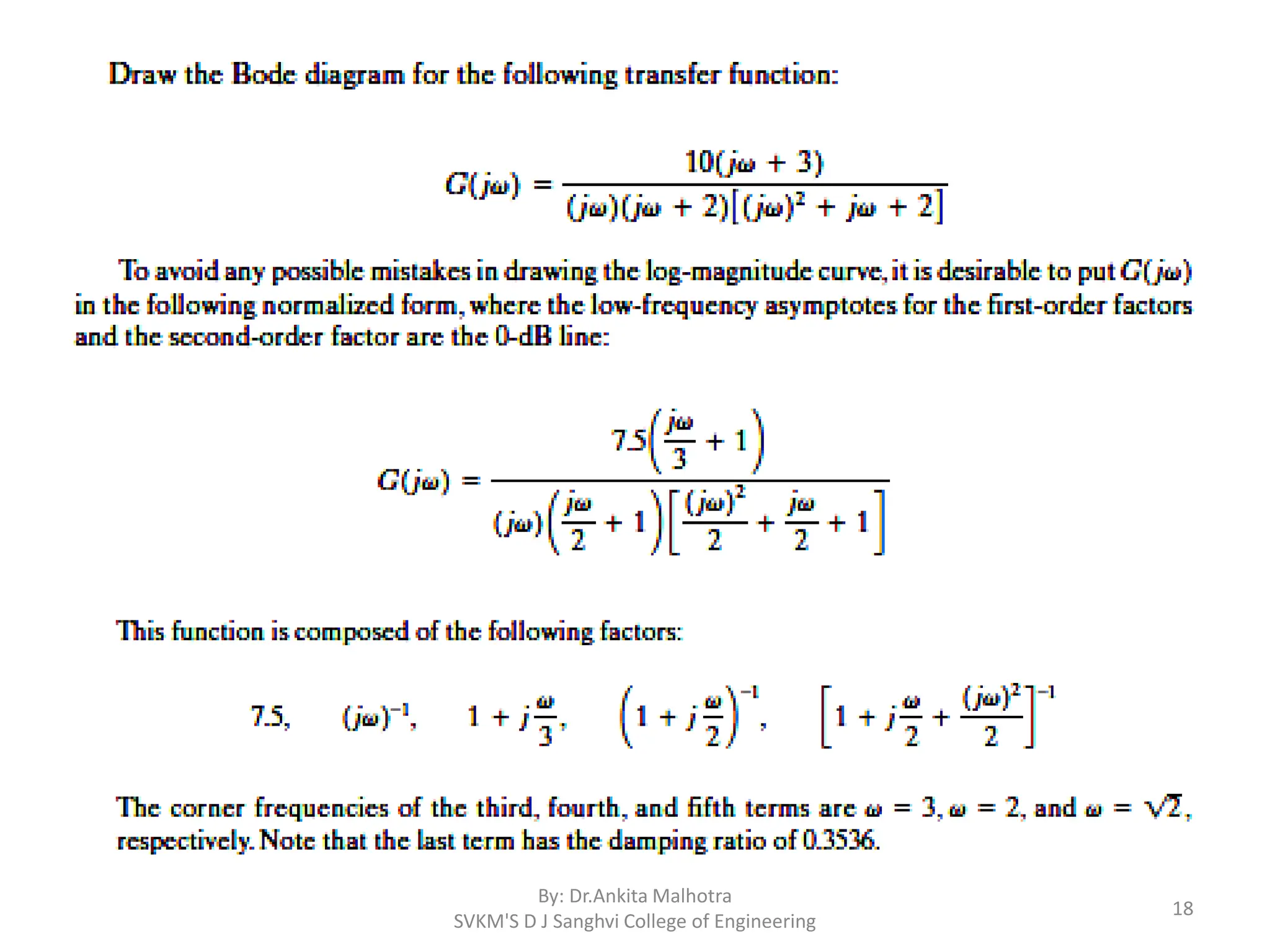
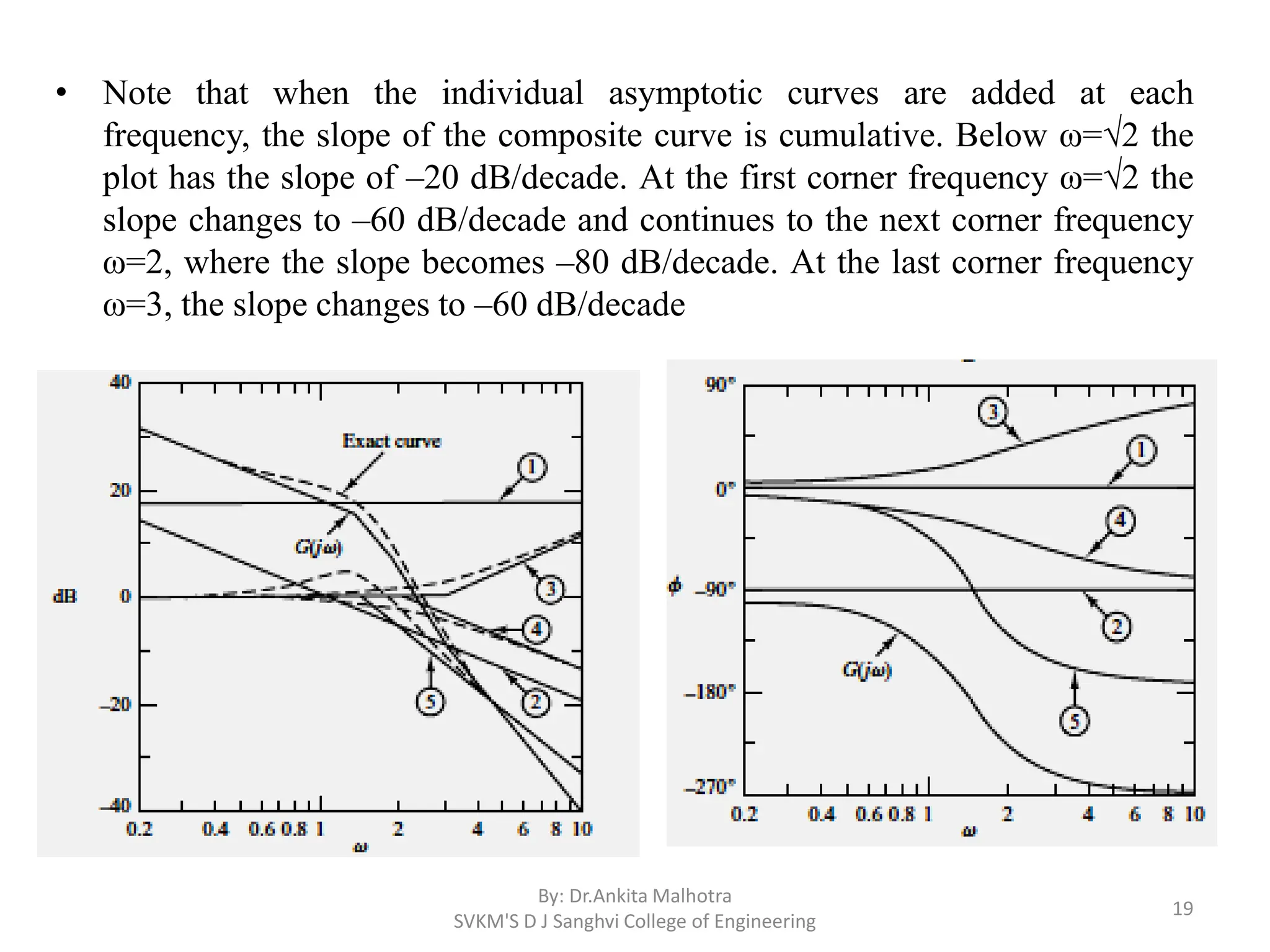
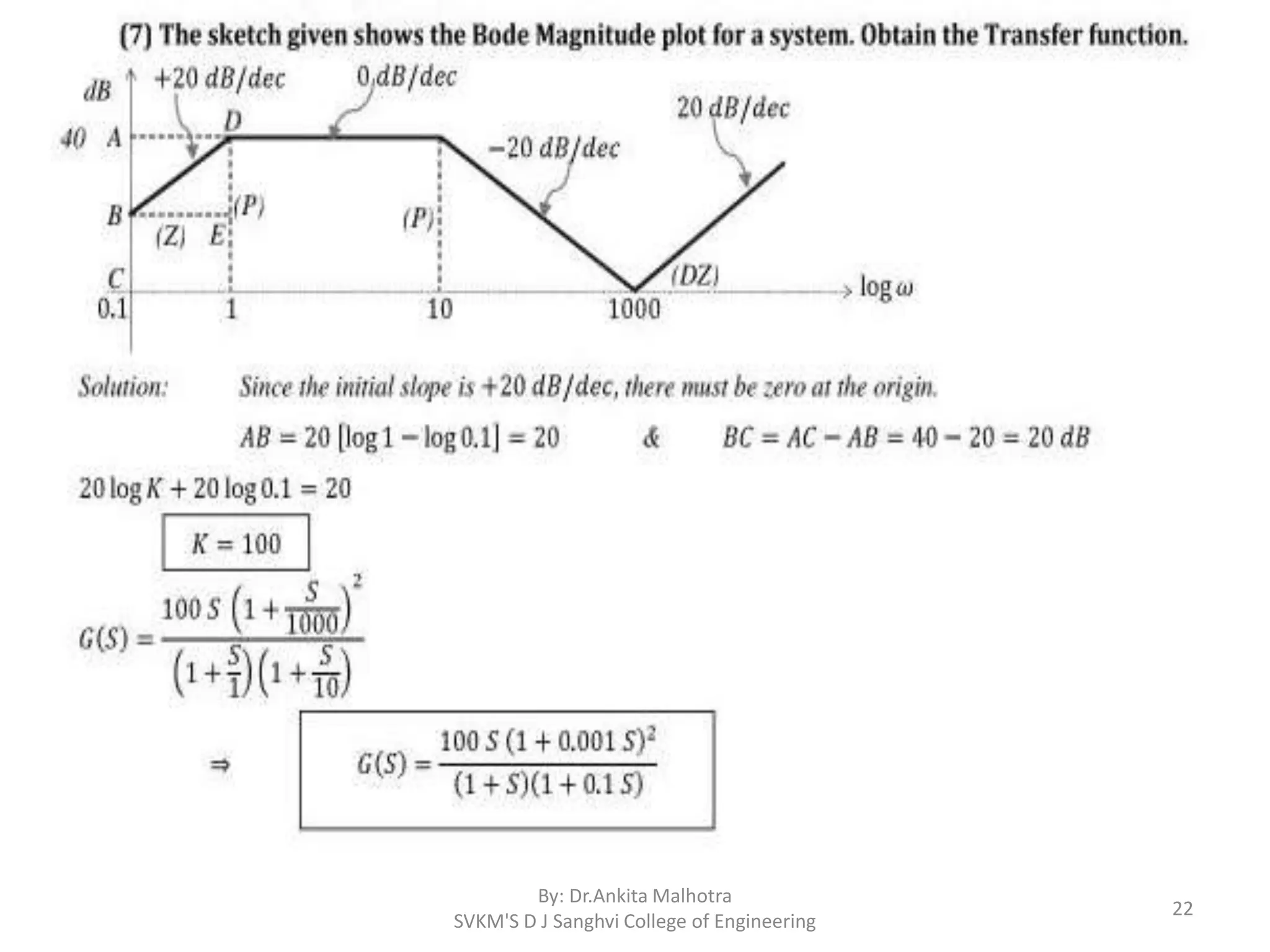
• Note that when the individual asymptotic curves are added at each
frequency, the slope of the composite curve is cumulative. Below ω=√2 the
plot has the slope of –20 dB/decade. At the first corner frequency ω=√2 the
slope changes to –60 dB/decade and continues to the next corner frequency
ω=2, where the slope becomes –80 dB/decade. At the last corner frequency
ω=3, the slope changes to –60 dB/decade
By: Dr.Ankita Malhotra
SVKM'S D J Sanghvi College of Engineering
19
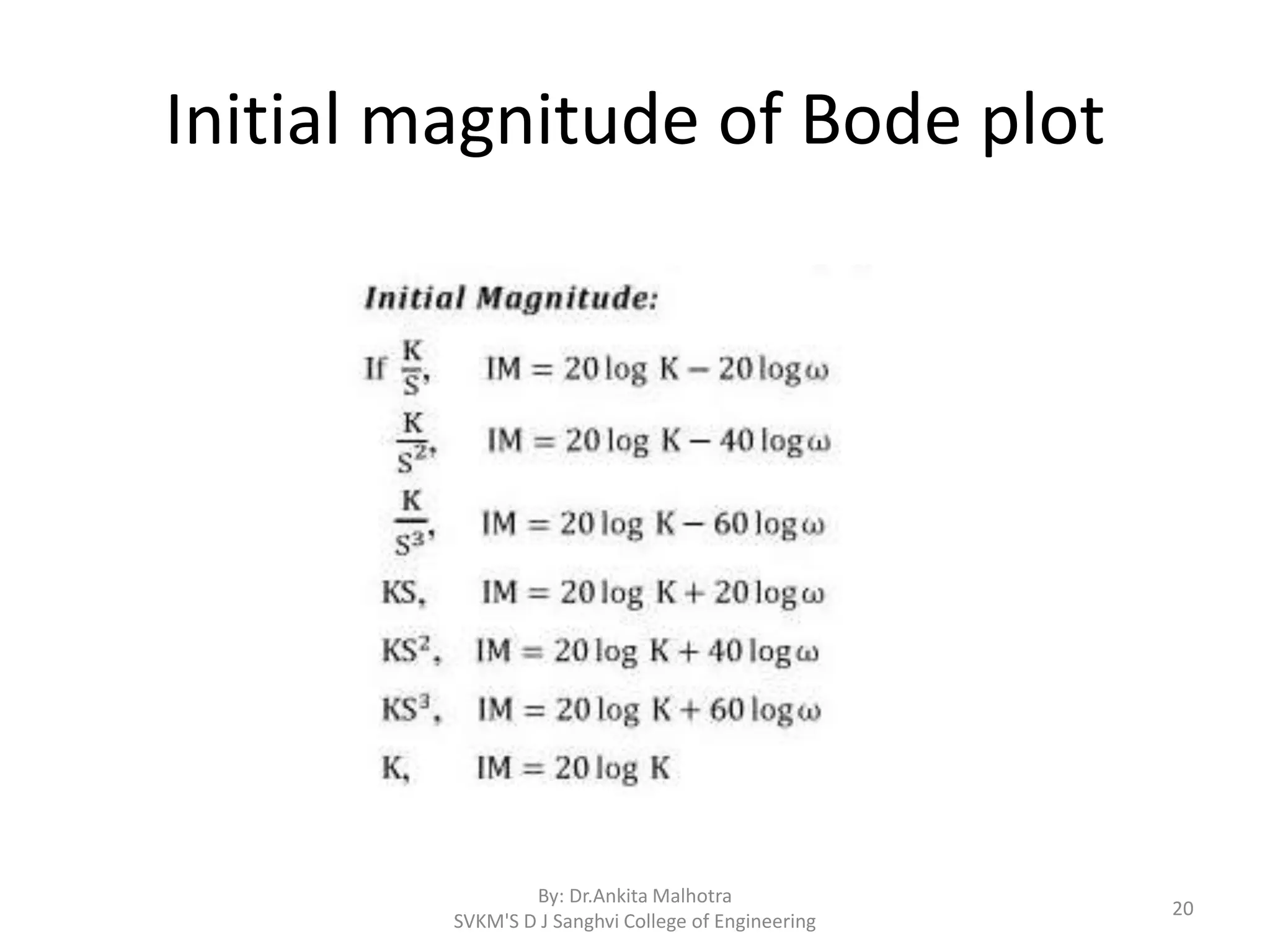
Initial magnitude of Bode plot
By: Dr.Ankita Malhotra
SVKM'S D J Sanghvi College of Engineering
20
By: Dr.Ankita Malhotra
SVKM'S D J Sanghvi College of Engineering
21
By: Dr.Ankita Malhotra
SVKM'S D J Sanghvi College of Engineering
22
Nyquist criteria
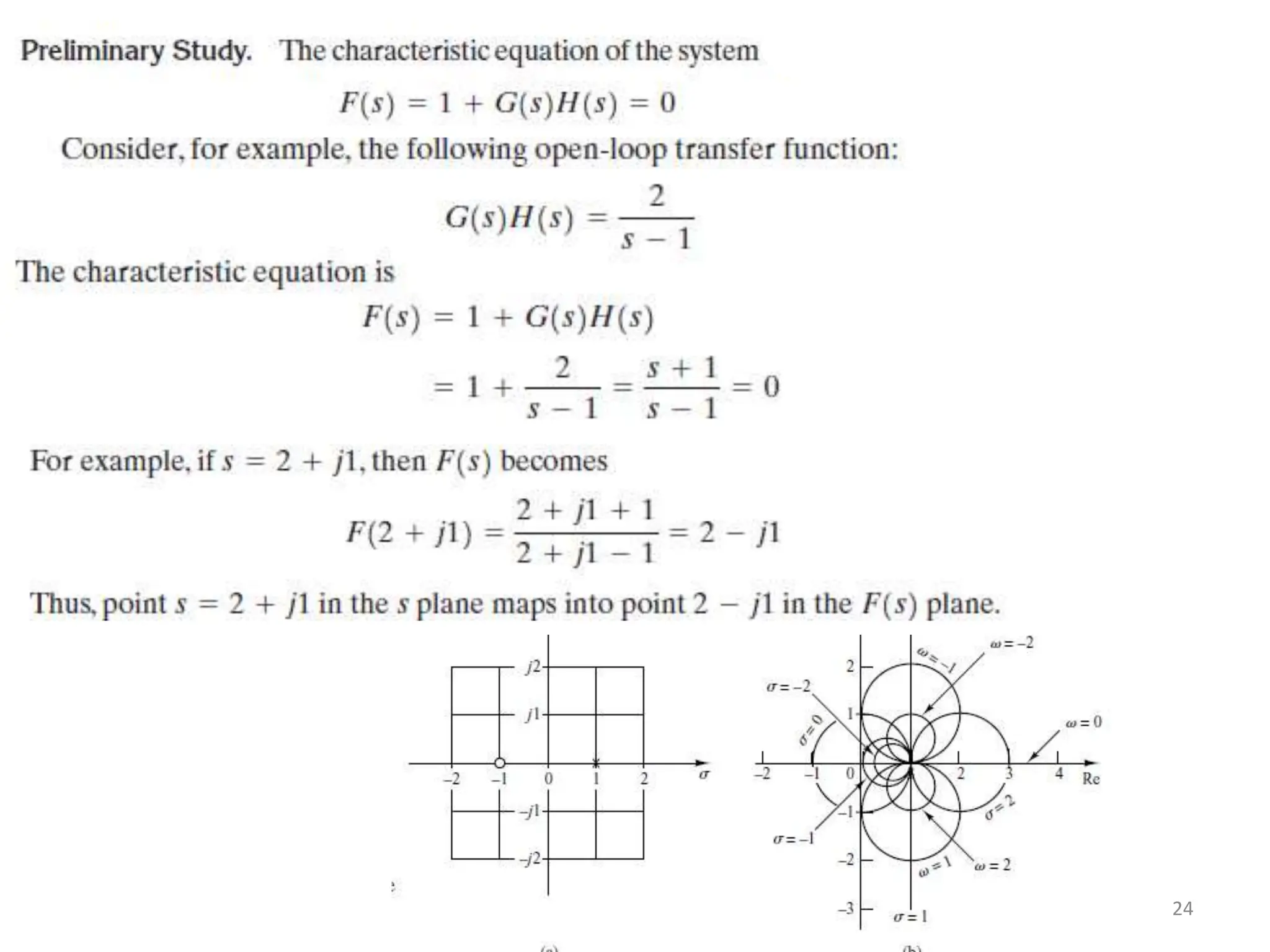
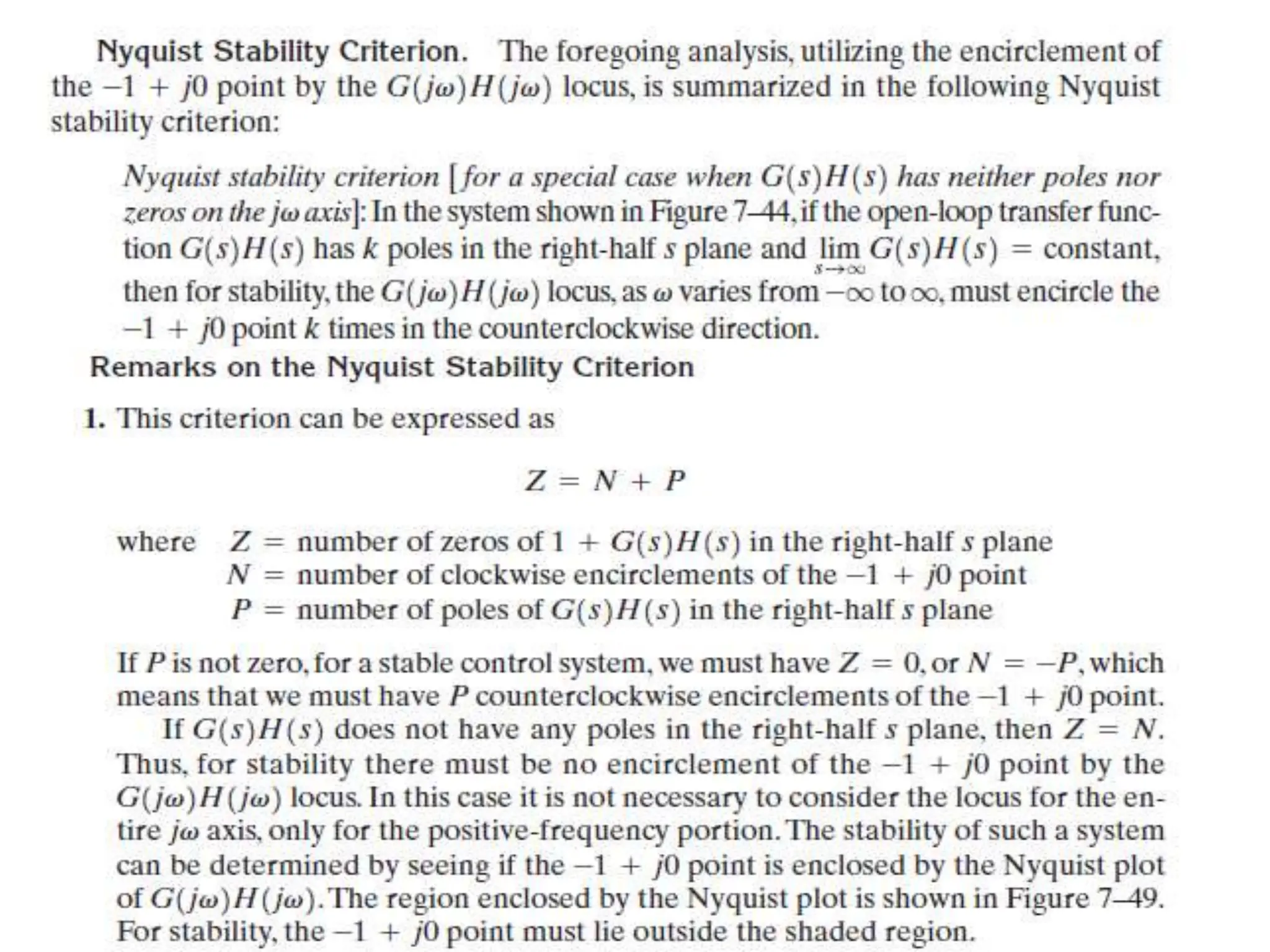
• The Nyquist stability criterion determines the stability of a closed-loop
system from its open-loop frequency response and open-loop poles.
• Let closed loop TF is
By: Dr.Ankita Malhotra
SVKM'S D J Sanghvi College of Engineering
23
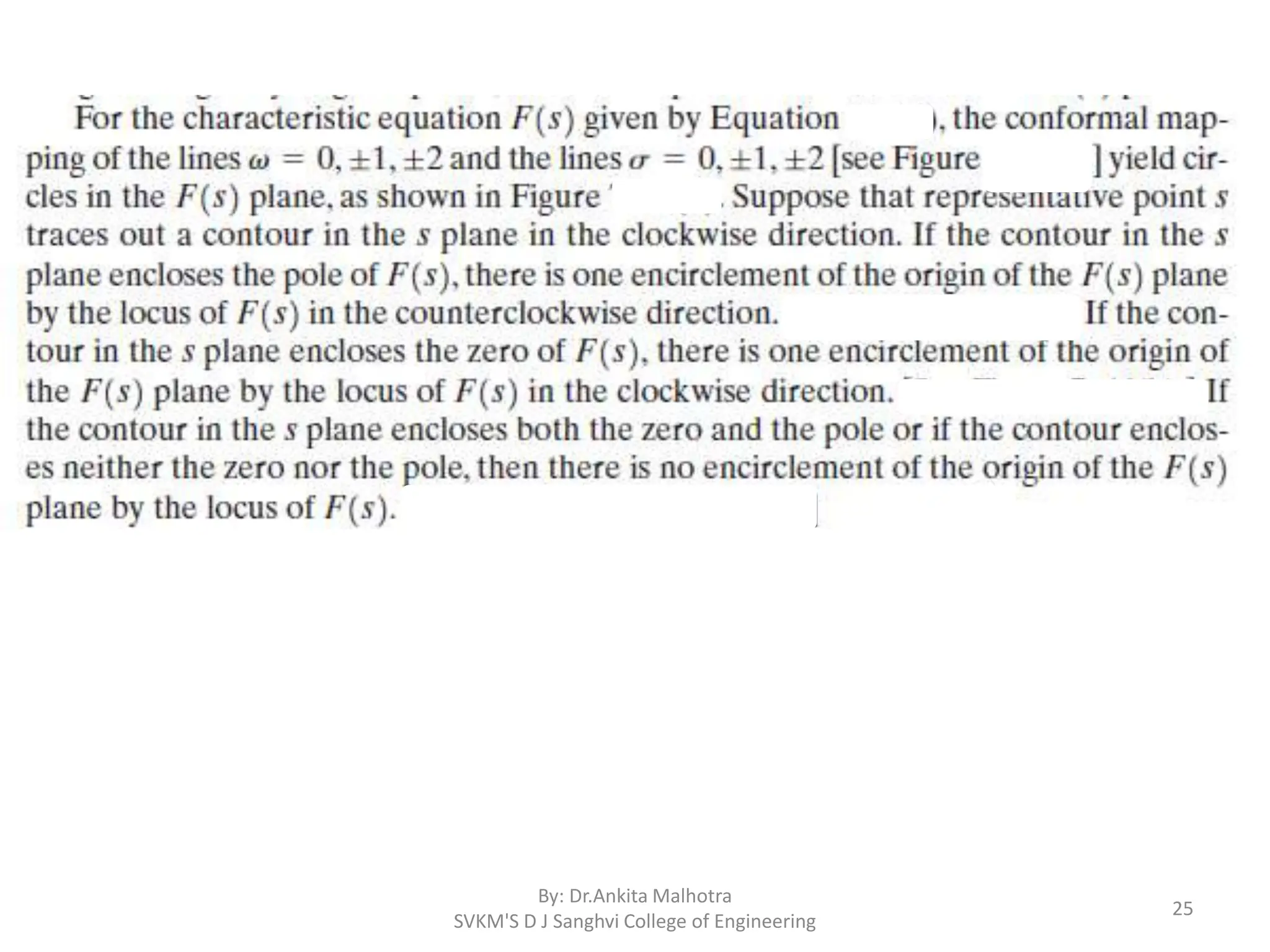
must lie in the left-half s plane. [It is noted that, although poles and zeros of the open-loop
transfer function G(s)H(s) may be in the right-half s plane, the system is stable if all the
poles of the closed-loop transfer function (that is, the roots of the characteristic equation)
are in the left-half s plane.] The Nyquist stability criterion relates the open-loop frequency
response G(jw)H(jw) to the number of zeros and poles of 1+G(s)H(s) that lie in the
right-half s plane.
By: Dr.Ankita Malhotra
SVKM'S D J Sanghvi College of Engineering
24
By: Dr.Ankita Malhotra
SVKM'S D J Sanghvi College of Engineering
25
By: Dr.Ankita Malhotra
SVKM'S D J Sanghvi College of Engineering
26
By: Dr.Ankita Malhotra
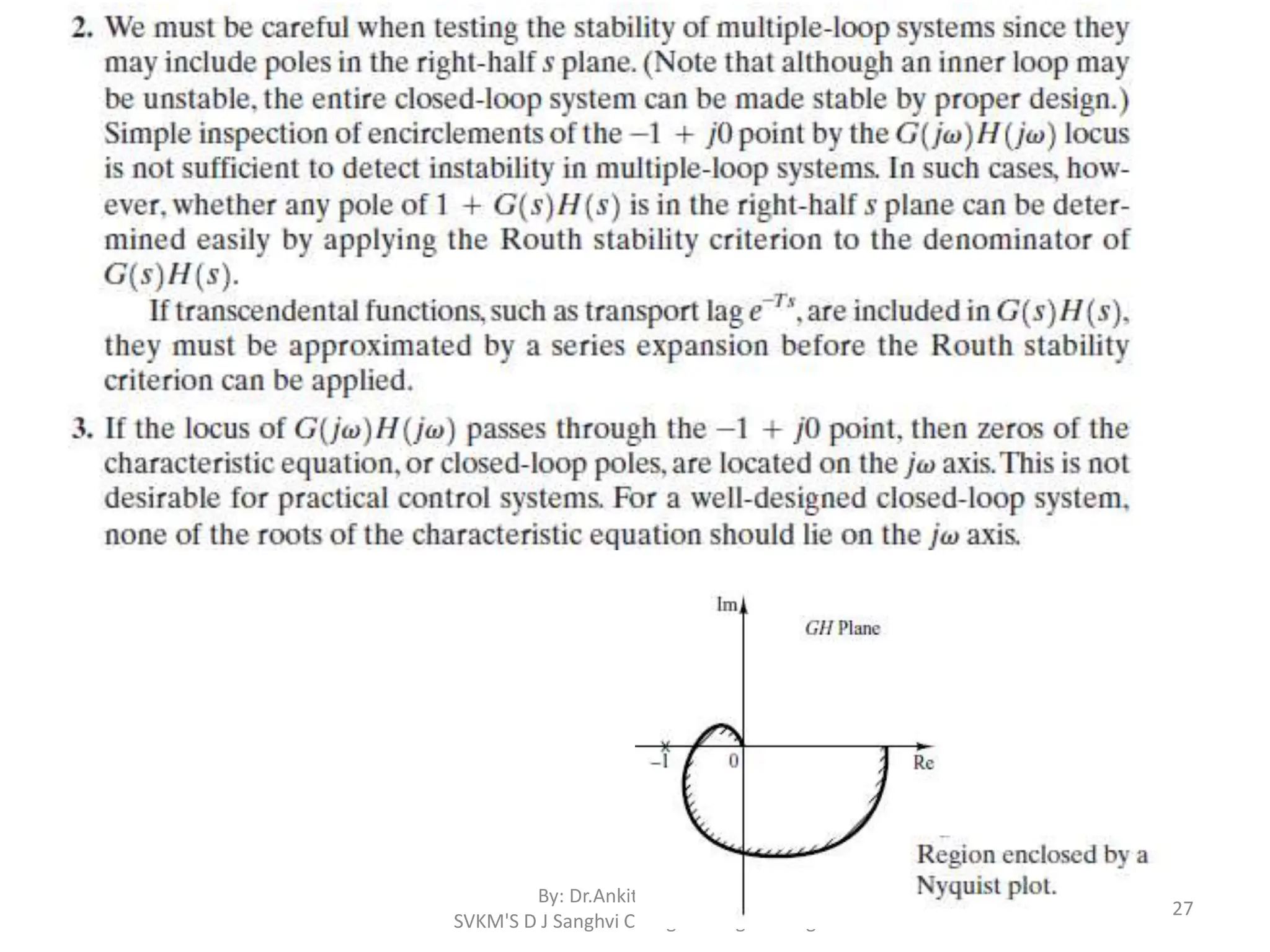
SVKM'S D J Sanghvi College of Engineering
27
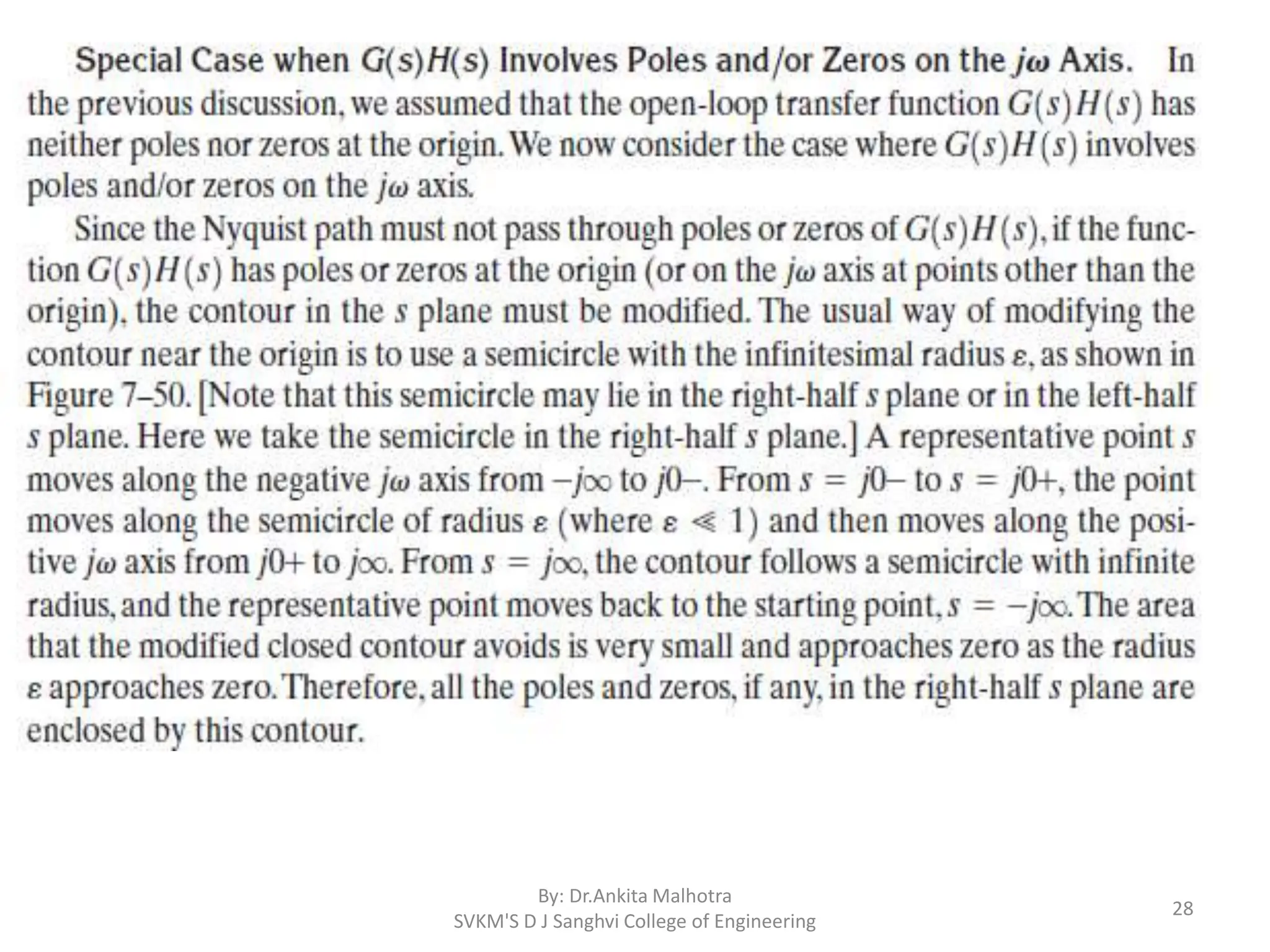
By: Dr.Ankita Malhotra
SVKM'S D J Sanghvi College of Engineering
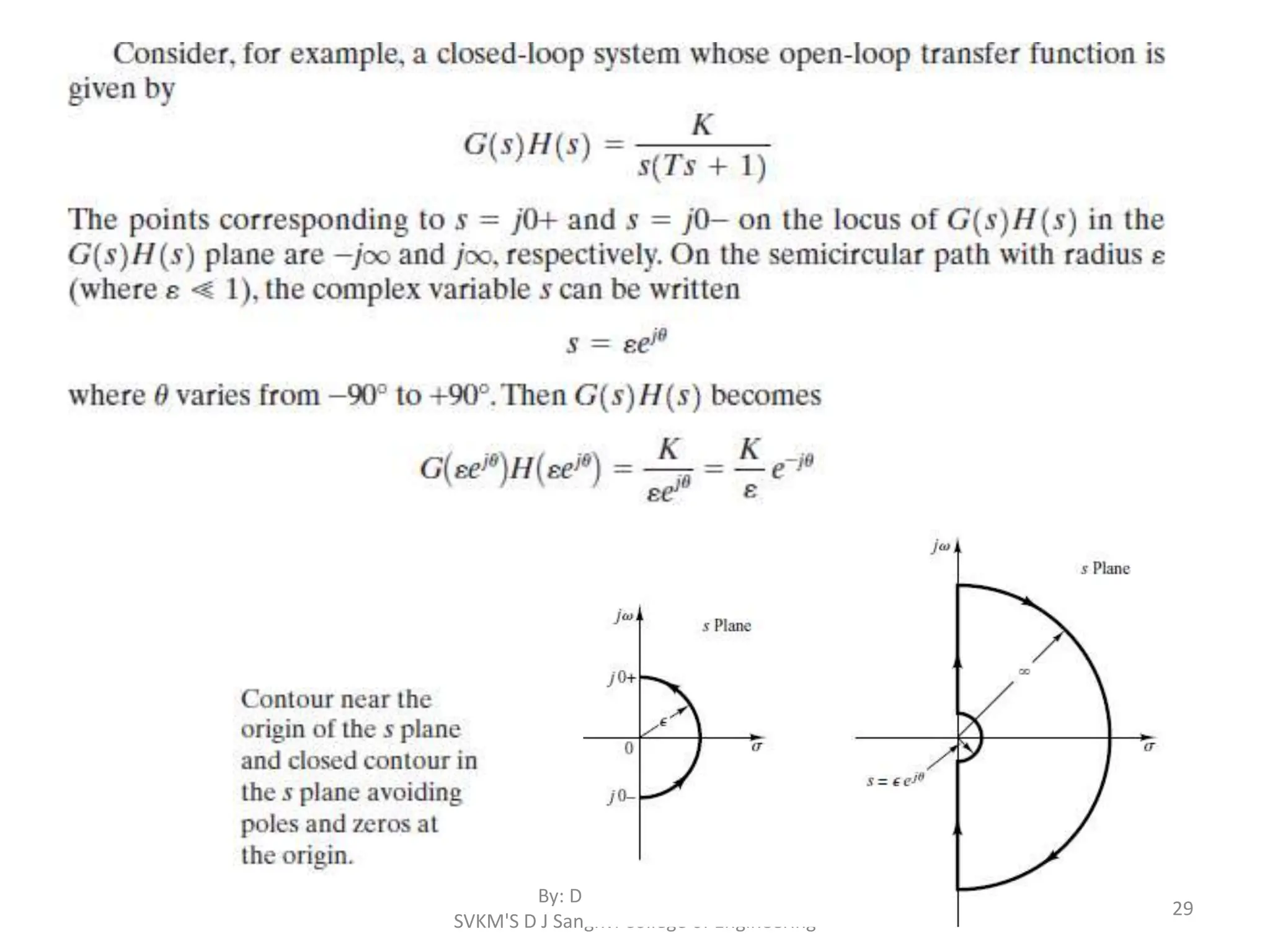
28
By: Dr.Ankita Malhotra
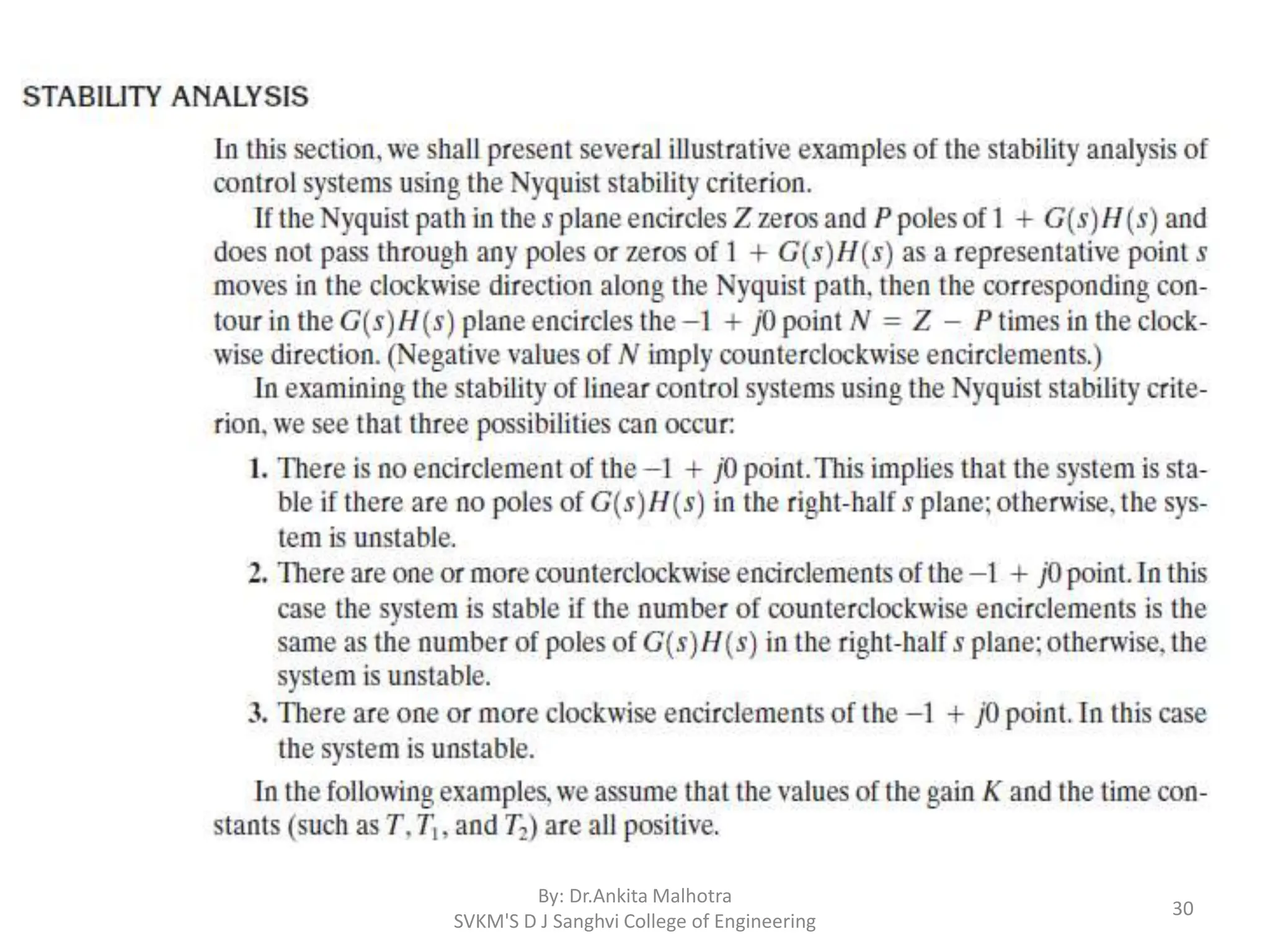
SVKM'S D J Sanghvi College of Engineering
29
By: Dr.Ankita Malhotra
SVKM'S D J Sanghvi College of Engineering
30

Stability of control systems in frequency domain

  • 1.
    Unit -6 Stability Analysisin Frequency Domain 1 By: Dr.Ankita Malhotra SVKM'S D J Sanghvi College of Engineering
  • 2.
    Control Systems Analysisand Design by Frequency Response Method • By the term frequency response, we mean the steady-state response of a system to a sinusoidal input. In frequency-response methods, we vary the frequency of the input signal over a certain range and study the resulting response. • An advantage of the frequency-response approach is that frequency-response tests are, in general, simple and can be made accurately by use of readily available sinusoidal signal generators and precise measurement equipment. Often the transfer functions of complicated components can be determined experimentally by frequency-response tests. • In addition, the frequency-response approach has the advantages that a system may be designed so that the effects of undesirable noise are negligible and that such analysis and design can be extended to certain nonlinear control systems. By: Dr.Ankita Malhotra SVKM'S D J Sanghvi College of Engineering 2
  • 3.
    • Obtaining Steady-StateOutputs to Sinusoidal Inputs. We shall show that the steady-state output of a transfer function system can be obtained directly from the sinusoidal transfer function—that is, the transfer function in which s is replaced by jω, where ωis angular frequency. • Suppose that the transfer function G(s) of the system can be written as a ratio of two polynomials in s; that is • The Laplace-transformed output Y(s) of the system is then By: Dr.Ankita Malhotra SVKM'S D J Sanghvi College of Engineering 3
  • 4.
    • For astable system, –s1, –s2 ,.. –sn have negative real parts. Therefore, as t approaches infinity, the terms , approach zero. • Thus the steady-state response becomes: By: Dr.Ankita Malhotra SVKM'S D J Sanghvi College of Engineering 4 Y(s) The angle f may be negative, positive, or zero. Similarly, we obtain the following expression for G(–jv):
  • 5.
    • Where Y=X|G(jω)|.We see that a stable, linear, time-invariant system subjected to a sinusoidal input will, at steady state, have a sinusoidal output of the same frequency as the input. But the amplitude and phase of the output will, in general, be different from those of the input. By: Dr.Ankita Malhotra SVKM'S D J Sanghvi College of Engineering 5
  • 6.
    By: Dr.Ankita Malhotra SVKM'SD J Sanghvi College of Engineering 6 It can be seen that for small ω, the amplitude of the steady-state output yss(t) is almost equal to K times the amplitude of the input. The phase shift of the output is small for small ω. For large ω, the amplitude of the output is small and almost inversely proportional to ω. The phase shift approaches –90° as ω approaches infinity. This is a phase-lag network. Example: Consider the given transfer function
  • 7.
    Bode Plots • BodeDiagrams or Logarithmic Plots. A Bode diagram consists of two graphs: One is a plot of the logarithm of the magnitude of a sinusoidal transfer function; the other is a plot of the phase angle; both are plotted against the frequency on a logarithmic scale. • Basic Factors of G( jω)H(jω). As stated earlier, the main advantage in using the logarithmic plot is the relative ease of plotting frequency-response curves. The basic factors that very frequently occur in an arbitrary transfer function G(jω)H(jω) are: • 1. Gain K • 2. Integral and derivative factors (jω) • 3. First-order factors (1+jωT) • 4. Quadratic factors Once we become familiar with the logarithmic plots of these basic factors, it is possible to utilize them in constructing a composite logarithmic plot for any general form of G(jω)H(jω) by sketching the curves for each factor and adding individual curves graphically, because adding the logarithms of the gains corresponds to multiplying them together. By: Dr.Ankita Malhotra SVKM'S D J Sanghvi College of Engineering 7
  • 8.
    • The GainK. A number greater than unity has a positive value in decibels, while a number smaller than unity has a negative value. The log-magnitude curve for a constant gain K is a horizontal straight line at the magnitude of 20 logK decibels. The phase angle of the gain K is zero. The effect of varying the gain K in the transfer function is that it raises or lowers the log-magnitude curve of the transfer function by the corresponding constant amount, but it has no effect on the phase curve. By: Dr.Ankita Malhotra SVKM'S D J Sanghvi College of Engineering 8
  • 9.
    • Integral andDerivative Factors ( jω). The logarithmic magnitude of 1/jω in decibels is- • The phase angle of 1/jω is constant and equal to –90°. • In Bode diagrams, frequency ratios are expressed in terms of octaves or decades. An octave is a frequency band from ω1 to 2ω1 ,where ω1 is any frequency value. A decade is a frequency band from ω1 to 10ω1 ,where again v1 is any frequency. • If the log magnitude –20 logv dB is plotted against v on a logarithmic scale, it is a straight line. • If the transfer function contains the factor the log magnitude becomes, respectively, By: Dr.Ankita Malhotra SVKM'S D J Sanghvi College of Engineering 9
  • 10.
    By: Dr.Ankita Malhotra SVKM'SD J Sanghvi College of Engineering 10
  • 11.
    By: Dr.Ankita Malhotra SVKM'SD J Sanghvi College of Engineering 11
  • 12.
    By: Dr.Ankita Malhotra SVKM'SD J Sanghvi College of Engineering 12
  • 13.
    • Quadratic Factors:Control systems often possess quadratic factors of the form- The magnitude and phase of the quadratic factor depend on both the corner frequency and the damping ratio . The asymptotic frequency-response curve may be obtained as follows: By: Dr.Ankita Malhotra SVKM'S D J Sanghvi College of Engineering 13
  • 14.
    By: Dr.Ankita Malhotra SVKM'SD J Sanghvi College of Engineering 14 above.
  • 15.
    By: Dr.Ankita Malhotra SVKM'SD J Sanghvi College of Engineering 15 If |G(jw)|as a peak value at some frequency, this frequency is called the resonant frequency. Since the numerator of is constant, a peak value of will occur when denominator is minimum.
  • 16.
    By: Dr.Ankita Malhotra SVKM'SD J Sanghvi College of Engineering 16
  • 17.
    Log-magnitude curves, togetherwith the asymptotes, and phase-angle curves of the quadratic transfer function By: Dr.Ankita Malhotra SVKM'S D J Sanghvi College of Engineering 17
  • 18.
    By: Dr.Ankita Malhotra SVKM'SD J Sanghvi College of Engineering 18
  • 19.
    • Note thatwhen the individual asymptotic curves are added at each frequency, the slope of the composite curve is cumulative. Below ω=√2 the plot has the slope of –20 dB/decade. At the first corner frequency ω=√2 the slope changes to –60 dB/decade and continues to the next corner frequency ω=2, where the slope becomes –80 dB/decade. At the last corner frequency ω=3, the slope changes to –60 dB/decade By: Dr.Ankita Malhotra SVKM'S D J Sanghvi College of Engineering 19
  • 20.
    Initial magnitude ofBode plot By: Dr.Ankita Malhotra SVKM'S D J Sanghvi College of Engineering 20
  • 21.
    By: Dr.Ankita Malhotra SVKM'SD J Sanghvi College of Engineering 21
  • 22.
    By: Dr.Ankita Malhotra SVKM'SD J Sanghvi College of Engineering 22
  • 23.
    Nyquist criteria • TheNyquist stability criterion determines the stability of a closed-loop system from its open-loop frequency response and open-loop poles. • Let closed loop TF is By: Dr.Ankita Malhotra SVKM'S D J Sanghvi College of Engineering 23 must lie in the left-half s plane. [It is noted that, although poles and zeros of the open-loop transfer function G(s)H(s) may be in the right-half s plane, the system is stable if all the poles of the closed-loop transfer function (that is, the roots of the characteristic equation) are in the left-half s plane.] The Nyquist stability criterion relates the open-loop frequency response G(jw)H(jw) to the number of zeros and poles of 1+G(s)H(s) that lie in the right-half s plane.
  • 24.
    By: Dr.Ankita Malhotra SVKM'SD J Sanghvi College of Engineering 24
  • 25.
    By: Dr.Ankita Malhotra SVKM'SD J Sanghvi College of Engineering 25
  • 26.
    By: Dr.Ankita Malhotra SVKM'SD J Sanghvi College of Engineering 26
  • 27.
    By: Dr.Ankita Malhotra SVKM'SD J Sanghvi College of Engineering 27
  • 28.
    By: Dr.Ankita Malhotra SVKM'SD J Sanghvi College of Engineering 28
  • 29.
    By: Dr.Ankita Malhotra SVKM'SD J Sanghvi College of Engineering 29
  • 30.
    By: Dr.Ankita Malhotra SVKM'SD J Sanghvi College of Engineering 30