BLOOD GROUPING
M.J. Afra
II – BSc Microbiology
Department Of Microbiology and Biotechnology
Thassim Beevi Abdul Kader College For Women Kilakarai
INTRODUCTION
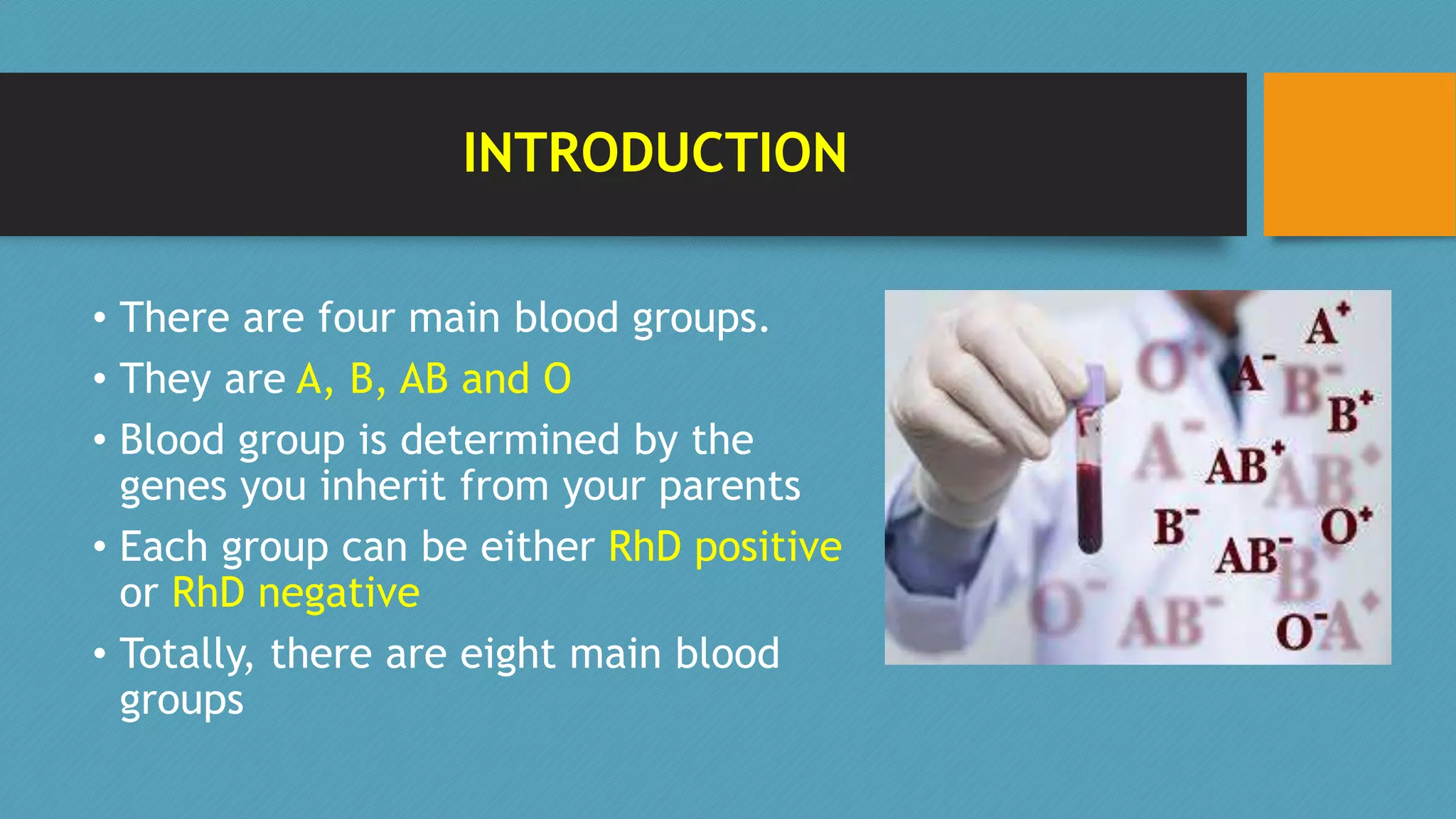
• There are four main blood groups.
• They are A, B, AB and O
• Blood group is determined by the
genes you inherit from your parents
• Each group can be either RhD positive
or RhD negative
• Totally, there are eight main blood
groups
WHAT IS BLOOD?
• Blood is a fluid that transport oxygen
and nutrients to the cell
• Blood is made up of Red Blood Cells
(RCB), White Blood Cells (WBC) and
Platelets
• The RBC, WBC and Platelets present in
the liquid called Plasma.
• Blood group is identified by antibodies
and antigens in the blood
ANTIGENS AND ANTIBODIES
• Antibodies are proteins found in the
plasma
• They are the parts of our body’s
natural defenses
• They recognize the foreign
substances and destroy them
• Antigens are protien molecules that
are found on the surface of red blood
cells
ABO BLOOD GROUPING
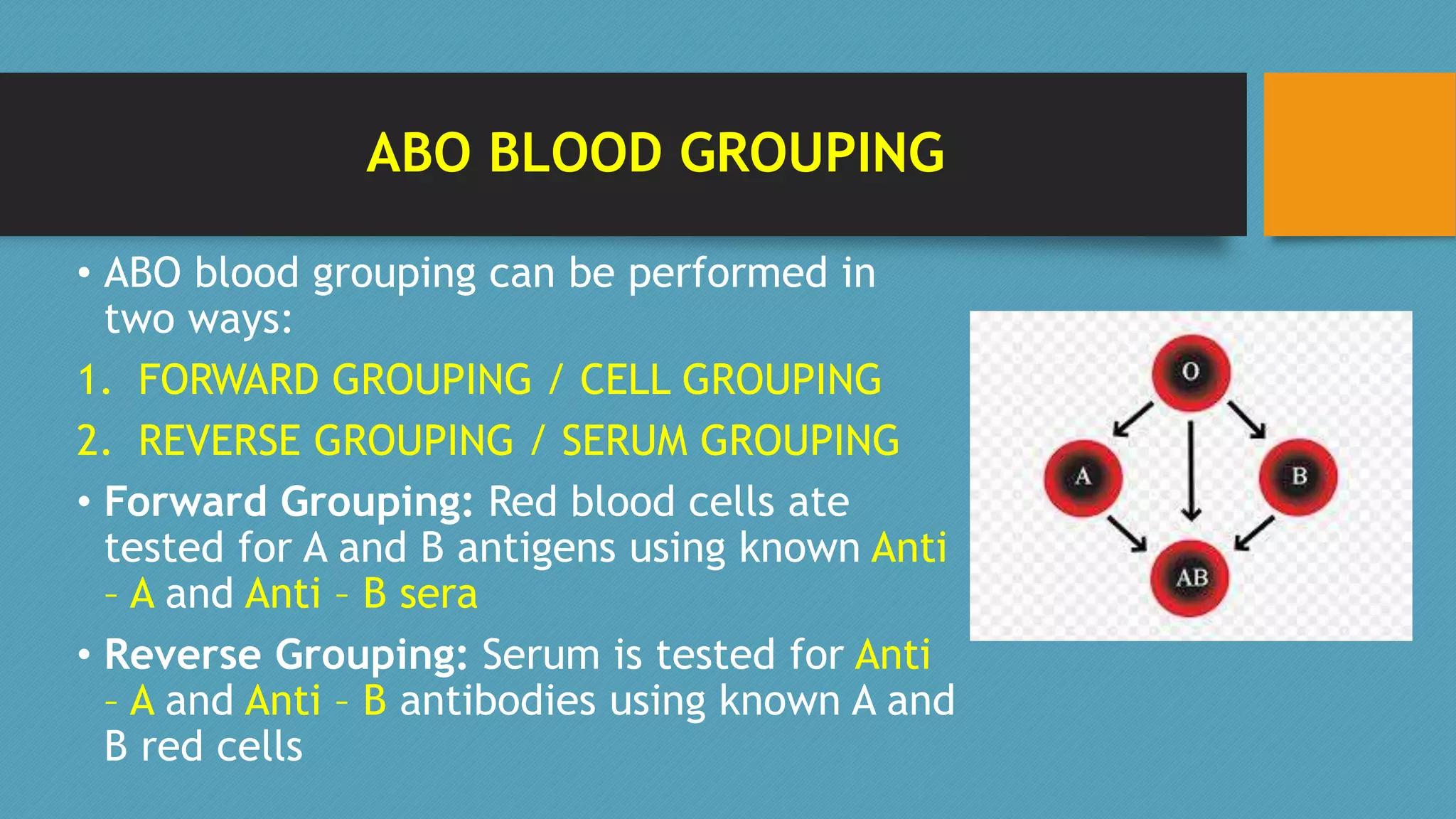
• ABO blood grouping can be performed in
two ways:
1. FORWARD GROUPING / CELL GROUPING
2. REVERSE GROUPING / SERUM GROUPING
• Forward Grouping: Red blood cells ate
tested for A and B antigens using known Anti
– A and Anti – B sera
• Reverse Grouping: Serum is tested for Anti
– A and Anti – B antibodies using known A and
B red cells
• There are four main blood groups defined by
ABO system:
1. Blood Group A – has A antigens on the RBC with
Anti – B antibodies in the plasma
2. Blood Group B – has B antigens with Anti – A
antibodies in the plasma
3. Blood Group O – has no antigens but both Anti
– A and Anti – B antibodies in the plasma
4. Blood Group AB – has both A and B antigens,
but no antibodies
• Blood Group O is the most common blood group.
Almost half of the population has blood group O
ABO BLOOD GROUPING
THE Rh SYSTEM
• Red blood cells sometimes have another
antigen, a protein known as the RhD
antigen
• If RhD antigen is present, your blood
group is RhD positive
• If RhD antigen is absent, your blood group
is RhD negative
• About 85% of the population have Rh
positive
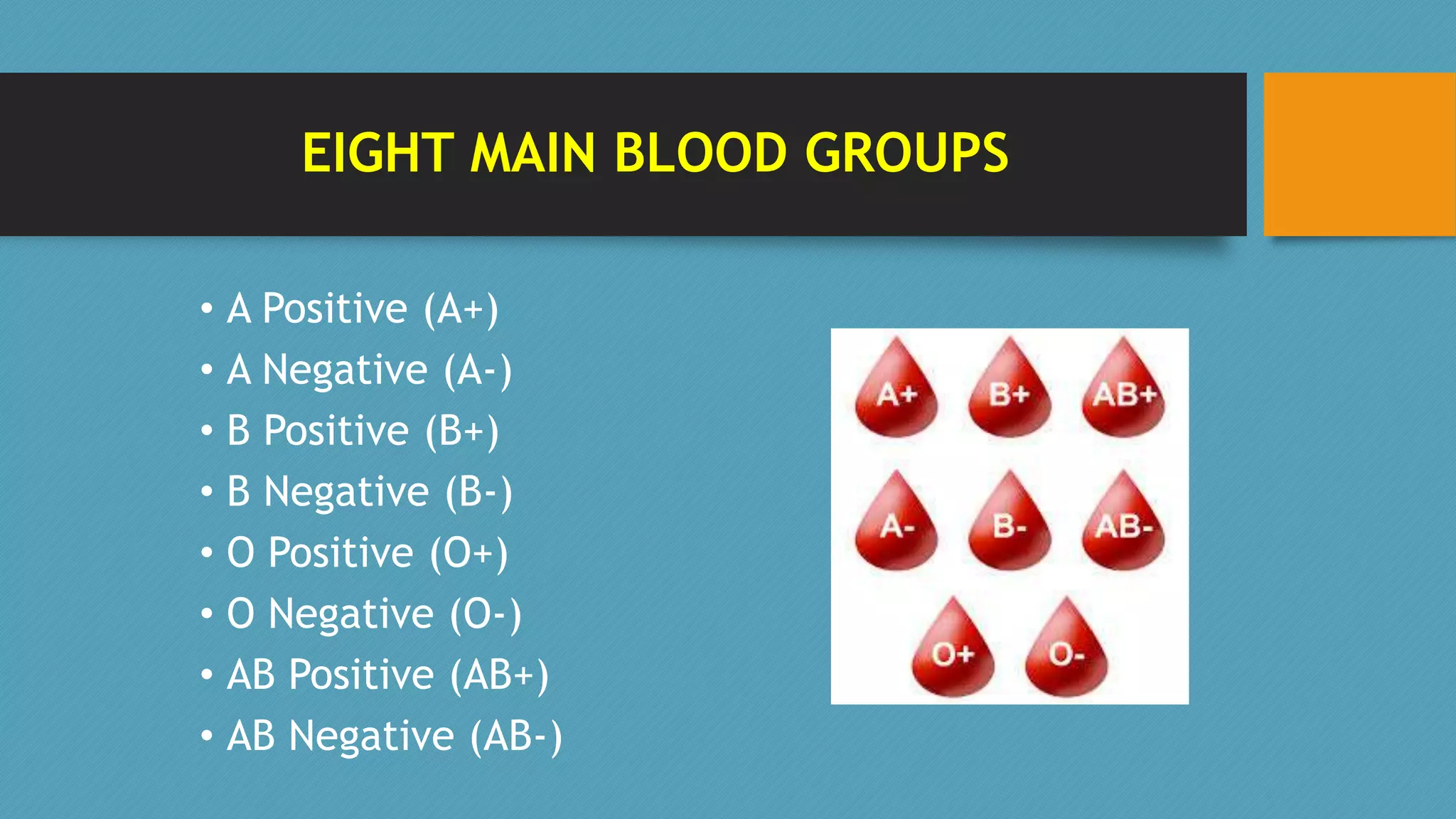
EIGHT MAIN BLOOD GROUPS
• A Positive (A+)
• A Negative (A-)
• B Positive (B+)
• B Negative (B-)
• O Positive (O+)
• O Negative (O-)
• AB Positive (AB+)
• AB Negative (AB-)
SAMPLE REQUIRED
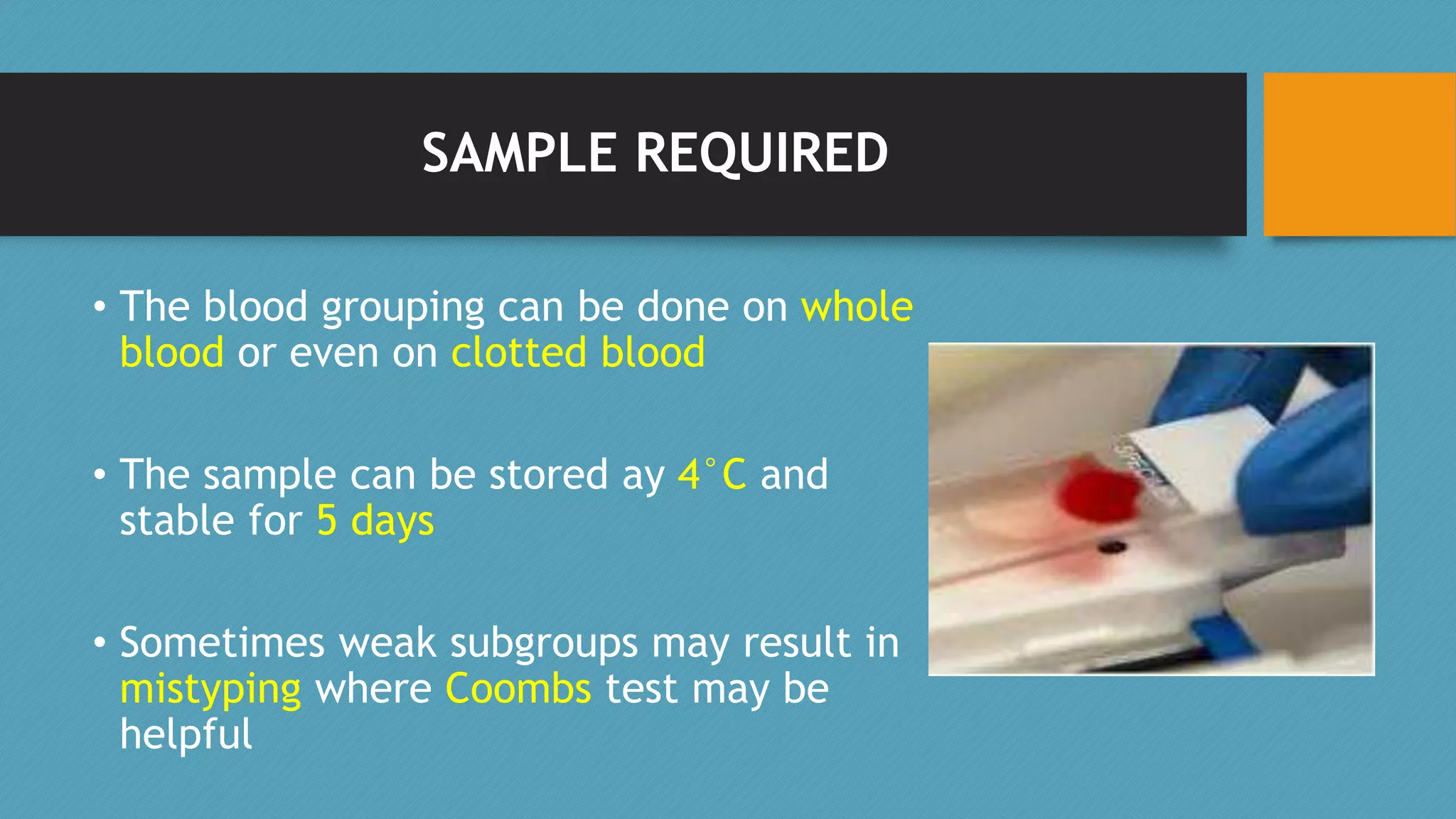
• The blood grouping can be done on whole
blood or even on clotted blood
• The sample can be stored ay 4°C and
stable for 5 days
• Sometimes weak subgroups may result in
mistyping where Coombs test may be
helpful
INDICATIONS
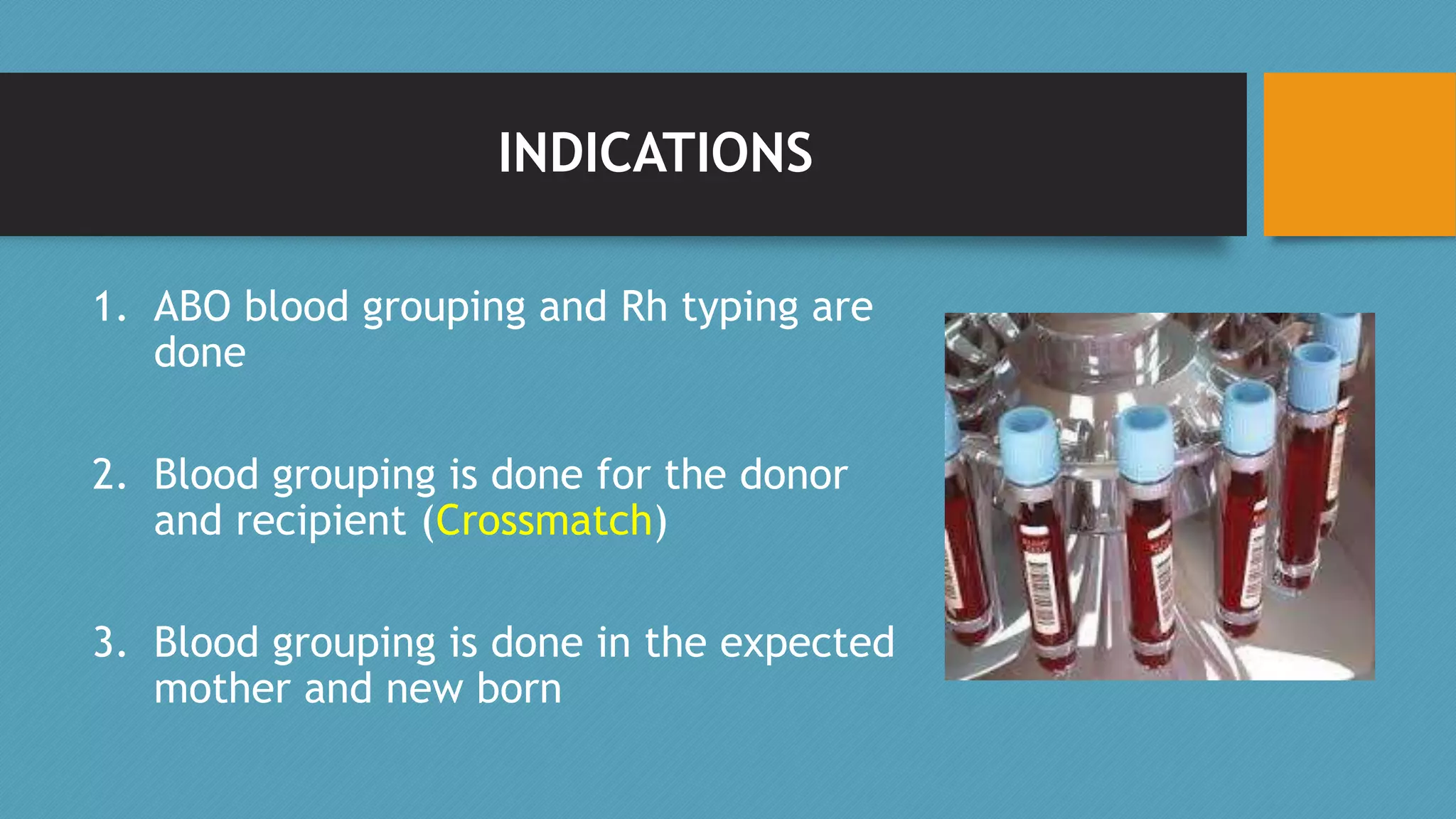
1. ABO blood grouping and Rh typing are
done
2. Blood grouping is done for the donor
and recipient (Crossmatch)
3. Blood grouping is done in the expected
mother and new born
REAGENTS
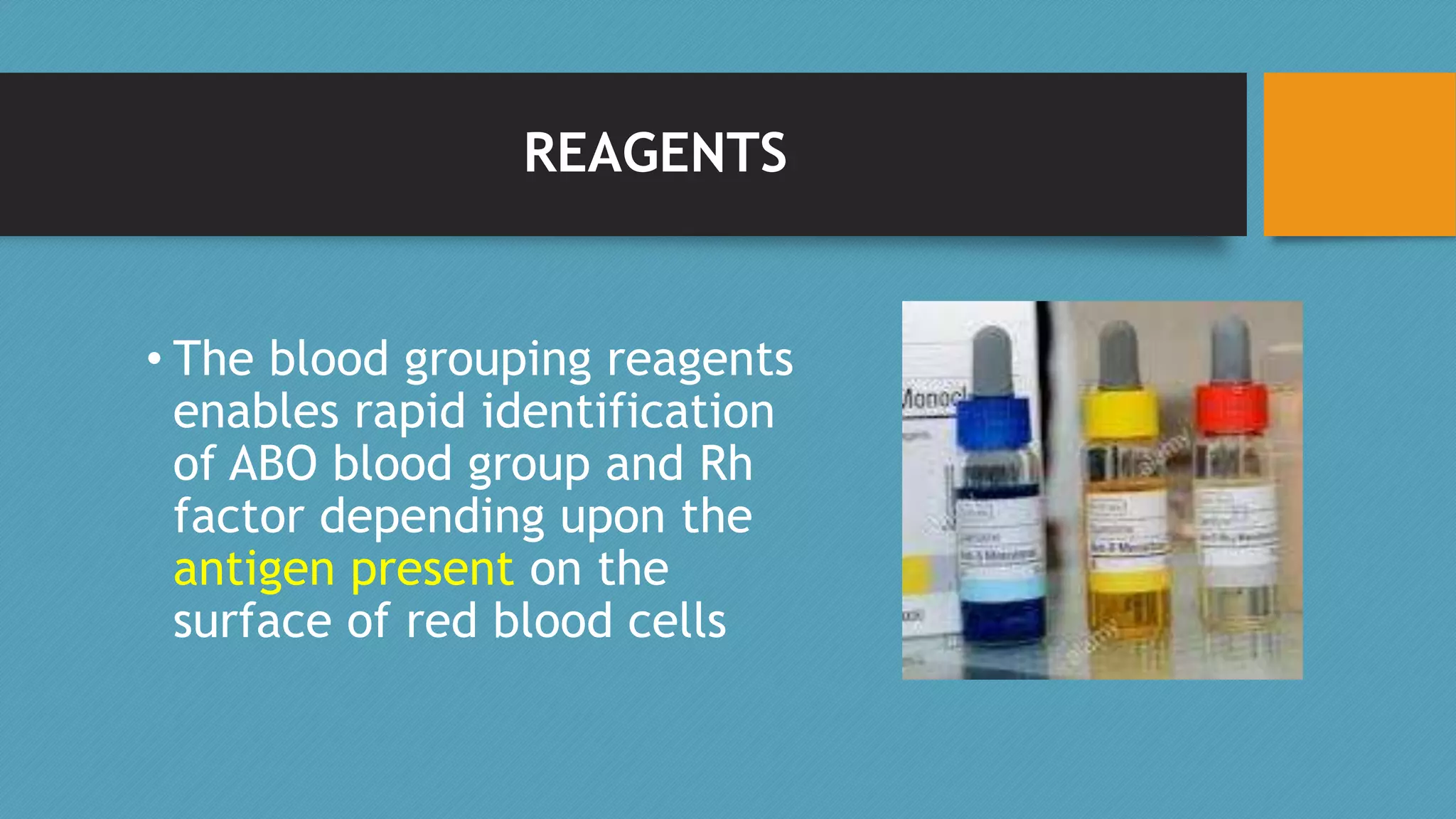
• The blood grouping reagents
enables rapid identification
of ABO blood group and Rh
factor depending upon the
antigen present on the
surface of red blood cells
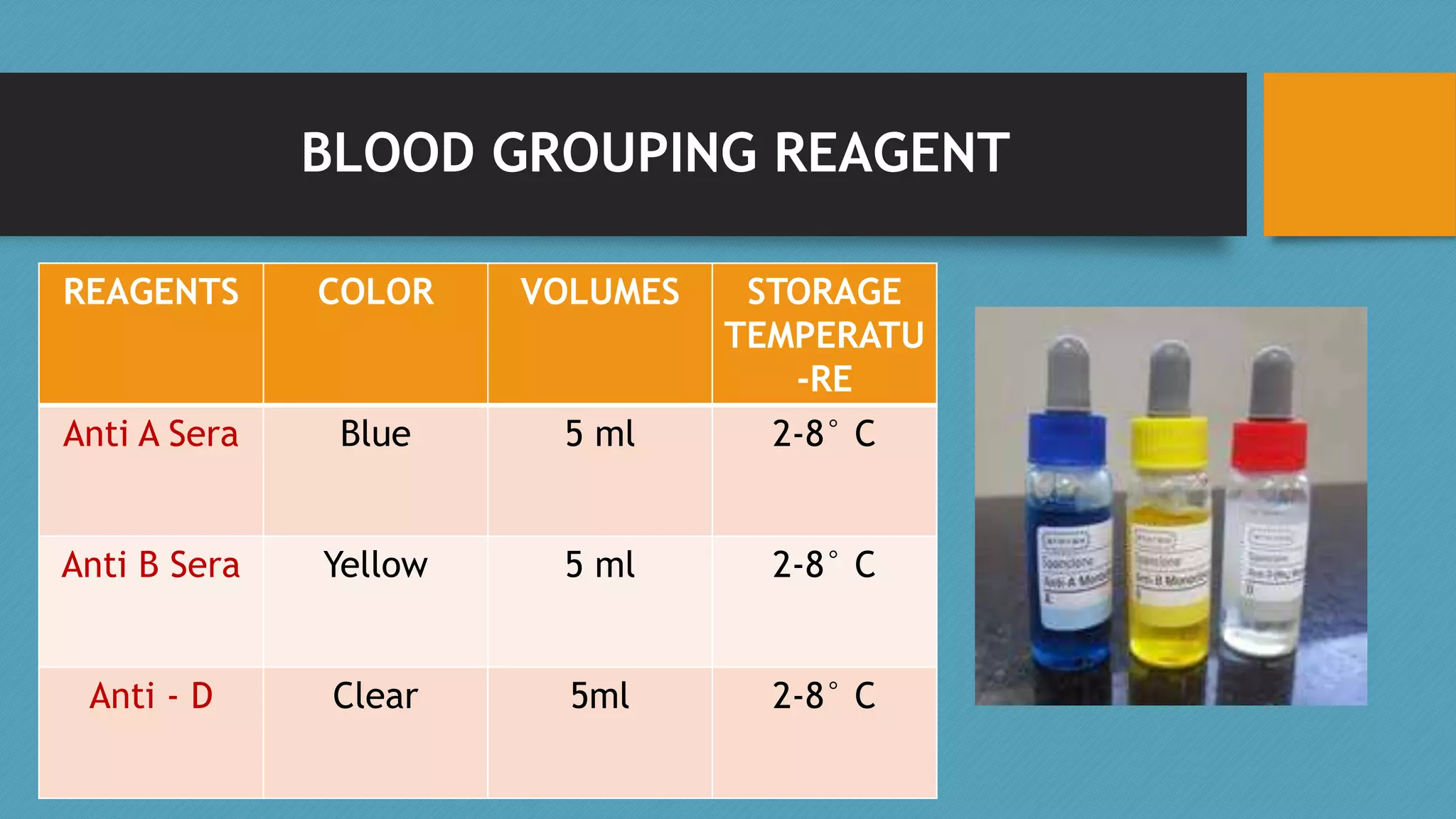
BLOOD GROUPING REAGENT
REAGENTS COLOR VOLUMES STORAGE
TEMPERATU
-RE
Anti A Sera Blue 5 ml 2-8° C
Anti B Sera Yellow 5 ml 2-8° C
Anti - D Clear 5ml 2-8° C
PROCEDURE
1. Inform the patient or individual about
the procedure to be carried out
2. Dangle the hand down to increase the
flow of blood in the fingers
3. Clean the fingertip to be pierced with
spirit or 70% alcohol and gently
massage the finger to increase blood
flow
PROCEDURE
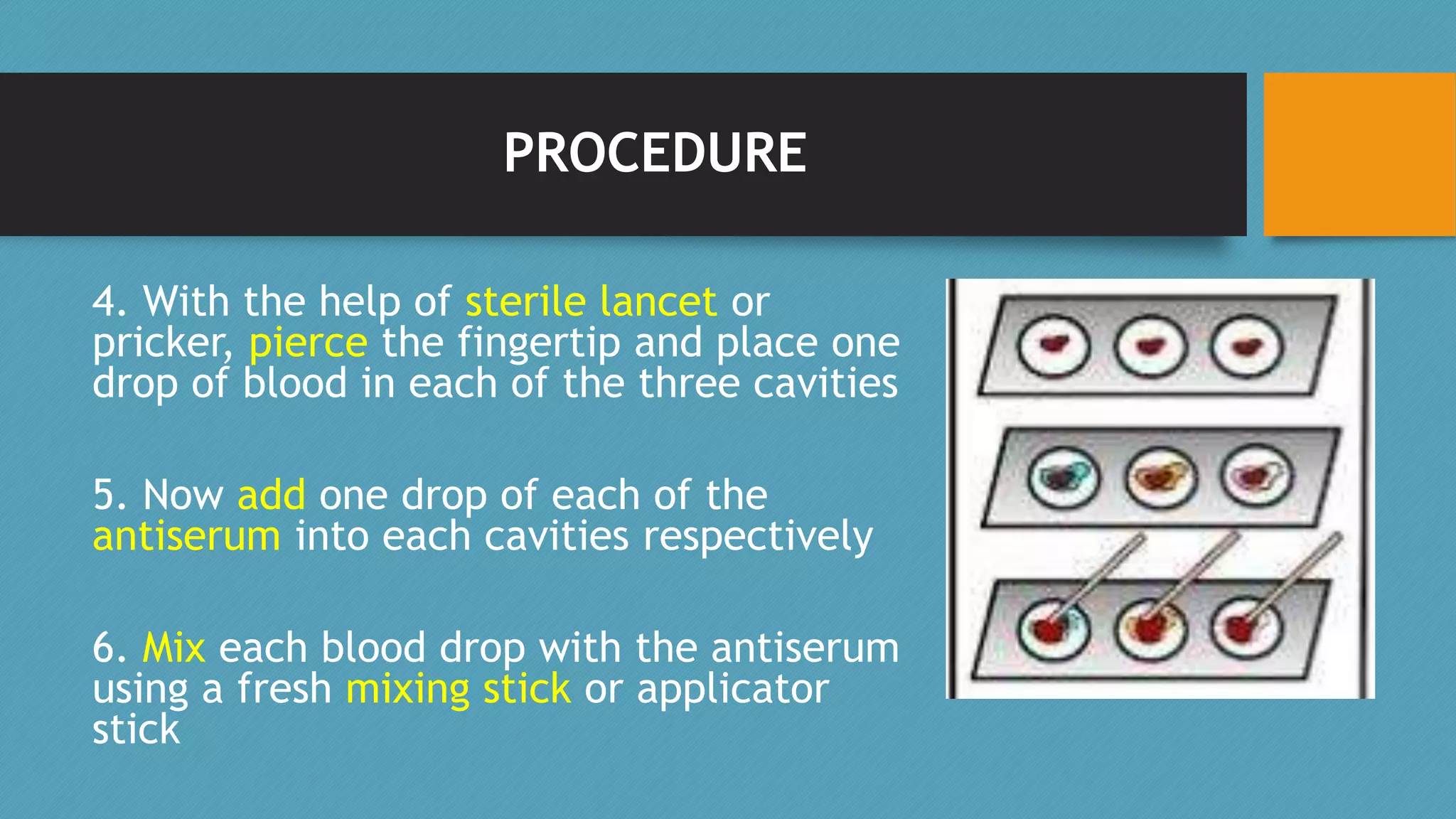
4. With the help of sterile lancet or
pricker, pierce the fingertip and place one
drop of blood in each of the three cavities
5. Now add one drop of each of the
antiserum into each cavities respectively
6. Mix each blood drop with the antiserum
using a fresh mixing stick or applicator
stick
PROCEDURE
7. Now, we can observe the
agglutinations in the form of fine red
granules within 30 seconds
8. Anti RhD takes slightly longer time
to agglutinate compared to Anti A
and Anti B
EXPECTED RESULTS
SLIDE
NUMBER
ANTI A ANTI B ANTI RhD BLOOD
GROUP
Slide 1 ✔ ✖ ✔ A+ve
Slide 2 ✖ ✔ ✔ B+ve
Slide 3 ✔ ✔ ✔ AB+ve
Slide 4 ✖ ✖ ✔ O+ve
✔ - Agglutination
✖ - No
Agglutination
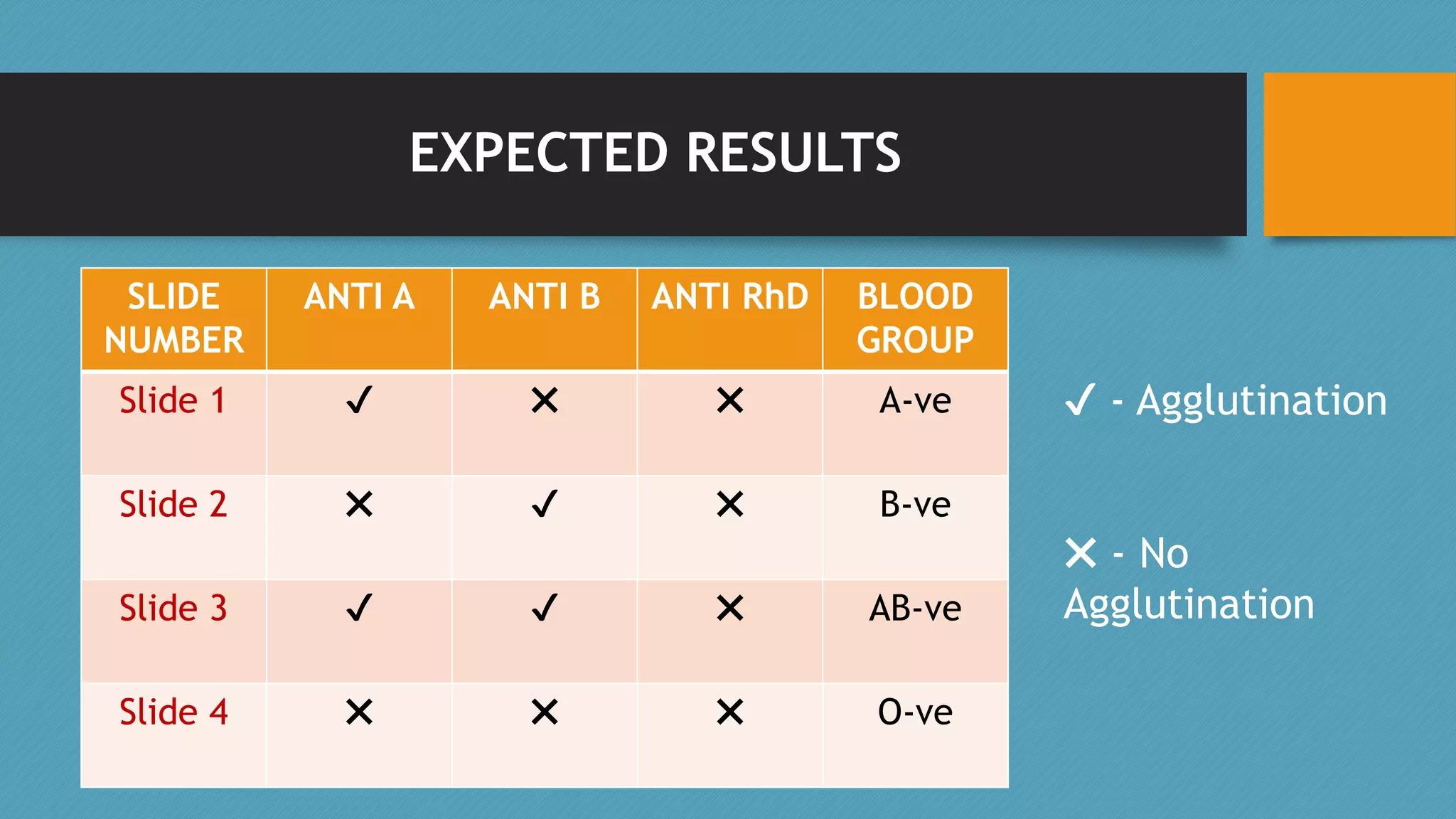
EXPECTED RESULTS
SLIDE
NUMBER
ANTI A ANTI B ANTI RhD BLOOD
GROUP
Slide 1 ✔ ✖ ✖ A-ve
Slide 2 ✖ ✔ ✖ B-ve
Slide 3 ✔ ✔ ✖ AB-ve
Slide 4 ✖ ✖ ✖ O-ve
✔ - Agglutination
✖ - No
Agglutination
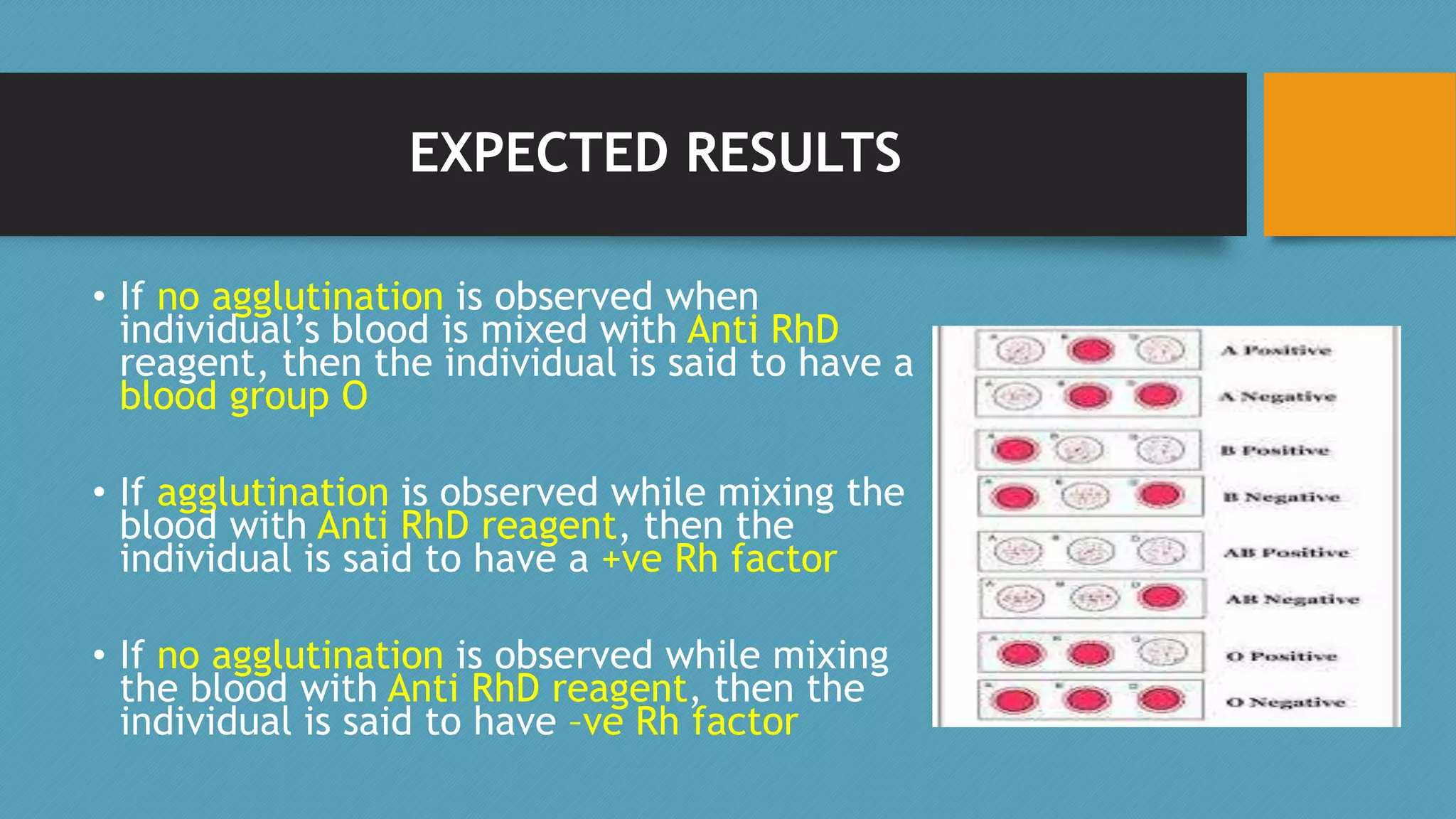
EXPECTED RESULTS
• If agglutination is observed when individual’s
blood is mixed with Anti A reagent, then the
individual is said to have a blood group A
• If agglutination is observed when individual’s
blood is mixed with Anti B reagent, then the
individual have a blood group B
• If agglutination is observed when individual’s
blood is mixed with Anti A and Anti B reagent,
then the individual is said to have a blood group
AB
• If no agglutination is observed when
individual’s blood is mixed with Anti RhD
reagent, then the individual is said to have a
blood group O
• If agglutination is observed while mixing the
blood with Anti RhD reagent, then the
individual is said to have a +ve Rh factor
• If no agglutination is observed while mixing
the blood with Anti RhD reagent, then the
individual is said to have –ve Rh factor
EXPECTED RESULTS
REFERENCE AND SOURCES
• https://www.labtestsguide.com/blood-group-test-procedure
• https://www.britannica.com/science/blood-group
• IMAGE SOURCES
• http://google.com
THANK YOU

ABO Blood Grouping

  • 1.
    BLOOD GROUPING M.J. Afra II– BSc Microbiology Department Of Microbiology and Biotechnology Thassim Beevi Abdul Kader College For Women Kilakarai
  • 2.
    INTRODUCTION • There arefour main blood groups. • They are A, B, AB and O • Blood group is determined by the genes you inherit from your parents • Each group can be either RhD positive or RhD negative • Totally, there are eight main blood groups
  • 3.
    WHAT IS BLOOD? •Blood is a fluid that transport oxygen and nutrients to the cell • Blood is made up of Red Blood Cells (RCB), White Blood Cells (WBC) and Platelets • The RBC, WBC and Platelets present in the liquid called Plasma. • Blood group is identified by antibodies and antigens in the blood
  • 4.
    ANTIGENS AND ANTIBODIES •Antibodies are proteins found in the plasma • They are the parts of our body’s natural defenses • They recognize the foreign substances and destroy them • Antigens are protien molecules that are found on the surface of red blood cells
  • 5.
    ABO BLOOD GROUPING •ABO blood grouping can be performed in two ways: 1. FORWARD GROUPING / CELL GROUPING 2. REVERSE GROUPING / SERUM GROUPING • Forward Grouping: Red blood cells ate tested for A and B antigens using known Anti – A and Anti – B sera • Reverse Grouping: Serum is tested for Anti – A and Anti – B antibodies using known A and B red cells
  • 6.
    • There arefour main blood groups defined by ABO system: 1. Blood Group A – has A antigens on the RBC with Anti – B antibodies in the plasma 2. Blood Group B – has B antigens with Anti – A antibodies in the plasma 3. Blood Group O – has no antigens but both Anti – A and Anti – B antibodies in the plasma 4. Blood Group AB – has both A and B antigens, but no antibodies • Blood Group O is the most common blood group. Almost half of the population has blood group O ABO BLOOD GROUPING
  • 7.
    THE Rh SYSTEM •Red blood cells sometimes have another antigen, a protein known as the RhD antigen • If RhD antigen is present, your blood group is RhD positive • If RhD antigen is absent, your blood group is RhD negative • About 85% of the population have Rh positive
  • 8.
    EIGHT MAIN BLOODGROUPS • A Positive (A+) • A Negative (A-) • B Positive (B+) • B Negative (B-) • O Positive (O+) • O Negative (O-) • AB Positive (AB+) • AB Negative (AB-)
  • 9.
    SAMPLE REQUIRED • Theblood grouping can be done on whole blood or even on clotted blood • The sample can be stored ay 4°C and stable for 5 days • Sometimes weak subgroups may result in mistyping where Coombs test may be helpful
  • 10.
    INDICATIONS 1. ABO bloodgrouping and Rh typing are done 2. Blood grouping is done for the donor and recipient (Crossmatch) 3. Blood grouping is done in the expected mother and new born
  • 11.
    REAGENTS • The bloodgrouping reagents enables rapid identification of ABO blood group and Rh factor depending upon the antigen present on the surface of red blood cells
  • 12.
    BLOOD GROUPING REAGENT REAGENTSCOLOR VOLUMES STORAGE TEMPERATU -RE Anti A Sera Blue 5 ml 2-8° C Anti B Sera Yellow 5 ml 2-8° C Anti - D Clear 5ml 2-8° C
  • 13.
    PROCEDURE 1. Inform thepatient or individual about the procedure to be carried out 2. Dangle the hand down to increase the flow of blood in the fingers 3. Clean the fingertip to be pierced with spirit or 70% alcohol and gently massage the finger to increase blood flow
  • 14.
    PROCEDURE 4. With thehelp of sterile lancet or pricker, pierce the fingertip and place one drop of blood in each of the three cavities 5. Now add one drop of each of the antiserum into each cavities respectively 6. Mix each blood drop with the antiserum using a fresh mixing stick or applicator stick
  • 15.
    PROCEDURE 7. Now, wecan observe the agglutinations in the form of fine red granules within 30 seconds 8. Anti RhD takes slightly longer time to agglutinate compared to Anti A and Anti B
  • 16.
    EXPECTED RESULTS SLIDE NUMBER ANTI AANTI B ANTI RhD BLOOD GROUP Slide 1 ✔ ✖ ✔ A+ve Slide 2 ✖ ✔ ✔ B+ve Slide 3 ✔ ✔ ✔ AB+ve Slide 4 ✖ ✖ ✔ O+ve ✔ - Agglutination ✖ - No Agglutination
  • 17.
    EXPECTED RESULTS SLIDE NUMBER ANTI AANTI B ANTI RhD BLOOD GROUP Slide 1 ✔ ✖ ✖ A-ve Slide 2 ✖ ✔ ✖ B-ve Slide 3 ✔ ✔ ✖ AB-ve Slide 4 ✖ ✖ ✖ O-ve ✔ - Agglutination ✖ - No Agglutination
  • 18.
    EXPECTED RESULTS • Ifagglutination is observed when individual’s blood is mixed with Anti A reagent, then the individual is said to have a blood group A • If agglutination is observed when individual’s blood is mixed with Anti B reagent, then the individual have a blood group B • If agglutination is observed when individual’s blood is mixed with Anti A and Anti B reagent, then the individual is said to have a blood group AB
  • 19.
    • If noagglutination is observed when individual’s blood is mixed with Anti RhD reagent, then the individual is said to have a blood group O • If agglutination is observed while mixing the blood with Anti RhD reagent, then the individual is said to have a +ve Rh factor • If no agglutination is observed while mixing the blood with Anti RhD reagent, then the individual is said to have –ve Rh factor EXPECTED RESULTS
  • 20.
    REFERENCE AND SOURCES •https://www.labtestsguide.com/blood-group-test-procedure • https://www.britannica.com/science/blood-group • IMAGE SOURCES • http://google.com
  • 21.