Prepared By: Vipin Kumar Shukla
Assistant Lecturer.
COMPLEMENT SYSTEM
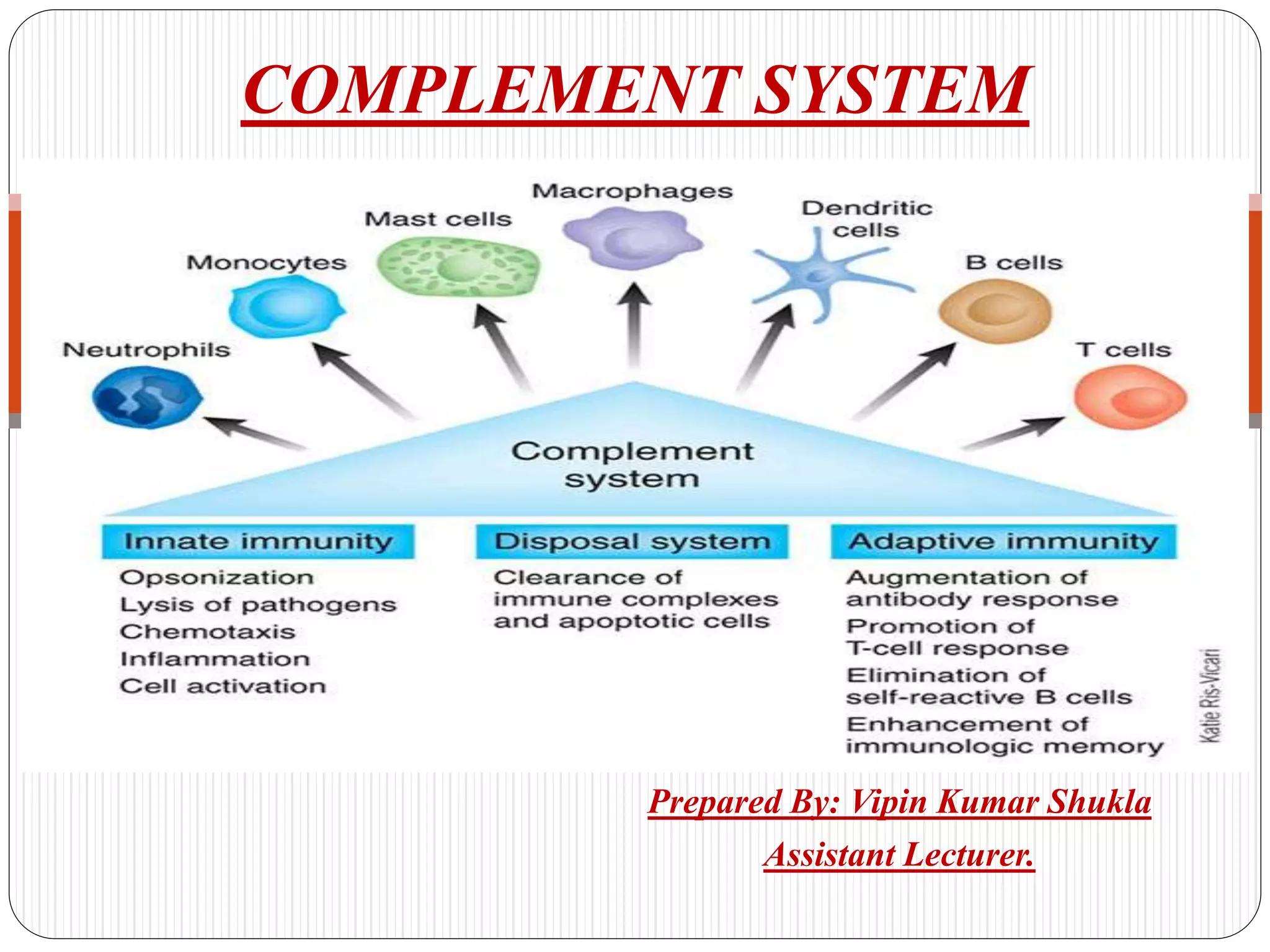
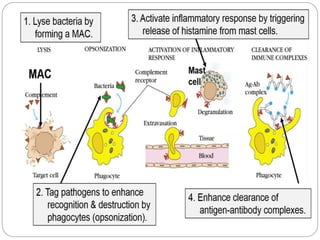
Functions of complement system:
Introduction :
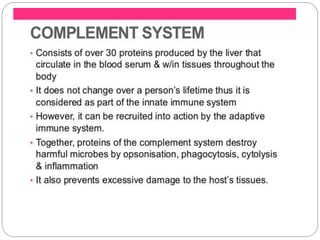
 The complement system, also known as complement
cascade, is a part of the immune system that enhances
(complements) the ability of antibodies and phagocytic
cells to clear microbes and damaged cells from an
organism, promote inflammation, and attack the pathogen's
cell membrane.
 It is part of the innate immune system, which is not
adaptable and does not change during an individual's
lifetime.
Continued……
 The complement system can, however, be recruited
and brought into action by antibodies generated by the
adaptive immune system.
 The complement system consists of a number of
small proteins that are synthesized by the liver, and
circulate in the blood as inactive precursors.
 When stimulated by one of several triggers, proteases in the
system cleave specific proteins to release cytokines and
initiate an amplifying cascade of further cleavages.
Continued…..
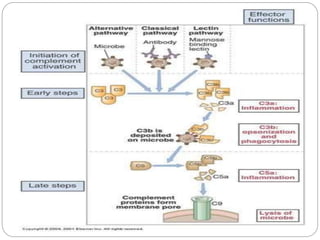
 The end result of this complement
activation or complement fixation cascade is stimulation
of phagocytes to clear foreign and damaged
material, inflammation to attract additional phagocytes,
and activation of the cell-killing membrane attack
complex.
 Over 30 proteins and protein fragments make up the
complement system, including serum proteins, and cell
membrane receptors. They account for about 10% of
the globulin fraction of blood serum.
Continued…….
 Complement is a chain of enzymes whose activation
eventually results in the disruption of cell membranes and
the destruction of cells or invading microorganisms.
Complement is an essential part of the body defense
system.
History of Complement System:
 In 1899 “Paul Ehrlich” coined the term complement.
According to this theory, the immune system consists of
cells that have specific receptors on their surface to
recognize antigens.
 Upon immunization with an antigen more of these
receptors are formed, and they are then shed from the cells
to circulate in the blood.
Continued……
 Those receptors which we now call "antibodies were called
by Ehrlich "amboceptors" to emphasize their bifunctional
binding capacity.
 They recognize and bind to a specific antigen, but they also
recognize and bind to the heat-labile antimicrobial
component of fresh serum.
 Ehrlich, therefore, named this heat-labile component
complement because it is something in the blood that
complements" the cells of the immune system.
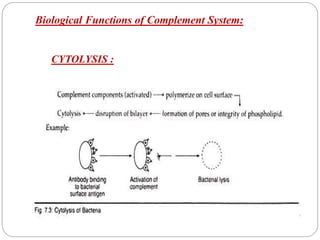
Biological Functions of Complement System:
CYTOLYSIS :
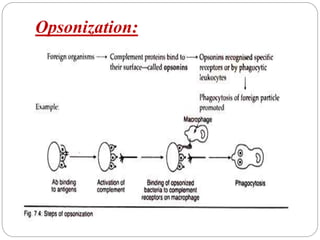
Opsonization:
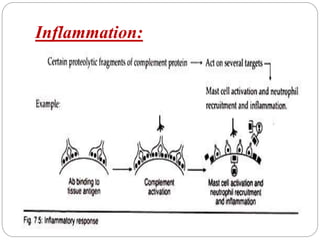
Inflammation:
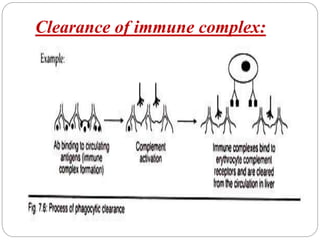
Clearance of immune complex:
Components of Complement System:
 The complement system is made up of a number (mostly
30) of distinct serum (blood plasma) and membrane
proteins which mostly assist the humoral branch of the
immune system.
 As after initial activation, the various complement
components interact sequentially to generate reaction
products that facilitate antigen clearance and inflammatory
response.
Continued…….
 Different pathways of complement finally generate a macro-
molecular membrane- attack complex (MAC) which helps to
lyse a variety of cells, bacteria and viruses.
 The complement products amplify the initial antigen-antibody
reaction and convert that reaction into a more effective defense
mechanism. Continuous proteolytic cleavage and activation of
successive complement proteins lead to the covalent bonding or
fixing of complement fragments to the pathogen surface.
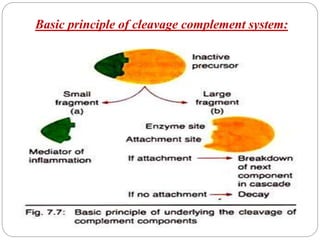
 Each precursor of complement is cleaved into two major
fragments- named as larger fragment (designated as ‘b’) and
smaller fragment (designated as ‘a’)
Continued,…..
 The major or larger ‘b’ fragment has two biologically active
sites—one binds to cell membranes to the target cell
towards the site of activation and the other for enzymatic
cleavage of the next complement component.
 The smaller ‘a’ fragments diffuse from the site and play a
role in initiating a localized inflammatory response
(chemotactic activity).
Basic principle of cleavage complement system:
Continued…..
 The proteins and glycoprotein's composing the complement
system are synthesized largely by liver hepatocytes, some
by blood monocytes, tissue macrophages and epithelial
cells of the gastro-intestinal and genitourinary tracts.
 The proteins that form the complement system are labelled
numerically with the prefix C (e.g., C1 –C9).
 Some complement components are designated by letter
symbols (e.g., factor B, D, P) or by trivial names (e.g.,
homologous factor).
Continued…….
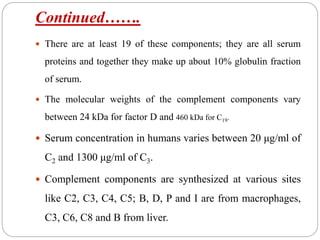
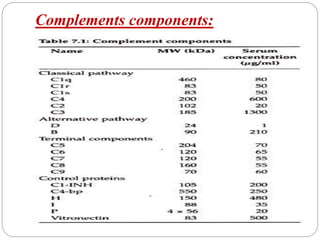
 There are at least 19 of these components; they are all serum
proteins and together they make up about 10% globulin fraction
of serum.
 The molecular weights of the complement components vary
between 24 kDa for factor D and 460 kDa for C19.
 Serum concentration in humans varies between 20 μg/ml of
C2 and 1300 μg/ml of C3.
 Complement components are synthesized at various sites
like C2, C3, C4, C5; B, D, P and I are from macrophages,
C3, C6, C8 and B from liver.
Complements components:
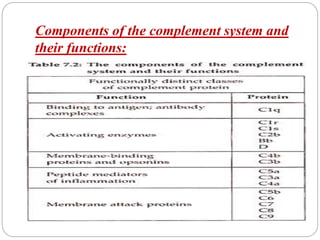
Components of the complement system and
their functions:
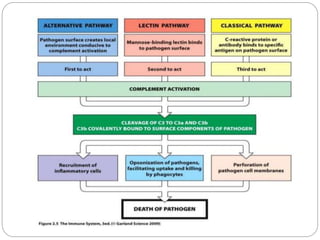
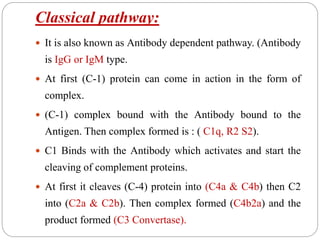
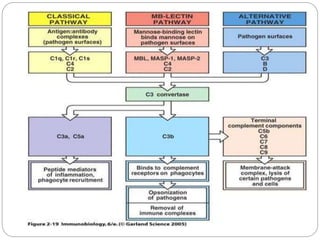
Classical pathway:
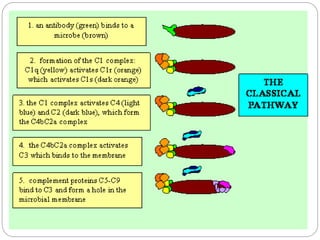
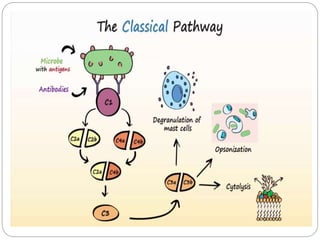
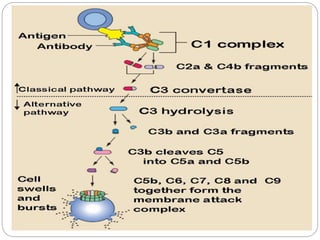
 It is also known as Antibody dependent pathway. (Antibody
is IgG or IgM type.
 At first (C-1) protein can come in action in the form of
complex.
 (C-1) complex bound with the Antibody bound to the
Antigen. Then complex formed is : ( C1q, R2 S2).
 C1 Binds with the Antibody which activates and start the
cleaving of complement proteins.
 At first it cleaves (C-4) protein into (C4a & C4b) then C2
into (C2a & C2b). Then complex formed (C4b2a) and the
product formed (C3 Convertase).
Continued…….
 The complex (C5b678) has the ability to polymerize the
(C9) molecule into pathogen membrane.
 Poly (C9) forms the MAC: Membrane attack complex were
influx of Ca ions and many other electrolytes into the target
cell, which eventually brings about the bursting of cell
through osmotic lysis.
Continued…….
 Again (C3) undergo cleaving and form the complex (C3a &
C3b). Whereas (C3a: Helps in inflammation) and (C3b:
combined with C3 Convertase.
 Thus we end up in a new enzyme : (C4b2a3b) that is also known
as (C5 Convertase).
 In the next step (C5 act and convert (C5 into (C5a & C5b).
 Later (C5) molecule recruit (C6,C7) Proteins and get into the
membrane of pathogen were it form the membrane of pathogen
and form the complex (C5bC6C7) and later it recruit (C8)
protein and we get complement protein ( C5b678).
Alternative Pathway of complement system:
 It is also known as independent complement pathway.
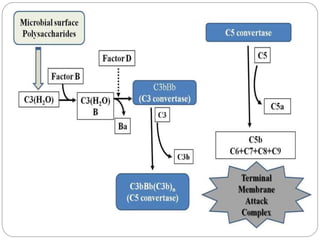
 It contains three factors: Factor B, Factor D and Properdin
protein (P).
 Factor D cleaves factor B.
 Factor B leads to the activation of Fluid Phase Convertase.
 Properdin molecule helps in attaching (C3b) molecule
towards cell membrane of pathogen.
Continued…..
 First of all (C3) molecule present in our plasma.
 It gets under spontaneous hydrolysis and convert into (C3H20).
 In this reaction thioester hydrolysis occurs.
 Factor B plasma act on factor D and convert it into two
fragments. (Bb & Ba).
 Then reaction takes place ( C3(H2O+Bb) it combined to form a
complex i.e. (C3(CH20)Bb.) Fluid phase c3 convertase).
 Fluid phase convertase works on few molecules of (C3) and
convert it into two fragments.(C3a & C3b) molecules and Bb)
present in plasma. (Bb + c3b) and form the complex (C3bbb).
Continued……..
 C3 convertase gain divided into two fragments: (c3a &
c3b) were (c3 joins with c3 convertase in the presence
of Properdin and form a complex named as (C3bb3b)
i.e. (C5) convertase of alternative pathway.
 C5 convertase again divides into two fragments (C5a
& C5b) here (C5b) target the membrane and recruit
extra (3) complement proteins named as : (C6,C7,&
C9), so complex formed is (C5bC78) having the
property to polymerize the (C9) molecule into the
pathogen membrane.
Continued……
 Here (C9) polymerize in target pathogen membrane and
eventually we get Poly (C-9) along with other membrane
proteins (MAC)and electrolytes are being exchanged
without any regulation.
 At last cell loses its electrolyte balance and loses its
osmotic balance,
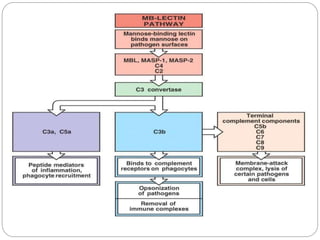
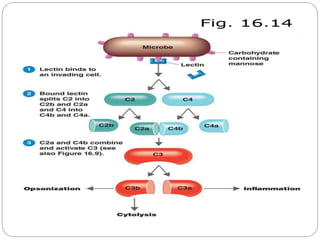
Lectin pathway of complement system:
 It is also known as Antibody independent pathway.
 It is quite similar with the classical pathway.
 It is initiated by pathogen membrane containing
carbohydrates like Mannose.
 It contain following components which are mentioned
below:
 MBL- Mannose Binding Lectin which bind with the
mannose of the pathogen.
 MASP1: MBL Associated protease I
 MASP2: MBL Associated protease -ii
Continued…….
 MASP-1 is an analogue pathway to (C1r) classical
pathway.
 MASP-II is an analogue of (C1s) of classical pathway.
 All the three complex join to form a complex on pathogen
membrane during lection pathway.
 Complex is just like (C1) pathway which is (C1qr2s2), this
complex has proteosomal activity on complement proteins.
Continued……
 Lectin molecule which has capability to bind mannose.
 It termed as MBL pathway.
 MBL gets to the pathogen membrane and binds with mannose.
 In the next step we have (MASP-1) and (MASP-II), they bind to
the (MBL) of mannose complex.
 Final component formed is (C1) like complex which act as
(C1qr2s2) of classical pathway.
 C1 likes complement acts on complement proteins and first of all
we see (C4) proteins gets fragmented into (C4a & C4b).
Continued…..
 Then this enzyme acts on (C2) and fragmented into (C2a &
C2b).
 (C4b + C2a) are the larger and active fragments of complement
system.
 These two active enzyme join together to form (C42Ba) i.e. (C3)
Convertase.
 C3 convertase acts on (C3) and convert it into (C3a & C3b)
whereas (C3a is smaller fragment & C3b is larger and active
finds with a (C3 Convertase enzyme).
 Thus we got an complex named as (C4b2a3b) i.e. (C5
Convertase).
Continued…..
 C5 convertase convert (C5) into two fragments: (C5a &
C5b).
 C5b gets into the pathogen membrane and recruit other
complex protein named as (C6,C7 & C8) and from a
complex called as (C5BC7,8) complex in pathogen
membrane surface of (C9) proteins.
 C9 protein incorporate into pathogen membrane to form a
(MAC) and (C5b6,7,8) polymerize the (C9) protein in
pathogen membrane poly (C9) protein.
Complement system
Complement system
Complement system

Complement system

  • 1.
    Prepared By: VipinKumar Shukla Assistant Lecturer. COMPLEMENT SYSTEM
  • 4.
  • 5.
    Introduction :  Thecomplement system, also known as complement cascade, is a part of the immune system that enhances (complements) the ability of antibodies and phagocytic cells to clear microbes and damaged cells from an organism, promote inflammation, and attack the pathogen's cell membrane.  It is part of the innate immune system, which is not adaptable and does not change during an individual's lifetime.
  • 6.
    Continued……  The complementsystem can, however, be recruited and brought into action by antibodies generated by the adaptive immune system.  The complement system consists of a number of small proteins that are synthesized by the liver, and circulate in the blood as inactive precursors.  When stimulated by one of several triggers, proteases in the system cleave specific proteins to release cytokines and initiate an amplifying cascade of further cleavages.
  • 7.
    Continued…..  The endresult of this complement activation or complement fixation cascade is stimulation of phagocytes to clear foreign and damaged material, inflammation to attract additional phagocytes, and activation of the cell-killing membrane attack complex.  Over 30 proteins and protein fragments make up the complement system, including serum proteins, and cell membrane receptors. They account for about 10% of the globulin fraction of blood serum.
  • 8.
    Continued…….  Complement isa chain of enzymes whose activation eventually results in the disruption of cell membranes and the destruction of cells or invading microorganisms. Complement is an essential part of the body defense system.
  • 10.
    History of ComplementSystem:  In 1899 “Paul Ehrlich” coined the term complement. According to this theory, the immune system consists of cells that have specific receptors on their surface to recognize antigens.  Upon immunization with an antigen more of these receptors are formed, and they are then shed from the cells to circulate in the blood.
  • 11.
    Continued……  Those receptorswhich we now call "antibodies were called by Ehrlich "amboceptors" to emphasize their bifunctional binding capacity.  They recognize and bind to a specific antigen, but they also recognize and bind to the heat-labile antimicrobial component of fresh serum.  Ehrlich, therefore, named this heat-labile component complement because it is something in the blood that complements" the cells of the immune system.
  • 12.
    Biological Functions ofComplement System: CYTOLYSIS :
  • 13.
  • 14.
  • 15.
  • 16.
    Components of ComplementSystem:  The complement system is made up of a number (mostly 30) of distinct serum (blood plasma) and membrane proteins which mostly assist the humoral branch of the immune system.  As after initial activation, the various complement components interact sequentially to generate reaction products that facilitate antigen clearance and inflammatory response.
  • 17.
    Continued…….  Different pathwaysof complement finally generate a macro- molecular membrane- attack complex (MAC) which helps to lyse a variety of cells, bacteria and viruses.  The complement products amplify the initial antigen-antibody reaction and convert that reaction into a more effective defense mechanism. Continuous proteolytic cleavage and activation of successive complement proteins lead to the covalent bonding or fixing of complement fragments to the pathogen surface.  Each precursor of complement is cleaved into two major fragments- named as larger fragment (designated as ‘b’) and smaller fragment (designated as ‘a’)
  • 18.
    Continued,…..  The majoror larger ‘b’ fragment has two biologically active sites—one binds to cell membranes to the target cell towards the site of activation and the other for enzymatic cleavage of the next complement component.  The smaller ‘a’ fragments diffuse from the site and play a role in initiating a localized inflammatory response (chemotactic activity).
  • 19.
    Basic principle ofcleavage complement system:
  • 20.
    Continued…..  The proteinsand glycoprotein's composing the complement system are synthesized largely by liver hepatocytes, some by blood monocytes, tissue macrophages and epithelial cells of the gastro-intestinal and genitourinary tracts.  The proteins that form the complement system are labelled numerically with the prefix C (e.g., C1 –C9).  Some complement components are designated by letter symbols (e.g., factor B, D, P) or by trivial names (e.g., homologous factor).
  • 21.
    Continued…….  There areat least 19 of these components; they are all serum proteins and together they make up about 10% globulin fraction of serum.  The molecular weights of the complement components vary between 24 kDa for factor D and 460 kDa for C19.  Serum concentration in humans varies between 20 μg/ml of C2 and 1300 μg/ml of C3.  Complement components are synthesized at various sites like C2, C3, C4, C5; B, D, P and I are from macrophages, C3, C6, C8 and B from liver.
  • 22.
  • 23.
    Components of thecomplement system and their functions:
  • 24.
    Classical pathway:  Itis also known as Antibody dependent pathway. (Antibody is IgG or IgM type.  At first (C-1) protein can come in action in the form of complex.  (C-1) complex bound with the Antibody bound to the Antigen. Then complex formed is : ( C1q, R2 S2).  C1 Binds with the Antibody which activates and start the cleaving of complement proteins.  At first it cleaves (C-4) protein into (C4a & C4b) then C2 into (C2a & C2b). Then complex formed (C4b2a) and the product formed (C3 Convertase).
  • 25.
    Continued…….  The complex(C5b678) has the ability to polymerize the (C9) molecule into pathogen membrane.  Poly (C9) forms the MAC: Membrane attack complex were influx of Ca ions and many other electrolytes into the target cell, which eventually brings about the bursting of cell through osmotic lysis.
  • 26.
    Continued…….  Again (C3)undergo cleaving and form the complex (C3a & C3b). Whereas (C3a: Helps in inflammation) and (C3b: combined with C3 Convertase.  Thus we end up in a new enzyme : (C4b2a3b) that is also known as (C5 Convertase).  In the next step (C5 act and convert (C5 into (C5a & C5b).  Later (C5) molecule recruit (C6,C7) Proteins and get into the membrane of pathogen were it form the membrane of pathogen and form the complex (C5bC6C7) and later it recruit (C8) protein and we get complement protein ( C5b678).
  • 29.
    Alternative Pathway ofcomplement system:  It is also known as independent complement pathway.  It contains three factors: Factor B, Factor D and Properdin protein (P).  Factor D cleaves factor B.  Factor B leads to the activation of Fluid Phase Convertase.  Properdin molecule helps in attaching (C3b) molecule towards cell membrane of pathogen.
  • 30.
    Continued…..  First ofall (C3) molecule present in our plasma.  It gets under spontaneous hydrolysis and convert into (C3H20).  In this reaction thioester hydrolysis occurs.  Factor B plasma act on factor D and convert it into two fragments. (Bb & Ba).  Then reaction takes place ( C3(H2O+Bb) it combined to form a complex i.e. (C3(CH20)Bb.) Fluid phase c3 convertase).  Fluid phase convertase works on few molecules of (C3) and convert it into two fragments.(C3a & C3b) molecules and Bb) present in plasma. (Bb + c3b) and form the complex (C3bbb).
  • 31.
    Continued……..  C3 convertasegain divided into two fragments: (c3a & c3b) were (c3 joins with c3 convertase in the presence of Properdin and form a complex named as (C3bb3b) i.e. (C5) convertase of alternative pathway.  C5 convertase again divides into two fragments (C5a & C5b) here (C5b) target the membrane and recruit extra (3) complement proteins named as : (C6,C7,& C9), so complex formed is (C5bC78) having the property to polymerize the (C9) molecule into the pathogen membrane.
  • 32.
    Continued……  Here (C9)polymerize in target pathogen membrane and eventually we get Poly (C-9) along with other membrane proteins (MAC)and electrolytes are being exchanged without any regulation.  At last cell loses its electrolyte balance and loses its osmotic balance,
  • 35.
    Lectin pathway ofcomplement system:  It is also known as Antibody independent pathway.  It is quite similar with the classical pathway.  It is initiated by pathogen membrane containing carbohydrates like Mannose.  It contain following components which are mentioned below:  MBL- Mannose Binding Lectin which bind with the mannose of the pathogen.  MASP1: MBL Associated protease I  MASP2: MBL Associated protease -ii
  • 36.
    Continued…….  MASP-1 isan analogue pathway to (C1r) classical pathway.  MASP-II is an analogue of (C1s) of classical pathway.  All the three complex join to form a complex on pathogen membrane during lection pathway.  Complex is just like (C1) pathway which is (C1qr2s2), this complex has proteosomal activity on complement proteins.
  • 38.
    Continued……  Lectin moleculewhich has capability to bind mannose.  It termed as MBL pathway.  MBL gets to the pathogen membrane and binds with mannose.  In the next step we have (MASP-1) and (MASP-II), they bind to the (MBL) of mannose complex.  Final component formed is (C1) like complex which act as (C1qr2s2) of classical pathway.  C1 likes complement acts on complement proteins and first of all we see (C4) proteins gets fragmented into (C4a & C4b).
  • 39.
    Continued…..  Then thisenzyme acts on (C2) and fragmented into (C2a & C2b).  (C4b + C2a) are the larger and active fragments of complement system.  These two active enzyme join together to form (C42Ba) i.e. (C3) Convertase.  C3 convertase acts on (C3) and convert it into (C3a & C3b) whereas (C3a is smaller fragment & C3b is larger and active finds with a (C3 Convertase enzyme).  Thus we got an complex named as (C4b2a3b) i.e. (C5 Convertase).
  • 41.
    Continued…..  C5 convertaseconvert (C5) into two fragments: (C5a & C5b).  C5b gets into the pathogen membrane and recruit other complex protein named as (C6,C7 & C8) and from a complex called as (C5BC7,8) complex in pathogen membrane surface of (C9) proteins.  C9 protein incorporate into pathogen membrane to form a (MAC) and (C5b6,7,8) polymerize the (C9) protein in pathogen membrane poly (C9) protein.