The Rh(D) Antigen
Rh is the most complex system, with over
45 antigens
The complexity of the Rh blood group
Antignss is due to the highly polymorphic
genes that encode them.
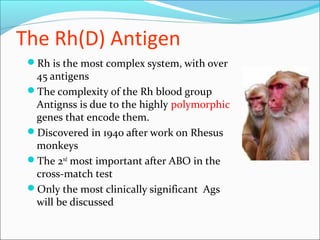
Discovered in 1940 after work on Rhesus
monkeys
The 2nd
most important after ABO in the
cross-match test
Only the most clinically significant Ags
will be discussed
ID CARD
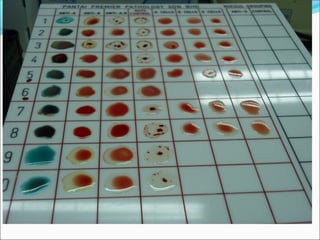
The ID card combined testing of forward and
reverse grouping as well as Rh D determination.
Positive: Agglutinated cells forming red line on
surface of gel
 Negative: Compact button of cells on the bottom
of microtube.
Rh blood group antigens are proteins
The antigens of the Rh blood group are proteins.
The RhD gene encodes the D antigen, which is a
large protein on the red blood cell membrane, &
the most important.
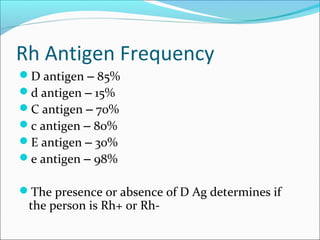
Rh Antigen Frequency
D antigen – 85%
d antigen – 15%
C antigen – 70%
c antigen – 80%
E antigen – 30%
e antigen – 98%
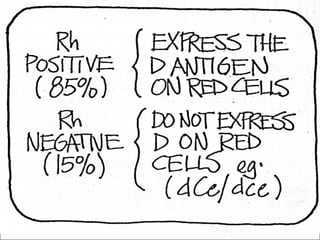
The presence or absence of D Ag determines if
the person is Rh+ or Rh-
Significance
After ABO, the Rh system is the second most important
system. This is because:
The D antigen is extremely immunogenic.
It causes the production of anti-D in 50 - 70% of Rh(D)
negative people who are exposed to the D antigen.
Moreover, anti-D is the most common cause of severe
HDN and can cause in Utero death.
Because of this, in blood transfusion, the patient and
donor are matched for Rh(D) type as well as ABO groups.
The C and E Ags are not as immunogenic as D, routine
typing for these Ags is not performed
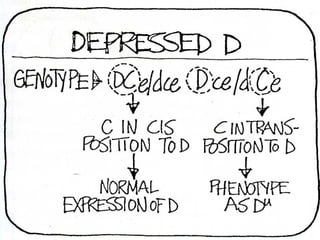
• Weak expression of the Rh system on the RBC, (Du
)
• Du
red cells can be classified into three categories
according to the mechanism that account for the
Weak D antigen
Variants of D
Hemolytic disease of the Newborn (HDN)
Usually related to D antigen exposure and the formation
of anti-D
Usually results from D negative female and D positive
male producing and offspring.
The baby will probably be D positive.
1st
pregnancy not effected, the 2nd
pregnancy and on will be
effected-results in still birth, severe jaundice, anemia
related to HDN.
To prevent this occurrence the female is administered
RHIG.

Rh blood group ss

  • 2.
    The Rh(D) Antigen Rhis the most complex system, with over 45 antigens The complexity of the Rh blood group Antignss is due to the highly polymorphic genes that encode them. Discovered in 1940 after work on Rhesus monkeys The 2nd most important after ABO in the cross-match test Only the most clinically significant Ags will be discussed
  • 4.
    ID CARD The IDcard combined testing of forward and reverse grouping as well as Rh D determination. Positive: Agglutinated cells forming red line on surface of gel  Negative: Compact button of cells on the bottom of microtube.
  • 5.
    Rh blood groupantigens are proteins The antigens of the Rh blood group are proteins. The RhD gene encodes the D antigen, which is a large protein on the red blood cell membrane, & the most important.
  • 6.
    Rh Antigen Frequency Dantigen – 85% d antigen – 15% C antigen – 70% c antigen – 80% E antigen – 30% e antigen – 98% The presence or absence of D Ag determines if the person is Rh+ or Rh-
  • 8.
    Significance After ABO, theRh system is the second most important system. This is because: The D antigen is extremely immunogenic. It causes the production of anti-D in 50 - 70% of Rh(D) negative people who are exposed to the D antigen. Moreover, anti-D is the most common cause of severe HDN and can cause in Utero death. Because of this, in blood transfusion, the patient and donor are matched for Rh(D) type as well as ABO groups. The C and E Ags are not as immunogenic as D, routine typing for these Ags is not performed
  • 9.
    • Weak expressionof the Rh system on the RBC, (Du ) • Du red cells can be classified into three categories according to the mechanism that account for the Weak D antigen Variants of D
  • 11.
    Hemolytic disease ofthe Newborn (HDN) Usually related to D antigen exposure and the formation of anti-D Usually results from D negative female and D positive male producing and offspring. The baby will probably be D positive. 1st pregnancy not effected, the 2nd pregnancy and on will be effected-results in still birth, severe jaundice, anemia related to HDN. To prevent this occurrence the female is administered RHIG.

Editor's Notes

  • #3 It received its name in 1940, when Landsteiner and Wiener immunized rabbits with red blood cells from rhesus monkeys and found that the rabbit antirhesus antibody agglutinated approximately 85 percent of human red blood cells tested. They gave the name "Rh" to this determinant present on all rhesus monkey cells and apparently present on 85 percent of human red blood cells.
  • #9 Capable of inducing an immune response; antigenic