BLOOD FILM EXAMINATION
BLOOD FILM PREPARATION
made on clean glass slides
Films may be spread by hand or by
means of an automated slide spreader
Manual Method
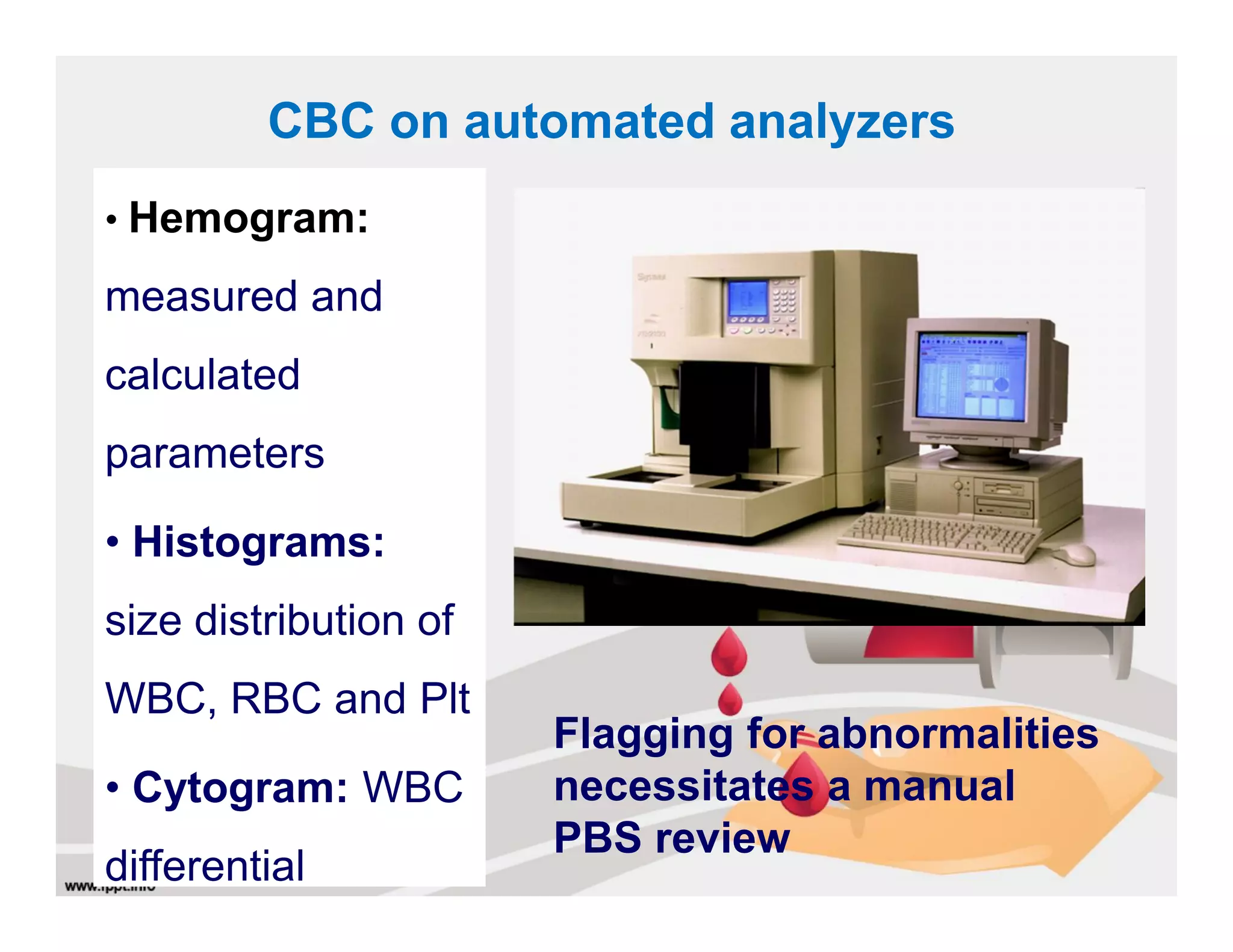
• Hemogram:
measured and
calculated
parameters
• Histograms:
size distribution of
WBC, RBC and Plt
• Cytogram: WBC
differential
CBC on automated analyzers
Flagging for abnormalities
necessitates a manual
PBS review
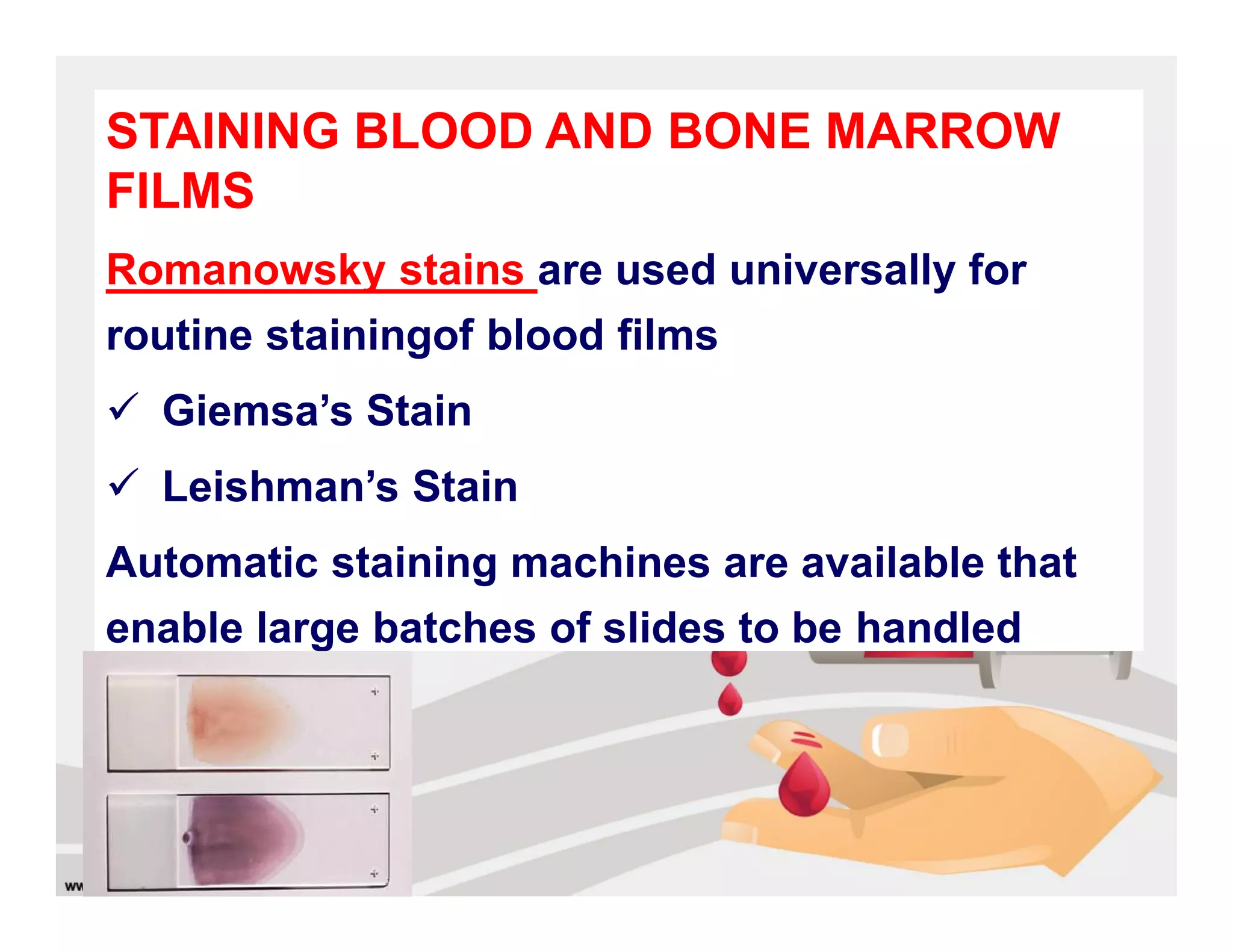
STAINING BLOOD AND BONE MARROW
FILMS
Romanowsky stains are used universally for
routine stainingof blood films
 Giemsa’s Stain
 Leishman’s Stain
Automatic staining machines are available that
enable large batches of slides to be handled
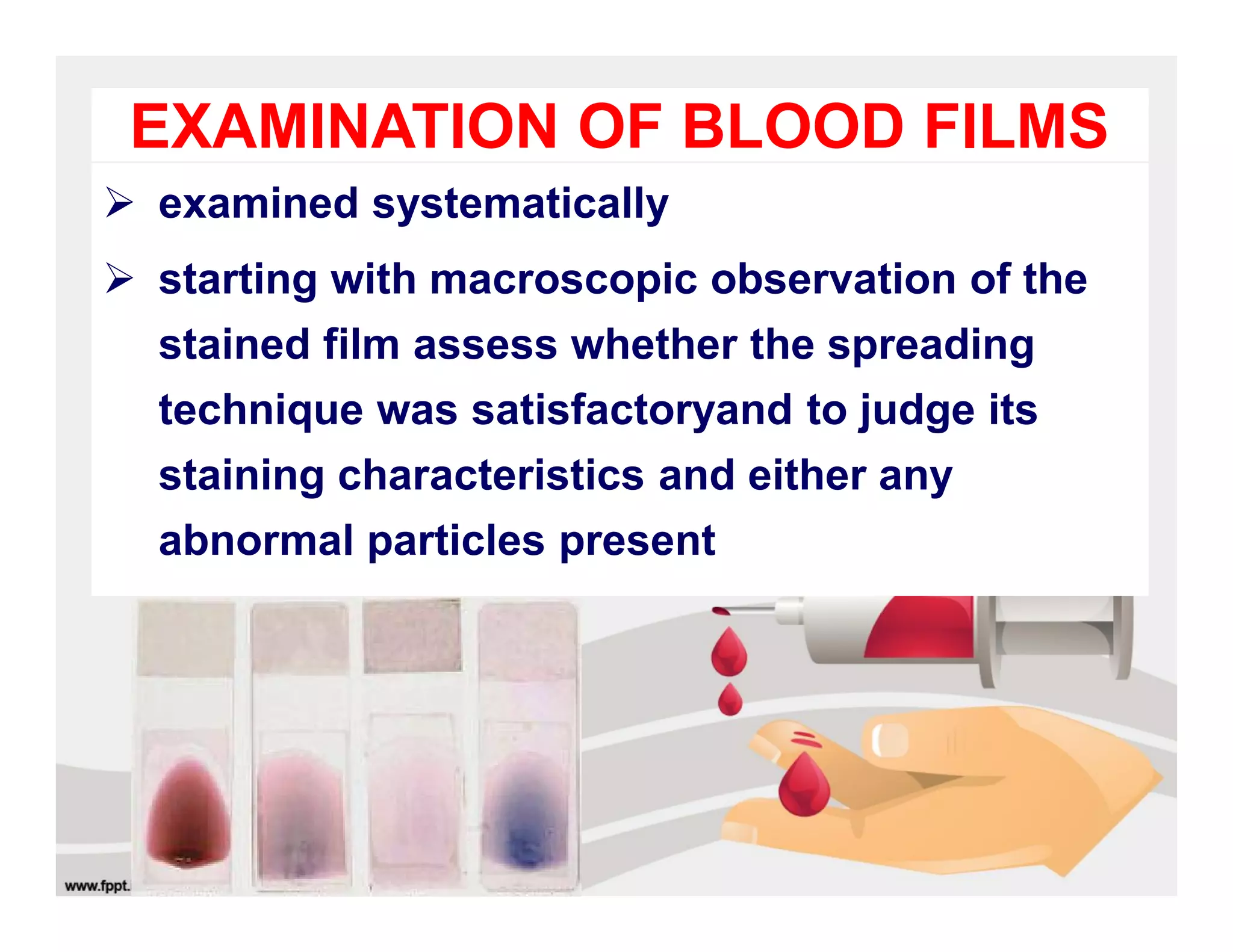
EXAMINATION OF BLOOD FILMS
 examined systematically
 starting with macroscopic observation of the
stained film assess whether the spreading
technique was satisfactoryand to judge its
staining characteristics and either any
abnormal particles present
EXAMINATION OF BLOOD FILMS
Microscopic examination- progressing from low-
power to high-power
Under low magnification to:
(a) get an idea of the quality of the preparation
(b) assess whether red cell agglutination, excessive
rouleaux formation or platelet aggregation is present
(c) assess the number, distribution and staining
of the leucocytes
(d) find an area where the red cells are evenly distributed
and are not distorted
EXAMINATION OF BLOOD FILMS
Having selected a suitable area,
Inspection under high-power magnification
for the final examination of unusual cells and for
looking at fine details
1. RBC
 Size, Shape
 Stain
 Arrangement
 Inclusions
 nucleated RBCs
2. WBC
 Total counts
 Differential counts
 Abnormal /immature WBC
3. Platelets
 Counts
 Abnormality
4. Parasites
EXAMINATION OF BLOOD FILMS
RED CELL MORPHOLOGY
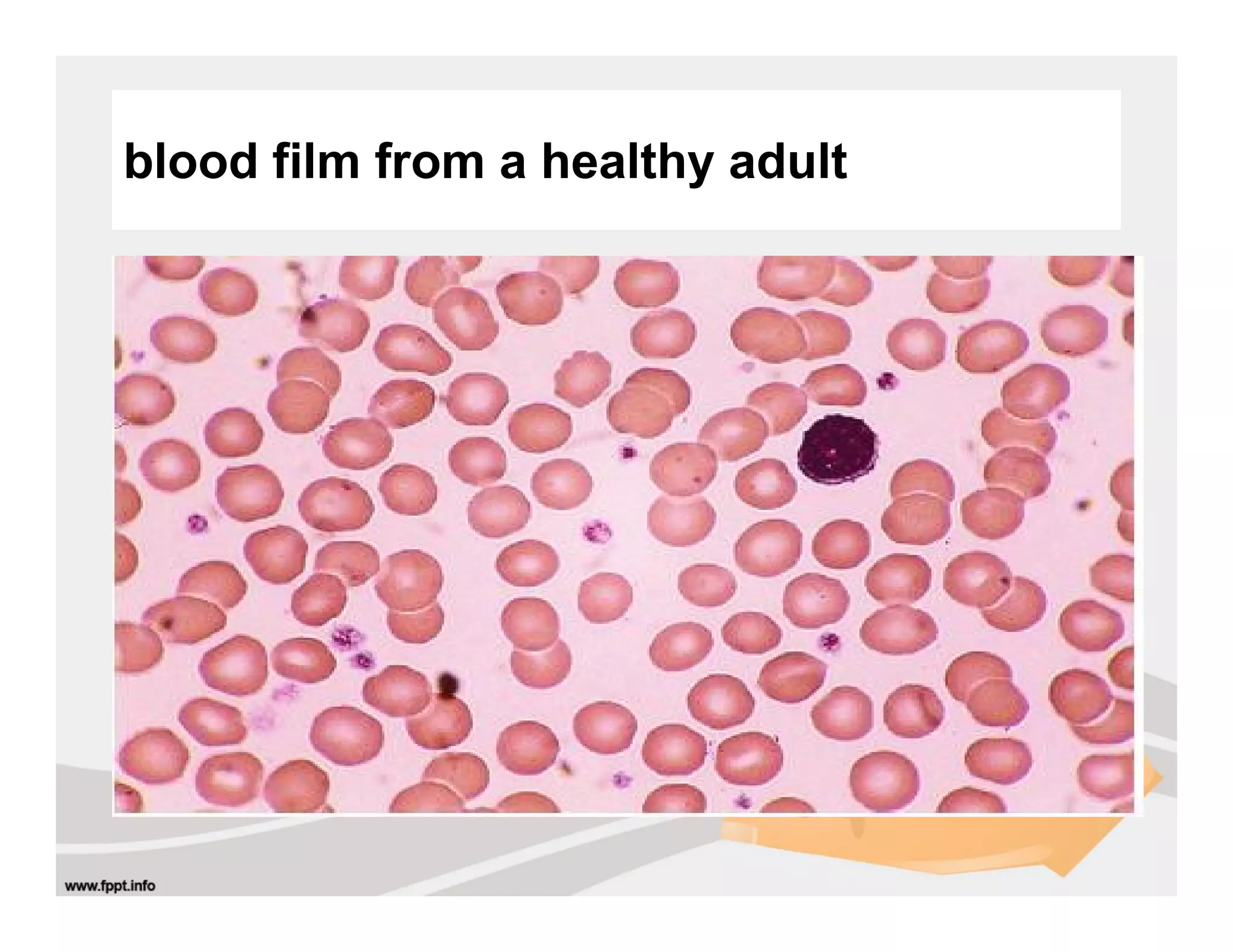
NORMAL
SHAPE - round, smooth contours
SIZE- range of 7–8 μm (about the same as that of the nucleus
of a small lymphocyte on the dried film)
STAIN - Central pallor 1/3 of total area
stain quite deeply with the eosin component of
Romanowsky dyes, particularly at the periphery of
the cell as a result of the cell’s normal biconcavity
Biconcave disc
Diameter : 7 - 8 μm
Central pallor occupy 1/3
rd of total
Size : approx. same as
nucleus of mature
lymphocyte
NORMAL RED CELL MORPHOLOGY
blood film from a healthy adult
ABNORMAL ERYTHROPOIESIS
Anisocytosis- variation in size of RBC
result of the presence of cells larger than normal
(macrocytosis), cells smaller than normal
(microcytosis) or both; frequently both
macrocytes and microcytes are present
Microcytes
 results from a defect in haemoglobin
formation
 characteristic of iron deficiency anaemia
various types of thalassaemia and severe
cases of anaemia of chronic disease.
Anisocytosis
Anisocytosis
Macrocytes
 classically found in megaloblastic anaemias
 also present in some cases of aplastic anaemia,
myelodysplastic syndromes ,other
dyserythropoietic states, in patients being
treated with hydroxyurea, chronic alcoholic &
chronic liver disease
Poikilocytosis –variation in shape of RBC
produced in many types of abnormal
erythropoiesis
for example
- megaloblastic anaemia
- iron deficiency anaemia
- Thalassaemia
- Myelofibrosis
ABNORMAL ERYTHROPOIESIS
Poikilocytosis
Elliptocytes and ovalocytes
 present when there is dyserythropoiesis
 in megaloblastic anaemia (macro-ovalocytes)
 in iron deficiency anaemia (‘pencil cells’)
Target Cells
refers to a cell in which there is a central round
stained area and a peripheral rim of
haemoglobinized cytoplasm separated by non-
staining or more lightly staining cytoplasm
result from cells having a surface that is
disproportionately large compared with their
volume
are seen in films in chronic liver diseases, iron
deficiency anaemia and thalassaemia
Poikilocytosis
Sickle Cells - vary in shape between boat-shaped forms
and sickles
SPICULATED CELLS AND RED CELL FRAGMENTATION
- Schistocytosis – Fragmented red cells
- Acanthocytosis- abnormality of the red cell in which
there are a small number of spicules of inconstant length,
thickness
-Stomatocytosis ,
Red cell inclusion bodies- Howell–Jolly Bodies
Pappenheimer Bodies
Basophilic stippling or punctate basophilia
Poikilocytosis
Basophillic stippling Hereditary spherocytosis
target cells
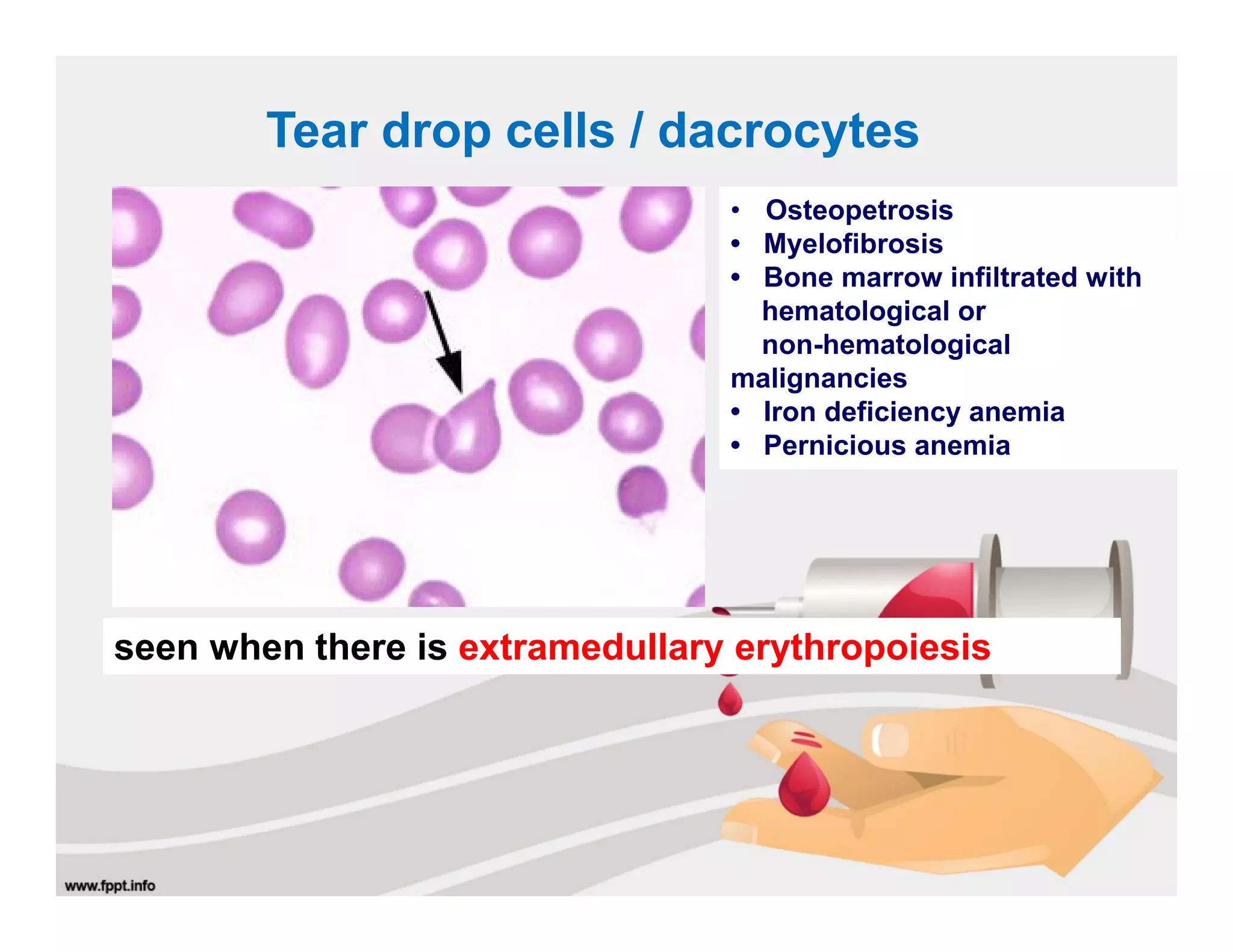
seen when there is extramedullary erythropoiesis
Tear drop cells / dacrocytes
• Osteopetrosis
• Myelofibrosis
• Bone marrow infiltrated with
hematological or
non-hematological
malignancies
• Iron deficiency anemia
• Pernicious anemia
INADEQUATE HAEMOGLOBIN
FORMATION
Hypochromia
 refers to the presence of red cells that stain
unusually palely
 two possible causes: a lowered haemoglobin
concentration and abnormal thinness of the
red cells
Hyperchromasia (Hyperchromia)
 deep staining of the red cells with a lack of
central pallor
 seen in two circumstances
- in the presence of macrocytes
- cells are abnormally rounded
Abnormally rounded cells may be either
spherocytes or irregularly contracted cells
Spherocytosis
 cells that are more spheroidal (i.e. less disc like)
than normal red cells but maintain a regular
outline
 diameter is less and thickness is greater than
normal
 result from genetic defects of the red cell
membrane as in hereditary spherocytosis,
haemolytic anaemia
Anisochromasia-
Dimorphic Red Cell Population
 abnormal variability in staining of red with two
distinct populations
 is characteristic of a changing situation
It can occur during the development or resolution
of iron deficiency anaemia
Polychromasia
Blue-gray coloration of RBCS.
Due RNA remnants
Increased - Increased erythropoietic
activity. Decreased - Hypoproliferative
states.
Hemolytic anemias
•Blood loss anemias
•Recovering anemia
Hypochromic Microcytic
Anaemia
 Iron deficiency Anaemia
 Thalasemia
 Anemia of chronic disease
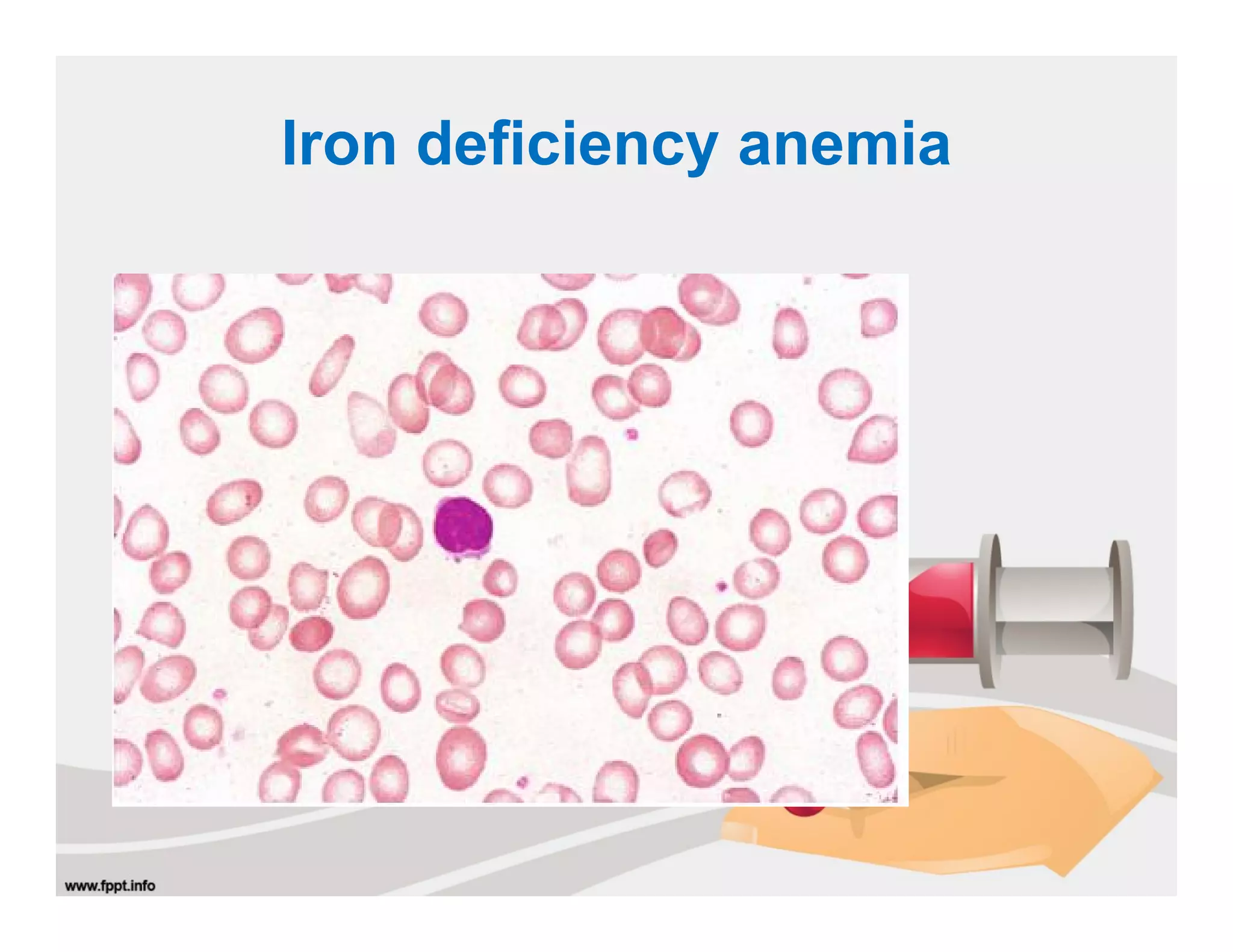
Iron deficiency anemia
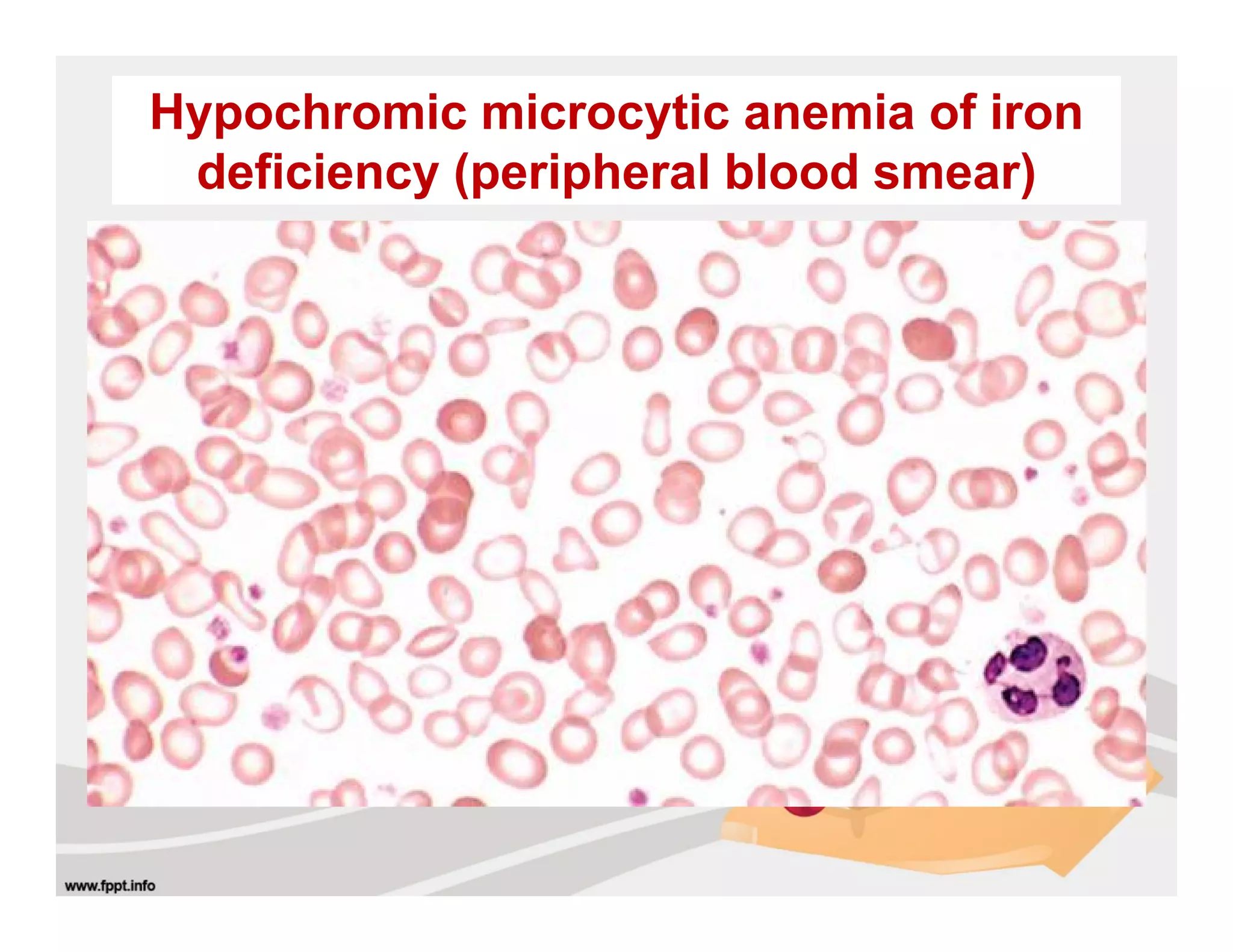
Hypochromic microcytic anemia of iron
deficiency (peripheral blood smear)
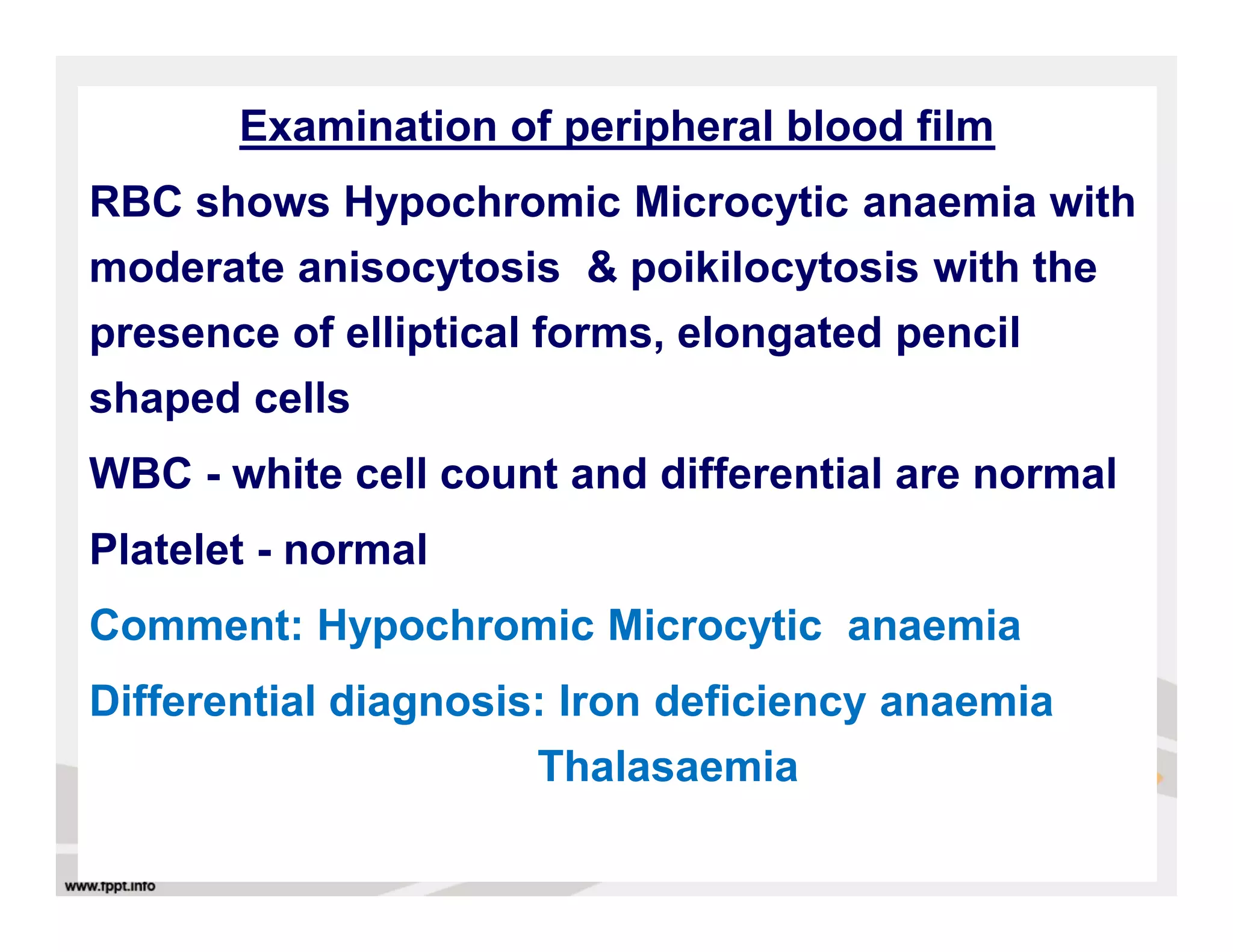
Examination of peripheral blood film
RBC shows Hypochromic Microcytic anaemia with
moderate anisocytosis & poikilocytosis with the
presence of elliptical forms, elongated pencil
shaped cells
WBC - white cell count and differential are normal
Platelet - normal
Comment: Hypochromic Microcytic anaemia
Differential diagnosis: Iron deficiency anaemia
Thalasaemia
Investigation of a microcytic hypochromic
anaemia
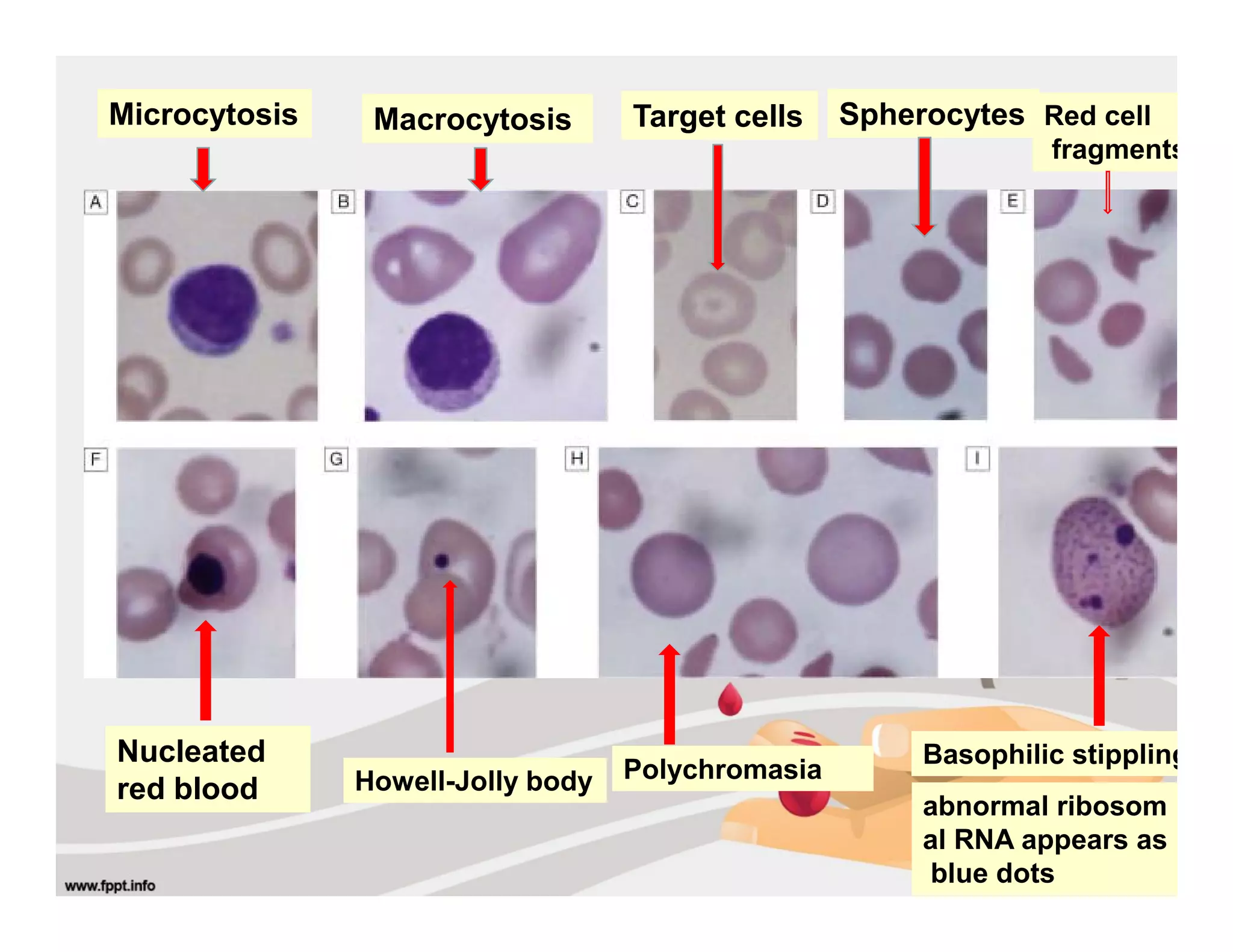
Microcytosis Macrocytosis Target cells Spherocytes Red cell
fragments
Nucleated
red blood Howell-Jolly body
Basophilic stippling
Polychromasia
abnormal ribosom
al RNA appears as
blue dots
Shows marked anisocytosis, marked poikilocytosis,
one unusually large macrocyte and one severely
hypochromic cell
Blood film showing macrocytes, oval macrocytes & a
hypersegmented neutrophil
Blood film showing
hypochromia, microcytosis and poikilocytosis
Investigation of a macrocytic anaemia
Blood film examination

Blood film examination

  • 1.
  • 2.
    BLOOD FILM PREPARATION madeon clean glass slides Films may be spread by hand or by means of an automated slide spreader Manual Method
  • 3.
    • Hemogram: measured and calculated parameters •Histograms: size distribution of WBC, RBC and Plt • Cytogram: WBC differential CBC on automated analyzers Flagging for abnormalities necessitates a manual PBS review
  • 4.
    STAINING BLOOD ANDBONE MARROW FILMS Romanowsky stains are used universally for routine stainingof blood films  Giemsa’s Stain  Leishman’s Stain Automatic staining machines are available that enable large batches of slides to be handled
  • 5.
    EXAMINATION OF BLOODFILMS  examined systematically  starting with macroscopic observation of the stained film assess whether the spreading technique was satisfactoryand to judge its staining characteristics and either any abnormal particles present
  • 6.
    EXAMINATION OF BLOODFILMS Microscopic examination- progressing from low- power to high-power Under low magnification to: (a) get an idea of the quality of the preparation (b) assess whether red cell agglutination, excessive rouleaux formation or platelet aggregation is present (c) assess the number, distribution and staining of the leucocytes (d) find an area where the red cells are evenly distributed and are not distorted
  • 7.
    EXAMINATION OF BLOODFILMS Having selected a suitable area, Inspection under high-power magnification for the final examination of unusual cells and for looking at fine details
  • 8.
    1. RBC  Size,Shape  Stain  Arrangement  Inclusions  nucleated RBCs 2. WBC  Total counts  Differential counts  Abnormal /immature WBC 3. Platelets  Counts  Abnormality 4. Parasites EXAMINATION OF BLOOD FILMS
  • 9.
    RED CELL MORPHOLOGY NORMAL SHAPE- round, smooth contours SIZE- range of 7–8 μm (about the same as that of the nucleus of a small lymphocyte on the dried film) STAIN - Central pallor 1/3 of total area stain quite deeply with the eosin component of Romanowsky dyes, particularly at the periphery of the cell as a result of the cell’s normal biconcavity
  • 10.
    Biconcave disc Diameter :7 - 8 μm Central pallor occupy 1/3 rd of total Size : approx. same as nucleus of mature lymphocyte NORMAL RED CELL MORPHOLOGY
  • 11.
    blood film froma healthy adult
  • 12.
    ABNORMAL ERYTHROPOIESIS Anisocytosis- variationin size of RBC result of the presence of cells larger than normal (macrocytosis), cells smaller than normal (microcytosis) or both; frequently both macrocytes and microcytes are present
  • 13.
    Microcytes  results froma defect in haemoglobin formation  characteristic of iron deficiency anaemia various types of thalassaemia and severe cases of anaemia of chronic disease. Anisocytosis
  • 14.
    Anisocytosis Macrocytes  classically foundin megaloblastic anaemias  also present in some cases of aplastic anaemia, myelodysplastic syndromes ,other dyserythropoietic states, in patients being treated with hydroxyurea, chronic alcoholic & chronic liver disease
  • 15.
    Poikilocytosis –variation inshape of RBC produced in many types of abnormal erythropoiesis for example - megaloblastic anaemia - iron deficiency anaemia - Thalassaemia - Myelofibrosis ABNORMAL ERYTHROPOIESIS
  • 16.
    Poikilocytosis Elliptocytes and ovalocytes present when there is dyserythropoiesis  in megaloblastic anaemia (macro-ovalocytes)  in iron deficiency anaemia (‘pencil cells’)
  • 17.
    Target Cells refers toa cell in which there is a central round stained area and a peripheral rim of haemoglobinized cytoplasm separated by non- staining or more lightly staining cytoplasm result from cells having a surface that is disproportionately large compared with their volume are seen in films in chronic liver diseases, iron deficiency anaemia and thalassaemia Poikilocytosis
  • 18.
    Sickle Cells -vary in shape between boat-shaped forms and sickles SPICULATED CELLS AND RED CELL FRAGMENTATION - Schistocytosis – Fragmented red cells - Acanthocytosis- abnormality of the red cell in which there are a small number of spicules of inconstant length, thickness -Stomatocytosis , Red cell inclusion bodies- Howell–Jolly Bodies Pappenheimer Bodies Basophilic stippling or punctate basophilia Poikilocytosis
  • 19.
    Basophillic stippling Hereditaryspherocytosis target cells
  • 20.
    seen when thereis extramedullary erythropoiesis Tear drop cells / dacrocytes • Osteopetrosis • Myelofibrosis • Bone marrow infiltrated with hematological or non-hematological malignancies • Iron deficiency anemia • Pernicious anemia
  • 21.
    INADEQUATE HAEMOGLOBIN FORMATION Hypochromia  refersto the presence of red cells that stain unusually palely  two possible causes: a lowered haemoglobin concentration and abnormal thinness of the red cells
  • 22.
    Hyperchromasia (Hyperchromia)  deepstaining of the red cells with a lack of central pallor  seen in two circumstances - in the presence of macrocytes - cells are abnormally rounded Abnormally rounded cells may be either spherocytes or irregularly contracted cells
  • 23.
    Spherocytosis  cells thatare more spheroidal (i.e. less disc like) than normal red cells but maintain a regular outline  diameter is less and thickness is greater than normal  result from genetic defects of the red cell membrane as in hereditary spherocytosis, haemolytic anaemia
  • 24.
    Anisochromasia- Dimorphic Red CellPopulation  abnormal variability in staining of red with two distinct populations  is characteristic of a changing situation It can occur during the development or resolution of iron deficiency anaemia
  • 25.
    Polychromasia Blue-gray coloration ofRBCS. Due RNA remnants Increased - Increased erythropoietic activity. Decreased - Hypoproliferative states. Hemolytic anemias •Blood loss anemias •Recovering anemia
  • 26.
    Hypochromic Microcytic Anaemia  Irondeficiency Anaemia  Thalasemia  Anemia of chronic disease
  • 27.
  • 28.
  • 29.
    Hypochromic microcytic anemiaof iron deficiency (peripheral blood smear)
  • 30.
    Examination of peripheralblood film RBC shows Hypochromic Microcytic anaemia with moderate anisocytosis & poikilocytosis with the presence of elliptical forms, elongated pencil shaped cells WBC - white cell count and differential are normal Platelet - normal Comment: Hypochromic Microcytic anaemia Differential diagnosis: Iron deficiency anaemia Thalasaemia
  • 31.
    Investigation of amicrocytic hypochromic anaemia
  • 32.
    Microcytosis Macrocytosis Targetcells Spherocytes Red cell fragments Nucleated red blood Howell-Jolly body Basophilic stippling Polychromasia abnormal ribosom al RNA appears as blue dots
  • 33.
    Shows marked anisocytosis,marked poikilocytosis, one unusually large macrocyte and one severely hypochromic cell
  • 34.
    Blood film showingmacrocytes, oval macrocytes & a hypersegmented neutrophil
  • 35.
    Blood film showing hypochromia,microcytosis and poikilocytosis
  • 36.
    Investigation of amacrocytic anaemia