Dr. Aye Aye Tun
Lecturer
Pathology Unit
Aimst University
Explain how the immune system of the host
responds to the presence of a tumour
Learning objectives:
This lecture provides an understanding
of
Tumor antigens
Antitumor effector mechanism
Immunosurveillance
Learning outcomes
At the end of this lecture student will be able to
 Prove the role of immunity in cancers
 List tumor antigens and specify their importance
 Describe the Immunosurveillance of cancer
 Explain how the immune system of the host
responds to the presence of a tumour
 Explain the mechanisms by which tumors evade
the immune system
Tumors arise from accumulated genetic
mutations
Carcinogenesis is a multistep process at both the
phenotypic and the genetic levels
resulting from the accumulation of multiple
mutations
Nonlethal genetic damage lies at the heart of
carcinogenesis
A tumor is formed by the clonal expansion of
a single precursor cell that has incurred
genetic damage
(i.e., tumors are monoclonal)
Types of genes that control cancer
Four classes of regulatory genes
1. growth-promoting proto-oncogenes
2. growth-inhibiting tumor suppressor genes
3. genes that regulate programmed cell
death (apoptosis)
4. genes involved in DNA repair
principal targets of genetic damage
The immune system play a critical role
in
distinguishing self from nonself molecules
Eliminating infectious agents
Immune system react to antigens
that it recognizes as foreign
Tumor cells can be recognized by the
immune system as non-self
Paul Ehrlich proposed that
immune-mediated recognition of
autologous tumor cells can be capable
of eliminating transformed cells
Immune surveillance
Lewis Thomas and Macfarlane Burnet
Recognition and destruction of non-self
tumor cells by the immune system
(immunological resistance of the host against
the development of cancer)
 regression of metastases after removal of primary
tumor
 infiltrations of tumors by lymphocytes and
macrophages
 lymphocyte proliferation in draining sites of
cancer
 direct demonstration of tumor-specific T cells and
antibodies in patients
 increased cancer risk after immunosuppression
and immunodeficiency
Evidence for tumor immunity
Cancer immunoediting describe the
effects of the immune system
 in preventing tumor formation
 in “sculpting” the immunogenic properties of
tumors to select tumor cells that escape immune
elimination
How does the immune system eliminate
cancer cells?
How do cancer cells escape from
Immunosurveilance?
How can we help to win the battle between
immune system and cancers?
Many tumors do elicit an immune
response due to tumor antigens
Many tumors evade host immune response
through several mechanisms
two categories
based on their patterns of expression
Tumor-specific antigens - present only on tumor
cells and not on any normal cells
Tumor-associated antigens - present on tumor
cells and also on some normal cells
Classification of tumor antigens
based on their molecular structure and source
1. Products of Mutated Oncogenes and Tumor Suppressor
Genes
2. Products of other Mutated Genes
3. Over expressed or Aberrantly Expressed Cellular
Proteins
4. Tumor Antigens Produced by Oncogenic Viruses
5. Oncofetal antigens
6. Altered glycolipids and glycoproteins
7. Cell type-specific differentiation antigens
TUMOR ANTIGENS
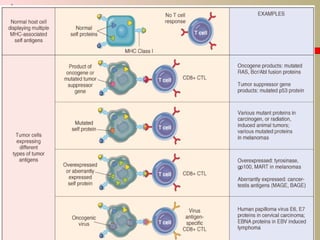
Products of mutated genes
derived from the products of mutant proto-oncogenes,
tumor suppressor genes, or other mutated genes
synthesized in the cytoplasm of tumor cells, and like any
cytoplasmic protein, they may enter the class I MHC
antigenprocessing pathway and be recognized by CD8+ T
cells
In addition, these proteins may enter the class II antigen-
processing pathway in antigen-presenting cells that have
phagocytosed dead tumor cells, and thus be recognized
by CD4+ T cells also
TUMOR ANTIGENS
Products of mutated genes
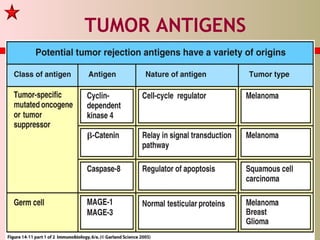
products of β-catenin, RAS, p53, and
CDK4 genes BCR-ABL protein
Because the mutant proteins are present only in
tumors, their peptides are expressed only in
tumor cells
TUMOR ANTIGENS
Overexpressed or aberrantly expressed
proteins
Tumor antigens may be normal cellular proteins
that are abnormally expressed in tumor cells and
elicit immune responses
Tyrosinase , MAGE(melanoma antigen gene )
is expressed on melanomas
TUMOR ANTIGENS
Oncofetal antigens
proteins that are expressed at high levels on
cancer cells and in normal developing
(fetal) but not adult tissues
their main importance is that they provide
markers that aid in tumor diagnosis
TUMOR ANTIGENS
Oncofetal antigens
Carcino-embryonic antigens (CEA)Carcino-embryonic antigens (CEA)
-- Normally expressed during fetal life on fetal gut
- GIT, pancreas, biliary system and cancer breast
Alpha fetoprotein(AFP):
-- Normally expressed in fetal life
- hepatocellularcarcinoma
TUMOR ANTIGENS
antigens produced by oncogenic
viruses
Oncogenic viruses (eg; HPV,EBV, HBV) produce
proteins that are recognized as foreign by
the immune system
TUMOR ANTIGENS
Altered Cell Surface Glycolipids and
Glycoproteins
Expression of higher than normal levels and/or
abnormal forms of surface glycoproteins and
glycolipids
diagnostic markers and targets for therapy
These altered molecules include gangliosides,
blood group antigens, and mucins
TUMOR ANTIGENS
Altered Cell Surface Glycolipids and
Glycoproteins
These include
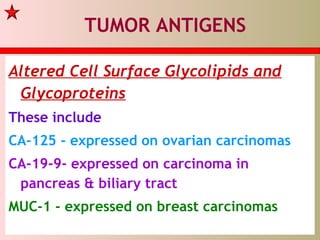
CA-125 - expressed on ovarian carcinomas
CA-19-9- expressed on carcinoma in
pancreas & biliary tract
MUC-1 - expressed on breast carcinomas
TUMOR ANTIGENS
Cell Type-Specific Differentiation Antigens
Tumors express molecules that are normally
present on the cells of origin
Important for identifying the tissue of origin of
tumors
These antigens are called differentiation
antigens because they are specific for
particular lineages or differentiation stages
of various cell types
TUMOR ANTIGENS
Altered Cell Surface Glycolipids and
Glycoproteins
Mucins are high-molecular-weight glycoproteins
containing numerous O-linked carbohydrate side
chains on a core polypeptide
Tumors often have dysregulated expression of the enzymes
that synthesize these carbohydrate side chains, which
leads to the appearance of tumor-specific epitopes on the
carbohydrate side chains or on the abnormally exposed
polypeptide core
TUMOR ANTIGENS
Altered Cell Surface Glycolipids and
Glycoproteins
These include
CA-125 - expressed on ovarian carcinomas
CA-19-9- expressed on carcinoma in
pancreas & biliary tract
MUC-1 - expressed on breast carcinomas
TUMOR ANTIGENS
Cell Type-Specific Differentiation
Antigens
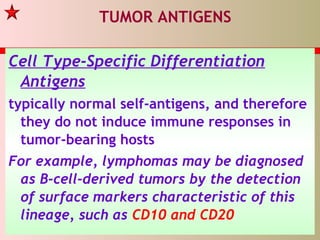
typically normal self-antigens, and therefore
they do not induce immune responses in
tumor-bearing hosts
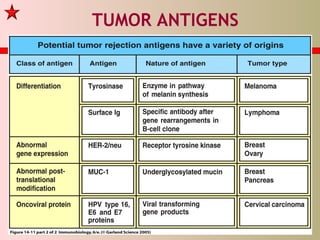
For example, lymphomas may be diagnosed
as B-cell-derived tumors by the detection
of surface markers characteristic of this
lineage, such as CD10 and CD20
TUMOR ANTIGENS
TUMOR ANTIGENS
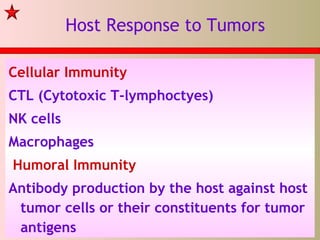
Host Response to Tumors
Cellular Immunity
CTL (Cytotoxic T-lymphoctyes)
NK cells
Macrophages
Humoral Immunity
Antibody production by the host against host
tumor cells or their constituents for tumor
antigens
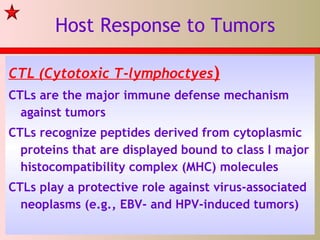
Host Response to Tumors
CTL (Cytotoxic T-lymphoctyes)
CTLs are the major immune defense mechanism
against tumors
CTLs recognize peptides derived from cytoplasmic
proteins that are displayed bound to class I major
histocompatibility complex (MHC) molecules
CTLs play a protective role against virus-associated
neoplasms (e.g., EBV- and HPV-induced tumors)
Host Response to Tumors
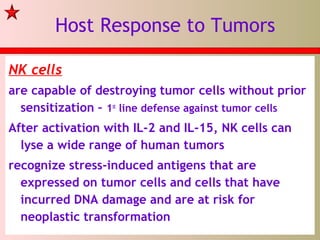
NK cells
are capable of destroying tumor cells without prior
sensitization – 1st
line defense against tumor cells
After activation with IL-2 and IL-15, NK cells can
lyse a wide range of human tumors
recognize stress-induced antigens that are
expressed on tumor cells and cells that have
incurred DNA damage and are at risk for
neoplastic transformation
Host Response to Tumors
Macrophages
Activated macrophages exhibit cytotoxicity
against tumor cells in vitro
Activated macrophages may kill tumors by
mechanisms similar to those used to kill
microbes
(e.g., production of reactive oxygen
metabolites or by secretion of TNF)
Host Response to Tumors
T cells, NK cells, and macrophages may
collaborate in antitumor reactivity
interferon-γ, a cytokine secreted by T
cells and NK cells, is a potent
activator of macrophages
Host immune response evasion by
tumor cells
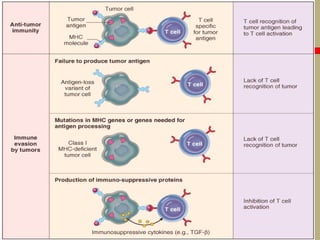
Selective outgrowth of antigen-negative variants
loss or reduced expression of histocompatibility
antigens
Lack of costimulation
Immunosuppression
Antigen masking
Apoptosis of cytotoxic T cells
Host immune response evasion by
tumor cells
Selective outgrowth of antigen-negative variants
- during tumor progression, strongly immunogenic
subclones may be eliminated
loss or reduced expression of histocompatibility
antigens
- tumor cells may fail to express normal levels of HLA class I
molecules, thereby escaping attack by cytotoxic T cells
Such cells, however, may trigger NK cells
Host immune response evasion by
tumor cells
Lack of costimulation
- sensitization of T cells requires two signals, one
by a foreign peptide presented by MHC molecules
and the other by costimulatory molecules
- although tumor cells may express peptide
antigens with class I molecules, they often do not
express costimulatory molecules
Host immune response evasion by
tumor cells
Immunosuppression
-Many oncogenic agents (e.g., chemicals and
ionizing radiation) suppress host immune responses
-Tumors or tumor products also may be
immunosuppressive. For example, TGF-β, secreted
in large quantities by many tumors, is a potent
immunosuppressant
Host immune response evasion by
tumor cells
Antigen masking
-The cell surface antigens of tumors may be hidden, or
masked, from the immune system by glycocalyx molecules,
such as sialic acid–containing mucopolysaccharides
Apoptosis of cytotoxic T cells
Some melanomas and hepatocellular carcinomas express
FasL. It has been postulated that these tumors kill Fas-
expressing T lymphocytes that come in contact with them,
thus eliminating tumor-specific T cells
Immunodiagnosis
Tumor antigens
 useful as tumor markers
 released only from tumor tissue
 Specific for a given tumor type
 Has direct relationship to the tumor cell
 Present in all patients with tumor
Tumors release antigen macromolecules that
can be detected in vivo and in vitro
Immunodiagnosis
Examples of tumor antigens used for tumor markers
Alpha-Fetoprotein
Beta-subunit of human chorionic gonadotropin (B-HCG)
Prostate-specific antigen (PSA)
CA 125
Radio-labeled monoclonal antibody B72.3
Carcinoembryonic Antigen (CEA)
Immunodiagnosis
Immunohistochemistry
 Categorization of undifferentiated malignant
tumors
 Determination of site of origin of metastatic
tumors
 Detection of molecules that have prognostic or
therapeutic significance
Immunotherapy
Adoptive T cell therapy (AIT)
Passive immunotherapy using antibodies
Active-specific immunotherapy by using vaccines
Passive immunotherapy: mAbs
Herceptin: anti-HER-2/neu in breast cancer
patients
Rituximab: anti-CD20 in patients with non-
Hodgkin’s lymphoma
Limitations: clearance by soluble Ags, antigenic
variation of the tumor, inefficient killing or
penetration into the tumor mass

Tumor immunity

  • 1.
    Dr. Aye AyeTun Lecturer Pathology Unit Aimst University
  • 2.
    Explain how theimmune system of the host responds to the presence of a tumour
  • 3.
    Learning objectives: This lectureprovides an understanding of Tumor antigens Antitumor effector mechanism Immunosurveillance
  • 4.
    Learning outcomes At theend of this lecture student will be able to  Prove the role of immunity in cancers  List tumor antigens and specify their importance  Describe the Immunosurveillance of cancer  Explain how the immune system of the host responds to the presence of a tumour  Explain the mechanisms by which tumors evade the immune system
  • 5.
    Tumors arise fromaccumulated genetic mutations Carcinogenesis is a multistep process at both the phenotypic and the genetic levels resulting from the accumulation of multiple mutations
  • 6.
    Nonlethal genetic damagelies at the heart of carcinogenesis A tumor is formed by the clonal expansion of a single precursor cell that has incurred genetic damage (i.e., tumors are monoclonal)
  • 7.
    Types of genesthat control cancer Four classes of regulatory genes 1. growth-promoting proto-oncogenes 2. growth-inhibiting tumor suppressor genes 3. genes that regulate programmed cell death (apoptosis) 4. genes involved in DNA repair principal targets of genetic damage
  • 8.
    The immune systemplay a critical role in distinguishing self from nonself molecules Eliminating infectious agents
  • 9.
    Immune system reactto antigens that it recognizes as foreign Tumor cells can be recognized by the immune system as non-self
  • 10.
    Paul Ehrlich proposedthat immune-mediated recognition of autologous tumor cells can be capable of eliminating transformed cells
  • 11.
    Immune surveillance Lewis Thomasand Macfarlane Burnet Recognition and destruction of non-self tumor cells by the immune system (immunological resistance of the host against the development of cancer)
  • 12.
     regression ofmetastases after removal of primary tumor  infiltrations of tumors by lymphocytes and macrophages  lymphocyte proliferation in draining sites of cancer  direct demonstration of tumor-specific T cells and antibodies in patients  increased cancer risk after immunosuppression and immunodeficiency Evidence for tumor immunity
  • 13.
    Cancer immunoediting describethe effects of the immune system  in preventing tumor formation  in “sculpting” the immunogenic properties of tumors to select tumor cells that escape immune elimination
  • 14.
    How does theimmune system eliminate cancer cells? How do cancer cells escape from Immunosurveilance? How can we help to win the battle between immune system and cancers?
  • 15.
    Many tumors doelicit an immune response due to tumor antigens Many tumors evade host immune response through several mechanisms
  • 16.
    two categories based ontheir patterns of expression Tumor-specific antigens - present only on tumor cells and not on any normal cells Tumor-associated antigens - present on tumor cells and also on some normal cells Classification of tumor antigens
  • 17.
    Classification of tumorantigens based on their molecular structure and source 1. Products of Mutated Oncogenes and Tumor Suppressor Genes 2. Products of other Mutated Genes 3. Over expressed or Aberrantly Expressed Cellular Proteins 4. Tumor Antigens Produced by Oncogenic Viruses 5. Oncofetal antigens 6. Altered glycolipids and glycoproteins 7. Cell type-specific differentiation antigens
  • 18.
    TUMOR ANTIGENS Products ofmutated genes derived from the products of mutant proto-oncogenes, tumor suppressor genes, or other mutated genes synthesized in the cytoplasm of tumor cells, and like any cytoplasmic protein, they may enter the class I MHC antigenprocessing pathway and be recognized by CD8+ T cells In addition, these proteins may enter the class II antigen- processing pathway in antigen-presenting cells that have phagocytosed dead tumor cells, and thus be recognized by CD4+ T cells also
  • 19.
    TUMOR ANTIGENS Products ofmutated genes products of β-catenin, RAS, p53, and CDK4 genes BCR-ABL protein Because the mutant proteins are present only in tumors, their peptides are expressed only in tumor cells
  • 20.
    TUMOR ANTIGENS Overexpressed oraberrantly expressed proteins Tumor antigens may be normal cellular proteins that are abnormally expressed in tumor cells and elicit immune responses Tyrosinase , MAGE(melanoma antigen gene ) is expressed on melanomas
  • 21.
    TUMOR ANTIGENS Oncofetal antigens proteinsthat are expressed at high levels on cancer cells and in normal developing (fetal) but not adult tissues their main importance is that they provide markers that aid in tumor diagnosis
  • 22.
    TUMOR ANTIGENS Oncofetal antigens Carcino-embryonicantigens (CEA)Carcino-embryonic antigens (CEA) -- Normally expressed during fetal life on fetal gut - GIT, pancreas, biliary system and cancer breast Alpha fetoprotein(AFP): -- Normally expressed in fetal life - hepatocellularcarcinoma
  • 23.
    TUMOR ANTIGENS antigens producedby oncogenic viruses Oncogenic viruses (eg; HPV,EBV, HBV) produce proteins that are recognized as foreign by the immune system
  • 24.
    TUMOR ANTIGENS Altered CellSurface Glycolipids and Glycoproteins Expression of higher than normal levels and/or abnormal forms of surface glycoproteins and glycolipids diagnostic markers and targets for therapy These altered molecules include gangliosides, blood group antigens, and mucins
  • 25.
    TUMOR ANTIGENS Altered CellSurface Glycolipids and Glycoproteins These include CA-125 - expressed on ovarian carcinomas CA-19-9- expressed on carcinoma in pancreas & biliary tract MUC-1 - expressed on breast carcinomas
  • 26.
    TUMOR ANTIGENS Cell Type-SpecificDifferentiation Antigens Tumors express molecules that are normally present on the cells of origin Important for identifying the tissue of origin of tumors These antigens are called differentiation antigens because they are specific for particular lineages or differentiation stages of various cell types
  • 27.
    TUMOR ANTIGENS Altered CellSurface Glycolipids and Glycoproteins Mucins are high-molecular-weight glycoproteins containing numerous O-linked carbohydrate side chains on a core polypeptide Tumors often have dysregulated expression of the enzymes that synthesize these carbohydrate side chains, which leads to the appearance of tumor-specific epitopes on the carbohydrate side chains or on the abnormally exposed polypeptide core
  • 28.
    TUMOR ANTIGENS Altered CellSurface Glycolipids and Glycoproteins These include CA-125 - expressed on ovarian carcinomas CA-19-9- expressed on carcinoma in pancreas & biliary tract MUC-1 - expressed on breast carcinomas
  • 29.
    TUMOR ANTIGENS Cell Type-SpecificDifferentiation Antigens typically normal self-antigens, and therefore they do not induce immune responses in tumor-bearing hosts For example, lymphomas may be diagnosed as B-cell-derived tumors by the detection of surface markers characteristic of this lineage, such as CD10 and CD20
  • 30.
  • 31.
  • 32.
    Host Response toTumors Cellular Immunity CTL (Cytotoxic T-lymphoctyes) NK cells Macrophages Humoral Immunity Antibody production by the host against host tumor cells or their constituents for tumor antigens
  • 33.
    Host Response toTumors CTL (Cytotoxic T-lymphoctyes) CTLs are the major immune defense mechanism against tumors CTLs recognize peptides derived from cytoplasmic proteins that are displayed bound to class I major histocompatibility complex (MHC) molecules CTLs play a protective role against virus-associated neoplasms (e.g., EBV- and HPV-induced tumors)
  • 35.
    Host Response toTumors NK cells are capable of destroying tumor cells without prior sensitization – 1st line defense against tumor cells After activation with IL-2 and IL-15, NK cells can lyse a wide range of human tumors recognize stress-induced antigens that are expressed on tumor cells and cells that have incurred DNA damage and are at risk for neoplastic transformation
  • 36.
    Host Response toTumors Macrophages Activated macrophages exhibit cytotoxicity against tumor cells in vitro Activated macrophages may kill tumors by mechanisms similar to those used to kill microbes (e.g., production of reactive oxygen metabolites or by secretion of TNF)
  • 37.
    Host Response toTumors T cells, NK cells, and macrophages may collaborate in antitumor reactivity interferon-γ, a cytokine secreted by T cells and NK cells, is a potent activator of macrophages
  • 38.
    Host immune responseevasion by tumor cells Selective outgrowth of antigen-negative variants loss or reduced expression of histocompatibility antigens Lack of costimulation Immunosuppression Antigen masking Apoptosis of cytotoxic T cells
  • 39.
    Host immune responseevasion by tumor cells Selective outgrowth of antigen-negative variants - during tumor progression, strongly immunogenic subclones may be eliminated loss or reduced expression of histocompatibility antigens - tumor cells may fail to express normal levels of HLA class I molecules, thereby escaping attack by cytotoxic T cells Such cells, however, may trigger NK cells
  • 40.
    Host immune responseevasion by tumor cells Lack of costimulation - sensitization of T cells requires two signals, one by a foreign peptide presented by MHC molecules and the other by costimulatory molecules - although tumor cells may express peptide antigens with class I molecules, they often do not express costimulatory molecules
  • 41.
    Host immune responseevasion by tumor cells Immunosuppression -Many oncogenic agents (e.g., chemicals and ionizing radiation) suppress host immune responses -Tumors or tumor products also may be immunosuppressive. For example, TGF-β, secreted in large quantities by many tumors, is a potent immunosuppressant
  • 42.
    Host immune responseevasion by tumor cells Antigen masking -The cell surface antigens of tumors may be hidden, or masked, from the immune system by glycocalyx molecules, such as sialic acid–containing mucopolysaccharides Apoptosis of cytotoxic T cells Some melanomas and hepatocellular carcinomas express FasL. It has been postulated that these tumors kill Fas- expressing T lymphocytes that come in contact with them, thus eliminating tumor-specific T cells
  • 44.
    Immunodiagnosis Tumor antigens  usefulas tumor markers  released only from tumor tissue  Specific for a given tumor type  Has direct relationship to the tumor cell  Present in all patients with tumor Tumors release antigen macromolecules that can be detected in vivo and in vitro
  • 45.
    Immunodiagnosis Examples of tumorantigens used for tumor markers Alpha-Fetoprotein Beta-subunit of human chorionic gonadotropin (B-HCG) Prostate-specific antigen (PSA) CA 125 Radio-labeled monoclonal antibody B72.3 Carcinoembryonic Antigen (CEA)
  • 46.
    Immunodiagnosis Immunohistochemistry  Categorization ofundifferentiated malignant tumors  Determination of site of origin of metastatic tumors  Detection of molecules that have prognostic or therapeutic significance
  • 47.
    Immunotherapy Adoptive T celltherapy (AIT) Passive immunotherapy using antibodies Active-specific immunotherapy by using vaccines
  • 48.
    Passive immunotherapy: mAbs Herceptin:anti-HER-2/neu in breast cancer patients Rituximab: anti-CD20 in patients with non- Hodgkin’s lymphoma Limitations: clearance by soluble Ags, antigenic variation of the tumor, inefficient killing or penetration into the tumor mass