CHAPTER TWO
RED CELL MORPHOLOGY STUDY
1
Acknowledgements
• Addisa Ababa University
• Jimma University
• Haramaya University
• Hawassa University
• University of Gondar
• American Society for Clinical Pathology
• Center for Disease Control and Prevention-Ethiopia
2
Objectives
At the end of this chapter, the students shall be able to:
 Explain the purpose of red cell morphology assessment
 Describe the morphology of normal red cells
 List and describe the different abnormal erythrocyte forms
 Correlate the different abnormal RBC morphology with
clinical entities
 Perform assessment of red cell morphology on a stained
blood film
 Understand and apply the reporting system of the red cell
morphology assessment findings
3
1.1 INTRODUCTION
 The morphology of blood cells in stained films is the
basis of laboratory diagnosis of hematologic disorders
including:
Anemias
Leukemias
Infections
 A careful examination of a well-spread and well-stained
film can be more informative than a series of
investigations
 The film should be covered with a cover glass using a
neutral mounting medium
this step is not, however, mandatory
4
1.1 Introduction cont’d
 The blood film should be inspected under low power
magnification in order to:
get an idea of the quality of the preparation, i.e.,
whether red cell agglutination or excessive rouleaux
is present
get an idea of the number, distribution and staining of
the leucocytes
find an area where the red cells are evenly distributed
and are not distorted
 Having selected a suitable area, the 40x dry or 100x oil
immersion objective is used to appreciate:
variation in red cell size, shape and staining, and
fine details such as cytoplasmic granules and other
red cell inclusions
5
Five RBC morphological features are
evaluated on the blood smear:
• Variations in RBC Size
• Variations in RBC Color
• Variations in RBC Shape
• RBC Inclusions
• Variations in RBC Distribution/Pattern
1.2 Morphology of Normal Mature Red
cells (Discocytes)
 In health, red cells are said to be normocytic and
normochromic
 In well spread and stained films the great majority of the
cells have:
Round smooth contours
Have diameters within the comparatively narrow
range of 6.0-8.0m
A thickness of 2.5m at the periphery and 1.0m in
the center
 As a rough guide, normal red cell size appears to be
about the same as that of the nucleus of a small
lymphocyte
7
1.2 Morphology of Normal Mature Red
cells (Discocytes) cont’d
 The hemoglobin stains with the eosin component of
Romanowsky dyes and owing to the biconcavity of the
cell, stains:
More pale at the center, and
Quite deeply at the periphery
This depth and distribution of staining in normal
red cells is described as normochromic
8
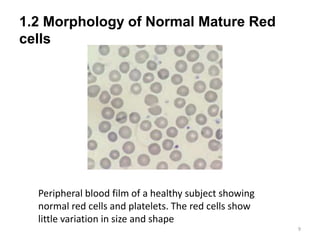
1.2 Morphology of Normal Mature Red
cells
9
Peripheral blood film of a healthy subject showing
normal red cells and platelets. The red cells show
little variation in size and shape
1.3 Size Variation (Anisocytosis)
Macrocytes
 Have diameter greater than 8.0m and the mean cell
volume is also increased
 Because of their increased hemoglobin content they
stain darker than discocytes
 Macrocytosis is seen in stress erythropoiesis as seen in
conditions such as hemolytic anemia and also during
recovery from acute blood loss, and Megaloblastic
anemia
10
1.3 Size Variation cont’d
11
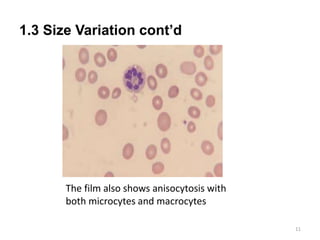
The film also shows anisocytosis with
both microcytes and macrocytes
1.3 Size Variation cont’d
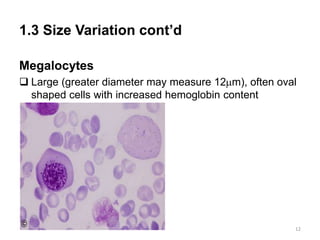
Megalocytes
 Large (greater diameter may measure 12m), often oval
shaped cells with increased hemoglobin content
12
1.3 Size Variation cont’d
 True megalocytes are identified only if megaloblasts
have been identified in bone marrow aspirates
 Megalocytes are seen in vitamin B12 and/or folic acid
deficiency, in association with some leukemias and in
refractory anemias
Microcytes
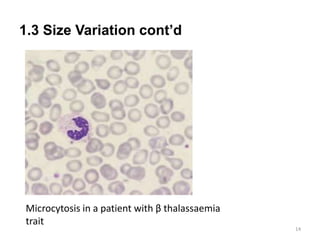
 Have diameter less than 6.0m but may appear to have
normal size caused by flattening of the cells during
smear preparation
 The mean cell volume is decreased to less than 80.0fl
 Area of central pallor usually increases because of the
coexistent hypochromia
 Are seen in iron deficiency anemia and a slight degree of
microcytosis is seen in inflammation
13
1.3 Size Variation cont’d
14
Microcytosis in a patient with β thalassaemia
trait
1.4 Variation in Shape (Poikilocytosis)
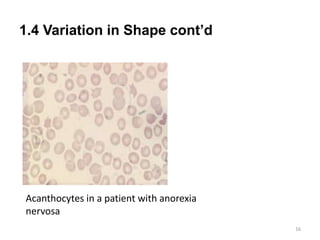
Acanthocytes ('spiny cells')
 Spheroidal cells with 3-12 spicules of uneven length
irregularly distributed over the cell surface.
 Seen in:
disorders of lipid metabolism
alcoholic liver cirrhosis and
Hepatitis
15
1.4 Variation in Shape cont’d
16
Acanthocytes in a patient with anorexia
nervosa
1.4 Variation in Shape cont’d
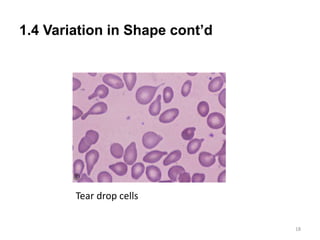
Dacrocytes ('Tear drop cells')
 These are tear drop or pear shaped red cells
 Could be considered to be discocytes with a single drawn out
spicule.
 It is thought that stretching of the cell membrane beyond a
certain limit results in loss of deformability and ability to revert
to normal discoid shape.
 Seen in:
Myelofibrosis,
Myeloid metaplasia
 Tumour metastases to the bone marrow
 Tuberculosis
Drug-induced Heinz body formation
17
1.4 Variation in Shape cont’d
18
Tear drop cells
1.4 Variation in Shape cont’d
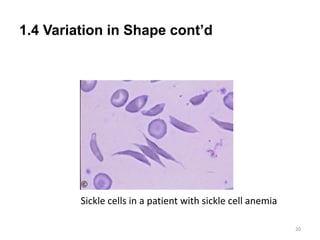
Drepanocytes ('sickle cells')
 These are crescent shaped red cells because of the
formation of rod-like polymers of Hb S or some other
rare hemoglobins
 Have an increased surface area and increased
mechanical fragility which leads to hemolysis and hence
severe anemia
 They are primarily seen in sickle cell anemia where there
is substitution of valine for glutamic acid at position 6 of
the beta chain in the hemoglobin molecule
19
1.4 Variation in Shape cont’d
20
Sickle cells in a patient with sickle cell anemia
1.4 Variation in Shape cont’d
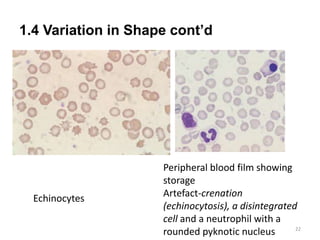
Echinocytes ('crenated cells')
 Red cells showing numerous, short, evenly distributed
spicules of equal length
 These are probably the most common artifacts in a blood
film:
Consistently found in blood samples that have been
stored for some time at room temperature and
 Because of diffusion of alkaline substances from the
slide into the cells resulting in an increase in pH and
thus crenation of the cells
 In vivo they are seen in uremia, pyruvate kinase
deficiency and neonatal liver diseases
21
1.4 Variation in Shape cont’d
22
Echinocytes
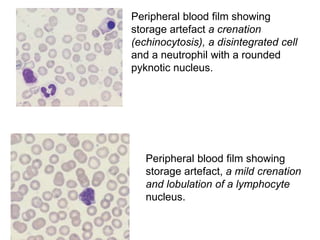
Peripheral blood film showing
storage
Artefact-crenation
(echinocytosis), a disintegrated
cell and a neutrophil with a
rounded pyknotic nucleus
1.4 Variation in Shape cont’d
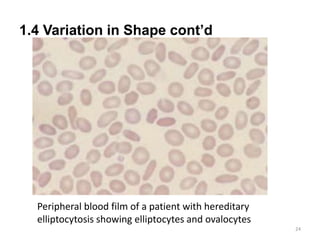
Elliptocytes/ovalocytes
 Elliptical or oval shaped red cells. Normally less than 1%
of the red cells are elliptical/oval shaped.
 Found in almost all anemias where approximately 10%
of the red cells may assume elliptical/oval shape and in
hereditary elliptocytosis where almost all the red cells
are elliptical.
23
1.4 Variation in Shape cont’d
24
Peripheral blood film of a patient with hereditary
elliptocytosis showing elliptocytes and ovalocytes
1.4 Variation in Shape cont’d
Schistocytes ('fragmented cells')
 Two types can be distinguished:
Small fragments of cells of varying shape, sometimes
with sharp angles or spines ('spur cells'), sometimes
round in contour, usually staining deeply but
occasionally palely as a result of loss of hemoglobin
at the time of fragmentation
25
1.4 Variation in Shape cont’d
26
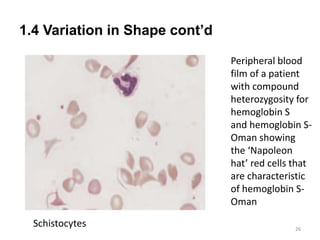
Schistocytes
Peripheral blood
film of a patient
with compound
heterozygosity for
hemoglobin S
and hemoglobin S-
Oman showing
the ‘Napoleon
hat’ red cells that
are characteristic
of hemoglobin S-
Oman
1.4 Variation in Shape cont’d
27
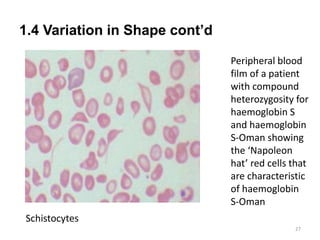
Schistocytes
Peripheral blood
film of a patient
with compound
heterozygosity for
haemoglobin S
and haemoglobin
S-Oman showing
the ‘Napoleon
hat’ red cells that
are characteristic
of haemoglobin
S-Oman
1.4 Variation in Shape cont’d
Larger cells mainly with round contour from which
fragments have been split off, e.g., 'helmet cells'
 They are findings in:
Certain genetically determined disorders, e.g.,
The thalassemias
Hereditary elliptocytosis
Acquired disorders of red cell formation,
megaloblastic and iron deficiency anemias
Direct thermal injury as in severe burns
Burr cells
 Small cells or cell fragments bearing one or a few spines
 Found particularly in uremia
28
1.4 Variation in Shape cont’d
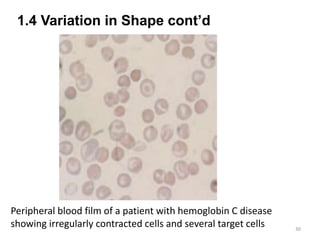
Leptocytes ('target cells'/'Mexican hat cells')
 These are cells showing an area of central staining
 They are abnormally thin cells
 They are common findings in obstructive liver diseases
where there is accumulation of cholesterol and lecithin
due to inhibition of plasma LCAT activity by bile salts
 Variable numbers are seen in iron deficiency anemia and
thalassemia
 There is gross target cell formation after splenectomy
29
1.4 Variation in Shape cont’d
30
Peripheral blood film of a patient with hemoglobin C disease
showing irregularly contracted cells and several target cells
1.4 Variation in Shape cont’d
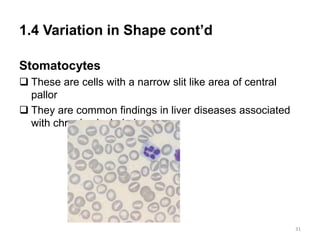
Stomatocytes
 These are cells with a narrow slit like area of central
pallor
 They are common findings in liver diseases associated
with chronic alcohol abuse
31
1.4 Variation in Shape cont’d
Spherocytes/Microspherocytes
 Dense staining spherical cells with smaller diameter and
greater thickness than normal
 They are formed as a result of loss of membrane due to:
Genetic lack of structural proteins in the red cell
membrane
Chemicals
Bacterial toxins (Clostridium welchii)
Antibody-mediated hemolytic anemias
Burn injury
32
1.4 Variation in Shape cont’d
33
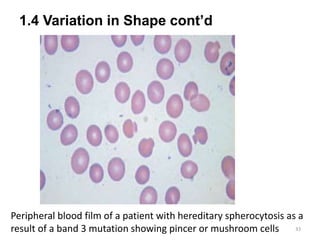
Peripheral blood film of a patient with hereditary spherocytosis as a
result of a band 3 mutation showing pincer or mushroom cells
1.4 Variation in Shape cont’d
34
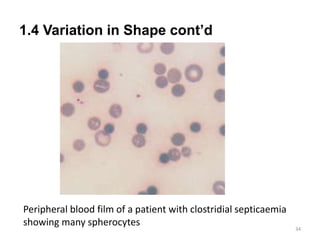
Peripheral blood film of a patient with clostridial septicaemia
showing many spherocytes
1.4 Variation in Shape cont’d
35
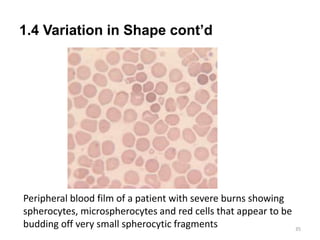
Peripheral blood film of a patient with severe burns showing
spherocytes, microspherocytes and red cells that appear to be
budding off very small spherocytic fragments
1.4 Variation in Shape cont’d
 They are commonly seen in hereditary spherocytosis
that is associated with:
abnormalities in membrane protein
lipid loss and
excessive flux of Na+ across the membrane
36
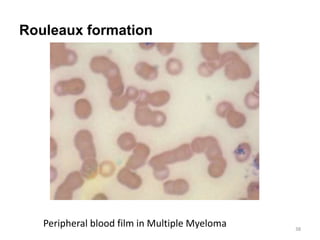
1.5. Rouleaux formation
(Abnormalities in Distribution)
 Red cells are aligned in formations resembling stacks of
coins
 May be seen as artifacts in the thick areas of the blood
film
 They are often associated with:
Hyperproteinemia
chronic inflammatory disorders
multiple myeloma
macroglobulinemia
37
Rouleaux formation
38
Peripheral blood film in Multiple Myeloma
Peripheral blood film showing
storage artefact a crenation
(echinocytosis), a disintegrated cell
and a neutrophil with a rounded
pyknotic nucleus.
Peripheral blood film showing
storage artefact, a mild crenation
and lobulation of a lymphocyte
nucleus.
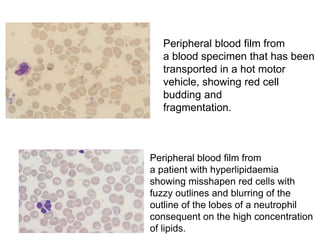
Peripheral blood film from
a blood specimen that has been
transported in a hot motor
vehicle, showing red cell
budding and
fragmentation.
Peripheral blood film from
a patient with hyperlipidaemia
showing misshapen red cells with
fuzzy outlines and blurring of the
outline of the lobes of a neutrophil
consequent on the high concentration
of lipids.
1.5 Abnormalities in Red cell Hemoglobinization
Hypochromia/Hypochromasia
 Hypochromic red cells:
Contain less than the normal amount of hemoglobin
The central pale area is increased to more than one-
third of the cell diameter
In severe hypochromia the hemoglobin appears as a
thin rim at the periphery of the cell
The cells are usually microcytic and may assume
target shape
41
1.5 Abnormalities in Red cell
Hemoglobinization cont’d
42
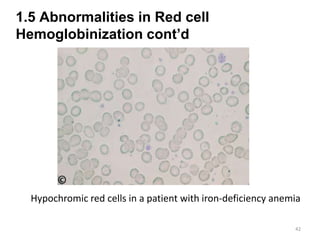
Hypochromic red cells in a patient with iron-deficiency anemia
1.5 Abnormalities in Red cell
Hemoglobinization cont’d
 It is a consistent finding in iron deficiency anemia,
thalassemia and sideroblastic anemia.
 In doubtful cases it is wise to compare the staining of the
suspect film with that of a normal film stained at the
same time
 Poor drying of the film may cause a 'false
hypochromia‘
This can be distinguished from a true one in that the
change in the central pale area is sudden while in true
hypochromia it is gradual
43
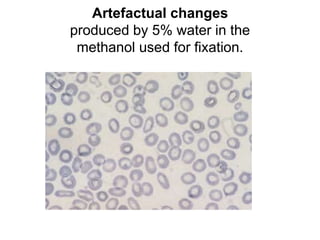
Artefactual changes
produced by 5% water in the
methanol used for fixation.
1.5 Abnormalities in Red cell
Hemoglobinization cont’d
Hyperchromia/Hyperchromasia
 Because over-saturation of a red cell can not take place,
true hyperchromia does not exist
 Usually, deep staining of red cells is seen in:
Macrocytosis when the red cell thickness is increased
and the mean cell volume also increased
Spherocytes in which the red cell thickness is greater
than normal and the mean cell hemoglobin
concentration is slightly increased
45
1.5 Abnormalities in Red cell
Hemoglobinization cont’d
Polychromasia/Polychromatophilia
 As reticulocytes contain residual RNA:
They will have the affinity for the basic component of
the Romanowsky stain, and
Assume a degree of blue staining proportional to the
amount of RNA
An increase in reticulocytes in the peripheral blood
will be seen as a polychromatic red cell population
which is also macrocytic
46
1.5 Abnormalities in Red cell
Hemoglobinization cont’d
47
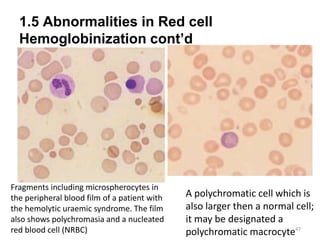
Fragments including microspherocytes in
the peripheral blood film of a patient with
the hemolytic uraemic syndrome. The film
also shows polychromasia and a nucleated
red blood cell (NRBC)
A polychromatic cell which is
also larger then a normal cell;
it may be designated a
polychromatic macrocyte
1.5 Abnormalities in Red cell
Hemoglobinization cont’d
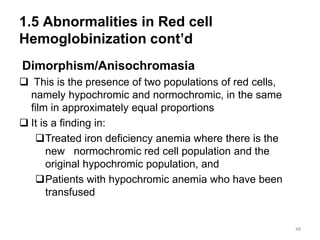
Dimorphism/Anisochromasia
 This is the presence of two populations of red cells,
namely hypochromic and normochromic, in the same
film in approximately equal proportions
 It is a finding in:
Treated iron deficiency anemia where there is the
new normochromic red cell population and the
original hypochromic population, and
Patients with hypochromic anemia who have been
transfused
48
1.5 Abnormalities in Red cell
Hemoglobinization cont’d
49
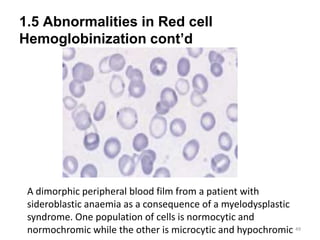
A dimorphic peripheral blood film from a patient with
sideroblastic anaemia as a consequence of a myelodysplastic
syndrome. One population of cells is normocytic and
normochromic while the other is microcytic and hypochromic
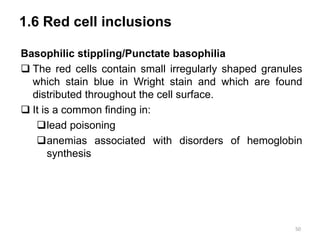
1.6 Red cell inclusions
Basophilic stippling/Punctate basophilia
 The red cells contain small irregularly shaped granules
which stain blue in Wright stain and which are found
distributed throughout the cell surface.
 It is a common finding in:
lead poisoning
anemias associated with disorders of hemoglobin
synthesis
50
1.6 Red cell inclusions cont’d
51
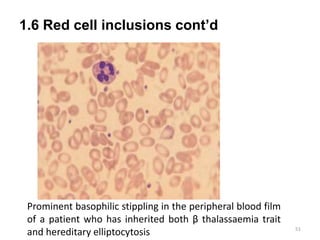
Prominent basophilic stippling in the peripheral blood film
of a patient who has inherited both β thalassaemia trait
and hereditary elliptocytosis
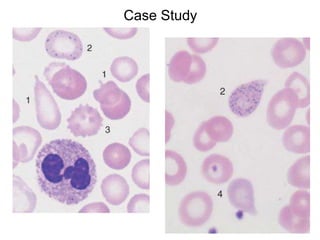
Case Study
1.6 Red cell inclusions cont’d
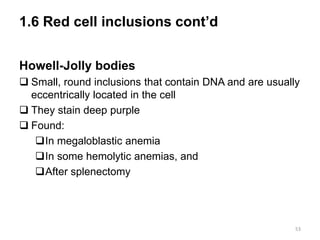
Howell-Jolly bodies
 Small, round inclusions that contain DNA and are usually
eccentrically located in the cell
 They stain deep purple
 Found:
In megaloblastic anemia
In some hemolytic anemias, and
After splenectomy
53
1.6 Red cell inclusions cont’d
54
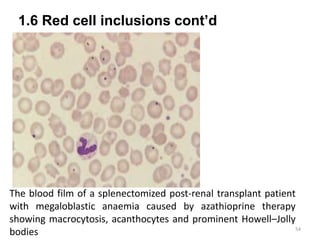
The blood film of a splenectomized post-renal transplant patient
with megaloblastic anaemia caused by azathioprine therapy
showing macrocytosis, acanthocytes and prominent Howell–Jolly
bodies
1.6 Red cell inclusions cont’d
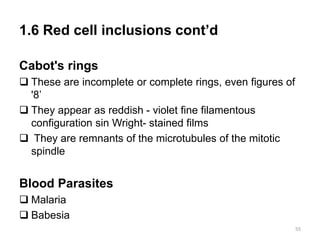
Cabot's rings
 These are incomplete or complete rings, even figures of
'8’
 They appear as reddish - violet fine filamentous
configuration sin Wright- stained films
 They are remnants of the microtubules of the mitotic
spindle
Blood Parasites
 Malaria
 Babesia
55
1.6 Red cell inclusions cont’d
56
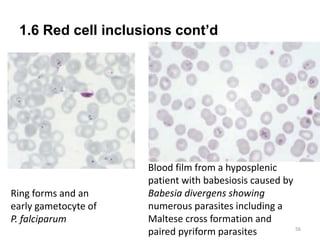
Ring forms and an
early gametocyte of
P. falciparum
Blood film from a hyposplenic
patient with babesiosis caused by
Babesia divergens showing
numerous parasites including a
Maltese cross formation and
paired pyriform parasites
Review of Abnormal RBC Morphology
Objectives
 Distinguish normal and abnormal RBC morphology with
respect to the following:
 Size, including alterations caused by a heterogeneous or
dimorphic RBC population
 Haemoglobin content
 RNA concentration (polychromasia/reticulocytes)
 Shape alterations
 RBC inclusion bodies
 Variations in red cell pattern
 Artifact
 List synonyms for abnormal RBC morphology
Objectives
 Identify the composition of RBC inclusion bodies, including
the following stains used to identify:
 Wright’s Romanowsky stain
 Perl’s Prussian blue iron stain
 Supravital stain
 Correlate abnormal RBC morphology with associated
conditions
Five RBC morphological
features are evaluated on the
blood smear:
 Variations in RBC Size
 Variations in RBC Color
 Variations in RBC Shape
 RBC Inclusions
 Variations in RBC Distribution/Pattern
Five RBC morphological
features are evaluated on the
blood smear:
 Variations in RBC Size**
 Variations in RBC Color
 Variations in RBC Shape
 RBC Inclusions
 Variations in RBC Distribution/Pattern
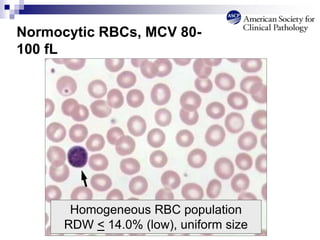
Normocytic RBCs, MCV 80-
100 fL
Homogeneous RBC population
RDW < 14.0% (low), uniform size
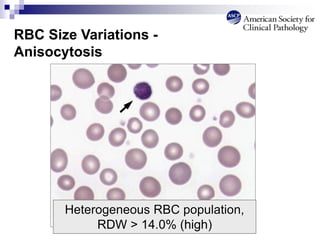
RBC Size Variations -
Anisocytosis
Heterogeneous RBC population,
RDW > 14.0% (high)
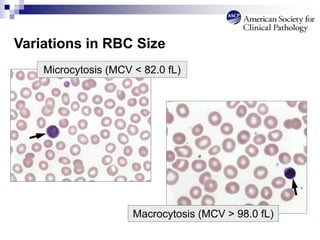
Variations in RBC Size
Microcytosis (MCV < 82.0 fL)
Macrocytosis (MCV > 98.0 fL)
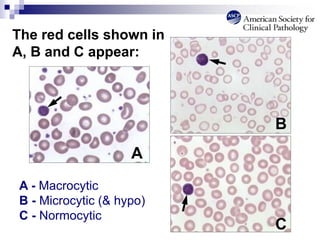
The red cells shown in
A, B and C appear:
A - Macrocytic
B - Microcytic (& hypo)
C - Normocytic
A
B
C
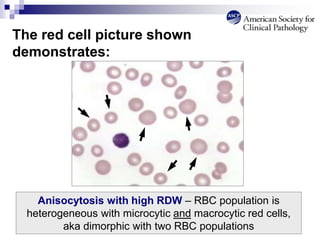
The red cell picture shown
demonstrates:
Anisocytosis with high RDW – RBC population is
heterogeneous with microcytic and macrocytic red cells,
aka dimorphic with two RBC populations
Five RBC morphological
features are evaluated on the
blood smear:
 Variations in RBC Size
 Variations in RBC Color**
 Variations in RBC Shape
 RBC Inclusions
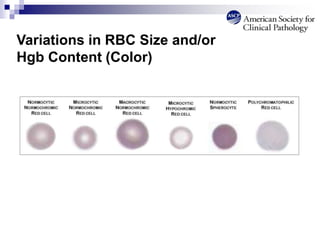
 Variations in RBC Distribution/Pattern
Variations in RBC Size and/or
Hgb Content (Color)
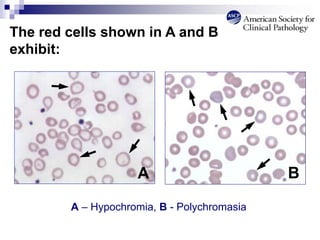
The red cells shown in A and B
exhibit:
A – Hypochromia, B - Polychromasia
B
A
 Variations in RBC Size
 Variations in RBC Color
 Variations in RBC Shape**
 RBC Inclusions
 Variations in RBC Distribution/Pattern
Five RBC morphological
features are evaluated on the
blood smear:
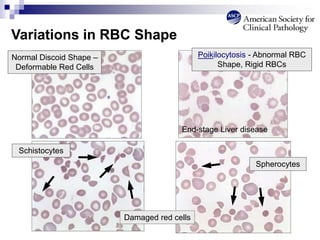
End-stage Liver disease
Spherocytes
Schistocytes
Poikilocytosis - Abnormal RBC
Shape, Rigid RBCs
Normal Discoid Shape –
Deformable Red Cells
Damaged red cells
Variations in RBC Shape
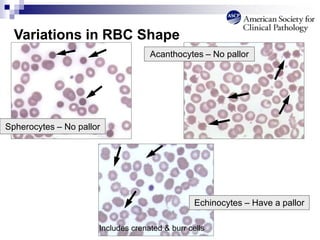
Spherocytes – No pallor
Acanthocytes – No pallor
Variations in RBC Shape
Echinocytes – Have a pallor
Includes crenated & burr cells
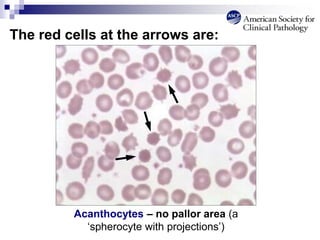
The red cells at the arrows are:
Acanthocytes – no pallor area (a
‘spherocyte with projections’)
Variations in RBC Shape
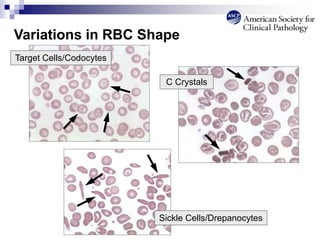
Target Cells/Codocytes
C Crystals
Sickle Cells/Drepanocytes
Variations in RBC Shape
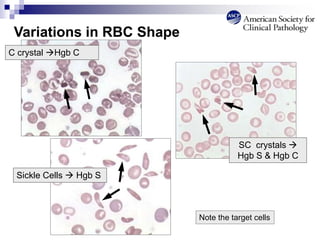
C crystal Hgb C
SC crystals 
Hgb S & Hgb C
Sickle Cells  Hgb S
Note the target cells
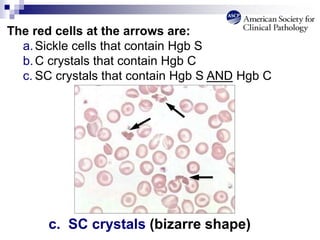
The red cells at the arrows are:
a.Sickle cells that contain Hgb S
b.C crystals that contain Hgb C
c. SC crystals that contain Hgb S AND Hgb C
c. SC crystals (bizarre shape)
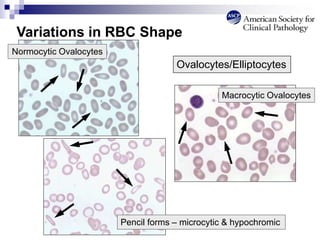
Variations in RBC Shape
Pencil forms – microcytic & hypochromic
Ovalocytes/Elliptocytes
Normocytic Ovalocytes
Macrocytic Ovalocytes
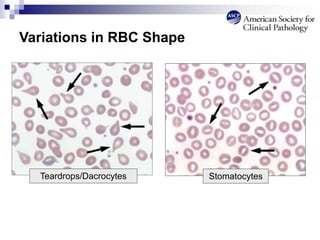
Variations in RBC Shape
Stomatocytes
Teardrops/Dacrocytes
 Variations in RBC Size
 Variations in RBC Color
 Variations in RBC Shape
 RBC Inclusions**
 Variations in RBC Distribution/Pattern
Five RBC morphological
features are evaluated on the
blood smear:
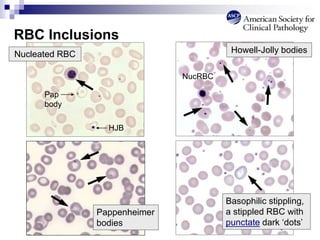
RBC Inclusions
Basophilic stippling,
a stippled RBC with
punctate dark ‘dots’
Howell-Jolly bodies
Pappenheimer
bodies
NucRBC
Nucleated RBC
HJB
Pap
body
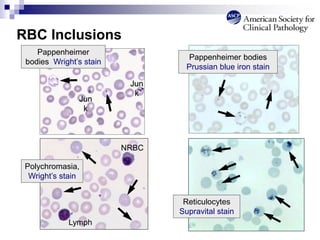
RBC Inclusions
Reticulocytes
Supravital stain
Polychromasia,
Wright’s stain
NRBC
Lymph
Pappenheimer bodies
Prussian blue iron stain
Pappenheimer
bodies Wright’s stain
Jun
k
Jun
k
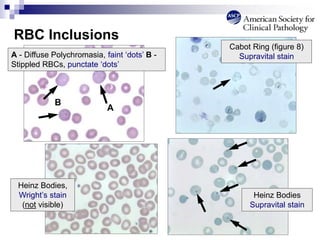
RBC Inclusions
B
A
A - Diffuse Polychromasia, faint ‘dots’ B -
Stippled RBCs, punctate ‘dots’
Cabot Ring (figure 8)
Supravital stain
Heinz Bodies,
Wright’s stain
(not visible)
Heinz Bodies
Supravital stain
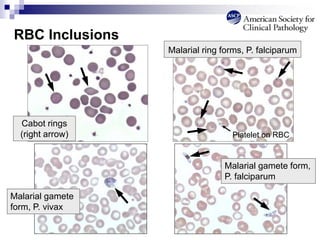
RBC Inclusions
Malarial gamete
form, P. vivax
Malarial gamete form,
P. falciparum
Malarial ring forms, P. falciparum
Platelet on RBC
Cabot rings
(right arrow)
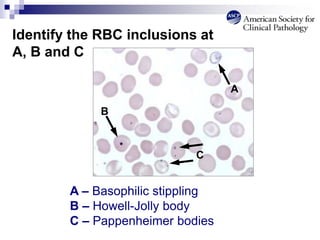
Identify the RBC inclusions at
A, B and C
A – Basophilic stippling
B – Howell-Jolly body
C – Pappenheimer bodies
B
C
A
 Variations in RBC Size
 Variations in RBC Color
 Variations in RBC Shape
 RBC Inclusions**
 Variations in RBC Distribution/Pattern
Five RBC morphological
features are evaluated on the
blood smear:
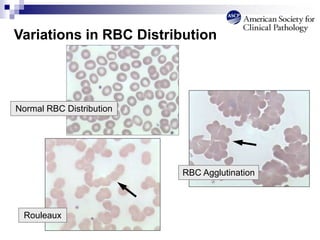
Variations in RBC Distribution
Rouleaux
RBC Agglutination
Normal RBC Distribution
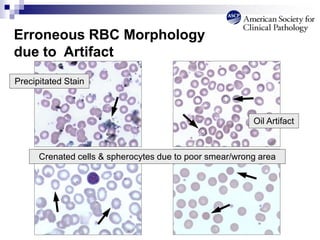
Erroneous RBC Morphology
due to Artifact
Oil Artifact
Precipitated Stain
Crenated cells & spherocytes due to poor smear/wrong area
Summary for RBC Morphology
RBC Morphology:
 Size, including alterations caused by a
heterogeneous or dimorphic RBC population
 Haemoglobin content
 RNA concentration (polychromasia/reticulocytes)
 Shape alterations
 RBC inclusion bodies
 Variations in red cell pattern
 Artifact
 synonyms for abnormal RBC morphology
 composition of RBC inclusion bodies, including stains
used to identify
 abnormal RBC morphology with associated
conditions
Review Questions
1. What parameters of the red cell morphology are
appraised in red cell morphology study on a stained
blood film? Supplement your answers with examples.
89
Bibliography
• MA Lichtman, E Beutler, U Seligsohn, K Kaushansky, TO
Kipps (Editors). William’s Hematology. 7th Ed. McGraw-
Hill Co. Inc. 2008.
• Dacie, John V and Lewis, S.M. Practical Hematology
10th Edition Churchill-Livingstone 2006.
• Wintrobe, Maxwell M. Clinical Hematology 11th Edition
Lea and Febiger, Philadelphia 2003.
90

Hema II Chapter 2_RBC morphology study_AT.ppt

  • 1.
    CHAPTER TWO RED CELLMORPHOLOGY STUDY 1
  • 2.
    Acknowledgements • Addisa AbabaUniversity • Jimma University • Haramaya University • Hawassa University • University of Gondar • American Society for Clinical Pathology • Center for Disease Control and Prevention-Ethiopia 2
  • 3.
    Objectives At the endof this chapter, the students shall be able to:  Explain the purpose of red cell morphology assessment  Describe the morphology of normal red cells  List and describe the different abnormal erythrocyte forms  Correlate the different abnormal RBC morphology with clinical entities  Perform assessment of red cell morphology on a stained blood film  Understand and apply the reporting system of the red cell morphology assessment findings 3
  • 4.
    1.1 INTRODUCTION  Themorphology of blood cells in stained films is the basis of laboratory diagnosis of hematologic disorders including: Anemias Leukemias Infections  A careful examination of a well-spread and well-stained film can be more informative than a series of investigations  The film should be covered with a cover glass using a neutral mounting medium this step is not, however, mandatory 4
  • 5.
    1.1 Introduction cont’d The blood film should be inspected under low power magnification in order to: get an idea of the quality of the preparation, i.e., whether red cell agglutination or excessive rouleaux is present get an idea of the number, distribution and staining of the leucocytes find an area where the red cells are evenly distributed and are not distorted  Having selected a suitable area, the 40x dry or 100x oil immersion objective is used to appreciate: variation in red cell size, shape and staining, and fine details such as cytoplasmic granules and other red cell inclusions 5
  • 6.
    Five RBC morphologicalfeatures are evaluated on the blood smear: • Variations in RBC Size • Variations in RBC Color • Variations in RBC Shape • RBC Inclusions • Variations in RBC Distribution/Pattern
  • 7.
    1.2 Morphology ofNormal Mature Red cells (Discocytes)  In health, red cells are said to be normocytic and normochromic  In well spread and stained films the great majority of the cells have: Round smooth contours Have diameters within the comparatively narrow range of 6.0-8.0m A thickness of 2.5m at the periphery and 1.0m in the center  As a rough guide, normal red cell size appears to be about the same as that of the nucleus of a small lymphocyte 7
  • 8.
    1.2 Morphology ofNormal Mature Red cells (Discocytes) cont’d  The hemoglobin stains with the eosin component of Romanowsky dyes and owing to the biconcavity of the cell, stains: More pale at the center, and Quite deeply at the periphery This depth and distribution of staining in normal red cells is described as normochromic 8
  • 9.
    1.2 Morphology ofNormal Mature Red cells 9 Peripheral blood film of a healthy subject showing normal red cells and platelets. The red cells show little variation in size and shape
  • 10.
    1.3 Size Variation(Anisocytosis) Macrocytes  Have diameter greater than 8.0m and the mean cell volume is also increased  Because of their increased hemoglobin content they stain darker than discocytes  Macrocytosis is seen in stress erythropoiesis as seen in conditions such as hemolytic anemia and also during recovery from acute blood loss, and Megaloblastic anemia 10
  • 11.
    1.3 Size Variationcont’d 11 The film also shows anisocytosis with both microcytes and macrocytes
  • 12.
    1.3 Size Variationcont’d Megalocytes  Large (greater diameter may measure 12m), often oval shaped cells with increased hemoglobin content 12
  • 13.
    1.3 Size Variationcont’d  True megalocytes are identified only if megaloblasts have been identified in bone marrow aspirates  Megalocytes are seen in vitamin B12 and/or folic acid deficiency, in association with some leukemias and in refractory anemias Microcytes  Have diameter less than 6.0m but may appear to have normal size caused by flattening of the cells during smear preparation  The mean cell volume is decreased to less than 80.0fl  Area of central pallor usually increases because of the coexistent hypochromia  Are seen in iron deficiency anemia and a slight degree of microcytosis is seen in inflammation 13
  • 14.
    1.3 Size Variationcont’d 14 Microcytosis in a patient with β thalassaemia trait
  • 15.
    1.4 Variation inShape (Poikilocytosis) Acanthocytes ('spiny cells')  Spheroidal cells with 3-12 spicules of uneven length irregularly distributed over the cell surface.  Seen in: disorders of lipid metabolism alcoholic liver cirrhosis and Hepatitis 15
  • 16.
    1.4 Variation inShape cont’d 16 Acanthocytes in a patient with anorexia nervosa
  • 17.
    1.4 Variation inShape cont’d Dacrocytes ('Tear drop cells')  These are tear drop or pear shaped red cells  Could be considered to be discocytes with a single drawn out spicule.  It is thought that stretching of the cell membrane beyond a certain limit results in loss of deformability and ability to revert to normal discoid shape.  Seen in: Myelofibrosis, Myeloid metaplasia  Tumour metastases to the bone marrow  Tuberculosis Drug-induced Heinz body formation 17
  • 18.
    1.4 Variation inShape cont’d 18 Tear drop cells
  • 19.
    1.4 Variation inShape cont’d Drepanocytes ('sickle cells')  These are crescent shaped red cells because of the formation of rod-like polymers of Hb S or some other rare hemoglobins  Have an increased surface area and increased mechanical fragility which leads to hemolysis and hence severe anemia  They are primarily seen in sickle cell anemia where there is substitution of valine for glutamic acid at position 6 of the beta chain in the hemoglobin molecule 19
  • 20.
    1.4 Variation inShape cont’d 20 Sickle cells in a patient with sickle cell anemia
  • 21.
    1.4 Variation inShape cont’d Echinocytes ('crenated cells')  Red cells showing numerous, short, evenly distributed spicules of equal length  These are probably the most common artifacts in a blood film: Consistently found in blood samples that have been stored for some time at room temperature and  Because of diffusion of alkaline substances from the slide into the cells resulting in an increase in pH and thus crenation of the cells  In vivo they are seen in uremia, pyruvate kinase deficiency and neonatal liver diseases 21
  • 22.
    1.4 Variation inShape cont’d 22 Echinocytes Peripheral blood film showing storage Artefact-crenation (echinocytosis), a disintegrated cell and a neutrophil with a rounded pyknotic nucleus
  • 23.
    1.4 Variation inShape cont’d Elliptocytes/ovalocytes  Elliptical or oval shaped red cells. Normally less than 1% of the red cells are elliptical/oval shaped.  Found in almost all anemias where approximately 10% of the red cells may assume elliptical/oval shape and in hereditary elliptocytosis where almost all the red cells are elliptical. 23
  • 24.
    1.4 Variation inShape cont’d 24 Peripheral blood film of a patient with hereditary elliptocytosis showing elliptocytes and ovalocytes
  • 25.
    1.4 Variation inShape cont’d Schistocytes ('fragmented cells')  Two types can be distinguished: Small fragments of cells of varying shape, sometimes with sharp angles or spines ('spur cells'), sometimes round in contour, usually staining deeply but occasionally palely as a result of loss of hemoglobin at the time of fragmentation 25
  • 26.
    1.4 Variation inShape cont’d 26 Schistocytes Peripheral blood film of a patient with compound heterozygosity for hemoglobin S and hemoglobin S- Oman showing the ‘Napoleon hat’ red cells that are characteristic of hemoglobin S- Oman
  • 27.
    1.4 Variation inShape cont’d 27 Schistocytes Peripheral blood film of a patient with compound heterozygosity for haemoglobin S and haemoglobin S-Oman showing the ‘Napoleon hat’ red cells that are characteristic of haemoglobin S-Oman
  • 28.
    1.4 Variation inShape cont’d Larger cells mainly with round contour from which fragments have been split off, e.g., 'helmet cells'  They are findings in: Certain genetically determined disorders, e.g., The thalassemias Hereditary elliptocytosis Acquired disorders of red cell formation, megaloblastic and iron deficiency anemias Direct thermal injury as in severe burns Burr cells  Small cells or cell fragments bearing one or a few spines  Found particularly in uremia 28
  • 29.
    1.4 Variation inShape cont’d Leptocytes ('target cells'/'Mexican hat cells')  These are cells showing an area of central staining  They are abnormally thin cells  They are common findings in obstructive liver diseases where there is accumulation of cholesterol and lecithin due to inhibition of plasma LCAT activity by bile salts  Variable numbers are seen in iron deficiency anemia and thalassemia  There is gross target cell formation after splenectomy 29
  • 30.
    1.4 Variation inShape cont’d 30 Peripheral blood film of a patient with hemoglobin C disease showing irregularly contracted cells and several target cells
  • 31.
    1.4 Variation inShape cont’d Stomatocytes  These are cells with a narrow slit like area of central pallor  They are common findings in liver diseases associated with chronic alcohol abuse 31
  • 32.
    1.4 Variation inShape cont’d Spherocytes/Microspherocytes  Dense staining spherical cells with smaller diameter and greater thickness than normal  They are formed as a result of loss of membrane due to: Genetic lack of structural proteins in the red cell membrane Chemicals Bacterial toxins (Clostridium welchii) Antibody-mediated hemolytic anemias Burn injury 32
  • 33.
    1.4 Variation inShape cont’d 33 Peripheral blood film of a patient with hereditary spherocytosis as a result of a band 3 mutation showing pincer or mushroom cells
  • 34.
    1.4 Variation inShape cont’d 34 Peripheral blood film of a patient with clostridial septicaemia showing many spherocytes
  • 35.
    1.4 Variation inShape cont’d 35 Peripheral blood film of a patient with severe burns showing spherocytes, microspherocytes and red cells that appear to be budding off very small spherocytic fragments
  • 36.
    1.4 Variation inShape cont’d  They are commonly seen in hereditary spherocytosis that is associated with: abnormalities in membrane protein lipid loss and excessive flux of Na+ across the membrane 36
  • 37.
    1.5. Rouleaux formation (Abnormalitiesin Distribution)  Red cells are aligned in formations resembling stacks of coins  May be seen as artifacts in the thick areas of the blood film  They are often associated with: Hyperproteinemia chronic inflammatory disorders multiple myeloma macroglobulinemia 37
  • 38.
  • 39.
    Peripheral blood filmshowing storage artefact a crenation (echinocytosis), a disintegrated cell and a neutrophil with a rounded pyknotic nucleus. Peripheral blood film showing storage artefact, a mild crenation and lobulation of a lymphocyte nucleus.
  • 40.
    Peripheral blood filmfrom a blood specimen that has been transported in a hot motor vehicle, showing red cell budding and fragmentation. Peripheral blood film from a patient with hyperlipidaemia showing misshapen red cells with fuzzy outlines and blurring of the outline of the lobes of a neutrophil consequent on the high concentration of lipids.
  • 41.
    1.5 Abnormalities inRed cell Hemoglobinization Hypochromia/Hypochromasia  Hypochromic red cells: Contain less than the normal amount of hemoglobin The central pale area is increased to more than one- third of the cell diameter In severe hypochromia the hemoglobin appears as a thin rim at the periphery of the cell The cells are usually microcytic and may assume target shape 41
  • 42.
    1.5 Abnormalities inRed cell Hemoglobinization cont’d 42 Hypochromic red cells in a patient with iron-deficiency anemia
  • 43.
    1.5 Abnormalities inRed cell Hemoglobinization cont’d  It is a consistent finding in iron deficiency anemia, thalassemia and sideroblastic anemia.  In doubtful cases it is wise to compare the staining of the suspect film with that of a normal film stained at the same time  Poor drying of the film may cause a 'false hypochromia‘ This can be distinguished from a true one in that the change in the central pale area is sudden while in true hypochromia it is gradual 43
  • 44.
    Artefactual changes produced by5% water in the methanol used for fixation.
  • 45.
    1.5 Abnormalities inRed cell Hemoglobinization cont’d Hyperchromia/Hyperchromasia  Because over-saturation of a red cell can not take place, true hyperchromia does not exist  Usually, deep staining of red cells is seen in: Macrocytosis when the red cell thickness is increased and the mean cell volume also increased Spherocytes in which the red cell thickness is greater than normal and the mean cell hemoglobin concentration is slightly increased 45
  • 46.
    1.5 Abnormalities inRed cell Hemoglobinization cont’d Polychromasia/Polychromatophilia  As reticulocytes contain residual RNA: They will have the affinity for the basic component of the Romanowsky stain, and Assume a degree of blue staining proportional to the amount of RNA An increase in reticulocytes in the peripheral blood will be seen as a polychromatic red cell population which is also macrocytic 46
  • 47.
    1.5 Abnormalities inRed cell Hemoglobinization cont’d 47 Fragments including microspherocytes in the peripheral blood film of a patient with the hemolytic uraemic syndrome. The film also shows polychromasia and a nucleated red blood cell (NRBC) A polychromatic cell which is also larger then a normal cell; it may be designated a polychromatic macrocyte
  • 48.
    1.5 Abnormalities inRed cell Hemoglobinization cont’d Dimorphism/Anisochromasia  This is the presence of two populations of red cells, namely hypochromic and normochromic, in the same film in approximately equal proportions  It is a finding in: Treated iron deficiency anemia where there is the new normochromic red cell population and the original hypochromic population, and Patients with hypochromic anemia who have been transfused 48
  • 49.
    1.5 Abnormalities inRed cell Hemoglobinization cont’d 49 A dimorphic peripheral blood film from a patient with sideroblastic anaemia as a consequence of a myelodysplastic syndrome. One population of cells is normocytic and normochromic while the other is microcytic and hypochromic
  • 50.
    1.6 Red cellinclusions Basophilic stippling/Punctate basophilia  The red cells contain small irregularly shaped granules which stain blue in Wright stain and which are found distributed throughout the cell surface.  It is a common finding in: lead poisoning anemias associated with disorders of hemoglobin synthesis 50
  • 51.
    1.6 Red cellinclusions cont’d 51 Prominent basophilic stippling in the peripheral blood film of a patient who has inherited both β thalassaemia trait and hereditary elliptocytosis
  • 52.
  • 53.
    1.6 Red cellinclusions cont’d Howell-Jolly bodies  Small, round inclusions that contain DNA and are usually eccentrically located in the cell  They stain deep purple  Found: In megaloblastic anemia In some hemolytic anemias, and After splenectomy 53
  • 54.
    1.6 Red cellinclusions cont’d 54 The blood film of a splenectomized post-renal transplant patient with megaloblastic anaemia caused by azathioprine therapy showing macrocytosis, acanthocytes and prominent Howell–Jolly bodies
  • 55.
    1.6 Red cellinclusions cont’d Cabot's rings  These are incomplete or complete rings, even figures of '8’  They appear as reddish - violet fine filamentous configuration sin Wright- stained films  They are remnants of the microtubules of the mitotic spindle Blood Parasites  Malaria  Babesia 55
  • 56.
    1.6 Red cellinclusions cont’d 56 Ring forms and an early gametocyte of P. falciparum Blood film from a hyposplenic patient with babesiosis caused by Babesia divergens showing numerous parasites including a Maltese cross formation and paired pyriform parasites
  • 57.
    Review of AbnormalRBC Morphology
  • 58.
    Objectives  Distinguish normaland abnormal RBC morphology with respect to the following:  Size, including alterations caused by a heterogeneous or dimorphic RBC population  Haemoglobin content  RNA concentration (polychromasia/reticulocytes)  Shape alterations  RBC inclusion bodies  Variations in red cell pattern  Artifact  List synonyms for abnormal RBC morphology
  • 59.
    Objectives  Identify thecomposition of RBC inclusion bodies, including the following stains used to identify:  Wright’s Romanowsky stain  Perl’s Prussian blue iron stain  Supravital stain  Correlate abnormal RBC morphology with associated conditions
  • 60.
    Five RBC morphological featuresare evaluated on the blood smear:  Variations in RBC Size  Variations in RBC Color  Variations in RBC Shape  RBC Inclusions  Variations in RBC Distribution/Pattern
  • 61.
    Five RBC morphological featuresare evaluated on the blood smear:  Variations in RBC Size**  Variations in RBC Color  Variations in RBC Shape  RBC Inclusions  Variations in RBC Distribution/Pattern
  • 62.
    Normocytic RBCs, MCV80- 100 fL Homogeneous RBC population RDW < 14.0% (low), uniform size
  • 63.
    RBC Size Variations- Anisocytosis Heterogeneous RBC population, RDW > 14.0% (high)
  • 64.
    Variations in RBCSize Microcytosis (MCV < 82.0 fL) Macrocytosis (MCV > 98.0 fL)
  • 65.
    The red cellsshown in A, B and C appear: A - Macrocytic B - Microcytic (& hypo) C - Normocytic A B C
  • 66.
    The red cellpicture shown demonstrates: Anisocytosis with high RDW – RBC population is heterogeneous with microcytic and macrocytic red cells, aka dimorphic with two RBC populations
  • 67.
    Five RBC morphological featuresare evaluated on the blood smear:  Variations in RBC Size  Variations in RBC Color**  Variations in RBC Shape  RBC Inclusions  Variations in RBC Distribution/Pattern
  • 68.
    Variations in RBCSize and/or Hgb Content (Color)
  • 69.
    The red cellsshown in A and B exhibit: A – Hypochromia, B - Polychromasia B A
  • 70.
     Variations inRBC Size  Variations in RBC Color  Variations in RBC Shape**  RBC Inclusions  Variations in RBC Distribution/Pattern Five RBC morphological features are evaluated on the blood smear:
  • 71.
    End-stage Liver disease Spherocytes Schistocytes Poikilocytosis- Abnormal RBC Shape, Rigid RBCs Normal Discoid Shape – Deformable Red Cells Damaged red cells Variations in RBC Shape
  • 72.
    Spherocytes – Nopallor Acanthocytes – No pallor Variations in RBC Shape Echinocytes – Have a pallor Includes crenated & burr cells
  • 73.
    The red cellsat the arrows are: Acanthocytes – no pallor area (a ‘spherocyte with projections’)
  • 74.
    Variations in RBCShape Target Cells/Codocytes C Crystals Sickle Cells/Drepanocytes
  • 75.
    Variations in RBCShape C crystal Hgb C SC crystals  Hgb S & Hgb C Sickle Cells  Hgb S Note the target cells
  • 76.
    The red cellsat the arrows are: a.Sickle cells that contain Hgb S b.C crystals that contain Hgb C c. SC crystals that contain Hgb S AND Hgb C c. SC crystals (bizarre shape)
  • 77.
    Variations in RBCShape Pencil forms – microcytic & hypochromic Ovalocytes/Elliptocytes Normocytic Ovalocytes Macrocytic Ovalocytes
  • 78.
    Variations in RBCShape Stomatocytes Teardrops/Dacrocytes
  • 79.
     Variations inRBC Size  Variations in RBC Color  Variations in RBC Shape  RBC Inclusions**  Variations in RBC Distribution/Pattern Five RBC morphological features are evaluated on the blood smear:
  • 80.
    RBC Inclusions Basophilic stippling, astippled RBC with punctate dark ‘dots’ Howell-Jolly bodies Pappenheimer bodies NucRBC Nucleated RBC HJB Pap body
  • 81.
    RBC Inclusions Reticulocytes Supravital stain Polychromasia, Wright’sstain NRBC Lymph Pappenheimer bodies Prussian blue iron stain Pappenheimer bodies Wright’s stain Jun k Jun k
  • 82.
    RBC Inclusions B A A -Diffuse Polychromasia, faint ‘dots’ B - Stippled RBCs, punctate ‘dots’ Cabot Ring (figure 8) Supravital stain Heinz Bodies, Wright’s stain (not visible) Heinz Bodies Supravital stain
  • 83.
    RBC Inclusions Malarial gamete form,P. vivax Malarial gamete form, P. falciparum Malarial ring forms, P. falciparum Platelet on RBC Cabot rings (right arrow)
  • 84.
    Identify the RBCinclusions at A, B and C A – Basophilic stippling B – Howell-Jolly body C – Pappenheimer bodies B C A
  • 85.
     Variations inRBC Size  Variations in RBC Color  Variations in RBC Shape  RBC Inclusions**  Variations in RBC Distribution/Pattern Five RBC morphological features are evaluated on the blood smear:
  • 86.
    Variations in RBCDistribution Rouleaux RBC Agglutination Normal RBC Distribution
  • 87.
    Erroneous RBC Morphology dueto Artifact Oil Artifact Precipitated Stain Crenated cells & spherocytes due to poor smear/wrong area
  • 88.
    Summary for RBCMorphology RBC Morphology:  Size, including alterations caused by a heterogeneous or dimorphic RBC population  Haemoglobin content  RNA concentration (polychromasia/reticulocytes)  Shape alterations  RBC inclusion bodies  Variations in red cell pattern  Artifact  synonyms for abnormal RBC morphology  composition of RBC inclusion bodies, including stains used to identify  abnormal RBC morphology with associated conditions
  • 89.
    Review Questions 1. Whatparameters of the red cell morphology are appraised in red cell morphology study on a stained blood film? Supplement your answers with examples. 89
  • 90.
    Bibliography • MA Lichtman,E Beutler, U Seligsohn, K Kaushansky, TO Kipps (Editors). William’s Hematology. 7th Ed. McGraw- Hill Co. Inc. 2008. • Dacie, John V and Lewis, S.M. Practical Hematology 10th Edition Churchill-Livingstone 2006. • Wintrobe, Maxwell M. Clinical Hematology 11th Edition Lea and Febiger, Philadelphia 2003. 90