


BLAST
Kishan Sharma
M.Sc. 2nd Year
Biotechnology
Manipal University
Jaipur
BLAST
 Basic Local Alignment Search Tool
 It is a sequence similarity search program for comparing
biological sequences such as amino acid sequence of
different proteins or the nucleotides of DNA sequences with
sequence database or library sequences.
BLAST
 BLAST was designed by Eugene Myers , Samuel Karlin ,
Stephen Altschul, Warren Gish, David J. Lipman and Webb
Miller at the National Institute of Health and was published in
Journal of Molecular Biology in 1990.
 It was originally developed & controlled by NCBI .
 Link: http://www.ncbi.nlm.nih.gov/BLAST/
BLAST
 Sequence alignments provide a powerful way to compare
sequences with previously characterized genes.
 Both functional and evolutionary information can be inferred from
well designed queries and alignments.
 The BLAST detects local as well as global alignments and regions
of similarity in unrelated proteins can be detected.
BLAST
BLAST types
 Blastp : compares protein query against proteins sequence
database.
 tBlastn : Compares a protein query sequence against a
nucleotide sequence database.
 Blastn : compares nucleotide query against nucleotide
sequence database.
BLAST types
 Blastx : Compares a nucleotide query sequence translated in
all reading frames against a protein sequence database.
 This option may be used to find potential translation
products of an unknown nucleotide sequence.
 tBlastx : compares nucleotide query against translated
nucleotide sequence database.
BLAST
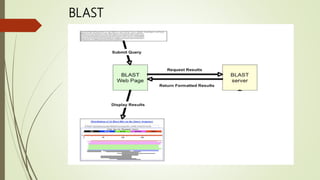
 All BLAST programs use a substitution scoring matrix (BLOSUM or
PAM), determines pair-wise alignment scores.
 BLAST finds homologous sequences , not by comparing either
sequences in its entirety, but rather by locating short matches
between the two sequences.
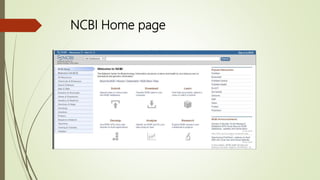
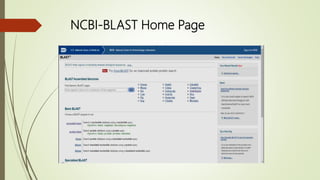
NCBI Home page
NCBI-BLAST Home Page
Applications of BLAST
 Identifying Species: With the use of BLAST, you can possibly correctly
identify a species and/or find homologous species.
 This can be useful, for example, when one is working with a DNA
sequence from an unknown species.
 Establishing Phylogeny: Using the results received through BLAST,
one can create a phylogenetic tree using the BLAST web-page.
Applications of BLAST
 DNA Mapping: When working with a known species, and looking to
sequence a gene at an unknown location, BLAST can compare the
chromosomal position of the sequence of interest, to relevant sequences
in the database.
 Locating Domains: When working with a protein sequence you can
input it into BLAST, to locate known domains within the sequence of
interest.
 Comparison: When working with genes, BLAST can locate common
genes in two related species, and can be used to map annotations from
one organism to another.
Thankyou

BLAST Search tool

  • 1.
    BLAST Kishan Sharma M.Sc. 2ndYear Biotechnology Manipal University Jaipur
  • 2.
    BLAST  Basic LocalAlignment Search Tool  It is a sequence similarity search program for comparing biological sequences such as amino acid sequence of different proteins or the nucleotides of DNA sequences with sequence database or library sequences.
  • 3.
    BLAST  BLAST wasdesigned by Eugene Myers , Samuel Karlin , Stephen Altschul, Warren Gish, David J. Lipman and Webb Miller at the National Institute of Health and was published in Journal of Molecular Biology in 1990.  It was originally developed & controlled by NCBI .  Link: http://www.ncbi.nlm.nih.gov/BLAST/
  • 4.
    BLAST  Sequence alignmentsprovide a powerful way to compare sequences with previously characterized genes.  Both functional and evolutionary information can be inferred from well designed queries and alignments.  The BLAST detects local as well as global alignments and regions of similarity in unrelated proteins can be detected.
  • 5.
  • 6.
    BLAST types  Blastp: compares protein query against proteins sequence database.  tBlastn : Compares a protein query sequence against a nucleotide sequence database.  Blastn : compares nucleotide query against nucleotide sequence database.
  • 7.
    BLAST types  Blastx: Compares a nucleotide query sequence translated in all reading frames against a protein sequence database.  This option may be used to find potential translation products of an unknown nucleotide sequence.  tBlastx : compares nucleotide query against translated nucleotide sequence database.
  • 8.
    BLAST  All BLASTprograms use a substitution scoring matrix (BLOSUM or PAM), determines pair-wise alignment scores.  BLAST finds homologous sequences , not by comparing either sequences in its entirety, but rather by locating short matches between the two sequences.
  • 9.
  • 10.
  • 11.
    Applications of BLAST Identifying Species: With the use of BLAST, you can possibly correctly identify a species and/or find homologous species.  This can be useful, for example, when one is working with a DNA sequence from an unknown species.  Establishing Phylogeny: Using the results received through BLAST, one can create a phylogenetic tree using the BLAST web-page.
  • 12.
    Applications of BLAST DNA Mapping: When working with a known species, and looking to sequence a gene at an unknown location, BLAST can compare the chromosomal position of the sequence of interest, to relevant sequences in the database.  Locating Domains: When working with a protein sequence you can input it into BLAST, to locate known domains within the sequence of interest.  Comparison: When working with genes, BLAST can locate common genes in two related species, and can be used to map annotations from one organism to another.
  • 13.