BLACKOUT AVOIDANCE
&
UNDERVOLTAGE LOAD
SHEDDING
BLACKOUT AVOIDANCE
&
UNDERVOLTAGE LOAD
SHEDDING
Chuck Mozina
Consultant
Beckwith Electric
Chuck Mozina
Consultant
Beckwith Electric
BLACKOUTS
How and why they occur
Why voltage rather than frequency is the
leading edge indicator of system collapse
How blackout conditions effect generators
and generator protection
Undervoltage load shedding
Blackout Avoidance
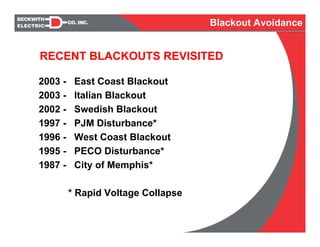
RECENT BLACKOUTS
2003 - East Coast Blackout
2003 - Italian Blackout
2002 - Swedish Blackout
1997 - PJM Disturbance
1996 - West Coast Blackout
1995 - PECO Disturbance
1987 - City of Memphis
Blackout Avoidance
Root Cause of Recent Blackouts
VOLTAGE COLLAPSE – WHY?
Today, major generation sources are remote from
load centers. This was NOT the case 35 years
ago.
This makes the power system very reliant on
transmission system to transport power to load
centers.
Blackout Avoidance
VOLTAGE COLLAPSE – WHY?
Purchase power from remote sources to save
$$$.
New generation built remotely from load
centers.
Little new transmission being built.
Utility loads are increasingly made up of air
conditioning motors susceptible to stall
conditions due to transmission system faults.
Root Cause of Recent Blackouts
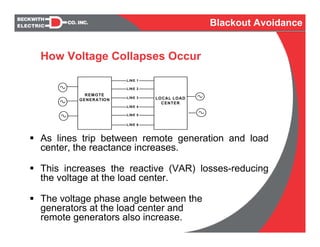
Blackout Avoidance
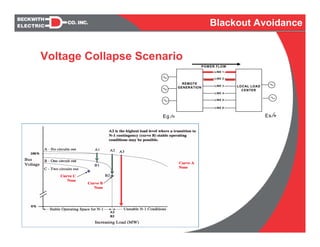
As lines trip between remote generation and load
center, the reactance increases.
This increases the reactive (VAR) losses-reducing
the voltage at the load center.
The voltage phase angle between the
generators at the load center and
remote generators also increase.
REMOTE
GENERATION LOCAL LOAD
CENTER
LINE 1
LINE 2
LINE 3
LINE 4
LINE 5
LINE 6
How Voltage Collapses Occur
Blackout Avoidance
POWER TRANSFER
EXAMPLE
POWER TRANSFER
EXAMPLE
Blackout Avoidance
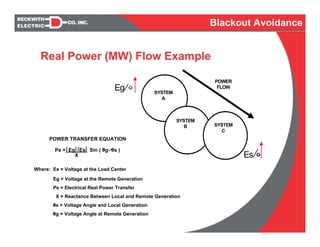
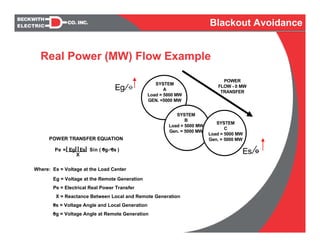
Real Power (MW) Flow Example
SYSTEM
A
SYSTEM
B SYSTEM
C
Eg O
Es O
POWER
FLOW
Blackout Avoidance
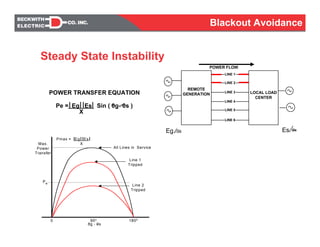
Pe = Eg Es Sin ( 0g- 0s )
X
Where: Eg = Voltage at the Load Center
Generation
Es = Voltage at the Remote Generation
Pe = Electrical Real Power Transfer
X = Reactance Between Local and
Remote Generation
0g = Votage Angle and Local Generation
0s = Voltage Angle at Remote Generation
POWER TRANSFER EQUATION
Where: Es = Voltage at the Load Center
Eg = Voltage at the Remote Generation
Pe = Electrical Real Power Transfer
X = Reactance Between Local and Remote Generation
0s = Voltage Angle and Local Generation
0g = Voltage Angle at Remote Generation
Pe = Eg Es Sin ( 0g- 0s )
X
Where: Eg = Voltage at the Load Center
Generation
Es = Voltage at the Remote Generation
Pe = Electrical Real Power Transfer
X = Reactance Between Local and
Remote Generation
0g = Voltage Angle and Local Generation
0s = Voltage Angle at Remote Generation
POWER TRANSFER EQUATION
SYSTEM
A
Load = 5000 MW
GEN. =5000 MW
SYSTEM
B
Load = 5000 MW
Gen. = 5000 MW
SYSTEM
C
Load = 5000 MW
Gen. = 5000 MW
Eg O
Es O
POWER
FLOW - 0 MW
TRANSFER
Real Power (MW) Flow Example
Blackout Avoidance
Where: Es = Voltage at the Load Center
Eg = Voltage at the Remote Generation
Pe = Electrical Real Power Transfer
X = Reactance Between Local and Remote Generation
0s = Voltage Angle and Local Generation
0g = Voltage Angle at Remote Generation
Pe = Eg Es Sin ( 0g- 0s )
X
Where: Eg = Voltage at the Load Center
Generation
Es = Voltage at the Remote Generation
Pe = Electrical Real Power Transfer
X = Reactance Between Local and
Remote Generation
0g = Voltage Angle and Local Generation
0s = Voltage Angle at Remote Generation
POWER TRANSFER EQUATION
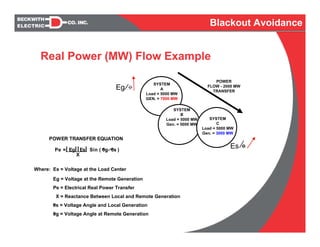
Real Power (MW) Flow Example
SYSTEM
A
Load = 5000 MW
GEN. = 7000 MW
SYSTEM
B
Load = 5000 MW
Gen. = 5000 MW
SYSTEM
C
Load = 5000 MW
Gen. = 3000 MW
Eg O
Es O
POWER
FLOW - 2000 MW
TRANSFER
Blackout Avoidance
Where: Es = Voltage at the Load Center
Eg = Voltage at the Remote Generation
Pe = Electrical Real Power Transfer
X = Reactance Between Local and Remote Generation
0s = Voltage Angle and Local Generation
0g = Voltage Angle at Remote Generation
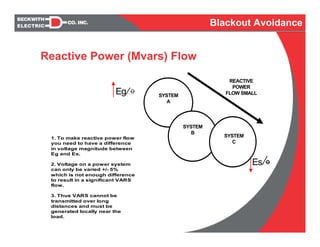
SYSTEM
A
SYSTEM
B
SYSTEM
C
Eg O
Es O
REACTIVE
POWER
FLOW SMALL
1. To make reactive power flow
you need to have a difference
in voltage magnitude between
Eg and Es.
2. Voltage on a power system
can only be varied +/- 5%
which is not enough difference
to result in a significant VARS
flow.
3. Thus VARS cannot be
transmitted over long
distances and must be
generated locally near the
load.
Reactive Power (Mvars) Flow
Blackout Avoidance
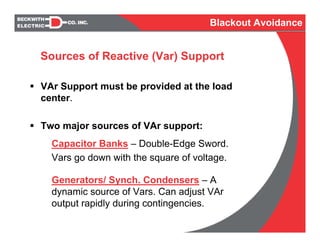
VAr Support must be provided at the load
center.
Two major sources of VAr support:
Capacitor Banks – Double-Edge Sword.
Vars go down with the square of voltage.
Generators/ Synch. Condensers – A
dynamic source of Vars. Can adjust VAr
output rapidly during contingencies.
Sources of Reactive (Var) Support
Blackout Avoidance
LOAD RESPONSE
TO
LOW VOLTAGE
LOAD RESPONSE
TO
LOW VOLTAGE
Blackout Avoidance
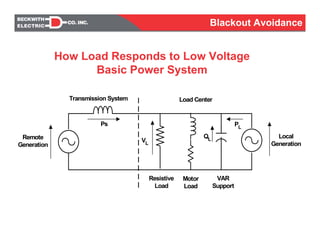
How Load Responds to Low Voltage
Basic Power System
Remote
Generation
Transmission System Load Center
Resistive
Load
Motor
Load
VAR
Support
Local
Generation
Ps PL
QLVL
Blackout Avoidance
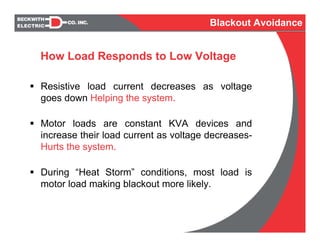
Resistive load current decreases as voltage
goes down Helping the system.
Motor loads are constant KVA devices and
increase their load current as voltage decreases-
Hurts the system.
During “Heat Storm” conditions, most load is
motor load making blackout more likely.
How Load Responds to Low Voltage
Blackout Avoidance
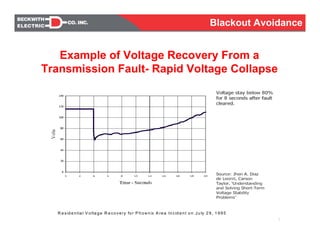
Example of Voltage Recovery From a
Transmission Fault- Rapid Voltage Collapse
R e sid e n tia l V o lta g e R e co ve ry fo r P h o e n ix A re a In cid e n t o n Ju ly 2 9 , 1 9 9 5
Blackout Avoidance
RECENT BLACKOUTS REVISITED
2003 - East Coast Blackout
2003 - Italian Blackout
2002 - Swedish Blackout
1997 - PJM Disturbance*
1996 - West Coast Blackout
1995 - PECO Disturbance*
1987 - City of Memphis*
* Rapid Voltage Collapse
Blackout Avoidance
POWER SYSTEM
INSTABILITY
POWER SYSTEM
INSTABILITY
Blackout Avoidance
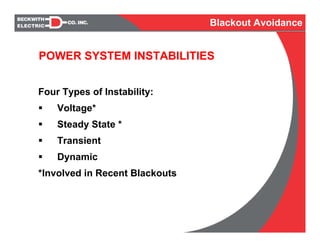
POWER SYSTEM INSTABILITIES
Four Types of Instability:
Voltage*
Steady State *
Transient
Dynamic
*Involved in Recent Blackouts
Blackout Avoidance
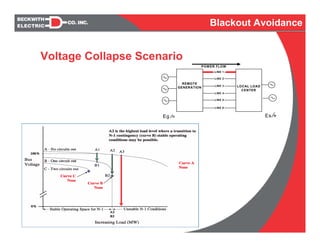
REMOTE
GENERATION LOCAL LOAD
CENTER
LINE 1
LINE 2
LINE 3
LINE 4
LINE 5
LINE 6
Eg O Es O
POWER FLOW
Voltage Collapse Scenario
Blackout Avoidance
REMOTE
GENERATION LOCAL LOAD
CENTER
LINE 1
LINE 2
LINE 3
LINE 4
LINE 5
LINE 6
Eg O Es O
POWER FLOW
Voltage Collapse Scenario
Blackout Avoidance
0 1800
Max.
Power
Transfer
All Lines in Service
Line 1
Tripped
Line 2
Tripped
Pe
Pmax = Eg Es
X
0g - 0s
90o0 1800
Max.
Power
Transfer
All Lines in Service
Line 1
Tripped
Line 2
Tripped
Pe
Pmax = Eg Es
X
0g - 0s
90o
Pe = Eg Es Sin ( 0g- 0s )
X
POWER TRANSFER EQUATION
REMOTE
GENERATION LOCAL LOAD
CENTER
LINE 1
LINE 2
LINE 3
LINE 4
LINE 5
LINE 6
Eg Og Es Os
POWER FLOW
0 1800
Max.
Power
Transfer
All Lines in Service
Line 1
Tripped
Line 2
Tripped
Pe
Pmax = Eg Es
X
0g - 0s
90o
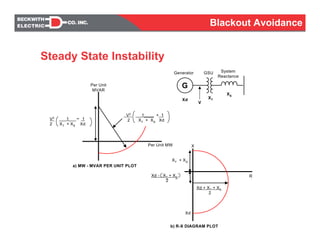
Steady State Instability
Blackout Avoidance
Generator
G
GSU System
Reactance
V
Xd XT
XS
V2
__ 1____ + 1
2 XT + XS Xd
Per Unit MW
Per Unit
MVAR
V2
___1___ 1
2 XT + XS Xd
a) MW - MVAR PER UNIT PLOT
X
R
Xd + XT + XS
2
XT
+ XS
Xd - XT
+ XS
2
b) R-X DIAGRAM PLOT
Xd
Steady State Instability
Blackout Avoidance
GENERATOR RESPONDS
TO BLACKOUT
CONDITIONS
GENERATOR RESPONDS
TO BLACKOUT
CONDITIONS
Blackout Avoidance
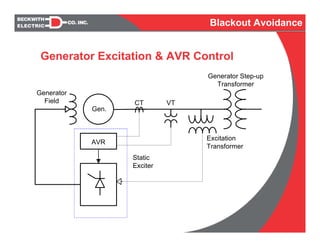
Gen.
AVR
Excitation
Transformer
Generator Step-up
Transformer
CT VT
Generator
Field
Static
Exciter
Generator Excitation & AVR Control
Blackout Avoidance
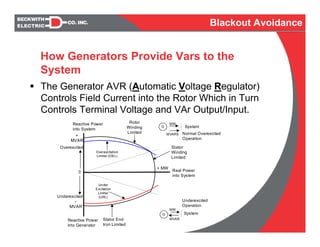
The Generator AVR (Automatic Voltage Regulator)
Controls Field Current into the Rotor Which in Turn
Controls Terminal Voltage and VAr Output/Input.
G
Reactive Power
into System
Reactive Power
into Generator
Real Power
into System
+
MVAR
Overexcited
Underexcited
0
-
MVAR
G
Under
Excitation
Limiter
(URL)
+ MW
MW
MVARS
Overexcitation
Limiter (OEL)
Rotor
Winding
Limited
Stator
Winding
Limited
Stator End
Iron Limited
MW
MVAR
System
System
Normal Overexcited
Operation
Underexcited
Operation
How Generators Provide Vars to the
System
Blackout Avoidance
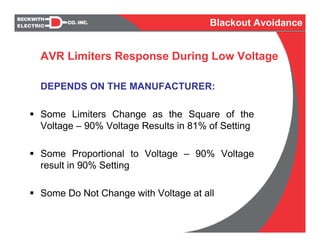
DEPENDS ON THE MANUFACTURER:
Some Limiters Change as the Square of the
Voltage – 90% Voltage Results in 81% of Setting
Some Proportional to Voltage – 90% Voltage
result in 90% Setting
Some Do Not Change with Voltage at all
AVR Limiters Response During Low Voltage
Blackout Avoidance
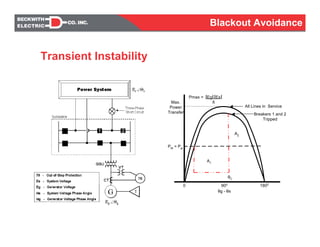
0 1800
Max.
Power
Transfer
All Lines in Service
Breakers 1 and 2
Tripped
PM = Pe
Pmax = Eg Es
X
0g - 0s
90o
A2
0C
A1
Transient Instability
Blackout Avoidance
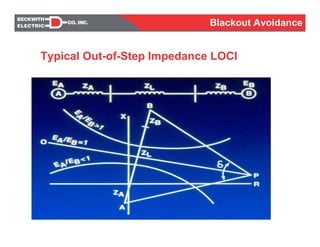
Typical Out-of-Step Impedance LOCI
Blackout Avoidance
Occurs when fast acting AVR control amplifies
rather than damps small MW oscillations.
Occurs when generators are remote from load
Solution is AVR Power System Stabilizers
(PSS) – Low Freq. Filter
Required by WECC in the Western USA for
generators larger than 30 MVA
Dynamic Instability
Blackout Avoidance
GENERATOR PROTECTION
RESPOND TO BLACKOUT
CONDITIONS
GENERATOR PROTECTION
RESPOND TO BLACKOUT
CONDITIONS
Blackout Avoidance
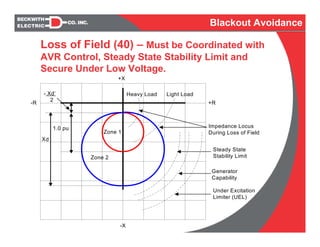
Loss of Field (40)
Overexcitation (24)
Overexcitation (24) System Backup (21 & 51V)
Under Frequency (81)
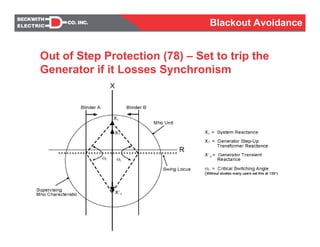
Out of Step Protection (78)
Key Generator Protection Functions
Effected by Major System Disturbances
Blackout Avoidance
Generator Protection Effected by Major
System Disturbances
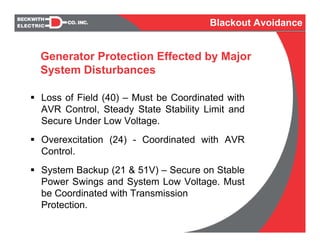
Loss of Field (40) – Must be Coordinated with
AVR Control, Steady State Stability Limit and
Secure Under Low Voltage.
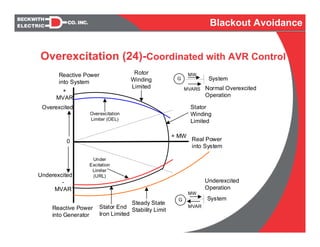
Overexcitation (24) - Coordinated with AVR
Control.
System Backup (21 & 51V) – Secure on Stable
Power Swings and System Low Voltage. Must
be Coordinated with Transmission
Protection.
Blackout Avoidance
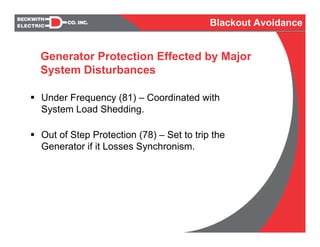
Under Frequency (81) – Coordinated with
System Load Shedding.
Out of Step Protection (78) – Set to trip the
Generator if it Losses Synchronism.
Generator Protection Effected by Major
System Disturbances
Blackout Avoidance
+X
-X
+R-R
- Xd’
2
Xd
Generator
Capability
Under Excitation
Limiter (UEL)
Heavy Load Light Load
Impedance Locus
During Loss of Field
1.0 pu
Steady State
Stability Limit
Zone 1
Zone 2
Loss of Field (40) – Must be Coordinated with
AVR Control, Steady State Stability Limit and
Secure Under Low Voltage.
Blackout Avoidance
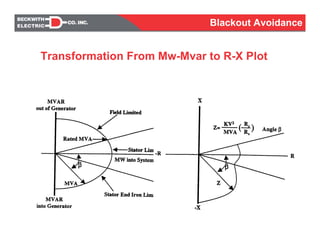
Transformation From Mw-Mvar to R-X Plot
Blackout Avoidance
G
Reactive Power
into System
Reactive Power
into Generator
Real Power
into System
+
MVAR
Overexcited
Underexcited
0
-
MVAR
G
Under
Excitation
Limiter
(URL)
+ MW
MW
MVARS
Overexcitation
Limiter (OEL)
Rotor
Winding
Limited
Stator
Winding
Limited
Stator End
Iron Limited
Steady State
Stability Limit
MW
MVAR
System
System
Normal Overexcited
Operation
Underexcited
Operation
Overexcitation (24)-Coordinated with AVR Control
Blackout Avoidance
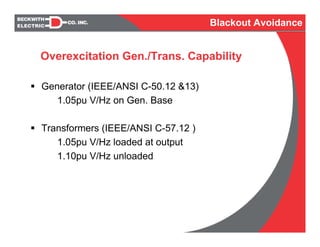
Generator (IEEE/ANSI C-50.12 &13)
1.05pu V/Hz on Gen. Base
Transformers (IEEE/ANSI C-57.12 )
1.05pu V/Hz loaded at output
1.10pu V/Hz unloaded
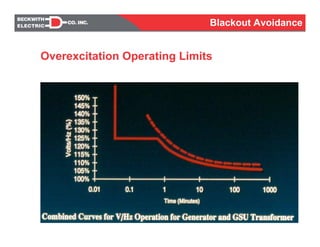
Overexcitation Gen./Trans. Capability
Blackout Avoidance
Figure #4C
Overexcitation Operating Limits
Blackout Avoidance
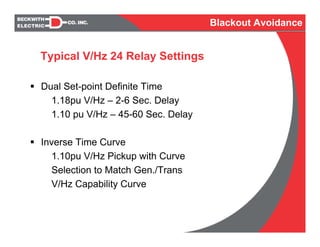
Dual Set-point Definite Time
1.18pu V/Hz – 2-6 Sec. Delay
1.10 pu V/Hz – 45-60 Sec. Delay
Inverse Time Curve
1.10pu V/Hz Pickup with Curve
Selection to Match Gen./Trans
V/Hz Capability Curve
Typical V/Hz 24 Relay Settings
Blackout Avoidance
J X
R
Z2
Z1
RPFA
Max.
Torque
Angle
Generator
Capability
Curve
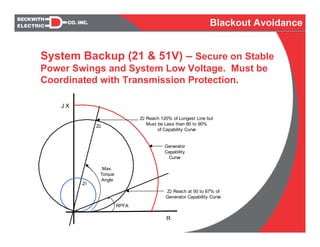
Z2 Reach at 50 to 67% of
Generator Capability Curve
Z2 Reach 120% of Longest Line but
Must be Less than 80 to 90%
of Capability Curve
System Backup (21 & 51V) – Secure on Stable
Power Swings and System Low Voltage. Must be
Coordinated with Transmission Protection.
Blackout Avoidance
J X
R
Z2
Z1
Max.
Torque
Angle
Generator
Capability
Curve
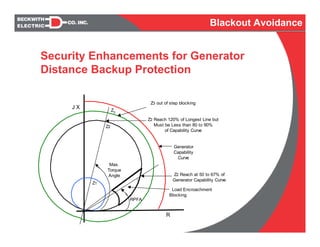
Z2 Reach at 50 to 67% of
Generator Capability Curve
Z2 Reach 120% of Longest Line but
Must be Less than 80 to 90%
of Capability Curve
Z3 out of step blocking
Load Encroachment
Blocking
RPFA
Z3
Security Enhancements for Generator
Distance Backup Protection
Blackout Avoidance
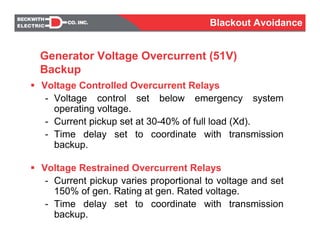
Voltage Controlled Overcurrent Relays
- Voltage control set below emergency system
operating voltage.
- Current pickup set at 30-40% of full load (Xd).
- Time delay set to coordinate with transmission
backup.
Voltage Restrained Overcurrent Relays
- Current pickup varies proportional to voltage and set
150% of gen. Rating at gen. Rated voltage.
- Time delay set to coordinate with transmission
backup.
Generator Voltage Overcurrent (51V)
Backup
Blackout Avoidance
Coordinate Under Frequency Tripping of Generator
With North American Electric Reliability Council
(NERC) System Load Shedding Regions – WECC,
ECAR, ERCOT, PJM, Others.
Hydro Generators not affected by Under Frequency
Gas Turbines Controls Run Back Mw Output When
Frequency Drops
Under Frequency (81) – Coordinated with
System Load Shedding
Blackout Avoidance
Out of Step Protection (78) – Set to trip the
Generator if it Losses Synchronism
Blackout Avoidance
Undervoltage Condition Not Itself Harmful To
Synchronous Generators – V/Hz is a Low Limit.
Auxiliary System is Effected By Low Voltage –
Auxiliary Motor Tripping Can Shut Down Gens.
U.S. Nuclear Plants Have Second Level Voltage
Separation Relays on Auxiliary System.
Automatic Generator Control (AGC) can Cause
Problems when the Power System Breaks-up into
Islands.
Undervoltage Power Plant Trippings
Brought About By System Var Deficits
Blackout Avoidance
SYSTEM UNDERVOLTAGE
LOAD SHEDDING
(UVLS)
SYSTEM UNDERVOLTAGE
LOAD SHEDDING
(UVLS)
Blackout Avoidance
Utility Undervoltage Load Shedding (UVLS)
ATTEMPT TO BALANCE MVAR LOAD WITH MVAR
SOURCES BY SHEDDING LOAD.
TWO TYPES OF UVLS SCHEMES:
Decentralized - Relays Measure Voltage at load to be
shed.
Centralized – Relays Measure Voltage at Key
locations. Voltage transmitted to Central Location and
combined with other System Information. Schemes
Called SPS or Wide Area Protection.
Blackout Avoidance
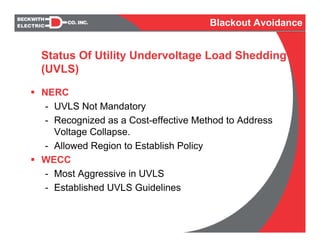
Status Of Utility Undervoltage Load Shedding
(UVLS)
NERC
- UVLS Not Mandatory
- Recognized as a Cost-effective Method to Address
Voltage Collapse.
- Allowed Region to Establish Policy
WECC
- Most Aggressive in UVLS
- Established UVLS Guidelines
Blackout Avoidance
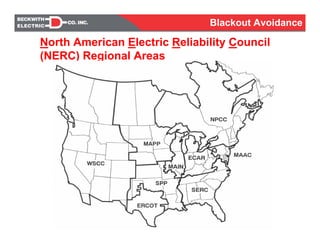
North American Electric Reliability Council
(NERC) Regional Areas
Blackout Avoidance
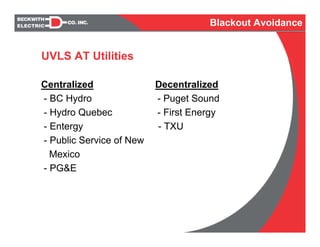
UVLS AT Utilities
Centralized Decentralized
- BC Hydro - Puget Sound
- Hydro Quebec - First Energy
- Entergy - TXU
- Public Service of New
Mexico
- PG&E
Blackout Avoidance
Blackout Avoidance
DESIGNING A SECURE
UVLS
SCHEME
DESIGNING A SECURE
UVLS
SCHEME
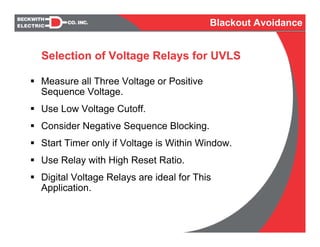
Selection of Voltage Relays for UVLS
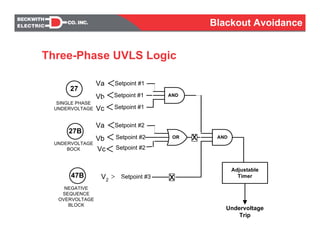
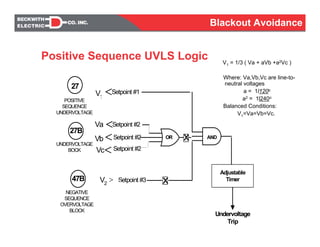
Measure all Three Voltage or Positive
Sequence Voltage.
Use Low Voltage Cutoff.
Consider Negative Sequence Blocking.
Start Timer only if Voltage is Within Window.
Use Relay with High Reset Ratio.
Digital Voltage Relays are ideal for This
Application.
Blackout Avoidance
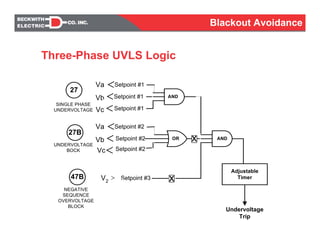
Three-Phase UVLS Logic
27
27B
47B
Va ≤
Vb
Vc
Setpoint #1
≤
≤
Setpoint #1
Setpoint #1
AND
Adjustable
Timer
Undervoltage
Trip
AND
SINGLE PHASE
UNDERVOLTAGE
Va ≤
Vb
Vc
Setpoint #2
≤
≤
Setpoint #2
Setpoint #2
OR xUNDERVOLTAGE
BOCK
V2
Setpoint #3≥ x
NEGATIVE
SEQUENCE
OVERVOLTAGE
BLOCK
Blackout Avoidance
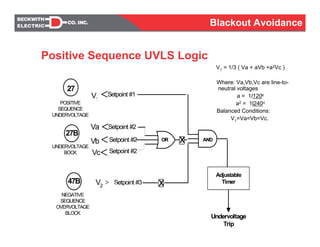
Positive Sequence UVLS Logic
V1 = 1/3 ( Va + aVb +a2Vc )
Where: Va,Vb,Vc are line-to-
neutral voltages
a = 1l120o
a2 = 1l240o
Balanced Conditions:
V1=Va=Vb=Vc.
27
27B
47B
V1 ≤Setpoint #1
Adjustable
Timer
Undervoltage
Trip
AND
POSITIVE
SEQUENCE
UNDERVOLTAGE
Va ≤
Vb
Vc
Setpoint #2
≤
≤
Setpoint #2
Setpoint #2
OR xUNDERVOLTAGE
BOCK
V2
Setpoint #3≥ x
NEGATIVE
SEQUENCE
OVERVOLTAGE
BLOCK
Blackout Avoidance
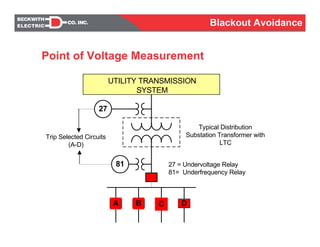
Point of Voltage Measurement
UTILITY TRANSMISSION
SYSTEM
27
81
A C
Trip Selected Circuits
(A-D)
Typical Distribution
Substation Transformer with
LTC
B D
27 = Undervoltage Relay
81= Underfrequency Relay
Blackout Avoidance
UVLS SETTING
CONSIDERATIONS
UVLS SETTING
CONSIDERATIONS
Blackout Avoidance
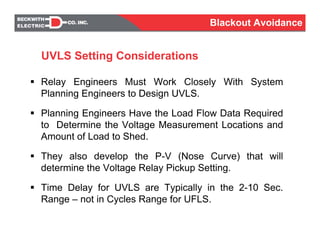
UVLS Setting Considerations
Relay Engineers Must Work Closely With System
Planning Engineers to Design UVLS.
Planning Engineers Have the Load Flow Data Required
to Determine the Voltage Measurement Locations and
Amount of Load to Shed.
They also develop the P-V (Nose Curve) that will
determine the Voltage Relay Pickup Setting.
Time Delay for UVLS are Typically in the 2-10 Sec.
Range – not in Cycles Range for UFLS.
Blackout Avoidance
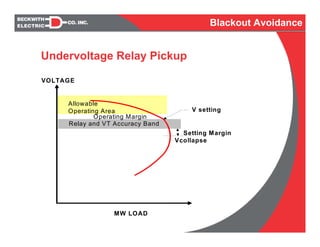
Undervoltage Relay Pickup
MW LOAD
VOLTAGE
Vcollapse
Setting Margin
Relay and VT Accuracy Band
V setting
Allowable
Operating Area
Operating Margin
Blackout Avoidance
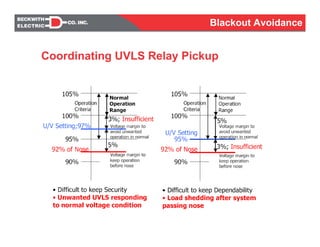
Coordinating UVLS Relay Pickup
Blackout Avoidance
NEW M-3401
BECKWITH LOAD
SHEDDING RELAY
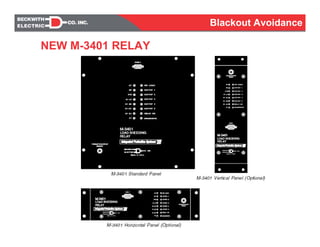
NEW M-3401
BECKWITH LOAD
SHEDDING RELAY
Blackout Avoidance
NEW M-3401 RELAY
Blackout Avoidance
Blackout Avoidance
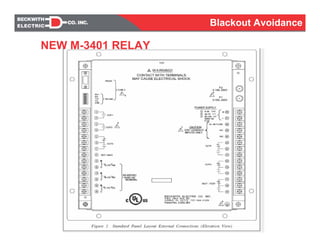
NEW M-3401 RELAY
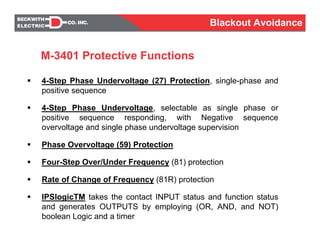
M-3401 Protective Functions
Blackout Avoidance
4-Step Phase Undervoltage (27) Protection, single-phase and
positive sequence
4-Step Phase Undervoltage, selectable as single phase or
positive sequence responding, with Negative sequence
overvoltage and single phase undervoltage supervision
Phase Overvoltage (59) Protection
Four-Step Over/Under Frequency (81) protection
Rate of Change of Frequency (81R) protection
IPSlogicTM takes the contact INPUT status and function status
and generates OUTPUTS by employing (OR, AND, and NOT)
boolean Logic and a timer
Three-Phase UVLS Logic
27
27B
47B
Va ≤
Vb
Vc
Setpoint #1
≤
≤
Setpoint #1
Setpoint #1
AND
Adjustable
Timer
Undervoltage
Trip
AND
SINGLE PHASE
UNDERVOLTAGE
Va ≤
Vb
Vc
Setpoint #2
≤
≤
Setpoint #2
Setpoint #2
OR xUNDERVOLTAGE
BOCK
V2
Setpoint #3≥ x
NEGATIVE
SEQUENCE
OVERVOLTAGE
BLOCK
Blackout Avoidance
Positive Sequence UVLS Logic V1 = 1/3 ( Va + aVb +a2Vc )
Where: Va,Vb,Vc are line-to-
neutral voltages
a = 1l120o
a2 = 1l240o
Balanced Conditions:
V1=Va=Vb=Vc.
27
27B
47B
V1 ≤Setpoint #1
Adjustable
Timer
Undervoltage
Trip
AND
POSITIVE
SEQUENCE
UNDERVOLTAGE
Va ≤
Vb
Vc
Setpoint #2
≤
≤
Setpoint #2
Setpoint #2
OR xUNDERVOLTAGE
BOCK
V2
Setpoint #3≥ x
NEGATIVE
SEQUENCE
OVERVOLTAGE
BLOCK
Blackout Avoidance
Blackout Avoidance
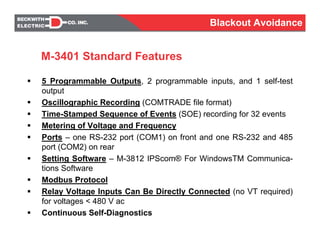
5 Programmable Outputs, 2 programmable inputs, and 1 self-test
output
Oscillographic Recording (COMTRADE file format)
Time-Stamped Sequence of Events (SOE) recording for 32 events
Metering of Voltage and Frequency
Ports – one RS-232 port (COM1) on front and one RS-232 and 485
port (COM2) on rear
Setting Software – M-3812 IPScom® For WindowsTM Communica-
tions Software
Modbus Protocol
Relay Voltage Inputs Can Be Directly Connected (no VT required)
for voltages < 480 V ac
Continuous Self-Diagnostics
M-3401 Standard Features
CONCLUSIONS
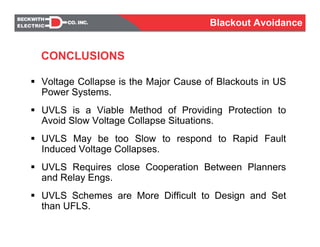
Voltage Collapse is the Major Cause of Blackouts in US
Power Systems.
UVLS is a Viable Method of Providing Protection to
Avoid Slow Voltage Collapse Situations.
UVLS May be too Slow to respond to Rapid Fault
Induced Voltage Collapses.
UVLS Requires close Cooperation Between Planners
and Relay Engs.
UVLS Schemes are More Difficult to Design and Set
than UFLS.
Blackout Avoidance
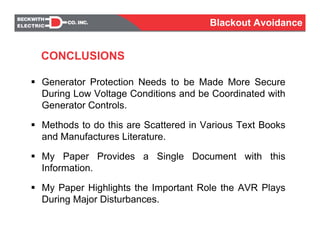
Generator Protection Needs to be Made More Secure
During Low Voltage Conditions and be Coordinated with
Generator Controls.
Methods to do this are Scattered in Various Text Books
and Manufactures Literature.
My Paper Provides a Single Document with this
Information.
My Paper Highlights the Important Role the AVR Plays
During Major Disturbances.
CONCLUSIONS
Blackout Avoidance
BLACKOUT AVOIDANCE
&
UNDERVOLTAGE LOAD SHEDDING
BLACKOUT AVOIDANCE
&
UNDERVOLTAGE LOAD SHEDDING
THE END
Questions ?
THE END
Questions ?
Blackout Avoidance
©2008 Beckwith Electric Co., Inc.

Blackout Avoidance & Undervoltage Load Shedding

  • 1.
    BLACKOUT AVOIDANCE & UNDERVOLTAGE LOAD SHEDDING BLACKOUTAVOIDANCE & UNDERVOLTAGE LOAD SHEDDING Chuck Mozina Consultant Beckwith Electric Chuck Mozina Consultant Beckwith Electric
  • 2.
    BLACKOUTS How and whythey occur Why voltage rather than frequency is the leading edge indicator of system collapse How blackout conditions effect generators and generator protection Undervoltage load shedding Blackout Avoidance
  • 3.
    RECENT BLACKOUTS 2003 -East Coast Blackout 2003 - Italian Blackout 2002 - Swedish Blackout 1997 - PJM Disturbance 1996 - West Coast Blackout 1995 - PECO Disturbance 1987 - City of Memphis Blackout Avoidance
  • 4.
    Root Cause ofRecent Blackouts VOLTAGE COLLAPSE – WHY? Today, major generation sources are remote from load centers. This was NOT the case 35 years ago. This makes the power system very reliant on transmission system to transport power to load centers. Blackout Avoidance
  • 5.
    VOLTAGE COLLAPSE –WHY? Purchase power from remote sources to save $$$. New generation built remotely from load centers. Little new transmission being built. Utility loads are increasingly made up of air conditioning motors susceptible to stall conditions due to transmission system faults. Root Cause of Recent Blackouts Blackout Avoidance
  • 6.
    As lines tripbetween remote generation and load center, the reactance increases. This increases the reactive (VAR) losses-reducing the voltage at the load center. The voltage phase angle between the generators at the load center and remote generators also increase. REMOTE GENERATION LOCAL LOAD CENTER LINE 1 LINE 2 LINE 3 LINE 4 LINE 5 LINE 6 How Voltage Collapses Occur Blackout Avoidance
  • 7.
  • 8.
    Real Power (MW)Flow Example SYSTEM A SYSTEM B SYSTEM C Eg O Es O POWER FLOW Blackout Avoidance Pe = Eg Es Sin ( 0g- 0s ) X Where: Eg = Voltage at the Load Center Generation Es = Voltage at the Remote Generation Pe = Electrical Real Power Transfer X = Reactance Between Local and Remote Generation 0g = Votage Angle and Local Generation 0s = Voltage Angle at Remote Generation POWER TRANSFER EQUATION Where: Es = Voltage at the Load Center Eg = Voltage at the Remote Generation Pe = Electrical Real Power Transfer X = Reactance Between Local and Remote Generation 0s = Voltage Angle and Local Generation 0g = Voltage Angle at Remote Generation
  • 9.
    Pe = EgEs Sin ( 0g- 0s ) X Where: Eg = Voltage at the Load Center Generation Es = Voltage at the Remote Generation Pe = Electrical Real Power Transfer X = Reactance Between Local and Remote Generation 0g = Voltage Angle and Local Generation 0s = Voltage Angle at Remote Generation POWER TRANSFER EQUATION SYSTEM A Load = 5000 MW GEN. =5000 MW SYSTEM B Load = 5000 MW Gen. = 5000 MW SYSTEM C Load = 5000 MW Gen. = 5000 MW Eg O Es O POWER FLOW - 0 MW TRANSFER Real Power (MW) Flow Example Blackout Avoidance Where: Es = Voltage at the Load Center Eg = Voltage at the Remote Generation Pe = Electrical Real Power Transfer X = Reactance Between Local and Remote Generation 0s = Voltage Angle and Local Generation 0g = Voltage Angle at Remote Generation
  • 10.
    Pe = EgEs Sin ( 0g- 0s ) X Where: Eg = Voltage at the Load Center Generation Es = Voltage at the Remote Generation Pe = Electrical Real Power Transfer X = Reactance Between Local and Remote Generation 0g = Voltage Angle and Local Generation 0s = Voltage Angle at Remote Generation POWER TRANSFER EQUATION Real Power (MW) Flow Example SYSTEM A Load = 5000 MW GEN. = 7000 MW SYSTEM B Load = 5000 MW Gen. = 5000 MW SYSTEM C Load = 5000 MW Gen. = 3000 MW Eg O Es O POWER FLOW - 2000 MW TRANSFER Blackout Avoidance Where: Es = Voltage at the Load Center Eg = Voltage at the Remote Generation Pe = Electrical Real Power Transfer X = Reactance Between Local and Remote Generation 0s = Voltage Angle and Local Generation 0g = Voltage Angle at Remote Generation
  • 11.
    SYSTEM A SYSTEM B SYSTEM C Eg O Es O REACTIVE POWER FLOWSMALL 1. To make reactive power flow you need to have a difference in voltage magnitude between Eg and Es. 2. Voltage on a power system can only be varied +/- 5% which is not enough difference to result in a significant VARS flow. 3. Thus VARS cannot be transmitted over long distances and must be generated locally near the load. Reactive Power (Mvars) Flow Blackout Avoidance
  • 12.
    VAr Support mustbe provided at the load center. Two major sources of VAr support: Capacitor Banks – Double-Edge Sword. Vars go down with the square of voltage. Generators/ Synch. Condensers – A dynamic source of Vars. Can adjust VAr output rapidly during contingencies. Sources of Reactive (Var) Support Blackout Avoidance
  • 13.
    LOAD RESPONSE TO LOW VOLTAGE LOADRESPONSE TO LOW VOLTAGE Blackout Avoidance
  • 14.
    How Load Respondsto Low Voltage Basic Power System Remote Generation Transmission System Load Center Resistive Load Motor Load VAR Support Local Generation Ps PL QLVL Blackout Avoidance
  • 15.
    Resistive load currentdecreases as voltage goes down Helping the system. Motor loads are constant KVA devices and increase their load current as voltage decreases- Hurts the system. During “Heat Storm” conditions, most load is motor load making blackout more likely. How Load Responds to Low Voltage Blackout Avoidance
  • 16.
    Example of VoltageRecovery From a Transmission Fault- Rapid Voltage Collapse R e sid e n tia l V o lta g e R e co ve ry fo r P h o e n ix A re a In cid e n t o n Ju ly 2 9 , 1 9 9 5 Blackout Avoidance
  • 17.
    RECENT BLACKOUTS REVISITED 2003- East Coast Blackout 2003 - Italian Blackout 2002 - Swedish Blackout 1997 - PJM Disturbance* 1996 - West Coast Blackout 1995 - PECO Disturbance* 1987 - City of Memphis* * Rapid Voltage Collapse Blackout Avoidance
  • 18.
  • 19.
    POWER SYSTEM INSTABILITIES FourTypes of Instability: Voltage* Steady State * Transient Dynamic *Involved in Recent Blackouts Blackout Avoidance
  • 20.
    REMOTE GENERATION LOCAL LOAD CENTER LINE1 LINE 2 LINE 3 LINE 4 LINE 5 LINE 6 Eg O Es O POWER FLOW Voltage Collapse Scenario Blackout Avoidance
  • 21.
    REMOTE GENERATION LOCAL LOAD CENTER LINE1 LINE 2 LINE 3 LINE 4 LINE 5 LINE 6 Eg O Es O POWER FLOW Voltage Collapse Scenario Blackout Avoidance
  • 22.
    0 1800 Max. Power Transfer All Linesin Service Line 1 Tripped Line 2 Tripped Pe Pmax = Eg Es X 0g - 0s 90o0 1800 Max. Power Transfer All Lines in Service Line 1 Tripped Line 2 Tripped Pe Pmax = Eg Es X 0g - 0s 90o Pe = Eg Es Sin ( 0g- 0s ) X POWER TRANSFER EQUATION REMOTE GENERATION LOCAL LOAD CENTER LINE 1 LINE 2 LINE 3 LINE 4 LINE 5 LINE 6 Eg Og Es Os POWER FLOW 0 1800 Max. Power Transfer All Lines in Service Line 1 Tripped Line 2 Tripped Pe Pmax = Eg Es X 0g - 0s 90o Steady State Instability Blackout Avoidance
  • 23.
    Generator G GSU System Reactance V Xd XT XS V2 __1____ + 1 2 XT + XS Xd Per Unit MW Per Unit MVAR V2 ___1___ 1 2 XT + XS Xd a) MW - MVAR PER UNIT PLOT X R Xd + XT + XS 2 XT + XS Xd - XT + XS 2 b) R-X DIAGRAM PLOT Xd Steady State Instability Blackout Avoidance
  • 24.
    GENERATOR RESPONDS TO BLACKOUT CONDITIONS GENERATORRESPONDS TO BLACKOUT CONDITIONS Blackout Avoidance
  • 25.
  • 26.
    The Generator AVR(Automatic Voltage Regulator) Controls Field Current into the Rotor Which in Turn Controls Terminal Voltage and VAr Output/Input. G Reactive Power into System Reactive Power into Generator Real Power into System + MVAR Overexcited Underexcited 0 - MVAR G Under Excitation Limiter (URL) + MW MW MVARS Overexcitation Limiter (OEL) Rotor Winding Limited Stator Winding Limited Stator End Iron Limited MW MVAR System System Normal Overexcited Operation Underexcited Operation How Generators Provide Vars to the System Blackout Avoidance
  • 27.
    DEPENDS ON THEMANUFACTURER: Some Limiters Change as the Square of the Voltage – 90% Voltage Results in 81% of Setting Some Proportional to Voltage – 90% Voltage result in 90% Setting Some Do Not Change with Voltage at all AVR Limiters Response During Low Voltage Blackout Avoidance
  • 28.
    0 1800 Max. Power Transfer All Linesin Service Breakers 1 and 2 Tripped PM = Pe Pmax = Eg Es X 0g - 0s 90o A2 0C A1 Transient Instability Blackout Avoidance
  • 29.
    Typical Out-of-Step ImpedanceLOCI Blackout Avoidance
  • 30.
    Occurs when fastacting AVR control amplifies rather than damps small MW oscillations. Occurs when generators are remote from load Solution is AVR Power System Stabilizers (PSS) – Low Freq. Filter Required by WECC in the Western USA for generators larger than 30 MVA Dynamic Instability Blackout Avoidance
  • 31.
    GENERATOR PROTECTION RESPOND TOBLACKOUT CONDITIONS GENERATOR PROTECTION RESPOND TO BLACKOUT CONDITIONS Blackout Avoidance
  • 32.
    Loss of Field(40) Overexcitation (24) Overexcitation (24) System Backup (21 & 51V) Under Frequency (81) Out of Step Protection (78) Key Generator Protection Functions Effected by Major System Disturbances Blackout Avoidance
  • 33.
    Generator Protection Effectedby Major System Disturbances Loss of Field (40) – Must be Coordinated with AVR Control, Steady State Stability Limit and Secure Under Low Voltage. Overexcitation (24) - Coordinated with AVR Control. System Backup (21 & 51V) – Secure on Stable Power Swings and System Low Voltage. Must be Coordinated with Transmission Protection. Blackout Avoidance
  • 34.
    Under Frequency (81)– Coordinated with System Load Shedding. Out of Step Protection (78) – Set to trip the Generator if it Losses Synchronism. Generator Protection Effected by Major System Disturbances Blackout Avoidance
  • 35.
    +X -X +R-R - Xd’ 2 Xd Generator Capability Under Excitation Limiter(UEL) Heavy Load Light Load Impedance Locus During Loss of Field 1.0 pu Steady State Stability Limit Zone 1 Zone 2 Loss of Field (40) – Must be Coordinated with AVR Control, Steady State Stability Limit and Secure Under Low Voltage. Blackout Avoidance
  • 36.
    Transformation From Mw-Mvarto R-X Plot Blackout Avoidance
  • 37.
    G Reactive Power into System ReactivePower into Generator Real Power into System + MVAR Overexcited Underexcited 0 - MVAR G Under Excitation Limiter (URL) + MW MW MVARS Overexcitation Limiter (OEL) Rotor Winding Limited Stator Winding Limited Stator End Iron Limited Steady State Stability Limit MW MVAR System System Normal Overexcited Operation Underexcited Operation Overexcitation (24)-Coordinated with AVR Control Blackout Avoidance
  • 38.
    Generator (IEEE/ANSI C-50.12&13) 1.05pu V/Hz on Gen. Base Transformers (IEEE/ANSI C-57.12 ) 1.05pu V/Hz loaded at output 1.10pu V/Hz unloaded Overexcitation Gen./Trans. Capability Blackout Avoidance
  • 39.
    Figure #4C Overexcitation OperatingLimits Blackout Avoidance
  • 40.
    Dual Set-point DefiniteTime 1.18pu V/Hz – 2-6 Sec. Delay 1.10 pu V/Hz – 45-60 Sec. Delay Inverse Time Curve 1.10pu V/Hz Pickup with Curve Selection to Match Gen./Trans V/Hz Capability Curve Typical V/Hz 24 Relay Settings Blackout Avoidance
  • 41.
    J X R Z2 Z1 RPFA Max. Torque Angle Generator Capability Curve Z2 Reachat 50 to 67% of Generator Capability Curve Z2 Reach 120% of Longest Line but Must be Less than 80 to 90% of Capability Curve System Backup (21 & 51V) – Secure on Stable Power Swings and System Low Voltage. Must be Coordinated with Transmission Protection. Blackout Avoidance
  • 42.
    J X R Z2 Z1 Max. Torque Angle Generator Capability Curve Z2 Reachat 50 to 67% of Generator Capability Curve Z2 Reach 120% of Longest Line but Must be Less than 80 to 90% of Capability Curve Z3 out of step blocking Load Encroachment Blocking RPFA Z3 Security Enhancements for Generator Distance Backup Protection Blackout Avoidance
  • 43.
    Voltage Controlled OvercurrentRelays - Voltage control set below emergency system operating voltage. - Current pickup set at 30-40% of full load (Xd). - Time delay set to coordinate with transmission backup. Voltage Restrained Overcurrent Relays - Current pickup varies proportional to voltage and set 150% of gen. Rating at gen. Rated voltage. - Time delay set to coordinate with transmission backup. Generator Voltage Overcurrent (51V) Backup Blackout Avoidance
  • 44.
    Coordinate Under FrequencyTripping of Generator With North American Electric Reliability Council (NERC) System Load Shedding Regions – WECC, ECAR, ERCOT, PJM, Others. Hydro Generators not affected by Under Frequency Gas Turbines Controls Run Back Mw Output When Frequency Drops Under Frequency (81) – Coordinated with System Load Shedding Blackout Avoidance
  • 45.
    Out of StepProtection (78) – Set to trip the Generator if it Losses Synchronism Blackout Avoidance
  • 46.
    Undervoltage Condition NotItself Harmful To Synchronous Generators – V/Hz is a Low Limit. Auxiliary System is Effected By Low Voltage – Auxiliary Motor Tripping Can Shut Down Gens. U.S. Nuclear Plants Have Second Level Voltage Separation Relays on Auxiliary System. Automatic Generator Control (AGC) can Cause Problems when the Power System Breaks-up into Islands. Undervoltage Power Plant Trippings Brought About By System Var Deficits Blackout Avoidance
  • 47.
    SYSTEM UNDERVOLTAGE LOAD SHEDDING (UVLS) SYSTEMUNDERVOLTAGE LOAD SHEDDING (UVLS) Blackout Avoidance
  • 48.
    Utility Undervoltage LoadShedding (UVLS) ATTEMPT TO BALANCE MVAR LOAD WITH MVAR SOURCES BY SHEDDING LOAD. TWO TYPES OF UVLS SCHEMES: Decentralized - Relays Measure Voltage at load to be shed. Centralized – Relays Measure Voltage at Key locations. Voltage transmitted to Central Location and combined with other System Information. Schemes Called SPS or Wide Area Protection. Blackout Avoidance
  • 49.
    Status Of UtilityUndervoltage Load Shedding (UVLS) NERC - UVLS Not Mandatory - Recognized as a Cost-effective Method to Address Voltage Collapse. - Allowed Region to Establish Policy WECC - Most Aggressive in UVLS - Established UVLS Guidelines Blackout Avoidance
  • 50.
    North American ElectricReliability Council (NERC) Regional Areas Blackout Avoidance
  • 51.
    UVLS AT Utilities CentralizedDecentralized - BC Hydro - Puget Sound - Hydro Quebec - First Energy - Entergy - TXU - Public Service of New Mexico - PG&E Blackout Avoidance
  • 52.
    Blackout Avoidance DESIGNING ASECURE UVLS SCHEME DESIGNING A SECURE UVLS SCHEME
  • 53.
    Selection of VoltageRelays for UVLS Measure all Three Voltage or Positive Sequence Voltage. Use Low Voltage Cutoff. Consider Negative Sequence Blocking. Start Timer only if Voltage is Within Window. Use Relay with High Reset Ratio. Digital Voltage Relays are ideal for This Application. Blackout Avoidance
  • 54.
    Three-Phase UVLS Logic 27 27B 47B Va≤ Vb Vc Setpoint #1 ≤ ≤ Setpoint #1 Setpoint #1 AND Adjustable Timer Undervoltage Trip AND SINGLE PHASE UNDERVOLTAGE Va ≤ Vb Vc Setpoint #2 ≤ ≤ Setpoint #2 Setpoint #2 OR xUNDERVOLTAGE BOCK V2 Setpoint #3≥ x NEGATIVE SEQUENCE OVERVOLTAGE BLOCK Blackout Avoidance
  • 55.
    Positive Sequence UVLSLogic V1 = 1/3 ( Va + aVb +a2Vc ) Where: Va,Vb,Vc are line-to- neutral voltages a = 1l120o a2 = 1l240o Balanced Conditions: V1=Va=Vb=Vc. 27 27B 47B V1 ≤Setpoint #1 Adjustable Timer Undervoltage Trip AND POSITIVE SEQUENCE UNDERVOLTAGE Va ≤ Vb Vc Setpoint #2 ≤ ≤ Setpoint #2 Setpoint #2 OR xUNDERVOLTAGE BOCK V2 Setpoint #3≥ x NEGATIVE SEQUENCE OVERVOLTAGE BLOCK Blackout Avoidance
  • 56.
    Point of VoltageMeasurement UTILITY TRANSMISSION SYSTEM 27 81 A C Trip Selected Circuits (A-D) Typical Distribution Substation Transformer with LTC B D 27 = Undervoltage Relay 81= Underfrequency Relay Blackout Avoidance
  • 57.
  • 58.
    UVLS Setting Considerations RelayEngineers Must Work Closely With System Planning Engineers to Design UVLS. Planning Engineers Have the Load Flow Data Required to Determine the Voltage Measurement Locations and Amount of Load to Shed. They also develop the P-V (Nose Curve) that will determine the Voltage Relay Pickup Setting. Time Delay for UVLS are Typically in the 2-10 Sec. Range – not in Cycles Range for UFLS. Blackout Avoidance
  • 59.
    Undervoltage Relay Pickup MWLOAD VOLTAGE Vcollapse Setting Margin Relay and VT Accuracy Band V setting Allowable Operating Area Operating Margin Blackout Avoidance
  • 60.
    Coordinating UVLS RelayPickup Blackout Avoidance
  • 61.
    NEW M-3401 BECKWITH LOAD SHEDDINGRELAY NEW M-3401 BECKWITH LOAD SHEDDING RELAY Blackout Avoidance
  • 62.
  • 63.
  • 64.
    M-3401 Protective Functions BlackoutAvoidance 4-Step Phase Undervoltage (27) Protection, single-phase and positive sequence 4-Step Phase Undervoltage, selectable as single phase or positive sequence responding, with Negative sequence overvoltage and single phase undervoltage supervision Phase Overvoltage (59) Protection Four-Step Over/Under Frequency (81) protection Rate of Change of Frequency (81R) protection IPSlogicTM takes the contact INPUT status and function status and generates OUTPUTS by employing (OR, AND, and NOT) boolean Logic and a timer
  • 65.
    Three-Phase UVLS Logic 27 27B 47B Va≤ Vb Vc Setpoint #1 ≤ ≤ Setpoint #1 Setpoint #1 AND Adjustable Timer Undervoltage Trip AND SINGLE PHASE UNDERVOLTAGE Va ≤ Vb Vc Setpoint #2 ≤ ≤ Setpoint #2 Setpoint #2 OR xUNDERVOLTAGE BOCK V2 Setpoint #3≥ x NEGATIVE SEQUENCE OVERVOLTAGE BLOCK Blackout Avoidance
  • 66.
    Positive Sequence UVLSLogic V1 = 1/3 ( Va + aVb +a2Vc ) Where: Va,Vb,Vc are line-to- neutral voltages a = 1l120o a2 = 1l240o Balanced Conditions: V1=Va=Vb=Vc. 27 27B 47B V1 ≤Setpoint #1 Adjustable Timer Undervoltage Trip AND POSITIVE SEQUENCE UNDERVOLTAGE Va ≤ Vb Vc Setpoint #2 ≤ ≤ Setpoint #2 Setpoint #2 OR xUNDERVOLTAGE BOCK V2 Setpoint #3≥ x NEGATIVE SEQUENCE OVERVOLTAGE BLOCK Blackout Avoidance
  • 67.
    Blackout Avoidance 5 ProgrammableOutputs, 2 programmable inputs, and 1 self-test output Oscillographic Recording (COMTRADE file format) Time-Stamped Sequence of Events (SOE) recording for 32 events Metering of Voltage and Frequency Ports – one RS-232 port (COM1) on front and one RS-232 and 485 port (COM2) on rear Setting Software – M-3812 IPScom® For WindowsTM Communica- tions Software Modbus Protocol Relay Voltage Inputs Can Be Directly Connected (no VT required) for voltages < 480 V ac Continuous Self-Diagnostics M-3401 Standard Features
  • 68.
    CONCLUSIONS Voltage Collapse isthe Major Cause of Blackouts in US Power Systems. UVLS is a Viable Method of Providing Protection to Avoid Slow Voltage Collapse Situations. UVLS May be too Slow to respond to Rapid Fault Induced Voltage Collapses. UVLS Requires close Cooperation Between Planners and Relay Engs. UVLS Schemes are More Difficult to Design and Set than UFLS. Blackout Avoidance
  • 69.
    Generator Protection Needsto be Made More Secure During Low Voltage Conditions and be Coordinated with Generator Controls. Methods to do this are Scattered in Various Text Books and Manufactures Literature. My Paper Provides a Single Document with this Information. My Paper Highlights the Important Role the AVR Plays During Major Disturbances. CONCLUSIONS Blackout Avoidance
  • 70.
    BLACKOUT AVOIDANCE & UNDERVOLTAGE LOADSHEDDING BLACKOUT AVOIDANCE & UNDERVOLTAGE LOAD SHEDDING THE END Questions ? THE END Questions ? Blackout Avoidance ©2008 Beckwith Electric Co., Inc.