1               19-03-04


PDF created with pdfFactory Pro trial version www.pdffactory.com
EXCITATION SYSTEM

         INTRODUCTION

                  All synchronous machines excepting certain machines like permanent magnet
         generators require a DC supply to excite their field winding. As synchronous machine is a
         constant speedy machine for a constant frequency supply, the output voltage of the machine
         depends on the excitation current. The control of excitation current for maintaining constant
         voltage at generator output terminals started with control through a field rheostat, the supply
         being obtained from DC Exciter. The modern trend in interconnected operation of power
         systems for the purpose of reliability and in increasing unit size of generators for the
         purposes of economy has been mainly, responsible for the evolution of new excitation
         schemes.
                  Former practice, to have an excitation bus fed by a number of exciters operating in
         parallel and supplying power to the fields of all the alternators in the station, is now obsolete.
         The present practice is unit exciter scheme, i.e. each alternator to have its own exciter.
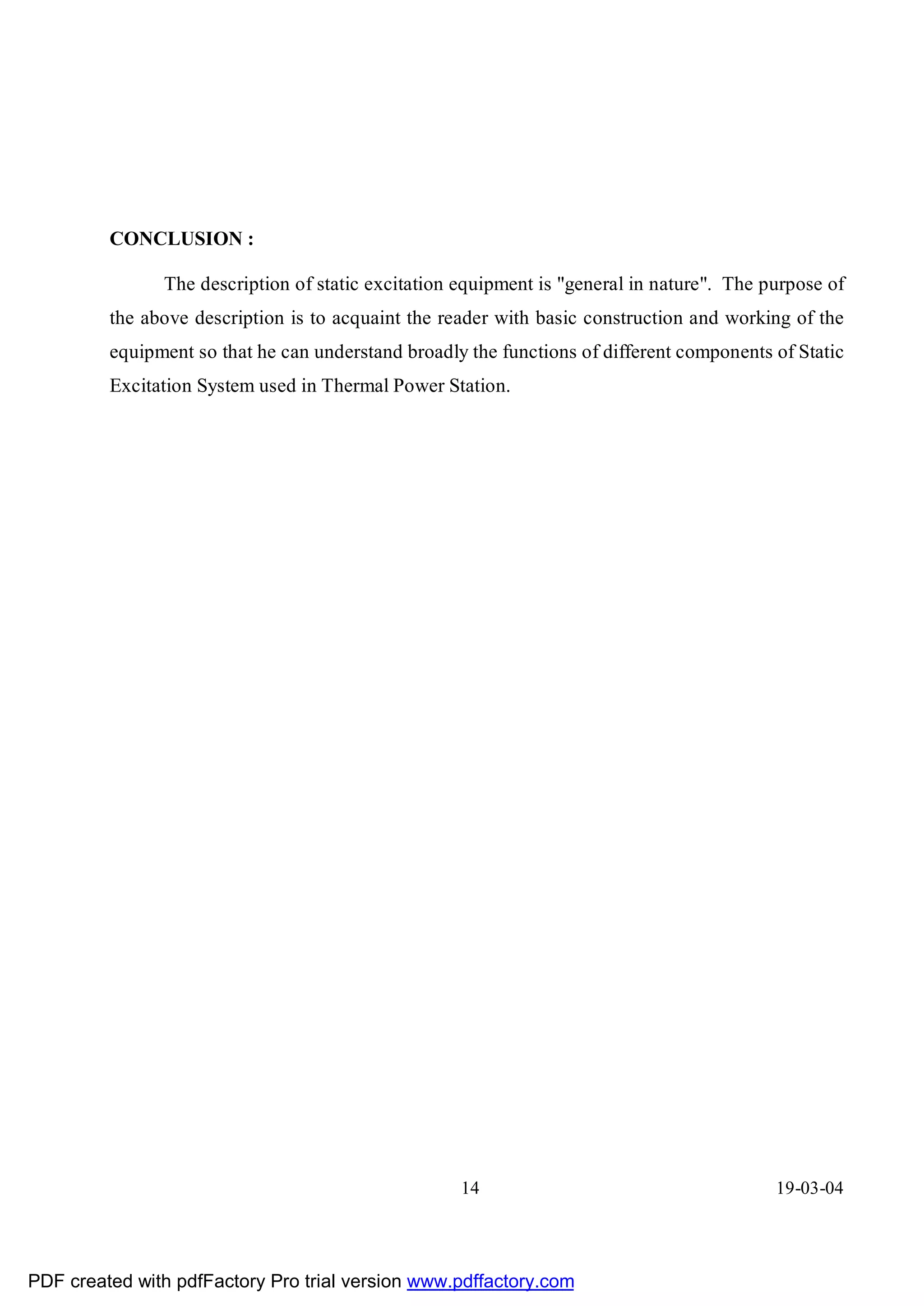
         However in some plants reserve bus exciter/stand by exciter also provided in case of failure
         of unit exciter (Fig. 1)
                  Exciter should be capable of supplying necessary excitation for alternator in a
         reasonable period during normal and abnormal conditions, so that alternator will be in
         synchronism with the grid.

         THE RATING OF THE EXCITER

                  Under normal conditions, exciter rating will be in the order of 0.3 to 0.6% of
         generator rating (approx.). Its rating also expressed in 10 to 15 amp. (approx.) per MW at
         normal load. Under field forcing conditions exciter rating will be 1 to 1.5% (approx) of the
         generator rating. Typical exciter ratings for various capacity of generators are as given
         below:


                                                         2                                       19-03-04


PDF created with pdfFactory Pro trial version www.pdffactory.com
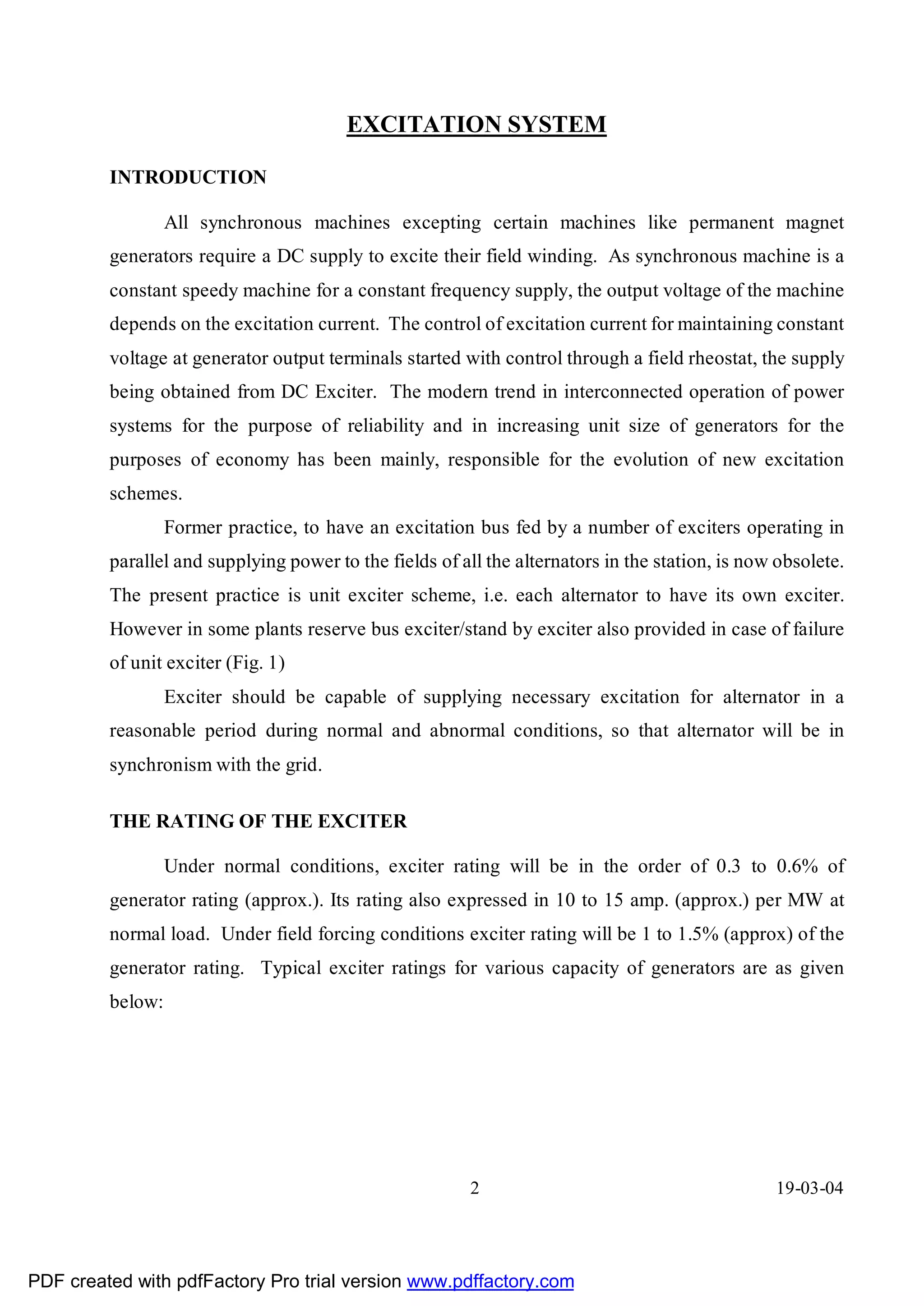
EXCITER RATINGS FOR DIFFERENT CAPACITIES OF GENERATORS
                                    INSTALLED IN INDIA (UPTO 210 MW)
                                             TURBO GENERATOR
          1    Max. Continuous rating (MW)                   210       110    100        60     50
          2    Rated Power factor                           0.85       0.8   0.85      0.873    0.8
          3    Rated Terminal Voltage (in KV)               15.75      11    10.5        11    10.5
          4    Rated current (Amp.)                         9050      7220   6480      3250    3440
                                                    EXCITER
          5    Slip ring voltage at full load condition(V)   310       440 280.1       350     240
          6    Excitation current at MCR condition (Amp) 2600         1500 1680        800     667
          7    Rated output (KW)                             806       660  470        280     160
          8    Ex. Rating in % of Gen. rating               0.38       0.6 0.47        0.47    0.32

         TYPES OF THE EXCITATION SYSTEM
             There are two types of Excitation System. These are mainly classified as (i) Dynamic
         exciter (rotating type) (ii) Static Exciter (static type). The different types excitation which
         are being used are indicated as given below :
         (1)     (a) Separately Excited (thro' pilot exciter) (DC) Excitation System
                 (b) Self Excited              (shunt)       (DC) Excitation System
         (2)     High frequency AC Excitation System
         (3)     Brushless Excitation System
         (4)     Static Excitation System


                 Among the above types of exciters, Static excitation system plays a very important
         roll in modern interconnected power system operation due to its fast acting, good response in
         voltage & reactive power control and satisfactory steady state stability condition. For the
         machines 500 MW & above and fire hazards areas, Brushless Excitation System is preferred
         due to larger requirement of current & plant safety respectively.


                                                         3                                      19-03-04


PDF created with pdfFactory Pro trial version www.pdffactory.com
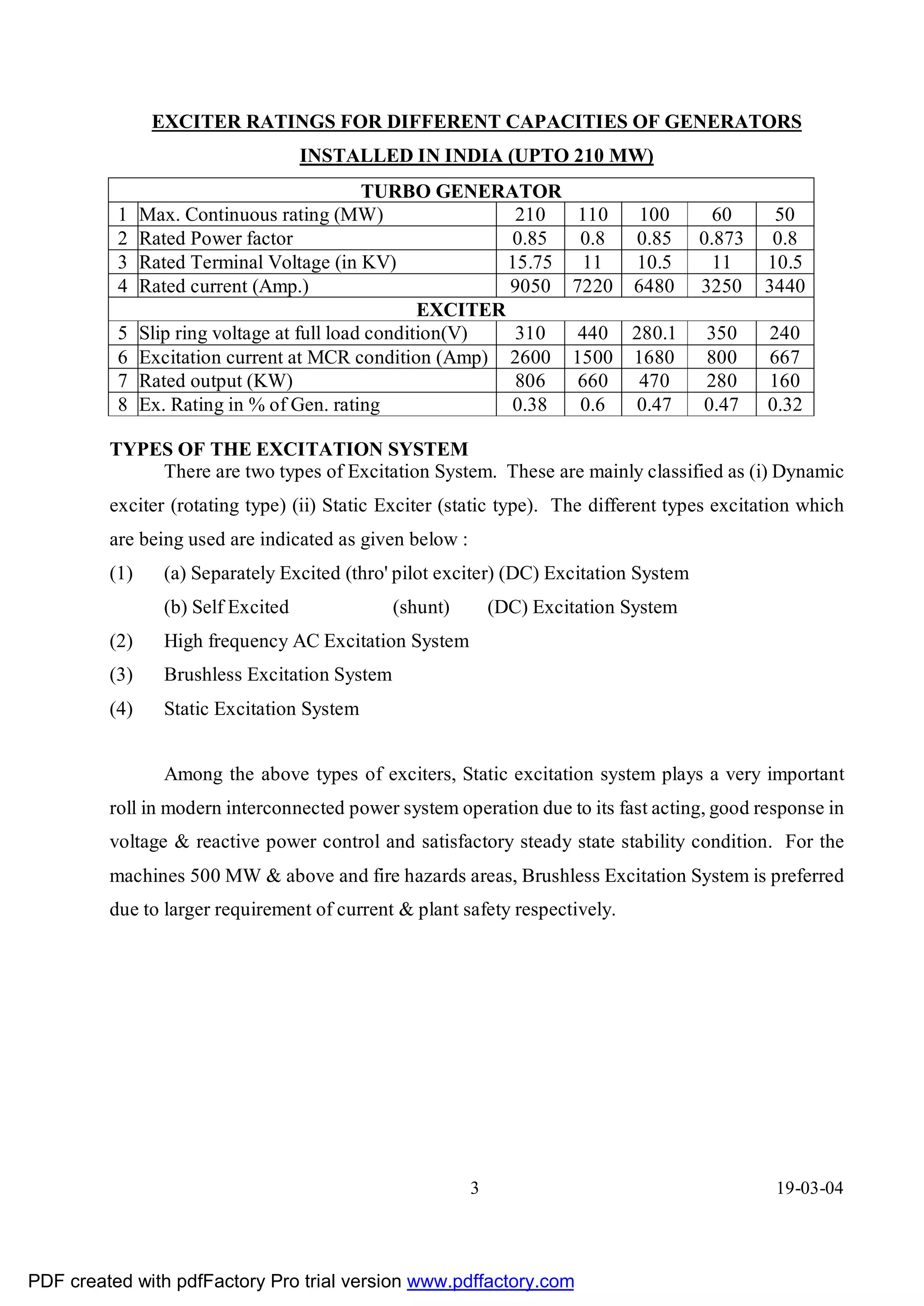
THE RELATIVE MERITS OF DIFFERENT EXCITERS ARE LISTED AS GIVEN BELOW:

                        VARIOUS EXCITATION SYSTEMS AND THEIR RELATIVE MERITS

         1. TYPE               STATIC EXCITER        DC EXCITER    AC EXCITER WITH   BRUSHLESS
                                                                   STATIONARY DIODES
         2. COMPOUNDING        YES                   YES           YES                      ------
            INCLUDED
         3. EXCITATION         TRANSFORMER &         SMALL TRAFO SMALL TRAFO           SMALL TRAFO
            SUPPLY             COMPOUNDING
                               TRAFO
         4. LENGTH OF          SHORT                 MEDIUM        MEDIUM              LONGER
            MACHINE
         5. CONTROL            VERY FAST             SLOWER        SLOWER              SLOWER
            RESPONSE
         6. PROTECTION         GOOD                  GOOD          GOOD                GOOD
            SELECTIVITY
         7. RESPONSE           FLEXIBLE              LIMITED       LIMITED             LIMITED
            RATIO
            SELECTION
         8. COMPONENT          SLIPRING              SLIPRING & SLIPRING               NONE
            REQUIRING                                COMMUTATOR
            MAINTENANCE
         9. FAST DE-           YES                   YES           YES                 NO
            EXCITATION


         INTRODUCTION TO STATIC EXCITATION EQUIPMENTF ITS SALIENT FEATURES AND
         COMPARISON WITH OTHER SYSTEMS:

                   At present various type of excitation systems, such as, conventional DC, High
         frequency AC, Static & Brushless are being adopted in India and abroad.
                   The conventional DC exciter was the unchallenged source of Generator Excitation for
         nearly fifty years till the rating of turbo-generators reached around 10OMW. In the last three
         to four decades, alternative arrangements have been widely adopted because of limitations of
         the DC exciters. With increase in generator ratings, it is no longer enough to consider the
         exciter used as earlier. Instead, the performance of the whole excitation system including the
         automatic voltage regulator and the response of the main generator have to be considered.
         Techno econ6mic considerations, grid requirements, reliability and easy maintenance have
         become prime considerations.


                                                        4                                     19-03-04


PDF created with pdfFactory Pro trial version www.pdffactory.com
TYPES OF EXCITATION SYSTEMS (TYPICAL) 1. CONVENTIONAL D.C. EXCITER

               The earliest AC turbine generators obtained their excitation supply from the power
          station direct current distribution system. Each machine had a rheostat in series with its
          field winding to permit adjustment of the terminal voltage and reactive load. This method
          was suitable for machines which needed small field power and low internal reactance. As
          generator sizes increased excitation power requirements also increased and it became
          increasingly desirable for each unit to be self sufficient for excitation and thus the shaft
          driven DC exciter was introduced.

          2.     AC (HIGH FREQUENCY) EXCITATION SYSTEM:

               This system was developed to avoid commutator and Brush Gear assembly. In this
          system, a shaft driven AC pilot exciter, which has a rotating permanent magnetic field and
          a stationary armature, feeds the DC field current of the main high frequency AC exciter
          through controlled rectifiers. The high frequency output of the stationary armature is
          rectified by stationary diodes and fed via slip-rings to the field of the main turbo generator.
          A response ratio of about two can be achieved.

          3.     BRUSHLESS SYSTEM:

               Supply of high current by means of slip rings involves considerable operational
         problems and it requires suitable design of slip rings and brush gear.
               In brushless excitation system diode rectifiers are mounted on the generator shaft and
         their output is directly connected to the field of the alternator thus eliminating brushes and
         slip rings. This arrangement necessitates the use of a rotating armature and stationary field
         system for the main AC exciter. The voltage regulator final stage takes the form of a
         thyristor bridge controlling the field of the main AC exciter which is fed from PMG on the
         same shaft. The response ratio of brushless excitation system is normally about two.


                                                       5                                        19-03-04


PDF created with pdfFactory Pro trial version www.pdffactory.com
4.     STATIC EXCITATION SYSTEM:

                In order to maintain system stability in interconnected system network it is necessary
         to have fast acting excitation system for large synchronous machines which means the field
         current must be adjusted extremely fast to the changing operational conditions. Besides
         maintaining the field current and steady state stability the excitation system is required to
         extend the stability limits. It is because of these reasons the static excitation system is
         preferred to conventional excitation systems.


                In this system, the AC power is tapped off from the generator terminal stepped down
         and rectified by fully controlled thyristor Bridges and then fed to the generator field thereby
         controlling the generator voltage output. A high control speed is achieved by using an
         internal free control and power electronic system. Any deviation in the generator terminal
         voltage is sensed by an error detector and causes the voltage regulator to advance or retard
         the firing angle of the thyristors thereby controlling the field excitation of the alternator.


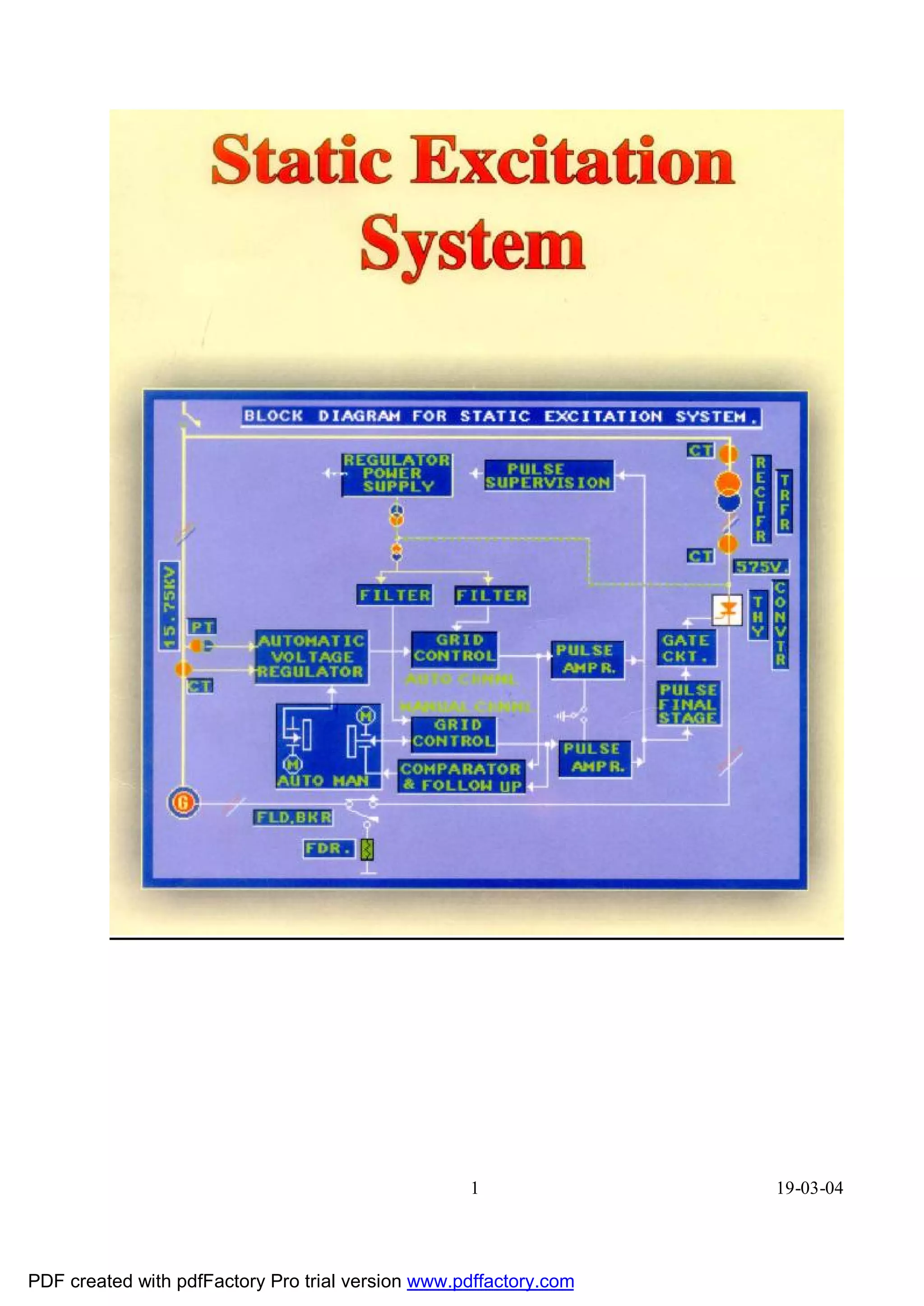
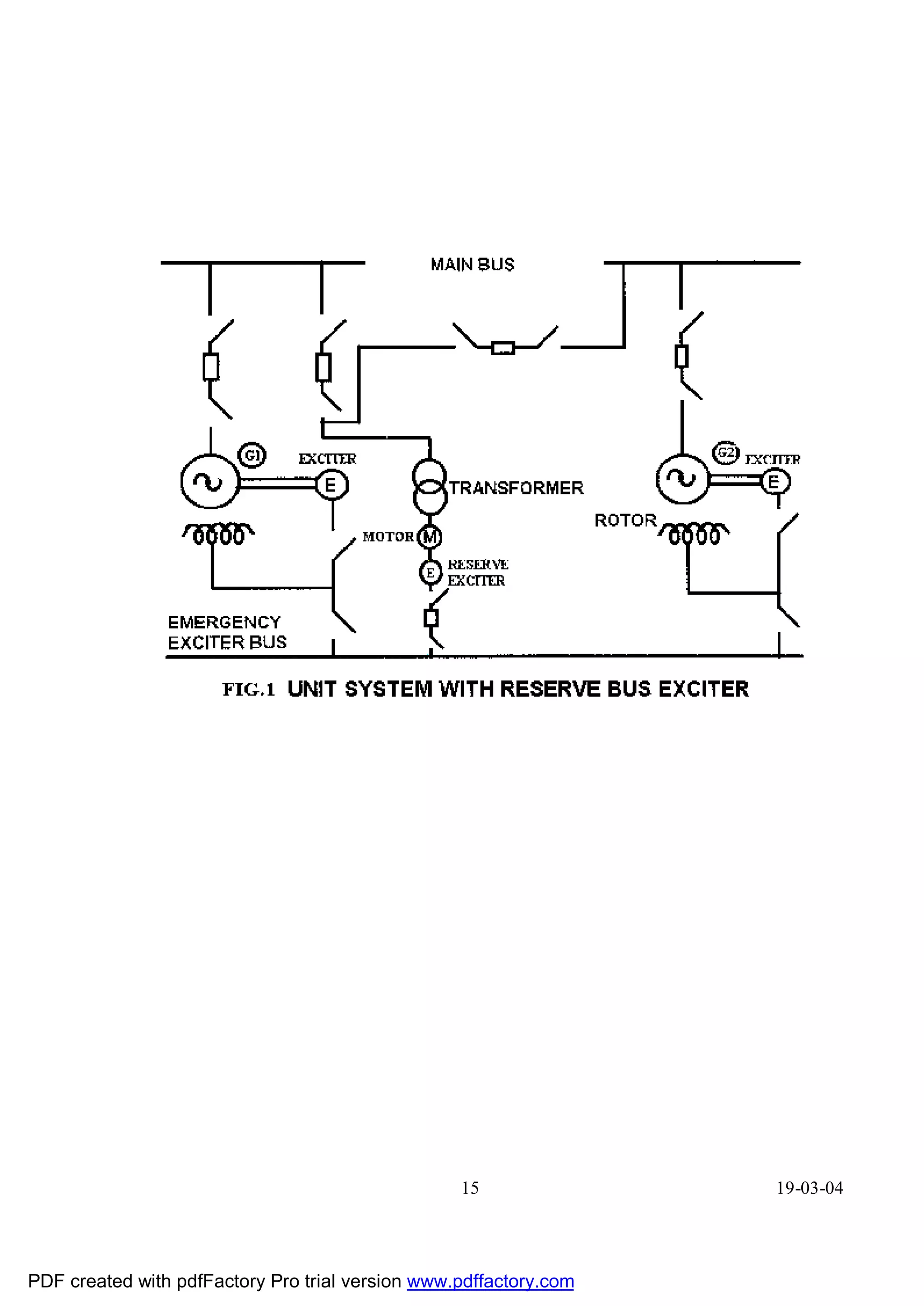
                In Fig.2 SI.No.(4) Shows a block diagram for a static excitation system. Static
         Excitation system can be designed without any difficulty to achieve high response ratio
         which is required by the system. The response ratio in the order of 3 to 5 -can be achieved
         by this system.


                This equipment controls the generator terminal voltage, and hence the reactive load
         flow by adjusting the excitation current.        The rotating exciter is dispensed with and
         Transformer & silicon controlled rectifiers (SCRS) are used which directly feed the field of
         the Alternator.


         Description of Static Excitation System.

                   Static Excitation Equipment Consist of
                   1) Rectifier Transformer
                   2) SCR output stage
                   3) Excitation start up & field discharge equipment
                                                         6                                        19-03-04


PDF created with pdfFactory Pro trial version www.pdffactory.com
4)    Regulator and operational control circuits


         In the above 1, 2, 3 are power Circuit of Static Excitation System 4 is control Circuit of
         Static Excitation System.
         Rectifier Transformer:

                The excitation power is taken from generator output and fed through the excitation
         (rectifier) transformer which steps down to the required voltage, for the SCR bridge and then
         fed through the field breaker to the generator field. The rectifier transformer used in the SEE
         should have high reliability as failure of this will cause shutdown of unit/power station.


                Dry type cast coil transformer is suitable for static excitation applications. The
         transformer is selected such that it supplies rated excitation current at rated voltage
         continuously and is capable of supplying ceiling current at the ceiling excitation for a short
         period of ten seconds.

         SCR OUTPUT STAGE :

                The SCR output stage consists of a suitable number of bridges connected in parallel.
         Each thyristor bridge comprises of six thyristors, working as a six pulse fully controlled
         bridge. Current carrying capacity of each bridge depends on the rating of individual
         thyristor. Thyristors are designed such that their junction temperature rise is well within its
         specified rating. By changing the firing angle of the thyristors variable output is obtained.
         Each bridge is controlled by one final pulse stage and is cooled by a fan.


                These bridges are equipped with protection devices and failure of one bridge causes
         alarm. If there is a failure of one more thyristor bridges then the excitation current will be
         limited to a predetermined value lesser than the normal current. However, failure of the
         third, bridge results in tripping and rapid de-excitation of the generator. The above is
         applicable for 4 bridges thyristor with (n-1) principle operation.


                                                        7                                      19-03-04


PDF created with pdfFactory Pro trial version www.pdffactory.com
EXCITATION START UP AND FIELD DISCHARGE EQUIPMENT:

                For the initial build-up of the generator voltage, a field-flashing equipment is
         required. The rating of this equipment depends on the no-load excitation requirement and
         field time constant of the generator. From the reliability point of view, provision for both the
         AC & DC field flashing are provided.
                The field breaker is selected such that it carries the full load excitation current
         continuously and also it breaks the max. field current when the three phase short circuit
         occurs at the generator terminals.
                The field discharge resistor is normally of non-linear type for medium and large
         capacity machines i.e. voltage dependent resistor.
                To protect the field winding of the generator against over voltages, an over voltage
         protection along with a current limiting resistor is used to limit the over voltage across the
         field winding. The OVP operates on the insulation break over Principle. The voltage level
         at which OVP should operate is selected based on insulation level of field winding of the
         generator.
         REGULATOR & OPERATIONAL CONTROL CIRCUITS (CONTROL ELECTRONICS) :

                Regulator is the heart of the system. This regulates the generator voltage by
         controlling the firing pulses to the thyristors.
         a)     ERROR DETECTOR & AMPLIFIER:

                The Generator terminal voltage is stepped down by a three phase PT.and fed to the
         AVR. The a.c. input thus obtained is rectified, filtered and compared against a highly
         stabilized reference value and the difference is amplified in different stages of amplification.
         The AVR is designed with highly stable elements so that variation in ambient temperature
         does not cause any drift or change in the output level. Three CTs sensing the output current
         of the generator feed proportional current across variable resistors in the AVR. The voltage
         thus obtained across the resistors, can be added vectorially either for compounding or for
         transformer drop compensation. The percentage of compensation can be adjusted as the
         resistors are of variable type.

                                                            8                                   19-03-04


PDF created with pdfFactory Pro trial version www.pdffactory.com
b)   GRID - CONTROL UNIT:
                The output of the AVR is fed to a grid control unit, it gets its synchronous a.c.
         reference through a filter circuit and generates six double, pulses spaced 600 electrical apart
         whose position depends on the output of the AVR, i.e. the pulse position varies continuously
         as a function of the control voltage. Two relays are provided, by energising which, the
         pulses can be either blocked completely or shifted to inverter mode of operation.
         c)     PULSE - AMPLIFIER:
                The pulse output of the ""Grid control unit "' is amplified further at an intermediate
         stage amplification. This is also known as pulse intermediate stage. The unit has a d.c.
         power supply, which operates from a three phase 38OV supply and delivers +15V,1 –
         l5V,+5V, and a coarse stabilized voltage VL. A built in relay is provided which can be used
         for blocking the 6 pulse channels. In a two channel system (like Auto and Manual), the
         change over is effected by energising/ de-energizing the relay.
         d)     PULSE FINAL STAGE:
                This unit receives input pulses from the pulse amplifier and transmits them through
         pulse transformers to the gates of the thyristors. A built in power supply provides the
         required d.c. supply to the final pulse and amplifier. Each Thyristor bridge has its own final
         pulse stage.   Therefore, even if a thyristor bridge fails with its final pulse stage, the
         remaining thyristors bridges can continue to cater to full load requirement of the machine
         and thereby ensure (n-1) operation.
         e)     MANUALCONTROLCHANNEL:
                A separate manual control channel is provided where the controlling d.c. signal in
         taken from a stabilized d.c. voltage through a motor operated potentiometer. The d.c. signal
         is fed to a separate grid control unit whose output pulses after being amplified at an
         intermediate stage can be fed to the final pulse stage. When one channel is working,
         generating the required pulses, the other remains blocked. Therefore a changeover from
         ""Auto" to "Manual' control or vice versa is effected by blocking or releasing the pulses of
         the corresponding intermediate stage.


                                                       9                                       19-03-04


PDF created with pdfFactory Pro trial version www.pdffactory.com
"A pulse supervision unit detects spurious pulses or loss of pulses at the pulses bus
         bar and transfers control from Automatic Channel to manual channel.
         f)     FOLLOW-UP UNIT:

                To ensure a smooth changeover from 'Auto"' to Manual" control, it is necessary that
         the position of the pulses on both channels should be identical. A pulse comparison unit
         detects any difference in the position of the pulses and with the help of a follow-up unit
         actuates the motor operated potentiometer on the "'Manual"' Channel to turn in a direction so
         as to eliminate the difference.
                However, while transferring control from "Manual"' to "Auto" mode any difference in
         the two control levels can be visually checked on a balance meter and adjusted to obtain null
         before change over.
         g)     LIMIT CONTROLLERS:

                When a generator is running in parallel with the power network, it is essential to
         maintain it in sychronism without exceeding the rating of the machine and also without the
         protection system tripping. Only automatic Regulator cannot ensure this. It is necessary to
         influence the voltage regulator by suitable means to limit the over excitation and under
         excitation. This not only improves the security of the parallel operation but makes operation
         of the system easier. However limiters do not replace the protection system but only prevent
         the protection system from tripping unnecessarily under extreme transient.conditions.


                The AVR also has a built-in frequency dependent circuit so that when the machine is
         running below the rated frequency from the regulated voltage should be proportional to
         frequency. With the help of a potentiometer provided in the AVR, the circuit can be made to
         respond proportionally to voltage above a certain frequency and proportional to a voltage
         below the certain frequency. The range of adjustment of this cut off frequency lies between
         40 and 60 Hz.


                                                     10                                      19-03-04


PDF created with pdfFactory Pro trial version www.pdffactory.com
The static excitation system is equipped with three limiters which act in conjunction
          with the AVR. These limiters are as under
                   -     Rotor current limiter
                   -     Rotor angle limiter
                   -     Stator current limiter
          i)       ROTOR CURRENT LIMITER:
                   The unit basically comprises an actual value converter a limiter with adjustable PID
          characteristics a reference value; dv/dt sensor and a signalisation unit.
                   The field current is measured on the a.c. input side of the thyristor converter and is
          converted into proportional d.c. voitages. The signal is compared with an adjustable
          reference value, amplified, and with necessary time lapse fed to the voltage regulator input.
                   Rotor current limiter avoids thermal overloading of the rotor winding and is provided
          to protect the generator rotor against excessively long duration over loads. The ceiling
          excitation is limited to a predetermined limit and is allowed to flow for a time which is
          dependant upon the rate of rise of field current before being limited to the thermal limit
          value.
    ii)   ROTOR ANGLE LIMITER:
                   This unit limits the angle between the voltage of the network centre and the rotor
          voltage or it limits the angle between the generator voltage and the rotor voltage. It
          comprises an actual value converter, a limiting amplifier with adjustable PID characteristics
          and a reference value unit. The limiting regulator operates as soon as the d.c. value exceeds
          the reference value. For its operation the Unit is given separate power supply from a d.c.
          power pack.


                                                        11                                      19-03-04


PDF created with pdfFactory Pro trial version www.pdffactory.com
It generates a d.c. signal proportional to the load or rotor angle from the stator current
         and voltage by means of a simple analog circuit. The device takes over as soon as the set
         limit angle is exceeded. By increasing the excitation and ignoring opposite control signals
         the unit is prevented from failing out of step.


         iii)    STATOR CURRENT LIMITER:

                This unit functions in conjunction with an integrator unit which provides the
         necessary dead time and the gradient, that can be adjusted by potentiometers. The regulator
         consists essentially of a measuring converter, two comparators, two PID regulators and a d.c.
         power pack. A discriminator in the circuit differentiates between inductive and capacitive
         current. The positive and negative signals processed by two separate amplifiers are brought
         to the output stage and only that output which has to take care of the limitation is made
         effective.


                Stator current limiter avoids thermal over loading of the stator windings. Stator
         current limiter is provided to protect the generator against long duration of large stator
         currents. For excessive inductive current it acts over the AVR after a certain time lag and
         decreases the excitation current to limit the inductive current to the limit value. But for
         excessive capacitive current it acts on the AVR without time delay to increase the Excitation
         and thereby reduce the capacitive loading. This is necessary as there is a risk for the
         machine failing out of step during under excited mode of operation.

         h)     SLIP STABILIZING UNITS:

                The slip stabilizing unit is used for the suppression of rotor oscillations of the
         alternator through the additional influence of excitation. The slip as well as acceleration
         signals needed for the stabilization are derived from active power delivered by the alternator.
         Both the signals, which are correspondingly amplified and summed up, influence the


                                                       12                                       19-03-04


PDF created with pdfFactory Pro trial version www.pdffactory.com
excitation of the synchronous machine through AVR in a manner as to suppress the Rotor
         oscillations.


         POWER SUPPLY:

                The voltage regulating equipment needs an a.c. supply 38OV 3 Phase for its power
         supply units which is derived from the secondary side of the rectifier transformer through an
         auxiliary transformer. This voltage is reduced to different levels required for the power
         packs by means of multi-winding transformers.
                A separate transformer supplies the synchronous voltage 3x38OV for the filter circuit
         of each channel and the voltage relay. During testing and pre-commissioning activities when
         generator voltage is not available, the station auxiliary supply 3 Phase 415V can be
         temporarily connected through an. auxiliary step down transformer for testing purpose with
         the help of a regulator test/service switch.
                The supply for the, thyristor Bridge fan is taken from an independent transformer
         which gets it input supply from the secondary of the excitation transformer.
                The control & protection relays need 48V & 24VDC which are delivered from the
         station battery by means of the DC/DC converters, which are internally protected against
         overload.
         PROTECTIONS:

                 The following protections are provided in the Static Excitation Equipment.
                 1)      Rectifier transformer over current instantaneous and delayed.
                 2)      Rectifier transformer over Temperature
                 3)      Rotor Over-Voltage
                 4)      Rotor earth fault.
                 5)      Fuse failure monitoring circuit for thyristors
                 6)      Loss of control voltage (48V & 24V)
                 7)      dv/dt protection of SCR by snubber net works
                 8)      Cooling System failure for thyristors


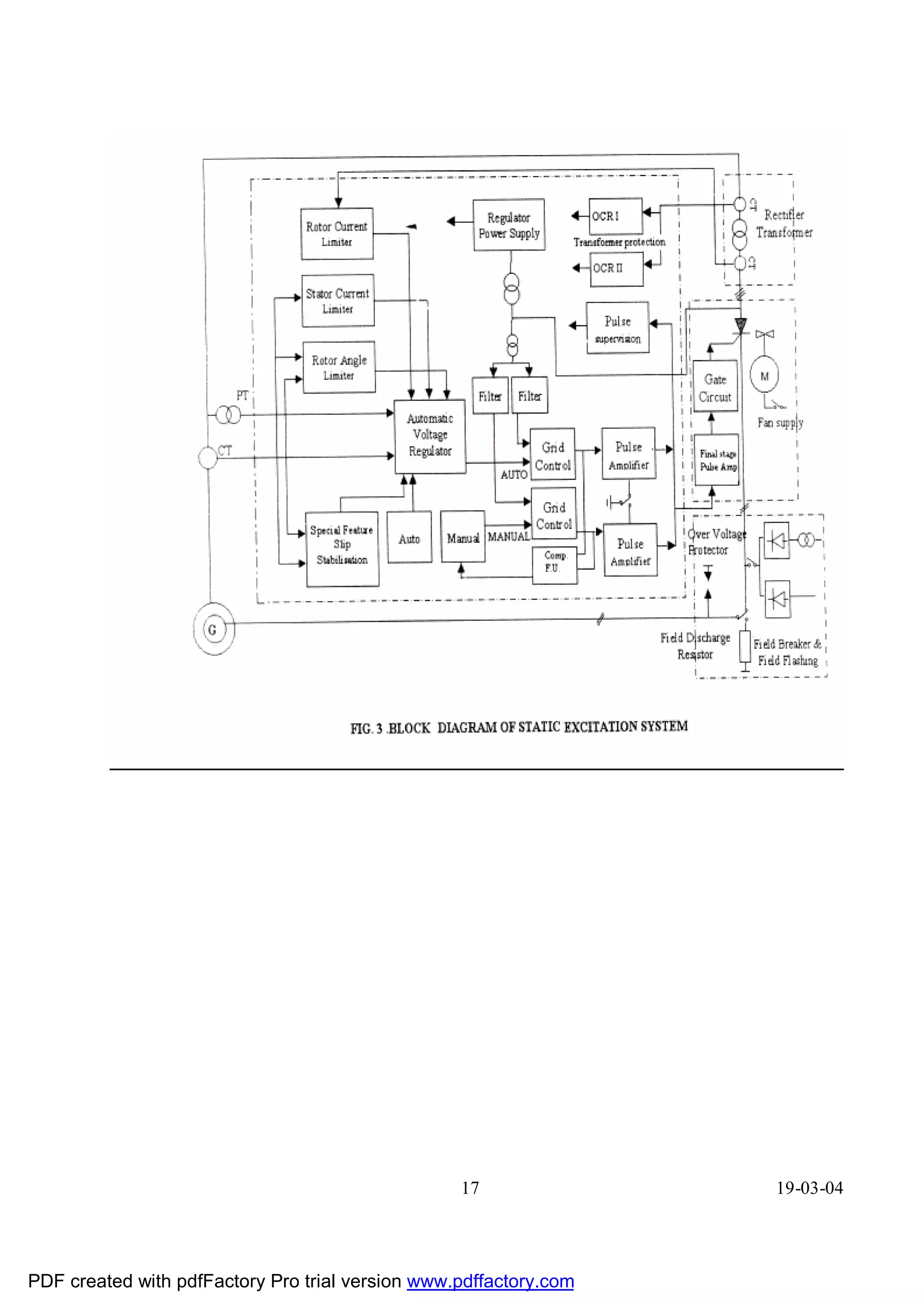
                 The block diagram of the Static Excitation Equipment is given in Fig.(3).
                                                        13                                    19-03-04


PDF created with pdfFactory Pro trial version www.pdffactory.com
CONCLUSION :

               The description of static excitation equipment is "general in nature". The purpose of
         the above description is to acquaint the reader with basic construction and working of the
         equipment so that he can understand broadly the functions of different components of Static
         Excitation System used in Thermal Power Station.


                                                    14                                     19-03-04


PDF created with pdfFactory Pro trial version www.pdffactory.com
15               19-03-04


PDF created with pdfFactory Pro trial version www.pdffactory.com
16               19-03-04


PDF created with pdfFactory Pro trial version www.pdffactory.com
17               19-03-04


PDF created with pdfFactory Pro trial version www.pdffactory.com
SIGNIFICANCE OF MACHINE CAPA BILI TY DIAGRAM AND
                       OPERATIONAL REOUIREMENTS OF EXCITATION SYSTEM :

         Capability diagram of Generators give the safe operating regimes and limitations etc.
         This is of great help to the operating Engineers to ensure operations of the machines
         accordingly.


         Their information particularly for limiting zones of operations are useful in setting the
         various limiters of Automatic Voltage Regulator.
         One typical procedure for the construction of capability diagram is given in subsequent
         paras/page.


         Operational requirements of excitation system essentially call for a fast response particularly
         High Initial Response Excitation System, High degree of Reliability and also suitable
         arrangement for field discharge.


         RESPONSE:

                The fastness of action of an Excitation system is measured/expressed by the term
         ""Response Ratio of the Excitation system,". The original definition of this by measuring
         the rise of exciter volts in first 0.5 second is well known i.e. rate of rise of voltage/Sec.
         Static Exciter has very ""High Initial Response" as given in IEEE STDS-421 and attains 95%
         of the ceiling voltage level within 0.1 second or less. Thus it greatly helps for power system
         stability consideration. Typical Response time for static excitation Equipment, is Twenty
         Milli-Seconds.


                                                      18                                       19-03-04


PDF created with pdfFactory Pro trial version www.pdffactory.com
RELIABILITY:

                      For     Power      System            application, Reliability is a
         very important criteria. To ensure this, components are carefully selected, liberal ratings
         wherever required are used and redundancies built in. In Static Excitation equipment ""n"'
         No. of Thyristor bridges are used, with (n-1) principle of operation i.e. even with one of
         bridges out of operation, full load requirement can be met by balance bridges in parallel.
         Wherever specified/required by customers, 2 x100 % bridges are also given.


         FIELD DISCHARGE:


               During load condition whenever the Field breaker, opens suddenly there will be a
         surge voltage in the rotor which will. damage the rotor winding insulation. To avoid this
         rotor winding is connected to the earth through field discharge Resistor thereby by passing
         the surge voltage to earth and limiting the current to earth. Field discharge greatly helps to
         limit the damages. 'Non-linear field discharge resistance is used which helps in faster field
         suppression/discharge.


         CAPABILITY DIAGRAM CONSTRUCTION:


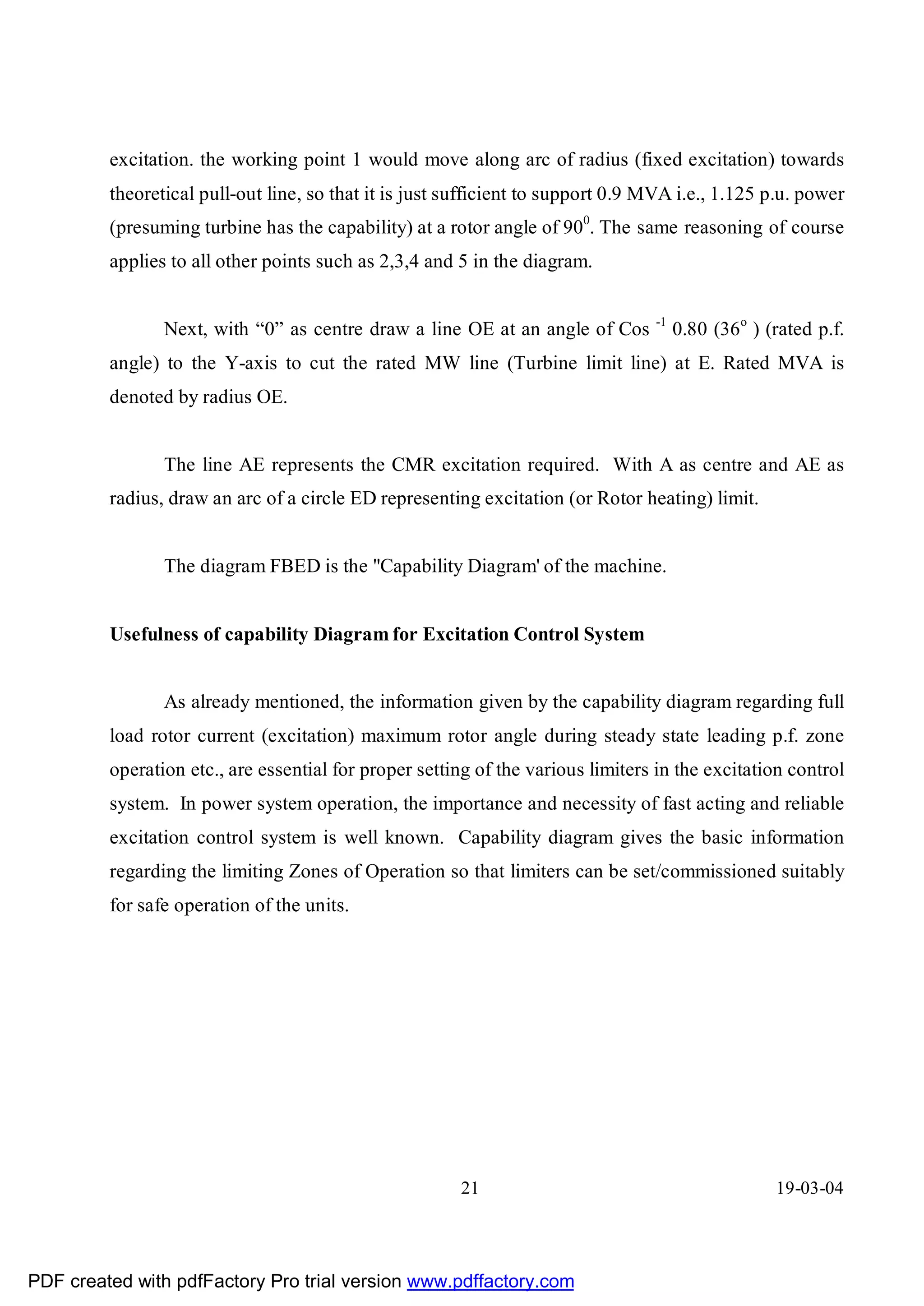
              Let us take an example of a 100 MW Turbo-Generator of 0.80 p.f. (nominal) rating and
         having a SCR of 0.60 Choosing suitable scale, MW values are marked on Y axis and MVAR
         values on X-axis. Refer to Fig.4 which has been drawn on per unit basis and hence bases
         must be defined for interpreting actual values. It is usual to define the rated MVA of the
         machine as Base MVA (i.e. MVA) in which case rated MW is 0.8 MVA. In this case MVA
         = 125 and rated MW = (0.8*125) = 100 MW. The other base unit to define is the per unit
         excitation and this is usually taken as rotor AMPS to give rated terminal voltage on open-
         circuit on Air-Gap Line. To obtain actual values, the p.u. figures from the capability
         diagram must be multiplied by the based values just given.


              The various MW/MVAR values and the excitation current (Rotor Amps) can be also be
         marked directly for the use of operators.
                                                     19                                       19-03-04


PDF created with pdfFactory Pro trial version www.pdffactory.com
It should be noted that the diagram scaling is only correct for rated machine terminal
         voltage and that all values must be appropriately adjusted for different values of terminal
         voltage i.e., they must be multiplied by V2, so that if the terminal voltage is say 90% of
         normal, then all scalings would have to be multiplied by (0.9) 2 = 0.81, although excitation
         scaling would remain the same.
               It is obviously undesirable to operate the machine upto theoretical stability limits.
         Operators have to be informed through this diagram safe limits for operation to allow for
         various unpredictable change such as sudden power increase, a drift in Bus-Bar voltage due
         to lines or plant tripping etc.
               It is usual to relate this safety factor to an increase in power demand with no
         corresponding increase in excitation. The percentage of the power increase used in this way
         defines the shape and position of the "Practical Stability Limit Line".
               Referring back to the example stated above, let us assume that it is required to have a
         12.5 percent (or 1.125 p.u) power margin. This depends on the size of the unit and operating
         practices. On X-axis mark point A such that OA = (MVA x SCR) i.e. in this case.
                = (125 x 0.6)              75 MVAR       i.e. 0.6 pu
               From the point 'A' the dotted line "AS' denotes the theoretical stability line. Horizon tal
         lines parallel to X-axis denote the MW (constant powers lines. Power intervals P equal to
         the required safety margin, in this case 0.125 p.u. of rated power i.e.,, (0.8 x 0.125) = 0.10
         p.u. of MVA are marked on the theoretical stability line AS for the loads of 0, 0.20, 0.40,
         0.60 and 0.80 p.u. MVA i.e., at points e,d,c,b and a. With radii Aa, Ab, Ac, Ad and Ae arcs
         of circles are drawn with A as centre to cut the 0.8, 0.6, 0.4, 0.2 and zero power lines. These
         intercepts are then joined by a continuous curve F B G. This will then be the "Practical
         Stability Line" for a 12.5% power margin.


                The reasoning behind this construction can be understood by taking the case of "Aa"
         arc. This point 1 (or B) would be working point of the machine at 0.8 p.u. MVA power with
         an excitation of "AaAmps. Since the basis of the safety margin is that there should be
         provision for increase in power without any change in


                                                       20                                       19-03-04


PDF created with pdfFactory Pro trial version www.pdffactory.com
excitation. the working point 1 would move along arc of radius (fixed excitation) towards
         theoretical pull-out line, so that it is just sufficient to support 0.9 MVA i.e., 1.125 p.u. power
         (presuming turbine has the capability) at a rotor angle of 900. The same reasoning of course
         applies to all other points such as 2,3,4 and 5 in the diagram.

                                                                                 -1
                Next, with “0” as centre draw a line OE at an angle of Cos            0.80 (36o ) (rated p.f.
         angle) to the Y-axis to cut the rated MW line (Turbine limit line) at E. Rated MVA is
         denoted by radius OE.


                The line AE represents the CMR excitation required. With A as centre and AE as
         radius, draw an arc of a circle ED representing excitation (or Rotor heating) limit.


                The diagram FBED is the "Capability Diagram' of the machine.


         Usefulness of capability Diagram for Excitation Control System


                As already mentioned, the information given by the capability diagram regarding full
         load rotor current (excitation) maximum rotor angle during steady state leading p.f. zone
         operation etc., are essential for proper setting of the various limiters in the excitation control
         system. In power system operation, the importance and necessity of fast acting and reliable
         excitation control system is well known. Capability diagram gives the basic information
         regarding the limiting Zones of Operation so that limiters can be set/commissioned suitably
         for safe operation of the units.


                                                       21                                          19-03-04


PDF created with pdfFactory Pro trial version www.pdffactory.com
22               19-03-04


PDF created with pdfFactory Pro trial version www.pdffactory.com
PERFORMANCE AND CHARACTERISTICS 0 F

                                STATIC EXCITATION EOUIPMENT

              The steady state and transient behaviours of a synchronous machine coupled to
              an infinite system must be matched' to the desired operating conditions by
              suitable selection of control functions in the entire excitation system.

              The basic requirement of a closed loop excitation control system is to hold the
              terminal voltage of a generator at a predetermined value independent of the
              change has to contribute the following functions also.

         a)   Maintenance of stable operation of a machine under steady state, transient and
              dynamic conditions.

         b)   Satisfactory operation with other machines connected in parallel.

         c)    Effective utilisation of machine capabilities without exceeding machine
               operating limits.

         In order to understand the performance of excitation system and to achieve above
         mentioned functions, the following parameters are necessary to be studied.

         CEILING VOLTAGE:

              It is the maximum voltage, that can be impressed on the field under specified
              conditions. Ceiling voltage ultimately determines how fast the field current can
              be changed. For normal disturbances, ceiling condition prevails for a few cycles
              (Ten seconds maximum) to either increase or decrease the excitation until the
              system returns to steady operating state. For Static Excitation, the ceiling
              voltage ranges from 1.6 to 2.0 times the rated one, which is considered to be
              adequate for a fast system response.


                                                   23                                    19-03-04


PDF created with pdfFactory Pro trial version www.pdffactory.com
RESPONSE:
                Response is defined as the rate of increase (or decrease) of the excitation system
         output voltage which can be seen from the excitation voltage time response curve. The
         starting point for evaluating the rate of change shall be the initial rated value. This is a rough
         measure of how fast the exciter output circuit voltage will rise within a specified time, when
         the excitation control is adjusted in the maximum increasing direction. Response ratio is the
         numerical value which is obtained when the excitation system response in volts per sec.
         measured over first 0.5 sec. This applies only for the increasing Excitation. As the response
         is non linear the response ratio is determined in terms of equivalent voltage time area for 0.5
         seconds as shown in Fig. 5. Area abd = Area acd, by approximation.


         STEADY STATE ACCURACY:
                It is the degree of correspondence between the controlled variable and the ideal value
         under specified steady state conditions. The accuracy of the excitations system for changing
         the field parameters to keep the generator terminal voltage at a fixed level depends on its
         static gain and time constants. By choosing a higher static gain for the system, the steady
         state error can be minimised . appreciably and thereby improving the steady state accuracy
         within +0.50%. This can be reduced further with proper integral control.


         OTHER SPECIFICATIONS:


                Excitation system performance could be judged by the exciter voltage Vs time
         characteristics in response to a step change in the generated voltage (See Fig.6)


                   The factors to be studied for optimum performance are
                   a)   Overshoot
                   b)   Rise Time
                   c)   Se,.tiing time
                   d)   Damping ratio


                                                       24                                        19-03-04


PDF created with pdfFactory Pro trial version www.pdffactory.com
For ideal performance, it should have one overshoot and one undershoot with a
         quicker rise time to have a smaller steady state error. Details of each of the parameters are
         not discussed here since the requirement varies from case to case.
         TRANSIENT AND DYNAMIC STABILITY LIMIT:
                 The success of excitation control lies upon the extent of meeting the requirement of
         capability of the machine and thereby giving the dynamic performance of the system. Fast
         excitation helps during disturbances and contributes to the system stability by allowing the
         required transfer of power even during the disturbances. Due to smaller time constants in the
         excitation control loop, it is assumed that quick control efforts could be achieved through
         this.
                 In transient stability the machine is subjected to a severe disturbance (during fault
         etc.) for a short time. This results in dip in the machine terminal voltage and power transfer.
         Taking one machine connected to infinite bus, the equation for power transfer can be written
         as


                       p      vt * v Sin d
                              X


                 Where Vt     Machine        terminal voltage
                       v      Infinite       bus voltage


         X          Interconnected reactance
         d         Load angle
                 From the above equation if "Vt" is reduced 'P' is reduced by corresponding amount.
         For maintaining the power transferpthe excitation should be fast acting enough to boost up
         the field to ceiling and thereby holding the terminal voltage 'Vt' at the desired value. Thus it
         is advantageous to have higher speed and ceiling values in excitation control circuitry.
         Similarly after the fault is removed, the reactance 'X' suddenly changes thereby causing
         unbalance condition due to power swings which in turn needs fast corrective action through
         excitation system to bring the machine to normal operating conditions.

                                                      25                                        19-03-04


PDF created with pdfFactory Pro trial version www.pdffactory.com
Modern fast and high response excitation system helps in two ways by reducing the
         severity of the machines first swing during transient disturbances and also ensuring that the
         subsequent swings are smaller than the first one. Thus it helps in increasing the transient
         stability limit. With a typical static excitation system, ceiling level can be achieved within
         20 milliseconds due to which it offers an improved transient stability limits.


                Following a disturbance, the group of machines operating in the same control group
         experience smaller oscillations. Moreover the oscillating control group of machines react
         with each other reinforcing these oscillations. Here. the change in excitation may not result
         in a stable operation (for slow acting exciters) because by the time corrective action being
         taken by the excitation system (due to the inherent system delay) the oscillating system
         changes causing separate excitation requirement to be met. Though faster excitation system
         avoids this problem to certain extent power system stabilizers as mentioned earlier are
         employed along with the automatic voitacie regulators to damp out the subsequent smaller
         swings in the system. The stabilizer gain is adjusted to a value depending on the negative
         damping of the system and other network parameters. Power System to damp out the
         subsequent smalibr Swings in the system. The stabilizer gain is adjusted to a value
         depending on the negative damping of the system and other network parameters. Power
         System stabiliser helps to damp out inter area oscillations explained above and also local
         machine system oscillations.


                In addition to the above, limiters are generally built into the excitation system for
         large generators connected to the grid. This helps to extract maximum operating output i.e.,
         optimal utilisation of the machine's capability without jeopardising its stability. These limit
         controllers act on both the lagging and leading side in the capability diagram and set below
         the operating points of the protective relays. Thus they prevent unnecessary tripling@by
         keeping the system parameters well within the safe limits. The limit controllers do not
         replace the function of the protective relays. These limiters enhance the stability of the
         machine, thereby increasing its availability to the network. These cannot dispense with
         protective relays.

                                                      26                                       19-03-04


PDF created with pdfFactory Pro trial version www.pdffactory.com
EFFECT OF EXCITATION SYSTEM ON TRANSIENT STABILITY:
                Since the transient stability problems deal with the performance of power system
         when subjected to sudden disturbance, sometimes leading to loss of synchronism, it is
         worthwhile to study the behaviour during the first owing as the period is of very short
         duration. The major factors influencing the outcome are the machine behaviour and the
         power network dynamic relations. For this it is assumed that the mechanical power supplied
         by the prime-mover remains constant during the disturbance. Therefore the effect of
         excitation control on this type of transient depends on its ability to help generator to maintain
         its output power in the above period.
                The main factors that affect the performance during severe transients are
         1)     The disturbance influence of impact; This includes the type of disturbance, its
                location and duration.
         2)     The ability of the transmission system to maintain synchronising forces during the
                transients.
         3)     Turbine and generator parameters.
         These factors mainly affect the first swing transient. The system parameters
         influencing these factors are
         i)     The synchronous machine parameters. Of these, the most important are
                a)     The Interia constant
                b)     The direct axis transient reactance
                c)     The direct axis open circuit time constant
                d)     The ability of the excitation systems to hold the synchronous machine and
                       increase the output during transients.
         ii)    The transmission system impedances under normal, faulted and post-fault conditions.
                Here the flexibility of switching out faulted section is important such that the large
                transfer admittances between synchronous machine are maintained when fault is
                cleared.
         iii)   The protective relaying scheme and equipment. The objective is to detect the fault
                and isolate the faulty sections quickly with minimum disruption. of the


                                                       27                                        19-03-04


PDF created with pdfFactory Pro trial version www.pdffactory.com
During transients initiated by a fault, the armature reaction has the tendency to reduce
         the flux linkage. Hence the type of excitation must be so chosen as to have a fast speed of
         response and a high ceiling voltage (can be,referred to the static type) as an aid to the
         transient stability. With the help of faster boosting up of the excitation, the internal machine
         flux can be offsetted and consequently the machine output power may be increased during
         the first swing. This results in the reduction of accelerating power and thereby effects
         improvements of transient performance of the system.


                                                      28                                        19-03-04


PDF created with pdfFactory Pro trial version www.pdffactory.com
29               19-03-04


PDF created with pdfFactory Pro trial version www.pdffactory.com
30               19-03-04


PDF created with pdfFactory Pro trial version www.pdffactory.com
THYRISTOR - CHARACTERISTICS & ITS APPLICATION IN STATIC
                                      EXCITATION SYSTEM


         INTRODUCTION
              In the latest trend of excitation system neither the rheostatic mode of excitation control
         nor the magnetic amplifier type of control system is used as these are sluggish in action and
         have an inherent dead band of operation because of their low loop gains.
              The use of SCRs at the power stage for the excitation system with voltage regulator
         control the response of the system is much faster than the conventional ones. The modern
         excitation systems incorporating SCRs at their power stage have a very low dead band.


         SYSTEM DESCRIPTION
                The excitation power being fed from the generator terminals or auxiliary supply
         through normally a stepdown transformer and then to the input of the SCRs bridge. The
         voltage regulator having closed loop control compares the actual terminal voltage of machine
         with that of the set reference value and forms an error signal, which controls the firing angle
         of the thyristor bridge. Subsequently, the variable controlled DC voltage is applied to the
         field of the generator through a field breaker. The SCRs bridge forms an important integral
         part of the excitation system by providing an accurate and fast field DC voltage control.


         THEORY OF DEVICE
                The SCR consists of four layers of P and N material and three junctions between
         layers. This has got two blocking states. When the anode terminal is biased positively with
         respect to the cathode, the junctions 31 and 33 are forward biased whereas 32 would be
         reverse biased. So that current flow is blocked and the SCR is said to be in the forward
         blocking state. Similarly, with a negative voltage applied to the anode with respect to
         cathode, ]unction 31 and 33 are reverse biased and junction 32 is forward biased and the
         device will not switch on. This state of the


                                                        31                                     19-03-04


PDF created with pdfFactory Pro trial version www.pdffactory.com
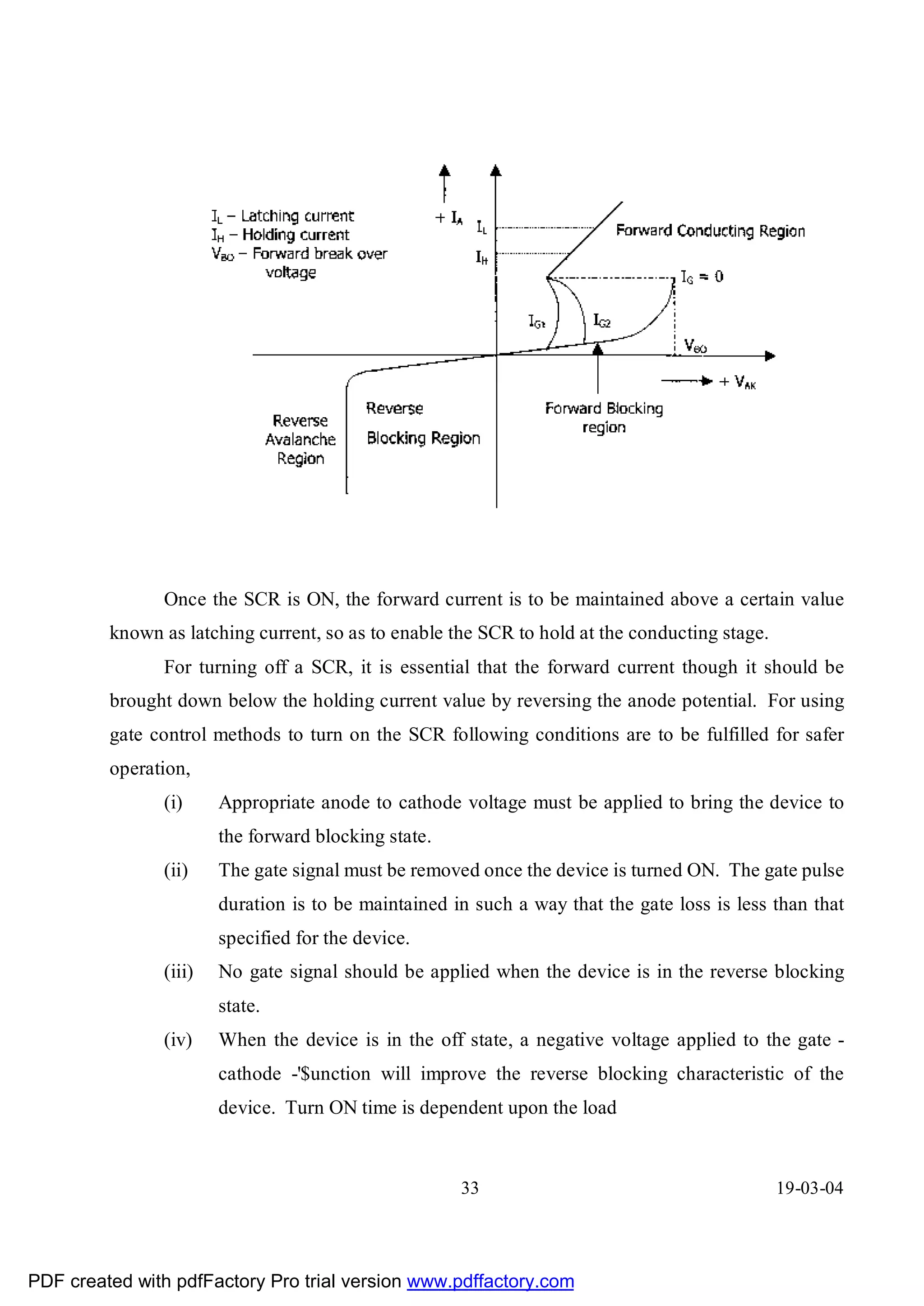
SCR is called as reverse blocking state or high impedance state. The SCR can be driven into
         conduction state when blocking characteristic is erased and the SCR continues to conduct
         until the current level fails below the certain lower value termed as holding current of the
         SCR.
                The SCR can be turned on by increasing the anode voltage sufficiently to exceed the
         break over voltage, so that the reverse biased ]unction 32 breaks down because of large
         voltage gradient across the depletion layers and the forward current increases. It is limited
         only by the external resistance of the circuit. The most convenient method of switching the
         SCR is by applying a positive trigger pulse to the gate of the SCR with lower positive anode
         voltage than the break down voltage. This is known as the gate control.


                                                     32                                      19-03-04


PDF created with pdfFactory Pro trial version www.pdffactory.com
Once the SCR is ON, the forward current is to be maintained above a certain value
         known as latching current, so as to enable the SCR to hold at the conducting stage.
               For turning off a SCR, it is essential that the forward current though it should be
         brought down below the holding current value by reversing the anode potential. For using
         gate control methods to turn on the SCR following conditions are to be fulfilled for safer
         operation,
               (i)     Appropriate anode to cathode voltage must be applied to bring the device to
                       the forward blocking state.
               (ii)    The gate signal must be removed once the device is turned ON. The gate pulse
                       duration is to be maintained in such a way that the gate loss is less than that
                       specified for the device.
               (iii)   No gate signal should be applied when the device is in the reverse blocking
                       state.
               (iv)    When the device is in the off state, a negative voltage applied to the gate -
                       cathode -'$unction will improve the reverse blocking characteristic of the
                       device. Turn ON time is dependent upon the load


                                                     33                                        19-03-04


PDF created with pdfFactory Pro trial version www.pdffactory.com
current and the rate of rise of gate pulse. Turn off time depends on the recombination of
         charges near junction 32. Some typical values of turn ON and OFF times are 1 to 4
         microsecs and 10 to 250 microsecs respectively. For power frequency applications these
         turn ON and OFF times does not pose any problems.
                               SELECTION PROCEDURE OF SCR BRIDGES FOR
                                          STATIC EXCITATION SYSTEM


              The following factors are taken into account,
                     (i)    Peak inverse voltage
                     (ii) Junction temperature
                     (iii) dv/dt Rating
                     (iv) di/dt Rating
                     (v) Gate firing requirement
                     (vi) Current rating


         PARALLEL OPERATION
               For certain high current applicatio ns or for redundancy for the power stage
         paralleling of the devices are required. For such cases, following points must be carefully
         observed while designing the entire system.
               (i)         For paralleling, the connections which are done by bus bars and cables etc., are
                           to be kept symmetrical as far as practicable.
               (H)         Cooling for the devices are to be kept almost similar (i.e.) the positions and
                           type of mounting of the bridges and the cooling fans are to be,maintained
                           identical.
               (iii)       RC circuit should be so designed to keep the RC discharge current through the
                           device within the specified limit under all circumstances. In addition to the
                           above, precautions are to be taken to limit the rate of rise of RC discharge
                           current by providing decoupting reactors in series with the device.


                                                          34                                       19-03-04


PDF created with pdfFactory Pro trial version www.pdffactory.com
(iv) The       above        series decoupling        reactors with proper tolerances
                       also serve the purpose of reducing the missharing factor for the parallel
                       connected device. While designing this, missharing factor is to be taken into
                       account for the junction temperature calculation


         SNUBBER CIRCUIT
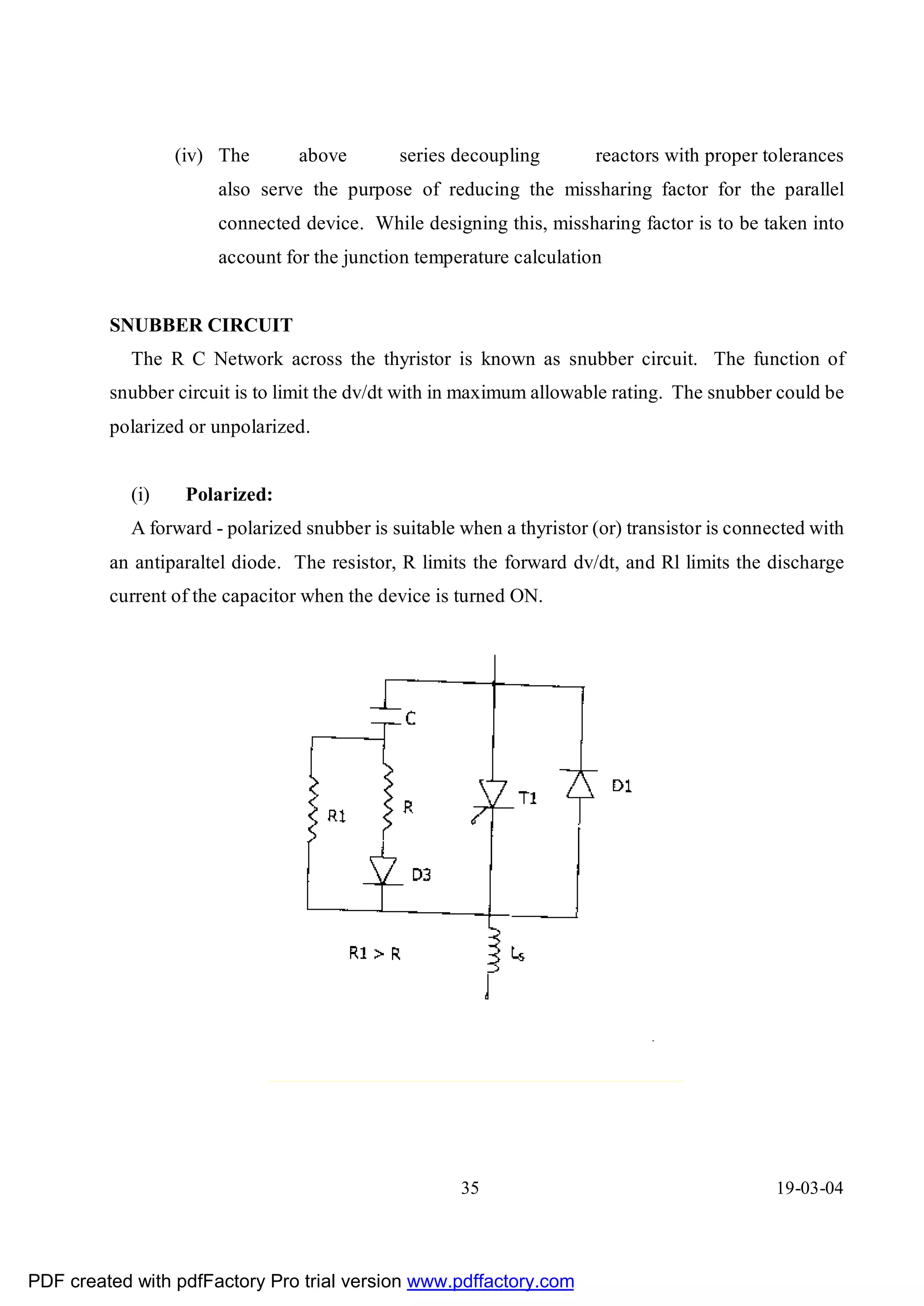
            The R C Network across the thyristor is known as snubber circuit. The function of
         snubber circuit is to limit the dv/dt with in maximum allowable rating. The snubber could be
         polarized or unpolarized.


            (i)    Polarized:
            A forward - polarized snubber is suitable when a thyristor (or) transistor is connected with
         an antiparaltel diode. The resistor, R limits the forward dv/dt, and Rl limits the discharge
         current of the capacitor when the device is turned ON.


                                                      35                                       19-03-04


PDF created with pdfFactory Pro trial version www.pdffactory.com
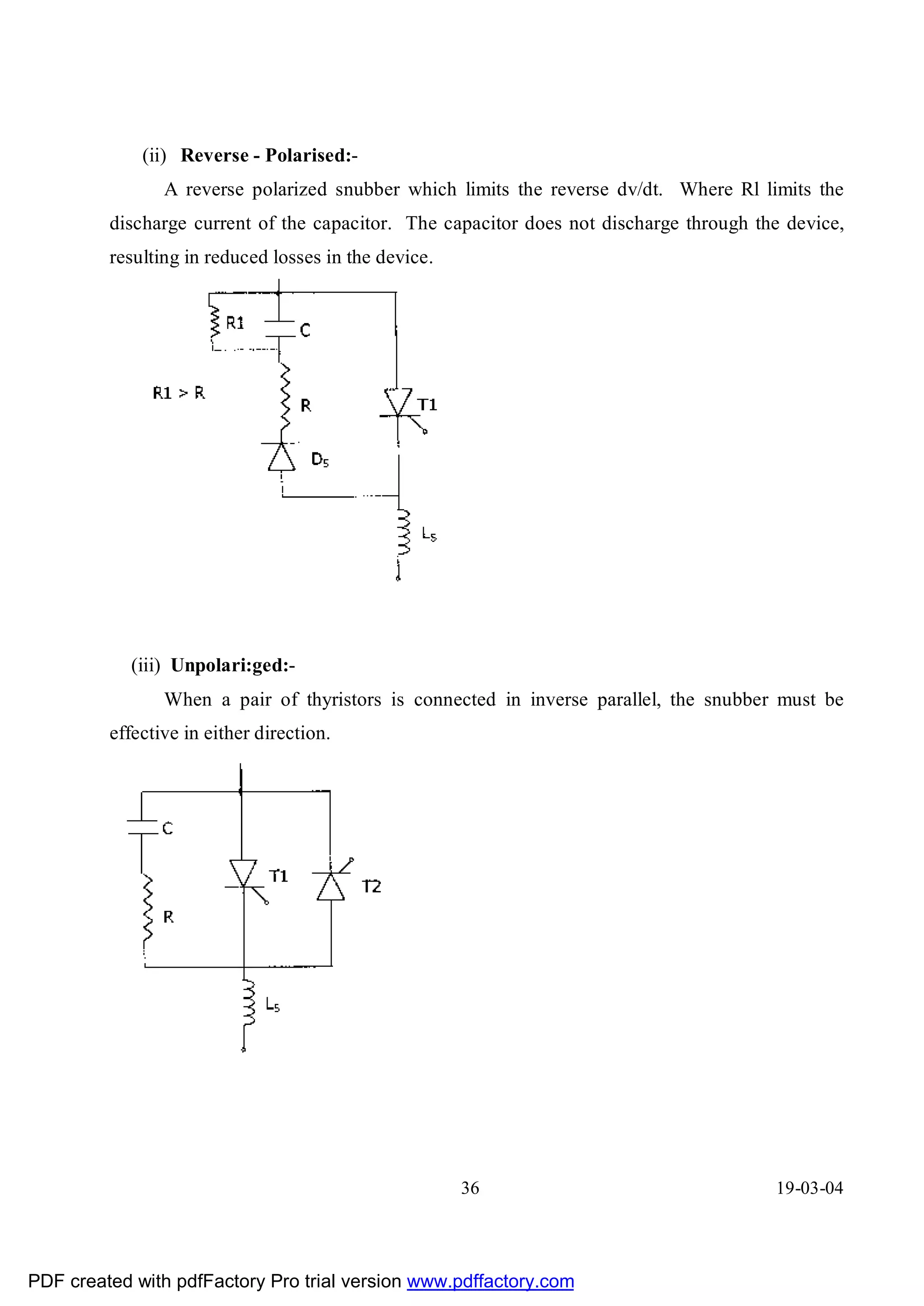
(ii) Reverse - Polarised:-
                A reverse polarized snubber which limits the reverse dv/dt. Where Rl limits the
         discharge current of the capacitor. The capacitor does not discharge through the device,
         resulting in reduced losses in the device.


            (iii) Unpolari:ged:-
                When a pair of thyristors is connected in inverse parallel, the snubber must be
         effective in either direction.


                                                      36                                19-03-04


PDF created with pdfFactory Pro trial version www.pdffactory.com
AVR - UN 2010


               The Automatic voltage regulator type UN 2010 is an electronic control module
         specially designed for the voltage regulation of synchronous machines. It primarly consists
         of an actual value converter, a control amplifier with PID characteristics which compares the
         actual value with the set reference value and forms an output proportional to the difference.
         The output of this module controls the gate control circuit UN 1001. The module does not
         have an INBUILT power supply and derives its power from UN 2004, the pulse intermediate
         stage and power supply unit. The AVR works on + 1SVDC supply.


         The main features of this module are listed below
         a)    The AVR comprises of an input circuit which accepts 3 phase voltage signals of
               11OVAC and 3 phase current signals of SA or 1A A.C. It is thus necessary to use
               intermediate PT"s and CT"s to transform the generator voltage and current to the
               above mentioned values. The module itself contains PT"s and CT"s with further step
               down the signals to make them compatible with electronic circuit.


               A CIRCUITARY is available in the module for adding the current signals
               VECTORIALY to the voltage signals for providing compensation as a function of
               active or reactive power flowing in the generator terminals.


         b)    An actual value converting circuit for converting the AC input signal to DC signal
               with minimum ripple with the aid of filter network.


         c)    A reference value circuit using temperature compensated zener diodes. The output of
               which is taken to an external potentiometer that provides 90-110 % range of operation
               of the generator voltage.


                                                     37                                      19-03-04


PDF created with pdfFactory Pro trial version www.pdffactory.com
d)    A control amplifier which compares the reference and actual value and provides an
               output proportional to the deviation. Apart from this, it has the facility to accept other
               inputs for operation in conjunction with various limiters and power system stabilizer.
         e)    A voltage proportional to frequency network which reduces the excitation current
               when frequency falls below the set level, thus keeping the air gap
               flux constant. This prevents saturation of connected transformers and
               possible over voltage.


                                                      38                                       19-03-04


PDF created with pdfFactory Pro trial version www.pdffactory.com
LIMITERS IN STATIC EXCITATION SYSTEM
                                            LIMIT CONTROLLERS
                With ever increasing size of generating units today, more stringent requirements have
         to be met by excitation systems. Today, it is proven beyond doubt, that Static Excitation
         assures, stable operation both under dynamic and transient conditions, Generators running in
         parallel with the power net-work even under extreme conditions must remain in synchronism
         without- the maximum load limit on it being exceeded and without the protective relays
         operating.   An automatic voltage regulator AVR alone cannot ensure this. Optimum
         utilisation of the generator can be ensured only if the basic AVR is influenced by additional
         signals to limit the under-excitation and over-excitation of the machine.           Thus, limit
         controllers working in conjunction with the AVR ensure :
                a)        Optimum utilisation of the machine.
                b)    Security of parallel operation etc.


                Limit controllers simplify the job of the operating-staff and enables stable operation
         close to the limiting values. With limit controllers in service, operational errors and faults in
         the regulator lead only to the limit value control and not to disconnection.
                It has to be understood that limit controllers however are not meant to replace the
         protection system but they are only intended to prevent the protection system from operating
         under extreme transient conditions.


         PARAMETERS FOR LIMITATIONS:
              Limiters, whenever they intervene, influence the voltage regulator suitable to bring
         about a corresponding change in the excitation. The following are the parameters which are
         to be limited.
         1)   Stator current under condition of over Excitation and under excitation
         2)   Rotor current
         3)   Rotor angle or the load angle


                                                       39                                        19-03-04


PDF created with pdfFactory Pro trial version www.pdffactory.com
MECHANISM OF LIMITER INTERVENTION:
              During over-excitation, the Rotor current and stator current limiters intervene to bring
         about a reduction in excitation. On the otherhand during under excitation, limitation of rotor
         angle and stator current influence to increase the excitation. Rotor and stator current limiters
         must be designed to intervene after a certain delay so as to permit temporary over/ceiling
         excitation, limiters do not impair the control behaviour of the AVR as over-excited condition
         can exist in the event of load surge or because of short-lived faults in the power supply
         network. The AVR reacts to a distance fault (say 3 phase short circuit) and commands
         ceiling excitation to be applied, thereby increasing the synchronosing torque of the machine
         and prevents it from losing synchronism. However, if the short circuit persists and has not
         been cleared by system protection after a set time, delayed rotor current limiters comes into
         operation preventing the generator and the excitation equipment from being subjected to
         thermal over load. An identical situation prevails during sudden connection of load to the
         system. The AVR enable short-time ceiling excitation to prevail so as to obtain lower
         settling time.


              The under-excited mode, the rotor angle limiter and stator current limiter must
         intervene instantaneously to increase the excitation to prevent further increment in the rotor
         angle.
              In the under excited mode, stator current limiter is essentially used with multiple-pole
         synchronous condensers which run at suitable level of excitation to increase the capacitive
         absorption capability of the machine.
           POWER DIAGRAM OF THE GENERATOR AND RANGE OF INFLUENCE OF
                                          LIMIT CONTROLLERS
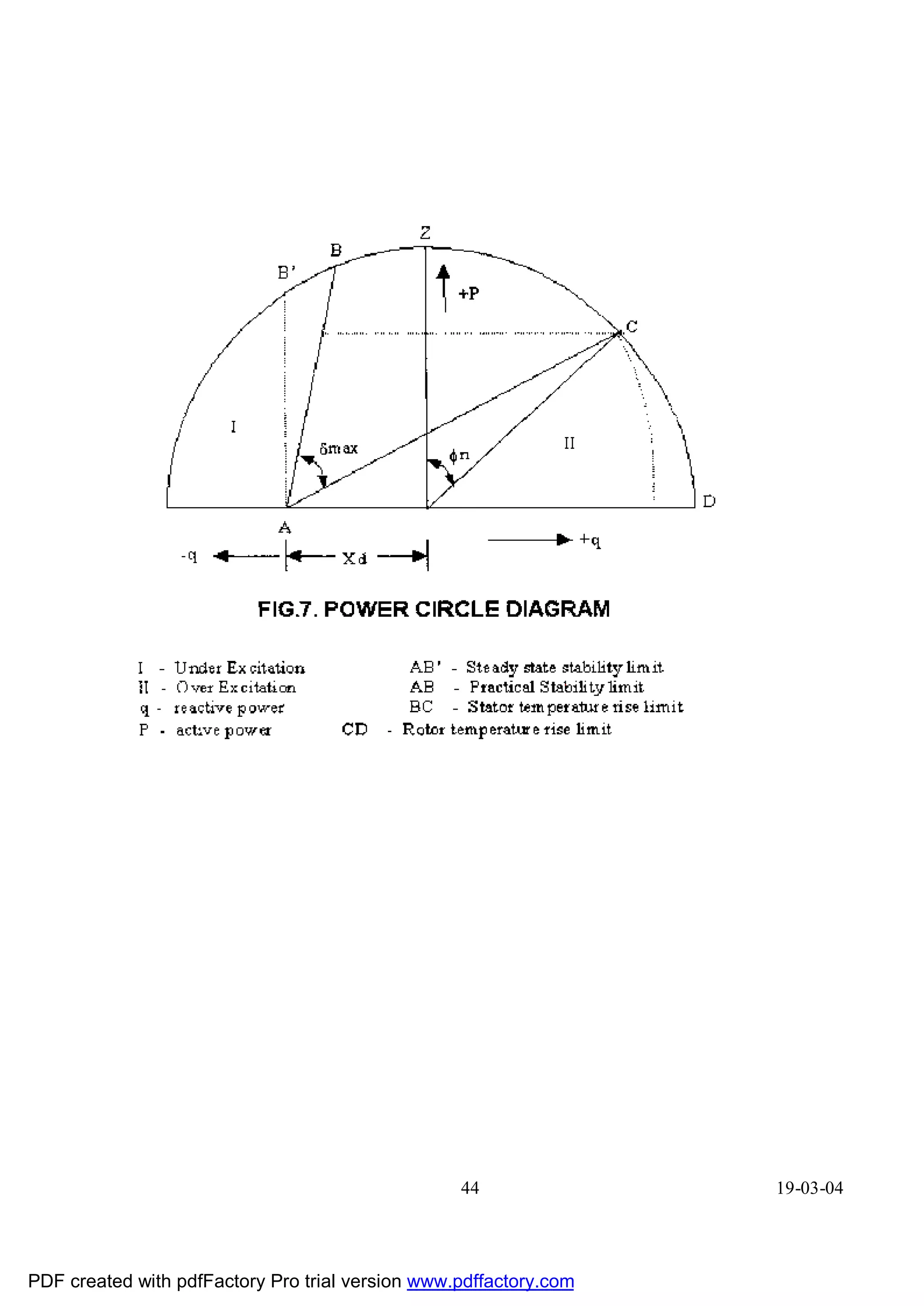
                  The operational limits of the sychronous machine are shown in the power circle
         diagram. The application and range of influence of the limiters depends on the conditions in
         the installation and the generator data. The possible zone of intervention of the limiterg is
         marked in the power chart/power circle diagram. Fig.7


                                                      40                                        19-03-04


PDF created with pdfFactory Pro trial version www.pdffactory.com
ROTOR ANGLE LIMITER:
               Line AB represents the range of influence of the Rotor Angle, Limiter the maximum
         angle of which has been taken as 85'. Although stable operation can be ensured even beyond
         850 with the fast acting load angle limiter in action and achieve greater possible reactive
         power absorption capability, the load angle is limited for practical purposes to 850 because
         of the following considerations :
         1)    In the event of a short circuit in the systems,.the generators may accelerate owing to
               the abrupt partial removal of the electrical load and as the turbine governor cannot act
               fast, the rotor angle increases and the angle can become so large relative to the system
               vector that the machine may fall out of step.
         2)    The excitation system (AVR) switches over to manual mode in the event of internal
               faults in the auto-mode. Changeover to manual-mode signifies constant excitation
               and hence a stable operation upto a maximum angle of 900 electrical only is possible.


               The rotor angle limiter limits the load angle of the machine to an acceptable
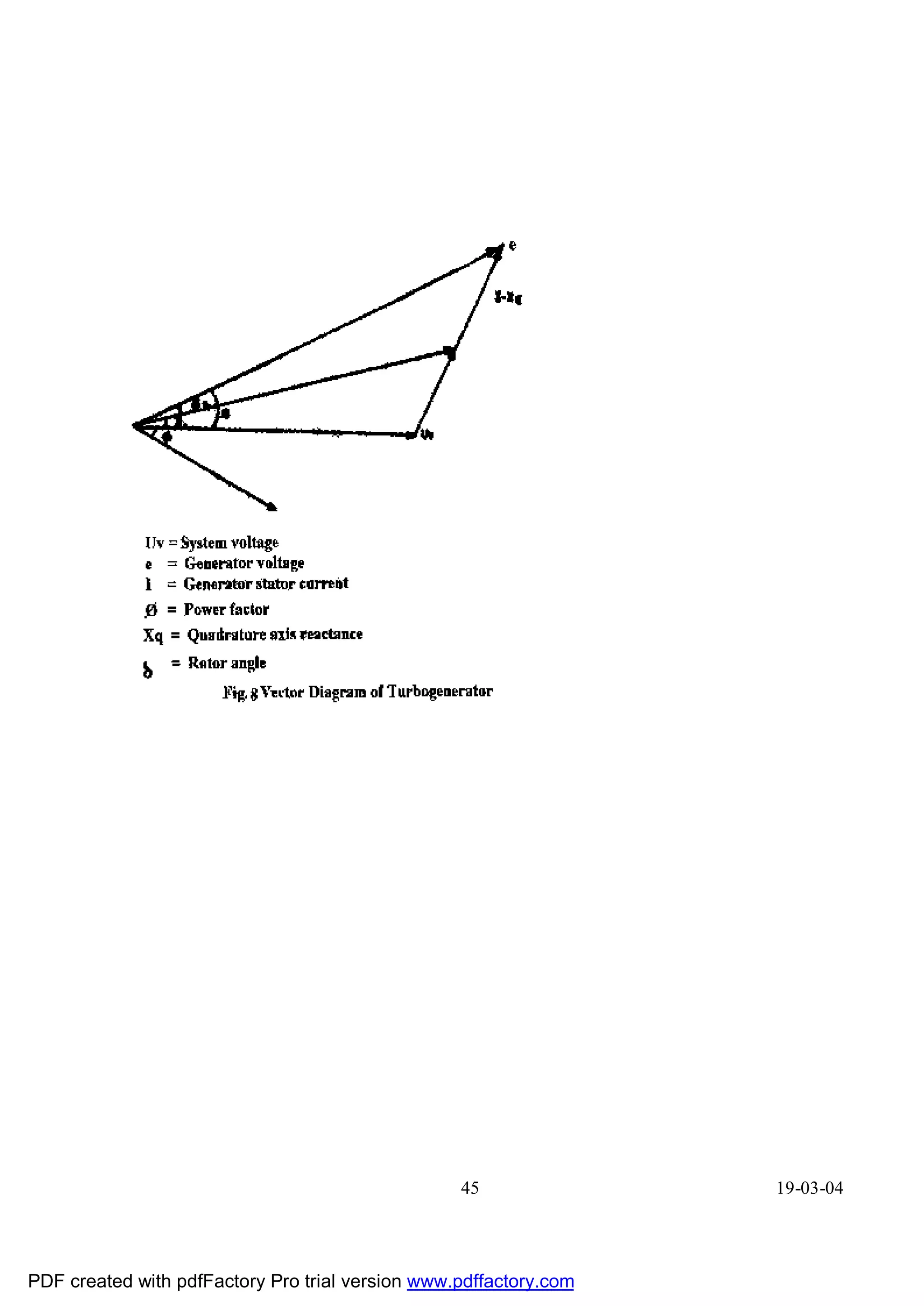
         present value. The load angle is the electrical angle between the voltage vector of the system
         and the vector of the machine voltage 'e' fig.8. The system vector is derived from the voltage
         vector of the generator Uv by adding to it the voltage drop in reactances external to the
         machine. This takes into account the transformers and transmission lines between the
         generator and the system load centre. The rotor voltage is simulated adding the inductive
         voltage drop in the machine IXq. The system voltage at the load centre is obtained by
         subtracting Ixe drop (Reactance drop in the transmission line, transformers etc.) from the
         generator terminal voltage.


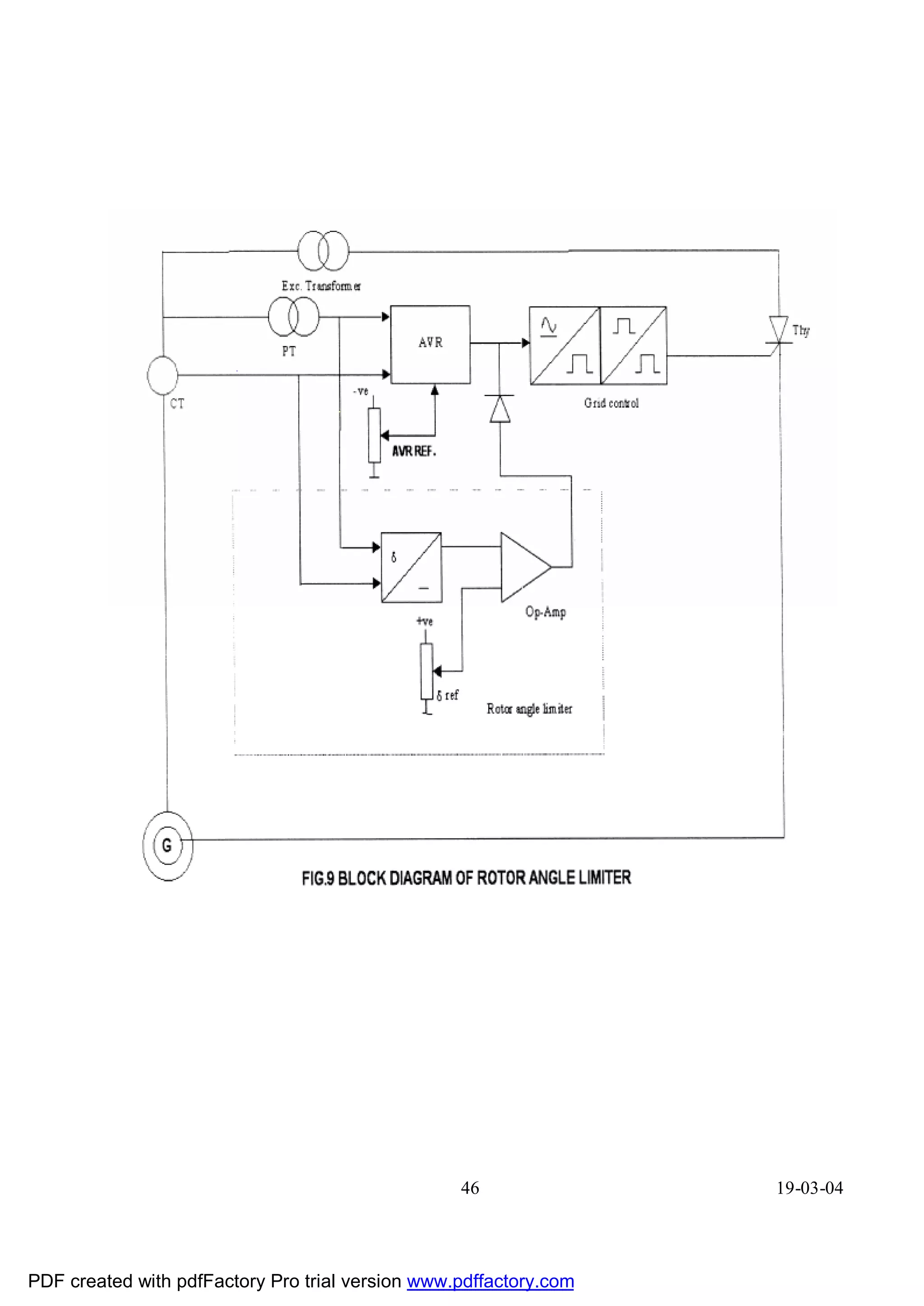
               The phase angle between 'e' and UN is converted into a proportional dc voltage. The
         actual value is compared with an adjustable reference and fed to the input of an operational
         amplifier. In case the angle exceeds the set value the output signal immediately takes over
         the control of thyristor network to build up the generator air-gap flux fast enough to avoid
         slipping. It stands to reason that the output of the limiter acts directly over AVR output to
         avoid any loss of time due to filter time constants in the AVR. Fig.9 explains the operation
         of Automatic Voltage regulator in conjection with rotor angle limiter.

                                                     41                                        19-03-04


PDF created with pdfFactory Pro trial version www.pdffactory.com
ROTOR CURRENT LIMITER:
                The AVR drive the field or the thyristor network into overload for one or more of the
         following reasons :
         a)     faulty handling b) system voltage reduction c) loss of sensing voltage to AVR and d)
         failure within the controller.     The excitation limiter must prevent this overload from
         persisting. On the other hand, during dynamic disturbances in the system the excitation
         should not be reduced at once, but ceiling excitation should be possible for a limited time.
                The limiter can be operated in three different modes as explained below to cater the
         above requirements.


         i)     Simple mode: In this mode the excitation current is limited to a preset maximum
         value. The limiter intenienes with a time delay which is proportional to the magnitude of the
         over load. Which the limiter in operation, the current is limited steadily to the rated value.


         11)    Mixed Mode: If during the above period of limitation, the generator voltage dips
         steeply for any reason, the ceiling excitation limit is validated again. The ceiling excitation
         current helps in increasing the short circuit current in the fault zones and hente aid selective
         tripping of the faulted section.


         iii)   Switching mode : In the switching mode the excitation is limited to the thermal or
         rated current value. Only in case of sharp dip in the machine voltage, the ceiling limit was
         unable momentarily. The limit switches back to the rated value after the set time.


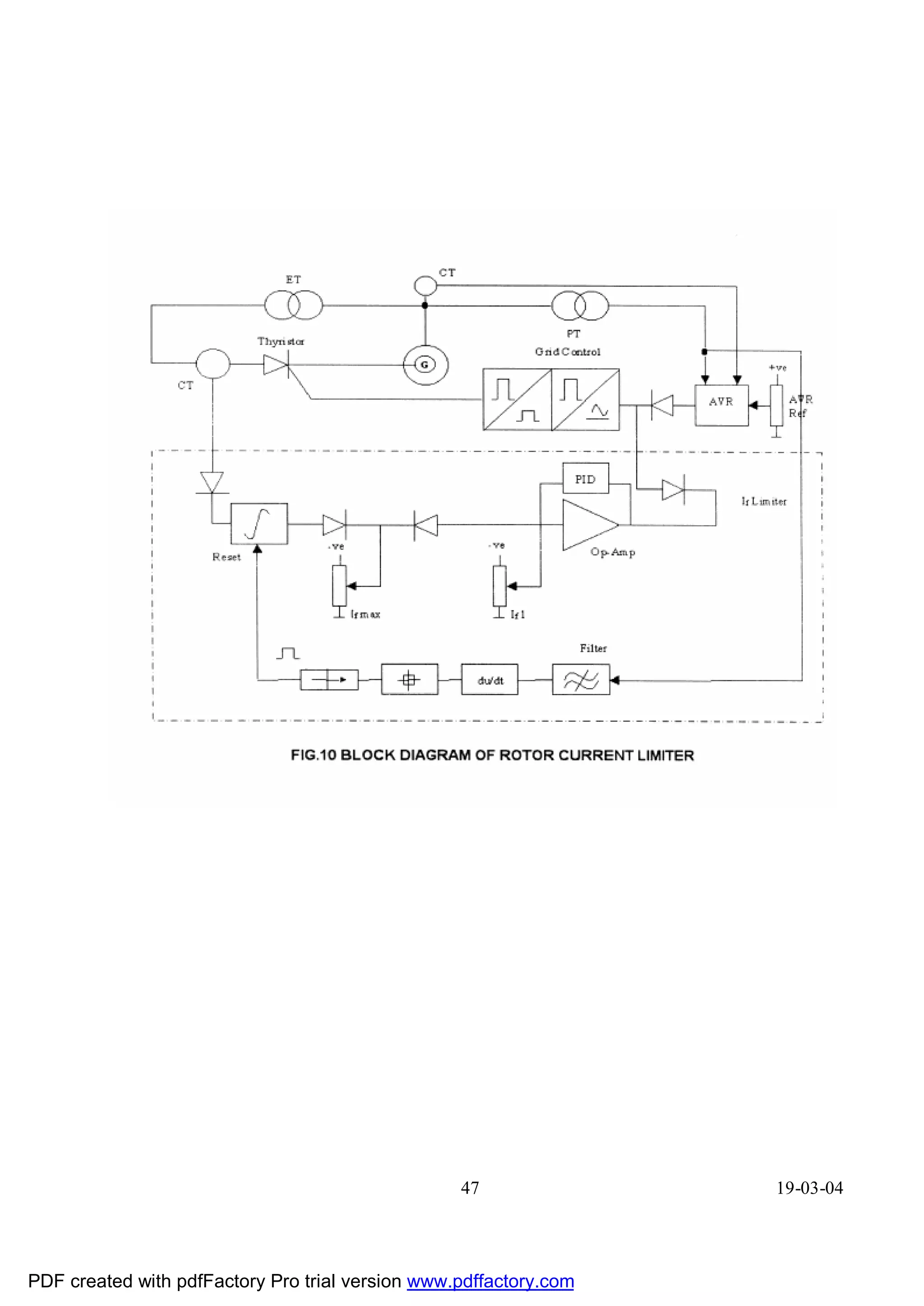
                Figure-10 gives the block diagram of a rotor current limiter acting in conjunction with
         AVR to limit the over excitation in the desired fashion.


                                                       42                                       19-03-04


PDF created with pdfFactory Pro trial version www.pdffactory.com
STATOR CURRENT LIMITER:


              The stator current limiter has to influence the AVR differently depending on whether
         the machine is over-excited or under-excited. The excitation current is to be suitably
         reduced to limit the inductive stator current and is increased to limit the capacitive current.
         The rotor angie limiter provides a more definite protection in preventing the machine from
         failing out of step.    Capacitive stator current limitation comes into play only with
         synchronous condensers which are to some extent negatively excited with generators it
         prevents excessive leading MVAR loading corresponding to any given MW load.


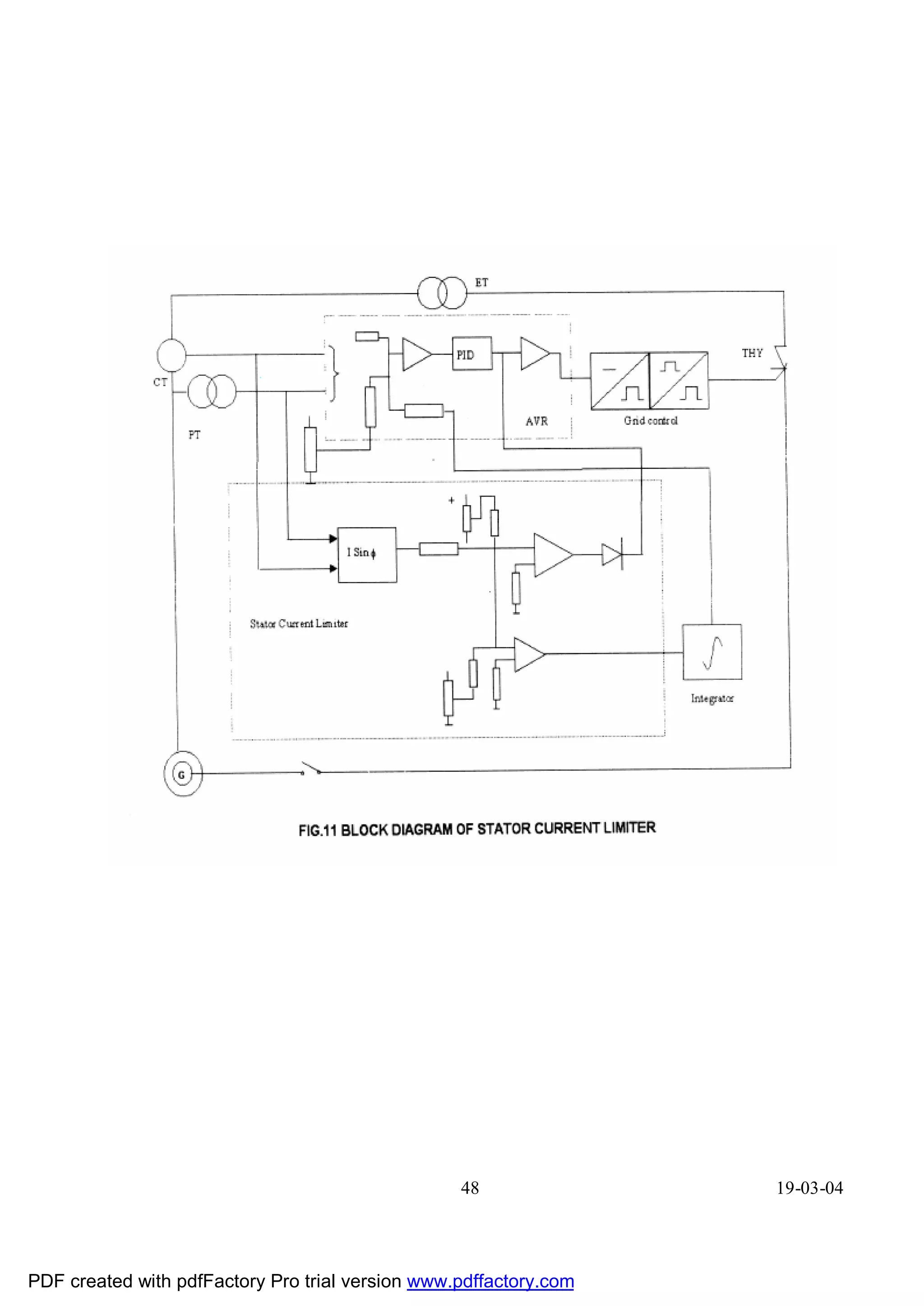
              The generator stator current is converted into polarised dc signal +ve or -ve, depending
         upon whether the machine is over-excited or under-excited. This voltage forms the actual
         value for the controllers which process each of the bipolar signal independently. One of the
         these controllers compare the capacitive stator current against its reference and acts directly
         on the regulator via a de-coupling diode to increase the excitation. The action of second
         controller which limits the inductive stator current is delayed by means of an integrator
         before it influences the control input of the AVR so as to reduce the excitation. The time lag
         offered is perfectly acceptable as far as stator overheating is concerned because of the
         integrator time constant is set one order less than the stator thermal time constant. Fig. 11
         shows an AVR operating in conjunction with a stator current limiter.


                                                      43                                       19-03-04


PDF created with pdfFactory Pro trial version www.pdffactory.com
44               19-03-04


PDF created with pdfFactory Pro trial version www.pdffactory.com
45               19-03-04


PDF created with pdfFactory Pro trial version www.pdffactory.com
46               19-03-04


PDF created with pdfFactory Pro trial version www.pdffactory.com
47               19-03-04


PDF created with pdfFactory Pro trial version www.pdffactory.com
48               19-03-04


PDF created with pdfFactory Pro trial version www.pdffactory.com
EXCITATION TRANSFORMER


         INTRODUCTION:
                Rectifier transformers directly connected to the generator terminals and feeding power
         to the field of the machine via thyristor converters, plays an important role in an excitation
         system and in turn power generation Reliability of this transformer has to be ensured in all
         respects.
                Importance of rectifier transformer has been realised ever-since the mercury arc
         converters came into existence for important applications like large power drives and
         excitation systems. A gradual development has taken place from oil filled transformers to
         (resin) cast coil type transformers (dry type) for Excitation transformer.
                Oil and clophen/Sovtol Iilied transformers are still adopted for large rating. However,
         in urban areas and thickly populated cities where pollution control is a so to be thought of;
         certain countries like West Germany have brought out regulation that oil immersed
         transformers can be used only under special circumstances. Further, use of clophen/Sovtol
         filled transformers has already been banned almost in all advanced countries because of
         poisonous gases emanating in case of damages. Moreover, there has been constant rise in
         price of oil in the international market, resulting in substantial increase in the total price of
         transformer and its maintenance. Not only the above reasons but other hazards have led the
         scientists to think of an alternate design which could gradually replace the oil and clophen/
         Sovtot filled transformers. Accordingly vacuum impregnated dry type transformers were
         taken up for large power and high voltage rating. The results were however not satisfactory
         because of many limitations like effect of atmosphere, over voitages and the need for proper
         drying out after long break in service. Therefore the need was felt to have better alternative
         and cast resin moulding technique came into existence. The development of cast resin
         transformers has led to the production of dry insulated type transformers upto 36 KV. These
         transformers have not only been


                                                       49                                       19-03-04


PDF created with pdfFactory Pro trial version www.pdffactory.com
found comparable to oil filled transformers but also proved their superiority in all respects.
         These transformers are of class "F" insulation and indoor type.


         VOLTAGE AND POWER RATING:
                The selection of the secondary voltage of excitation transformer depends upon the
         filed forcing voltage. The primary voltage is the same as that of generator terminal voltage.
         Current rating is dependant on the maximum continuous current in the field winding.
         Generally the power rating of the Excitation transformer used in Static Excitation System is
         around 1 % of the rating of generator in MVA.


         ENCLOSURE AND COOLING:
                The enclosures are normally designed to ensure natural air cooling/Forced air cooling
         to the transformers. These enclosures are made to IP20, IP21 or IP23 depending upon the
         requirement. Forced cooling arrangement provides increase in rating by 40% than that with
         natural air cooled transformer. Normally this arrangement is switched on during peak load
         period or in summer to deliver more current from the same transformer. The description that
         follows compares resin cast coil, dry type transformers with other transformers for various
         characteristics.


         SALIENT FEATURES
         SHORT CIRCUIT PROOF:
                The dynamic short circuit strength exceeds by far that of oil immersed transformers as
         well as that of conventional dry type transformers. In the event of a short circuit the cast
         resin transformer is not endangered mechanically, and only thermal damage can take place.
         The high mechanical strength is achieved by casting the coils in epoxy resin with a fiber
         glass filler to form a compact tubular spool. An insulation thickness of 1-2mm is quite
         adequate to withstand the force that occur during operation.


                                                     50                                       19-03-04


PDF created with pdfFactory Pro trial version www.pdffactory.com
HIGH OVER LOAD CAPACITY:
                In certain applications where rectifier transformer is subjected to intermittent loads
         like rolling mill, furnace, traction and also in excitation duly high current increase, is
         followed by low current demand. It results in the windings to be mechanically stressed to a
         greater extent.


                In cast resin transformers all the windings are cast and therefore no difficulties
         concerning mechanical strength due to repeated overloads. Normally H.V. & L.V. Coils are
         cast separately, all the forces appearing on one winding can be suitable absorbed by itself.
         The resultant forces between primary and secondary windings can be made to absorb by
         putting suitable support blocks between the coils and frame. Position of the support blocks
         can be conveniently designed to reduce the forces to a lower value in contrast to
         conventional type transformer.


                Conventional type, wound coil transformers consume a considerable amount of
         insulation material like paper which absorbs. the expansion of conductor and coils have to be
         recompressed after certain periods', The cast coils being homogeneous, the coil structure
         expands and contracts as a whole and the movement is taken care of by means of an elastic
         support. Recompression of the coils is therefore not required.
                In synthetic liquid cooled transformer there is a rated temperature jump between
         winding and cooling liquid of the order of 20 to 250C with current density 3 to 4 A/Sq.mm.
         In contrast, in these transformers with class F insulation the allowable temperature rise
         between coil and air is of the order of 1000C with the same current density. This clearly
         indicates the heating time constant of cast resin, normally 6-10 times, higher than that of oil
         filled transformers.


         RESISTT AGAINST TEMPERATURE FLUCTUATION:


                The selected insulation material is fiber glass reinforced epoxy resin which has got
         high tensile and bending strength. Therefore the transformer can withstand the wide range of
         temperature fluctuations.

                                                      51                                       19-03-04


PDF created with pdfFactory Pro trial version www.pdffactory.com
MOISTURE PROOF:
                The cast resin coils are impregnated and cast under vacuum which ensures the
         voidless embedding of all windings into a system of uniform glass fiber-epoxy laminate.
         This process helps the coil to offer an increased protection against moisture.
                Conventional dry type transformers are not moisture proof. The winding do absorb
         humidity and there is danger of flashover once they are put in service after a long period.


         IMMEDIATE SWITCH ON:
                Because of the cast resin coil, the coils are homogeneously built in all respects. There
         is no possibility of effect of moisture and ambient temperature fluctuations over coils. Under
         such case the transformer can be directly switched on without predrying the same after long
         interruption from service.


         IMPULSE STRENGTH:
                Impulse strength of these transformers is higher than that of conventional dry type
         transformers and is comparable to that of oil cooled transformers according to any
         international standard.


         NON-INFLAMMAIBLE
                Due to high quality of non-hydroscopic material, it has been proved that neither with
         welding cutting torches nor with welding electric arc the cast coil resin could be induced to
         burn and as such is almost non-inflammable.


         PARTIAL DISCHARGE:
                During operation, there is no partial discharges inside the winding, exceeding narrow
         band 10 P.C. i.e. transformers are designed for long life.


                                                      52                                       19-03-04


PDF created with pdfFactory Pro trial version www.pdffactory.com
COMPACT INSTALLATION:
                Compared to oil and clophen/Sovtol filled transformers, the use of this type
         transformer required less space, less weight and above all, the cost for the necessary erection
         of catch-pits no longer exist. Because the cast resin coils are non-inflammable in nature a
         sub-station consisting of a number of such transformers can be installed in the same building
         near to the consumer end there by the power losses due to long distribution lines are also
         avoided.
         NO LEAKING:
                Nothing can leak out from these transformers in contrast to clophen/sovtol and oil
         filled transformers where there is a possibility of the liquid leaking. Therefore there is no
         need to make catchpits at sites to avoid contamination to the ground water.


         MAINTENANCE FREE:
              Considering all above mentioned features it can be concluded that these transformers
              are virtually free from maintenance.
         -    No re-adjustment of the winding and no re-tensioning of the individual coils are
              required to maintain the short circuit strength.
         -    No control of oil is required
         -    No checking of electrical quality of used oil
         -    No dry out is necessary even after long interruption from use.
         OVER CURRENT PROTECTION :
                It is normally achieved with the help of current transformers mounted on each phase
         on H.T. Side of excitation transformer. From current transformers current signals are given
         to two over current relays, one is meant for instantaneous over current protection, another is
         set for delayed over current protection. The latter is set to suit the field forcing requirements.


         OVER TEMPERATURE PROTECTION:
                It is achieved with the help of temperature sensors kept near the hot spot zone of the
         L.V. Coils. The sensors have non-linear characteristic.

                                                       53                                        19-03-04


PDF created with pdfFactory Pro trial version www.pdffactory.com
The resistance of the sensor is increased considerably after a certain temperature limit.
         Normally two limits of over temperature are kept depending on the class of insulating
         material used, one is the warning limit and another one for tripping of the equipment. Both
         these limits are obtained by independent temperature sensor. The output of the sensors are
         brought to the temperature monitoring equipment which signalises or calls for tripping.


         CONNECTION ARRANGEMENT:
                Normally the excitation transformer will have DyS vector group connection to
         suppress harmonics. The angular displacement between HT and LT winding is 1500
         Electrical degrees.


         OPERATING CONDITION:
                Inspite of all advantages of the cast coil resin transformers mentioned above, it is
         recommended that this transformer should be mounted in an enclosure installed away from
         water, oil leaking sources, away from sun rays and heat dissipating equipments. Care has to
         be taken that sufficient free space all around is available to maintain the ambient temperature
         and ventilation. The installation of the transformer has to be thought of in the beginning
         itself to avoid dust. However, dust/carbon particles must be removed during periodical shut
         downs. Normally this transformer is located just below the generator at exciter end either at
         "O" meter level or at 4.Sm level.


         CONCLUSION
         In excitation systems, practically cast resin dry type transformers are used and there is no
         necessity presently of using of oil cooled transformers with its inherent disadvantages of fire-
         risk etc., as already mentioned. Further for indoor application it is preferable to use only dry
         type transformers.


                                                      54                                        19-03-04


PDF created with pdfFactory Pro trial version www.pdffactory.com
OPERATION OF STATIC EXCITATION EQUIPMENT


                Initially the main Circuit Breaker as well as Field Circuit Breaker is in open
         condition. The signal lamp ""Excitation off' shows that the machine is not excited.


                In order to start up the machine, machine should be first brought to nominal speed i.e.
         3000 RPM. Pre-selection to be done for selecting the manual or auto control. The signal
         lamps on the control unit indicate whether auto or manual control has been pre~selected.


                As soon as the nominal speed is reached, the FFB (Field Flashing Breaker) & FB
         (Field Breaker) to be closed. This is achieved through pressing the luminous button in the
         cubicle or by a parallel connected push button (remote). Since the remanance voltage of the
         machine is not sufficient to operate the regulator, initially suitable station A.C. voltage via
         full wave bridge rectifier or suitable DC voltage from station batteries to be supplied through
         Field Flashing Breaker. The machine voltage rises to 30% , then the electronic regulation
         start functioning by getting the released pulses, which were blocked till then. The blocking
         of pulses is cancelled through voltage relay and regulator takes over the function of
         regulating the machine voltage.


                At 70% of the machine voltage, the field flashing (FF) supply is switched off with the
         help of FFB. Till 70% of Machine voltage both Auxiliary supply and main supply are
         available for excitation. However for avoiding re-entry of supply to FF unit, blocking diodes
         are provided both in A/C & DC supply circuit. From 70% of machine voltage the total
         requirement of Excitation current is taken through SCR. The reference value for auto control
         can be set between 90% & 110% of nominal voltage. For manual control variation of
         voltage can be done through Potentiometer from 0 to 90% or 0 to 110% as per the
         requirement.


                                                      55                                       19-03-04


PDF created with pdfFactory Pro trial version www.pdffactory.com
The power circuit of Static Excitation station consist of the following
                      1)     Excitation Transformer
                      2)     Thyristor Bridges
                      3)     FFB, FB etc. (Field Flashing Breaker, Field Breaker)
                      The electronic regulation cubicle consists of various unitrols (The unitrots are
                      modular type & each unitrol is assigned with specific no. for identification).
                      The following are some of the module/unitrol used in regulation cubicle.
         UNITROLS - UN
               UN     1024                 FIELD CURRENT LIMITER
                      1022                 STATOR CURRENT LIMITER
                      1043                 ROTOR ANGLE LIMITER
                      2010                 A.V.R
                      1001                 GATE CONTROL UNIT
                      2004                 POWER SUPPLY & AMPLIFIERS
                      2001                 FINAL PULSE AMPLIFIER


               UN     0053                 PULSE SUPERVISION UNIT
                      0040                 PULSE COMPARATOR UNIT
                      0516                 SUPPLY SUPERVISION UNIT


               UN     0510                 FOLLOW UP MODULE
                      1011                 COMPARATOR UNIT
                      007                  POTENTIO METER
                      0014                 TRANSDUCER
                      0030                 POWER TRANSDUCER (ACTUAL POWER
                                         MEASUREMENT UNIT)
                      0072                 SUPERVISION & SUMMING UP UNIT
                      0517                 SUPPLY SUPERVISION UNIT
               KT     7480                 DCJDC CONVERTOR 220/48V
               UN     7467                 48124V

                                                      56                                     19-03-04


PDF created with pdfFactory Pro trial version www.pdffactory.com
SALIENT FEATURES OF STATIC EXCITATION SYSTEM


         MERIT OF STATIC EXCITATION SYSTEM


         I      PERFORMANCE


         1)     Faster Response in voltage & Reactive Power Control
         2)     Higher Accuracies of Voltage control
         3)     Faster discharge of field energy with inversion of thyristor bridge output
         4)     Provision of limiters & stabilizing equipment help to improve dynamic & transient
                stability
         5)     Largely independent of variation in the excitation supply voltage & frequency


         II     OPERATIONIMAINTENANCE


         1)     Redundancies in different Circuits increase reliability and availability
         2)     Adequate monitoring facilities aid fault finding & reduce down time
         3)     Absence of rotating parts enables less maintenance
         4)     Lower SCR value for larger generators (Reduces weight/compact in size & cost)


         III    GENERAL


         1)    Uprating of the machine can be done by adding additional power circuits/adding more
               redundancies
         2)    Location of the equipment can be planned independent of the machine thereby
               increasing the flexibility in the plant layout
         3)    Retrofitting of Static Excitation Equipment for old slow acting exciter
         4)    Length of the machine shorter when compare to other excitation equipment


                                                        57                                   19-03-04


PDF created with pdfFactory Pro trial version www.pdffactory.com
IV)    PURPOSEIFUNCTION OF STATIC EXCITATION SYSTEM


         1)     Regulate stator voltage (Terminal V) of the machine
         2)     Meet excitation power requirements under all normal operating conditions
         3)     Enable maximum utilisation of machine capability
         4)     Guard the machine against inadvertent tripping during transients
         5)     Improve dynamic and transient stability thereby increasing plant/machine availability
         6)     Regulate MVAR loading with in iirffits
         7)     Flexibility in control (Auto/manual)
         8)    Fast acting to meet demand during dynamic performance of Generator


         IMPORTANT FEATURES IN STATIC EXCITATION SYSTEM


         1)     Dual channel (Auto and Manual)
         2)     Limiters
         3)     Slip stabilisation
         4)     Redundancy in thyristor bridge
         5)     Part load operation with bridge failure
         6)     Manual follow up control
         7)     Non-linear field discharge'resistor
         8)     Maintenance free dry cast coil excitation Transformer
         9)     Isolation of faculty thyristor bridge for repairs
         10)    Withdrawable type of power modules
         11)    Stabilised DC power supply units for a very wide variation of input AC voltage
         12)    Control voltage standardised with DCJDC converters (48V/24V)
         13)    Min. & Max. Excitation limiters.
         14)    Volts/hertz. limiter (WF-Over fluxing Protection)
         15)    OVP


                                                       58                                   19-03-04


PDF created with pdfFactory Pro trial version www.pdffactory.com
CONCLUSION


         1.    Power and control supply is from generator itself through Excitation Transformer.
         2.    Four or more independent thyristor bridges (6 in each bridge). Three are enough for
               full load operation.
         3.    Four or more cooling fans for forced cooling of thyristors (Thyristors protected by
               interlock Circuit such that upon interruption in (AFR) Cooling the firing is cut off
               with in 20 seconds).
         4.    Thyristors protected by fast acting fuses (FSM). The failure of fuses is signaled and
               concerned bridge is isolated
         5.    During normal operation it is possible to work on any thyristor/Fuse etc. by isolating
               it on AC & DC sides
         6.    For 'Initial Excitation field flashing circuit is provided. AC or DC supply can be used.
               Circuit cuts off automatically when 70% Generator voltage (Stator) is reached.
         7.    Field interruption by double pole, double break field breaker with FDR in Circuit.
         8.    OVP - Over voltage shorting switch is provided across the field circuit to protect it
               against heavy over voitages. The switch cuts in a resistor and also gives a trip order
         9.    The voltage regulator is of two channels have independent power supplies, grid
               control units and first stage amplifiers. In auto control Generator Voltage is   sensed
               and maintained while on manual control a steady output depending on hand set
               reference is maintained.
         10.   Thyristor firing pulses are generated as per control voltage in GCU (1001). These
               pulses are blocked when Generator Voltage is less than 30% of rated value. They are
               shifted inverter operation region when the field breaker trips.


                                                      59                                        19-03-04


PDF created with pdfFactory Pro trial version www.pdffactory.com
11. These pulses are amplified in pulse amplified in pulse amplifier cum PS unit
              (2004). Here auto/manual pulses are released as per the channel in operation (for
              channel not in service pulses are blocked)
         12. Amplified pulses are led to final stage amplifier and from there to the
              thyristor via pulse transformers. Each bridge has one final stage pulse amplifier. The
              pulses are blocked here when any defects arises with in the bridge like fuse failure or
              interruption in cooling circuit etc.
         13. An earth fault relay gives an alarm when the insulation resistance of the field circuit
              goes below preset value.
         14. Stator current limiter, Rotor current limiter, Rotor angle limiter units are provided to
             ensure that the Generator is operated within the capability curve while working at limit
             conditions for effective utilisation.
         15. Slip stabiliser unit helps to stabilise the power swings and thus prevents the generator
             from tripping.
         16. Over current relays and temperature supervision protects the rectifier transformer.


                                                      60                                       19-03-04


PDF created with pdfFactory Pro trial version www.pdffactory.com
61               19-03-04


PDF created with pdfFactory Pro trial version www.pdffactory.com
Static excitation-system

  • 1.
    1 19-03-04 PDF created with pdfFactory Pro trial version www.pdffactory.com
  • 2.
    EXCITATION SYSTEM INTRODUCTION All synchronous machines excepting certain machines like permanent magnet generators require a DC supply to excite their field winding. As synchronous machine is a constant speedy machine for a constant frequency supply, the output voltage of the machine depends on the excitation current. The control of excitation current for maintaining constant voltage at generator output terminals started with control through a field rheostat, the supply being obtained from DC Exciter. The modern trend in interconnected operation of power systems for the purpose of reliability and in increasing unit size of generators for the purposes of economy has been mainly, responsible for the evolution of new excitation schemes. Former practice, to have an excitation bus fed by a number of exciters operating in parallel and supplying power to the fields of all the alternators in the station, is now obsolete. The present practice is unit exciter scheme, i.e. each alternator to have its own exciter. However in some plants reserve bus exciter/stand by exciter also provided in case of failure of unit exciter (Fig. 1) Exciter should be capable of supplying necessary excitation for alternator in a reasonable period during normal and abnormal conditions, so that alternator will be in synchronism with the grid. THE RATING OF THE EXCITER Under normal conditions, exciter rating will be in the order of 0.3 to 0.6% of generator rating (approx.). Its rating also expressed in 10 to 15 amp. (approx.) per MW at normal load. Under field forcing conditions exciter rating will be 1 to 1.5% (approx) of the generator rating. Typical exciter ratings for various capacity of generators are as given below: 2 19-03-04 PDF created with pdfFactory Pro trial version www.pdffactory.com
  • 3.
    EXCITER RATINGS FORDIFFERENT CAPACITIES OF GENERATORS INSTALLED IN INDIA (UPTO 210 MW) TURBO GENERATOR 1 Max. Continuous rating (MW) 210 110 100 60 50 2 Rated Power factor 0.85 0.8 0.85 0.873 0.8 3 Rated Terminal Voltage (in KV) 15.75 11 10.5 11 10.5 4 Rated current (Amp.) 9050 7220 6480 3250 3440 EXCITER 5 Slip ring voltage at full load condition(V) 310 440 280.1 350 240 6 Excitation current at MCR condition (Amp) 2600 1500 1680 800 667 7 Rated output (KW) 806 660 470 280 160 8 Ex. Rating in % of Gen. rating 0.38 0.6 0.47 0.47 0.32 TYPES OF THE EXCITATION SYSTEM There are two types of Excitation System. These are mainly classified as (i) Dynamic exciter (rotating type) (ii) Static Exciter (static type). The different types excitation which are being used are indicated as given below : (1) (a) Separately Excited (thro' pilot exciter) (DC) Excitation System (b) Self Excited (shunt) (DC) Excitation System (2) High frequency AC Excitation System (3) Brushless Excitation System (4) Static Excitation System Among the above types of exciters, Static excitation system plays a very important roll in modern interconnected power system operation due to its fast acting, good response in voltage & reactive power control and satisfactory steady state stability condition. For the machines 500 MW & above and fire hazards areas, Brushless Excitation System is preferred due to larger requirement of current & plant safety respectively. 3 19-03-04 PDF created with pdfFactory Pro trial version www.pdffactory.com
  • 4.
    THE RELATIVE MERITSOF DIFFERENT EXCITERS ARE LISTED AS GIVEN BELOW: VARIOUS EXCITATION SYSTEMS AND THEIR RELATIVE MERITS 1. TYPE STATIC EXCITER DC EXCITER AC EXCITER WITH BRUSHLESS STATIONARY DIODES 2. COMPOUNDING YES YES YES ------ INCLUDED 3. EXCITATION TRANSFORMER & SMALL TRAFO SMALL TRAFO SMALL TRAFO SUPPLY COMPOUNDING TRAFO 4. LENGTH OF SHORT MEDIUM MEDIUM LONGER MACHINE 5. CONTROL VERY FAST SLOWER SLOWER SLOWER RESPONSE 6. PROTECTION GOOD GOOD GOOD GOOD SELECTIVITY 7. RESPONSE FLEXIBLE LIMITED LIMITED LIMITED RATIO SELECTION 8. COMPONENT SLIPRING SLIPRING & SLIPRING NONE REQUIRING COMMUTATOR MAINTENANCE 9. FAST DE- YES YES YES NO EXCITATION INTRODUCTION TO STATIC EXCITATION EQUIPMENTF ITS SALIENT FEATURES AND COMPARISON WITH OTHER SYSTEMS: At present various type of excitation systems, such as, conventional DC, High frequency AC, Static & Brushless are being adopted in India and abroad. The conventional DC exciter was the unchallenged source of Generator Excitation for nearly fifty years till the rating of turbo-generators reached around 10OMW. In the last three to four decades, alternative arrangements have been widely adopted because of limitations of the DC exciters. With increase in generator ratings, it is no longer enough to consider the exciter used as earlier. Instead, the performance of the whole excitation system including the automatic voltage regulator and the response of the main generator have to be considered. Techno econ6mic considerations, grid requirements, reliability and easy maintenance have become prime considerations. 4 19-03-04 PDF created with pdfFactory Pro trial version www.pdffactory.com
  • 5.
    TYPES OF EXCITATIONSYSTEMS (TYPICAL) 1. CONVENTIONAL D.C. EXCITER The earliest AC turbine generators obtained their excitation supply from the power station direct current distribution system. Each machine had a rheostat in series with its field winding to permit adjustment of the terminal voltage and reactive load. This method was suitable for machines which needed small field power and low internal reactance. As generator sizes increased excitation power requirements also increased and it became increasingly desirable for each unit to be self sufficient for excitation and thus the shaft driven DC exciter was introduced. 2. AC (HIGH FREQUENCY) EXCITATION SYSTEM: This system was developed to avoid commutator and Brush Gear assembly. In this system, a shaft driven AC pilot exciter, which has a rotating permanent magnetic field and a stationary armature, feeds the DC field current of the main high frequency AC exciter through controlled rectifiers. The high frequency output of the stationary armature is rectified by stationary diodes and fed via slip-rings to the field of the main turbo generator. A response ratio of about two can be achieved. 3. BRUSHLESS SYSTEM: Supply of high current by means of slip rings involves considerable operational problems and it requires suitable design of slip rings and brush gear. In brushless excitation system diode rectifiers are mounted on the generator shaft and their output is directly connected to the field of the alternator thus eliminating brushes and slip rings. This arrangement necessitates the use of a rotating armature and stationary field system for the main AC exciter. The voltage regulator final stage takes the form of a thyristor bridge controlling the field of the main AC exciter which is fed from PMG on the same shaft. The response ratio of brushless excitation system is normally about two. 5 19-03-04 PDF created with pdfFactory Pro trial version www.pdffactory.com
  • 6.
    4. STATIC EXCITATION SYSTEM: In order to maintain system stability in interconnected system network it is necessary to have fast acting excitation system for large synchronous machines which means the field current must be adjusted extremely fast to the changing operational conditions. Besides maintaining the field current and steady state stability the excitation system is required to extend the stability limits. It is because of these reasons the static excitation system is preferred to conventional excitation systems. In this system, the AC power is tapped off from the generator terminal stepped down and rectified by fully controlled thyristor Bridges and then fed to the generator field thereby controlling the generator voltage output. A high control speed is achieved by using an internal free control and power electronic system. Any deviation in the generator terminal voltage is sensed by an error detector and causes the voltage regulator to advance or retard the firing angle of the thyristors thereby controlling the field excitation of the alternator. In Fig.2 SI.No.(4) Shows a block diagram for a static excitation system. Static Excitation system can be designed without any difficulty to achieve high response ratio which is required by the system. The response ratio in the order of 3 to 5 -can be achieved by this system. This equipment controls the generator terminal voltage, and hence the reactive load flow by adjusting the excitation current. The rotating exciter is dispensed with and Transformer & silicon controlled rectifiers (SCRS) are used which directly feed the field of the Alternator. Description of Static Excitation System. Static Excitation Equipment Consist of 1) Rectifier Transformer 2) SCR output stage 3) Excitation start up & field discharge equipment 6 19-03-04 PDF created with pdfFactory Pro trial version www.pdffactory.com
  • 7.
    4) Regulator and operational control circuits In the above 1, 2, 3 are power Circuit of Static Excitation System 4 is control Circuit of Static Excitation System. Rectifier Transformer: The excitation power is taken from generator output and fed through the excitation (rectifier) transformer which steps down to the required voltage, for the SCR bridge and then fed through the field breaker to the generator field. The rectifier transformer used in the SEE should have high reliability as failure of this will cause shutdown of unit/power station. Dry type cast coil transformer is suitable for static excitation applications. The transformer is selected such that it supplies rated excitation current at rated voltage continuously and is capable of supplying ceiling current at the ceiling excitation for a short period of ten seconds. SCR OUTPUT STAGE : The SCR output stage consists of a suitable number of bridges connected in parallel. Each thyristor bridge comprises of six thyristors, working as a six pulse fully controlled bridge. Current carrying capacity of each bridge depends on the rating of individual thyristor. Thyristors are designed such that their junction temperature rise is well within its specified rating. By changing the firing angle of the thyristors variable output is obtained. Each bridge is controlled by one final pulse stage and is cooled by a fan. These bridges are equipped with protection devices and failure of one bridge causes alarm. If there is a failure of one more thyristor bridges then the excitation current will be limited to a predetermined value lesser than the normal current. However, failure of the third, bridge results in tripping and rapid de-excitation of the generator. The above is applicable for 4 bridges thyristor with (n-1) principle operation. 7 19-03-04 PDF created with pdfFactory Pro trial version www.pdffactory.com
  • 8.
    EXCITATION START UPAND FIELD DISCHARGE EQUIPMENT: For the initial build-up of the generator voltage, a field-flashing equipment is required. The rating of this equipment depends on the no-load excitation requirement and field time constant of the generator. From the reliability point of view, provision for both the AC & DC field flashing are provided. The field breaker is selected such that it carries the full load excitation current continuously and also it breaks the max. field current when the three phase short circuit occurs at the generator terminals. The field discharge resistor is normally of non-linear type for medium and large capacity machines i.e. voltage dependent resistor. To protect the field winding of the generator against over voltages, an over voltage protection along with a current limiting resistor is used to limit the over voltage across the field winding. The OVP operates on the insulation break over Principle. The voltage level at which OVP should operate is selected based on insulation level of field winding of the generator. REGULATOR & OPERATIONAL CONTROL CIRCUITS (CONTROL ELECTRONICS) : Regulator is the heart of the system. This regulates the generator voltage by controlling the firing pulses to the thyristors. a) ERROR DETECTOR & AMPLIFIER: The Generator terminal voltage is stepped down by a three phase PT.and fed to the AVR. The a.c. input thus obtained is rectified, filtered and compared against a highly stabilized reference value and the difference is amplified in different stages of amplification. The AVR is designed with highly stable elements so that variation in ambient temperature does not cause any drift or change in the output level. Three CTs sensing the output current of the generator feed proportional current across variable resistors in the AVR. The voltage thus obtained across the resistors, can be added vectorially either for compounding or for transformer drop compensation. The percentage of compensation can be adjusted as the resistors are of variable type. 8 19-03-04 PDF created with pdfFactory Pro trial version www.pdffactory.com
  • 9.
    b) GRID - CONTROL UNIT: The output of the AVR is fed to a grid control unit, it gets its synchronous a.c. reference through a filter circuit and generates six double, pulses spaced 600 electrical apart whose position depends on the output of the AVR, i.e. the pulse position varies continuously as a function of the control voltage. Two relays are provided, by energising which, the pulses can be either blocked completely or shifted to inverter mode of operation. c) PULSE - AMPLIFIER: The pulse output of the ""Grid control unit "' is amplified further at an intermediate stage amplification. This is also known as pulse intermediate stage. The unit has a d.c. power supply, which operates from a three phase 38OV supply and delivers +15V,1 – l5V,+5V, and a coarse stabilized voltage VL. A built in relay is provided which can be used for blocking the 6 pulse channels. In a two channel system (like Auto and Manual), the change over is effected by energising/ de-energizing the relay. d) PULSE FINAL STAGE: This unit receives input pulses from the pulse amplifier and transmits them through pulse transformers to the gates of the thyristors. A built in power supply provides the required d.c. supply to the final pulse and amplifier. Each Thyristor bridge has its own final pulse stage. Therefore, even if a thyristor bridge fails with its final pulse stage, the remaining thyristors bridges can continue to cater to full load requirement of the machine and thereby ensure (n-1) operation. e) MANUALCONTROLCHANNEL: A separate manual control channel is provided where the controlling d.c. signal in taken from a stabilized d.c. voltage through a motor operated potentiometer. The d.c. signal is fed to a separate grid control unit whose output pulses after being amplified at an intermediate stage can be fed to the final pulse stage. When one channel is working, generating the required pulses, the other remains blocked. Therefore a changeover from ""Auto" to "Manual' control or vice versa is effected by blocking or releasing the pulses of the corresponding intermediate stage. 9 19-03-04 PDF created with pdfFactory Pro trial version www.pdffactory.com
  • 10.
    "A pulse supervisionunit detects spurious pulses or loss of pulses at the pulses bus bar and transfers control from Automatic Channel to manual channel. f) FOLLOW-UP UNIT: To ensure a smooth changeover from 'Auto"' to Manual" control, it is necessary that the position of the pulses on both channels should be identical. A pulse comparison unit detects any difference in the position of the pulses and with the help of a follow-up unit actuates the motor operated potentiometer on the "'Manual"' Channel to turn in a direction so as to eliminate the difference. However, while transferring control from "Manual"' to "Auto" mode any difference in the two control levels can be visually checked on a balance meter and adjusted to obtain null before change over. g) LIMIT CONTROLLERS: When a generator is running in parallel with the power network, it is essential to maintain it in sychronism without exceeding the rating of the machine and also without the protection system tripping. Only automatic Regulator cannot ensure this. It is necessary to influence the voltage regulator by suitable means to limit the over excitation and under excitation. This not only improves the security of the parallel operation but makes operation of the system easier. However limiters do not replace the protection system but only prevent the protection system from tripping unnecessarily under extreme transient.conditions. The AVR also has a built-in frequency dependent circuit so that when the machine is running below the rated frequency from the regulated voltage should be proportional to frequency. With the help of a potentiometer provided in the AVR, the circuit can be made to respond proportionally to voltage above a certain frequency and proportional to a voltage below the certain frequency. The range of adjustment of this cut off frequency lies between 40 and 60 Hz. 10 19-03-04 PDF created with pdfFactory Pro trial version www.pdffactory.com
  • 11.
    The static excitationsystem is equipped with three limiters which act in conjunction with the AVR. These limiters are as under - Rotor current limiter - Rotor angle limiter - Stator current limiter i) ROTOR CURRENT LIMITER: The unit basically comprises an actual value converter a limiter with adjustable PID characteristics a reference value; dv/dt sensor and a signalisation unit. The field current is measured on the a.c. input side of the thyristor converter and is converted into proportional d.c. voitages. The signal is compared with an adjustable reference value, amplified, and with necessary time lapse fed to the voltage regulator input. Rotor current limiter avoids thermal overloading of the rotor winding and is provided to protect the generator rotor against excessively long duration over loads. The ceiling excitation is limited to a predetermined limit and is allowed to flow for a time which is dependant upon the rate of rise of field current before being limited to the thermal limit value. ii) ROTOR ANGLE LIMITER: This unit limits the angle between the voltage of the network centre and the rotor voltage or it limits the angle between the generator voltage and the rotor voltage. It comprises an actual value converter, a limiting amplifier with adjustable PID characteristics and a reference value unit. The limiting regulator operates as soon as the d.c. value exceeds the reference value. For its operation the Unit is given separate power supply from a d.c. power pack. 11 19-03-04 PDF created with pdfFactory Pro trial version www.pdffactory.com
  • 12.
    It generates ad.c. signal proportional to the load or rotor angle from the stator current and voltage by means of a simple analog circuit. The device takes over as soon as the set limit angle is exceeded. By increasing the excitation and ignoring opposite control signals the unit is prevented from failing out of step. iii) STATOR CURRENT LIMITER: This unit functions in conjunction with an integrator unit which provides the necessary dead time and the gradient, that can be adjusted by potentiometers. The regulator consists essentially of a measuring converter, two comparators, two PID regulators and a d.c. power pack. A discriminator in the circuit differentiates between inductive and capacitive current. The positive and negative signals processed by two separate amplifiers are brought to the output stage and only that output which has to take care of the limitation is made effective. Stator current limiter avoids thermal over loading of the stator windings. Stator current limiter is provided to protect the generator against long duration of large stator currents. For excessive inductive current it acts over the AVR after a certain time lag and decreases the excitation current to limit the inductive current to the limit value. But for excessive capacitive current it acts on the AVR without time delay to increase the Excitation and thereby reduce the capacitive loading. This is necessary as there is a risk for the machine failing out of step during under excited mode of operation. h) SLIP STABILIZING UNITS: The slip stabilizing unit is used for the suppression of rotor oscillations of the alternator through the additional influence of excitation. The slip as well as acceleration signals needed for the stabilization are derived from active power delivered by the alternator. Both the signals, which are correspondingly amplified and summed up, influence the 12 19-03-04 PDF created with pdfFactory Pro trial version www.pdffactory.com
  • 13.
    excitation of thesynchronous machine through AVR in a manner as to suppress the Rotor oscillations. POWER SUPPLY: The voltage regulating equipment needs an a.c. supply 38OV 3 Phase for its power supply units which is derived from the secondary side of the rectifier transformer through an auxiliary transformer. This voltage is reduced to different levels required for the power packs by means of multi-winding transformers. A separate transformer supplies the synchronous voltage 3x38OV for the filter circuit of each channel and the voltage relay. During testing and pre-commissioning activities when generator voltage is not available, the station auxiliary supply 3 Phase 415V can be temporarily connected through an. auxiliary step down transformer for testing purpose with the help of a regulator test/service switch. The supply for the, thyristor Bridge fan is taken from an independent transformer which gets it input supply from the secondary of the excitation transformer. The control & protection relays need 48V & 24VDC which are delivered from the station battery by means of the DC/DC converters, which are internally protected against overload. PROTECTIONS: The following protections are provided in the Static Excitation Equipment. 1) Rectifier transformer over current instantaneous and delayed. 2) Rectifier transformer over Temperature 3) Rotor Over-Voltage 4) Rotor earth fault. 5) Fuse failure monitoring circuit for thyristors 6) Loss of control voltage (48V & 24V) 7) dv/dt protection of SCR by snubber net works 8) Cooling System failure for thyristors The block diagram of the Static Excitation Equipment is given in Fig.(3). 13 19-03-04 PDF created with pdfFactory Pro trial version www.pdffactory.com
  • 14.
    CONCLUSION : The description of static excitation equipment is "general in nature". The purpose of the above description is to acquaint the reader with basic construction and working of the equipment so that he can understand broadly the functions of different components of Static Excitation System used in Thermal Power Station. 14 19-03-04 PDF created with pdfFactory Pro trial version www.pdffactory.com
  • 15.
    15 19-03-04 PDF created with pdfFactory Pro trial version www.pdffactory.com
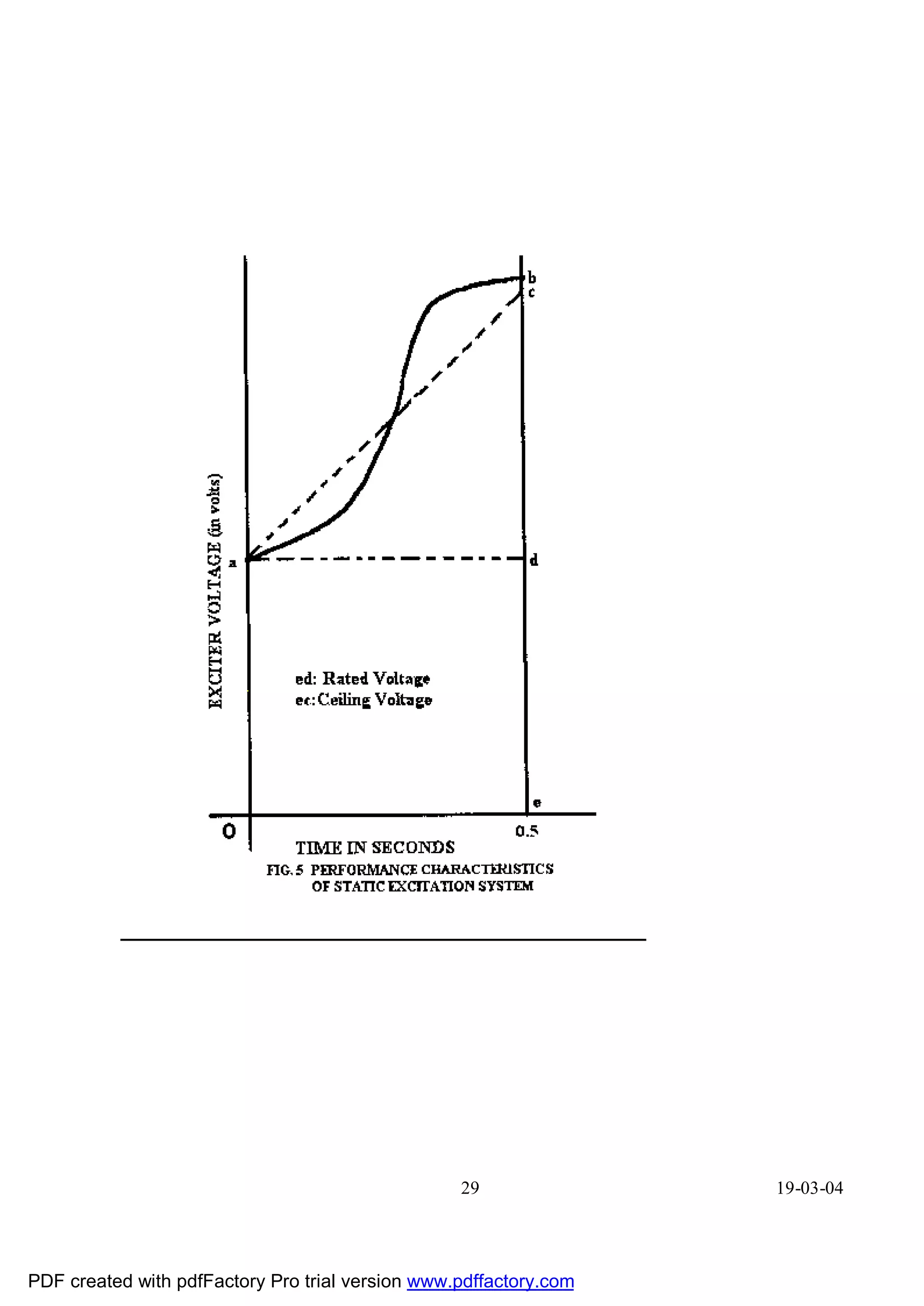
  • 16.
    16 19-03-04 PDF created with pdfFactory Pro trial version www.pdffactory.com
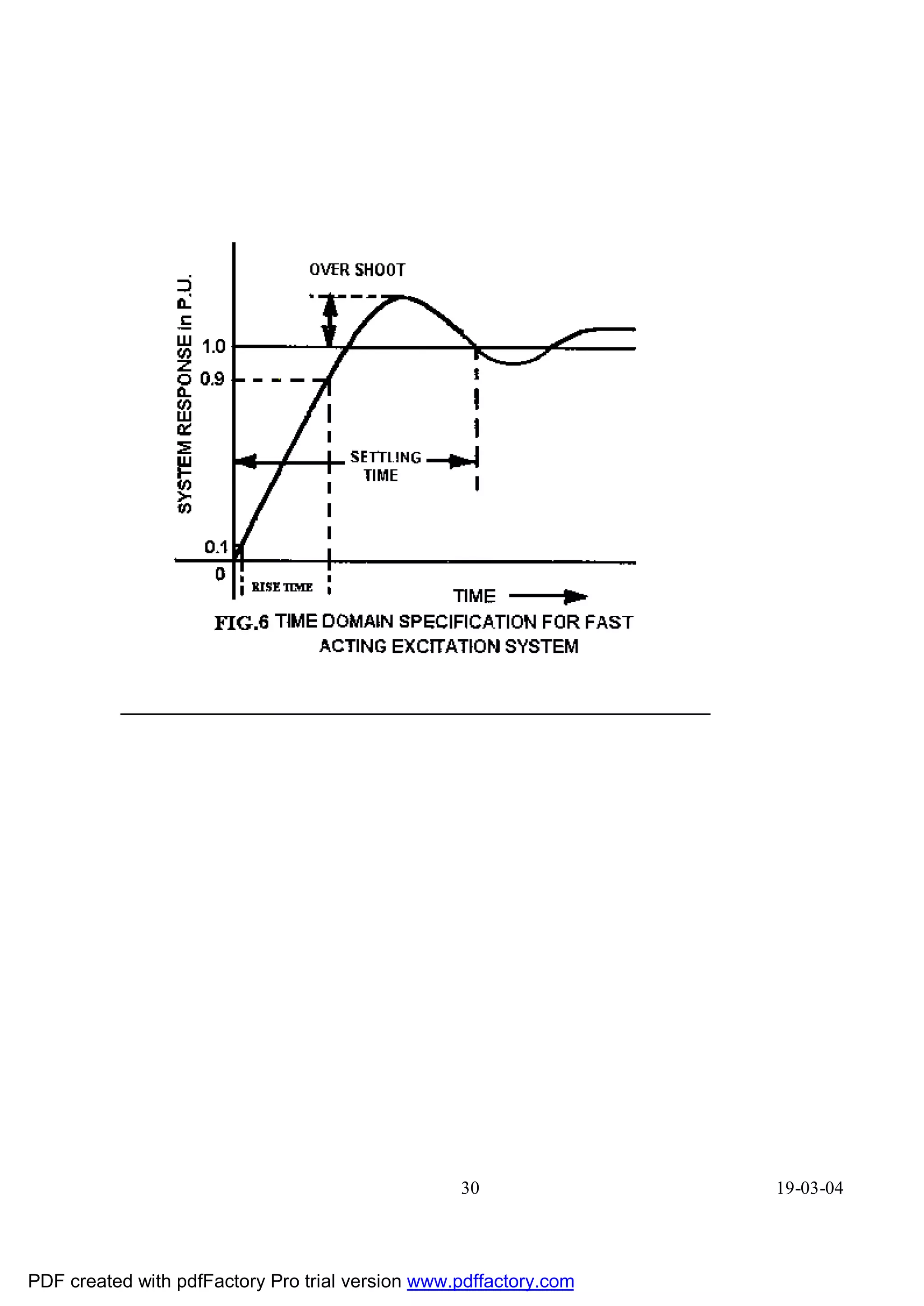
  • 17.
    17 19-03-04 PDF created with pdfFactory Pro trial version www.pdffactory.com
  • 18.
    SIGNIFICANCE OF MACHINECAPA BILI TY DIAGRAM AND OPERATIONAL REOUIREMENTS OF EXCITATION SYSTEM : Capability diagram of Generators give the safe operating regimes and limitations etc. This is of great help to the operating Engineers to ensure operations of the machines accordingly. Their information particularly for limiting zones of operations are useful in setting the various limiters of Automatic Voltage Regulator. One typical procedure for the construction of capability diagram is given in subsequent paras/page. Operational requirements of excitation system essentially call for a fast response particularly High Initial Response Excitation System, High degree of Reliability and also suitable arrangement for field discharge. RESPONSE: The fastness of action of an Excitation system is measured/expressed by the term ""Response Ratio of the Excitation system,". The original definition of this by measuring the rise of exciter volts in first 0.5 second is well known i.e. rate of rise of voltage/Sec. Static Exciter has very ""High Initial Response" as given in IEEE STDS-421 and attains 95% of the ceiling voltage level within 0.1 second or less. Thus it greatly helps for power system stability consideration. Typical Response time for static excitation Equipment, is Twenty Milli-Seconds. 18 19-03-04 PDF created with pdfFactory Pro trial version www.pdffactory.com
  • 19.
    RELIABILITY: For Power System application, Reliability is a very important criteria. To ensure this, components are carefully selected, liberal ratings wherever required are used and redundancies built in. In Static Excitation equipment ""n"' No. of Thyristor bridges are used, with (n-1) principle of operation i.e. even with one of bridges out of operation, full load requirement can be met by balance bridges in parallel. Wherever specified/required by customers, 2 x100 % bridges are also given. FIELD DISCHARGE: During load condition whenever the Field breaker, opens suddenly there will be a surge voltage in the rotor which will. damage the rotor winding insulation. To avoid this rotor winding is connected to the earth through field discharge Resistor thereby by passing the surge voltage to earth and limiting the current to earth. Field discharge greatly helps to limit the damages. 'Non-linear field discharge resistance is used which helps in faster field suppression/discharge. CAPABILITY DIAGRAM CONSTRUCTION: Let us take an example of a 100 MW Turbo-Generator of 0.80 p.f. (nominal) rating and having a SCR of 0.60 Choosing suitable scale, MW values are marked on Y axis and MVAR values on X-axis. Refer to Fig.4 which has been drawn on per unit basis and hence bases must be defined for interpreting actual values. It is usual to define the rated MVA of the machine as Base MVA (i.e. MVA) in which case rated MW is 0.8 MVA. In this case MVA = 125 and rated MW = (0.8*125) = 100 MW. The other base unit to define is the per unit excitation and this is usually taken as rotor AMPS to give rated terminal voltage on open- circuit on Air-Gap Line. To obtain actual values, the p.u. figures from the capability diagram must be multiplied by the based values just given. The various MW/MVAR values and the excitation current (Rotor Amps) can be also be marked directly for the use of operators. 19 19-03-04 PDF created with pdfFactory Pro trial version www.pdffactory.com
  • 20.
    It should benoted that the diagram scaling is only correct for rated machine terminal voltage and that all values must be appropriately adjusted for different values of terminal voltage i.e., they must be multiplied by V2, so that if the terminal voltage is say 90% of normal, then all scalings would have to be multiplied by (0.9) 2 = 0.81, although excitation scaling would remain the same. It is obviously undesirable to operate the machine upto theoretical stability limits. Operators have to be informed through this diagram safe limits for operation to allow for various unpredictable change such as sudden power increase, a drift in Bus-Bar voltage due to lines or plant tripping etc. It is usual to relate this safety factor to an increase in power demand with no corresponding increase in excitation. The percentage of the power increase used in this way defines the shape and position of the "Practical Stability Limit Line". Referring back to the example stated above, let us assume that it is required to have a 12.5 percent (or 1.125 p.u) power margin. This depends on the size of the unit and operating practices. On X-axis mark point A such that OA = (MVA x SCR) i.e. in this case. = (125 x 0.6) 75 MVAR i.e. 0.6 pu From the point 'A' the dotted line "AS' denotes the theoretical stability line. Horizon tal lines parallel to X-axis denote the MW (constant powers lines. Power intervals P equal to the required safety margin, in this case 0.125 p.u. of rated power i.e.,, (0.8 x 0.125) = 0.10 p.u. of MVA are marked on the theoretical stability line AS for the loads of 0, 0.20, 0.40, 0.60 and 0.80 p.u. MVA i.e., at points e,d,c,b and a. With radii Aa, Ab, Ac, Ad and Ae arcs of circles are drawn with A as centre to cut the 0.8, 0.6, 0.4, 0.2 and zero power lines. These intercepts are then joined by a continuous curve F B G. This will then be the "Practical Stability Line" for a 12.5% power margin. The reasoning behind this construction can be understood by taking the case of "Aa" arc. This point 1 (or B) would be working point of the machine at 0.8 p.u. MVA power with an excitation of "AaAmps. Since the basis of the safety margin is that there should be provision for increase in power without any change in 20 19-03-04 PDF created with pdfFactory Pro trial version www.pdffactory.com
  • 21.
    excitation. the workingpoint 1 would move along arc of radius (fixed excitation) towards theoretical pull-out line, so that it is just sufficient to support 0.9 MVA i.e., 1.125 p.u. power (presuming turbine has the capability) at a rotor angle of 900. The same reasoning of course applies to all other points such as 2,3,4 and 5 in the diagram. -1 Next, with “0” as centre draw a line OE at an angle of Cos 0.80 (36o ) (rated p.f. angle) to the Y-axis to cut the rated MW line (Turbine limit line) at E. Rated MVA is denoted by radius OE. The line AE represents the CMR excitation required. With A as centre and AE as radius, draw an arc of a circle ED representing excitation (or Rotor heating) limit. The diagram FBED is the "Capability Diagram' of the machine. Usefulness of capability Diagram for Excitation Control System As already mentioned, the information given by the capability diagram regarding full load rotor current (excitation) maximum rotor angle during steady state leading p.f. zone operation etc., are essential for proper setting of the various limiters in the excitation control system. In power system operation, the importance and necessity of fast acting and reliable excitation control system is well known. Capability diagram gives the basic information regarding the limiting Zones of Operation so that limiters can be set/commissioned suitably for safe operation of the units. 21 19-03-04 PDF created with pdfFactory Pro trial version www.pdffactory.com
  • 22.
    22 19-03-04 PDF created with pdfFactory Pro trial version www.pdffactory.com
  • 23.
    PERFORMANCE AND CHARACTERISTICS0 F STATIC EXCITATION EOUIPMENT The steady state and transient behaviours of a synchronous machine coupled to an infinite system must be matched' to the desired operating conditions by suitable selection of control functions in the entire excitation system. The basic requirement of a closed loop excitation control system is to hold the terminal voltage of a generator at a predetermined value independent of the change has to contribute the following functions also. a) Maintenance of stable operation of a machine under steady state, transient and dynamic conditions. b) Satisfactory operation with other machines connected in parallel. c) Effective utilisation of machine capabilities without exceeding machine operating limits. In order to understand the performance of excitation system and to achieve above mentioned functions, the following parameters are necessary to be studied. CEILING VOLTAGE: It is the maximum voltage, that can be impressed on the field under specified conditions. Ceiling voltage ultimately determines how fast the field current can be changed. For normal disturbances, ceiling condition prevails for a few cycles (Ten seconds maximum) to either increase or decrease the excitation until the system returns to steady operating state. For Static Excitation, the ceiling voltage ranges from 1.6 to 2.0 times the rated one, which is considered to be adequate for a fast system response. 23 19-03-04 PDF created with pdfFactory Pro trial version www.pdffactory.com
  • 24.
    RESPONSE: Response is defined as the rate of increase (or decrease) of the excitation system output voltage which can be seen from the excitation voltage time response curve. The starting point for evaluating the rate of change shall be the initial rated value. This is a rough measure of how fast the exciter output circuit voltage will rise within a specified time, when the excitation control is adjusted in the maximum increasing direction. Response ratio is the numerical value which is obtained when the excitation system response in volts per sec. measured over first 0.5 sec. This applies only for the increasing Excitation. As the response is non linear the response ratio is determined in terms of equivalent voltage time area for 0.5 seconds as shown in Fig. 5. Area abd = Area acd, by approximation. STEADY STATE ACCURACY: It is the degree of correspondence between the controlled variable and the ideal value under specified steady state conditions. The accuracy of the excitations system for changing the field parameters to keep the generator terminal voltage at a fixed level depends on its static gain and time constants. By choosing a higher static gain for the system, the steady state error can be minimised . appreciably and thereby improving the steady state accuracy within +0.50%. This can be reduced further with proper integral control. OTHER SPECIFICATIONS: Excitation system performance could be judged by the exciter voltage Vs time characteristics in response to a step change in the generated voltage (See Fig.6) The factors to be studied for optimum performance are a) Overshoot b) Rise Time c) Se,.tiing time d) Damping ratio 24 19-03-04 PDF created with pdfFactory Pro trial version www.pdffactory.com
  • 25.
    For ideal performance,it should have one overshoot and one undershoot with a quicker rise time to have a smaller steady state error. Details of each of the parameters are not discussed here since the requirement varies from case to case. TRANSIENT AND DYNAMIC STABILITY LIMIT: The success of excitation control lies upon the extent of meeting the requirement of capability of the machine and thereby giving the dynamic performance of the system. Fast excitation helps during disturbances and contributes to the system stability by allowing the required transfer of power even during the disturbances. Due to smaller time constants in the excitation control loop, it is assumed that quick control efforts could be achieved through this. In transient stability the machine is subjected to a severe disturbance (during fault etc.) for a short time. This results in dip in the machine terminal voltage and power transfer. Taking one machine connected to infinite bus, the equation for power transfer can be written as p vt * v Sin d X Where Vt Machine terminal voltage v Infinite bus voltage X Interconnected reactance d Load angle From the above equation if "Vt" is reduced 'P' is reduced by corresponding amount. For maintaining the power transferpthe excitation should be fast acting enough to boost up the field to ceiling and thereby holding the terminal voltage 'Vt' at the desired value. Thus it is advantageous to have higher speed and ceiling values in excitation control circuitry. Similarly after the fault is removed, the reactance 'X' suddenly changes thereby causing unbalance condition due to power swings which in turn needs fast corrective action through excitation system to bring the machine to normal operating conditions. 25 19-03-04 PDF created with pdfFactory Pro trial version www.pdffactory.com
  • 26.
    Modern fast andhigh response excitation system helps in two ways by reducing the severity of the machines first swing during transient disturbances and also ensuring that the subsequent swings are smaller than the first one. Thus it helps in increasing the transient stability limit. With a typical static excitation system, ceiling level can be achieved within 20 milliseconds due to which it offers an improved transient stability limits. Following a disturbance, the group of machines operating in the same control group experience smaller oscillations. Moreover the oscillating control group of machines react with each other reinforcing these oscillations. Here. the change in excitation may not result in a stable operation (for slow acting exciters) because by the time corrective action being taken by the excitation system (due to the inherent system delay) the oscillating system changes causing separate excitation requirement to be met. Though faster excitation system avoids this problem to certain extent power system stabilizers as mentioned earlier are employed along with the automatic voitacie regulators to damp out the subsequent smaller swings in the system. The stabilizer gain is adjusted to a value depending on the negative damping of the system and other network parameters. Power System to damp out the subsequent smalibr Swings in the system. The stabilizer gain is adjusted to a value depending on the negative damping of the system and other network parameters. Power System stabiliser helps to damp out inter area oscillations explained above and also local machine system oscillations. In addition to the above, limiters are generally built into the excitation system for large generators connected to the grid. This helps to extract maximum operating output i.e., optimal utilisation of the machine's capability without jeopardising its stability. These limit controllers act on both the lagging and leading side in the capability diagram and set below the operating points of the protective relays. Thus they prevent unnecessary tripling@by keeping the system parameters well within the safe limits. The limit controllers do not replace the function of the protective relays. These limiters enhance the stability of the machine, thereby increasing its availability to the network. These cannot dispense with protective relays. 26 19-03-04 PDF created with pdfFactory Pro trial version www.pdffactory.com
  • 27.
    EFFECT OF EXCITATIONSYSTEM ON TRANSIENT STABILITY: Since the transient stability problems deal with the performance of power system when subjected to sudden disturbance, sometimes leading to loss of synchronism, it is worthwhile to study the behaviour during the first owing as the period is of very short duration. The major factors influencing the outcome are the machine behaviour and the power network dynamic relations. For this it is assumed that the mechanical power supplied by the prime-mover remains constant during the disturbance. Therefore the effect of excitation control on this type of transient depends on its ability to help generator to maintain its output power in the above period. The main factors that affect the performance during severe transients are 1) The disturbance influence of impact; This includes the type of disturbance, its location and duration. 2) The ability of the transmission system to maintain synchronising forces during the transients. 3) Turbine and generator parameters. These factors mainly affect the first swing transient. The system parameters influencing these factors are i) The synchronous machine parameters. Of these, the most important are a) The Interia constant b) The direct axis transient reactance c) The direct axis open circuit time constant d) The ability of the excitation systems to hold the synchronous machine and increase the output during transients. ii) The transmission system impedances under normal, faulted and post-fault conditions. Here the flexibility of switching out faulted section is important such that the large transfer admittances between synchronous machine are maintained when fault is cleared. iii) The protective relaying scheme and equipment. The objective is to detect the fault and isolate the faulty sections quickly with minimum disruption. of the 27 19-03-04 PDF created with pdfFactory Pro trial version www.pdffactory.com
  • 28.
    During transients initiatedby a fault, the armature reaction has the tendency to reduce the flux linkage. Hence the type of excitation must be so chosen as to have a fast speed of response and a high ceiling voltage (can be,referred to the static type) as an aid to the transient stability. With the help of faster boosting up of the excitation, the internal machine flux can be offsetted and consequently the machine output power may be increased during the first swing. This results in the reduction of accelerating power and thereby effects improvements of transient performance of the system. 28 19-03-04 PDF created with pdfFactory Pro trial version www.pdffactory.com
  • 29.
    29 19-03-04 PDF created with pdfFactory Pro trial version www.pdffactory.com
  • 30.
    30 19-03-04 PDF created with pdfFactory Pro trial version www.pdffactory.com
  • 31.
    THYRISTOR - CHARACTERISTICS& ITS APPLICATION IN STATIC EXCITATION SYSTEM INTRODUCTION In the latest trend of excitation system neither the rheostatic mode of excitation control nor the magnetic amplifier type of control system is used as these are sluggish in action and have an inherent dead band of operation because of their low loop gains. The use of SCRs at the power stage for the excitation system with voltage regulator control the response of the system is much faster than the conventional ones. The modern excitation systems incorporating SCRs at their power stage have a very low dead band. SYSTEM DESCRIPTION The excitation power being fed from the generator terminals or auxiliary supply through normally a stepdown transformer and then to the input of the SCRs bridge. The voltage regulator having closed loop control compares the actual terminal voltage of machine with that of the set reference value and forms an error signal, which controls the firing angle of the thyristor bridge. Subsequently, the variable controlled DC voltage is applied to the field of the generator through a field breaker. The SCRs bridge forms an important integral part of the excitation system by providing an accurate and fast field DC voltage control. THEORY OF DEVICE The SCR consists of four layers of P and N material and three junctions between layers. This has got two blocking states. When the anode terminal is biased positively with respect to the cathode, the junctions 31 and 33 are forward biased whereas 32 would be reverse biased. So that current flow is blocked and the SCR is said to be in the forward blocking state. Similarly, with a negative voltage applied to the anode with respect to cathode, ]unction 31 and 33 are reverse biased and junction 32 is forward biased and the device will not switch on. This state of the 31 19-03-04 PDF created with pdfFactory Pro trial version www.pdffactory.com
  • 32.
    SCR is calledas reverse blocking state or high impedance state. The SCR can be driven into conduction state when blocking characteristic is erased and the SCR continues to conduct until the current level fails below the certain lower value termed as holding current of the SCR. The SCR can be turned on by increasing the anode voltage sufficiently to exceed the break over voltage, so that the reverse biased ]unction 32 breaks down because of large voltage gradient across the depletion layers and the forward current increases. It is limited only by the external resistance of the circuit. The most convenient method of switching the SCR is by applying a positive trigger pulse to the gate of the SCR with lower positive anode voltage than the break down voltage. This is known as the gate control. 32 19-03-04 PDF created with pdfFactory Pro trial version www.pdffactory.com
  • 33.
    Once the SCRis ON, the forward current is to be maintained above a certain value known as latching current, so as to enable the SCR to hold at the conducting stage. For turning off a SCR, it is essential that the forward current though it should be brought down below the holding current value by reversing the anode potential. For using gate control methods to turn on the SCR following conditions are to be fulfilled for safer operation, (i) Appropriate anode to cathode voltage must be applied to bring the device to the forward blocking state. (ii) The gate signal must be removed once the device is turned ON. The gate pulse duration is to be maintained in such a way that the gate loss is less than that specified for the device. (iii) No gate signal should be applied when the device is in the reverse blocking state. (iv) When the device is in the off state, a negative voltage applied to the gate - cathode -'$unction will improve the reverse blocking characteristic of the device. Turn ON time is dependent upon the load 33 19-03-04 PDF created with pdfFactory Pro trial version www.pdffactory.com
  • 34.
    current and therate of rise of gate pulse. Turn off time depends on the recombination of charges near junction 32. Some typical values of turn ON and OFF times are 1 to 4 microsecs and 10 to 250 microsecs respectively. For power frequency applications these turn ON and OFF times does not pose any problems. SELECTION PROCEDURE OF SCR BRIDGES FOR STATIC EXCITATION SYSTEM The following factors are taken into account, (i) Peak inverse voltage (ii) Junction temperature (iii) dv/dt Rating (iv) di/dt Rating (v) Gate firing requirement (vi) Current rating PARALLEL OPERATION For certain high current applicatio ns or for redundancy for the power stage paralleling of the devices are required. For such cases, following points must be carefully observed while designing the entire system. (i) For paralleling, the connections which are done by bus bars and cables etc., are to be kept symmetrical as far as practicable. (H) Cooling for the devices are to be kept almost similar (i.e.) the positions and type of mounting of the bridges and the cooling fans are to be,maintained identical. (iii) RC circuit should be so designed to keep the RC discharge current through the device within the specified limit under all circumstances. In addition to the above, precautions are to be taken to limit the rate of rise of RC discharge current by providing decoupting reactors in series with the device. 34 19-03-04 PDF created with pdfFactory Pro trial version www.pdffactory.com
  • 35.
    (iv) The above series decoupling reactors with proper tolerances also serve the purpose of reducing the missharing factor for the parallel connected device. While designing this, missharing factor is to be taken into account for the junction temperature calculation SNUBBER CIRCUIT The R C Network across the thyristor is known as snubber circuit. The function of snubber circuit is to limit the dv/dt with in maximum allowable rating. The snubber could be polarized or unpolarized. (i) Polarized: A forward - polarized snubber is suitable when a thyristor (or) transistor is connected with an antiparaltel diode. The resistor, R limits the forward dv/dt, and Rl limits the discharge current of the capacitor when the device is turned ON. 35 19-03-04 PDF created with pdfFactory Pro trial version www.pdffactory.com
  • 36.
    (ii) Reverse -Polarised:- A reverse polarized snubber which limits the reverse dv/dt. Where Rl limits the discharge current of the capacitor. The capacitor does not discharge through the device, resulting in reduced losses in the device. (iii) Unpolari:ged:- When a pair of thyristors is connected in inverse parallel, the snubber must be effective in either direction. 36 19-03-04 PDF created with pdfFactory Pro trial version www.pdffactory.com
  • 37.
    AVR - UN2010 The Automatic voltage regulator type UN 2010 is an electronic control module specially designed for the voltage regulation of synchronous machines. It primarly consists of an actual value converter, a control amplifier with PID characteristics which compares the actual value with the set reference value and forms an output proportional to the difference. The output of this module controls the gate control circuit UN 1001. The module does not have an INBUILT power supply and derives its power from UN 2004, the pulse intermediate stage and power supply unit. The AVR works on + 1SVDC supply. The main features of this module are listed below a) The AVR comprises of an input circuit which accepts 3 phase voltage signals of 11OVAC and 3 phase current signals of SA or 1A A.C. It is thus necessary to use intermediate PT"s and CT"s to transform the generator voltage and current to the above mentioned values. The module itself contains PT"s and CT"s with further step down the signals to make them compatible with electronic circuit. A CIRCUITARY is available in the module for adding the current signals VECTORIALY to the voltage signals for providing compensation as a function of active or reactive power flowing in the generator terminals. b) An actual value converting circuit for converting the AC input signal to DC signal with minimum ripple with the aid of filter network. c) A reference value circuit using temperature compensated zener diodes. The output of which is taken to an external potentiometer that provides 90-110 % range of operation of the generator voltage. 37 19-03-04 PDF created with pdfFactory Pro trial version www.pdffactory.com
  • 38.
    d) A control amplifier which compares the reference and actual value and provides an output proportional to the deviation. Apart from this, it has the facility to accept other inputs for operation in conjunction with various limiters and power system stabilizer. e) A voltage proportional to frequency network which reduces the excitation current when frequency falls below the set level, thus keeping the air gap flux constant. This prevents saturation of connected transformers and possible over voltage. 38 19-03-04 PDF created with pdfFactory Pro trial version www.pdffactory.com
  • 39.
    LIMITERS IN STATICEXCITATION SYSTEM LIMIT CONTROLLERS With ever increasing size of generating units today, more stringent requirements have to be met by excitation systems. Today, it is proven beyond doubt, that Static Excitation assures, stable operation both under dynamic and transient conditions, Generators running in parallel with the power net-work even under extreme conditions must remain in synchronism without- the maximum load limit on it being exceeded and without the protective relays operating. An automatic voltage regulator AVR alone cannot ensure this. Optimum utilisation of the generator can be ensured only if the basic AVR is influenced by additional signals to limit the under-excitation and over-excitation of the machine. Thus, limit controllers working in conjunction with the AVR ensure : a) Optimum utilisation of the machine. b) Security of parallel operation etc. Limit controllers simplify the job of the operating-staff and enables stable operation close to the limiting values. With limit controllers in service, operational errors and faults in the regulator lead only to the limit value control and not to disconnection. It has to be understood that limit controllers however are not meant to replace the protection system but they are only intended to prevent the protection system from operating under extreme transient conditions. PARAMETERS FOR LIMITATIONS: Limiters, whenever they intervene, influence the voltage regulator suitable to bring about a corresponding change in the excitation. The following are the parameters which are to be limited. 1) Stator current under condition of over Excitation and under excitation 2) Rotor current 3) Rotor angle or the load angle 39 19-03-04 PDF created with pdfFactory Pro trial version www.pdffactory.com
  • 40.
    MECHANISM OF LIMITERINTERVENTION: During over-excitation, the Rotor current and stator current limiters intervene to bring about a reduction in excitation. On the otherhand during under excitation, limitation of rotor angle and stator current influence to increase the excitation. Rotor and stator current limiters must be designed to intervene after a certain delay so as to permit temporary over/ceiling excitation, limiters do not impair the control behaviour of the AVR as over-excited condition can exist in the event of load surge or because of short-lived faults in the power supply network. The AVR reacts to a distance fault (say 3 phase short circuit) and commands ceiling excitation to be applied, thereby increasing the synchronosing torque of the machine and prevents it from losing synchronism. However, if the short circuit persists and has not been cleared by system protection after a set time, delayed rotor current limiters comes into operation preventing the generator and the excitation equipment from being subjected to thermal over load. An identical situation prevails during sudden connection of load to the system. The AVR enable short-time ceiling excitation to prevail so as to obtain lower settling time. The under-excited mode, the rotor angle limiter and stator current limiter must intervene instantaneously to increase the excitation to prevent further increment in the rotor angle. In the under excited mode, stator current limiter is essentially used with multiple-pole synchronous condensers which run at suitable level of excitation to increase the capacitive absorption capability of the machine. POWER DIAGRAM OF THE GENERATOR AND RANGE OF INFLUENCE OF LIMIT CONTROLLERS The operational limits of the sychronous machine are shown in the power circle diagram. The application and range of influence of the limiters depends on the conditions in the installation and the generator data. The possible zone of intervention of the limiterg is marked in the power chart/power circle diagram. Fig.7 40 19-03-04 PDF created with pdfFactory Pro trial version www.pdffactory.com
  • 41.
    ROTOR ANGLE LIMITER: Line AB represents the range of influence of the Rotor Angle, Limiter the maximum angle of which has been taken as 85'. Although stable operation can be ensured even beyond 850 with the fast acting load angle limiter in action and achieve greater possible reactive power absorption capability, the load angle is limited for practical purposes to 850 because of the following considerations : 1) In the event of a short circuit in the systems,.the generators may accelerate owing to the abrupt partial removal of the electrical load and as the turbine governor cannot act fast, the rotor angle increases and the angle can become so large relative to the system vector that the machine may fall out of step. 2) The excitation system (AVR) switches over to manual mode in the event of internal faults in the auto-mode. Changeover to manual-mode signifies constant excitation and hence a stable operation upto a maximum angle of 900 electrical only is possible. The rotor angle limiter limits the load angle of the machine to an acceptable present value. The load angle is the electrical angle between the voltage vector of the system and the vector of the machine voltage 'e' fig.8. The system vector is derived from the voltage vector of the generator Uv by adding to it the voltage drop in reactances external to the machine. This takes into account the transformers and transmission lines between the generator and the system load centre. The rotor voltage is simulated adding the inductive voltage drop in the machine IXq. The system voltage at the load centre is obtained by subtracting Ixe drop (Reactance drop in the transmission line, transformers etc.) from the generator terminal voltage. The phase angle between 'e' and UN is converted into a proportional dc voltage. The actual value is compared with an adjustable reference and fed to the input of an operational amplifier. In case the angle exceeds the set value the output signal immediately takes over the control of thyristor network to build up the generator air-gap flux fast enough to avoid slipping. It stands to reason that the output of the limiter acts directly over AVR output to avoid any loss of time due to filter time constants in the AVR. Fig.9 explains the operation of Automatic Voltage regulator in conjection with rotor angle limiter. 41 19-03-04 PDF created with pdfFactory Pro trial version www.pdffactory.com
  • 42.
    ROTOR CURRENT LIMITER: The AVR drive the field or the thyristor network into overload for one or more of the following reasons : a) faulty handling b) system voltage reduction c) loss of sensing voltage to AVR and d) failure within the controller. The excitation limiter must prevent this overload from persisting. On the other hand, during dynamic disturbances in the system the excitation should not be reduced at once, but ceiling excitation should be possible for a limited time. The limiter can be operated in three different modes as explained below to cater the above requirements. i) Simple mode: In this mode the excitation current is limited to a preset maximum value. The limiter intenienes with a time delay which is proportional to the magnitude of the over load. Which the limiter in operation, the current is limited steadily to the rated value. 11) Mixed Mode: If during the above period of limitation, the generator voltage dips steeply for any reason, the ceiling excitation limit is validated again. The ceiling excitation current helps in increasing the short circuit current in the fault zones and hente aid selective tripping of the faulted section. iii) Switching mode : In the switching mode the excitation is limited to the thermal or rated current value. Only in case of sharp dip in the machine voltage, the ceiling limit was unable momentarily. The limit switches back to the rated value after the set time. Figure-10 gives the block diagram of a rotor current limiter acting in conjunction with AVR to limit the over excitation in the desired fashion. 42 19-03-04 PDF created with pdfFactory Pro trial version www.pdffactory.com
  • 43.
    STATOR CURRENT LIMITER: The stator current limiter has to influence the AVR differently depending on whether the machine is over-excited or under-excited. The excitation current is to be suitably reduced to limit the inductive stator current and is increased to limit the capacitive current. The rotor angie limiter provides a more definite protection in preventing the machine from failing out of step. Capacitive stator current limitation comes into play only with synchronous condensers which are to some extent negatively excited with generators it prevents excessive leading MVAR loading corresponding to any given MW load. The generator stator current is converted into polarised dc signal +ve or -ve, depending upon whether the machine is over-excited or under-excited. This voltage forms the actual value for the controllers which process each of the bipolar signal independently. One of the these controllers compare the capacitive stator current against its reference and acts directly on the regulator via a de-coupling diode to increase the excitation. The action of second controller which limits the inductive stator current is delayed by means of an integrator before it influences the control input of the AVR so as to reduce the excitation. The time lag offered is perfectly acceptable as far as stator overheating is concerned because of the integrator time constant is set one order less than the stator thermal time constant. Fig. 11 shows an AVR operating in conjunction with a stator current limiter. 43 19-03-04 PDF created with pdfFactory Pro trial version www.pdffactory.com
  • 44.
    44 19-03-04 PDF created with pdfFactory Pro trial version www.pdffactory.com
  • 45.
    45 19-03-04 PDF created with pdfFactory Pro trial version www.pdffactory.com
  • 46.
    46 19-03-04 PDF created with pdfFactory Pro trial version www.pdffactory.com
  • 47.
    47 19-03-04 PDF created with pdfFactory Pro trial version www.pdffactory.com
  • 48.
    48 19-03-04 PDF created with pdfFactory Pro trial version www.pdffactory.com
  • 49.
    EXCITATION TRANSFORMER INTRODUCTION: Rectifier transformers directly connected to the generator terminals and feeding power to the field of the machine via thyristor converters, plays an important role in an excitation system and in turn power generation Reliability of this transformer has to be ensured in all respects. Importance of rectifier transformer has been realised ever-since the mercury arc converters came into existence for important applications like large power drives and excitation systems. A gradual development has taken place from oil filled transformers to (resin) cast coil type transformers (dry type) for Excitation transformer. Oil and clophen/Sovtol Iilied transformers are still adopted for large rating. However, in urban areas and thickly populated cities where pollution control is a so to be thought of; certain countries like West Germany have brought out regulation that oil immersed transformers can be used only under special circumstances. Further, use of clophen/Sovtol filled transformers has already been banned almost in all advanced countries because of poisonous gases emanating in case of damages. Moreover, there has been constant rise in price of oil in the international market, resulting in substantial increase in the total price of transformer and its maintenance. Not only the above reasons but other hazards have led the scientists to think of an alternate design which could gradually replace the oil and clophen/ Sovtot filled transformers. Accordingly vacuum impregnated dry type transformers were taken up for large power and high voltage rating. The results were however not satisfactory because of many limitations like effect of atmosphere, over voitages and the need for proper drying out after long break in service. Therefore the need was felt to have better alternative and cast resin moulding technique came into existence. The development of cast resin transformers has led to the production of dry insulated type transformers upto 36 KV. These transformers have not only been 49 19-03-04 PDF created with pdfFactory Pro trial version www.pdffactory.com
  • 50.
    found comparable tooil filled transformers but also proved their superiority in all respects. These transformers are of class "F" insulation and indoor type. VOLTAGE AND POWER RATING: The selection of the secondary voltage of excitation transformer depends upon the filed forcing voltage. The primary voltage is the same as that of generator terminal voltage. Current rating is dependant on the maximum continuous current in the field winding. Generally the power rating of the Excitation transformer used in Static Excitation System is around 1 % of the rating of generator in MVA. ENCLOSURE AND COOLING: The enclosures are normally designed to ensure natural air cooling/Forced air cooling to the transformers. These enclosures are made to IP20, IP21 or IP23 depending upon the requirement. Forced cooling arrangement provides increase in rating by 40% than that with natural air cooled transformer. Normally this arrangement is switched on during peak load period or in summer to deliver more current from the same transformer. The description that follows compares resin cast coil, dry type transformers with other transformers for various characteristics. SALIENT FEATURES SHORT CIRCUIT PROOF: The dynamic short circuit strength exceeds by far that of oil immersed transformers as well as that of conventional dry type transformers. In the event of a short circuit the cast resin transformer is not endangered mechanically, and only thermal damage can take place. The high mechanical strength is achieved by casting the coils in epoxy resin with a fiber glass filler to form a compact tubular spool. An insulation thickness of 1-2mm is quite adequate to withstand the force that occur during operation. 50 19-03-04 PDF created with pdfFactory Pro trial version www.pdffactory.com
  • 51.
    HIGH OVER LOADCAPACITY: In certain applications where rectifier transformer is subjected to intermittent loads like rolling mill, furnace, traction and also in excitation duly high current increase, is followed by low current demand. It results in the windings to be mechanically stressed to a greater extent. In cast resin transformers all the windings are cast and therefore no difficulties concerning mechanical strength due to repeated overloads. Normally H.V. & L.V. Coils are cast separately, all the forces appearing on one winding can be suitable absorbed by itself. The resultant forces between primary and secondary windings can be made to absorb by putting suitable support blocks between the coils and frame. Position of the support blocks can be conveniently designed to reduce the forces to a lower value in contrast to conventional type transformer. Conventional type, wound coil transformers consume a considerable amount of insulation material like paper which absorbs. the expansion of conductor and coils have to be recompressed after certain periods', The cast coils being homogeneous, the coil structure expands and contracts as a whole and the movement is taken care of by means of an elastic support. Recompression of the coils is therefore not required. In synthetic liquid cooled transformer there is a rated temperature jump between winding and cooling liquid of the order of 20 to 250C with current density 3 to 4 A/Sq.mm. In contrast, in these transformers with class F insulation the allowable temperature rise between coil and air is of the order of 1000C with the same current density. This clearly indicates the heating time constant of cast resin, normally 6-10 times, higher than that of oil filled transformers. RESISTT AGAINST TEMPERATURE FLUCTUATION: The selected insulation material is fiber glass reinforced epoxy resin which has got high tensile and bending strength. Therefore the transformer can withstand the wide range of temperature fluctuations. 51 19-03-04 PDF created with pdfFactory Pro trial version www.pdffactory.com
  • 52.
    MOISTURE PROOF: The cast resin coils are impregnated and cast under vacuum which ensures the voidless embedding of all windings into a system of uniform glass fiber-epoxy laminate. This process helps the coil to offer an increased protection against moisture. Conventional dry type transformers are not moisture proof. The winding do absorb humidity and there is danger of flashover once they are put in service after a long period. IMMEDIATE SWITCH ON: Because of the cast resin coil, the coils are homogeneously built in all respects. There is no possibility of effect of moisture and ambient temperature fluctuations over coils. Under such case the transformer can be directly switched on without predrying the same after long interruption from service. IMPULSE STRENGTH: Impulse strength of these transformers is higher than that of conventional dry type transformers and is comparable to that of oil cooled transformers according to any international standard. NON-INFLAMMAIBLE Due to high quality of non-hydroscopic material, it has been proved that neither with welding cutting torches nor with welding electric arc the cast coil resin could be induced to burn and as such is almost non-inflammable. PARTIAL DISCHARGE: During operation, there is no partial discharges inside the winding, exceeding narrow band 10 P.C. i.e. transformers are designed for long life. 52 19-03-04 PDF created with pdfFactory Pro trial version www.pdffactory.com
  • 53.
    COMPACT INSTALLATION: Compared to oil and clophen/Sovtol filled transformers, the use of this type transformer required less space, less weight and above all, the cost for the necessary erection of catch-pits no longer exist. Because the cast resin coils are non-inflammable in nature a sub-station consisting of a number of such transformers can be installed in the same building near to the consumer end there by the power losses due to long distribution lines are also avoided. NO LEAKING: Nothing can leak out from these transformers in contrast to clophen/sovtol and oil filled transformers where there is a possibility of the liquid leaking. Therefore there is no need to make catchpits at sites to avoid contamination to the ground water. MAINTENANCE FREE: Considering all above mentioned features it can be concluded that these transformers are virtually free from maintenance. - No re-adjustment of the winding and no re-tensioning of the individual coils are required to maintain the short circuit strength. - No control of oil is required - No checking of electrical quality of used oil - No dry out is necessary even after long interruption from use. OVER CURRENT PROTECTION : It is normally achieved with the help of current transformers mounted on each phase on H.T. Side of excitation transformer. From current transformers current signals are given to two over current relays, one is meant for instantaneous over current protection, another is set for delayed over current protection. The latter is set to suit the field forcing requirements. OVER TEMPERATURE PROTECTION: It is achieved with the help of temperature sensors kept near the hot spot zone of the L.V. Coils. The sensors have non-linear characteristic. 53 19-03-04 PDF created with pdfFactory Pro trial version www.pdffactory.com
  • 54.
    The resistance ofthe sensor is increased considerably after a certain temperature limit. Normally two limits of over temperature are kept depending on the class of insulating material used, one is the warning limit and another one for tripping of the equipment. Both these limits are obtained by independent temperature sensor. The output of the sensors are brought to the temperature monitoring equipment which signalises or calls for tripping. CONNECTION ARRANGEMENT: Normally the excitation transformer will have DyS vector group connection to suppress harmonics. The angular displacement between HT and LT winding is 1500 Electrical degrees. OPERATING CONDITION: Inspite of all advantages of the cast coil resin transformers mentioned above, it is recommended that this transformer should be mounted in an enclosure installed away from water, oil leaking sources, away from sun rays and heat dissipating equipments. Care has to be taken that sufficient free space all around is available to maintain the ambient temperature and ventilation. The installation of the transformer has to be thought of in the beginning itself to avoid dust. However, dust/carbon particles must be removed during periodical shut downs. Normally this transformer is located just below the generator at exciter end either at "O" meter level or at 4.Sm level. CONCLUSION In excitation systems, practically cast resin dry type transformers are used and there is no necessity presently of using of oil cooled transformers with its inherent disadvantages of fire- risk etc., as already mentioned. Further for indoor application it is preferable to use only dry type transformers. 54 19-03-04 PDF created with pdfFactory Pro trial version www.pdffactory.com
  • 55.
    OPERATION OF STATICEXCITATION EQUIPMENT Initially the main Circuit Breaker as well as Field Circuit Breaker is in open condition. The signal lamp ""Excitation off' shows that the machine is not excited. In order to start up the machine, machine should be first brought to nominal speed i.e. 3000 RPM. Pre-selection to be done for selecting the manual or auto control. The signal lamps on the control unit indicate whether auto or manual control has been pre~selected. As soon as the nominal speed is reached, the FFB (Field Flashing Breaker) & FB (Field Breaker) to be closed. This is achieved through pressing the luminous button in the cubicle or by a parallel connected push button (remote). Since the remanance voltage of the machine is not sufficient to operate the regulator, initially suitable station A.C. voltage via full wave bridge rectifier or suitable DC voltage from station batteries to be supplied through Field Flashing Breaker. The machine voltage rises to 30% , then the electronic regulation start functioning by getting the released pulses, which were blocked till then. The blocking of pulses is cancelled through voltage relay and regulator takes over the function of regulating the machine voltage. At 70% of the machine voltage, the field flashing (FF) supply is switched off with the help of FFB. Till 70% of Machine voltage both Auxiliary supply and main supply are available for excitation. However for avoiding re-entry of supply to FF unit, blocking diodes are provided both in A/C & DC supply circuit. From 70% of machine voltage the total requirement of Excitation current is taken through SCR. The reference value for auto control can be set between 90% & 110% of nominal voltage. For manual control variation of voltage can be done through Potentiometer from 0 to 90% or 0 to 110% as per the requirement. 55 19-03-04 PDF created with pdfFactory Pro trial version www.pdffactory.com
  • 56.
    The power circuitof Static Excitation station consist of the following 1) Excitation Transformer 2) Thyristor Bridges 3) FFB, FB etc. (Field Flashing Breaker, Field Breaker) The electronic regulation cubicle consists of various unitrols (The unitrots are modular type & each unitrol is assigned with specific no. for identification). The following are some of the module/unitrol used in regulation cubicle. UNITROLS - UN UN 1024 FIELD CURRENT LIMITER 1022 STATOR CURRENT LIMITER 1043 ROTOR ANGLE LIMITER 2010 A.V.R 1001 GATE CONTROL UNIT 2004 POWER SUPPLY & AMPLIFIERS 2001 FINAL PULSE AMPLIFIER UN 0053 PULSE SUPERVISION UNIT 0040 PULSE COMPARATOR UNIT 0516 SUPPLY SUPERVISION UNIT UN 0510 FOLLOW UP MODULE 1011 COMPARATOR UNIT 007 POTENTIO METER 0014 TRANSDUCER 0030 POWER TRANSDUCER (ACTUAL POWER MEASUREMENT UNIT) 0072 SUPERVISION & SUMMING UP UNIT 0517 SUPPLY SUPERVISION UNIT KT 7480 DCJDC CONVERTOR 220/48V UN 7467 48124V 56 19-03-04 PDF created with pdfFactory Pro trial version www.pdffactory.com
  • 57.
    SALIENT FEATURES OFSTATIC EXCITATION SYSTEM MERIT OF STATIC EXCITATION SYSTEM I PERFORMANCE 1) Faster Response in voltage & Reactive Power Control 2) Higher Accuracies of Voltage control 3) Faster discharge of field energy with inversion of thyristor bridge output 4) Provision of limiters & stabilizing equipment help to improve dynamic & transient stability 5) Largely independent of variation in the excitation supply voltage & frequency II OPERATIONIMAINTENANCE 1) Redundancies in different Circuits increase reliability and availability 2) Adequate monitoring facilities aid fault finding & reduce down time 3) Absence of rotating parts enables less maintenance 4) Lower SCR value for larger generators (Reduces weight/compact in size & cost) III GENERAL 1) Uprating of the machine can be done by adding additional power circuits/adding more redundancies 2) Location of the equipment can be planned independent of the machine thereby increasing the flexibility in the plant layout 3) Retrofitting of Static Excitation Equipment for old slow acting exciter 4) Length of the machine shorter when compare to other excitation equipment 57 19-03-04 PDF created with pdfFactory Pro trial version www.pdffactory.com
  • 58.
    IV) PURPOSEIFUNCTION OF STATIC EXCITATION SYSTEM 1) Regulate stator voltage (Terminal V) of the machine 2) Meet excitation power requirements under all normal operating conditions 3) Enable maximum utilisation of machine capability 4) Guard the machine against inadvertent tripping during transients 5) Improve dynamic and transient stability thereby increasing plant/machine availability 6) Regulate MVAR loading with in iirffits 7) Flexibility in control (Auto/manual) 8) Fast acting to meet demand during dynamic performance of Generator IMPORTANT FEATURES IN STATIC EXCITATION SYSTEM 1) Dual channel (Auto and Manual) 2) Limiters 3) Slip stabilisation 4) Redundancy in thyristor bridge 5) Part load operation with bridge failure 6) Manual follow up control 7) Non-linear field discharge'resistor 8) Maintenance free dry cast coil excitation Transformer 9) Isolation of faculty thyristor bridge for repairs 10) Withdrawable type of power modules 11) Stabilised DC power supply units for a very wide variation of input AC voltage 12) Control voltage standardised with DCJDC converters (48V/24V) 13) Min. & Max. Excitation limiters. 14) Volts/hertz. limiter (WF-Over fluxing Protection) 15) OVP 58 19-03-04 PDF created with pdfFactory Pro trial version www.pdffactory.com
  • 59.
    CONCLUSION 1. Power and control supply is from generator itself through Excitation Transformer. 2. Four or more independent thyristor bridges (6 in each bridge). Three are enough for full load operation. 3. Four or more cooling fans for forced cooling of thyristors (Thyristors protected by interlock Circuit such that upon interruption in (AFR) Cooling the firing is cut off with in 20 seconds). 4. Thyristors protected by fast acting fuses (FSM). The failure of fuses is signaled and concerned bridge is isolated 5. During normal operation it is possible to work on any thyristor/Fuse etc. by isolating it on AC & DC sides 6. For 'Initial Excitation field flashing circuit is provided. AC or DC supply can be used. Circuit cuts off automatically when 70% Generator voltage (Stator) is reached. 7. Field interruption by double pole, double break field breaker with FDR in Circuit. 8. OVP - Over voltage shorting switch is provided across the field circuit to protect it against heavy over voitages. The switch cuts in a resistor and also gives a trip order 9. The voltage regulator is of two channels have independent power supplies, grid control units and first stage amplifiers. In auto control Generator Voltage is sensed and maintained while on manual control a steady output depending on hand set reference is maintained. 10. Thyristor firing pulses are generated as per control voltage in GCU (1001). These pulses are blocked when Generator Voltage is less than 30% of rated value. They are shifted inverter operation region when the field breaker trips. 59 19-03-04 PDF created with pdfFactory Pro trial version www.pdffactory.com
  • 60.
    11. These pulsesare amplified in pulse amplified in pulse amplifier cum PS unit (2004). Here auto/manual pulses are released as per the channel in operation (for channel not in service pulses are blocked) 12. Amplified pulses are led to final stage amplifier and from there to the thyristor via pulse transformers. Each bridge has one final stage pulse amplifier. The pulses are blocked here when any defects arises with in the bridge like fuse failure or interruption in cooling circuit etc. 13. An earth fault relay gives an alarm when the insulation resistance of the field circuit goes below preset value. 14. Stator current limiter, Rotor current limiter, Rotor angle limiter units are provided to ensure that the Generator is operated within the capability curve while working at limit conditions for effective utilisation. 15. Slip stabiliser unit helps to stabilise the power swings and thus prevents the generator from tripping. 16. Over current relays and temperature supervision protects the rectifier transformer. 60 19-03-04 PDF created with pdfFactory Pro trial version www.pdffactory.com
  • 61.
    61 19-03-04 PDF created with pdfFactory Pro trial version www.pdffactory.com