Excitation
&
Capability Curve
of a Synchronous Generator
FB/TRAINING/E&I/GEN
Typical Configuration of a Power Plant
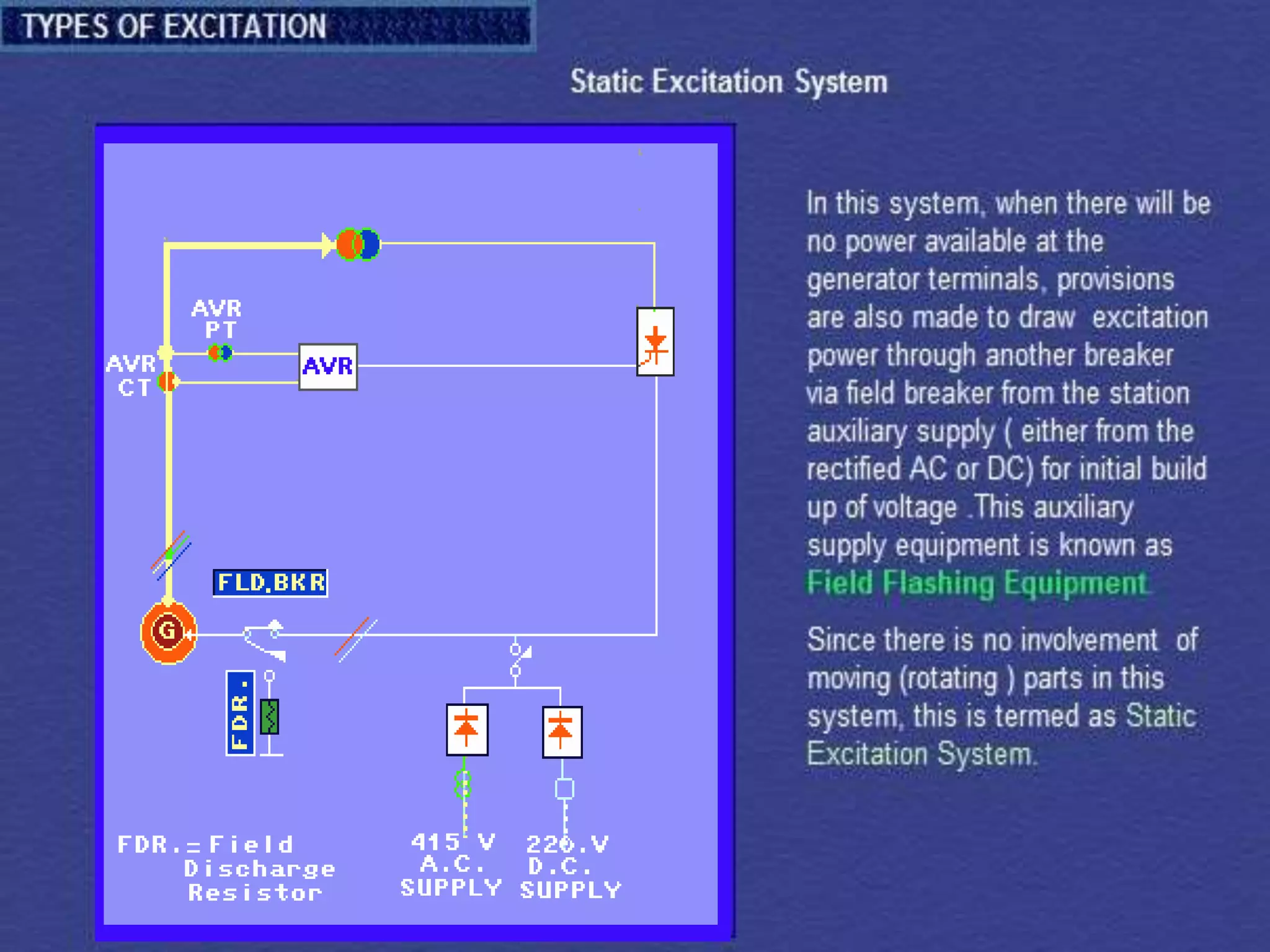
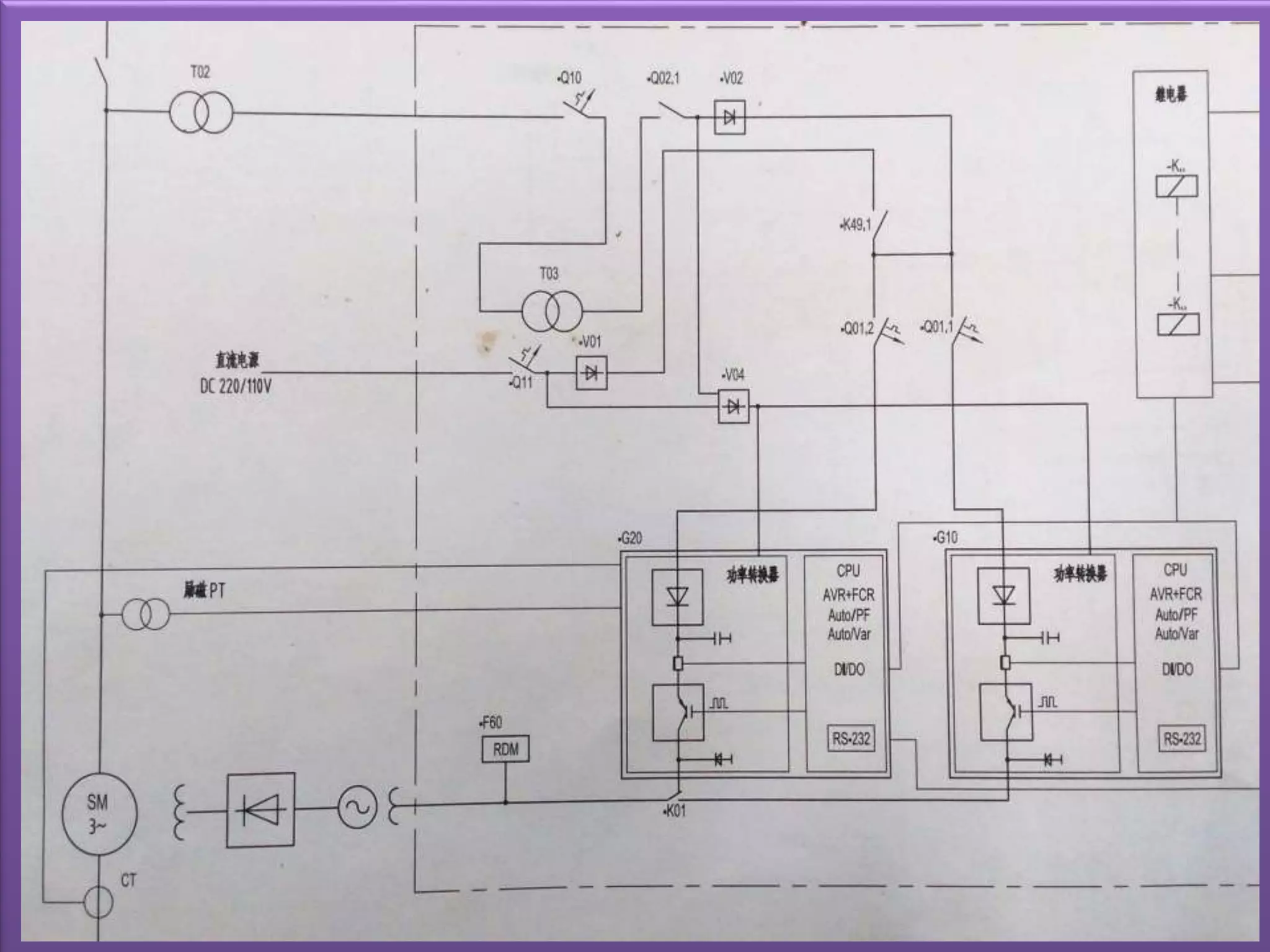
Excitation
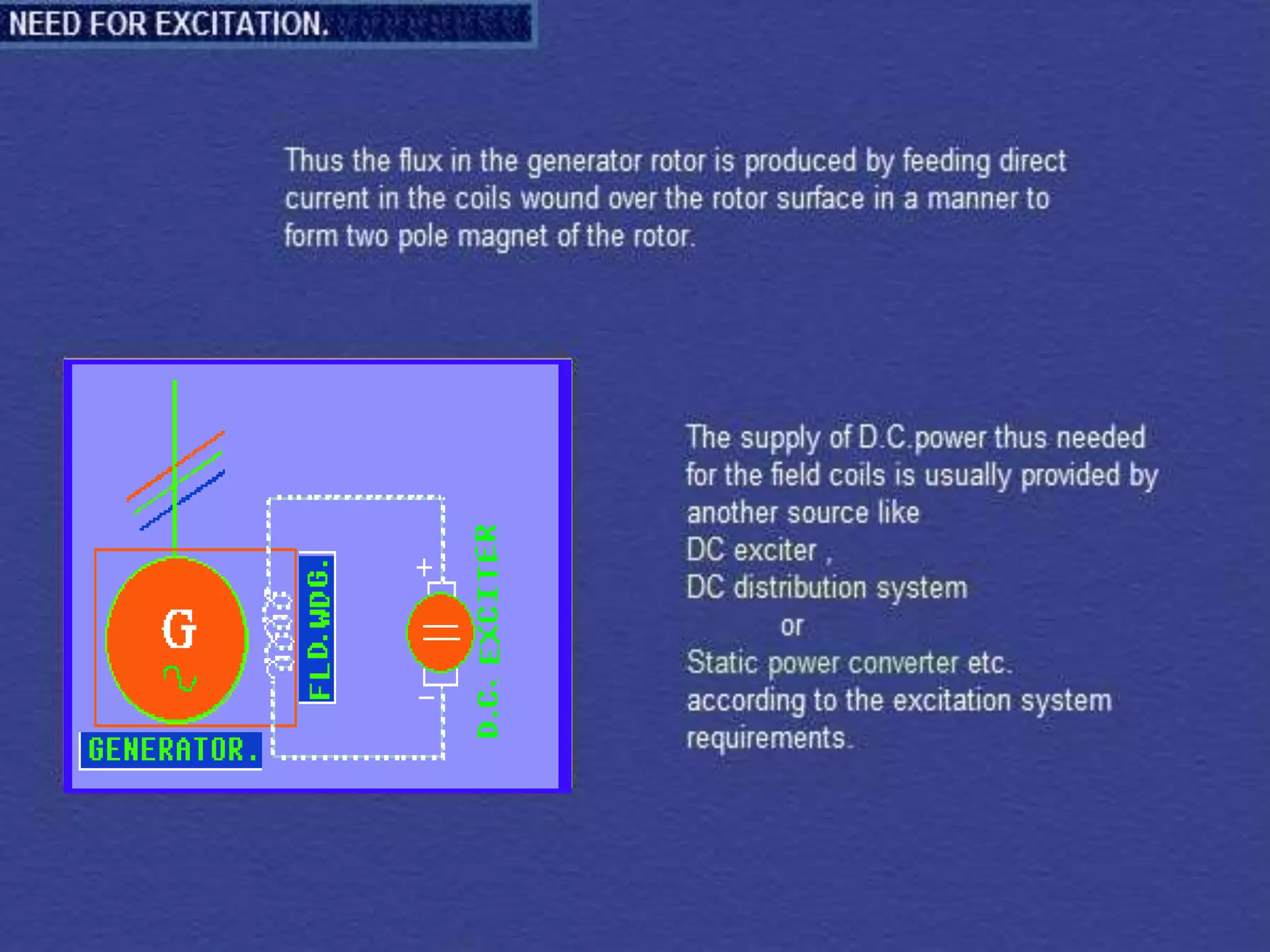
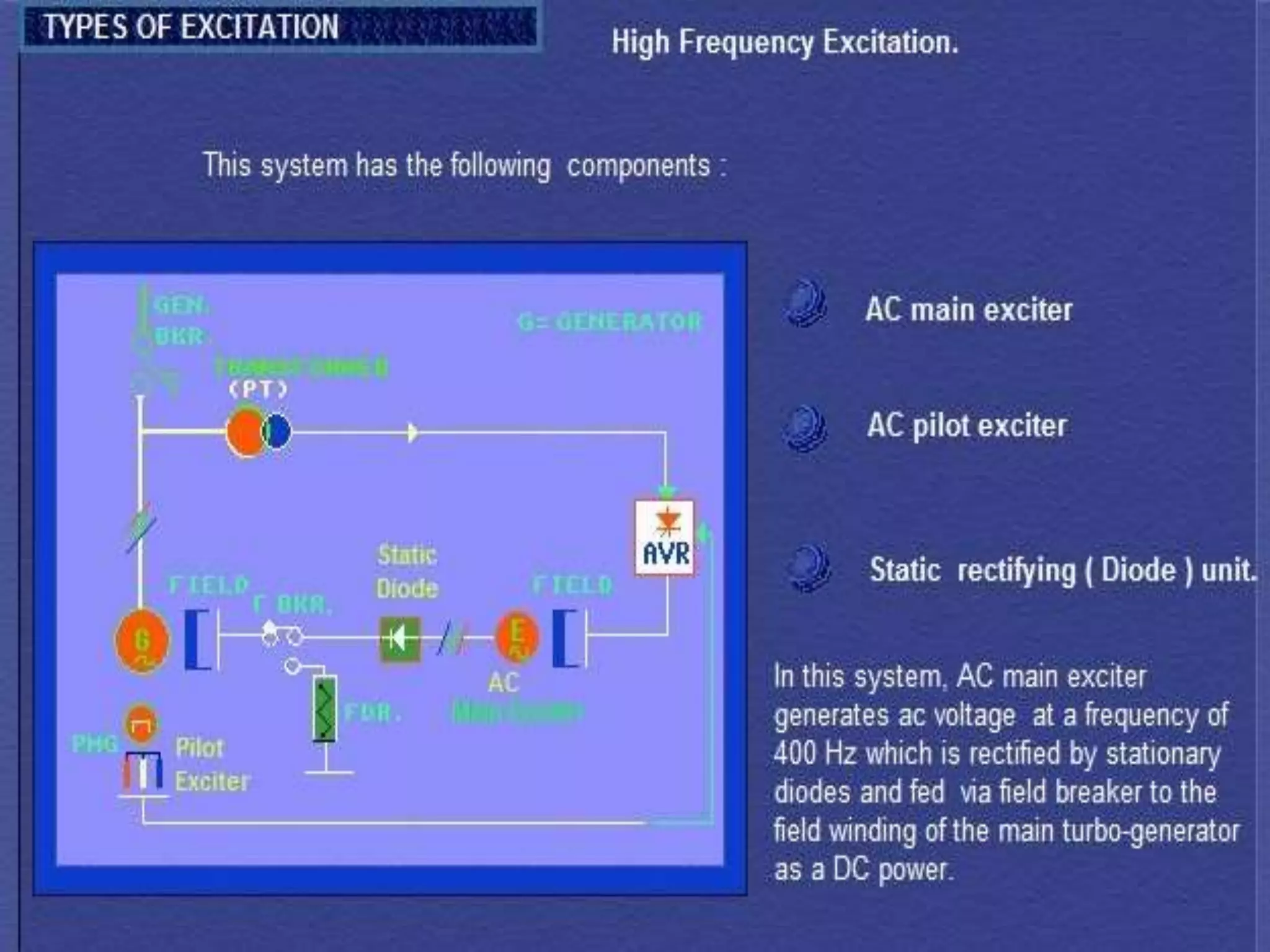
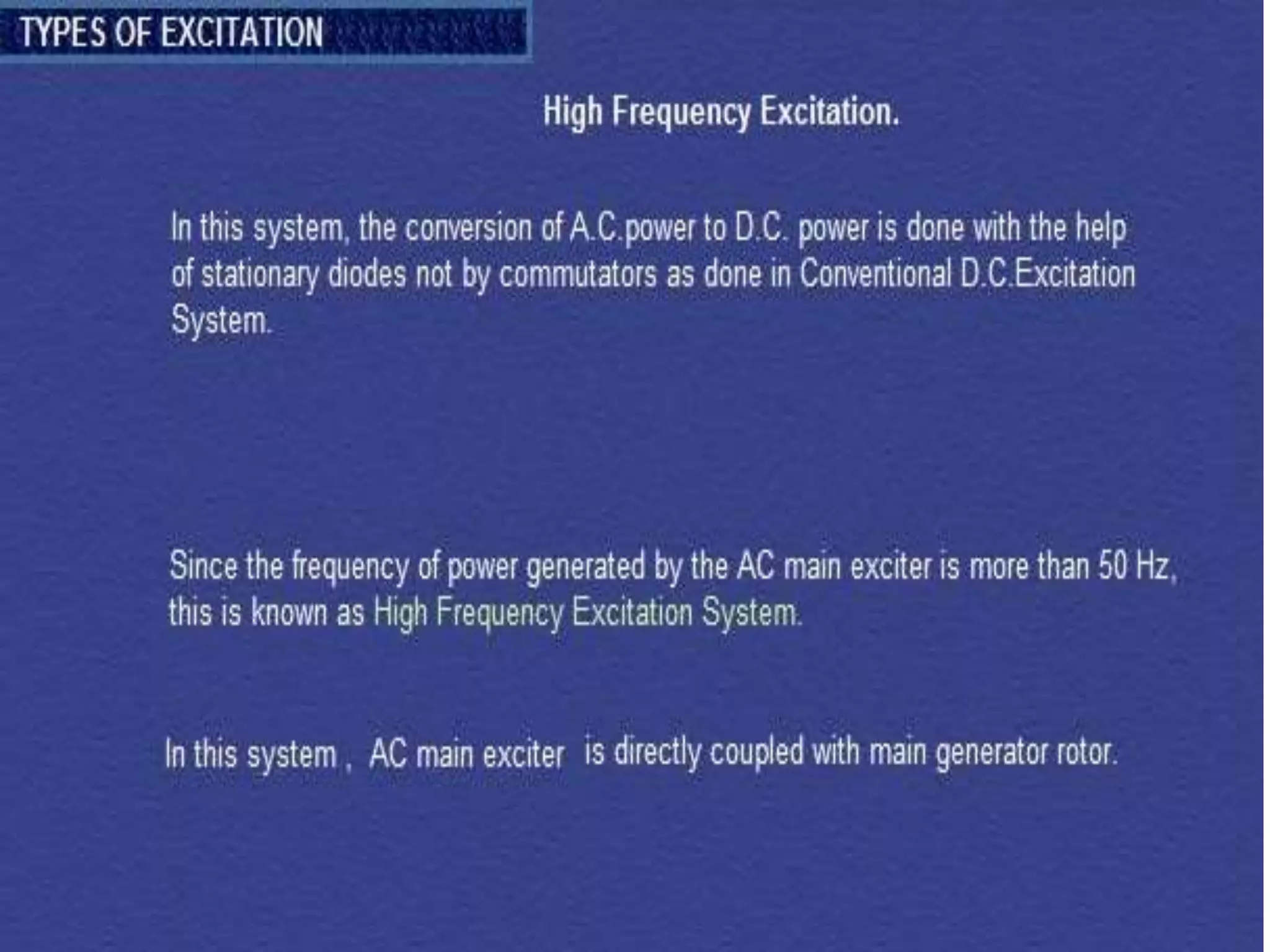
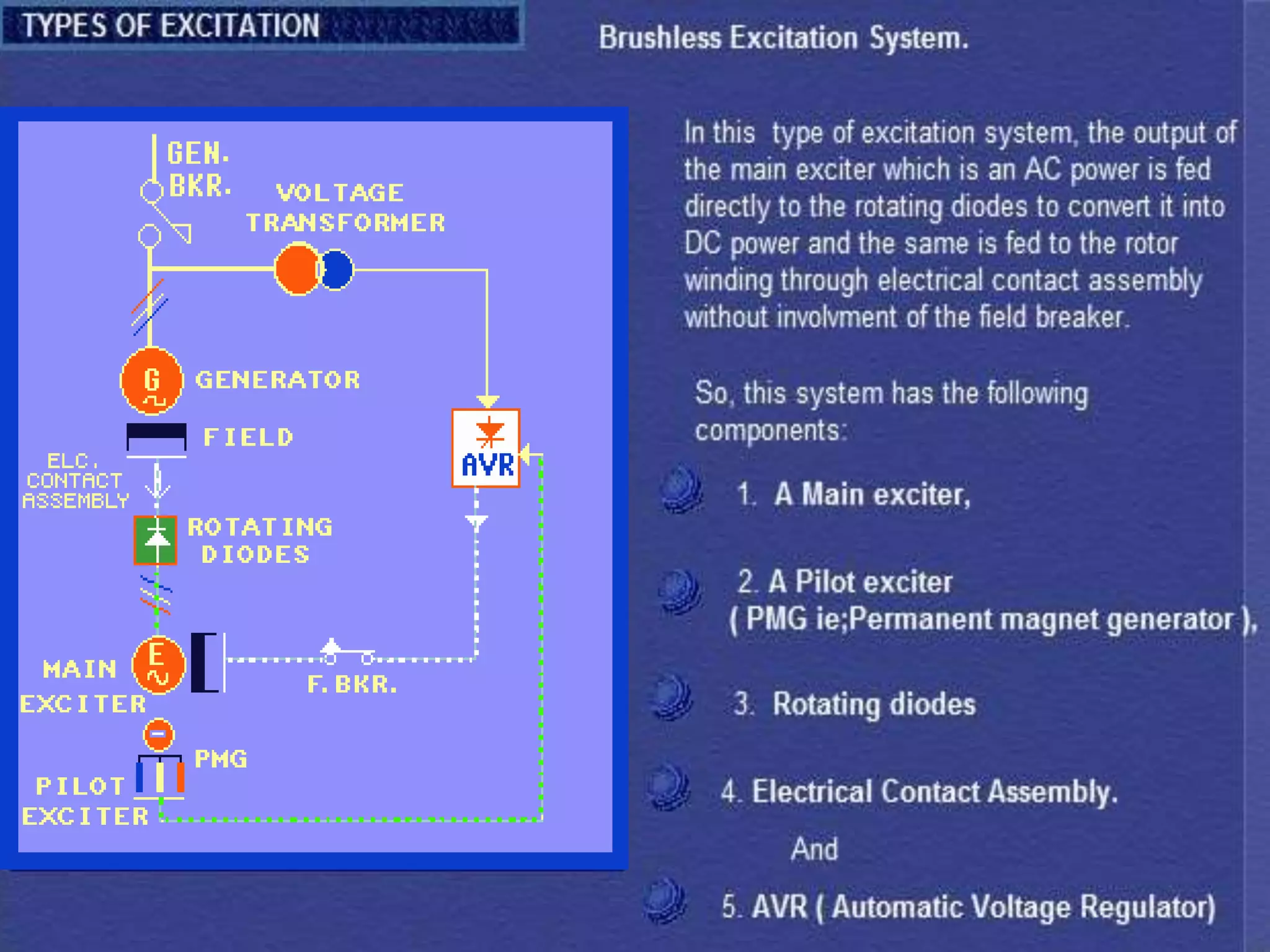
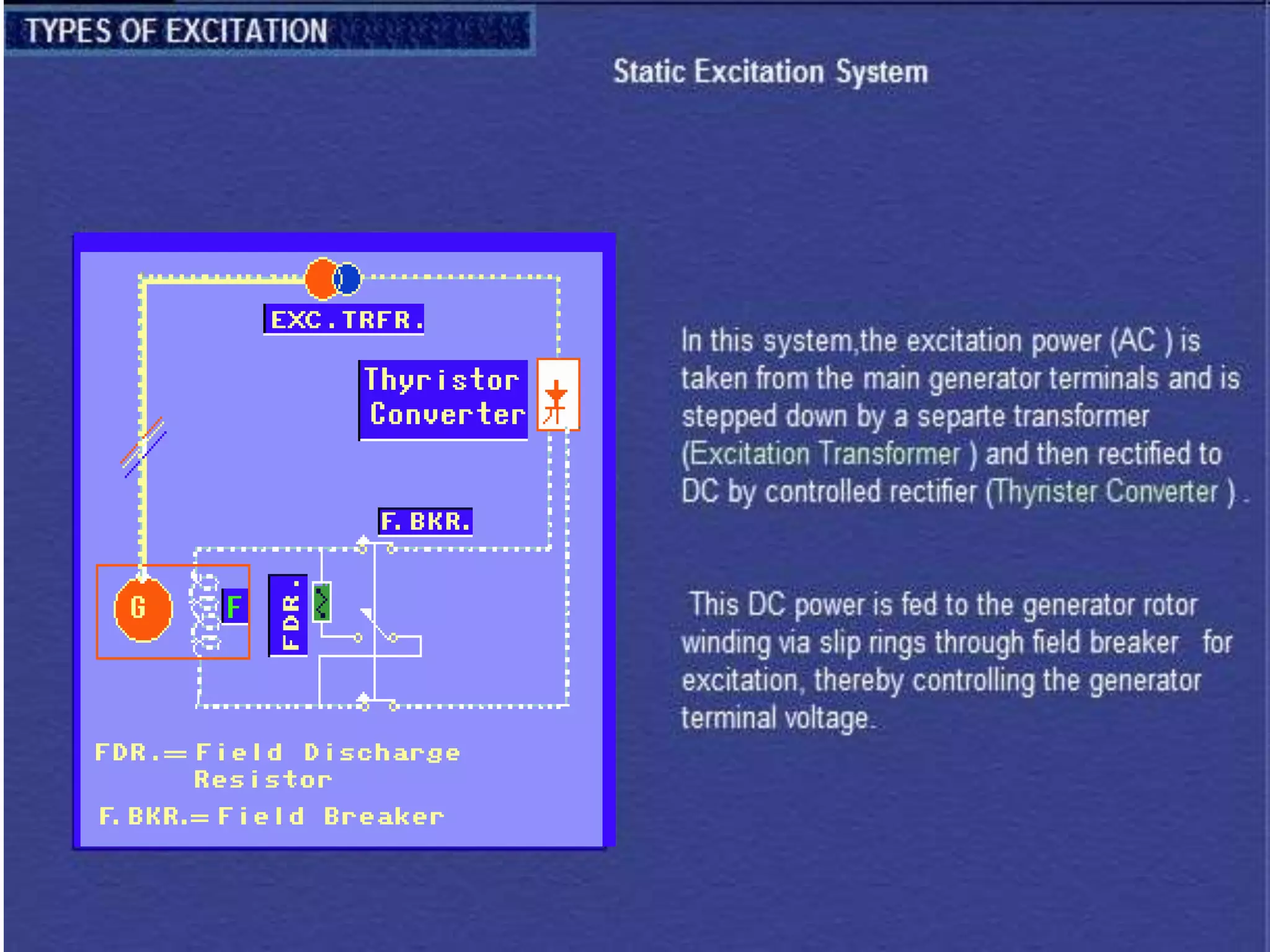
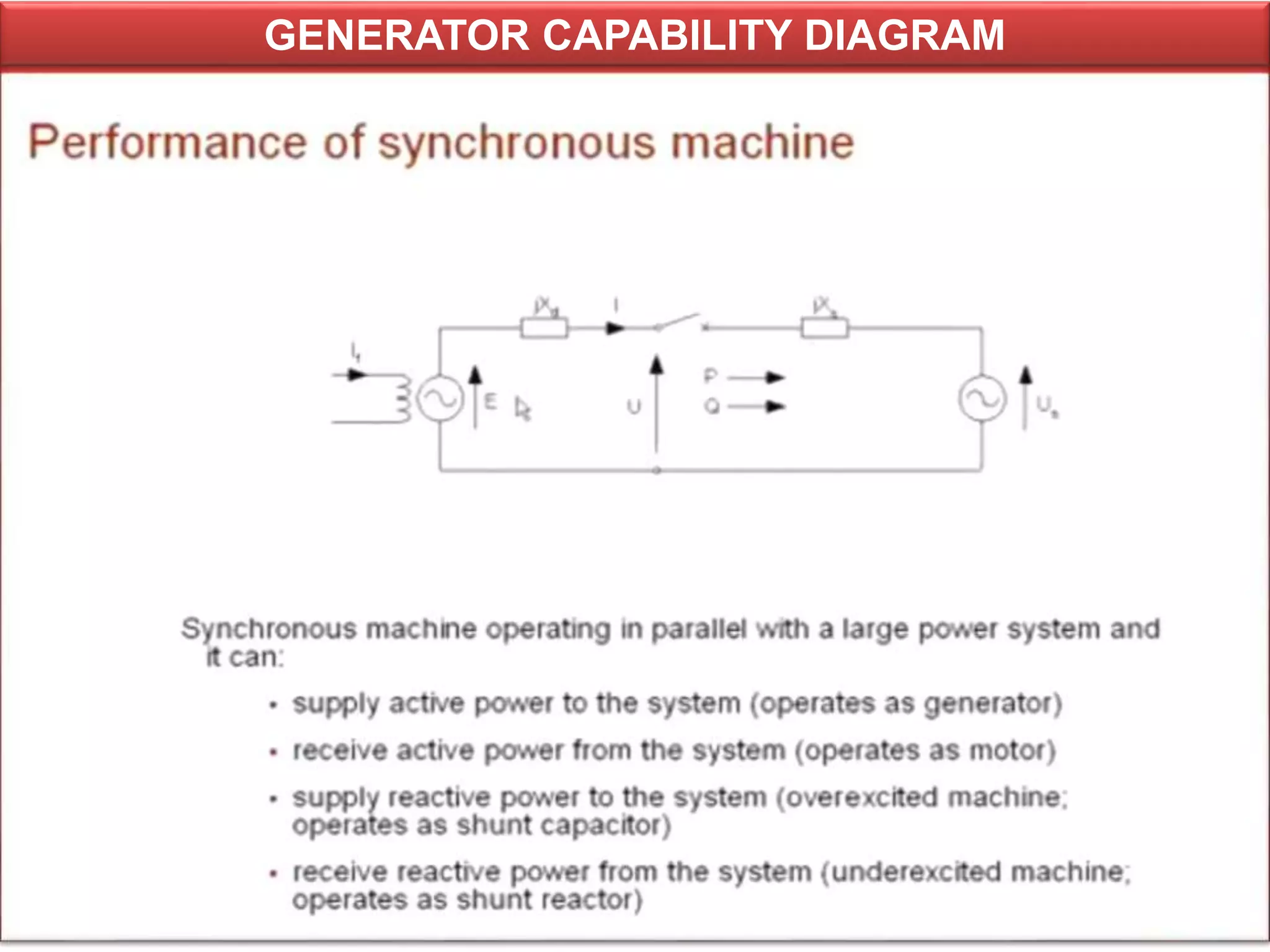
• The basic purpose of an excitation system is to provide direct current
to the synchronous machine field winding
• The basic control function of excitation system with respect to:
Generator: To supply and adjust the field current so as to maintain
constant terminal voltage and respond to transient disturbance with field
forcing in accordance with generator capability.
Power system :To respond quickly to improve transient stability and
also to modulate field to improve power system stability.
• The excitation system must have a means of measuring generator
stator voltage and current.
Capability Curve
of
Synchronous
Generator
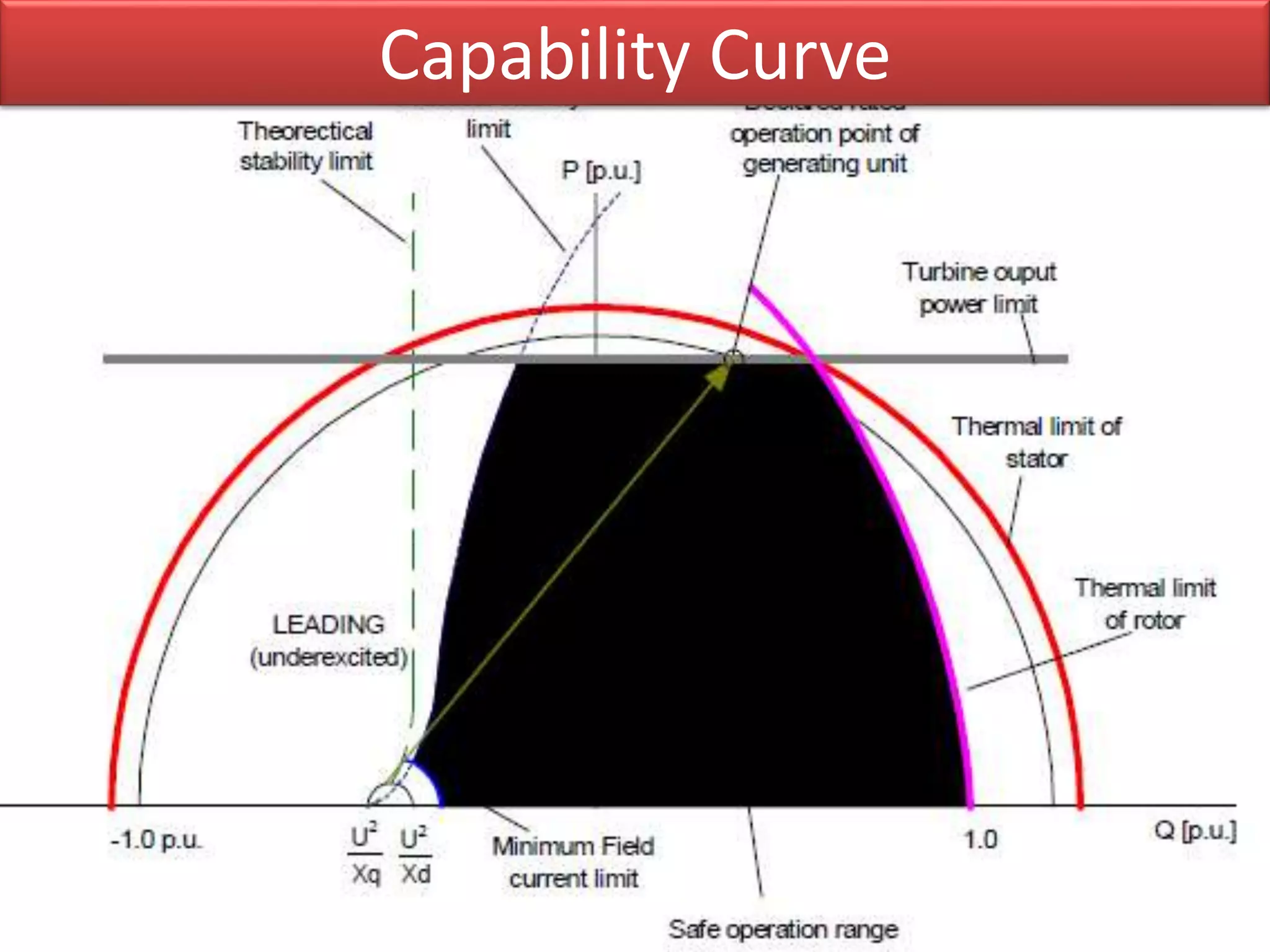
• The Capability Curve of a Synchronous Generator defines a
boundary within which the machine can operate safely.
• It is also known as Operating Charts or Capability Charts. The
permissible region of operation is restricted to the following
points given below.
 The MVA loading should not exceed the generator rating. This limit is
determined by the armature of the stator heating by the armature
current.
 The MW loading should not exceed the rating of the prime mover.
 The field current should not be allowed to exceed a specified value
determined by the heating of the field.
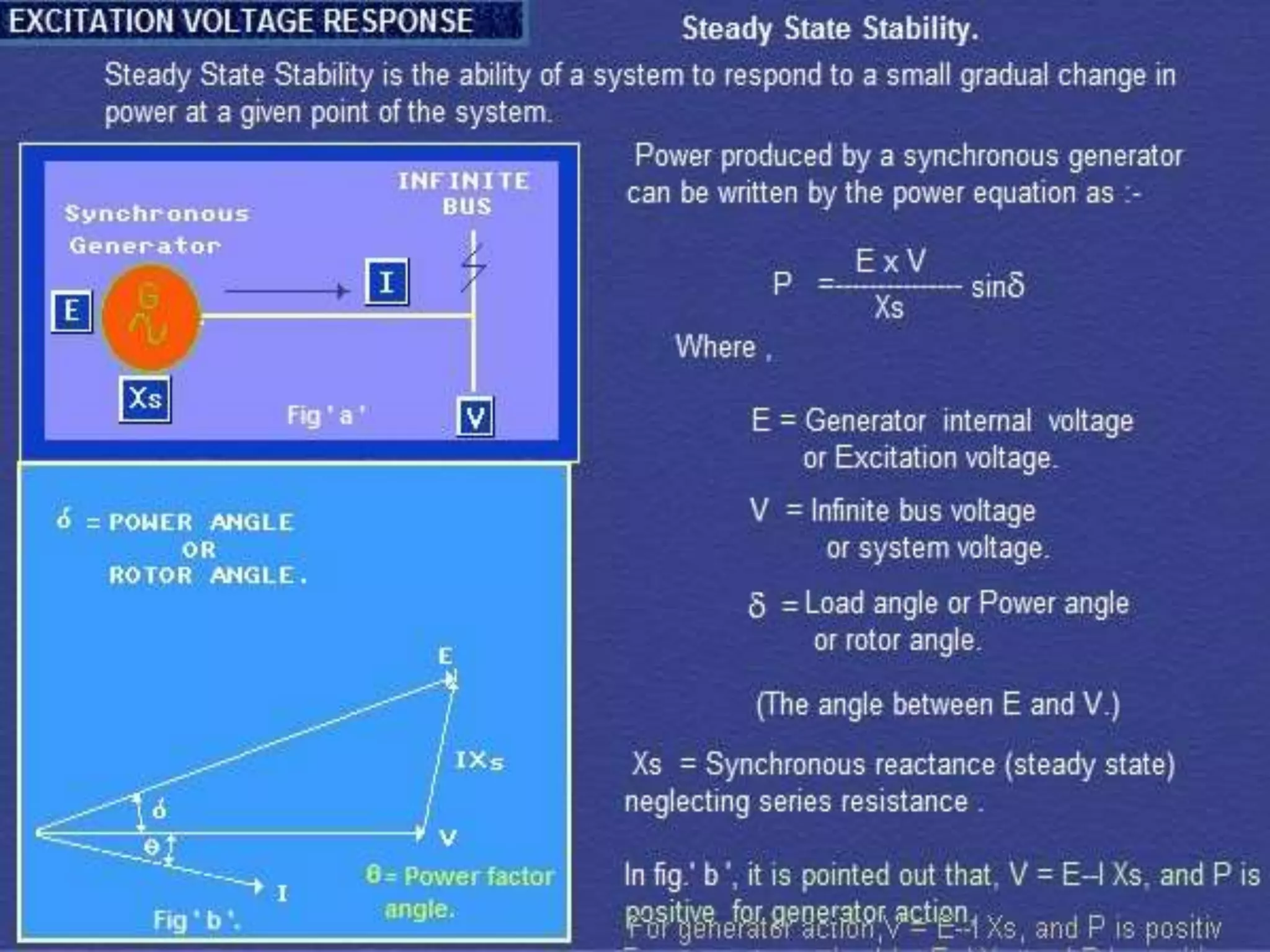
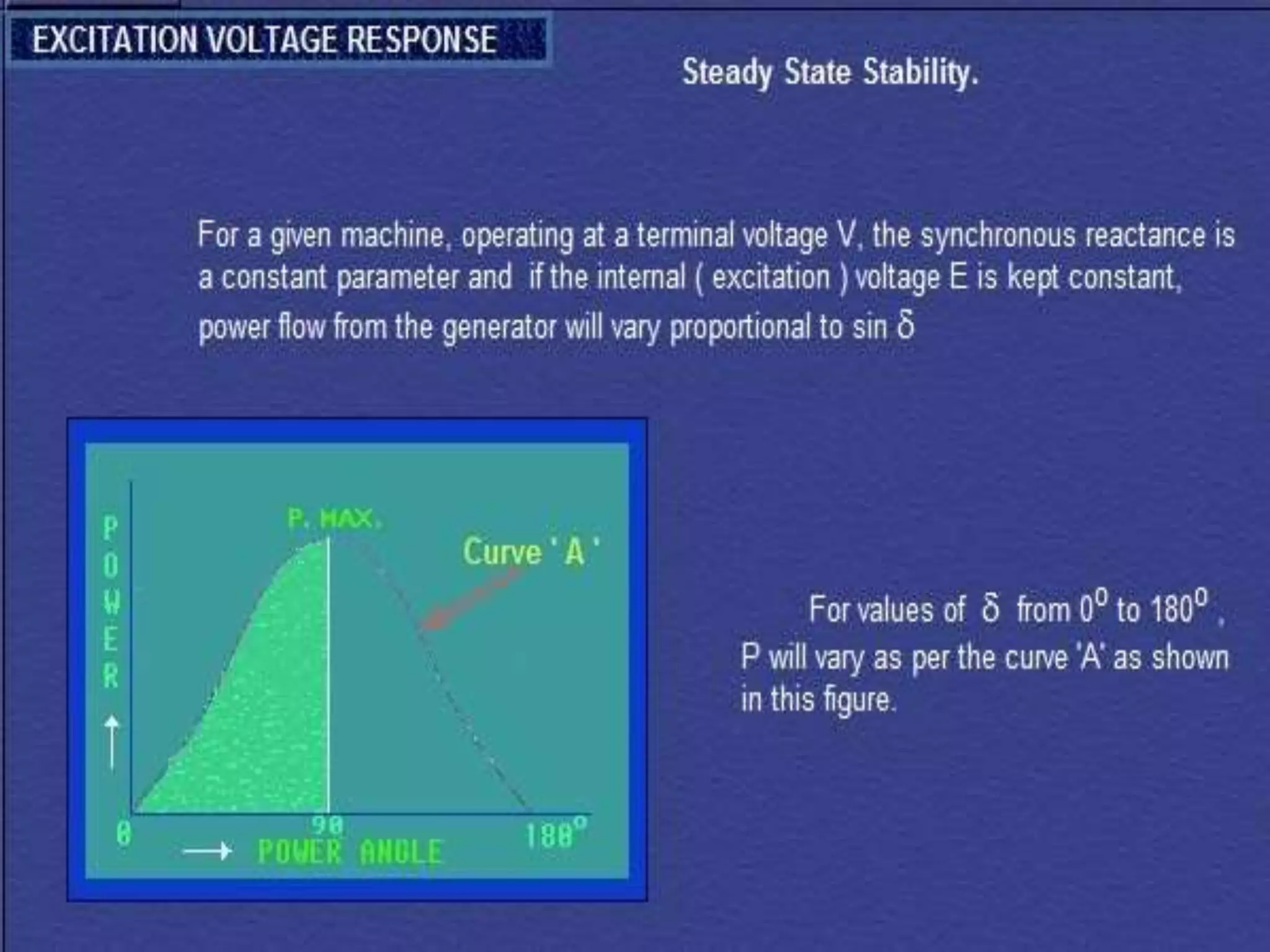
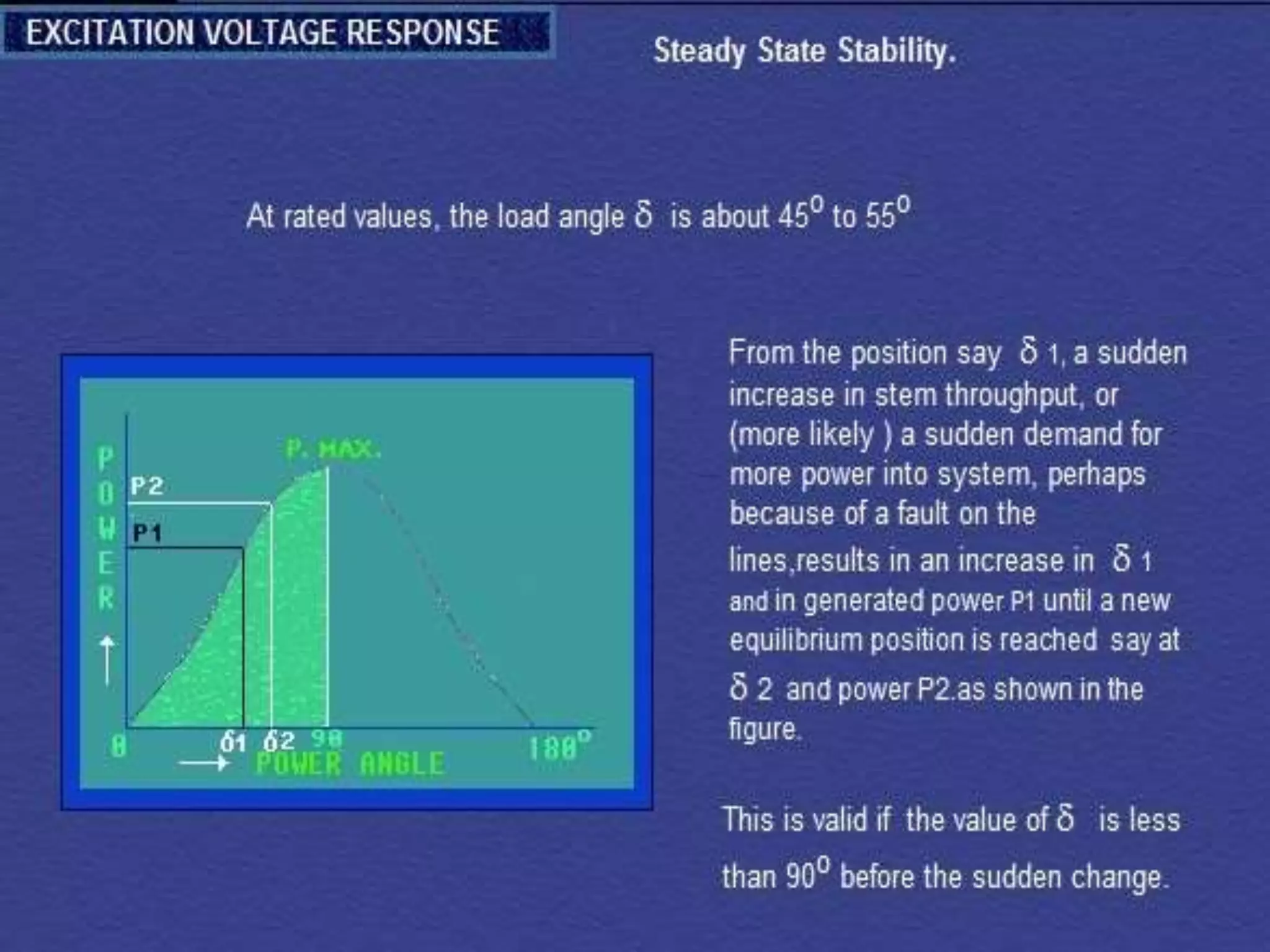
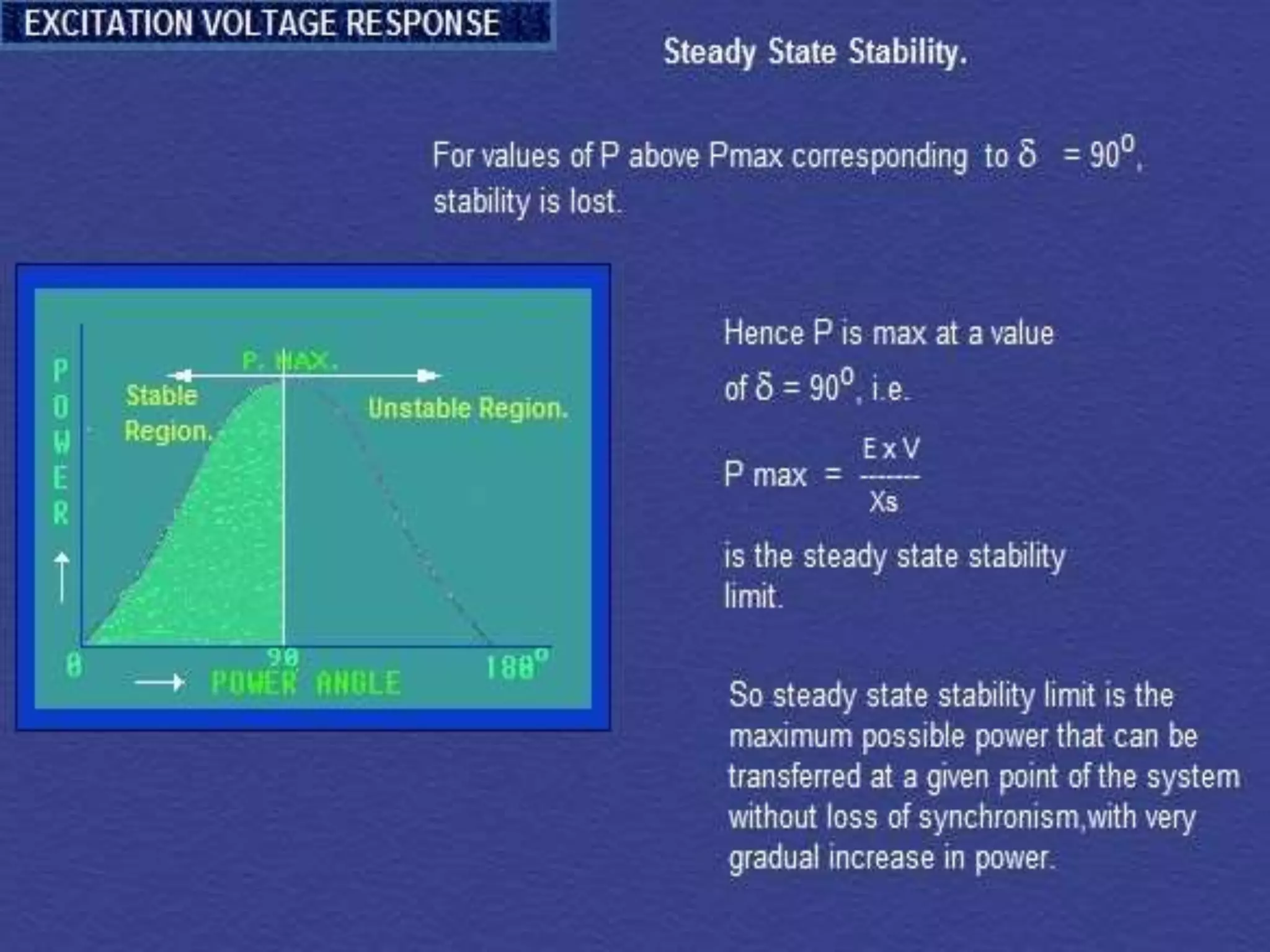
 For steady state or stable operation, the load angle δ must be less than
90 degrees. The theoretical stability limit of the stable condition
occurs when δ = 90⁰.
GENERATOR CAPABILITY DIAGRAM
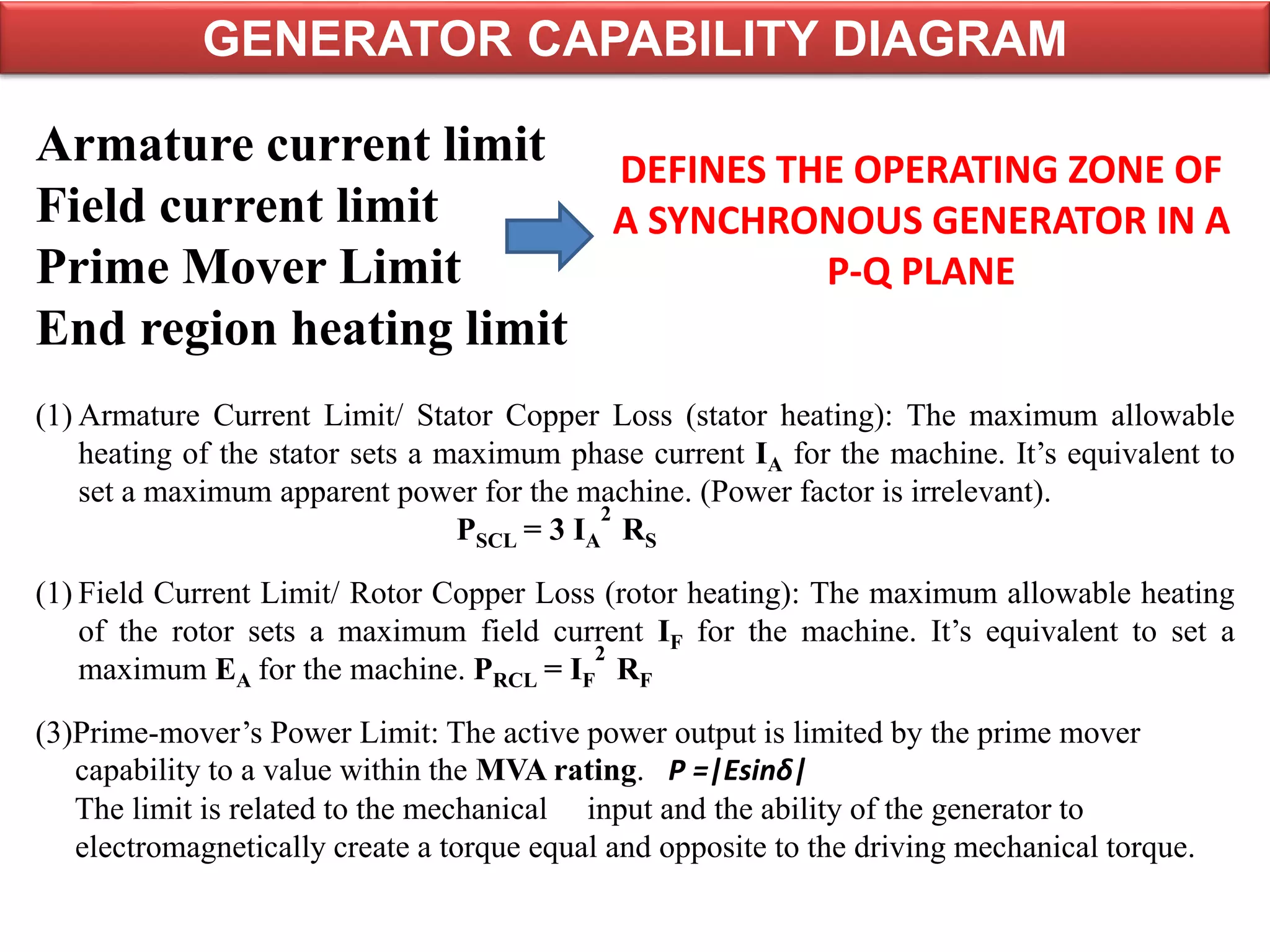
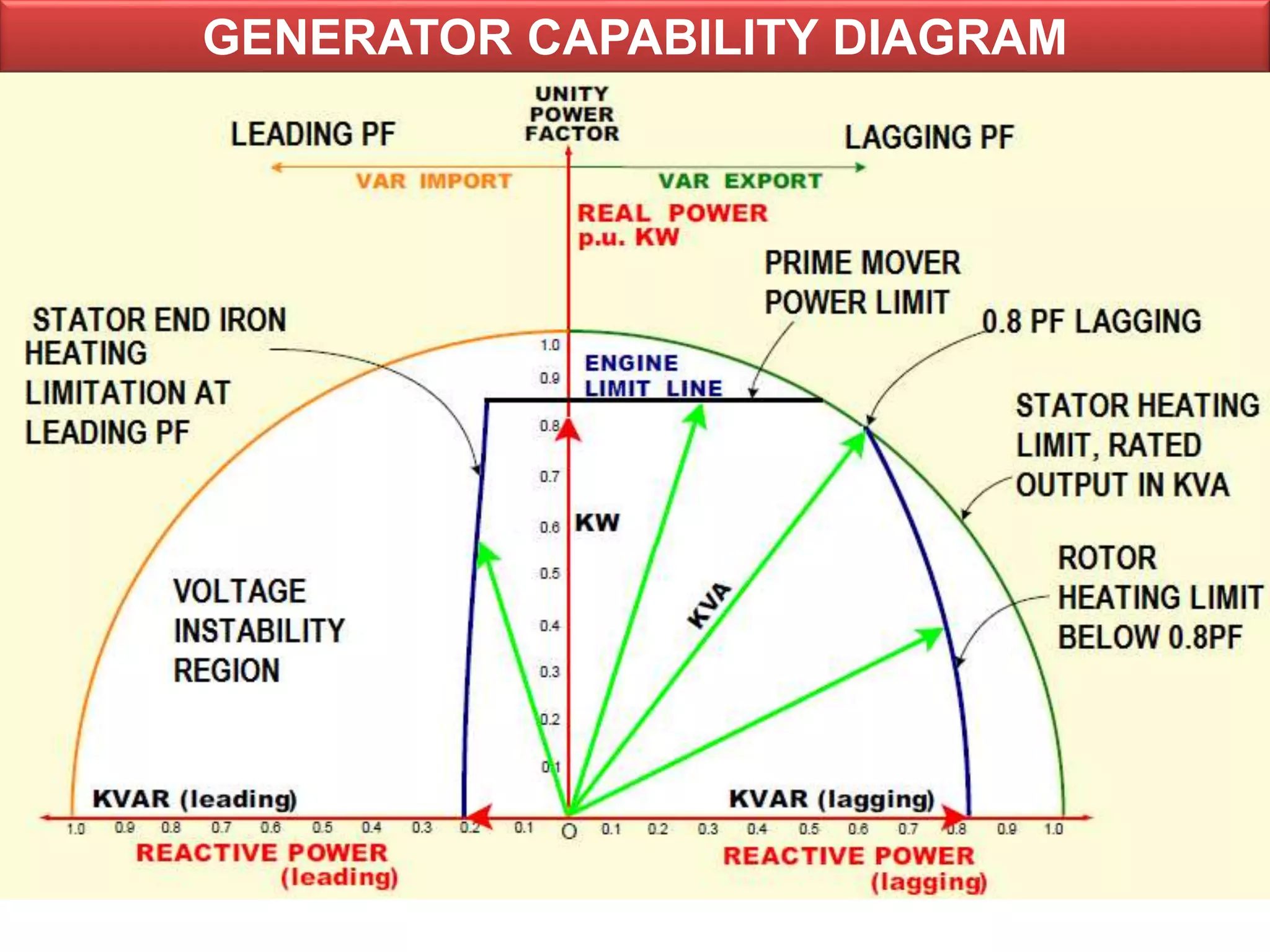
Armature current limit
Field current limit
Prime Mover Limit
End region heating limit
(1) Armature Current Limit/ Stator Copper Loss (stator heating): The maximum allowable
heating of the stator sets a maximum phase current IA for the machine. It’s equivalent to
set a maximum apparent power for the machine. (Power factor is irrelevant).
PSCL = 3 IA
2
RS
(1) Field Current Limit/ Rotor Copper Loss (rotor heating): The maximum allowable heating
of the rotor sets a maximum field current IF for the machine. It’s equivalent to set a
maximum EA for the machine. PRCL = IF
2
RF
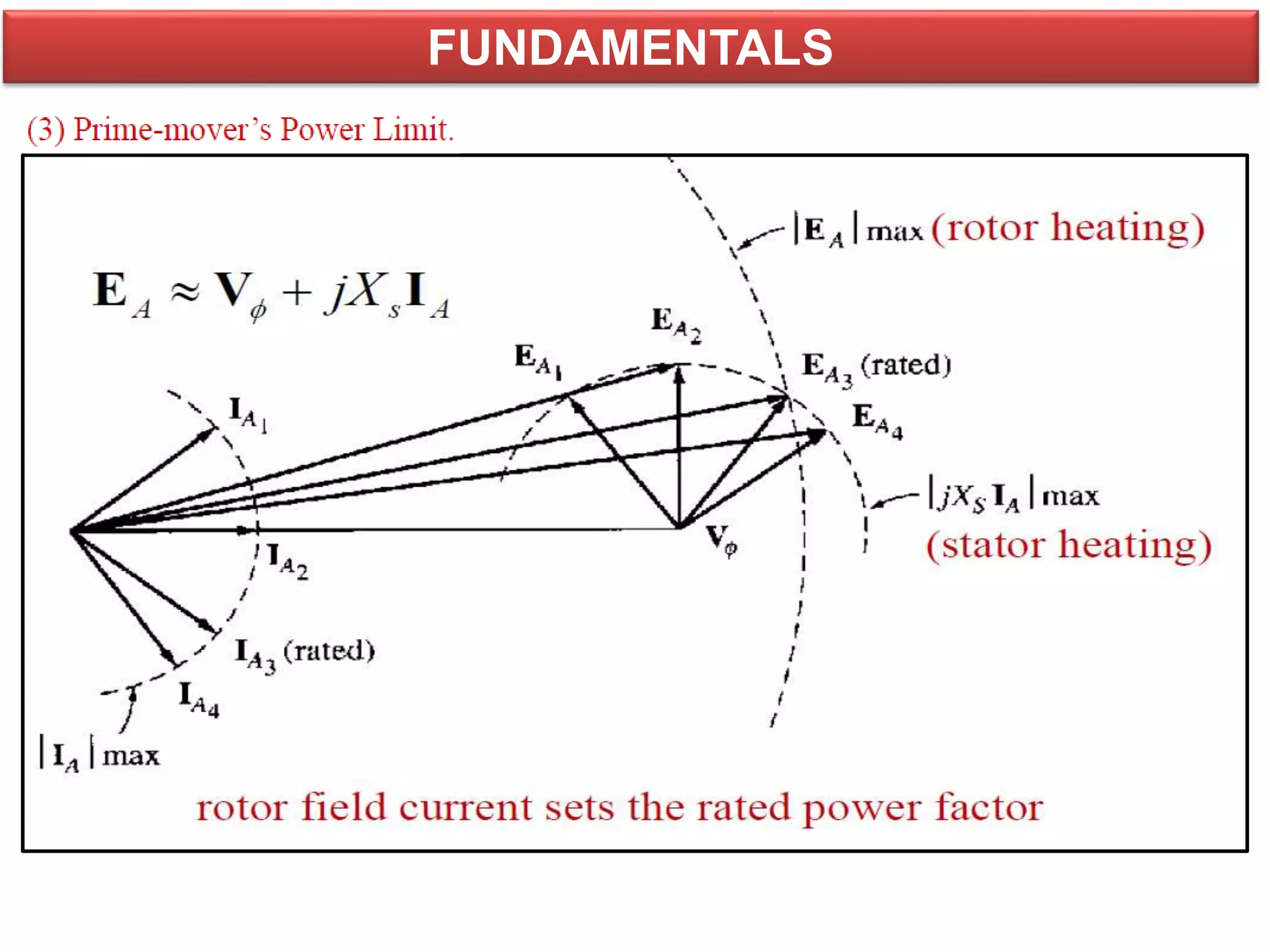
(3)Prime-mover’s Power Limit: The active power output is limited by the prime mover
capability to a value within the MVA rating. P =|Esinδ|
The limit is related to the mechanical input and the ability of the generator to
electromagnetically create a torque equal and opposite to the driving mechanical torque.
DEFINES THE OPERATING ZONE OF
A SYNCHRONOUS GENERATOR IN A
P-Q PLANE
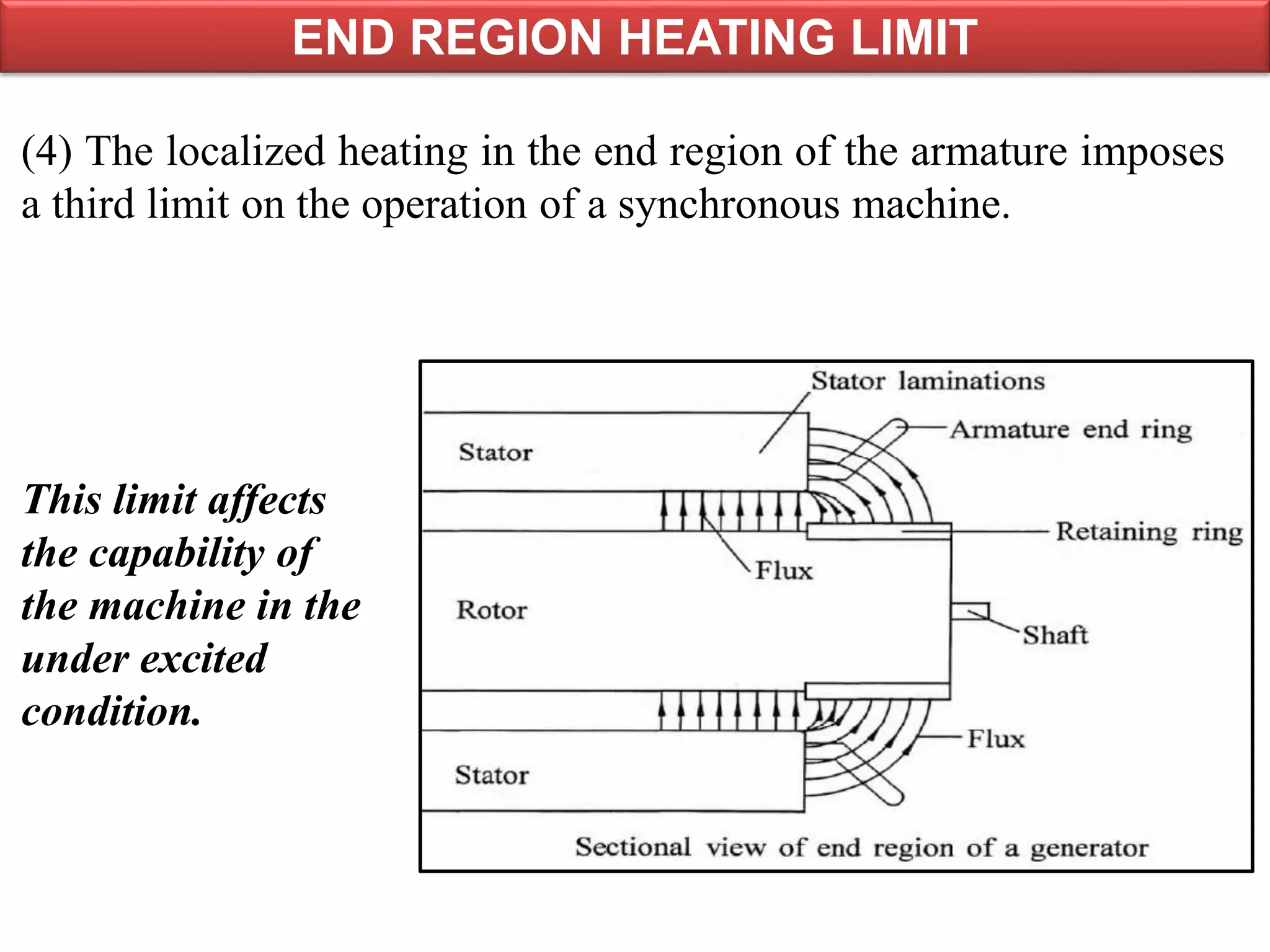
END REGION HEATING LIMIT
(4) The localized heating in the end region of the armature imposes
a third limit on the operation of a synchronous machine.
This limit affects
the capability of
the machine in the
under excited
condition.
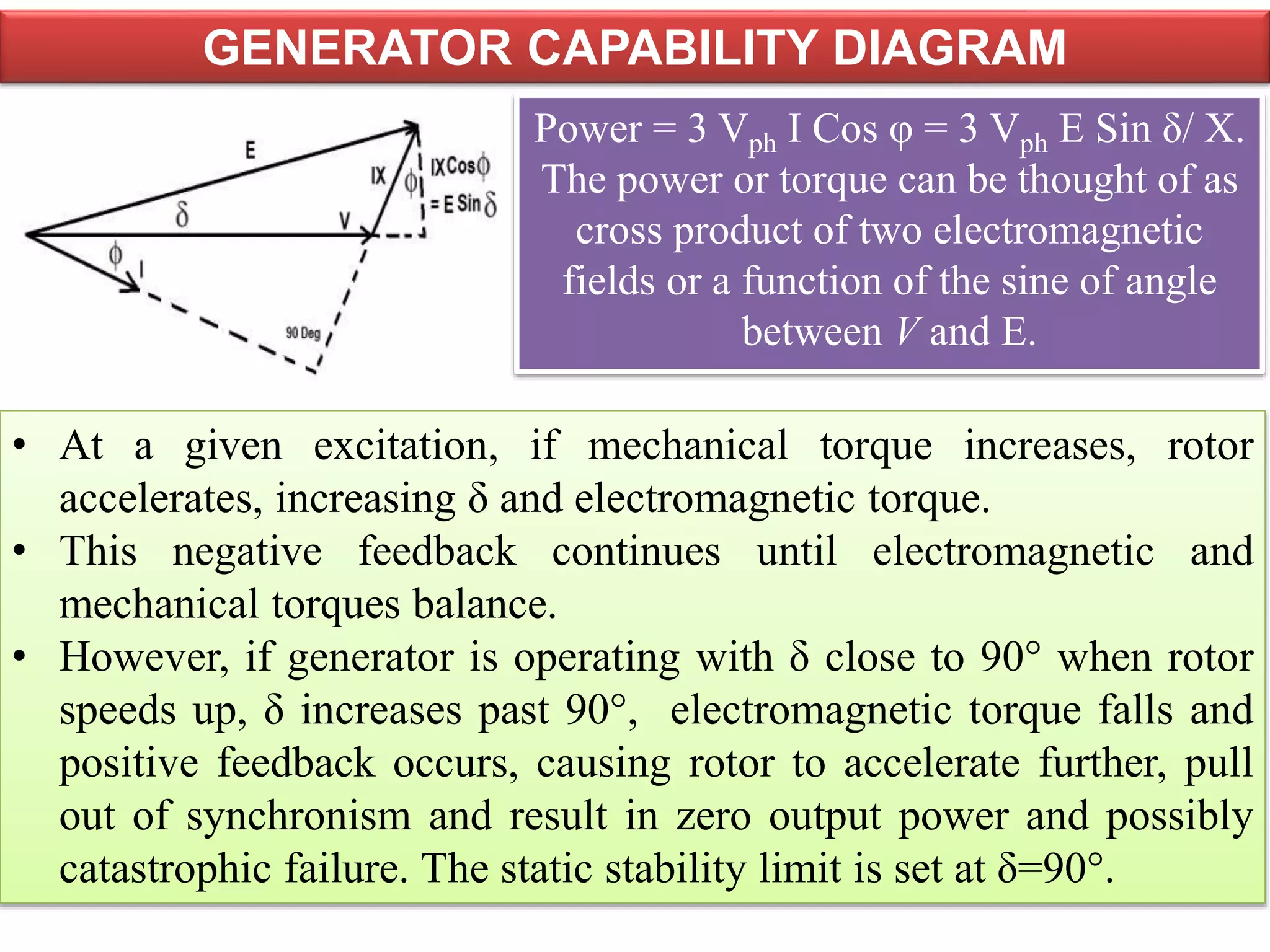
• At a given excitation, if mechanical torque increases, rotor
accelerates, increasing δ and electromagnetic torque.
• This negative feedback continues until electromagnetic and
mechanical torques balance.
• However, if generator is operating with δ close to 90° when rotor
speeds up, δ increases past 90°, electromagnetic torque falls and
positive feedback occurs, causing rotor to accelerate further, pull
out of synchronism and result in zero output power and possibly
catastrophic failure. The static stability limit is set at δ=90°.
GENERATOR CAPABILITY DIAGRAM
Power = 3 Vph I Cos φ = 3 Vph E Sin δ/ X.
The power or torque can be thought of as
cross product of two electromagnetic
fields or a function of the sine of angle
between V and E.
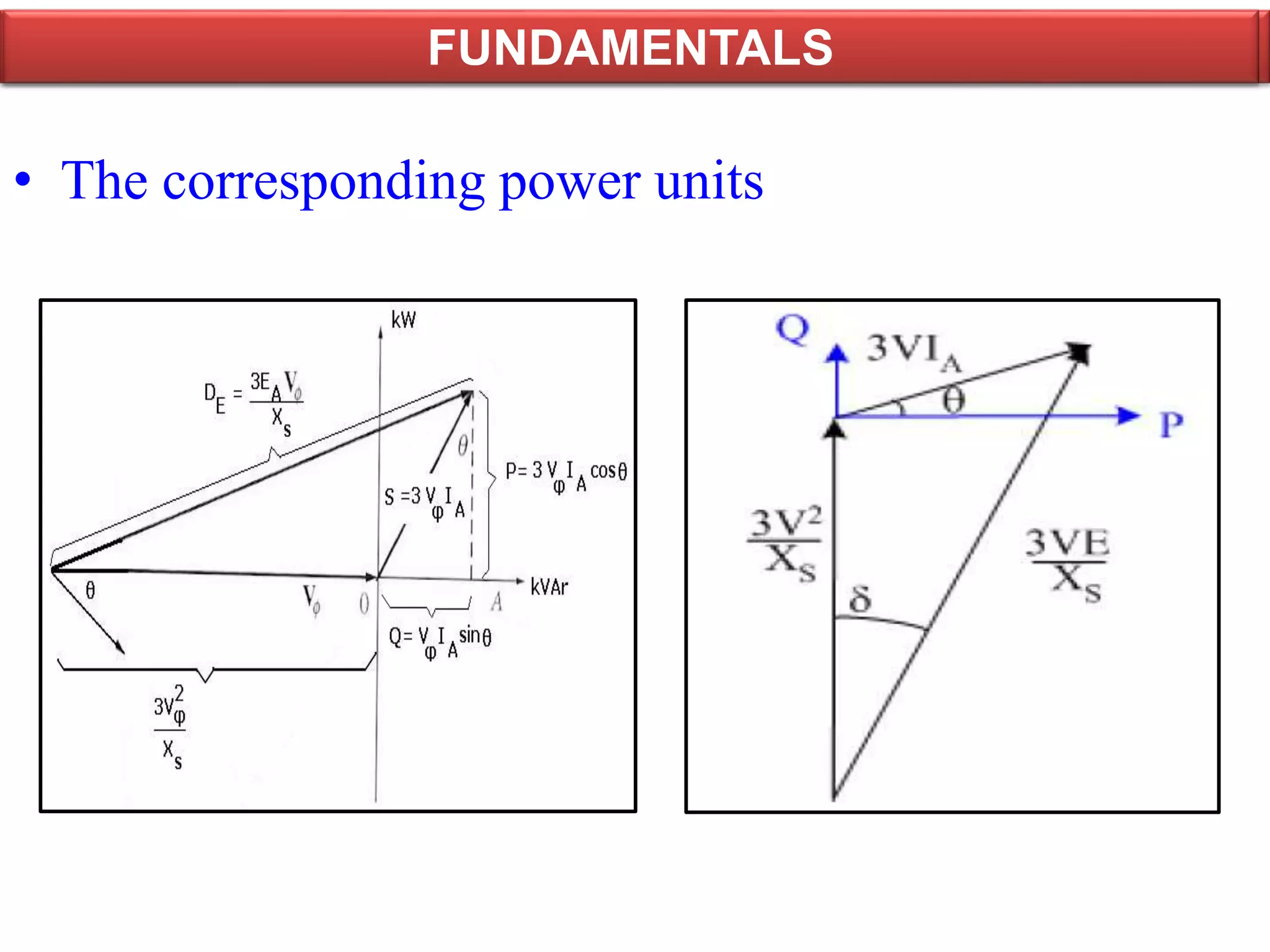
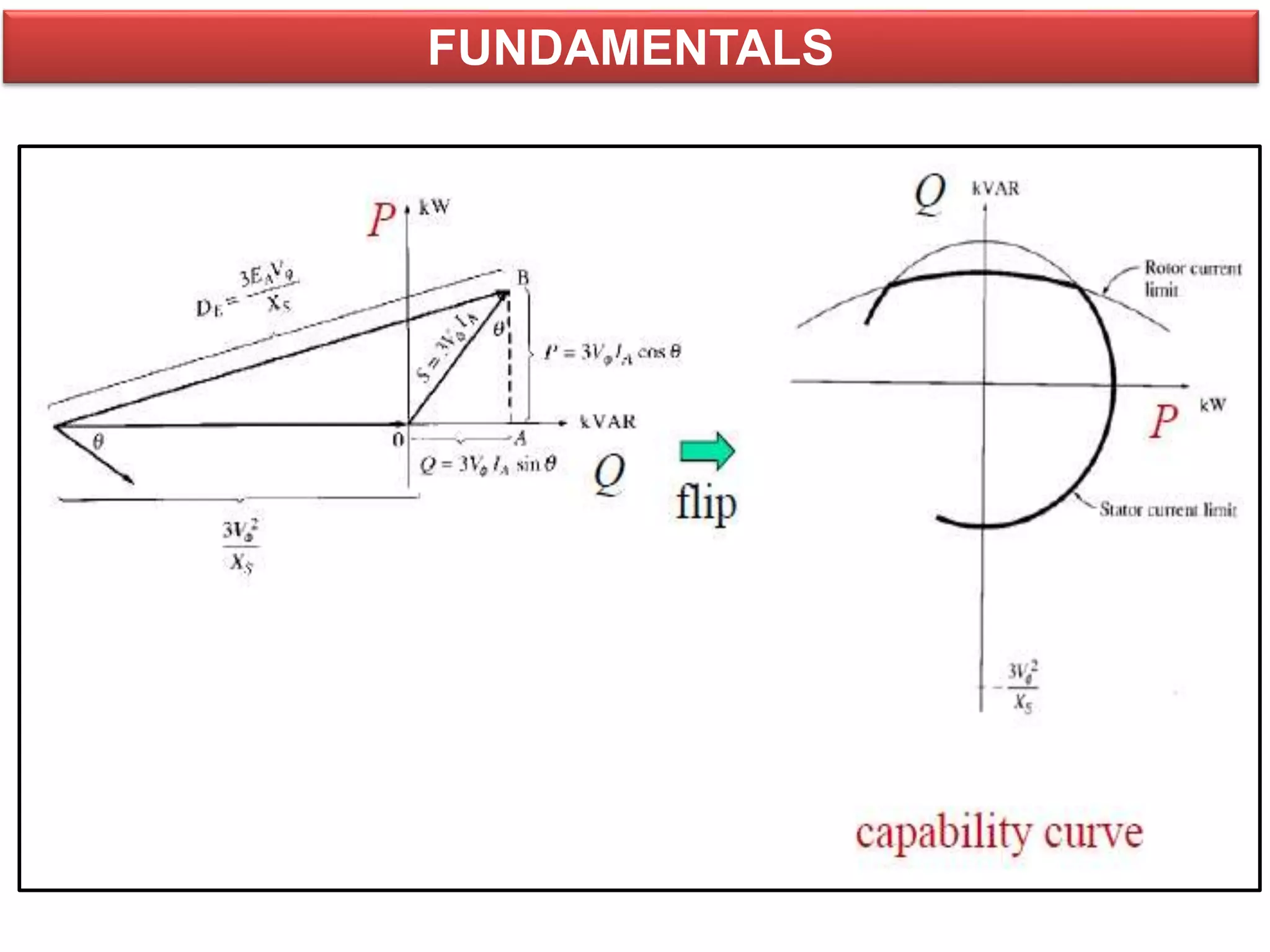
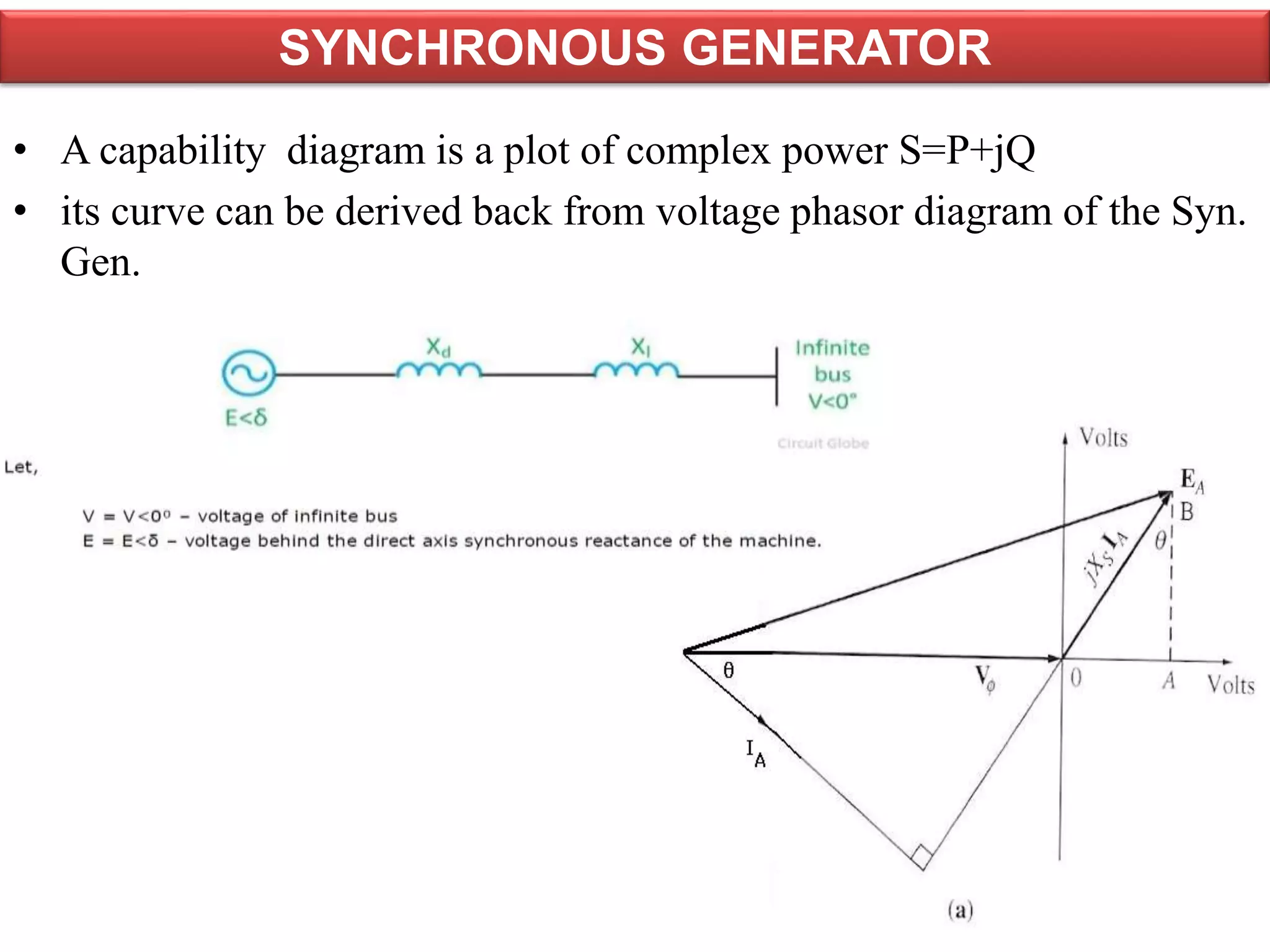
• A capability diagram is a plot of complex power S=P+jQ
• its curve can be derived back from voltage phasor diagram of the Syn.
Gen.
SYNCHRONOUS GENERATOR
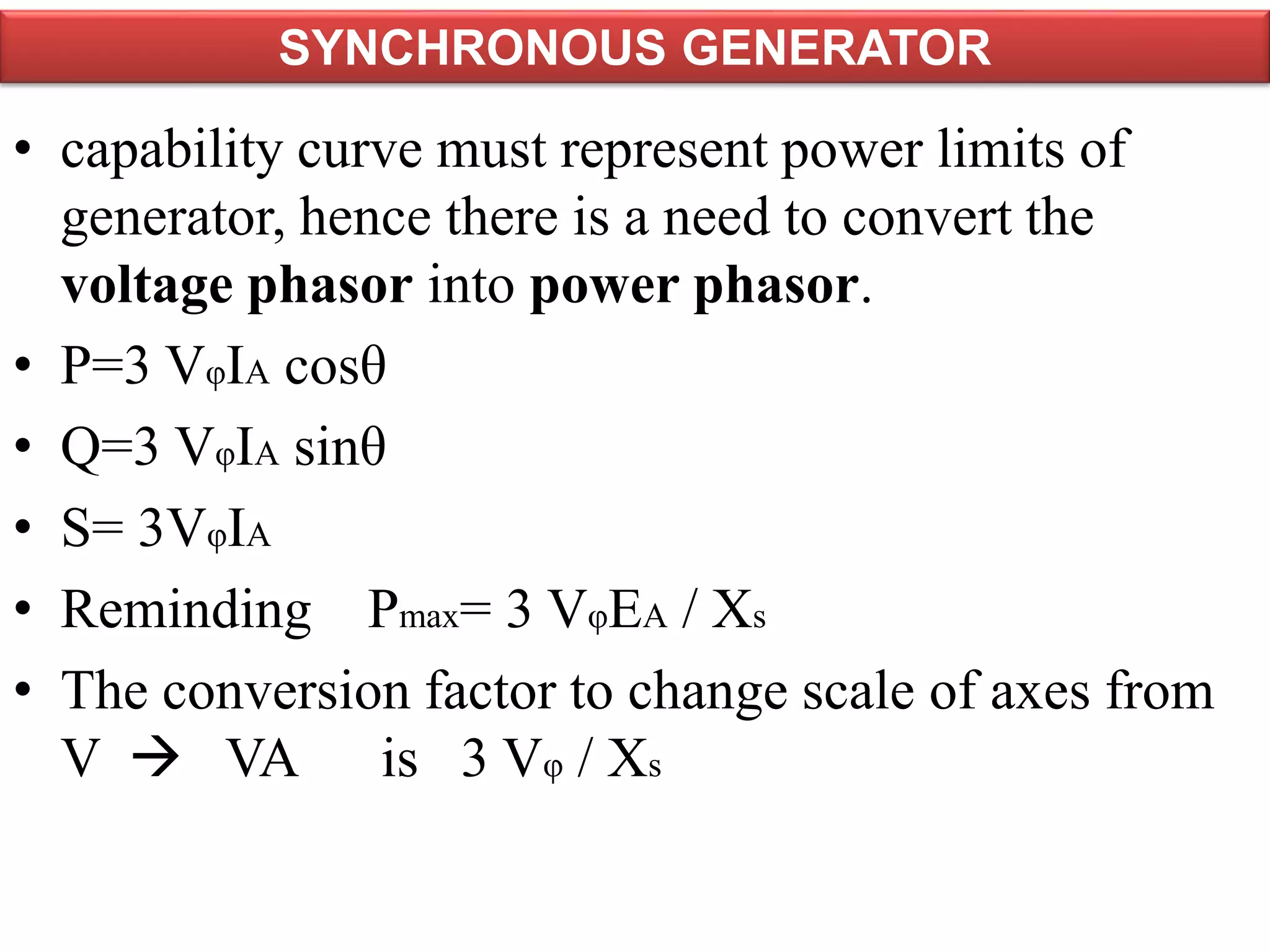
• capability curve must represent power limits of
generator, hence there is a need to convert the
voltage phasor into power phasor.
• P=3 VφIA cosθ
• Q=3 VφIA sinθ
• S= 3VφIA
• Reminding Pmax= 3 VφEA / Xs
• The conversion factor to change scale of axes from
V  VA is 3 Vφ / Xs
SYNCHRONOUS GENERATOR
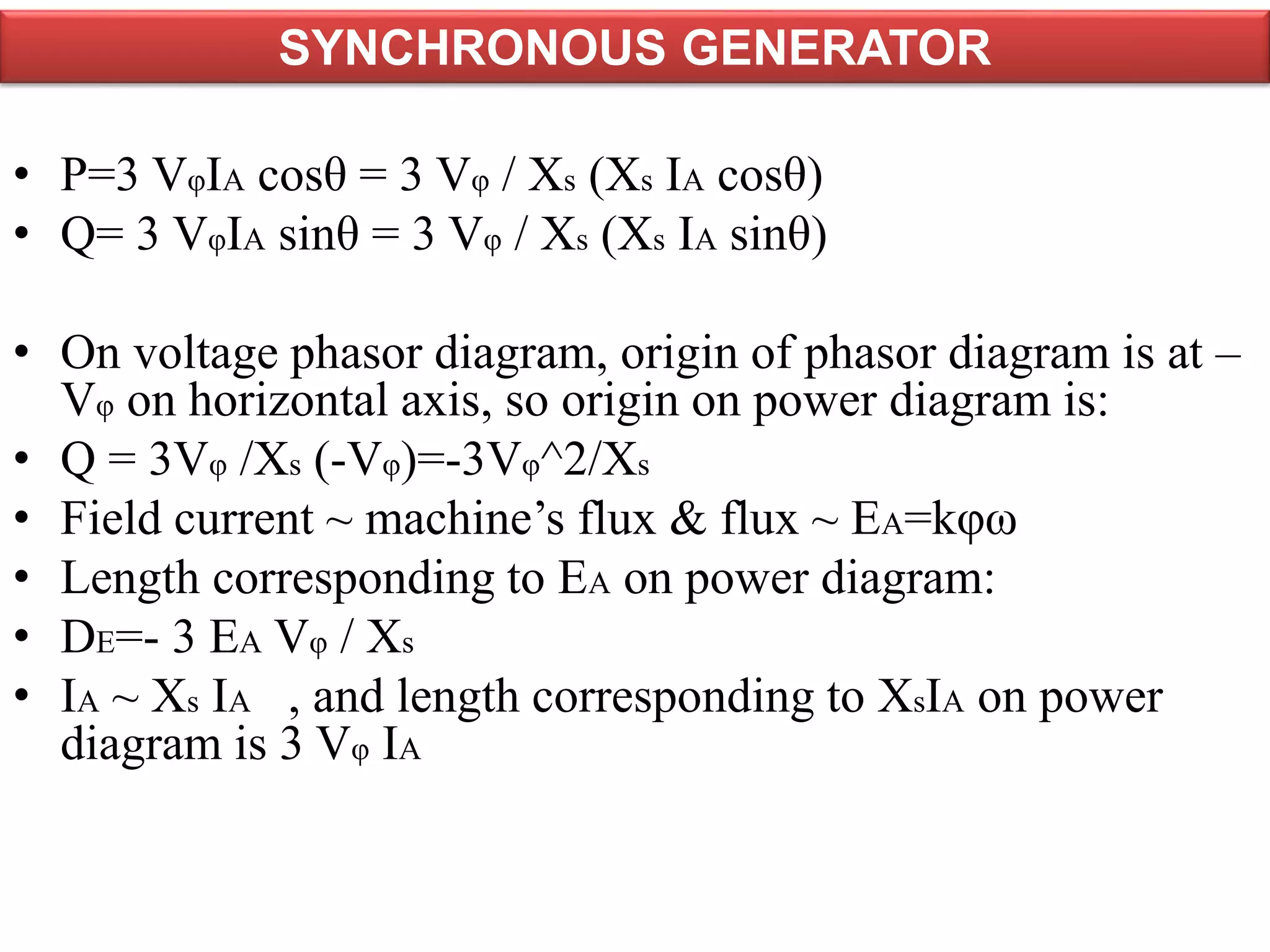
• P=3 VφIA cosθ = 3 Vφ / Xs (Xs IA cosθ)
• Q= 3 VφIA sinθ = 3 Vφ / Xs (Xs IA sinθ)
• On voltage phasor diagram, origin of phasor diagram is at –
Vφ on horizontal axis, so origin on power diagram is:
• Q = 3Vφ /Xs (-Vφ)=-3Vφ^2/Xs
• Field current ~ machine’s flux & flux ~ EA=kφω
• Length corresponding to EA on power diagram:
• DE=- 3 EA Vφ / Xs
• IA ~ Xs IA , and length corresponding to XsIA on power
diagram is 3 Vφ IA
SYNCHRONOUS GENERATOR
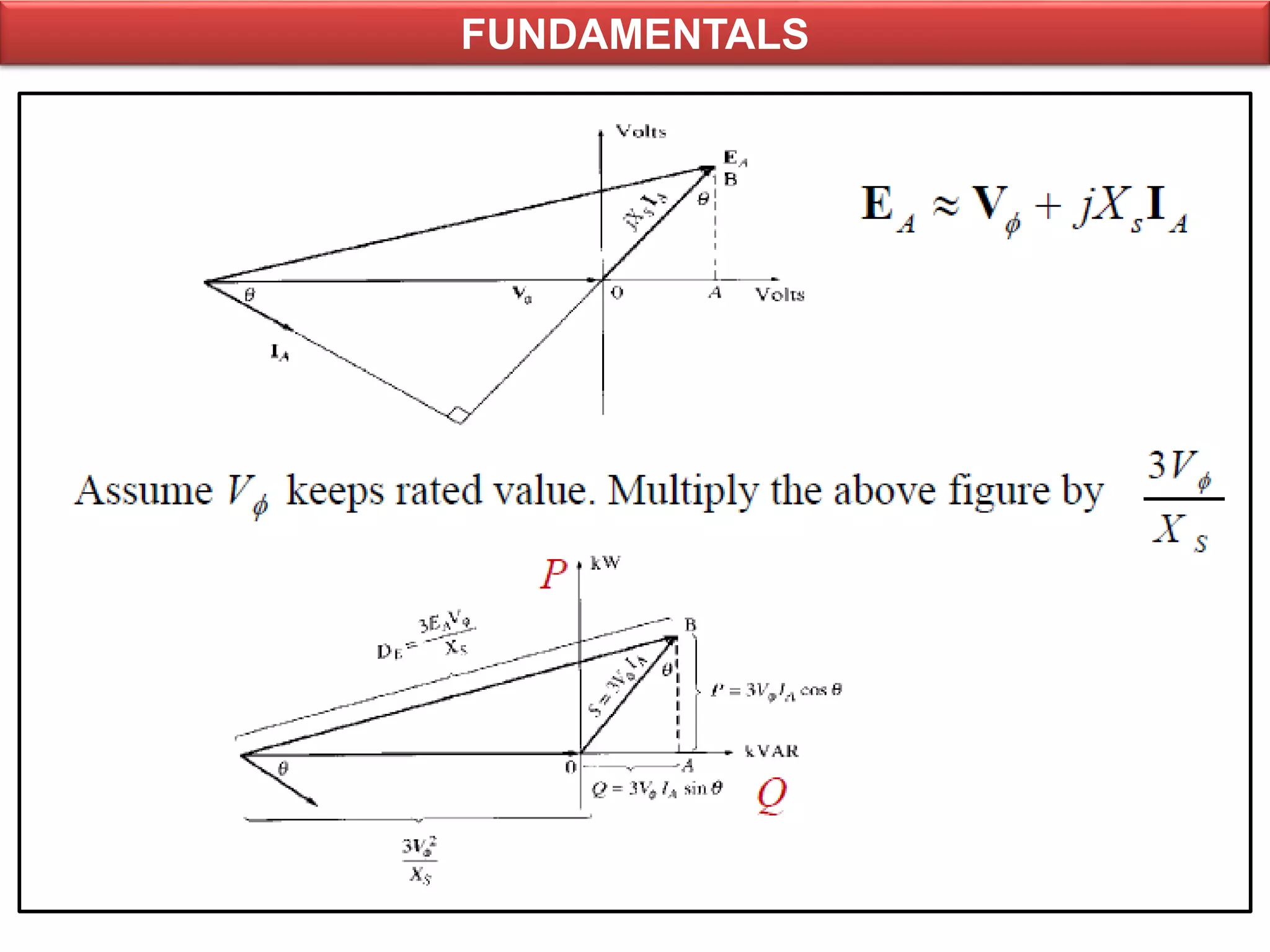
FUNDAMENTALS
• The corresponding power units
SYNCHRONOUS GENERATORFUNDAMENTALS
FUNDAMENTALS
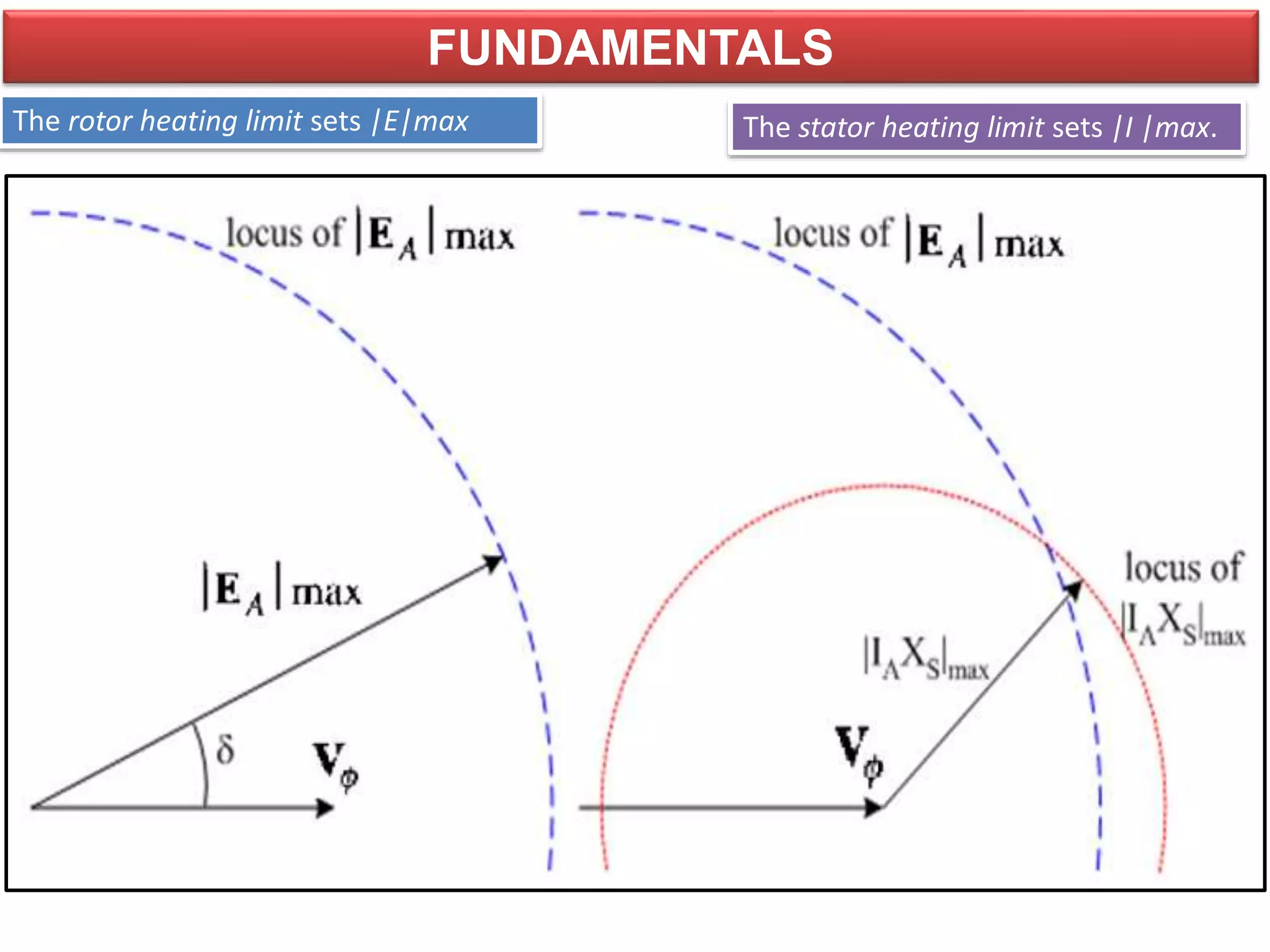
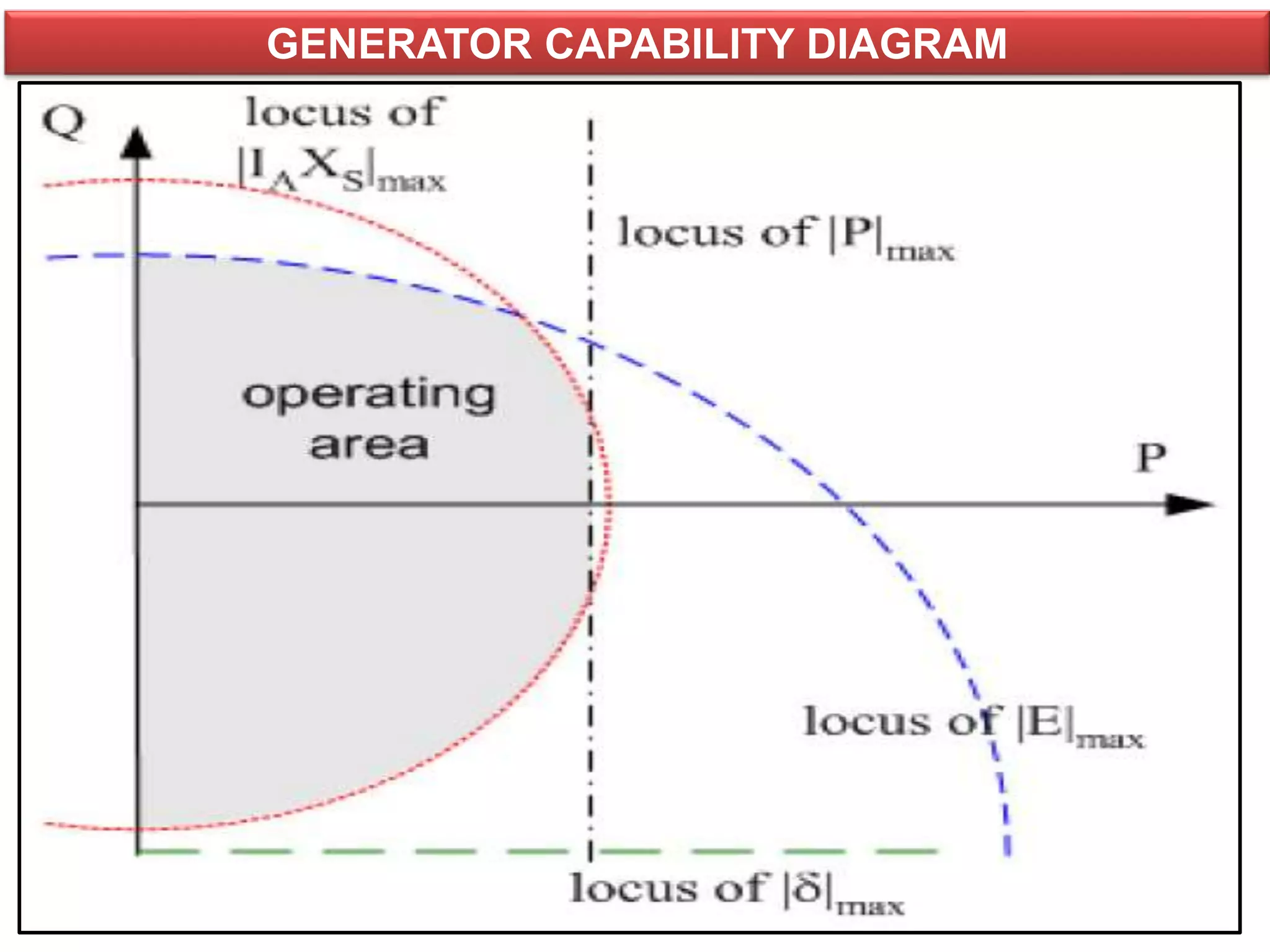
The rotor heating limit sets |E|max The stator heating limit sets |I |max.
FUNDAMENTALS
FUNDAMENTALS
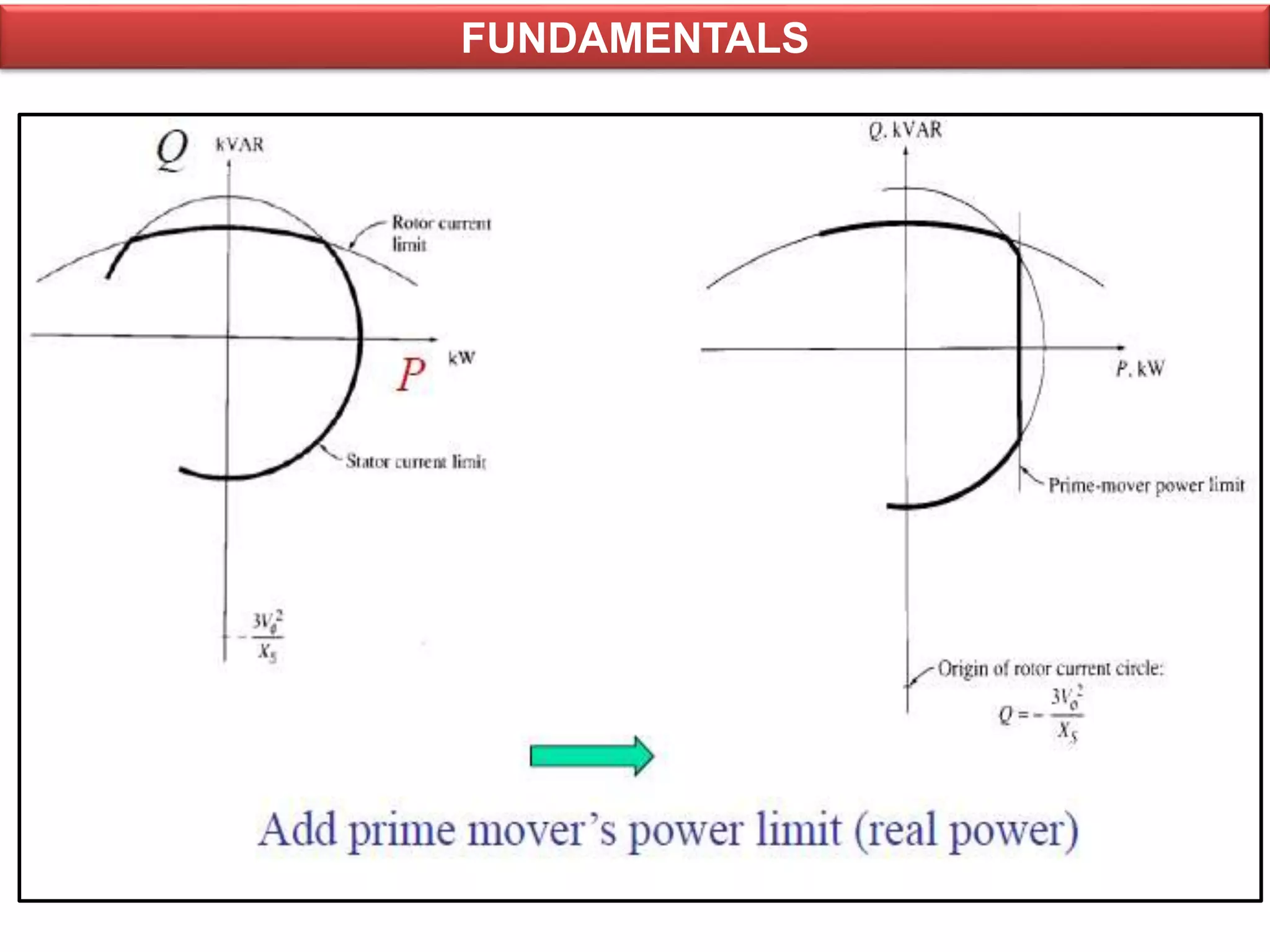
The final limit is related to the mechanical input and the ability of the generator
to electromagnetically create a torque equal and opposite to the driving
mechanical torque
FUNDAMENTALS
FUNDAMENTALS
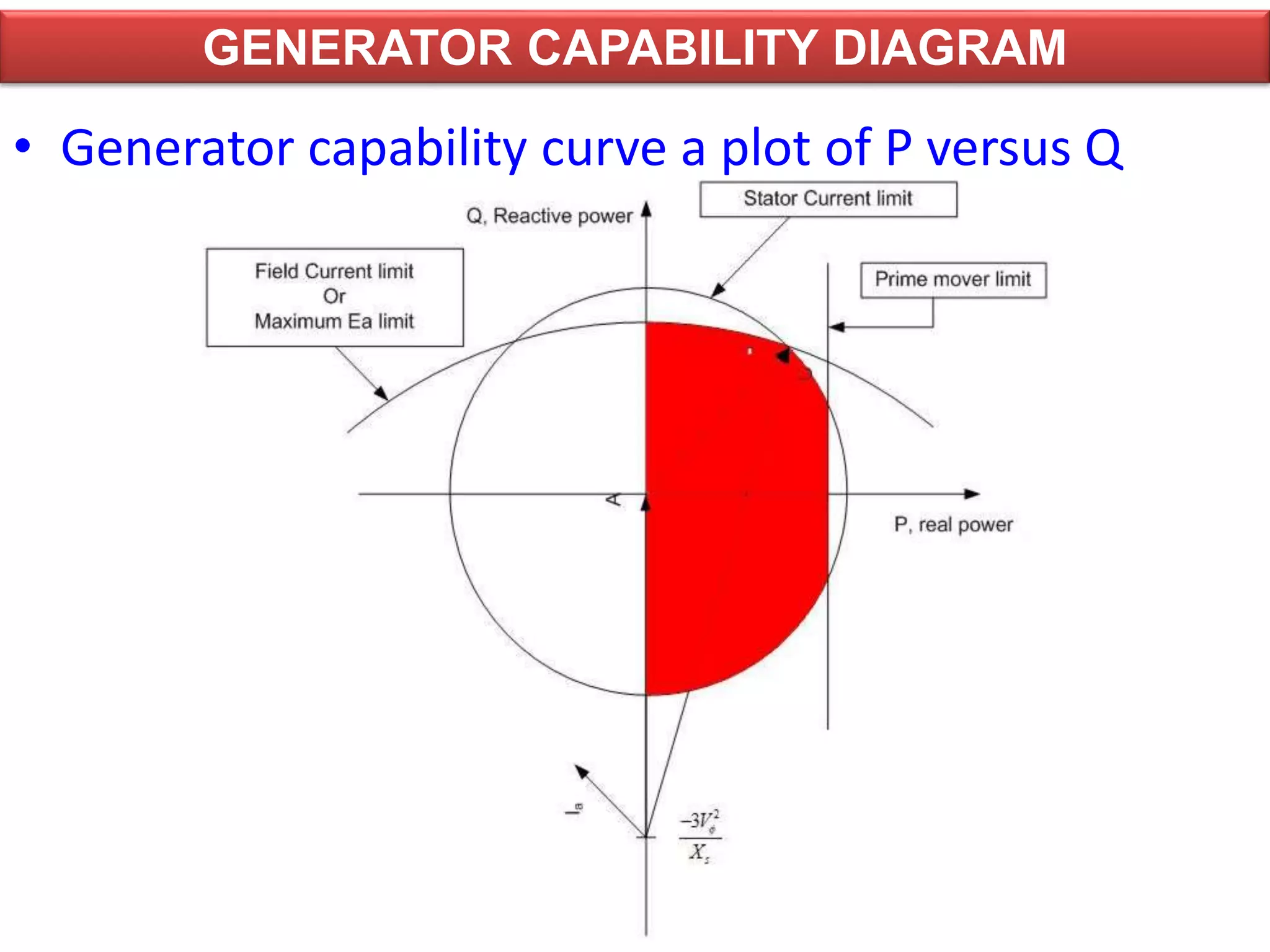
• Generator capability curve a plot of P versus Q
GENERATOR CAPABILITY DIAGRAM
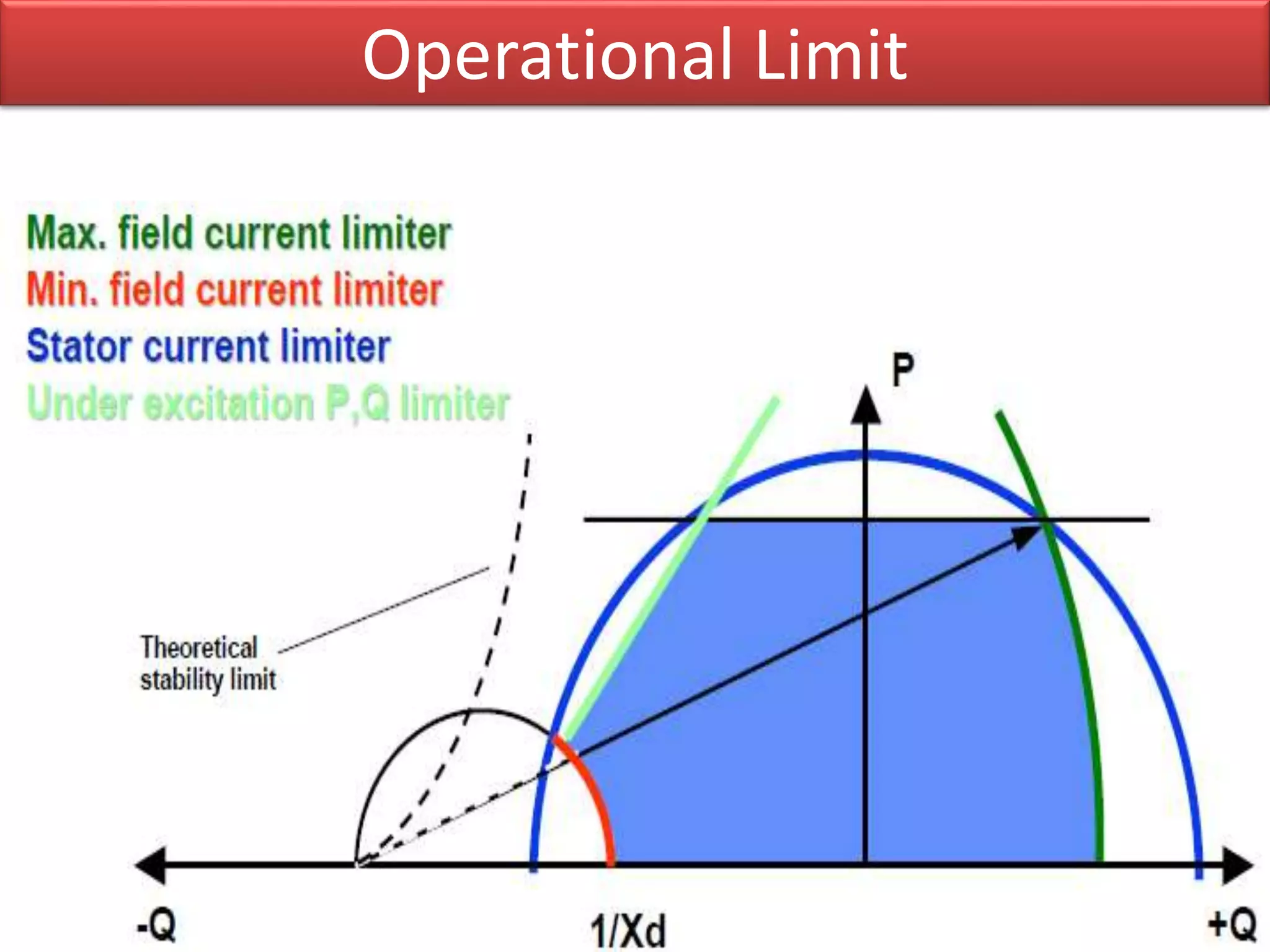
Operational Limit
Capability Curve
GENERATOR CAPABILITY DIAGRAM
SYN. GENERATOR RATING
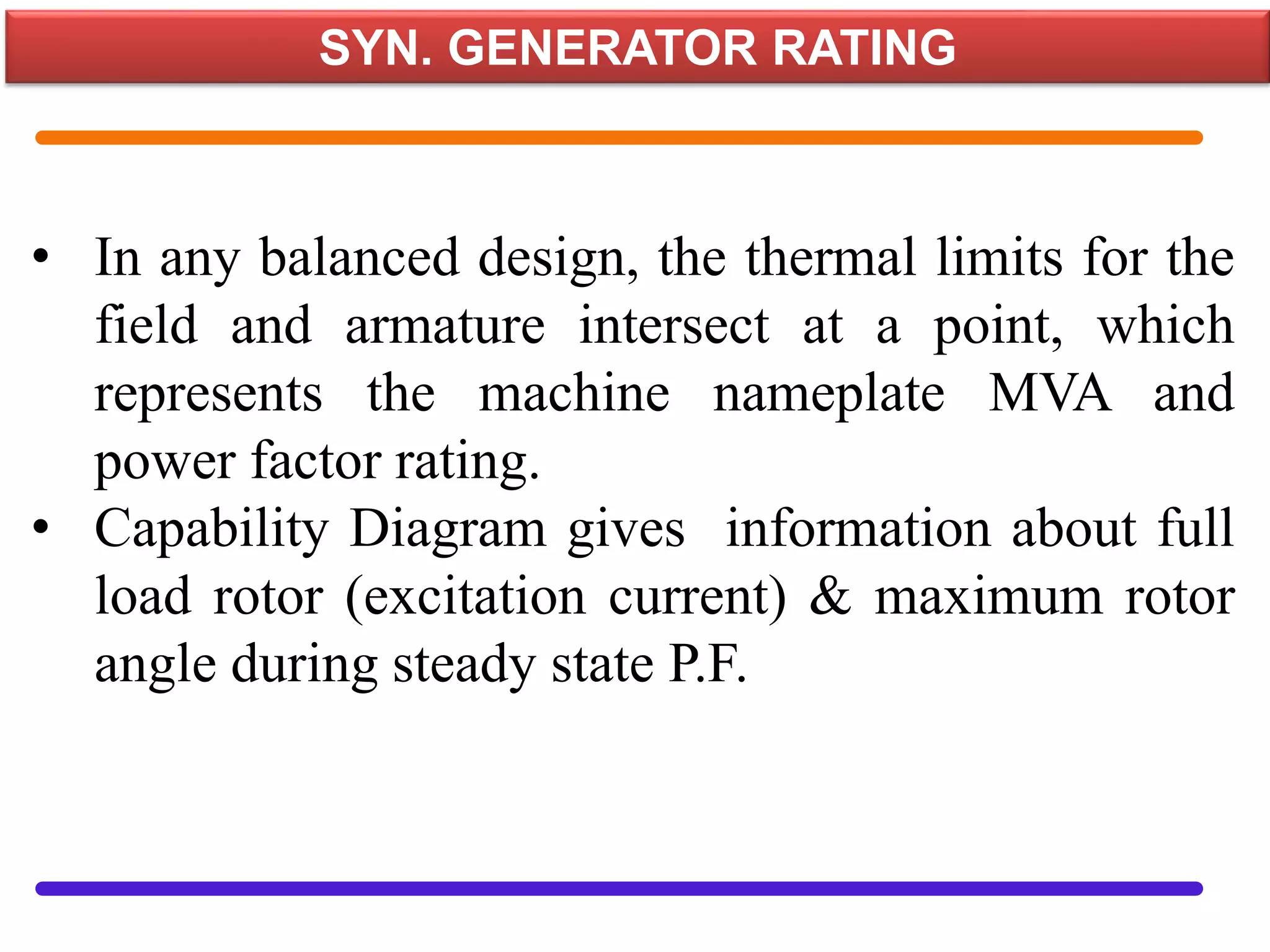
• In any balanced design, the thermal limits for the
field and armature intersect at a point, which
represents the machine nameplate MVA and
power factor rating.
• Capability Diagram gives information about full
load rotor (excitation current) & maximum rotor
angle during steady state P.F.
SYNCHRONOUS GENERATOR
Capability Curve of KP
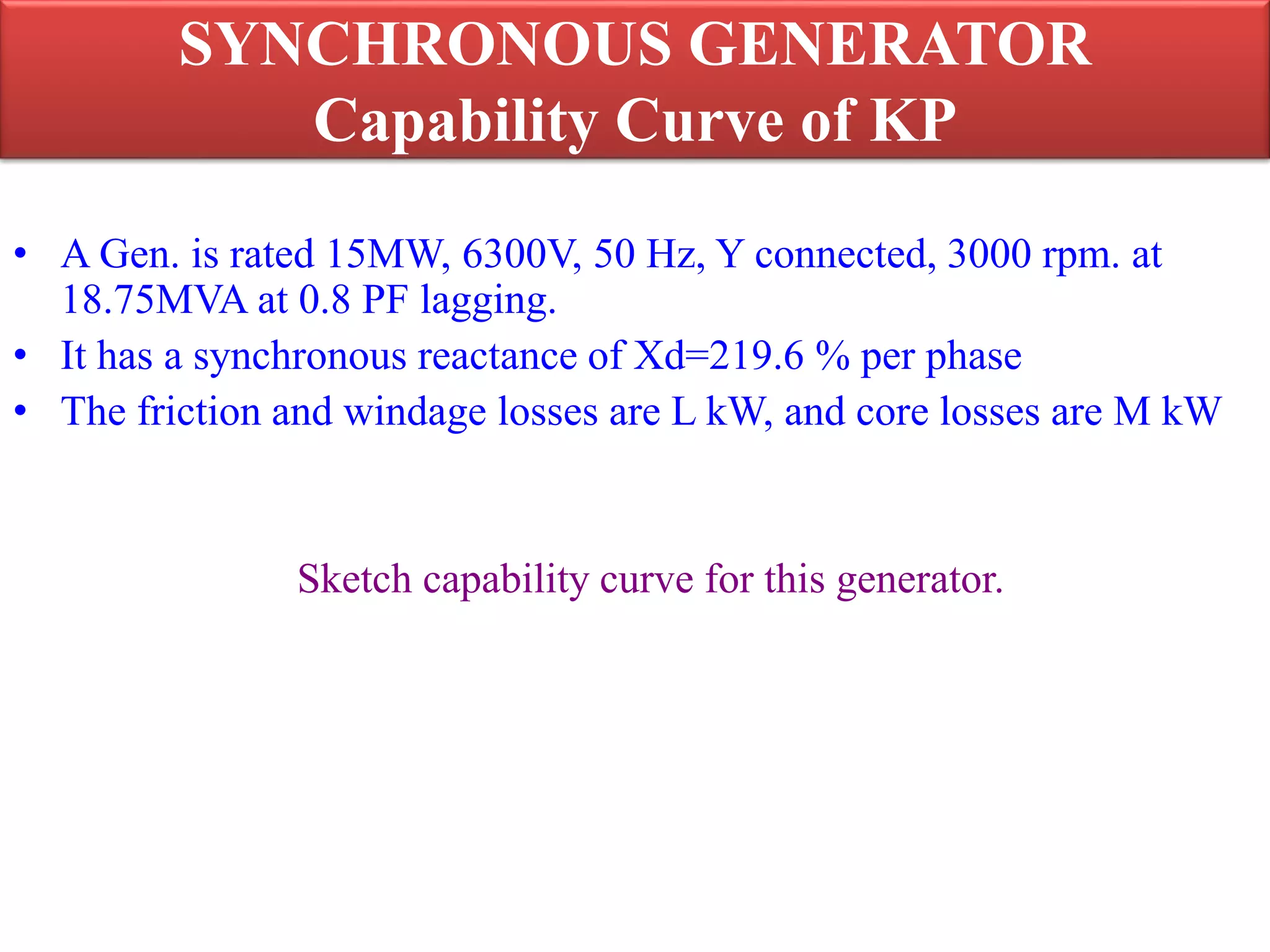
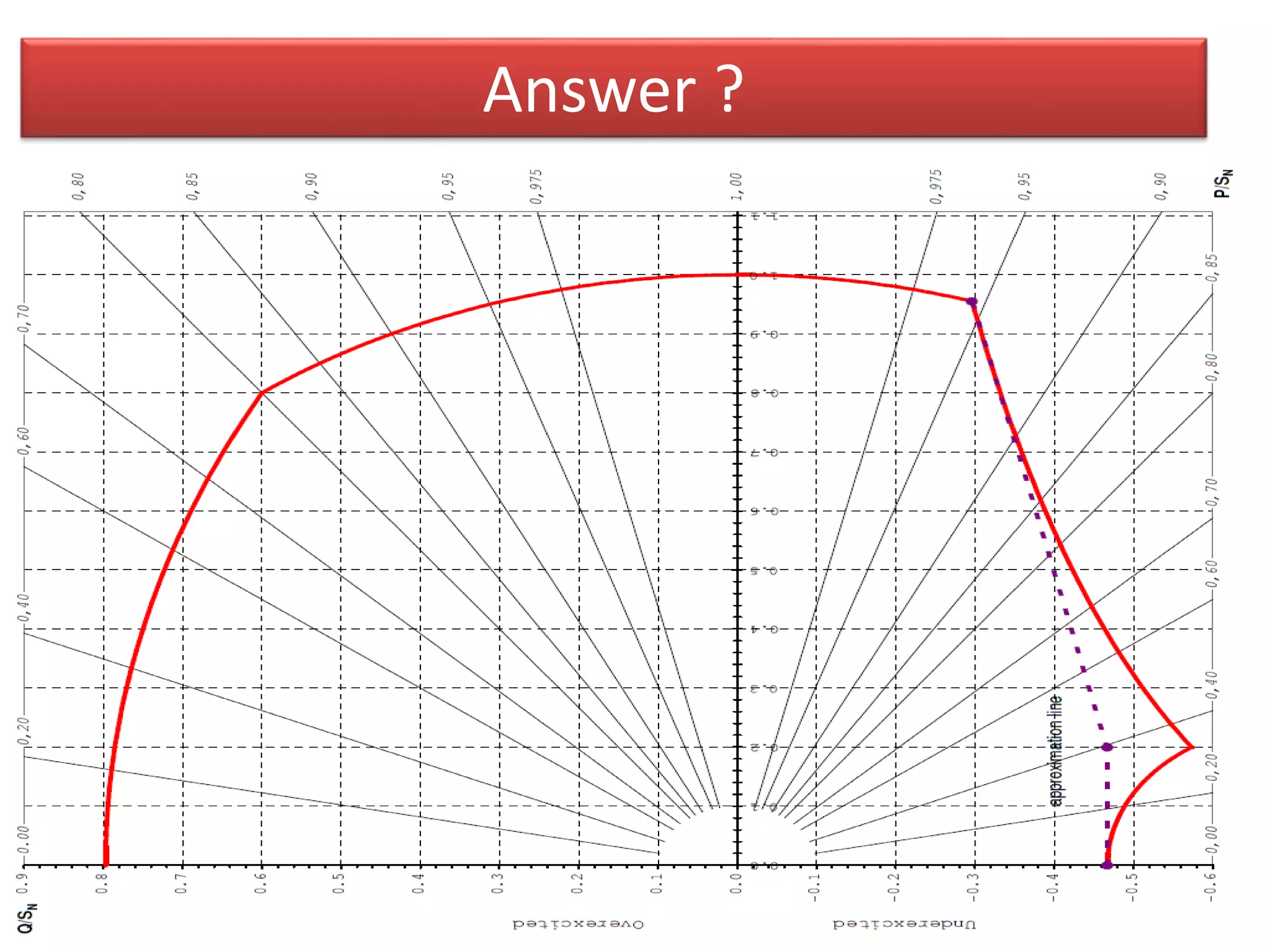
• A Gen. is rated 15MW, 6300V, 50 Hz, Y connected, 3000 rpm. at
18.75MVA at 0.8 PF lagging.
• It has a synchronous reactance of Xd=219.6 % per phase
• The friction and windage losses are L kW, and core losses are M kW
Sketch capability curve for this generator.
Answer ?
Presented By:
Er. Manoj Kumar Maharana
HOD Electrical
Feedback Power O&M Services Ltd.

Excitation System & capability curve of synchronous generator

  • 1.
    Excitation & Capability Curve of aSynchronous Generator FB/TRAINING/E&I/GEN
  • 2.
  • 3.
    Excitation • The basicpurpose of an excitation system is to provide direct current to the synchronous machine field winding • The basic control function of excitation system with respect to: Generator: To supply and adjust the field current so as to maintain constant terminal voltage and respond to transient disturbance with field forcing in accordance with generator capability. Power system :To respond quickly to improve transient stability and also to modulate field to improve power system stability. • The excitation system must have a means of measuring generator stator voltage and current.
  • 33.
  • 34.
    • The CapabilityCurve of a Synchronous Generator defines a boundary within which the machine can operate safely. • It is also known as Operating Charts or Capability Charts. The permissible region of operation is restricted to the following points given below.  The MVA loading should not exceed the generator rating. This limit is determined by the armature of the stator heating by the armature current.  The MW loading should not exceed the rating of the prime mover.  The field current should not be allowed to exceed a specified value determined by the heating of the field.  For steady state or stable operation, the load angle δ must be less than 90 degrees. The theoretical stability limit of the stable condition occurs when δ = 90⁰. GENERATOR CAPABILITY DIAGRAM
  • 35.
  • 36.
    GENERATOR CAPABILITY DIAGRAM Armaturecurrent limit Field current limit Prime Mover Limit End region heating limit (1) Armature Current Limit/ Stator Copper Loss (stator heating): The maximum allowable heating of the stator sets a maximum phase current IA for the machine. It’s equivalent to set a maximum apparent power for the machine. (Power factor is irrelevant). PSCL = 3 IA 2 RS (1) Field Current Limit/ Rotor Copper Loss (rotor heating): The maximum allowable heating of the rotor sets a maximum field current IF for the machine. It’s equivalent to set a maximum EA for the machine. PRCL = IF 2 RF (3)Prime-mover’s Power Limit: The active power output is limited by the prime mover capability to a value within the MVA rating. P =|Esinδ| The limit is related to the mechanical input and the ability of the generator to electromagnetically create a torque equal and opposite to the driving mechanical torque. DEFINES THE OPERATING ZONE OF A SYNCHRONOUS GENERATOR IN A P-Q PLANE
  • 37.
    END REGION HEATINGLIMIT (4) The localized heating in the end region of the armature imposes a third limit on the operation of a synchronous machine. This limit affects the capability of the machine in the under excited condition.
  • 38.
    • At agiven excitation, if mechanical torque increases, rotor accelerates, increasing δ and electromagnetic torque. • This negative feedback continues until electromagnetic and mechanical torques balance. • However, if generator is operating with δ close to 90° when rotor speeds up, δ increases past 90°, electromagnetic torque falls and positive feedback occurs, causing rotor to accelerate further, pull out of synchronism and result in zero output power and possibly catastrophic failure. The static stability limit is set at δ=90°. GENERATOR CAPABILITY DIAGRAM Power = 3 Vph I Cos φ = 3 Vph E Sin δ/ X. The power or torque can be thought of as cross product of two electromagnetic fields or a function of the sine of angle between V and E.
  • 39.
    • A capabilitydiagram is a plot of complex power S=P+jQ • its curve can be derived back from voltage phasor diagram of the Syn. Gen. SYNCHRONOUS GENERATOR
  • 40.
    • capability curvemust represent power limits of generator, hence there is a need to convert the voltage phasor into power phasor. • P=3 VφIA cosθ • Q=3 VφIA sinθ • S= 3VφIA • Reminding Pmax= 3 VφEA / Xs • The conversion factor to change scale of axes from V  VA is 3 Vφ / Xs SYNCHRONOUS GENERATOR
  • 41.
    • P=3 VφIAcosθ = 3 Vφ / Xs (Xs IA cosθ) • Q= 3 VφIA sinθ = 3 Vφ / Xs (Xs IA sinθ) • On voltage phasor diagram, origin of phasor diagram is at – Vφ on horizontal axis, so origin on power diagram is: • Q = 3Vφ /Xs (-Vφ)=-3Vφ^2/Xs • Field current ~ machine’s flux & flux ~ EA=kφω • Length corresponding to EA on power diagram: • DE=- 3 EA Vφ / Xs • IA ~ Xs IA , and length corresponding to XsIA on power diagram is 3 Vφ IA SYNCHRONOUS GENERATOR
  • 42.
  • 43.
    • The correspondingpower units SYNCHRONOUS GENERATORFUNDAMENTALS
  • 44.
    FUNDAMENTALS The rotor heatinglimit sets |E|max The stator heating limit sets |I |max.
  • 45.
  • 46.
    FUNDAMENTALS The final limitis related to the mechanical input and the ability of the generator to electromagnetically create a torque equal and opposite to the driving mechanical torque
  • 47.
  • 48.
  • 49.
    • Generator capabilitycurve a plot of P versus Q GENERATOR CAPABILITY DIAGRAM
  • 50.
  • 51.
  • 52.
  • 53.
  • 54.
    SYN. GENERATOR RATING •In any balanced design, the thermal limits for the field and armature intersect at a point, which represents the machine nameplate MVA and power factor rating. • Capability Diagram gives information about full load rotor (excitation current) & maximum rotor angle during steady state P.F.
  • 55.
    SYNCHRONOUS GENERATOR Capability Curveof KP • A Gen. is rated 15MW, 6300V, 50 Hz, Y connected, 3000 rpm. at 18.75MVA at 0.8 PF lagging. • It has a synchronous reactance of Xd=219.6 % per phase • The friction and windage losses are L kW, and core losses are M kW Sketch capability curve for this generator.
  • 56.
  • 57.
    Presented By: Er. ManojKumar Maharana HOD Electrical Feedback Power O&M Services Ltd.