Chuck Mozina
Consultant
Beckwith Electric Co. Inc.
Power Plant
“Horror Stories”
Power Plant
“Horror Stories”
To dispel the myth that nothing exciting ever
happens in power plants
Many power plant events are not short circuits and
are not easy to analyze (example—loss of field)
Many events involved human error by less
experienced operators
With the high volume of IPP plants coming on-line,
commissioning errors are occurring
“Lessons Learned” are important to avoid repeating
errors in the future
Why I wrote this paper:
“Horror Stories”
Multi-Phase Generator Faults
Stator Ground Current
Accidental Off-Line Generator Energizing
Overexcitation
Loss-of-Field
- ComTrade oscillo analysis
Generator Breaker Failure
- Breaker Interrupter Flashover
Power Plant Events That The Paper Addresses:
“Horror Stories”
Multi-Phase Generator Faults
“Horror Stories”
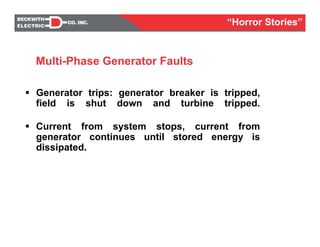
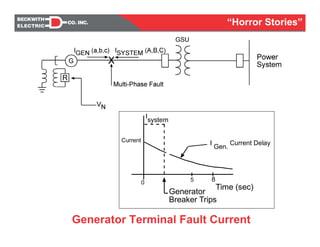
Generator trips: generator breaker is tripped,
field is shut down and turbine tripped.
Current from system stops, current from
generator continues until stored energy is
dissipated.
Multi-Phase Generator Faults
“Horror Stories”
Time (sec)
5 8
Generator
Breaker Trips
0
Current I
Gen.
Current Delay
I
system
Generator Terminal Fault Current
“Horror Stories”
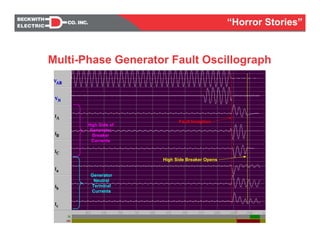
High Side of
Generator
Breaker
Currents
Generator
Neutral
Terminal
Currents
Fault Inception
High Side Breaker Opens
Multi-Phase Generator Fault Oscillograph
“Horror Stories”
G X
GSU
F1
X
F2
UAT
R
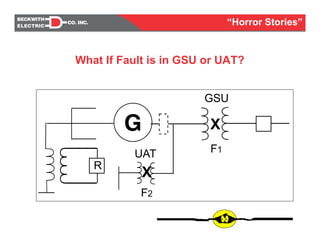
What If Fault is in GSU or UAT?
“Horror Stories”
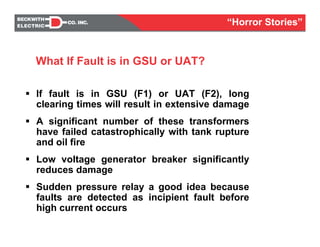
If fault is in GSU (F1) or UAT (F2), long
clearing times will result in extensive damage
A significant number of these transformers
have failed catastrophically with tank rupture
and oil fire
Low voltage generator breaker significantly
reduces damage
Sudden pressure relay a good idea because
faults are detected as incipient fault before
high current occurs
What If Fault is in GSU or UAT?
“Horror Stories”
There is no effective way to quickly “turn off”
generator fault current.
Long fault decay results in the vast majority of
damage (85%) occurring after tripping.
Make every effort in design to make sure the
only credible fault in the generator is a ground
fault.
Consider the value of including a generator
low voltage breaker in your next generator
addition to reduce exposure of GSU and
UAT to long clearing faults.
“Lessons Learned”
“Horror Stories”
Stator Ground Faults
“Horror Stories”
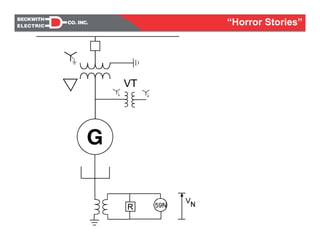
Generator Tripping: Generator breaker is
tripped, field is shut down and turbine is tripped.
Current from system stops when generator
breaker trips, current from generator continues
BUT magnitude is reduced to generator
grounding.
Stator Ground Faults
“Horror Stories”
“Horror Stories”
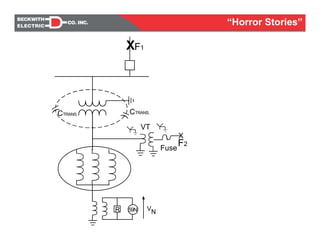
59N pickup generally set down to 5-6V pickup
to “see” faults near the neutral.
59N tripping must be delayed to coordinate
with:
- System ground faults
- Wye-wye generator VT’s fuses
Stator Ground Setting Coordination
“Horror Stories”
XF1
CTRANS.
X
VT
Fuse
R 59N VN
CTRANS.
F2
“Horror Stories”
Generator
Neutral
Voltage
Generator
Phase
Currents
Fault Inception
Breaker Opens
Trip Command
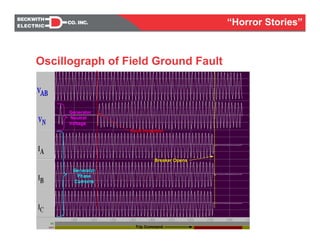
Oscillograph of Field Ground Fault
“Horror Stories”
Because grounding transformer impedance is
very high compared to generation—full line-to-
neutral voltage appears across transformer.
Not uncommon for fault to self-extinguish and
re-start because of low ground current.
Oscillograph of Field Ground Fault
“Horror Stories”
Oscillographic records played a key role in
preventing damaged generators from being
returned to service by confirming relaying
operated properly.
Oscillographic records can also speed a
generator’s return to service if relaying operated
improperly.
“Lessons Learned”
“Horror Stories”
Accidental Off-Line Generator Energizing
“Horror Stories”
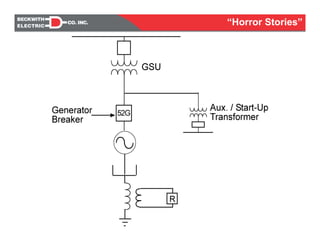
Event occurred during commissioning of a gas
turbine installation.
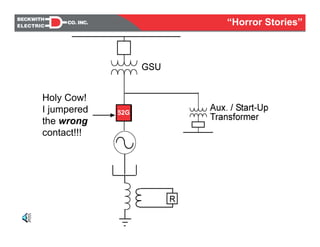
Commissioning crew was trying to simulate a
52A contact closer, but jumped the wiring studs
on a terminal block, closing the breaker.
Accidental Off-Line Generator Energizing
“Horror Stories”
“Horror Stories”
“Horror Stories”
Holy Cow!
I jumpered
the wrong
contact!!!
52G
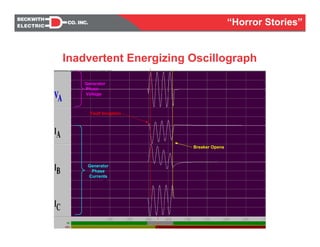
Generator
Phase
Voltage
Generator
Phase
Currents
Fault Inception
Breaker Opens
Inadvertent Energizing Oscillograph
“Horror Stories”
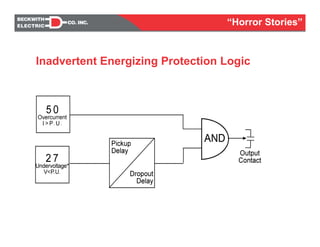
Inadvertent Energizing Protection Logic
“Horror Stories”
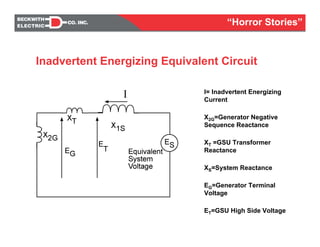
I= Inadvertent Energizing
Current
X2G=Generator Negative
Sequence Reactance
XT =GSU Transformer
Reactance
XS=System Reactance
EG=Generator Terminal
Voltage
ET=GSU High Side Voltage
Inadvertent Energizing Equivalent Circuit
“Horror Stories”
Despite the design of modern interlock
schemes to prevent it—inadvertent energizing
events continue to happen.
Dedicated inadvertent energizing protection is
needed even on new gas turbine plants with
generator low voltage breakers.
Inadvertent energizing schemes need to be in-
service when the generator is out of service.
“Lessons Learned”
“Horror Stories”
OverexcitationOverexcitation
“Horror Stories”
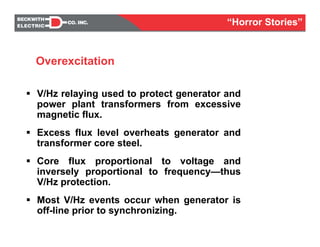
V/Hz relaying used to protect generator and
power plant transformers from excessive
magnetic flux.
Excess flux level overheats generator and
transformer core steel.
Core flux proportional to voltage and
inversely proportional to frequency—thus
V/Hz protection.
Most V/Hz events occur when generator is
off-line prior to synchronizing.
Overexcitation
“Horror Stories”
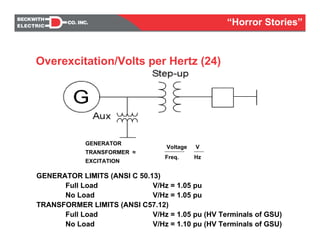
GENERATOR
TRANSFORMER ≈
EXCITATION
Voltage V
Freq. Hz
GENERATOR LIMITS (ANSI C 50.13)
Full Load V/Hz = 1.05 pu
No Load V/Hz = 1.05 pu
TRANSFORMER LIMITS (ANSI C57.12)
Full Load V/Hz = 1.05 pu (HV Terminals of GSU)
No Load V/Hz = 1.10 pu (HV Terminals of GSU)
Overexcitation/Volts per Hertz (24)
“Horror Stories”
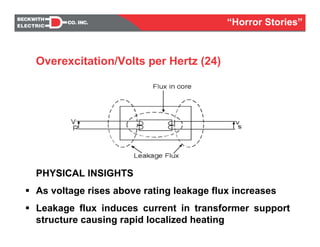
PHYSICAL INSIGHTS
As voltage rises above rating leakage flux increases
Leakage flux induces current in transformer support
structure causing rapid localized heating
Overexcitation/Volts per Hertz (24)
“Horror Stories”
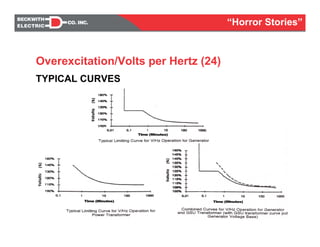
TYPICAL CURVES
Overexcitation/Volts per Hertz (24)
“Horror Stories”
CAUSES OF V/HZ PROBLEMS
Generator voltage regulator problems
- operating error during off-line manual regulator
operation
- control failure
- loss of VT regulator supply voltage
System problems
- unit load rejection: full load, partial rejection
- power system islanding during major
disturbances
Overexcitation/Volts per Hertz (24)
“Horror Stories”
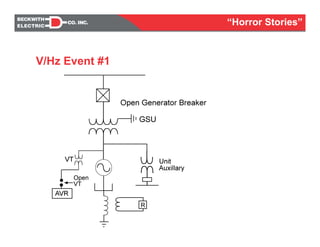
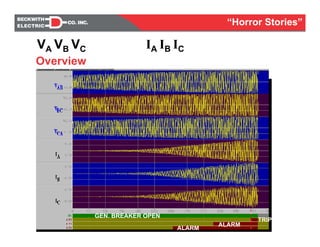
V/Hz Event #1
“Horror Stories”
TRIP
GEN. BREAKER OPEN
ALARM
ALARM
Overview
VA VB VC IA IB IC
“Horror Stories”
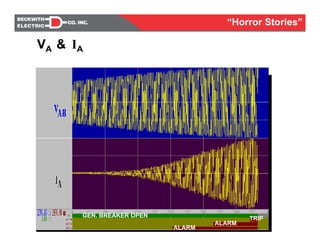
TRIPGEN. BREAKER OPEN
ALARM
ALARM
VA & IA
“Horror Stories”
TRIP
GEN. BREAKER OPEN
ALARM
ALARM
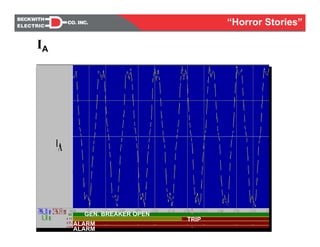
IA
“Horror Stories”
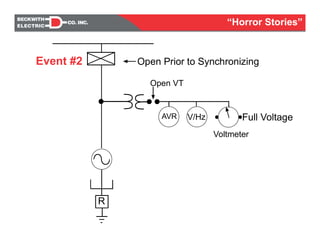
Open Prior to Synchronizing
AVR V/Hz
Open VT
R
Full Voltage
Voltmeter
Event #2
“Horror Stories”
Most V/Hz events occur when the generator is
off-line.
VT open circuit to the AVR is a frequent
condition that causes V/HZ events.
V/HZ protection should be in a different VT
circuit than the AVR to prevent a single open
VT from causing a V/Hz condition and at the
same time disabling protection.
“Lessons Learned”
“Horror Stories”
Loss-of-Field (40)
“Horror Stories”
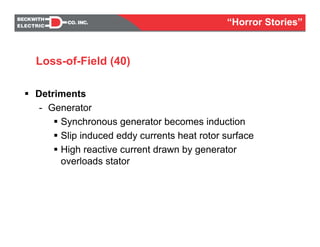
Detriments
- Generator
Synchronous generator becomes induction
Slip induced eddy currents heat rotor surface
High reactive current drawn by generator
overloads stator
Loss-of-Field (40)
“Horror Stories”
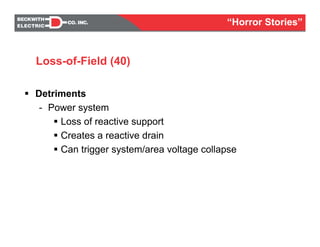
Detriments
- Power system
Loss of reactive support
Creates a reactive drain
Can trigger system/area voltage collapse
Loss-of-Field (40)
“Horror Stories”
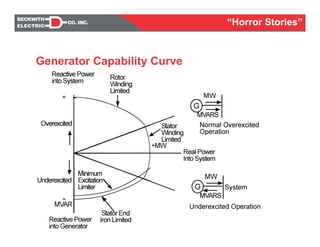
Generator Capability Curve
“Horror Stories”
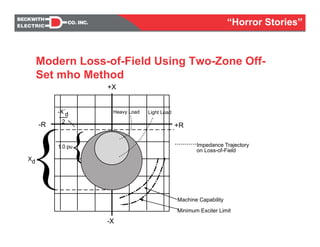
Impedance Trajectory
on Loss-of-Field
+X
-X
+R-R
Heavy Load Light Load
Machine Capability
Minimum Exciter Limit
Xd
{
-X´d
2
1.0 pu
Modern Loss-of-Field Using Two-Zone Off-
Set mho Method
“Horror Stories”
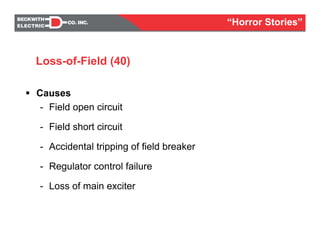
Causes
- Field open circuit
- Field short circuit
- Accidental tripping of field breaker
- Regulator control failure
- Loss of main exciter
Loss-of-Field (40)
“Horror Stories”
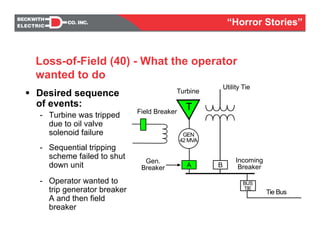
Desired sequence
of events:
- Turbine was tripped
due to oil valve
solenoid failure
- Sequential tripping
scheme failed to shut
down unit
- Operator wanted to
trip generator breaker
A and then field
breaker
Utility Tie
BA
GEN
42 MVA
BUS
TIE
Incoming
Breaker
Gen.
Breaker
T
Turbine
Field Breaker
Tie Bus
Loss-of-Field (40) - What the operator
wanted to do
“Horror Stories”
Utility Tie
BA
GEN
42 MVA
BUS
TIE
Incoming
Breaker
Gen.
Breaker
T
Turbine
Field Breaker
Tie Bus
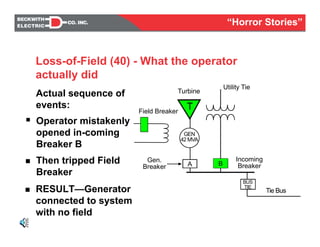
Actual sequence of
events:
Then tripped Field
Breaker
Operator mistakenly
opened in-coming
Breaker B
B
RESULT—Generator
connected to system
with no field
Loss-of-Field (40) - What the operator
actually did
“Horror Stories”
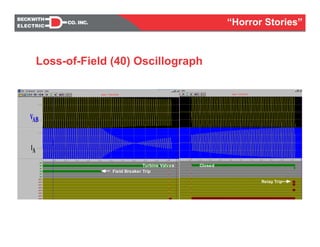
Turbine Valves Closed
Field Breaker Trip
Relay Trip
Loss-of-Field (40) Oscillograph
“Horror Stories”
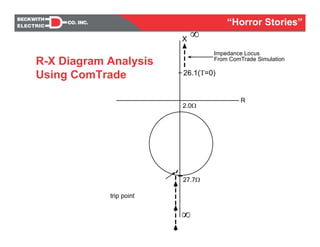
R
2.0Ω
27.7Ω
26.1(T=0)
X
trip point
Impedance Locus
From ComTrade Simulation
∞
∞
R-X Diagram Analysis
Using ComTrade
“Horror Stories”
Operating errors are a significant cause of loss-of-
field events.
Relay oscillographs provide unbiased evidence of
what actually happened.
Use of programmable inputs to monitor turbine
values and generator breaker(s) positions help
document sequence of events.
ComTrade provides a handy tool to verify loss-of-
field relay operation.
“Lessons Learned”
“Horror Stories”
Generator Breaker Failure
(Open Breaker Flashover)
“Horror Stories”
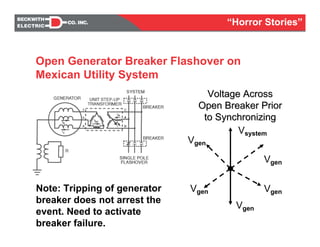
Note: Tripping of generator
breaker does not arrest the
event. Need to activate
breaker failure.
Vsystem
Vgen
Vgen
Vgen
Vgen
Vgen
Voltage AcrossVoltage Across
Open Breaker PriorOpen Breaker Prior
to Synchronizingto Synchronizing
Open Generator Breaker Flashover on
Mexican Utility System
“Horror Stories”
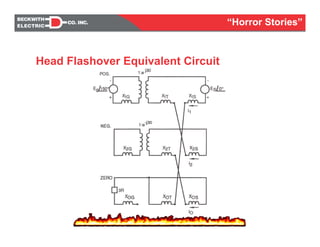
Head Flashover Equivalent Circuit
“Horror Stories”
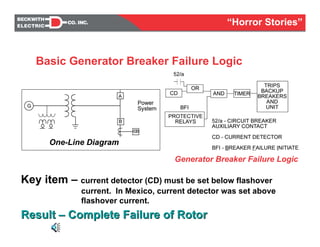
Key item – current detector (CD) must be set below flashover
current. In Mexico, current detector was set above
flashover current.
Result – Complete Failure of RotorResult – Complete Failure of Rotor
Generator Breaker Failure Logic
One-Line Diagram
Basic Generator Breaker Failure Logic
“Horror Stories”
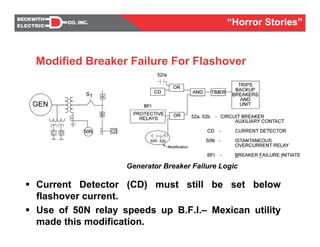
Current Detector (CD) must still be set below
flashover current.
Use of 50N relay speeds up B.F.I.– Mexican utility
made this modification.
One-Line Diagram
Generator Breaker Failure Logic
Modified Breaker Failure For Flashover
Protection
“Horror Stories”
Conclusions
Generator events are not as rare as some people believe
They are very disruptive and costly to a utility or IPP
owner. These events immediately cost the generator
owner $
Oscillographs and sequence-of-event data from digital
relays play a key role in determining what really
happened
This greatly helps to keep damaged generators off-line
and in returning undamaged machines to service
Many power plant events involve human error—may be
the result of downsizing
We learn from our experiences—or we are DOOMED to
repeat them
Conclusions
“Horror Stories”
The End
Power Plant
“Horror Stories”
Chuck Mozina
Consultant
Beckwith Electric Co. Inc.
“Horror Stories”
©2008 Beckwith Electric Co., Inc.

Power Plant Horror Stories

  • 1.
    Chuck Mozina Consultant Beckwith ElectricCo. Inc. Power Plant “Horror Stories” Power Plant “Horror Stories”
  • 2.
    To dispel themyth that nothing exciting ever happens in power plants Many power plant events are not short circuits and are not easy to analyze (example—loss of field) Many events involved human error by less experienced operators With the high volume of IPP plants coming on-line, commissioning errors are occurring “Lessons Learned” are important to avoid repeating errors in the future Why I wrote this paper: “Horror Stories”
  • 3.
    Multi-Phase Generator Faults StatorGround Current Accidental Off-Line Generator Energizing Overexcitation Loss-of-Field - ComTrade oscillo analysis Generator Breaker Failure - Breaker Interrupter Flashover Power Plant Events That The Paper Addresses: “Horror Stories”
  • 4.
  • 5.
    Generator trips: generatorbreaker is tripped, field is shut down and turbine tripped. Current from system stops, current from generator continues until stored energy is dissipated. Multi-Phase Generator Faults “Horror Stories”
  • 6.
    Time (sec) 5 8 Generator BreakerTrips 0 Current I Gen. Current Delay I system Generator Terminal Fault Current “Horror Stories”
  • 7.
    High Side of Generator Breaker Currents Generator Neutral Terminal Currents FaultInception High Side Breaker Opens Multi-Phase Generator Fault Oscillograph “Horror Stories”
  • 8.
    G X GSU F1 X F2 UAT R What IfFault is in GSU or UAT? “Horror Stories”
  • 9.
    If fault isin GSU (F1) or UAT (F2), long clearing times will result in extensive damage A significant number of these transformers have failed catastrophically with tank rupture and oil fire Low voltage generator breaker significantly reduces damage Sudden pressure relay a good idea because faults are detected as incipient fault before high current occurs What If Fault is in GSU or UAT? “Horror Stories”
  • 10.
    There is noeffective way to quickly “turn off” generator fault current. Long fault decay results in the vast majority of damage (85%) occurring after tripping. Make every effort in design to make sure the only credible fault in the generator is a ground fault. Consider the value of including a generator low voltage breaker in your next generator addition to reduce exposure of GSU and UAT to long clearing faults. “Lessons Learned” “Horror Stories”
  • 11.
  • 12.
    Generator Tripping: Generatorbreaker is tripped, field is shut down and turbine is tripped. Current from system stops when generator breaker trips, current from generator continues BUT magnitude is reduced to generator grounding. Stator Ground Faults “Horror Stories”
  • 13.
  • 14.
    59N pickup generallyset down to 5-6V pickup to “see” faults near the neutral. 59N tripping must be delayed to coordinate with: - System ground faults - Wye-wye generator VT’s fuses Stator Ground Setting Coordination “Horror Stories”
  • 15.
  • 16.
    Generator Neutral Voltage Generator Phase Currents Fault Inception Breaker Opens TripCommand Oscillograph of Field Ground Fault “Horror Stories”
  • 17.
    Because grounding transformerimpedance is very high compared to generation—full line-to- neutral voltage appears across transformer. Not uncommon for fault to self-extinguish and re-start because of low ground current. Oscillograph of Field Ground Fault “Horror Stories”
  • 18.
    Oscillographic records playeda key role in preventing damaged generators from being returned to service by confirming relaying operated properly. Oscillographic records can also speed a generator’s return to service if relaying operated improperly. “Lessons Learned” “Horror Stories”
  • 19.
    Accidental Off-Line GeneratorEnergizing “Horror Stories”
  • 20.
    Event occurred duringcommissioning of a gas turbine installation. Commissioning crew was trying to simulate a 52A contact closer, but jumped the wiring studs on a terminal block, closing the breaker. Accidental Off-Line Generator Energizing “Horror Stories”
  • 21.
  • 22.
    “Horror Stories” Holy Cow! Ijumpered the wrong contact!!! 52G
  • 23.
  • 24.
    Inadvertent Energizing ProtectionLogic “Horror Stories”
  • 25.
    I= Inadvertent Energizing Current X2G=GeneratorNegative Sequence Reactance XT =GSU Transformer Reactance XS=System Reactance EG=Generator Terminal Voltage ET=GSU High Side Voltage Inadvertent Energizing Equivalent Circuit “Horror Stories”
  • 26.
    Despite the designof modern interlock schemes to prevent it—inadvertent energizing events continue to happen. Dedicated inadvertent energizing protection is needed even on new gas turbine plants with generator low voltage breakers. Inadvertent energizing schemes need to be in- service when the generator is out of service. “Lessons Learned” “Horror Stories”
  • 27.
  • 28.
    V/Hz relaying usedto protect generator and power plant transformers from excessive magnetic flux. Excess flux level overheats generator and transformer core steel. Core flux proportional to voltage and inversely proportional to frequency—thus V/Hz protection. Most V/Hz events occur when generator is off-line prior to synchronizing. Overexcitation “Horror Stories”
  • 29.
    GENERATOR TRANSFORMER ≈ EXCITATION Voltage V Freq.Hz GENERATOR LIMITS (ANSI C 50.13) Full Load V/Hz = 1.05 pu No Load V/Hz = 1.05 pu TRANSFORMER LIMITS (ANSI C57.12) Full Load V/Hz = 1.05 pu (HV Terminals of GSU) No Load V/Hz = 1.10 pu (HV Terminals of GSU) Overexcitation/Volts per Hertz (24) “Horror Stories”
  • 30.
    PHYSICAL INSIGHTS As voltagerises above rating leakage flux increases Leakage flux induces current in transformer support structure causing rapid localized heating Overexcitation/Volts per Hertz (24) “Horror Stories”
  • 31.
    TYPICAL CURVES Overexcitation/Volts perHertz (24) “Horror Stories”
  • 32.
    CAUSES OF V/HZPROBLEMS Generator voltage regulator problems - operating error during off-line manual regulator operation - control failure - loss of VT regulator supply voltage System problems - unit load rejection: full load, partial rejection - power system islanding during major disturbances Overexcitation/Volts per Hertz (24) “Horror Stories”
  • 33.
  • 34.
    TRIP GEN. BREAKER OPEN ALARM ALARM Overview VAVB VC IA IB IC “Horror Stories”
  • 35.
    TRIPGEN. BREAKER OPEN ALARM ALARM VA& IA “Horror Stories”
  • 36.
  • 37.
    Open Prior toSynchronizing AVR V/Hz Open VT R Full Voltage Voltmeter Event #2 “Horror Stories”
  • 38.
    Most V/Hz eventsoccur when the generator is off-line. VT open circuit to the AVR is a frequent condition that causes V/HZ events. V/HZ protection should be in a different VT circuit than the AVR to prevent a single open VT from causing a V/Hz condition and at the same time disabling protection. “Lessons Learned” “Horror Stories”
  • 39.
  • 40.
    Detriments - Generator Synchronous generatorbecomes induction Slip induced eddy currents heat rotor surface High reactive current drawn by generator overloads stator Loss-of-Field (40) “Horror Stories”
  • 41.
    Detriments - Power system Lossof reactive support Creates a reactive drain Can trigger system/area voltage collapse Loss-of-Field (40) “Horror Stories”
  • 42.
  • 43.
    Impedance Trajectory on Loss-of-Field +X -X +R-R HeavyLoad Light Load Machine Capability Minimum Exciter Limit Xd { -X´d 2 1.0 pu Modern Loss-of-Field Using Two-Zone Off- Set mho Method “Horror Stories”
  • 44.
    Causes - Field opencircuit - Field short circuit - Accidental tripping of field breaker - Regulator control failure - Loss of main exciter Loss-of-Field (40) “Horror Stories”
  • 45.
    Desired sequence of events: -Turbine was tripped due to oil valve solenoid failure - Sequential tripping scheme failed to shut down unit - Operator wanted to trip generator breaker A and then field breaker Utility Tie BA GEN 42 MVA BUS TIE Incoming Breaker Gen. Breaker T Turbine Field Breaker Tie Bus Loss-of-Field (40) - What the operator wanted to do “Horror Stories”
  • 46.
    Utility Tie BA GEN 42 MVA BUS TIE Incoming Breaker Gen. Breaker T Turbine FieldBreaker Tie Bus Actual sequence of events: Then tripped Field Breaker Operator mistakenly opened in-coming Breaker B B RESULT—Generator connected to system with no field Loss-of-Field (40) - What the operator actually did “Horror Stories”
  • 47.
    Turbine Valves Closed FieldBreaker Trip Relay Trip Loss-of-Field (40) Oscillograph “Horror Stories”
  • 48.
    R 2.0Ω 27.7Ω 26.1(T=0) X trip point Impedance Locus FromComTrade Simulation ∞ ∞ R-X Diagram Analysis Using ComTrade “Horror Stories”
  • 49.
    Operating errors area significant cause of loss-of- field events. Relay oscillographs provide unbiased evidence of what actually happened. Use of programmable inputs to monitor turbine values and generator breaker(s) positions help document sequence of events. ComTrade provides a handy tool to verify loss-of- field relay operation. “Lessons Learned” “Horror Stories”
  • 50.
    Generator Breaker Failure (OpenBreaker Flashover) “Horror Stories”
  • 51.
    Note: Tripping ofgenerator breaker does not arrest the event. Need to activate breaker failure. Vsystem Vgen Vgen Vgen Vgen Vgen Voltage AcrossVoltage Across Open Breaker PriorOpen Breaker Prior to Synchronizingto Synchronizing Open Generator Breaker Flashover on Mexican Utility System “Horror Stories”
  • 52.
    Head Flashover EquivalentCircuit “Horror Stories”
  • 53.
    Key item –current detector (CD) must be set below flashover current. In Mexico, current detector was set above flashover current. Result – Complete Failure of RotorResult – Complete Failure of Rotor Generator Breaker Failure Logic One-Line Diagram Basic Generator Breaker Failure Logic “Horror Stories”
  • 54.
    Current Detector (CD)must still be set below flashover current. Use of 50N relay speeds up B.F.I.– Mexican utility made this modification. One-Line Diagram Generator Breaker Failure Logic Modified Breaker Failure For Flashover Protection “Horror Stories”
  • 55.
    Conclusions Generator events arenot as rare as some people believe They are very disruptive and costly to a utility or IPP owner. These events immediately cost the generator owner $ Oscillographs and sequence-of-event data from digital relays play a key role in determining what really happened This greatly helps to keep damaged generators off-line and in returning undamaged machines to service Many power plant events involve human error—may be the result of downsizing We learn from our experiences—or we are DOOMED to repeat them Conclusions “Horror Stories”
  • 56.
    The End Power Plant “HorrorStories” Chuck Mozina Consultant Beckwith Electric Co. Inc. “Horror Stories” ©2008 Beckwith Electric Co., Inc.