

by Nicholas Naing
Protection Systems for the Power Generators
Index
Agenta : 1 Nov 2014 1 p.m ~ 3 p.m “AGGC”
1.00 p.m : Welcome Speech by AGCC CEO
1.10 p.m : Introduction to the Speaker
1.15 p.m : Fault Analysis Detail
1.50 p.m : Tea Break
2.00 p.m : Protection Systems for Power Generators
2.40 p.m : Question and Answer Section
3.00 p.m : End of Presentation
Index
Generator Protection
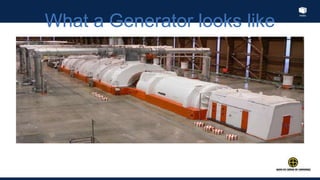
What a Generator looks like
Index
Overview
Index
Why Upgrade? Generator and
Transformer
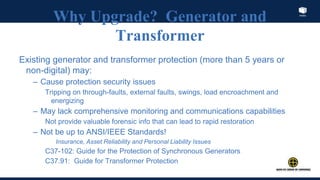
Existing generator and transformer protection (more than 5 years or
non-digital) may:
– Cause protection security issues
Tripping on through-faults, external faults, swings, load encroachment and
energizing
– May lack comprehensive monitoring and communications capabilities
Not provide valuable forensic info that can lead to rapid restoration
– Not be up to ANSI/IEEE Standards!
Insurance, Asset Reliability and Personal Liability Issues
C37-102: Guide for the Protection of Synchronous Generators
C37.91: Guide for Transformer Protection
Index
Theory
Index
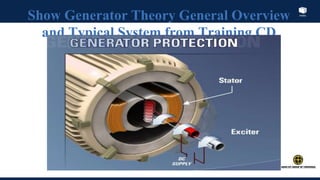
Show Generator Theory General Overview
and Typical System from Training CD
Index
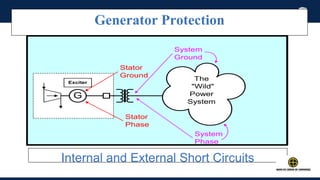
Generator Protection
Internal and External Short Circuits
The
"Wild"
Power
System
G
Exciter
Stator
Ground
Stator
Phase
System
Ground
System
Phase
Index
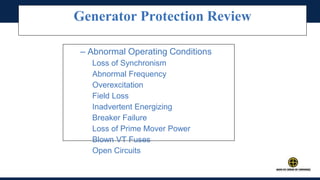
Generator Protection Review
– Abnormal Operating Conditions
Loss of Synchronism
Abnormal Frequency
Overexcitation
Field Loss
Inadvertent Energizing
Breaker Failure
Loss of Prime Mover Power
Blown VT Fuses
Open Circuits
Index
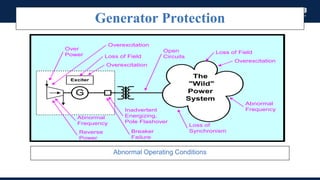
Generator Protection
Abnormal Operating Conditions
The
"Wild"
Power
System
G
Exciter
Loss of Field
Loss of Field
Overexcitation
Overexcitation
Overexcitation
Open
Circuits
Loss of
Synchronism
Inadvertent
Energizing,
Pole Flashover
Abnormal
Frequency
Abnormal
Frequency
Breaker
Failure
Reverse
Power
Over
Power
Index
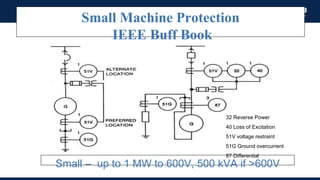
Small Machine Protection
IEEE Buff Book
Small – up to 1 MW to 600V, 500 kVA if >600V
32 Reverse Power
40 Loss of Excitation
51V voltage restraint
51G Ground overcurrent
87 Differential
Index
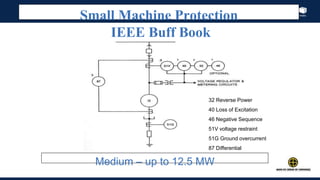
Small Machine Protection
IEEE Buff Book
Medium – up to 12.5 MW
32 Reverse Power
40 Loss of Excitation
46 Negative Sequence
51V voltage restraint
51G Ground overcurrent
87 Differential
Index
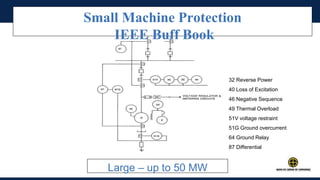
Small Machine Protection
IEEE Buff Book
Large – up to 50 MW
32 Reverse Power
40 Loss of Excitation
46 Negative Sequence
49 Thermal Overload
51V voltage restraint
51G Ground overcurrent
64 Ground Relay
87 Differential
Index
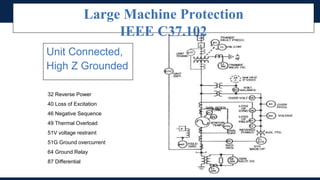
Unit Connected,
High Z Grounded
Large Machine Protection
IEEE C37.102
32 Reverse Power
40 Loss of Excitation
46 Negative Sequence
49 Thermal Overload
51V voltage restraint
51G Ground overcurrent
64 Ground Relay
87 Differential
Index
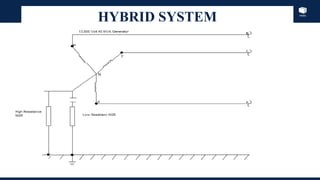
HYBRID SYSTEM
Index
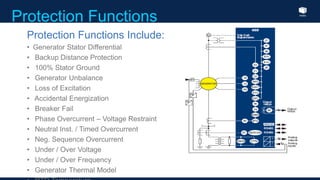
Protection Functions
Protection Functions Include:
• Generator Stator Differential
• Backup Distance Protection
• 100% Stator Ground
• Generator Unbalance
• Loss of Excitation
• Accidental Energization
• Breaker Fail
• Phase Overcurrent – Voltage Restraint
• Neutral Inst. / Timed Overcurrent
• Neg. Sequence Overcurrent
• Under / Over Voltage
• Under / Over Frequency
• Generator Thermal Model
Index
Generator Protection
Index
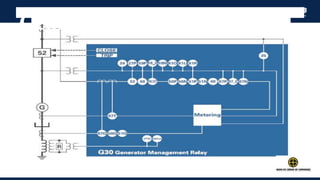
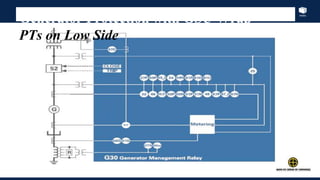
Generator Protection with GSU Wrap
PTs on Low Side
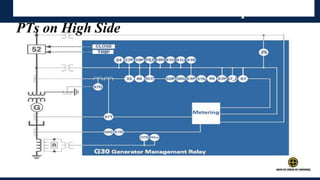
IndexGenerator Protection with GSU Wrap
PTs on High Side
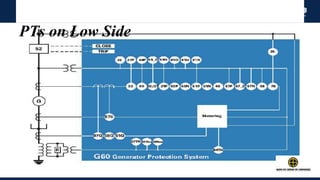
IndexGenerator Protection
PTs on Low Side
Index
Desirable Attributes - Generator
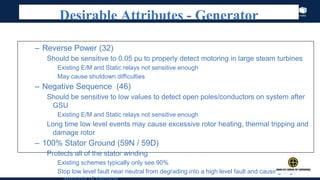
– Reverse Power (32)
Should be sensitive to 0.05 pu to properly detect motoring in large steam turbines
Existing E/M and Static relays not sensitive enough
May cause shutdown difficulties
– Negative Sequence (46)
Should be sensitive to low values to detect open poles/conductors on system after
GSU
Existing E/M and Static relays not sensitive enough
Long time low level events may cause excessive rotor heating, thermal tripping and
damage rotor
– 100% Stator Ground (59N / 59D)
Protects all of the stator winding
Existing schemes typically only see 90%
Stop low level fault near neutral from degrading into a high level fault and causing large
Index
Desirable Attributes - Generator
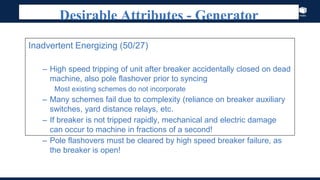
Inadvertent Energizing (50/27)
– High speed tripping of unit after breaker accidentally closed on dead
machine, also pole flashover prior to syncing
Most existing schemes do not incorporate
– Many schemes fail due to complexity (reliance on breaker auxiliary
switches, yard distance relays, etc.
– If breaker is not tripped rapidly, mechanical and electric damage
can occur to machine in fractions of a second!
– Pole flashovers must be cleared by high speed breaker failure, as
the breaker is open!
Index
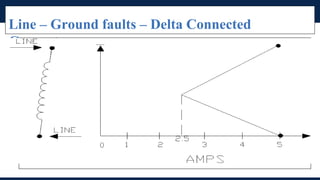
Line – Ground faults – Delta Connected
Generator
Index
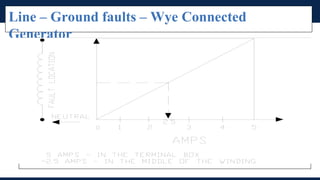
Line – Ground faults – Wye Connected
Generator
Index
Protection Functions
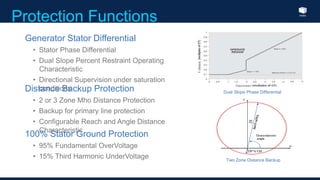
Generator Stator Differential
• Stator Phase Differential
• Dual Slope Percent Restraint Operating
Characteristic
• Directional Supervision under saturation
conditionsDistance Backup Protection
• 2 or 3 Zone Mho Distance Protection
• Backup for primary line protection
• Configurable Reach and Angle Distance
Characteristic
100% Stator Ground Protection
• 95% Fundamental OverVoltage
• 15% Third Harmonic UnderVoltage
Dual Slope Phase Differential
Two Zone Distance Backup
Index
Protection Functions
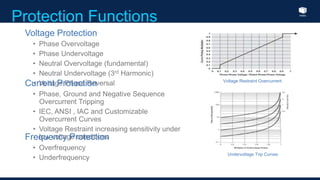
Voltage Restraint Overcurrent
Undervoltage Trip Curves
Voltage Protection
• Phase Overvoltage
• Phase Undervoltage
• Neutral Overvoltage (fundamental)
• Neutral Undervoltage (3rd Harmonic)
• Voltage Phase ReversalCurrent Protection
• Phase, Ground and Negative Sequence
Overcurrent Tripping
• IEC, ANSI , IAC and Customizable
Overcurrent Curves
• Voltage Restraint increasing sensitivity under
low voltage conditionsFrequency Protection
• Overfrequency
• Underfrequency
Index
Protection Functions
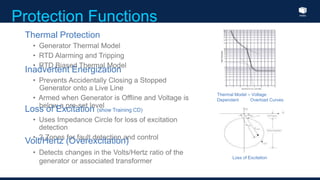
Loss of Excitation
Thermal Protection
• Generator Thermal Model
• RTD Alarming and Tripping
• RTD Biased Thermal Model
Inadvertent Energization
• Prevents Accidentally Closing a Stopped
Generator onto a Live Line
• Armed when Generator is Offline and Voltage is
below a pre-set level
Loss of Excitation (show Training CD)
• Uses Impedance Circle for loss of excitation
detection
• 2 Zones for fault detection and control
Volt/Hertz (Overexcitation)
• Detects changes in the Volts/Hertz ratio of the
generator or associated transformer
Thermal Model – Voltage
Dependant Overload Curves
Index
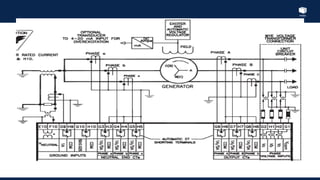
Wiring
Index
Index
Index
Index
Index
Example
Index
Agenda : 1 Nov 2014 1 p.m ~ 3 p.m “AGCC”
THANK YOU.

Protection Systems for Power generators

  • 1.
    by Nicholas Naing ProtectionSystems for the Power Generators
  • 2.
    Index Agenta : 1Nov 2014 1 p.m ~ 3 p.m “AGGC” 1.00 p.m : Welcome Speech by AGCC CEO 1.10 p.m : Introduction to the Speaker 1.15 p.m : Fault Analysis Detail 1.50 p.m : Tea Break 2.00 p.m : Protection Systems for Power Generators 2.40 p.m : Question and Answer Section 3.00 p.m : End of Presentation
  • 3.
  • 4.
  • 5.
    Index Why Upgrade? Generatorand Transformer Existing generator and transformer protection (more than 5 years or non-digital) may: – Cause protection security issues Tripping on through-faults, external faults, swings, load encroachment and energizing – May lack comprehensive monitoring and communications capabilities Not provide valuable forensic info that can lead to rapid restoration – Not be up to ANSI/IEEE Standards! Insurance, Asset Reliability and Personal Liability Issues C37-102: Guide for the Protection of Synchronous Generators C37.91: Guide for Transformer Protection
  • 6.
  • 7.
    Index Show Generator TheoryGeneral Overview and Typical System from Training CD
  • 8.
    Index Generator Protection Internal andExternal Short Circuits The "Wild" Power System G Exciter Stator Ground Stator Phase System Ground System Phase
  • 9.
    Index Generator Protection Review –Abnormal Operating Conditions Loss of Synchronism Abnormal Frequency Overexcitation Field Loss Inadvertent Energizing Breaker Failure Loss of Prime Mover Power Blown VT Fuses Open Circuits
  • 10.
    Index Generator Protection Abnormal OperatingConditions The "Wild" Power System G Exciter Loss of Field Loss of Field Overexcitation Overexcitation Overexcitation Open Circuits Loss of Synchronism Inadvertent Energizing, Pole Flashover Abnormal Frequency Abnormal Frequency Breaker Failure Reverse Power Over Power
  • 11.
    Index Small Machine Protection IEEEBuff Book Small – up to 1 MW to 600V, 500 kVA if >600V 32 Reverse Power 40 Loss of Excitation 51V voltage restraint 51G Ground overcurrent 87 Differential
  • 12.
    Index Small Machine Protection IEEEBuff Book Medium – up to 12.5 MW 32 Reverse Power 40 Loss of Excitation 46 Negative Sequence 51V voltage restraint 51G Ground overcurrent 87 Differential
  • 13.
    Index Small Machine Protection IEEEBuff Book Large – up to 50 MW 32 Reverse Power 40 Loss of Excitation 46 Negative Sequence 49 Thermal Overload 51V voltage restraint 51G Ground overcurrent 64 Ground Relay 87 Differential
  • 14.
    Index Unit Connected, High ZGrounded Large Machine Protection IEEE C37.102 32 Reverse Power 40 Loss of Excitation 46 Negative Sequence 49 Thermal Overload 51V voltage restraint 51G Ground overcurrent 64 Ground Relay 87 Differential
  • 15.
  • 16.
    Index Protection Functions Protection FunctionsInclude: • Generator Stator Differential • Backup Distance Protection • 100% Stator Ground • Generator Unbalance • Loss of Excitation • Accidental Energization • Breaker Fail • Phase Overcurrent – Voltage Restraint • Neutral Inst. / Timed Overcurrent • Neg. Sequence Overcurrent • Under / Over Voltage • Under / Over Frequency • Generator Thermal Model
  • 17.
  • 18.
    Index Generator Protection withGSU Wrap PTs on Low Side
  • 19.
    IndexGenerator Protection withGSU Wrap PTs on High Side
  • 20.
  • 21.
    Index Desirable Attributes -Generator – Reverse Power (32) Should be sensitive to 0.05 pu to properly detect motoring in large steam turbines Existing E/M and Static relays not sensitive enough May cause shutdown difficulties – Negative Sequence (46) Should be sensitive to low values to detect open poles/conductors on system after GSU Existing E/M and Static relays not sensitive enough Long time low level events may cause excessive rotor heating, thermal tripping and damage rotor – 100% Stator Ground (59N / 59D) Protects all of the stator winding Existing schemes typically only see 90% Stop low level fault near neutral from degrading into a high level fault and causing large
  • 22.
    Index Desirable Attributes -Generator Inadvertent Energizing (50/27) – High speed tripping of unit after breaker accidentally closed on dead machine, also pole flashover prior to syncing Most existing schemes do not incorporate – Many schemes fail due to complexity (reliance on breaker auxiliary switches, yard distance relays, etc. – If breaker is not tripped rapidly, mechanical and electric damage can occur to machine in fractions of a second! – Pole flashovers must be cleared by high speed breaker failure, as the breaker is open!
  • 23.
    Index Line – Groundfaults – Delta Connected Generator
  • 24.
    Index Line – Groundfaults – Wye Connected Generator
  • 25.
    Index Protection Functions Generator StatorDifferential • Stator Phase Differential • Dual Slope Percent Restraint Operating Characteristic • Directional Supervision under saturation conditionsDistance Backup Protection • 2 or 3 Zone Mho Distance Protection • Backup for primary line protection • Configurable Reach and Angle Distance Characteristic 100% Stator Ground Protection • 95% Fundamental OverVoltage • 15% Third Harmonic UnderVoltage Dual Slope Phase Differential Two Zone Distance Backup
  • 26.
    Index Protection Functions Voltage RestraintOvercurrent Undervoltage Trip Curves Voltage Protection • Phase Overvoltage • Phase Undervoltage • Neutral Overvoltage (fundamental) • Neutral Undervoltage (3rd Harmonic) • Voltage Phase ReversalCurrent Protection • Phase, Ground and Negative Sequence Overcurrent Tripping • IEC, ANSI , IAC and Customizable Overcurrent Curves • Voltage Restraint increasing sensitivity under low voltage conditionsFrequency Protection • Overfrequency • Underfrequency
  • 27.
    Index Protection Functions Loss ofExcitation Thermal Protection • Generator Thermal Model • RTD Alarming and Tripping • RTD Biased Thermal Model Inadvertent Energization • Prevents Accidentally Closing a Stopped Generator onto a Live Line • Armed when Generator is Offline and Voltage is below a pre-set level Loss of Excitation (show Training CD) • Uses Impedance Circle for loss of excitation detection • 2 Zones for fault detection and control Volt/Hertz (Overexcitation) • Detects changes in the Volts/Hertz ratio of the generator or associated transformer Thermal Model – Voltage Dependant Overload Curves
  • 28.
  • 29.
  • 30.
  • 31.
  • 32.
  • 33.
  • 34.
    Index Agenda : 1Nov 2014 1 p.m ~ 3 p.m “AGCC” THANK YOU.