CUPERTINO ELECTRIC
INTERNATIONAL ASSOCIATIONINTERNATIONAL ASSOCIATION
OFOF
ELECTRICAL INSPECTORSELECTRICAL INSPECTORS
2002 SOUTHWESTERN SECTION2002 SOUTHWESTERN SECTION
ANNUAL MEETINGANNUAL MEETING
EMERGENCY, LEGALLY REQUIREDEMERGENCY, LEGALLY REQUIRED
ANDAND
OPTIONAL STANDBY SYSTEMSOPTIONAL STANDBY SYSTEMS
Rudy Bergthold, P.E.
CUPERTINO ELECTRIC, INC.
San Jose, California
CUPERTINO ELECTRIC
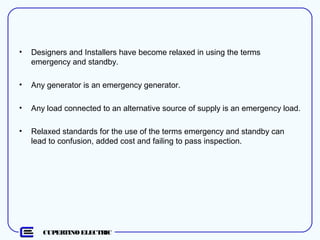
• Designers and Installers have become relaxed in using the terms
emergency and standby.
• Any generator is an emergency generator.
• Any load connected to an alternative source of supply is an emergency load.
• Relaxed standards for the use of the terms emergency and standby can
lead to confusion, added cost and failing to pass inspection.
CUPERTINO ELECTRIC
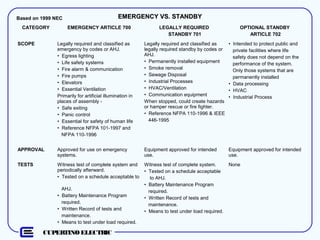
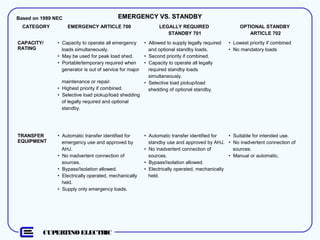
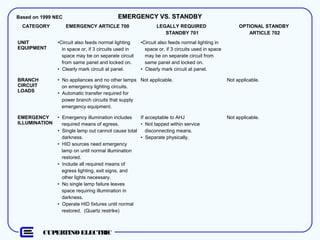
EMERGENCY VS. STANDBYEMERGENCY VS. STANDBY
CATEGORY EMERGENCY ARTICLE 700 LEGALLY REQUIRED
STANDBY 701
OPTIONAL STANDBY
ARTICLE 702
SCOPE Legally required and classified as
emergency by codes or AHJ.
• Egress lighting
• Life safety systems
• Fire alarm & communication
• Fire pumps
• Elevators
• Essential Ventilation
Primarily for artificial illumination in
places of assembly -
• Safe exiting
• Panic control
• Essential for safety of human life
• Reference NFPA 101-1997 and
NFPA 110-1996
Legally required and classified as
legally required standby by codes or
AHJ.
• Permanently installed equipment
• Smoke removal
• Sewage Disposal
• Industrial Processes
• HVAC/Ventilation
• Communication equipment
When stopped, could create hazards
or hamper rescue or fire fighter.
• Reference NFPA 110-1996 & IEEE
446-1995
• Intended to protect public and
private facilities where life
safety does not depend on the
performance of the system.
Only those systems that are
permanently installed
• Data processing
• HVAC
• Industrial Process
APPROVAL Approved for use on emergency
systems.
Equipment approved for intended
use.
Equipment approved for intended
use.
TESTS Witness test of complete system and
periodically afterward.
• Tested on a schedule acceptable to
AHJ.
• Battery Maintenance Program
required.
• Written Record of tests and
maintenance.
• Means to test under load required.
Witness test of complete system.
• Tested on a schedule acceptable
to AHJ.
• Battery Maintenance Program
required.
• Written Record of tests and
maintenance.
• Means to test under load required.
None
Based on 1999 NEC
CUPERTINO ELECTRIC
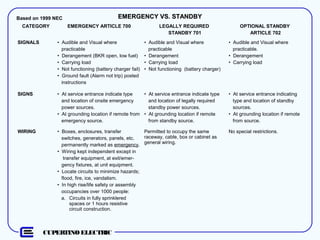
EMERGENCY VS. STANDBYEMERGENCY VS. STANDBY
CATEGORY EMERGENCY ARTICLE 700 LEGALLY REQUIRED
STANDBY 701
OPTIONAL STANDBY
ARTICLE 702
CAPACITY/
RATING
• Capacity to operate all emergency
loads simultaneously.
• May be used for peak load shed.
• Portable/temporary required when
generator is out of service for major
maintenance or repair.
• Highest priority if combined.
• Selective load pickup/load shedding
of legally required and optional
standby.
• Allowed to supply legally required
and optional standby loads.
• Second priority if combined.
• Capacity to operate all legally
required standby loads
simultaneously.
• Selective load pickup/load
shedding of optional standby.
• Lowest priority if combined
• No mandatory loads
TRANSFER
EQUIPMENT
• Automatic transfer identified for
emergency use and approved by
AHJ.
• No inadvertent connection of
sources.
• Bypass/Isolation allowed.
• Electrically operated, mechanically
held.
• Supply only emergency loads.
• Automatic transfer identified for
standby use and approved by AHJ.
• No inadvertent connection of
sources.
• Bypass/Isolation allowed.
• Electrically operated, mechanically
held.
• Suitable for intended use.
• No inadvertent connection of
sources.
• Manual or automatic.
Based on 1999 NEC
CUPERTINO ELECTRIC
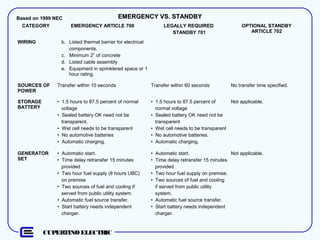
EMERGENCY VS. STANDBYEMERGENCY VS. STANDBY
CATEGORY EMERGENCY ARTICLE 700 LEGALLY REQUIRED
STANDBY 701
OPTIONAL STANDBY
ARTICLE 702
SIGNALS • Audible and Visual where
practicable
• Derangement (BKR open, low fuel)
• Carrying load
• Not functioning (battery charger fail)
• Ground fault (Alarm not trip) posted
instructions
• Audible and Visual where
practicable
• Derangement
• Carrying load
• Not functioning (battery charger)
• Audible and Visual where
practicable.
• Derangement
• Carrying load
SIGNS • At service entrance indicate type
and location of onsite emergency
power sources.
• At grounding location if remote from
emergency source.
• At service entrance indicate type
and location of legally required
standby power sources.
• At grounding location if remote
from standby source.
• At service entrance indicating
type and location of standby
sources.
• At grounding location if remote
from source.
WIRING • Boxes, enclosures, transfer
switches, generators, panels, etc.
permanently marked as emergency.
• Wiring kept independent except in
transfer equipment, at exit/emer-
gency fixtures, at unit equipment.
• Locate circuits to minimize hazards;
flood, fire, ice, vandalism.
• In high rise/life safety or assembly
occupancies over 1000 people:
a. Circuits in fully sprinklered
spaces or 1 hours resistive
circuit construction.
Permitted to occupy the same
raceway, cable, box or cabinet as
general wiring.
No special restrictions.
Based on 1999 NEC
CUPERTINO ELECTRIC
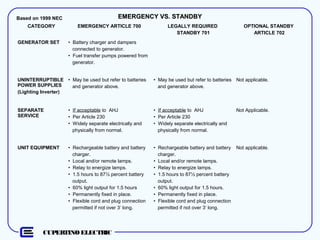
EMERGENCY VS. STANDBYEMERGENCY VS. STANDBY
CATEGORY EMERGENCY ARTICLE 700 LEGALLY REQUIRED
STANDBY 701
OPTIONAL STANDBY
ARTICLE 702
WIRING b. Listed thermal barrier for electrical
components.
c. Minimum 2” of concrete
d. Listed cable assembly
e. Equipment in sprinklered space or 1
hour rating.
SOURCES OF
POWER
Transfer within 10 seconds Transfer within 60 seconds No transfer time specified.
STORAGE
BATTERY
• 1.5 hours to 87.5 percent of normal
voltage
• Sealed battery OK need not be
transparent.
• Wet cell needs to be transparent
• No automotive batteries
• Automatic charging.
• 1.5 hours to 87.5 percent of
normal voltage
• Sealed battery OK need not be
transparent
• Wet cell needs to be transparent
• No automotive batteries.
• Automatic charging.
Not applicable.
GENERATOR
SET
• Automatic start.
• Time delay retransfer 15 minutes
provided
• Two hour fuel supply (8 hours UBC)
on premise
• Two sources of fuel and cooling if
served from public utility system.
• Automatic fuel source transfer.
• Start battery needs independent
charger.
• Automatic start.
• Time delay retransfer 15 minutes
provided
• Two hour fuel supply on premise.
• Two sources of fuel and cooling
if served from public utility
system.
• Automatic fuel source transfer.
• Start battery needs independent
charger.
Not applicable.
Based on 1999 NEC
CUPERTINO ELECTRIC
EMERGENCY VS. STANDBYEMERGENCY VS. STANDBY
CATEGORY EMERGENCY ARTICLE 700 LEGALLY REQUIRED
STANDBY 701
OPTIONAL STANDBY
ARTICLE 702
GENERATOR SET • Battery charger and dampers
connected to generator.
• Fuel transfer pumps powered from
generator.
UNINTERRUPTIBLE
POWER SUPPLIES
(Lighting Inverter)
• May be used but refer to batteries
and generator above.
• May be used but refer to batteries
and generator above.
Not applicable.
SEPARATE
SERVICE
• If acceptable to AHJ
• Per Article 230
• Widely separate electrically and
physically from normal.
• If acceptable to AHJ
• Per Article 230
• Widely separate electrically and
physically from normal.
Not Applicable.
UNIT EQUIPMENT • Rechargeable battery and battery
charger.
• Local and/or remote lamps.
• Relay to energize lamps.
• 1.5 hours to 87½ percent battery
output.
• 60% light output for 1.5 hours
• Permanently fixed in place.
• Flexible cord and plug connection
permitted if not over 3’ long.
• Rechargeable battery and battery
charger.
• Local and/or remote lamps.
• Relay to energize lamps.
• 1.5 hours to 87½ percent battery
output.
• 60% light output for 1.5 hours.
• Permanently fixed in place.
• Flexible cord and plug connection
permitted if not over 3’ long.
Not applicable.
Based on 1999 NEC
CUPERTINO ELECTRIC
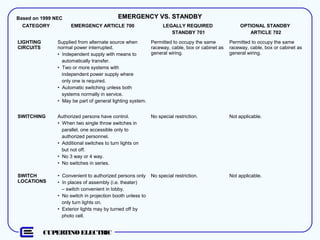
EMERGENCY VS. STANDBYEMERGENCY VS. STANDBYBased on 1999 NEC
CATEGORY EMERGENCY ARTICLE 700 LEGALLY REQUIRED
STANDBY 701
OPTIONAL STANDBY
ARTICLE 702
UNIT
EQUIPMENT
•Circuit also feeds normal lighting
in space or, if 3 circuits used in
space may be on separate circuit
from same panel and locked on.
• Clearly mark circuit at panel.
•Circuit also feeds normal lighting in
space or, if 3 circuits used in space
may be on separate circuit from
same panel and locked on.
• Clearly mark circuit at panel.
BRANCH
CIRCUIT
LOADS
• No appliances and no other lamps
on emergency lighting circuits.
• Automatic transfer required for
power branch circuits that supply
emergency equipment.
Not applicable. Not applicable.
EMERGENCY
ILLUMINATION
• Emergency illumination includes
required means of egress.
• Single lamp out cannot cause total
darkness.
• HID sources need emergency
lamp on until normal illumination
restored.
• Include all required means of
egress lighting, exit signs, and
other lights necessary.
• No single lamp failure leaves
space requiring illumination in
darkness.
• Operate HID fixtures until normal
restored. (Quartz restrike)
If acceptable to AHJ
• Not tapped within service
disconnecting means.
• Separate physically.
Not applicable.
CUPERTINO ELECTRIC
EMERGENCY VS. STANDBYEMERGENCY VS. STANDBYBased on 1999 NEC
CATEGORY EMERGENCY ARTICLE 700 LEGALLY REQUIRED
STANDBY 701
OPTIONAL STANDBY
ARTICLE 702
LIGHTING
CIRCUITS
Supplied from alternate source when
normal power interrupted.
• Independent supply with means to
automatically transfer.
• Two or more systems with
independent power supply where
only one is required.
• Automatic switching unless both
systems normally in service.
• May be part of general lighting system.
Permitted to occupy the same
raceway, cable, box or cabinet as
general wiring.
Permitted to occupy the same
raceway, cable, box or cabinet as
general wiring.
SWITCHING Authorized persons have control.
• When two single throw switches in
parallel, one accessible only to
authorized personnel.
• Additional switches to turn lights on
but not off.
• No 3 way or 4 way.
• No switches in series.
No special restriction. Not applicable.
SWITCH
LOCATIONS
• Convenient to authorized persons only
• In places of assembly (i.e. theater)
– switch convenient in lobby.
• No switch in projection booth unless to
only turn lights on.
• Exterior lights may by turned off by
photo cell.
No special restriction. Not applicable.
CUPERTINO ELECTRIC
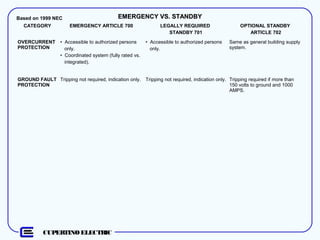
EMERGENCY VS. STANDBYEMERGENCY VS. STANDBYBased on 1999 NEC
CATEGORY EMERGENCY ARTICLE 700 LEGALLY REQUIRED
STANDBY 701
OPTIONAL STANDBY
ARTICLE 702
OVERCURRENT
PROTECTION
• Accessible to authorized persons
only.
• Coordinated system (fully rated vs.
integrated).
• Accessible to authorized persons
only.
Same as general building supply
system.
GROUND FAULT
PROTECTION
Tripping not required, indication only. Tripping not required, indication only. Tripping required if more than
150 volts to ground and 1000
AMPS.
CUPERTINO ELECTRIC
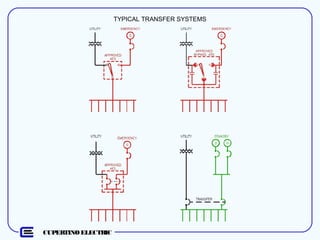
TYPICAL TRANSFER SYSTEMS
CUPERTINO ELECTRIC
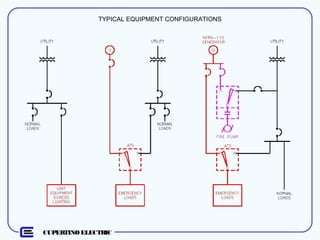
TYPICAL EQUIPMENT CONFIGURATIONS
CUPERTINO ELECTRIC
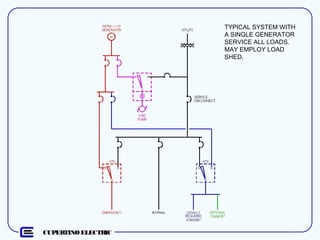
TYPICAL SYSTEM WITH
A SINGLE GENERATOR
SERVICE ALL LOADS.
MAY EMPLOY LOAD
SHED.
CUPERTINO ELECTRIC
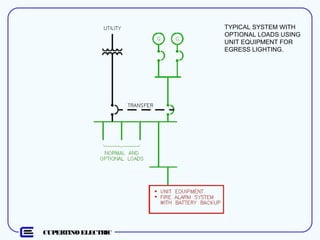
TYPICAL SYSTEM WITH
OPTIONAL LOADS USING
UNIT EQUIPMENT FOR
EGRESS LIGHTING.
CUPERTINO ELECTRIC
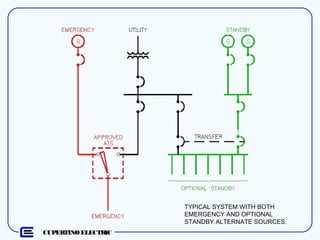
TYPICAL SYSTEM WITH BOTH
EMERGENCY AND OPTIONAL
STANDBY ALTERNATE SOURCES.
CUPERTINO ELECTRIC
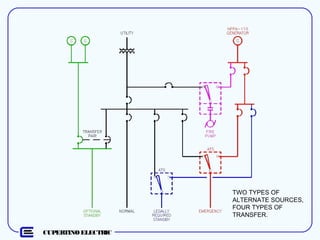
TWO TYPES OF
ALTERNATE SOURCES,
FOUR TYPES OF
TRANSFER.
CUPERTINO ELECTRIC
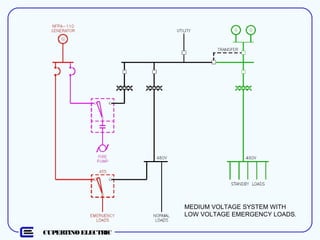
MEDIUM VOLTAGE SYSTEM WITH
LOW VOLTAGE EMERGENCY LOADS.
CUPERTINO ELECTRIC
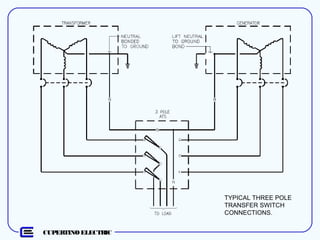
TYPICAL THREE POLE
TRANSFER SWITCH
CONNECTIONS.
CUPERTINO ELECTRIC
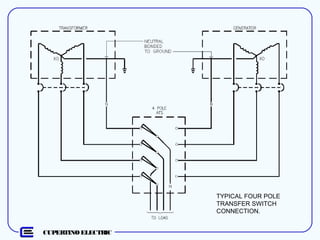
TYPICAL FOUR POLE
TRANSFER SWITCH
CONNECTION.
CUPERTINO ELECTRIC
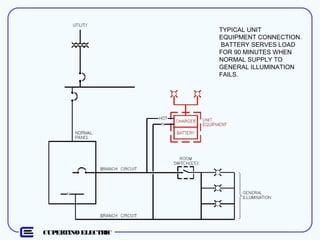
TYPICAL UNIT
EQUIPMENT CONNECTION.
BATTERY SERVES LOAD
FOR 90 MINUTES WHEN
NORMAL SUPPLY TO
GENERAL ILLUMINATION
FAILS.
CUPERTINO ELECTRIC
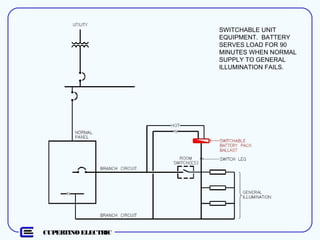
SWITCHABLE UNIT
EQUIPMENT. BATTERY
SERVES LOAD FOR 90
MINUTES WHEN NORMAL
SUPPLY TO GENERAL
ILLUMINATION FAILS.
CUPERTINO ELECTRIC
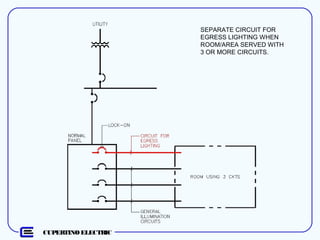
SEPARATE CIRCUIT FOR
EGRESS LIGHTING WHEN
ROOM/AREA SERVED WITH
3 OR MORE CIRCUITS.
CUPERTINO ELECTRIC
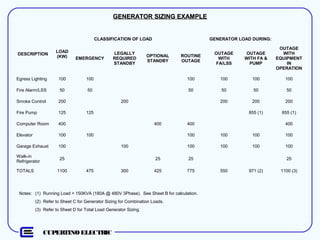
GENERATOR SIZING EXAMPLEGENERATOR SIZING EXAMPLE
Notes: (1) Running Load = 150KVA (180A @ 480V 3Phase). See Sheet B for calculation.
(2) Refer to Sheet C for Generator Sizing for Combination Loads.
(3) Refer to Sheet D for Total Load Generator Sizing.
DESCRIPTION
LOAD
(KW)
CLASSIFICATION OF LOAD GENERATOR LOAD DURING:
EMERGENCY
LEGALLY
REQUIRED
STANDBY
OPTIONAL
STANDBY
ROUTINE
OUTAGE
OUTAGE
WITH
FA/LSS
OUTAGE
WITH FA &
PUMP
OUTAGE
WITH
EQUIPMENT
IN
OPERATION
Egress Lighting 100 100 100 100 100 100
Fire Alarm/LSS 50 50 50 50 50 50
Smoke Control 200 200 200 200 200
Fire Pump 125 125 855 (1) 855 (1)
Computer Room 400 400 400 400
Elevator 100 100 100 100 100 100
Garage Exhaust 100 100 100 100 100 100
Walk-in
Refrigerator
25 25 25 25
TOTALS 1100 475 300 425 775 550 971 (2) 1100 (3)
CUPERTINO ELECTRIC
GENERATOR SIZING EXAMPLEGENERATOR SIZING EXAMPLE
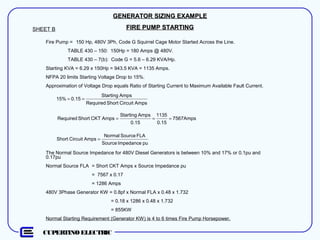
FIRE PUMP STARTINGFIRE PUMP STARTINGSHEET B
Fire Pump = 150 Hp, 480V 3Ph, Code G Squirrel Cage Motor Started Across the Line.
TABLE 430 – 150: 150Hp = 180 Amps @ 480V.
TABLE 430 – 7(b): Code G = 5.6 – 6.29 KVA/Hp.
Starting KVA = 6.29 x 150Hp = 943.5 KVA = 1135 Amps.
NFPA 20 limits Starting Voltage Drop to 15%.
Approximation of Voltage Drop equals Ratio of Starting Current to Maximum Available Fault Current.
AmpsCircuitShortRequired
AmpsStarting
0.1515% ==
7567Amps
0.15
1135
0.15
AmpsStarting
AmpsCKTShortRequired ===
The Normal Source Impedance for 480V Diesel Generators is between 10% and 17% or 0.1pu and
0.17pu
Normal Source FLA = Short CKT Amps x Source Impedance pu
= 7567 x 0.17
= 1286 Amps
480V 3Phase Generator KW = 0.8pf x Normal FLA x 0.48 x 1.732
= 0.18 x 1286 x 0.48 x 1.732
= 855KW
Normal Starting Requirement (Generator KW) is 4 to 6 times Fire Pump Horsepower.
puImpedanceSource
FLASourceNormal
AmpsCircuitShort =
CUPERTINO ELECTRIC
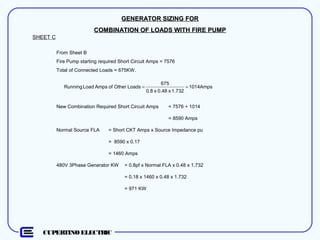
SHEET C
From Sheet B
Fire Pump starting required Short Circuit Amps = 7576
Total of Connected Loads = 675KW.
New Combination Required Short Circuit Amps = 7576 + 1014
= 8590 Amps
Normal Source FLA = Short CKT Amps x Source Impedance pu
= 8590 x 0.17
= 1460 Amps
480V 3Phase Generator KW = 0.8pf x Normal FLA x 0.48 x 1.732
= 0.18 x 1460 x 0.48 x 1.732
= 971 KW
GENERATOR SIZING FORGENERATOR SIZING FOR
COMBINATION OF LOADS WITH FIRE PUMPCOMBINATION OF LOADS WITH FIRE PUMP
1014Amps
1.732x0.48x0.8
675
LoadsOtherofAmpsLoadRunning ==
CUPERTINO ELECTRIC
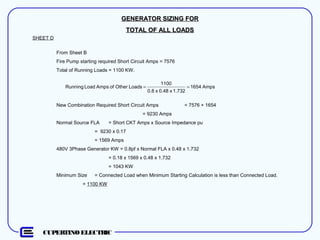
SHEET D
From Sheet B
Fire Pump starting required Short Circuit Amps = 7576
Total of Running Loads = 1100 KW.
New Combination Required Short Circuit Amps = 7576 + 1654
= 9230 Amps
Normal Source FLA = Short CKT Amps x Source Impedance pu
= 9230 x 0.17
= 1569 Amps
480V 3Phase Generator KW = 0.8pf x Normal FLA x 0.48 x 1.732
= 0.18 x 1569 x 0.48 x 1.732
= 1043 KW
Minimum Size = Connected Load when Minimum Starting Calculation is less than Connected Load.
= 1100 KW
GENERATOR SIZING FORGENERATOR SIZING FOR
TOTAL OF ALL LOADSTOTAL OF ALL LOADS
Amps1654
1.732x0.48x0.8
1100
LoadsOtherofAmpsLoadRunning ==

Emergency, Legally Required and Optional Standby Systems

  • 1.
    CUPERTINO ELECTRIC INTERNATIONAL ASSOCIATIONINTERNATIONALASSOCIATION OFOF ELECTRICAL INSPECTORSELECTRICAL INSPECTORS 2002 SOUTHWESTERN SECTION2002 SOUTHWESTERN SECTION ANNUAL MEETINGANNUAL MEETING EMERGENCY, LEGALLY REQUIREDEMERGENCY, LEGALLY REQUIRED ANDAND OPTIONAL STANDBY SYSTEMSOPTIONAL STANDBY SYSTEMS Rudy Bergthold, P.E. CUPERTINO ELECTRIC, INC. San Jose, California
  • 2.
    CUPERTINO ELECTRIC • Designersand Installers have become relaxed in using the terms emergency and standby. • Any generator is an emergency generator. • Any load connected to an alternative source of supply is an emergency load. • Relaxed standards for the use of the terms emergency and standby can lead to confusion, added cost and failing to pass inspection.
  • 3.
    CUPERTINO ELECTRIC EMERGENCY VS.STANDBYEMERGENCY VS. STANDBY CATEGORY EMERGENCY ARTICLE 700 LEGALLY REQUIRED STANDBY 701 OPTIONAL STANDBY ARTICLE 702 SCOPE Legally required and classified as emergency by codes or AHJ. • Egress lighting • Life safety systems • Fire alarm & communication • Fire pumps • Elevators • Essential Ventilation Primarily for artificial illumination in places of assembly - • Safe exiting • Panic control • Essential for safety of human life • Reference NFPA 101-1997 and NFPA 110-1996 Legally required and classified as legally required standby by codes or AHJ. • Permanently installed equipment • Smoke removal • Sewage Disposal • Industrial Processes • HVAC/Ventilation • Communication equipment When stopped, could create hazards or hamper rescue or fire fighter. • Reference NFPA 110-1996 & IEEE 446-1995 • Intended to protect public and private facilities where life safety does not depend on the performance of the system. Only those systems that are permanently installed • Data processing • HVAC • Industrial Process APPROVAL Approved for use on emergency systems. Equipment approved for intended use. Equipment approved for intended use. TESTS Witness test of complete system and periodically afterward. • Tested on a schedule acceptable to AHJ. • Battery Maintenance Program required. • Written Record of tests and maintenance. • Means to test under load required. Witness test of complete system. • Tested on a schedule acceptable to AHJ. • Battery Maintenance Program required. • Written Record of tests and maintenance. • Means to test under load required. None Based on 1999 NEC
  • 4.
    CUPERTINO ELECTRIC EMERGENCY VS.STANDBYEMERGENCY VS. STANDBY CATEGORY EMERGENCY ARTICLE 700 LEGALLY REQUIRED STANDBY 701 OPTIONAL STANDBY ARTICLE 702 CAPACITY/ RATING • Capacity to operate all emergency loads simultaneously. • May be used for peak load shed. • Portable/temporary required when generator is out of service for major maintenance or repair. • Highest priority if combined. • Selective load pickup/load shedding of legally required and optional standby. • Allowed to supply legally required and optional standby loads. • Second priority if combined. • Capacity to operate all legally required standby loads simultaneously. • Selective load pickup/load shedding of optional standby. • Lowest priority if combined • No mandatory loads TRANSFER EQUIPMENT • Automatic transfer identified for emergency use and approved by AHJ. • No inadvertent connection of sources. • Bypass/Isolation allowed. • Electrically operated, mechanically held. • Supply only emergency loads. • Automatic transfer identified for standby use and approved by AHJ. • No inadvertent connection of sources. • Bypass/Isolation allowed. • Electrically operated, mechanically held. • Suitable for intended use. • No inadvertent connection of sources. • Manual or automatic. Based on 1999 NEC
  • 5.
    CUPERTINO ELECTRIC EMERGENCY VS.STANDBYEMERGENCY VS. STANDBY CATEGORY EMERGENCY ARTICLE 700 LEGALLY REQUIRED STANDBY 701 OPTIONAL STANDBY ARTICLE 702 SIGNALS • Audible and Visual where practicable • Derangement (BKR open, low fuel) • Carrying load • Not functioning (battery charger fail) • Ground fault (Alarm not trip) posted instructions • Audible and Visual where practicable • Derangement • Carrying load • Not functioning (battery charger) • Audible and Visual where practicable. • Derangement • Carrying load SIGNS • At service entrance indicate type and location of onsite emergency power sources. • At grounding location if remote from emergency source. • At service entrance indicate type and location of legally required standby power sources. • At grounding location if remote from standby source. • At service entrance indicating type and location of standby sources. • At grounding location if remote from source. WIRING • Boxes, enclosures, transfer switches, generators, panels, etc. permanently marked as emergency. • Wiring kept independent except in transfer equipment, at exit/emer- gency fixtures, at unit equipment. • Locate circuits to minimize hazards; flood, fire, ice, vandalism. • In high rise/life safety or assembly occupancies over 1000 people: a. Circuits in fully sprinklered spaces or 1 hours resistive circuit construction. Permitted to occupy the same raceway, cable, box or cabinet as general wiring. No special restrictions. Based on 1999 NEC
  • 6.
    CUPERTINO ELECTRIC EMERGENCY VS.STANDBYEMERGENCY VS. STANDBY CATEGORY EMERGENCY ARTICLE 700 LEGALLY REQUIRED STANDBY 701 OPTIONAL STANDBY ARTICLE 702 WIRING b. Listed thermal barrier for electrical components. c. Minimum 2” of concrete d. Listed cable assembly e. Equipment in sprinklered space or 1 hour rating. SOURCES OF POWER Transfer within 10 seconds Transfer within 60 seconds No transfer time specified. STORAGE BATTERY • 1.5 hours to 87.5 percent of normal voltage • Sealed battery OK need not be transparent. • Wet cell needs to be transparent • No automotive batteries • Automatic charging. • 1.5 hours to 87.5 percent of normal voltage • Sealed battery OK need not be transparent • Wet cell needs to be transparent • No automotive batteries. • Automatic charging. Not applicable. GENERATOR SET • Automatic start. • Time delay retransfer 15 minutes provided • Two hour fuel supply (8 hours UBC) on premise • Two sources of fuel and cooling if served from public utility system. • Automatic fuel source transfer. • Start battery needs independent charger. • Automatic start. • Time delay retransfer 15 minutes provided • Two hour fuel supply on premise. • Two sources of fuel and cooling if served from public utility system. • Automatic fuel source transfer. • Start battery needs independent charger. Not applicable. Based on 1999 NEC
  • 7.
    CUPERTINO ELECTRIC EMERGENCY VS.STANDBYEMERGENCY VS. STANDBY CATEGORY EMERGENCY ARTICLE 700 LEGALLY REQUIRED STANDBY 701 OPTIONAL STANDBY ARTICLE 702 GENERATOR SET • Battery charger and dampers connected to generator. • Fuel transfer pumps powered from generator. UNINTERRUPTIBLE POWER SUPPLIES (Lighting Inverter) • May be used but refer to batteries and generator above. • May be used but refer to batteries and generator above. Not applicable. SEPARATE SERVICE • If acceptable to AHJ • Per Article 230 • Widely separate electrically and physically from normal. • If acceptable to AHJ • Per Article 230 • Widely separate electrically and physically from normal. Not Applicable. UNIT EQUIPMENT • Rechargeable battery and battery charger. • Local and/or remote lamps. • Relay to energize lamps. • 1.5 hours to 87½ percent battery output. • 60% light output for 1.5 hours • Permanently fixed in place. • Flexible cord and plug connection permitted if not over 3’ long. • Rechargeable battery and battery charger. • Local and/or remote lamps. • Relay to energize lamps. • 1.5 hours to 87½ percent battery output. • 60% light output for 1.5 hours. • Permanently fixed in place. • Flexible cord and plug connection permitted if not over 3’ long. Not applicable. Based on 1999 NEC
  • 8.
    CUPERTINO ELECTRIC EMERGENCY VS.STANDBYEMERGENCY VS. STANDBYBased on 1999 NEC CATEGORY EMERGENCY ARTICLE 700 LEGALLY REQUIRED STANDBY 701 OPTIONAL STANDBY ARTICLE 702 UNIT EQUIPMENT •Circuit also feeds normal lighting in space or, if 3 circuits used in space may be on separate circuit from same panel and locked on. • Clearly mark circuit at panel. •Circuit also feeds normal lighting in space or, if 3 circuits used in space may be on separate circuit from same panel and locked on. • Clearly mark circuit at panel. BRANCH CIRCUIT LOADS • No appliances and no other lamps on emergency lighting circuits. • Automatic transfer required for power branch circuits that supply emergency equipment. Not applicable. Not applicable. EMERGENCY ILLUMINATION • Emergency illumination includes required means of egress. • Single lamp out cannot cause total darkness. • HID sources need emergency lamp on until normal illumination restored. • Include all required means of egress lighting, exit signs, and other lights necessary. • No single lamp failure leaves space requiring illumination in darkness. • Operate HID fixtures until normal restored. (Quartz restrike) If acceptable to AHJ • Not tapped within service disconnecting means. • Separate physically. Not applicable.
  • 9.
    CUPERTINO ELECTRIC EMERGENCY VS.STANDBYEMERGENCY VS. STANDBYBased on 1999 NEC CATEGORY EMERGENCY ARTICLE 700 LEGALLY REQUIRED STANDBY 701 OPTIONAL STANDBY ARTICLE 702 LIGHTING CIRCUITS Supplied from alternate source when normal power interrupted. • Independent supply with means to automatically transfer. • Two or more systems with independent power supply where only one is required. • Automatic switching unless both systems normally in service. • May be part of general lighting system. Permitted to occupy the same raceway, cable, box or cabinet as general wiring. Permitted to occupy the same raceway, cable, box or cabinet as general wiring. SWITCHING Authorized persons have control. • When two single throw switches in parallel, one accessible only to authorized personnel. • Additional switches to turn lights on but not off. • No 3 way or 4 way. • No switches in series. No special restriction. Not applicable. SWITCH LOCATIONS • Convenient to authorized persons only • In places of assembly (i.e. theater) – switch convenient in lobby. • No switch in projection booth unless to only turn lights on. • Exterior lights may by turned off by photo cell. No special restriction. Not applicable.
  • 10.
    CUPERTINO ELECTRIC EMERGENCY VS.STANDBYEMERGENCY VS. STANDBYBased on 1999 NEC CATEGORY EMERGENCY ARTICLE 700 LEGALLY REQUIRED STANDBY 701 OPTIONAL STANDBY ARTICLE 702 OVERCURRENT PROTECTION • Accessible to authorized persons only. • Coordinated system (fully rated vs. integrated). • Accessible to authorized persons only. Same as general building supply system. GROUND FAULT PROTECTION Tripping not required, indication only. Tripping not required, indication only. Tripping required if more than 150 volts to ground and 1000 AMPS.
  • 11.
  • 12.
  • 13.
    CUPERTINO ELECTRIC TYPICAL SYSTEMWITH A SINGLE GENERATOR SERVICE ALL LOADS. MAY EMPLOY LOAD SHED.
  • 14.
    CUPERTINO ELECTRIC TYPICAL SYSTEMWITH OPTIONAL LOADS USING UNIT EQUIPMENT FOR EGRESS LIGHTING.
  • 15.
    CUPERTINO ELECTRIC TYPICAL SYSTEMWITH BOTH EMERGENCY AND OPTIONAL STANDBY ALTERNATE SOURCES.
  • 16.
    CUPERTINO ELECTRIC TWO TYPESOF ALTERNATE SOURCES, FOUR TYPES OF TRANSFER.
  • 17.
    CUPERTINO ELECTRIC MEDIUM VOLTAGESYSTEM WITH LOW VOLTAGE EMERGENCY LOADS.
  • 18.
    CUPERTINO ELECTRIC TYPICAL THREEPOLE TRANSFER SWITCH CONNECTIONS.
  • 19.
    CUPERTINO ELECTRIC TYPICAL FOURPOLE TRANSFER SWITCH CONNECTION.
  • 20.
    CUPERTINO ELECTRIC TYPICAL UNIT EQUIPMENTCONNECTION. BATTERY SERVES LOAD FOR 90 MINUTES WHEN NORMAL SUPPLY TO GENERAL ILLUMINATION FAILS.
  • 21.
    CUPERTINO ELECTRIC SWITCHABLE UNIT EQUIPMENT.BATTERY SERVES LOAD FOR 90 MINUTES WHEN NORMAL SUPPLY TO GENERAL ILLUMINATION FAILS.
  • 22.
    CUPERTINO ELECTRIC SEPARATE CIRCUITFOR EGRESS LIGHTING WHEN ROOM/AREA SERVED WITH 3 OR MORE CIRCUITS.
  • 23.
    CUPERTINO ELECTRIC GENERATOR SIZINGEXAMPLEGENERATOR SIZING EXAMPLE Notes: (1) Running Load = 150KVA (180A @ 480V 3Phase). See Sheet B for calculation. (2) Refer to Sheet C for Generator Sizing for Combination Loads. (3) Refer to Sheet D for Total Load Generator Sizing. DESCRIPTION LOAD (KW) CLASSIFICATION OF LOAD GENERATOR LOAD DURING: EMERGENCY LEGALLY REQUIRED STANDBY OPTIONAL STANDBY ROUTINE OUTAGE OUTAGE WITH FA/LSS OUTAGE WITH FA & PUMP OUTAGE WITH EQUIPMENT IN OPERATION Egress Lighting 100 100 100 100 100 100 Fire Alarm/LSS 50 50 50 50 50 50 Smoke Control 200 200 200 200 200 Fire Pump 125 125 855 (1) 855 (1) Computer Room 400 400 400 400 Elevator 100 100 100 100 100 100 Garage Exhaust 100 100 100 100 100 100 Walk-in Refrigerator 25 25 25 25 TOTALS 1100 475 300 425 775 550 971 (2) 1100 (3)
  • 24.
    CUPERTINO ELECTRIC GENERATOR SIZINGEXAMPLEGENERATOR SIZING EXAMPLE FIRE PUMP STARTINGFIRE PUMP STARTINGSHEET B Fire Pump = 150 Hp, 480V 3Ph, Code G Squirrel Cage Motor Started Across the Line. TABLE 430 – 150: 150Hp = 180 Amps @ 480V. TABLE 430 – 7(b): Code G = 5.6 – 6.29 KVA/Hp. Starting KVA = 6.29 x 150Hp = 943.5 KVA = 1135 Amps. NFPA 20 limits Starting Voltage Drop to 15%. Approximation of Voltage Drop equals Ratio of Starting Current to Maximum Available Fault Current. AmpsCircuitShortRequired AmpsStarting 0.1515% == 7567Amps 0.15 1135 0.15 AmpsStarting AmpsCKTShortRequired === The Normal Source Impedance for 480V Diesel Generators is between 10% and 17% or 0.1pu and 0.17pu Normal Source FLA = Short CKT Amps x Source Impedance pu = 7567 x 0.17 = 1286 Amps 480V 3Phase Generator KW = 0.8pf x Normal FLA x 0.48 x 1.732 = 0.18 x 1286 x 0.48 x 1.732 = 855KW Normal Starting Requirement (Generator KW) is 4 to 6 times Fire Pump Horsepower. puImpedanceSource FLASourceNormal AmpsCircuitShort =
  • 25.
    CUPERTINO ELECTRIC SHEET C FromSheet B Fire Pump starting required Short Circuit Amps = 7576 Total of Connected Loads = 675KW. New Combination Required Short Circuit Amps = 7576 + 1014 = 8590 Amps Normal Source FLA = Short CKT Amps x Source Impedance pu = 8590 x 0.17 = 1460 Amps 480V 3Phase Generator KW = 0.8pf x Normal FLA x 0.48 x 1.732 = 0.18 x 1460 x 0.48 x 1.732 = 971 KW GENERATOR SIZING FORGENERATOR SIZING FOR COMBINATION OF LOADS WITH FIRE PUMPCOMBINATION OF LOADS WITH FIRE PUMP 1014Amps 1.732x0.48x0.8 675 LoadsOtherofAmpsLoadRunning ==
  • 26.
    CUPERTINO ELECTRIC SHEET D FromSheet B Fire Pump starting required Short Circuit Amps = 7576 Total of Running Loads = 1100 KW. New Combination Required Short Circuit Amps = 7576 + 1654 = 9230 Amps Normal Source FLA = Short CKT Amps x Source Impedance pu = 9230 x 0.17 = 1569 Amps 480V 3Phase Generator KW = 0.8pf x Normal FLA x 0.48 x 1.732 = 0.18 x 1569 x 0.48 x 1.732 = 1043 KW Minimum Size = Connected Load when Minimum Starting Calculation is less than Connected Load. = 1100 KW GENERATOR SIZING FORGENERATOR SIZING FOR TOTAL OF ALL LOADSTOTAL OF ALL LOADS Amps1654 1.732x0.48x0.8 1100 LoadsOtherofAmpsLoadRunning ==