Presenter
Raja Masood Larik
PE 133053
Faculty of Electrical Engineering
OPTIMAL DESIGN OF AN UNDER VOLTAGE
LOAD SHEDDING SCHEME BY USING
HYBRID META-HEURISTIC TECHNIQUES
Supervisor
Prof. Dr. Mohd Wazir Bin Mustafa
CONTENTS
Introduction
Background
Literature Review
Problem Statement
Objectives of the project
Voltage Stability
Methodology
Conclusion
References
INTRODUCTION
• What is Load Shedding?
Load shedding is
When there is not enough electricity available to meet the demand from all
Eskom customers, it could be necessary to interrupt supply to certain areas. This is
called load shedding. It is different from a power outage that could occur for
several other reasons.
It is a last resort to balance electricity supply and demand. We will only apply
load-shedding when all other options have been exhausted.
It is an effective way to avoid total collapse of the electricity supply grid (a
national black-out) which will have disastrous outcomes for South Africa. If
unbalances on the power is not managed this could lead to the risk of collapse of
the entire power network. If this occurs, it could take more than a week to restore
power to the entire country. By rotating and shedding the load in a planned and
controlled manner, the system remains stable.
INTRODUCTION
• Before load-shedding is applied, Eskom makes
use of:
– Gas and hydro options
– Contracted and voluntary options with certain
large customers to reduce their demand.
– If all these measures have been exhausted and
demand still cannot be met, Eskom will proceed
with load-shedding.
When Load shedding is applied?
INTRODUCTION
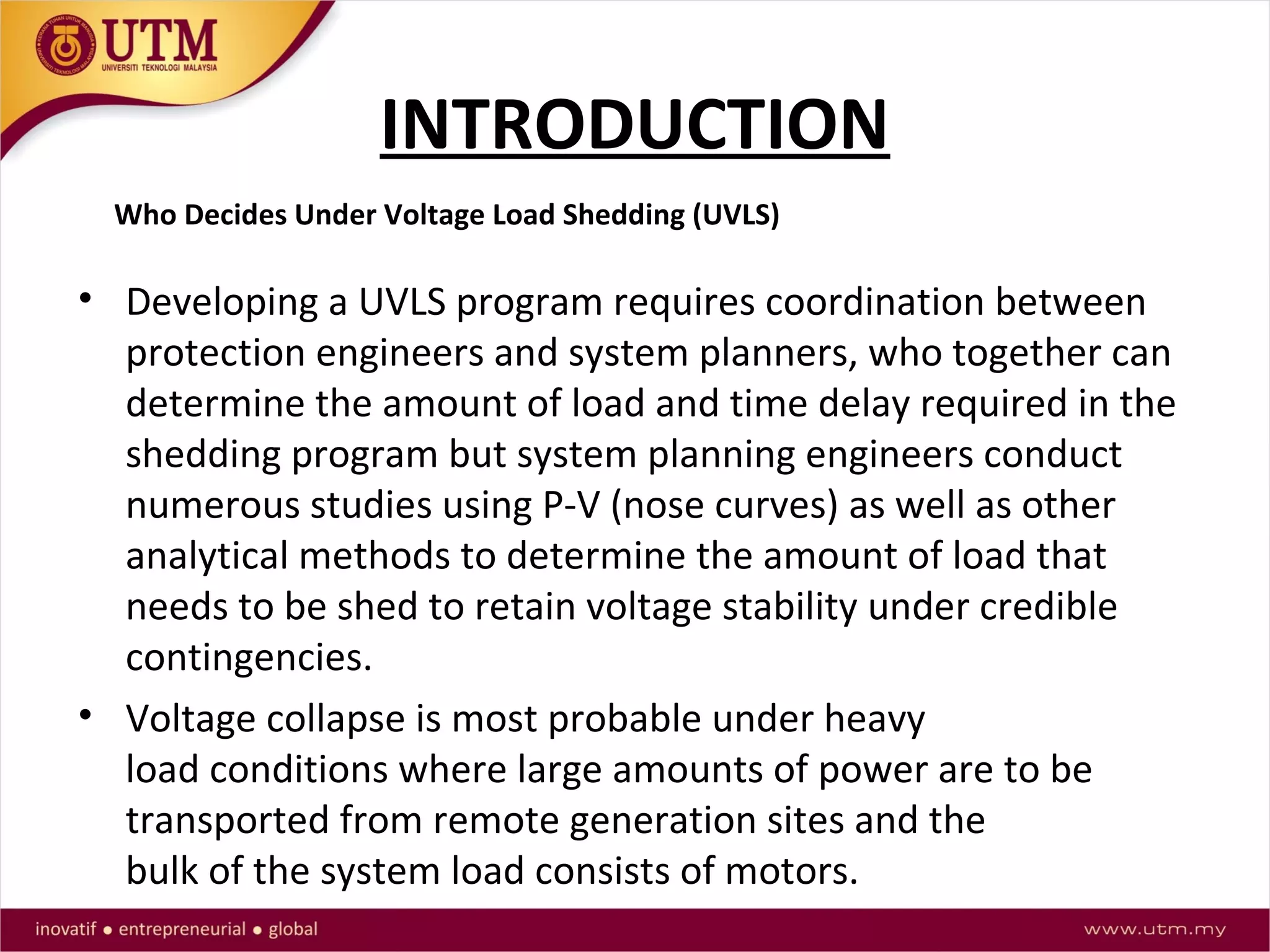
• Developing a UVLS program requires coordination between
protection engineers and system planners, who together can
determine the amount of load and time delay required in the
shedding program but system planning engineers conduct
numerous studies using P-V (nose curves) as well as other
analytical methods to determine the amount of load that
needs to be shed to retain voltage stability under credible
contingencies.
• Voltage collapse is most probable under heavy
load conditions where large amounts of power are to be
transported from remote generation sites and the
bulk of the system load consists of motors.
Who Decides Under Voltage Load Shedding (UVLS)
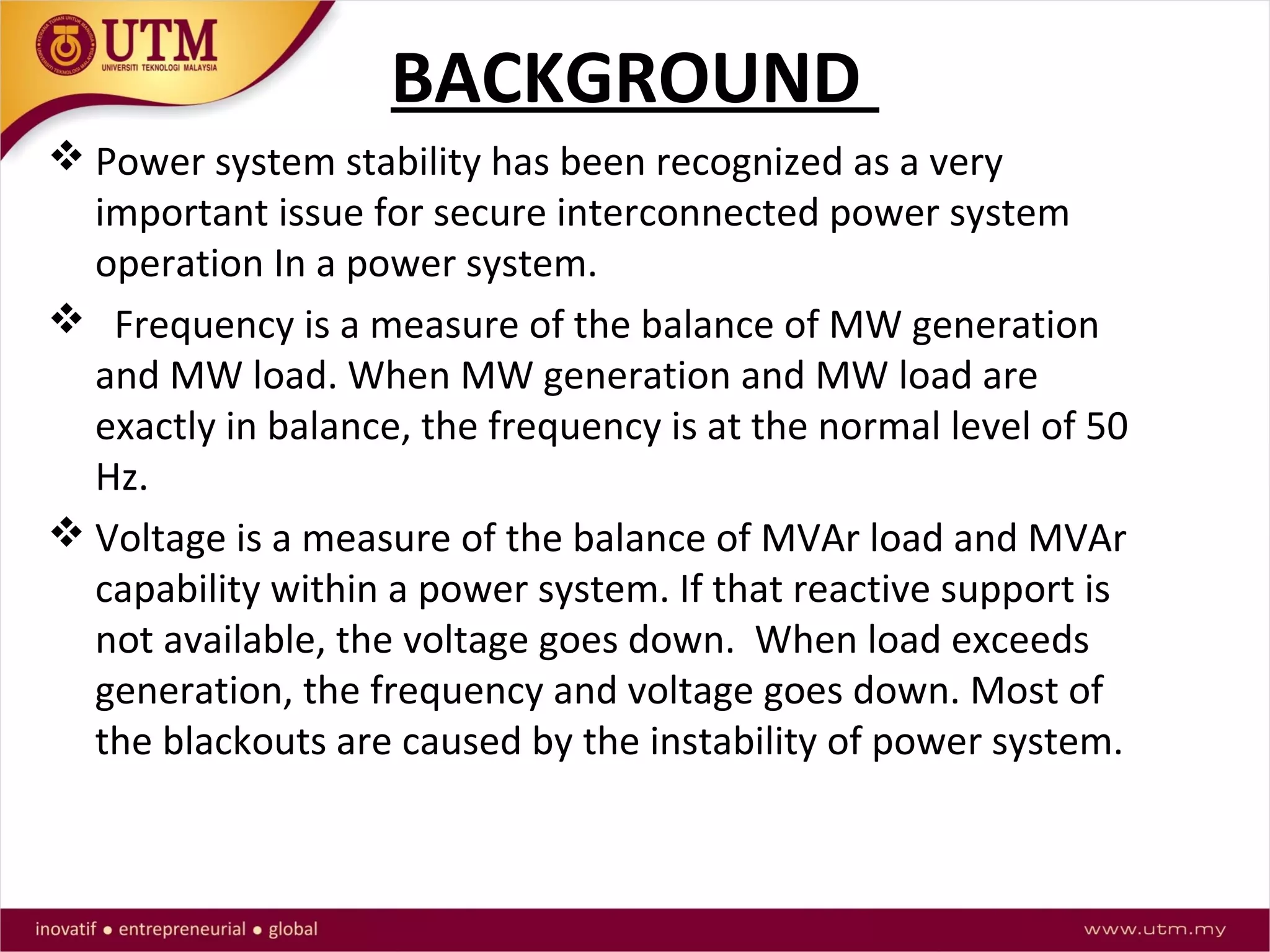
BACKGROUND
 Power system stability has been recognized as a very
important issue for secure interconnected power system
operation In a power system.
 Frequency is a measure of the balance of MW generation
and MW load. When MW generation and MW load are
exactly in balance, the frequency is at the normal level of 50
Hz.
 Voltage is a measure of the balance of MVAr load and MVAr
capability within a power system. If that reactive support is
not available, the voltage goes down. When load exceeds
generation, the frequency and voltage goes down. Most of
the blackouts are caused by the instability of power system.
LITERATURE REVIEW
S.No Author Technique Strength Weaknesses Journals/Yrs
of Publish
1 Abbas Ketabi
[20]
A sensitivity-based
method for UFLS
Hybrid and Multi area
Power Systems
Voltage stability is
ignored
IEEE Trans.on
smart grid 2015
2 Ahmad Ahmadi
[24]
New Integer-value
modeling
Minimizing total
amount of load shed and
the amount of
interruption cost
Hybrid Power
system not
considered
Journal
ELSEVIER
2014
3 M.M Hosseini
[23]
A techno economic multi-
objective optimization
Consider social welfare
and smart market
Hybrid Power
system not
considered
Journal
ELSEVIER
2013
4 Alireza
Saffarian
[22]
Designing the 3-D
combinational Load
shedding method
adaptive combinational
LS methods are
proposed
Traditional LS
schemes are not
capable of dealing
with combined
instabilities
IEEE Trans. On
power systems,
2011
5 Urban Rudez
[21]
Frequency of center of
inertia (COI) in adaptive
LS schemes
Only under frequency
load shedding
considered
under Voltage
load shedding not
considered
IEEE Trans. On
power systems,
2011
Summary of Related Work
LITERATURE REVIEW
S.No Authors Techniques Strength Weaknesses Journals/
Yrs of published
6 M.H.A Hamid UVLS based on
voltage stability
index
Dynamic simulation DG’s were not
considered
IEEE innovative
Smart grid
technologies
Proceedings 2014
7 Arief ardiaty Trajectory
sensitivity factor
(TSF)
Reduce the amount of LS by
15MW by using DFIG
Fail to reduce
asynchronous
power generate
from DFIG
Journal ELSEVIER
2012
8 Tamree Ranjbar
Mozafari [14]
Modal predictive
control
Can be implemented on
entire Power System
Sensitivity of the
modal were ignore
Journal ELSEVIER
2011
9 Y.Wang I.R
Pordanjani
Modal analysis
method
non-linear problem into a
series of linear programming
problems
Only N-1
Contingency has
considered
IET Generation
Transmission and
distribution 2010
10 K.Uma Rao Round Robin
Technique
Novel grading scheme for
loads to minimize the impact
of load shedding by taking
revenue loss, social factors
into consideration factors
into consideration
Dynamics were
ignored.
IEEE ISGT Asia
2013 proceedings
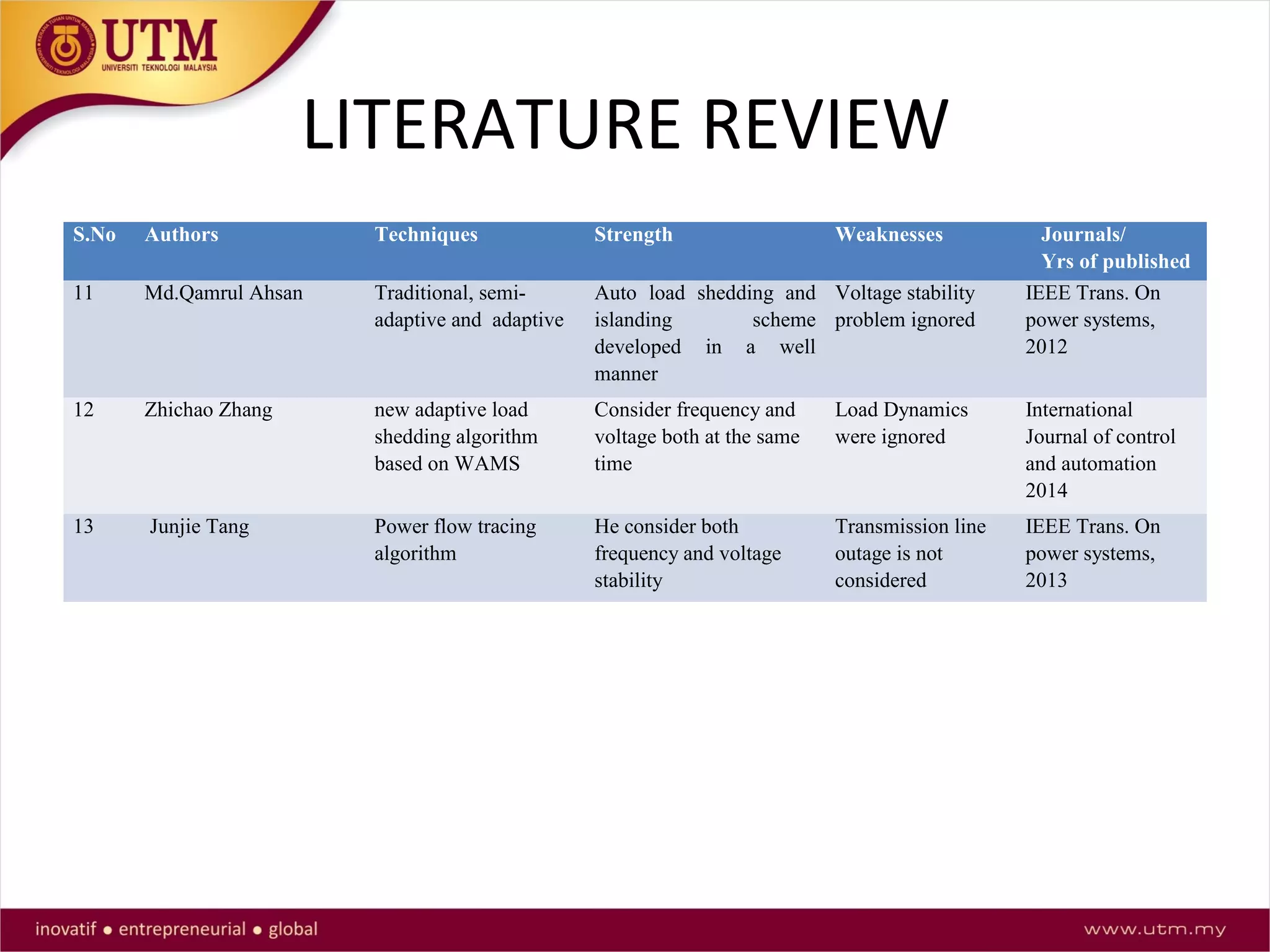
LITERATURE REVIEW
S.No Authors Techniques Strength Weaknesses Journals/
Yrs of published
11 Md.Qamrul Ahsan Traditional, semi-
adaptive and adaptive
Auto load shedding and
islanding scheme
developed in a well
manner
Voltage stability
problem ignored
IEEE Trans. On
power systems,
2012
12 Zhichao Zhang new adaptive load
shedding algorithm
based on WAMS
Consider frequency and
voltage both at the same
time
Load Dynamics
were ignored
International
Journal of control
and automation
2014
13 Junjie Tang Power flow tracing
algorithm
He consider both
frequency and voltage
stability
Transmission line
outage is not
considered
IEEE Trans. On
power systems,
2013
Problem Statement
 UVLS techniques are implemented to protect the power
system from voltage collapse. A look at major power
blackouts that have occurred around the world show that
most were caused by voltage instability problems [4].
 Voltage instability generally occurs due to either forced
outage of the generator or the line, or overloading. When this
happens, the reactive power demand in transmission lines
varies severely and may cause a blackout if not recovered
quickly.
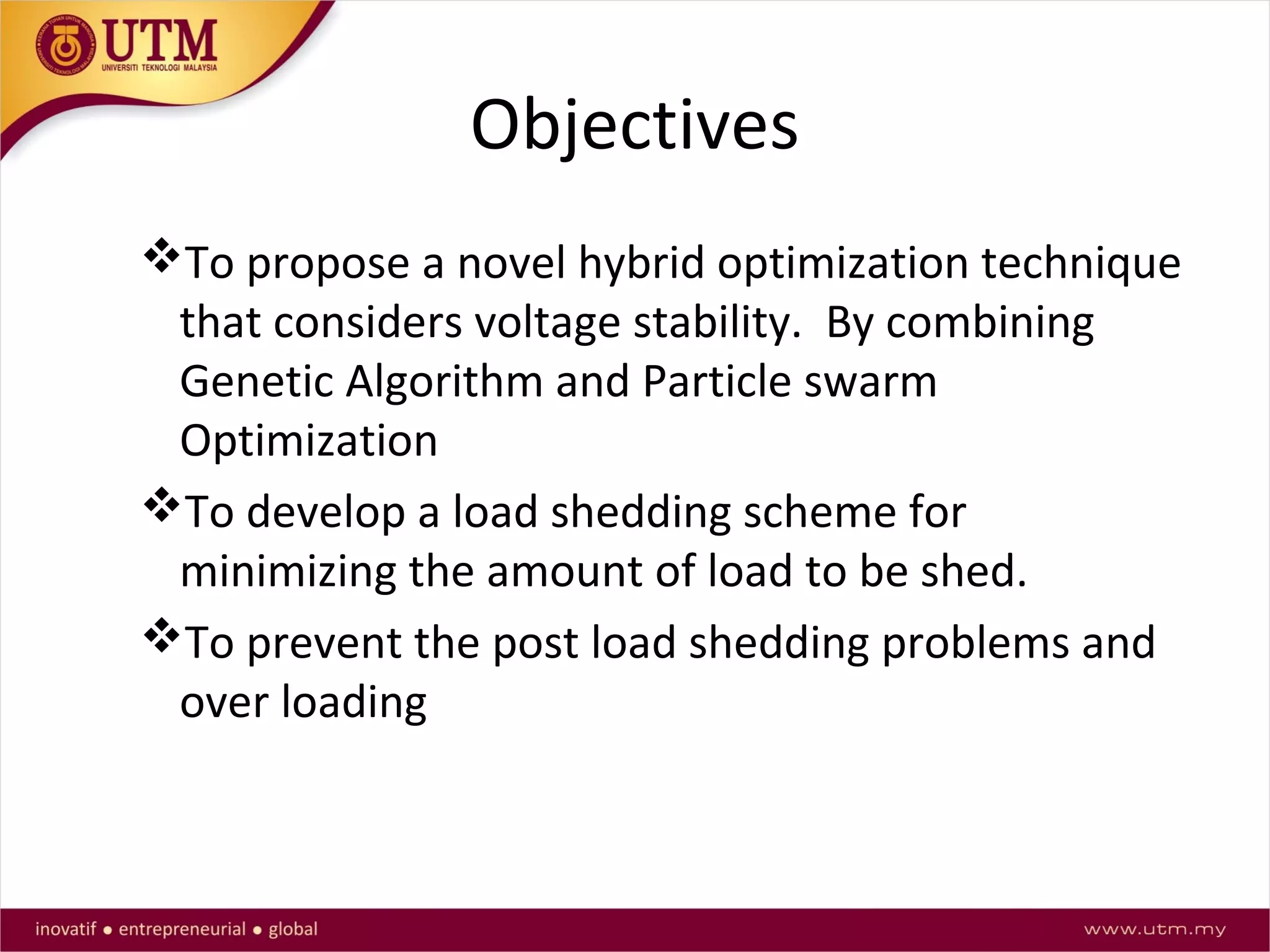
Objectives
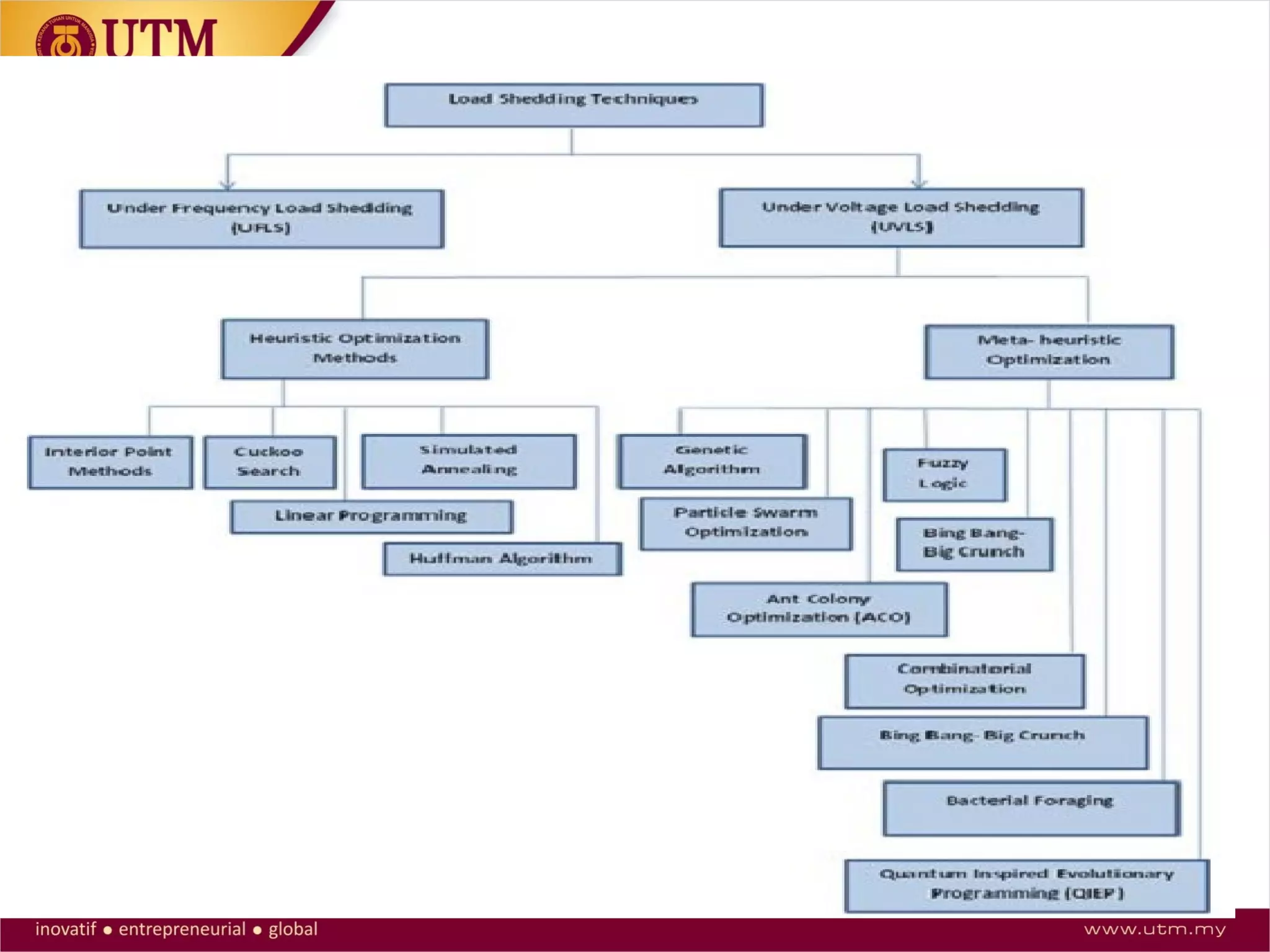
To propose a novel hybrid optimization technique
that considers voltage stability. By combining
Genetic Algorithm and Particle swarm
Optimization
To develop a load shedding scheme for
minimizing the amount of load to be shed.
To prevent the post load shedding problems and
over loading
Voltage Stabilization in Power Systems
Voltage stabilization refers to the ability of a power
system to maintain steady voltages at all buses in the
system after being subjected to a disturbance from a
given initial operating condition. It depends on the
ability to maintain/restore equilibrium between load
demand and load supply from the power system. [1]
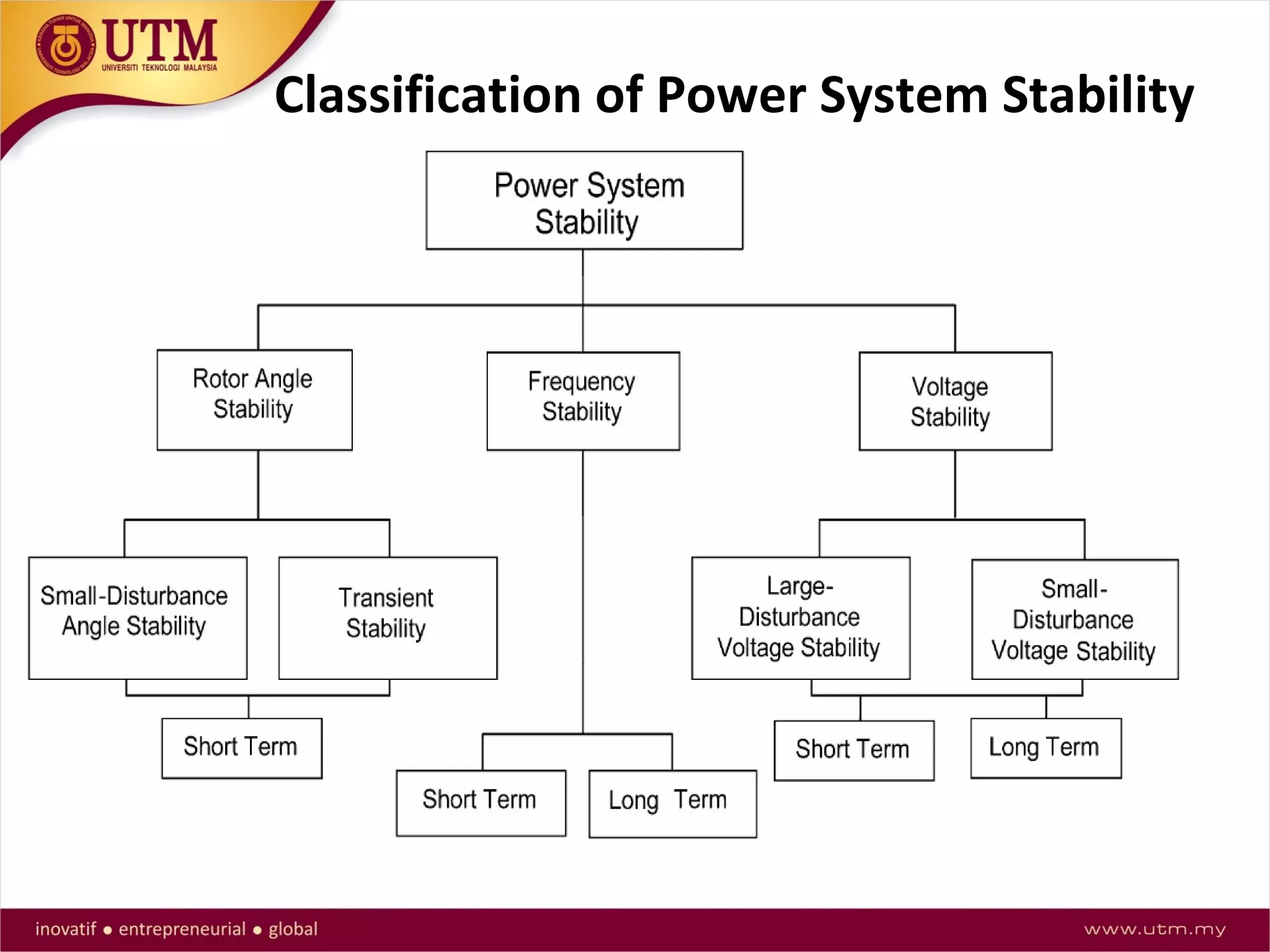
Classification of Power System Stability
Power system can be classified according
to different categories
Rotor angle stability refers to the ability of synchronous machines
of an interconnected power system to remain in synchronism after
being subjected to a disturbance. It depends on the ability to
maintain/restore equilibrium between electromagnetic torque and
mechanical torque of each synchronous machine in the system.
Frequency stability refers to the ability of a power system to
maintain steady frequency following a severe system upset resulting
in a significant imbalance between generation and load. It depends on
the ability to maintain/restore equilibrium between system
generation and load, with minimum unintentional loss of load.
Instability that may result occurs in the form of sustained frequency
swings leading to tripping of generating units and/or loads. Generally,
frequency stability problems are associated with inadequacies in
equipment responses, poor coordination of control and protection
equipment, or insufficient generation reserve.
Voltage Stabilization in Power Systems
 What is the voltage stabilization in power system?
 Power system stability may be broadly defined according to
different operating conditions, an important problem which is
frequently considered is the problem of voltage stabilization.
 This important issue of power system control is to maintain
steady acceptable voltage under normal operating and
disturbed conditions, which is referred as the problem of
voltage stabilization
Voltage Stabilization in Power Systems
 Why we need voltage stabilization?
 Instability that may result occurs in the form of a progressive
fall or rise of voltages of some buses.
 A possible outcome of voltage instability is loss of load in an
area, or tripping of transmission lines and other elements by
their protective systems leading to cascading outages. Loss of
synchronism of some generators may result from these
outages or from operating conditions that violate field
current limit. [1]
Voltage Stabilization in Power Systems
 A major factor contributing to voltage instability is the
voltage drop that occurs when active and reactive power
flow through of the transmission network; this limits the
capability of the transmission network for power
transfer and voltage support.
 Voltage stability is threatened when a disturbance
increases the reactive power demand beyond the
sustainable capacity of the available reactive power
resources.
Voltage Stabilization in Power Systems
 The type of Dynamic / Nonlinear load can also cause the
voltage instability.
 While the most common form of voltage instability is the
power frequency variation, the progressive drop of bus
voltages, and the overvoltage instability.
 Overvoltage can be caused by a capacitive behavior of the
network as well as by under excitation limiters preventing
generators and synchronous compensators from absorbing
the excess reactive power. [1]
Large-disturbance voltage stabilization:
• Large-disturbance voltage stabilization refers to the system’s
ability to maintain steady voltages following large
disturbances such as system faults, loss of generation, or
circuit contingencies.
• Determination of large-disturbance voltage stabilization
requires the examination of the nonlinear response of the
power system over a period of time sufficient to capture the
performance and interactions of such devices as motors,
underload transformer tap changers, and generator field-
current limiters.
The time frame of interest for voltage
stabilization problems may vary from a few
seconds to tens of minutes.
Therefore, voltage stabilization may be either
a short-term or a long-term phenomenon. [2]
Short-term voltage stabilization involves
dynamics of fast acting load components such
as induction motors, electronically controlled
loads. (several seconds)
Long-term voltage stabilization involves
slower acting equipment such as tap-changing
transformers, generator current limiters.
(several mins)
Small-disturbance voltage stabilization:
 Small-disturbance voltage stability refers to the system’s
ability to maintain steady voltages when subjected to small
perturbations such as incremental changes in system load.
 This form of stability is influenced by the characteristics of
loads, continuous controls, and discrete controls at a given
instant of time.
 This concept is useful in determining, at any instant, how the
system voltages will respond to small system changes.
Principles of UVLS
Amount of Load Curtailment
Appropriate location for load
curtailment
Timing to execute load curtailment
event
Meta-Heuristic techniques
for UVLS
By applying such techniques we may easily
handle large and complicated Power Systems
Less Power failures
Highly Stable
Enhanced Reliability
Self healing
Reduce the amount of load shed
Reduce the possibility of Blackouts
BLACKOUTS
• A blackout in a power system refers to the unavailability of
Electric power in a area for a short or long duration. These
power blackouts occurs due to natural and Technical reasons.
• Natural reasons
i. Animal contact with live conductor.
ii. Vehicular accident resulting damaged transmission poles.
iii. Tress falling on transmission line due to stormy weather.
• Technical Reasons
i. Human error
ii. Overloaded transmission lines
iii. Faults (L-G,L-L-G L-L-L-G)
iv. Stability issues
v. Faulty equipment
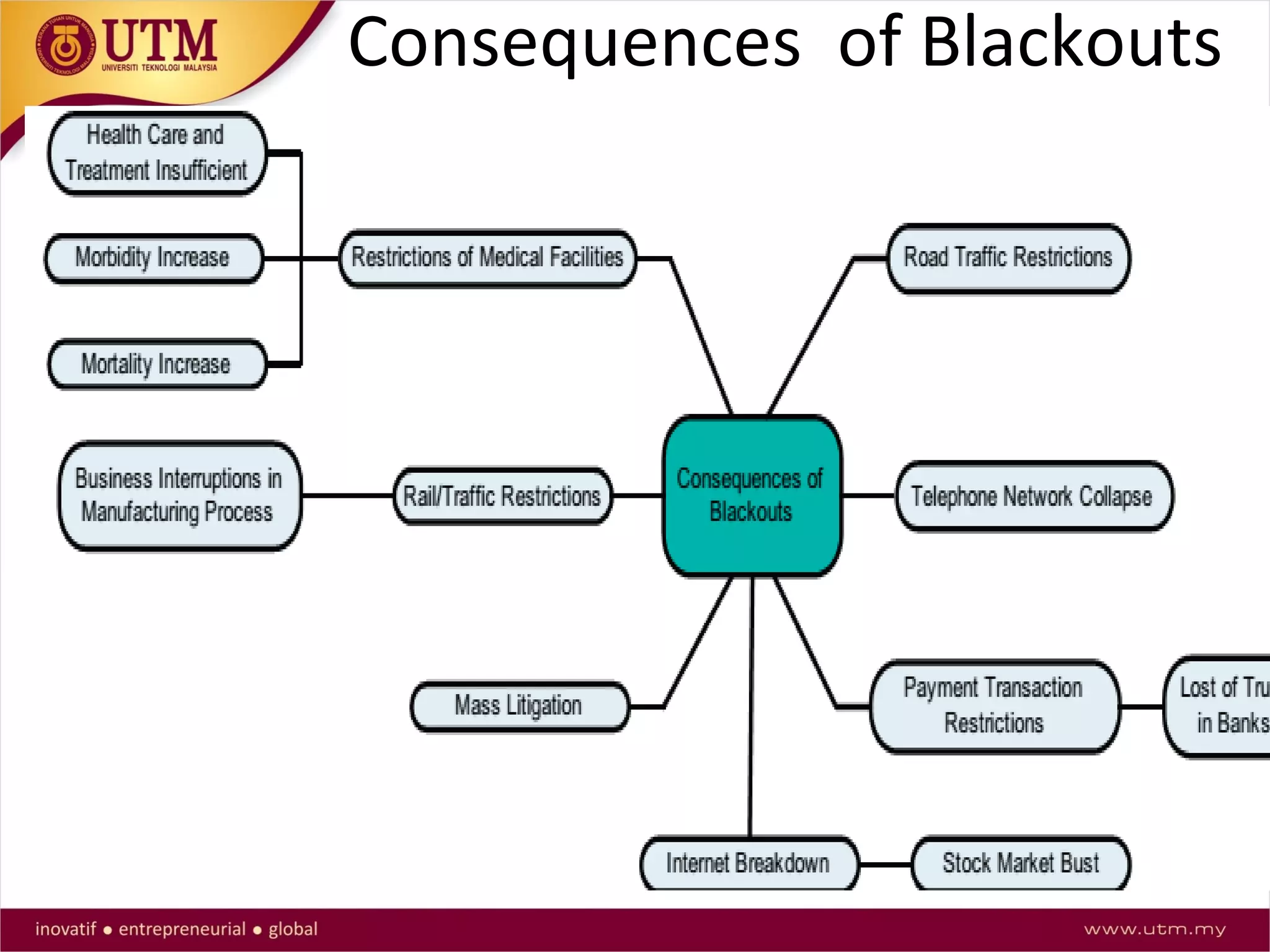
Consequences of Blackouts
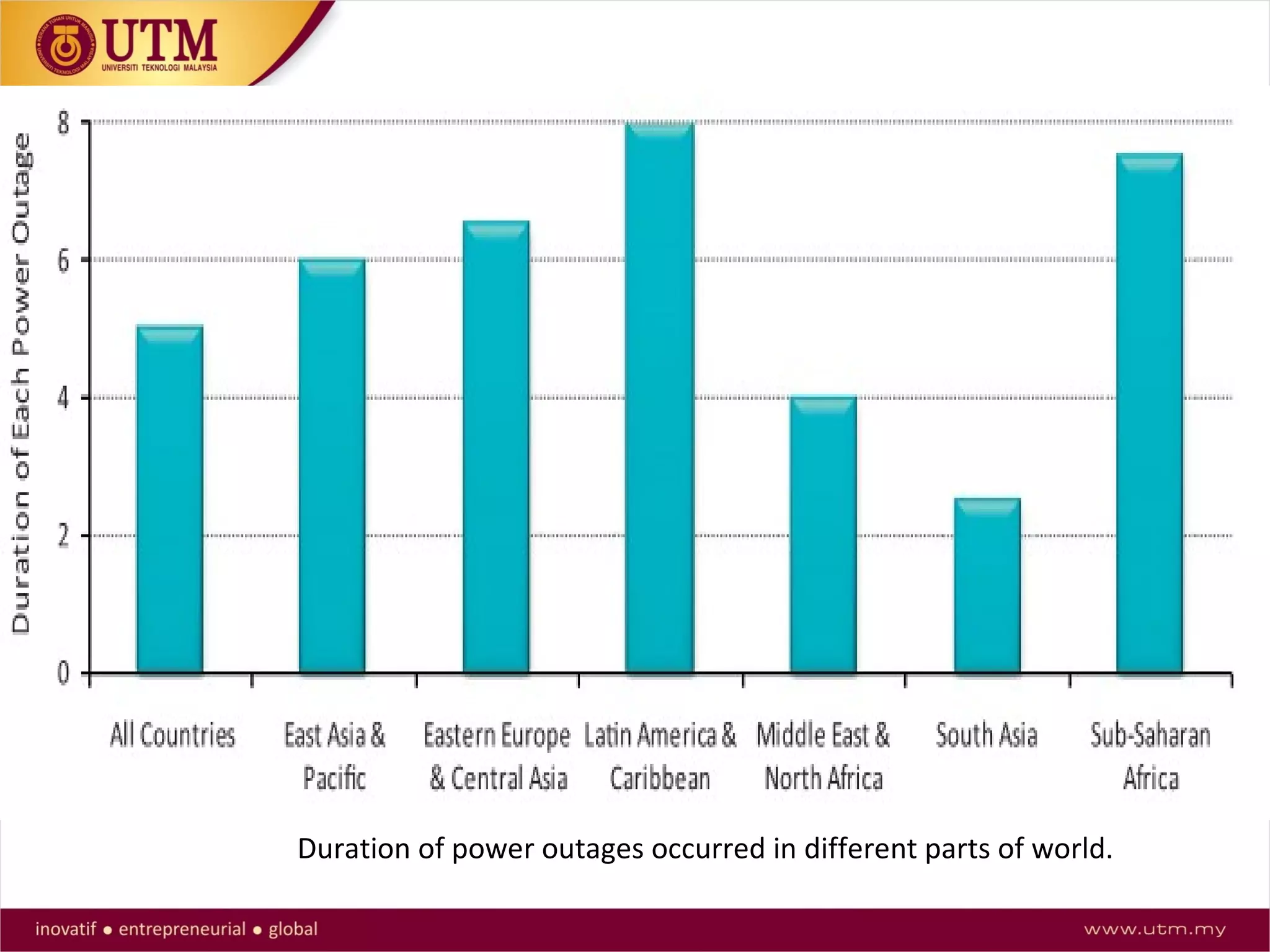
Duration of power outages occurred in different parts of world.
Limitation of conventional Load Shedding
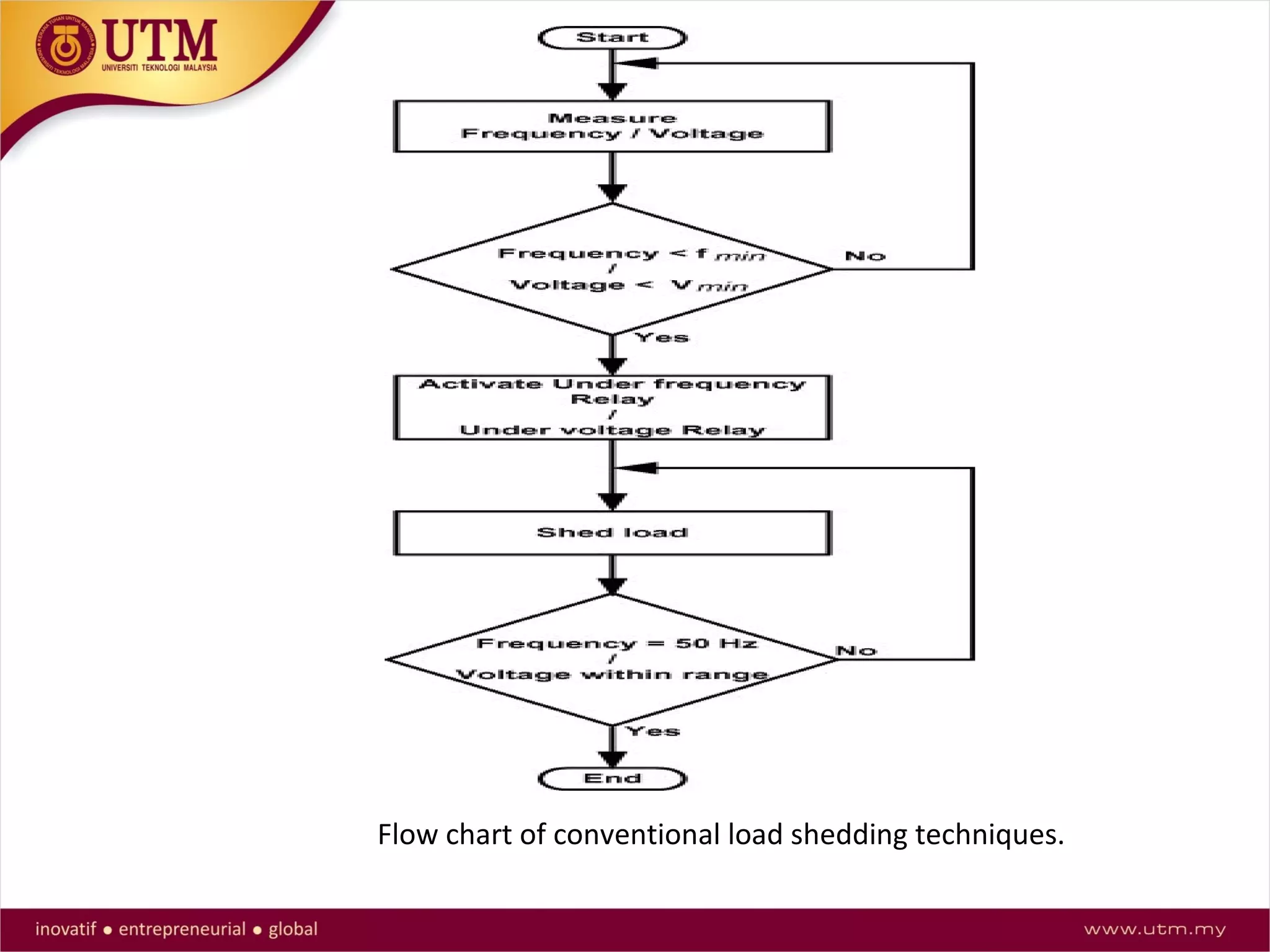
• Conventional load shedding techniques are limited by their
inability to provide optimum load shedding. They simply
follow a preset rule in which a fixed amount of load is shed
when frequency /voltage deviates from the nominal value.
The main disadvantage of this method is that it does not
estimate the actual amount of the power imbalance.
• The result is either over-shedding, which affects power
quality, social and economical loss or under-shedding, which
leads to tripping of electricity service and over frequency
problem.
Flow chart of conventional load shedding techniques.
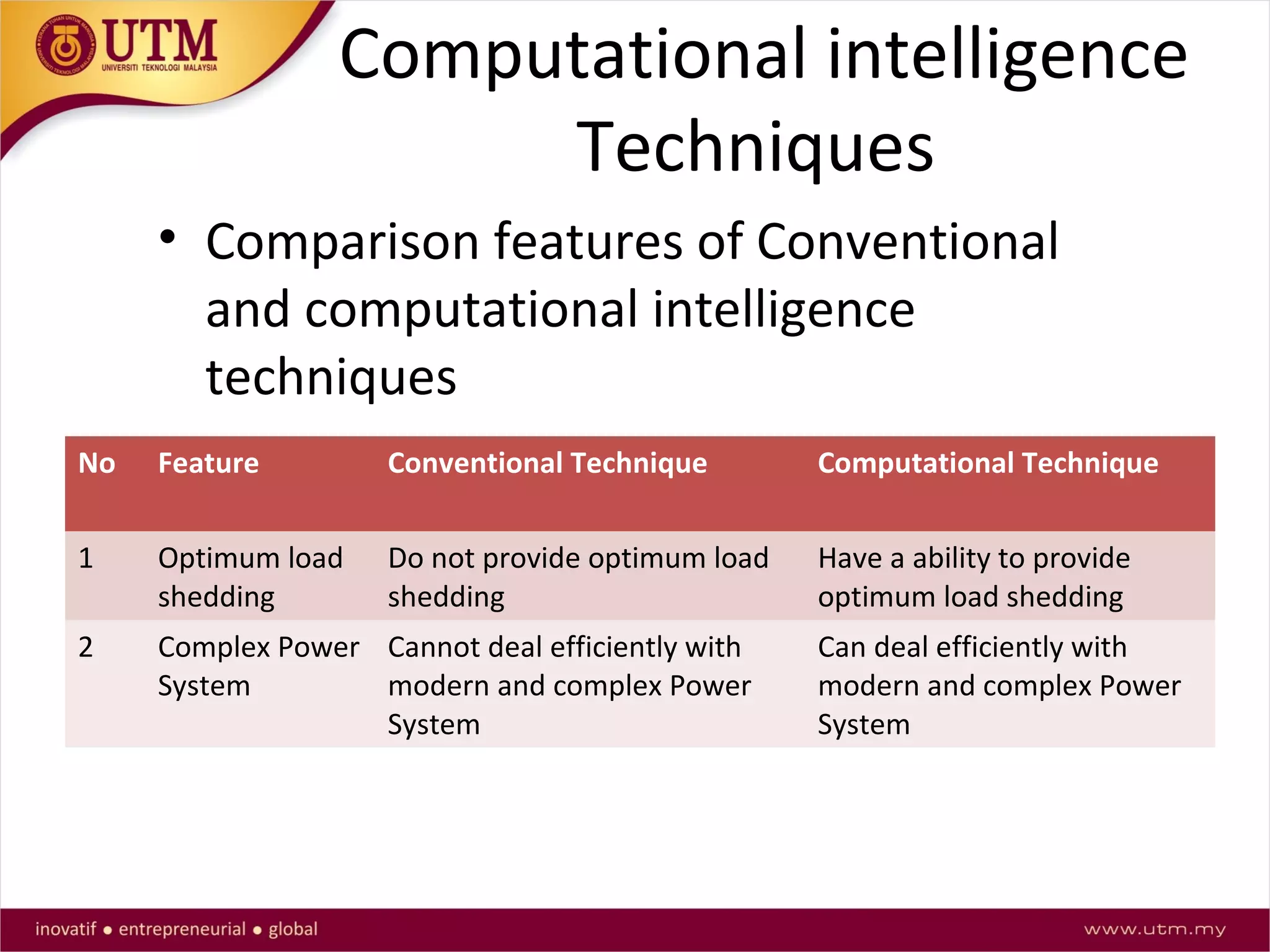
Computational intelligence
Techniques
• Comparison features of Conventional
and computational intelligence
techniques
No Feature Conventional Technique Computational Technique
1 Optimum load
shedding
Do not provide optimum load
shedding
Have a ability to provide
optimum load shedding
2 Complex Power
System
Cannot deal efficiently with
modern and complex Power
System
Can deal efficiently with
modern and complex Power
System
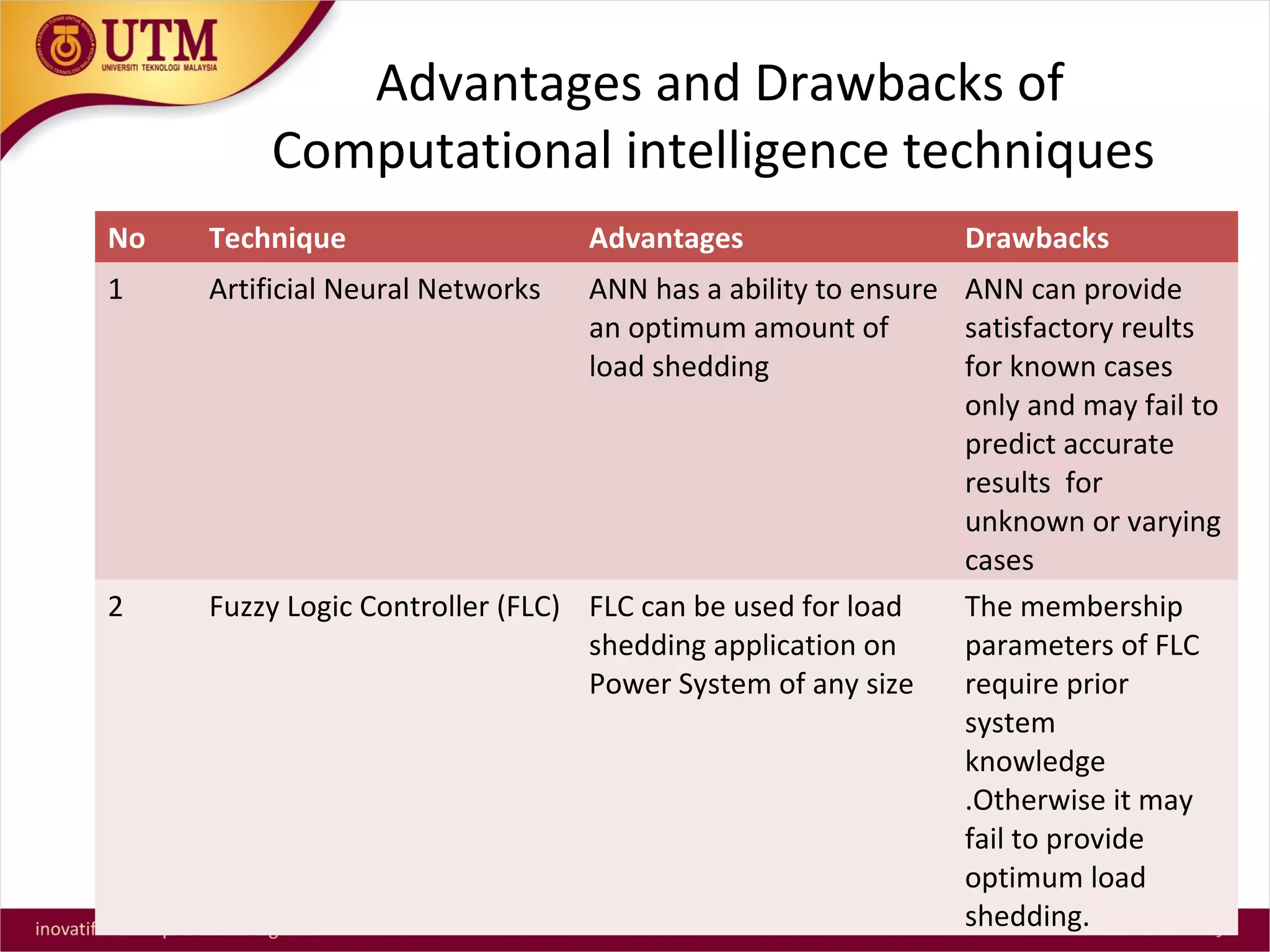
Advantages and Drawbacks of
Computational intelligence techniques
No Technique Advantages Drawbacks
1 Artificial Neural Networks ANN has a ability to ensure
an optimum amount of
load shedding
ANN can provide
satisfactory reults
for known cases
only and may fail to
predict accurate
results for
unknown or varying
cases
2 Fuzzy Logic Controller (FLC) FLC can be used for load
shedding application on
Power System of any size
The membership
parameters of FLC
require prior
system
knowledge
.Otherwise it may
fail to provide
optimum load
shedding.
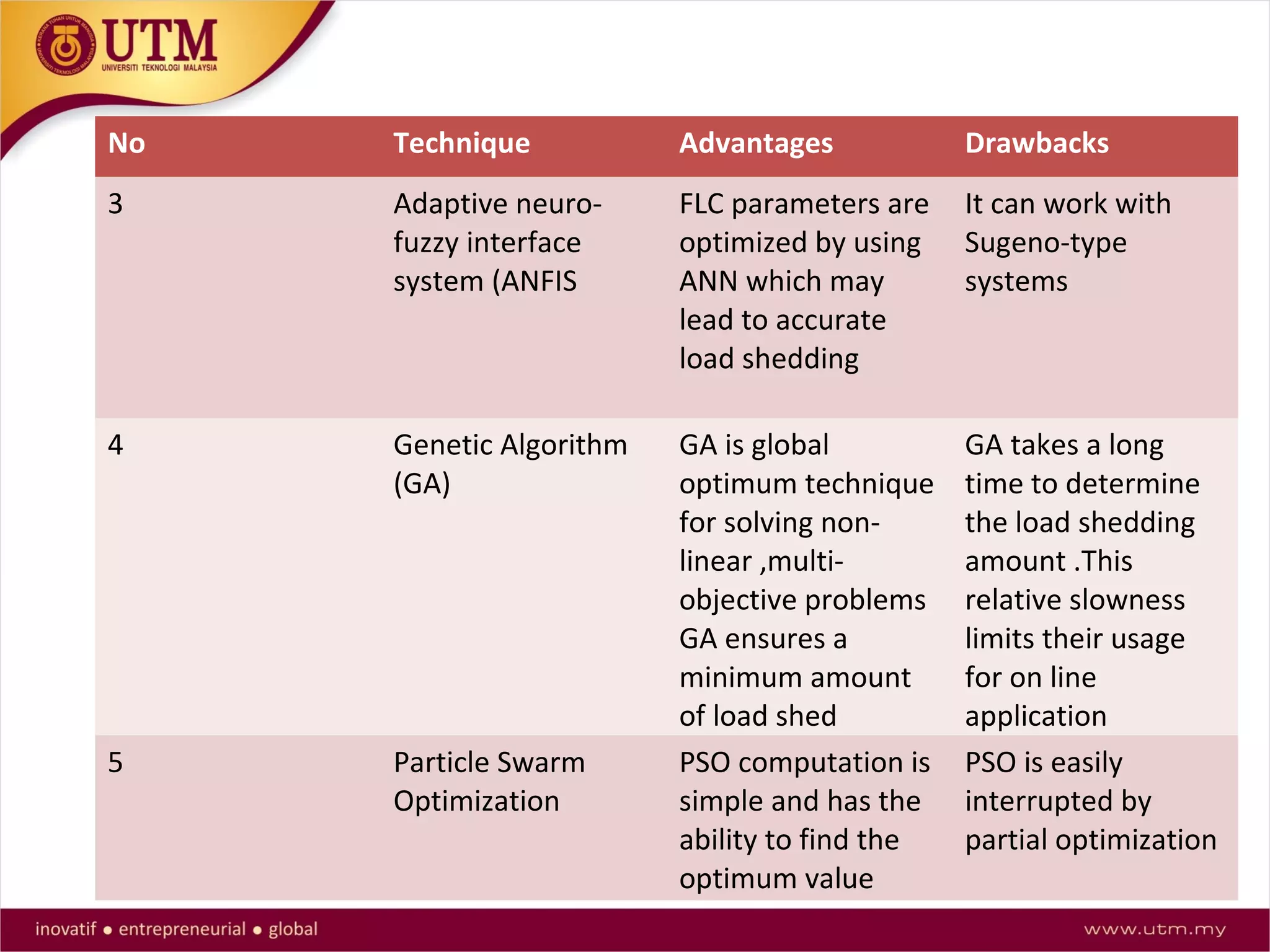
No Technique Advantages Drawbacks
3 Adaptive neuro-
fuzzy interface
system (ANFIS
FLC parameters are
optimized by using
ANN which may
lead to accurate
load shedding
It can work with
Sugeno-type
systems
4 Genetic Algorithm
(GA)
GA is global
optimum technique
for solving non-
linear ,multi-
objective problems
GA ensures a
minimum amount
of load shed
GA takes a long
time to determine
the load shedding
amount .This
relative slowness
limits their usage
for on line
application
5 Particle Swarm
Optimization
PSO computation is
simple and has the
ability to find the
optimum value
PSO is easily
interrupted by
partial optimization
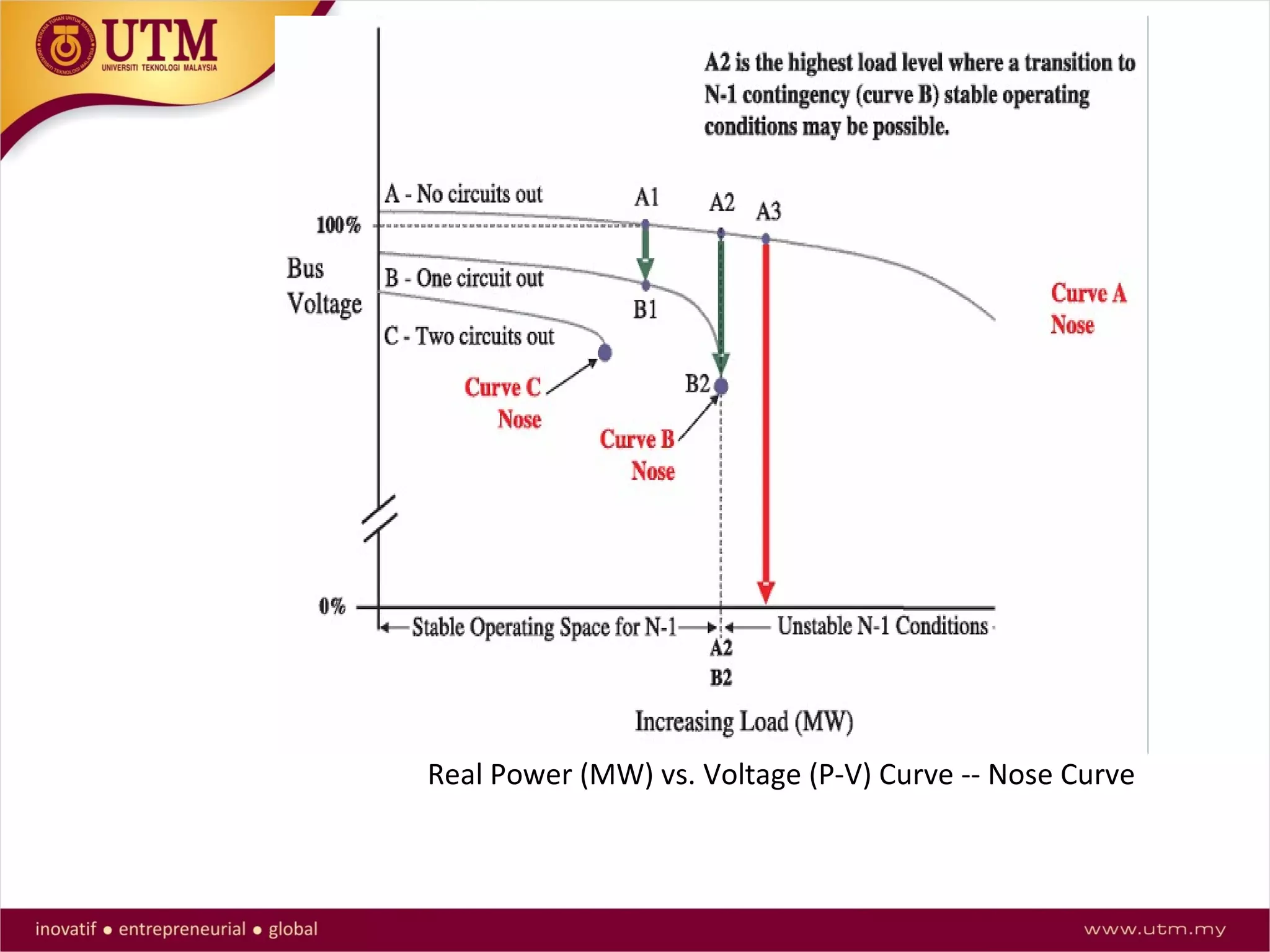
Real Power (MW) vs. Voltage (P-V) Curve -- Nose Curve
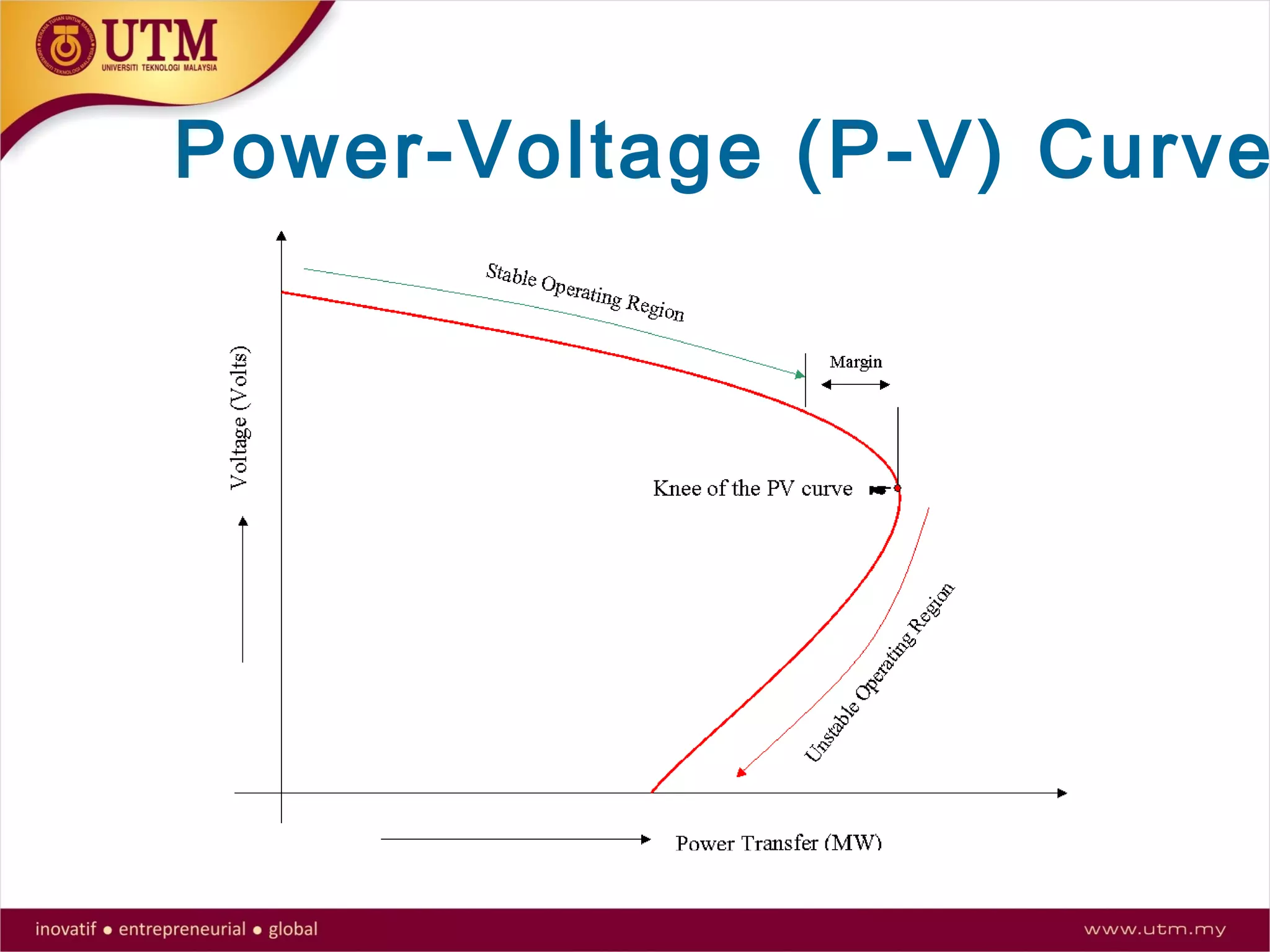
Power-Voltage (P-V) Curve
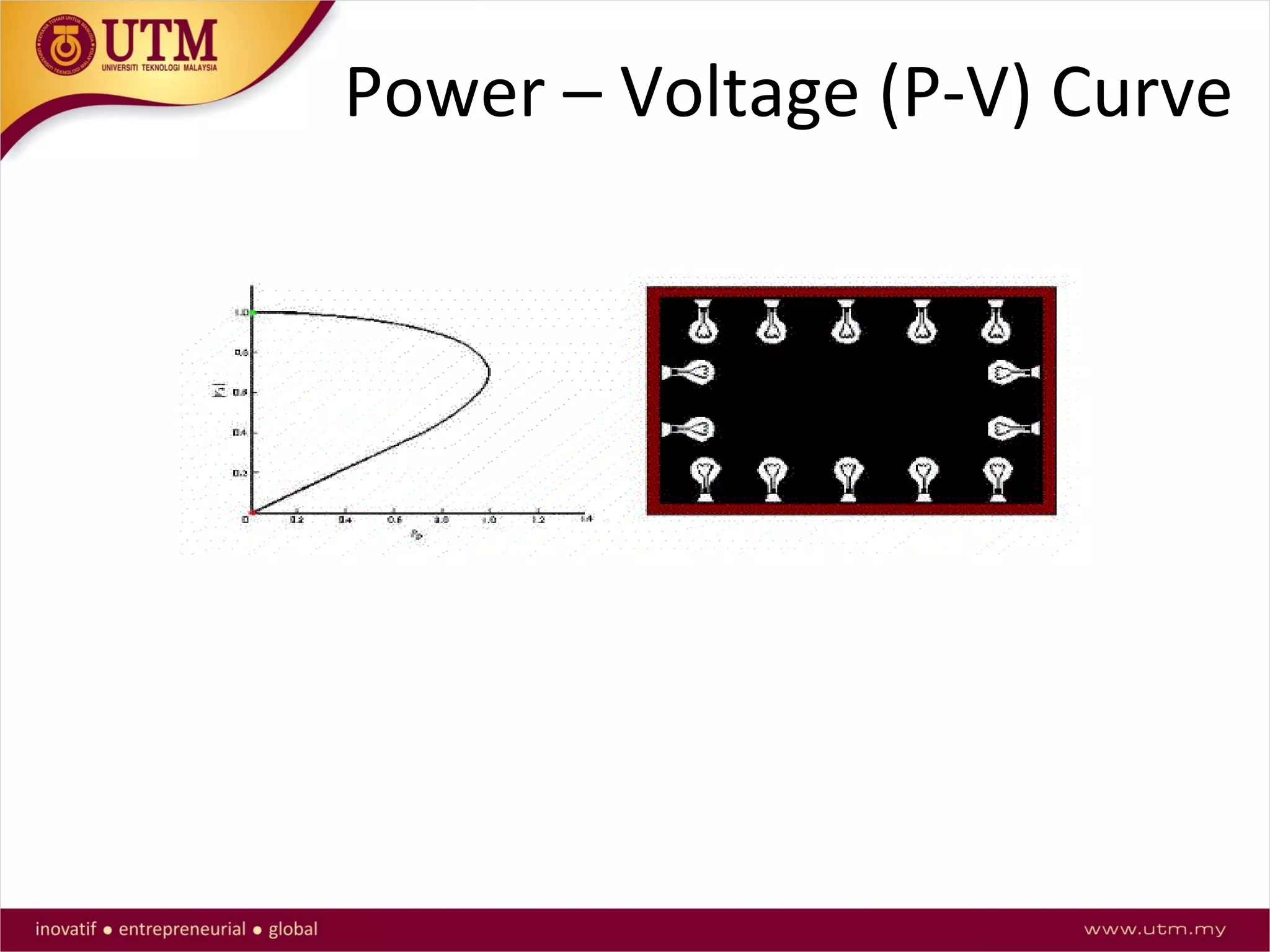
Power – Voltage (P-V) Curve
Voltage Stabilization Techniques in Power Systems
.
 Most sensitive loads which cause voltage instability
i. Induction Motors
ii. Discharge type Lamps
iii. Thermostatic Controlled Loads
iv. Load behind Under Load Tap Changers (ULTC)
 The driving force for voltage instability is usually the loads. In
response to a disturbance, power consumed by the loads
should be restored.
 A situation causing voltage instability occurs when load
dynamics attempt to restore power consumption beyond the
capability of the transmission network and the connected
generation.[1]
What cause voltage instability?
Main factors generally responsible for
voltage collapse incidents worldwide.
• Transmission system limitation
• Load behavior, including on load Tap changer
performance.
• Influence of protection and control system.
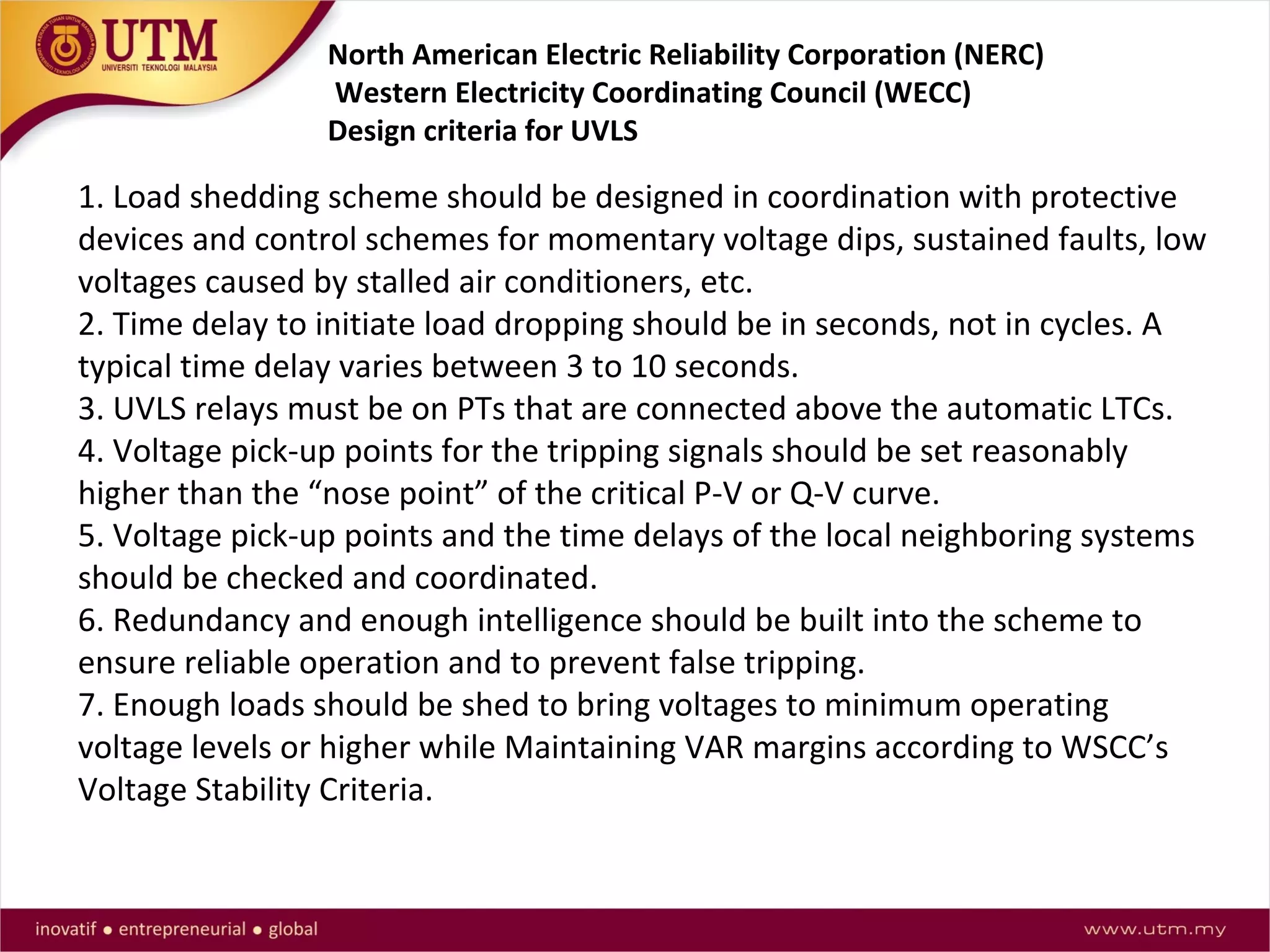
1. Load shedding scheme should be designed in coordination with protective
devices and control schemes for momentary voltage dips, sustained faults, low
voltages caused by stalled air conditioners, etc.
2. Time delay to initiate load dropping should be in seconds, not in cycles. A
typical time delay varies between 3 to 10 seconds.
3. UVLS relays must be on PTs that are connected above the automatic LTCs.
4. Voltage pick-up points for the tripping signals should be set reasonably
higher than the “nose point” of the critical P-V or Q-V curve.
5. Voltage pick-up points and the time delays of the local neighboring systems
should be checked and coordinated.
6. Redundancy and enough intelligence should be built into the scheme to
ensure reliable operation and to prevent false tripping.
7. Enough loads should be shed to bring voltages to minimum operating
voltage levels or higher while Maintaining VAR margins according to WSCC’s
Voltage Stability Criteria.
North American Electric Reliability Corporation (NERC)
Western Electricity Coordinating Council (WECC)
Design criteria for UVLS
Methodology
 Literature Review
 Data collection
 Modeling of Fuel cell,PV and Wind turbine
 Simulation Studies
 Analysis and Evaluation
 Proposed a Load shedding scheme
 Thesis writing and Publications
 MATLAB/Simulink and PSCAD
cont…..
Methodology
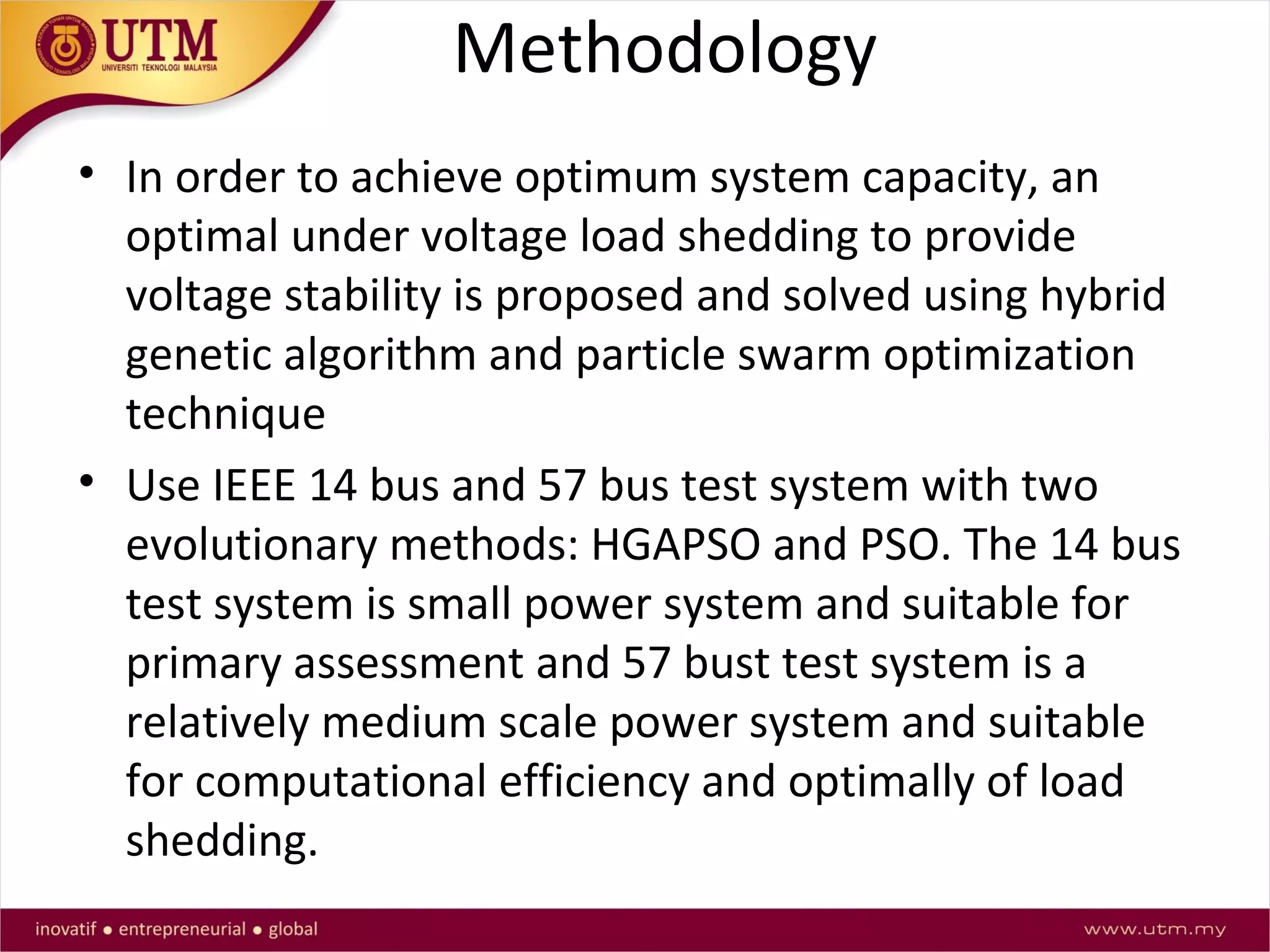
• In order to achieve optimum system capacity, an
optimal under voltage load shedding to provide
voltage stability is proposed and solved using hybrid
genetic algorithm and particle swarm optimization
technique
• Use IEEE 14 bus and 57 bus test system with two
evolutionary methods: HGAPSO and PSO. The 14 bus
test system is small power system and suitable for
primary assessment and 57 bust test system is a
relatively medium scale power system and suitable
for computational efficiency and optimally of load
shedding.
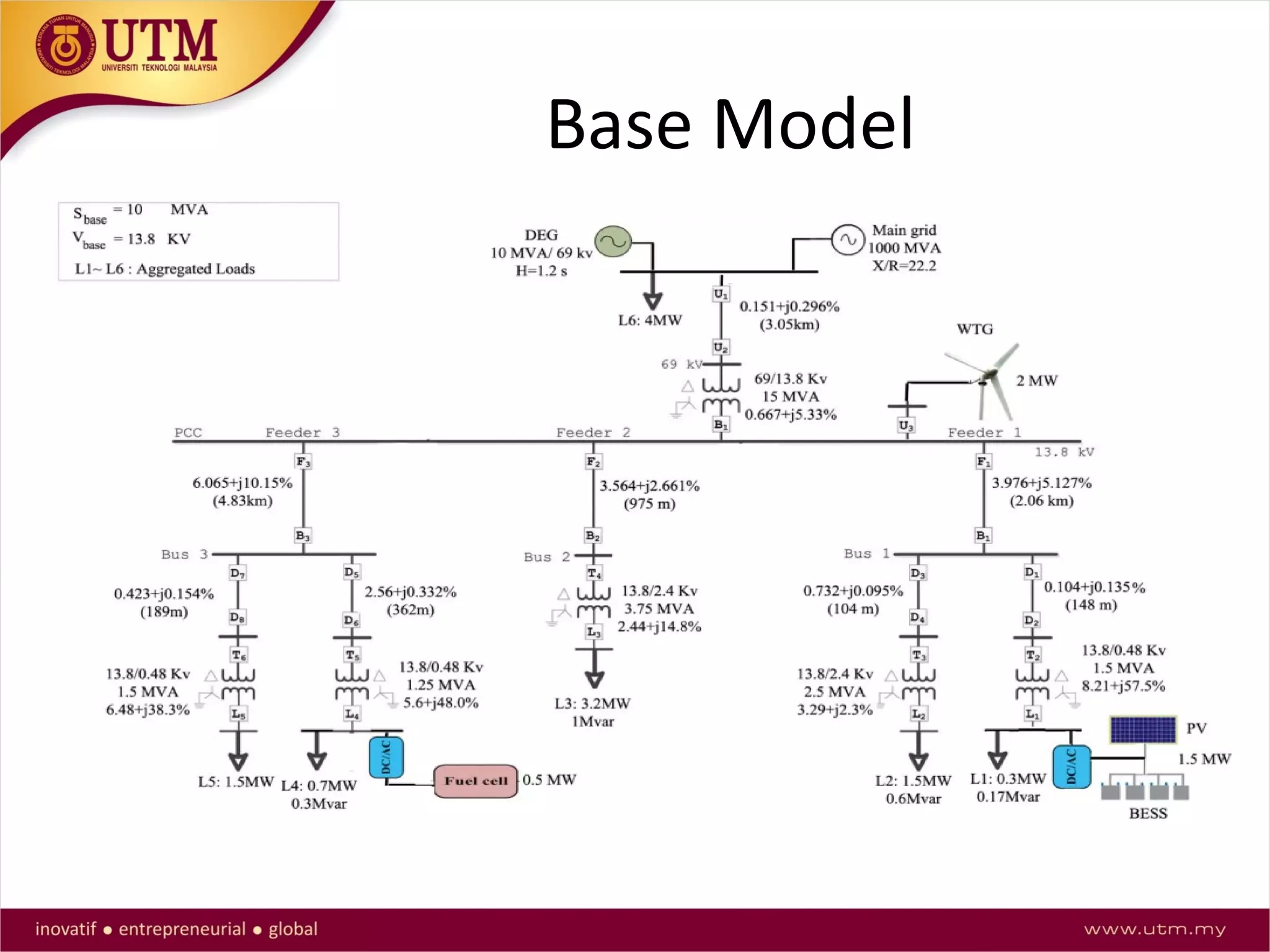
Base Model
•
Conclusion
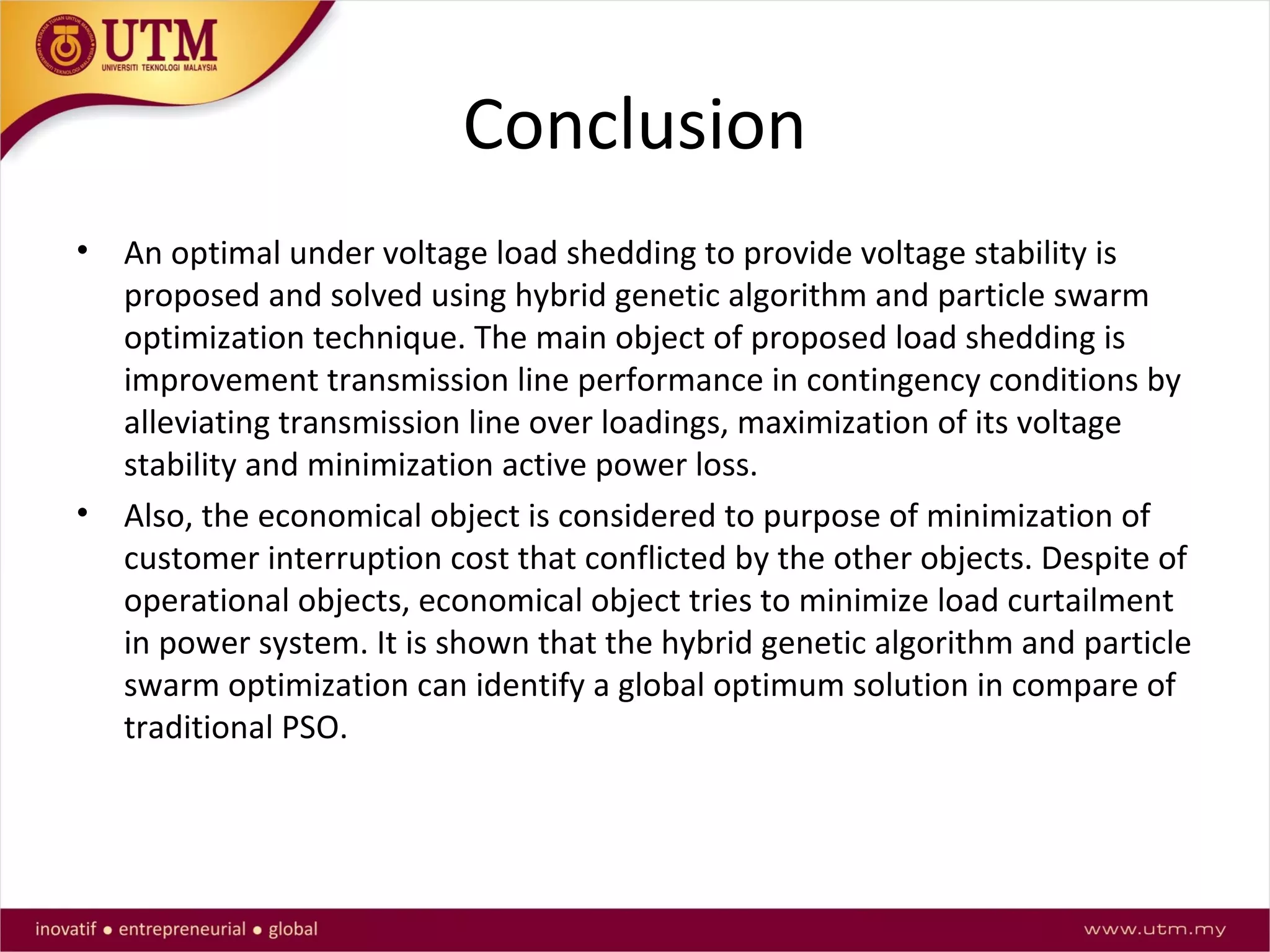
• An optimal under voltage load shedding to provide voltage stability is
proposed and solved using hybrid genetic algorithm and particle swarm
optimization technique. The main object of proposed load shedding is
improvement transmission line performance in contingency conditions by
alleviating transmission line over loadings, maximization of its voltage
stability and minimization active power loss.
• Also, the economical object is considered to purpose of minimization of
customer interruption cost that conflicted by the other objects. Despite of
operational objects, economical object tries to minimize load curtailment
in power system. It is shown that the hybrid genetic algorithm and particle
swarm optimization can identify a global optimum solution in compare of
traditional PSO.
References
[1] C. P. Steinmetz, “Power control and stability of electric generating stations,” AIEE
Trans., vol. XXXIX, Part II, pp. 1215–1287, July 1920.
[2] AIEE Subcommittee on Interconnections and Stability Factors, “First report of power
system stability,” AIEE Trans., pp. 51–80, 1926.
[3] P. Kundur, J. Paserba, V. Ajjarapu, G. Andersson, A. Bose, C. Canizares, N.
Hatziargyriou, D. Hill, A. Stankovic, C. Taylor, T. Van Cutsem, and V. Vittal, "Definition
and Classification of Power System Stability IEEE/CIGRE Joint Task Force on Stability
Terms and Definitions," IEEE Transactions on Power Systems, vol. 19, pp. 1387- 1401,
2004
[4] El-Sadek MZ. Preventive measures for voltage collapses and voltage failures in the
Egyptian power system. Electr Power Syst Res 1998;44:203–11 .
[5] Amraee T, Mozafari B, Ranjbar AM. An improved model for optimal under voltage
load shedding: particle swarm approach. IEEE Power India Conf 2006:6.
[6] J.A. Laghari, H. Mokhlis, A.H.A. Bakar, H. Mohamad., “Application of computational
intelligence techniques for load shedding in power systems: A review”, Energy
Conversion and Management, 2013, 75, pp. 130-140.
[7] C. J. Mozina, Power Plant Protection and Control Strategies for Blackout Avoidance,
Georgia Tech Protective Relay Conference, April 2005.
References
[8] North American Electric Reliability Council (NERC), 1987 System Disturbance Report, p19, July
1998.
[9] IEEE Power System Relaying Committee Report, Summary of System Protection and Voltage
Stability, Transactions on Power Delivery, Vol. 10. No. 2, April 1995.
[10] R. Verayiah, A. Mohamed, H.Shareef, I. Z. Abidin, “Review of Under-voltage Load Shedding
Schemes in Power System Operation” PRZEGLĄD ELEKTROTECHNICZNY, 2014, 90, pp.99 -103
[11] Sadati N, Amraee T, Ranjbar AM, “A global particle swarmbased-simulated annealing
optimization technique for undervoltage load shedding problem”. Appl Soft Comput 2009;9:652–
7.
[12 ] J. Kennedy, R. Eberhart, “Particle Swarm Optimization”, IEEE International Conference on
Neural Networks, Piscataway, NJ, pp. 1942-1948, 1995
[13] Amraee T, Ranjbar AM, Mozafari B, Sadati N. An enhance under voltage load shedding
scheme to provide voltage stability. Electr Power Syst Res 2007;77(8):1038–46.
[14] Amraee T, Ranjbar AM, Feuillet R. Adaptive under-voltage load shedding scheme using
model predictive control. Int J Electr Power Syst Res 2011;81(7):1507–13.
References
[15] S. A. Pourmousavi and M. H. Nehrir, “Real-time central demand response for primary
frequency regulation in microgrids,” IEEE Trans. Smart Grid, vol. 3, no. 4, pp. 1988–1996, Dec.
2012.
[16] F. Katiraei, M. R. Iravani, and P. W. Lehn, “Micro-grid autonomous operation during and
subsequent to islanding process,” IEEE Trans. Power Del., vol. 20, no. 1, pp. 248–257, Jan. 2005.
[17] IEEE Recommended Practice for Industrial and Commercial Power System Analysis, IEEE
Standard 399-1997, Aug. 1998.
[18] F. Echavarren, E. Lobato, R. Rouco, M. Navarrete, R. Casanova, and G. López, "A load
shedding algorithm for improvement of load margin to voltage collapse," in Power Tech
Conference Proceedings, 2003 IEEE Bologna, 2003, p. 6 pp. Vol. 1.
[19] B. Otomega and T. Van Cutsem, "Undervoltage load shedding using distributed controllers,"
Power Systems, IEEE Transactions on, vol. 22, pp. 1898-1907, 2007.
[20] A. Ketabi and M. H. Fini, “An underfrequency load shedding scheme for islanded microgrids,”
Int. J. Elect. Power Energy Syst., vol. 62, pp. 599–607, Nov. 2014.
[21] U. Rudez and R. Mihalic, “Monitoring the first frequency derivative to improve adaptive
underfrequency load-shedding schemes,” IEEE Trans. Power Syst., vol. 26, no. 2, pp. 839–846,
May 2011.
References
[22] A. Saffarian and M. Sanaye-Pasand, “Enhancement of power system stability
using adaptive combinational load shedding methods,” IEEE Trans. Power Syst., vol.
26, no. 3, pp. 1010–1020, Aug. 2011.
[23] Hosseini-Bioki MM, Rashidinejad M, Abdollahi A. An implementation of particle
swarm optimization to evaluate optimal under voltage load shedding in competitive
electricity markets. J Power Sour 2013;242:122–31.
[24] Ahmad Ahmadi ,Yousuf Alinejad-Beromi A new integer-vale modeling of
optimal load shedding to prevent voltage stability. Electrical Power and Energy
Systems 65(2015)210-219.
Thank You
QUESTIONS ???

Under voltage load shedding

  • 1.
    Presenter Raja Masood Larik PE133053 Faculty of Electrical Engineering OPTIMAL DESIGN OF AN UNDER VOLTAGE LOAD SHEDDING SCHEME BY USING HYBRID META-HEURISTIC TECHNIQUES Supervisor Prof. Dr. Mohd Wazir Bin Mustafa
  • 2.
    CONTENTS Introduction Background Literature Review Problem Statement Objectivesof the project Voltage Stability Methodology Conclusion References
  • 3.
    INTRODUCTION • What isLoad Shedding? Load shedding is When there is not enough electricity available to meet the demand from all Eskom customers, it could be necessary to interrupt supply to certain areas. This is called load shedding. It is different from a power outage that could occur for several other reasons. It is a last resort to balance electricity supply and demand. We will only apply load-shedding when all other options have been exhausted. It is an effective way to avoid total collapse of the electricity supply grid (a national black-out) which will have disastrous outcomes for South Africa. If unbalances on the power is not managed this could lead to the risk of collapse of the entire power network. If this occurs, it could take more than a week to restore power to the entire country. By rotating and shedding the load in a planned and controlled manner, the system remains stable.
  • 4.
    INTRODUCTION • Before load-sheddingis applied, Eskom makes use of: – Gas and hydro options – Contracted and voluntary options with certain large customers to reduce their demand. – If all these measures have been exhausted and demand still cannot be met, Eskom will proceed with load-shedding. When Load shedding is applied?
  • 5.
    INTRODUCTION • Developing aUVLS program requires coordination between protection engineers and system planners, who together can determine the amount of load and time delay required in the shedding program but system planning engineers conduct numerous studies using P-V (nose curves) as well as other analytical methods to determine the amount of load that needs to be shed to retain voltage stability under credible contingencies. • Voltage collapse is most probable under heavy load conditions where large amounts of power are to be transported from remote generation sites and the bulk of the system load consists of motors. Who Decides Under Voltage Load Shedding (UVLS)
  • 6.
    BACKGROUND  Power systemstability has been recognized as a very important issue for secure interconnected power system operation In a power system.  Frequency is a measure of the balance of MW generation and MW load. When MW generation and MW load are exactly in balance, the frequency is at the normal level of 50 Hz.  Voltage is a measure of the balance of MVAr load and MVAr capability within a power system. If that reactive support is not available, the voltage goes down. When load exceeds generation, the frequency and voltage goes down. Most of the blackouts are caused by the instability of power system.
  • 7.
    LITERATURE REVIEW S.No AuthorTechnique Strength Weaknesses Journals/Yrs of Publish 1 Abbas Ketabi [20] A sensitivity-based method for UFLS Hybrid and Multi area Power Systems Voltage stability is ignored IEEE Trans.on smart grid 2015 2 Ahmad Ahmadi [24] New Integer-value modeling Minimizing total amount of load shed and the amount of interruption cost Hybrid Power system not considered Journal ELSEVIER 2014 3 M.M Hosseini [23] A techno economic multi- objective optimization Consider social welfare and smart market Hybrid Power system not considered Journal ELSEVIER 2013 4 Alireza Saffarian [22] Designing the 3-D combinational Load shedding method adaptive combinational LS methods are proposed Traditional LS schemes are not capable of dealing with combined instabilities IEEE Trans. On power systems, 2011 5 Urban Rudez [21] Frequency of center of inertia (COI) in adaptive LS schemes Only under frequency load shedding considered under Voltage load shedding not considered IEEE Trans. On power systems, 2011 Summary of Related Work
  • 8.
    LITERATURE REVIEW S.No AuthorsTechniques Strength Weaknesses Journals/ Yrs of published 6 M.H.A Hamid UVLS based on voltage stability index Dynamic simulation DG’s were not considered IEEE innovative Smart grid technologies Proceedings 2014 7 Arief ardiaty Trajectory sensitivity factor (TSF) Reduce the amount of LS by 15MW by using DFIG Fail to reduce asynchronous power generate from DFIG Journal ELSEVIER 2012 8 Tamree Ranjbar Mozafari [14] Modal predictive control Can be implemented on entire Power System Sensitivity of the modal were ignore Journal ELSEVIER 2011 9 Y.Wang I.R Pordanjani Modal analysis method non-linear problem into a series of linear programming problems Only N-1 Contingency has considered IET Generation Transmission and distribution 2010 10 K.Uma Rao Round Robin Technique Novel grading scheme for loads to minimize the impact of load shedding by taking revenue loss, social factors into consideration factors into consideration Dynamics were ignored. IEEE ISGT Asia 2013 proceedings
  • 9.
    LITERATURE REVIEW S.No AuthorsTechniques Strength Weaknesses Journals/ Yrs of published 11 Md.Qamrul Ahsan Traditional, semi- adaptive and adaptive Auto load shedding and islanding scheme developed in a well manner Voltage stability problem ignored IEEE Trans. On power systems, 2012 12 Zhichao Zhang new adaptive load shedding algorithm based on WAMS Consider frequency and voltage both at the same time Load Dynamics were ignored International Journal of control and automation 2014 13 Junjie Tang Power flow tracing algorithm He consider both frequency and voltage stability Transmission line outage is not considered IEEE Trans. On power systems, 2013
  • 10.
    Problem Statement  UVLStechniques are implemented to protect the power system from voltage collapse. A look at major power blackouts that have occurred around the world show that most were caused by voltage instability problems [4].  Voltage instability generally occurs due to either forced outage of the generator or the line, or overloading. When this happens, the reactive power demand in transmission lines varies severely and may cause a blackout if not recovered quickly.
  • 11.
    Objectives To propose anovel hybrid optimization technique that considers voltage stability. By combining Genetic Algorithm and Particle swarm Optimization To develop a load shedding scheme for minimizing the amount of load to be shed. To prevent the post load shedding problems and over loading
  • 12.
    Voltage Stabilization inPower Systems Voltage stabilization refers to the ability of a power system to maintain steady voltages at all buses in the system after being subjected to a disturbance from a given initial operating condition. It depends on the ability to maintain/restore equilibrium between load demand and load supply from the power system. [1]
  • 13.
    Classification of PowerSystem Stability
  • 14.
    Power system canbe classified according to different categories Rotor angle stability refers to the ability of synchronous machines of an interconnected power system to remain in synchronism after being subjected to a disturbance. It depends on the ability to maintain/restore equilibrium between electromagnetic torque and mechanical torque of each synchronous machine in the system. Frequency stability refers to the ability of a power system to maintain steady frequency following a severe system upset resulting in a significant imbalance between generation and load. It depends on the ability to maintain/restore equilibrium between system generation and load, with minimum unintentional loss of load. Instability that may result occurs in the form of sustained frequency swings leading to tripping of generating units and/or loads. Generally, frequency stability problems are associated with inadequacies in equipment responses, poor coordination of control and protection equipment, or insufficient generation reserve.
  • 15.
    Voltage Stabilization inPower Systems  What is the voltage stabilization in power system?  Power system stability may be broadly defined according to different operating conditions, an important problem which is frequently considered is the problem of voltage stabilization.  This important issue of power system control is to maintain steady acceptable voltage under normal operating and disturbed conditions, which is referred as the problem of voltage stabilization
  • 16.
    Voltage Stabilization inPower Systems  Why we need voltage stabilization?  Instability that may result occurs in the form of a progressive fall or rise of voltages of some buses.  A possible outcome of voltage instability is loss of load in an area, or tripping of transmission lines and other elements by their protective systems leading to cascading outages. Loss of synchronism of some generators may result from these outages or from operating conditions that violate field current limit. [1]
  • 17.
    Voltage Stabilization inPower Systems  A major factor contributing to voltage instability is the voltage drop that occurs when active and reactive power flow through of the transmission network; this limits the capability of the transmission network for power transfer and voltage support.  Voltage stability is threatened when a disturbance increases the reactive power demand beyond the sustainable capacity of the available reactive power resources.
  • 18.
    Voltage Stabilization inPower Systems  The type of Dynamic / Nonlinear load can also cause the voltage instability.  While the most common form of voltage instability is the power frequency variation, the progressive drop of bus voltages, and the overvoltage instability.  Overvoltage can be caused by a capacitive behavior of the network as well as by under excitation limiters preventing generators and synchronous compensators from absorbing the excess reactive power. [1]
  • 19.
    Large-disturbance voltage stabilization: •Large-disturbance voltage stabilization refers to the system’s ability to maintain steady voltages following large disturbances such as system faults, loss of generation, or circuit contingencies. • Determination of large-disturbance voltage stabilization requires the examination of the nonlinear response of the power system over a period of time sufficient to capture the performance and interactions of such devices as motors, underload transformer tap changers, and generator field- current limiters.
  • 20.
    The time frameof interest for voltage stabilization problems may vary from a few seconds to tens of minutes. Therefore, voltage stabilization may be either a short-term or a long-term phenomenon. [2] Short-term voltage stabilization involves dynamics of fast acting load components such as induction motors, electronically controlled loads. (several seconds) Long-term voltage stabilization involves slower acting equipment such as tap-changing transformers, generator current limiters. (several mins)
  • 21.
    Small-disturbance voltage stabilization: Small-disturbance voltage stability refers to the system’s ability to maintain steady voltages when subjected to small perturbations such as incremental changes in system load.  This form of stability is influenced by the characteristics of loads, continuous controls, and discrete controls at a given instant of time.  This concept is useful in determining, at any instant, how the system voltages will respond to small system changes.
  • 23.
    Principles of UVLS Amountof Load Curtailment Appropriate location for load curtailment Timing to execute load curtailment event
  • 24.
    Meta-Heuristic techniques for UVLS Byapplying such techniques we may easily handle large and complicated Power Systems Less Power failures Highly Stable Enhanced Reliability Self healing Reduce the amount of load shed Reduce the possibility of Blackouts
  • 25.
    BLACKOUTS • A blackoutin a power system refers to the unavailability of Electric power in a area for a short or long duration. These power blackouts occurs due to natural and Technical reasons. • Natural reasons i. Animal contact with live conductor. ii. Vehicular accident resulting damaged transmission poles. iii. Tress falling on transmission line due to stormy weather. • Technical Reasons i. Human error ii. Overloaded transmission lines iii. Faults (L-G,L-L-G L-L-L-G) iv. Stability issues v. Faulty equipment
  • 26.
  • 27.
    Duration of poweroutages occurred in different parts of world.
  • 28.
    Limitation of conventionalLoad Shedding • Conventional load shedding techniques are limited by their inability to provide optimum load shedding. They simply follow a preset rule in which a fixed amount of load is shed when frequency /voltage deviates from the nominal value. The main disadvantage of this method is that it does not estimate the actual amount of the power imbalance. • The result is either over-shedding, which affects power quality, social and economical loss or under-shedding, which leads to tripping of electricity service and over frequency problem.
  • 29.
    Flow chart ofconventional load shedding techniques.
  • 30.
    Computational intelligence Techniques • Comparisonfeatures of Conventional and computational intelligence techniques No Feature Conventional Technique Computational Technique 1 Optimum load shedding Do not provide optimum load shedding Have a ability to provide optimum load shedding 2 Complex Power System Cannot deal efficiently with modern and complex Power System Can deal efficiently with modern and complex Power System
  • 31.
    Advantages and Drawbacksof Computational intelligence techniques No Technique Advantages Drawbacks 1 Artificial Neural Networks ANN has a ability to ensure an optimum amount of load shedding ANN can provide satisfactory reults for known cases only and may fail to predict accurate results for unknown or varying cases 2 Fuzzy Logic Controller (FLC) FLC can be used for load shedding application on Power System of any size The membership parameters of FLC require prior system knowledge .Otherwise it may fail to provide optimum load shedding.
  • 32.
    No Technique AdvantagesDrawbacks 3 Adaptive neuro- fuzzy interface system (ANFIS FLC parameters are optimized by using ANN which may lead to accurate load shedding It can work with Sugeno-type systems 4 Genetic Algorithm (GA) GA is global optimum technique for solving non- linear ,multi- objective problems GA ensures a minimum amount of load shed GA takes a long time to determine the load shedding amount .This relative slowness limits their usage for on line application 5 Particle Swarm Optimization PSO computation is simple and has the ability to find the optimum value PSO is easily interrupted by partial optimization
  • 33.
    Real Power (MW)vs. Voltage (P-V) Curve -- Nose Curve
  • 34.
  • 35.
    Power – Voltage(P-V) Curve
  • 36.
    Voltage Stabilization Techniquesin Power Systems .  Most sensitive loads which cause voltage instability i. Induction Motors ii. Discharge type Lamps iii. Thermostatic Controlled Loads iv. Load behind Under Load Tap Changers (ULTC)  The driving force for voltage instability is usually the loads. In response to a disturbance, power consumed by the loads should be restored.  A situation causing voltage instability occurs when load dynamics attempt to restore power consumption beyond the capability of the transmission network and the connected generation.[1] What cause voltage instability?
  • 37.
    Main factors generallyresponsible for voltage collapse incidents worldwide. • Transmission system limitation • Load behavior, including on load Tap changer performance. • Influence of protection and control system.
  • 38.
    1. Load sheddingscheme should be designed in coordination with protective devices and control schemes for momentary voltage dips, sustained faults, low voltages caused by stalled air conditioners, etc. 2. Time delay to initiate load dropping should be in seconds, not in cycles. A typical time delay varies between 3 to 10 seconds. 3. UVLS relays must be on PTs that are connected above the automatic LTCs. 4. Voltage pick-up points for the tripping signals should be set reasonably higher than the “nose point” of the critical P-V or Q-V curve. 5. Voltage pick-up points and the time delays of the local neighboring systems should be checked and coordinated. 6. Redundancy and enough intelligence should be built into the scheme to ensure reliable operation and to prevent false tripping. 7. Enough loads should be shed to bring voltages to minimum operating voltage levels or higher while Maintaining VAR margins according to WSCC’s Voltage Stability Criteria. North American Electric Reliability Corporation (NERC) Western Electricity Coordinating Council (WECC) Design criteria for UVLS
  • 44.
    Methodology  Literature Review Data collection  Modeling of Fuel cell,PV and Wind turbine  Simulation Studies  Analysis and Evaluation  Proposed a Load shedding scheme  Thesis writing and Publications  MATLAB/Simulink and PSCAD cont…..
  • 45.
    Methodology • In orderto achieve optimum system capacity, an optimal under voltage load shedding to provide voltage stability is proposed and solved using hybrid genetic algorithm and particle swarm optimization technique • Use IEEE 14 bus and 57 bus test system with two evolutionary methods: HGAPSO and PSO. The 14 bus test system is small power system and suitable for primary assessment and 57 bust test system is a relatively medium scale power system and suitable for computational efficiency and optimally of load shedding.
  • 46.
  • 47.
    Conclusion • An optimalunder voltage load shedding to provide voltage stability is proposed and solved using hybrid genetic algorithm and particle swarm optimization technique. The main object of proposed load shedding is improvement transmission line performance in contingency conditions by alleviating transmission line over loadings, maximization of its voltage stability and minimization active power loss. • Also, the economical object is considered to purpose of minimization of customer interruption cost that conflicted by the other objects. Despite of operational objects, economical object tries to minimize load curtailment in power system. It is shown that the hybrid genetic algorithm and particle swarm optimization can identify a global optimum solution in compare of traditional PSO.
  • 48.
    References [1] C. P.Steinmetz, “Power control and stability of electric generating stations,” AIEE Trans., vol. XXXIX, Part II, pp. 1215–1287, July 1920. [2] AIEE Subcommittee on Interconnections and Stability Factors, “First report of power system stability,” AIEE Trans., pp. 51–80, 1926. [3] P. Kundur, J. Paserba, V. Ajjarapu, G. Andersson, A. Bose, C. Canizares, N. Hatziargyriou, D. Hill, A. Stankovic, C. Taylor, T. Van Cutsem, and V. Vittal, "Definition and Classification of Power System Stability IEEE/CIGRE Joint Task Force on Stability Terms and Definitions," IEEE Transactions on Power Systems, vol. 19, pp. 1387- 1401, 2004 [4] El-Sadek MZ. Preventive measures for voltage collapses and voltage failures in the Egyptian power system. Electr Power Syst Res 1998;44:203–11 . [5] Amraee T, Mozafari B, Ranjbar AM. An improved model for optimal under voltage load shedding: particle swarm approach. IEEE Power India Conf 2006:6. [6] J.A. Laghari, H. Mokhlis, A.H.A. Bakar, H. Mohamad., “Application of computational intelligence techniques for load shedding in power systems: A review”, Energy Conversion and Management, 2013, 75, pp. 130-140. [7] C. J. Mozina, Power Plant Protection and Control Strategies for Blackout Avoidance, Georgia Tech Protective Relay Conference, April 2005.
  • 49.
    References [8] North AmericanElectric Reliability Council (NERC), 1987 System Disturbance Report, p19, July 1998. [9] IEEE Power System Relaying Committee Report, Summary of System Protection and Voltage Stability, Transactions on Power Delivery, Vol. 10. No. 2, April 1995. [10] R. Verayiah, A. Mohamed, H.Shareef, I. Z. Abidin, “Review of Under-voltage Load Shedding Schemes in Power System Operation” PRZEGLĄD ELEKTROTECHNICZNY, 2014, 90, pp.99 -103 [11] Sadati N, Amraee T, Ranjbar AM, “A global particle swarmbased-simulated annealing optimization technique for undervoltage load shedding problem”. Appl Soft Comput 2009;9:652– 7. [12 ] J. Kennedy, R. Eberhart, “Particle Swarm Optimization”, IEEE International Conference on Neural Networks, Piscataway, NJ, pp. 1942-1948, 1995 [13] Amraee T, Ranjbar AM, Mozafari B, Sadati N. An enhance under voltage load shedding scheme to provide voltage stability. Electr Power Syst Res 2007;77(8):1038–46. [14] Amraee T, Ranjbar AM, Feuillet R. Adaptive under-voltage load shedding scheme using model predictive control. Int J Electr Power Syst Res 2011;81(7):1507–13.
  • 50.
    References [15] S. A.Pourmousavi and M. H. Nehrir, “Real-time central demand response for primary frequency regulation in microgrids,” IEEE Trans. Smart Grid, vol. 3, no. 4, pp. 1988–1996, Dec. 2012. [16] F. Katiraei, M. R. Iravani, and P. W. Lehn, “Micro-grid autonomous operation during and subsequent to islanding process,” IEEE Trans. Power Del., vol. 20, no. 1, pp. 248–257, Jan. 2005. [17] IEEE Recommended Practice for Industrial and Commercial Power System Analysis, IEEE Standard 399-1997, Aug. 1998. [18] F. Echavarren, E. Lobato, R. Rouco, M. Navarrete, R. Casanova, and G. López, "A load shedding algorithm for improvement of load margin to voltage collapse," in Power Tech Conference Proceedings, 2003 IEEE Bologna, 2003, p. 6 pp. Vol. 1. [19] B. Otomega and T. Van Cutsem, "Undervoltage load shedding using distributed controllers," Power Systems, IEEE Transactions on, vol. 22, pp. 1898-1907, 2007. [20] A. Ketabi and M. H. Fini, “An underfrequency load shedding scheme for islanded microgrids,” Int. J. Elect. Power Energy Syst., vol. 62, pp. 599–607, Nov. 2014. [21] U. Rudez and R. Mihalic, “Monitoring the first frequency derivative to improve adaptive underfrequency load-shedding schemes,” IEEE Trans. Power Syst., vol. 26, no. 2, pp. 839–846, May 2011.
  • 51.
    References [22] A. Saffarianand M. Sanaye-Pasand, “Enhancement of power system stability using adaptive combinational load shedding methods,” IEEE Trans. Power Syst., vol. 26, no. 3, pp. 1010–1020, Aug. 2011. [23] Hosseini-Bioki MM, Rashidinejad M, Abdollahi A. An implementation of particle swarm optimization to evaluate optimal under voltage load shedding in competitive electricity markets. J Power Sour 2013;242:122–31. [24] Ahmad Ahmadi ,Yousuf Alinejad-Beromi A new integer-vale modeling of optimal load shedding to prevent voltage stability. Electrical Power and Energy Systems 65(2015)210-219.
  • 52.