Protection schemes
Zone of
protection
• Power system is protected in
zones, meaning that the whole
system is divided into various
sections.
• For each zone, there is one or
more protective schemes,
which are coordinated with
the overall protection with
the following characteristic of
boundaries set by CT locations.
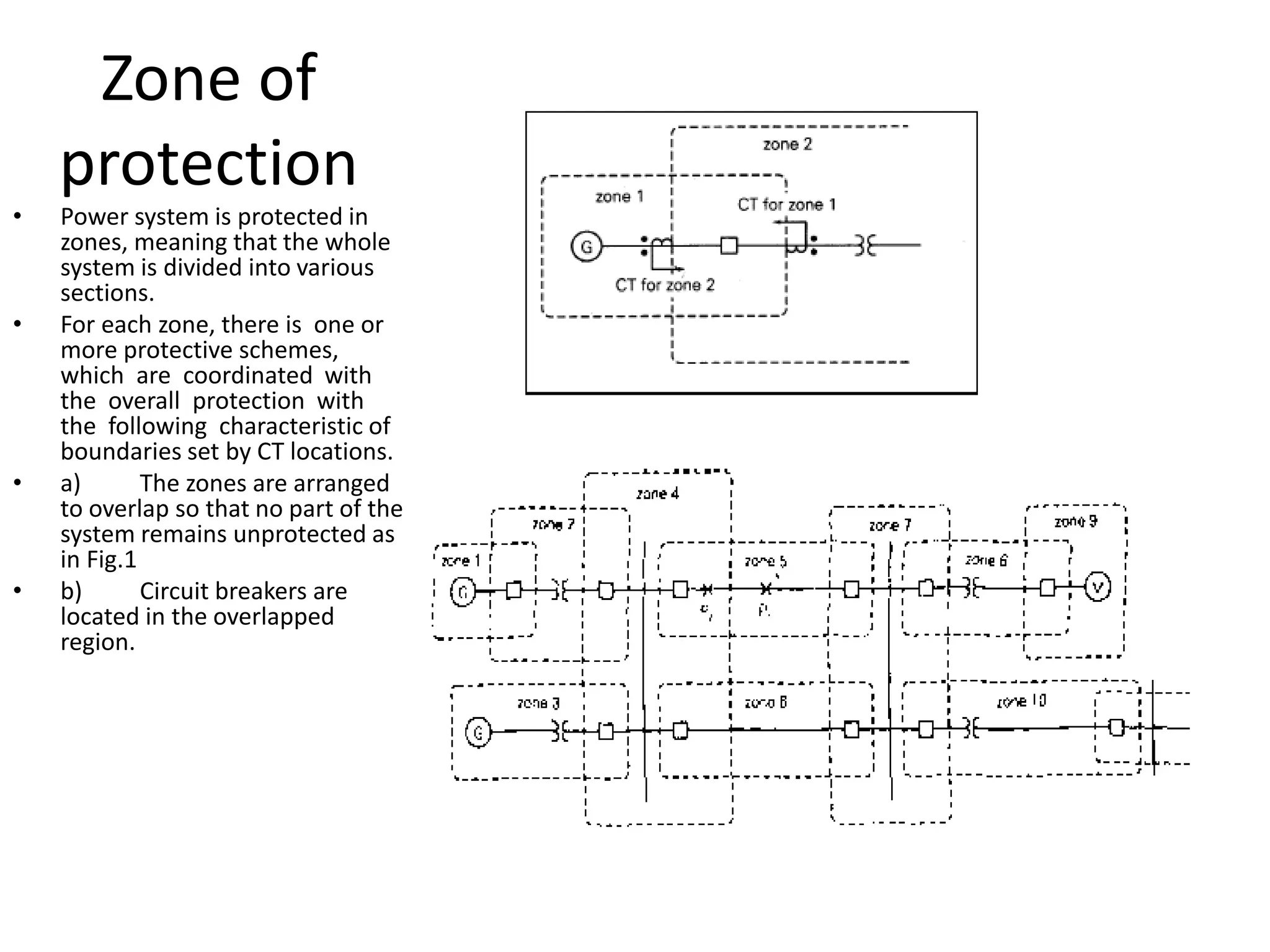
• a) The zones are arranged
to overlap so that no part of the
system remains unprotected as
in Fig.1
• b) Circuit breakers are
located in the overlapped
region.
Attributes of relaying
• Reliability: assurance that the relay will perform correctly.
Reliability has two aspects: Dependability & security
• Dependability is defined as the degree of certainty that a relay
system will operate correctly when required. On the other hand,
Security is the ability of the protection relay to avoid unnecessary
operation (malfunction) during day after day operation and for
faults outside the designated zone of protection. Such faults are
termed External or Through faults. In other words, dependability
indicates the ability of the protection system to perform correctly
when required, while security is its ability to avoid unnecessary
operation for external faults. Hence the protective relaying must be
ready to function, reliable and correct in-operation at all times
under any kind of fault and abnormal conditions of the power
system for which it has been designed.
• Selectivity: the relay scheme should be selective i.e., it should have the ability to
distinguish between the faults within its own zone of operation and the faults
outside the zone. The selective scheme ensures maximum continuity of service
with minimum system disconnection.
• Relays have an assigned area known as the primary protection zone. They must
promptly operate for any fault within that zone. However, relays may also operate
for a fault outside the zone. In these cases they provide backup protection for the
areas outside their primary zone; called the over-reached area. Selectivity is the
process of applying and setting the protective relays in a way that they operate
with fast speed for any fault within its primary zone of protection and are operated
with time lag for faults in their secondary zones for which they are to back up. This
is necessary to permit primary relays designed to this backup or over reached area
a sufficient time to operate. Otherwise, both sets of relays may operate for faults
in this over reached area. It is very important that backup protection should only
operate if the primary protection of that area fails to clear the fault.
•
• Speed : It minimizes fault duration and consequent
equipment damage. Speedy isolation of faulty portion of a
power system ensures:
– Improved power system stability
– Decreased amount of damage incurred
– Less annoyance to electric power consumers
– Less likely the development of one type of fault into other more
severe type
– Relay aid re-closure of circuit breakers to restore service to
customer.
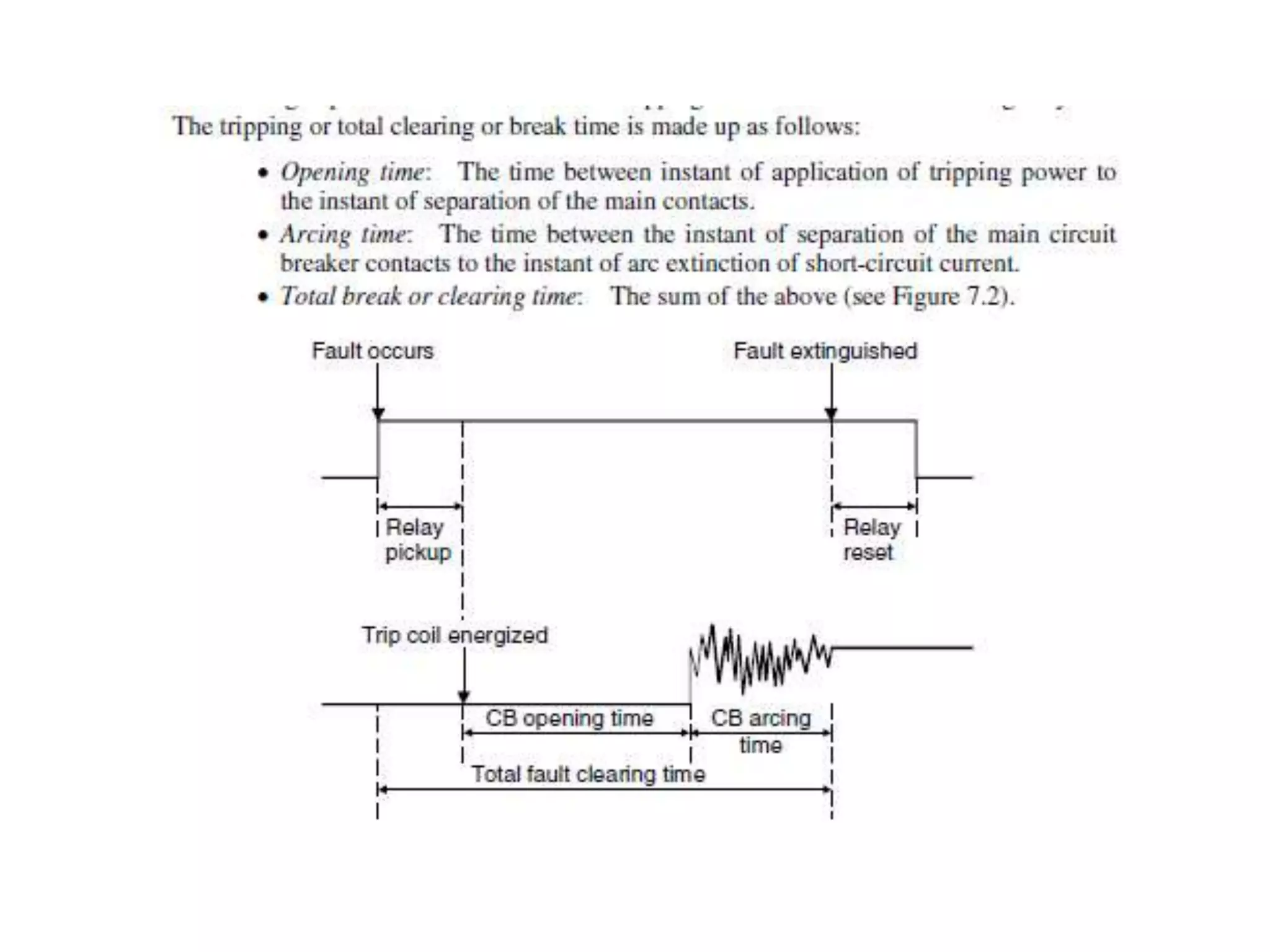
• clearing time “is the sum of the operating time of the
protective relaying and breaker interrupting time where:
• “The operating time of the protective relaying” is the time
elapsed from the instant of the fault occurrence up to the
closure of contact in the trip circuit of the circuit breaker
and
• “The breaker interrupting time” is the time elapsed from
the instant of the closing of trip circuit up to the instant
when the current is interrupted after the arc has extinct
between the open contacts of the circuit breaker .
• Modern high speed circuit protective relaying has operating
time of about 1.0 to 2.0 cycles i.e., 0.02 to 0.04 sec.
whereas modern high speed circuit breakers have
interrupting time of about 2.5 to 3.0 cycles i.e. 0.05 to 0.06
sc. Therefore the clearing time may be about 0.07 to 0.1
sec.
Protection schemes and zones

Protection schemes and zones

  • 1.
  • 2.
    Zone of protection • Powersystem is protected in zones, meaning that the whole system is divided into various sections. • For each zone, there is one or more protective schemes, which are coordinated with the overall protection with the following characteristic of boundaries set by CT locations. • a) The zones are arranged to overlap so that no part of the system remains unprotected as in Fig.1 • b) Circuit breakers are located in the overlapped region.
  • 3.
    Attributes of relaying •Reliability: assurance that the relay will perform correctly. Reliability has two aspects: Dependability & security • Dependability is defined as the degree of certainty that a relay system will operate correctly when required. On the other hand, Security is the ability of the protection relay to avoid unnecessary operation (malfunction) during day after day operation and for faults outside the designated zone of protection. Such faults are termed External or Through faults. In other words, dependability indicates the ability of the protection system to perform correctly when required, while security is its ability to avoid unnecessary operation for external faults. Hence the protective relaying must be ready to function, reliable and correct in-operation at all times under any kind of fault and abnormal conditions of the power system for which it has been designed.
  • 4.
    • Selectivity: therelay scheme should be selective i.e., it should have the ability to distinguish between the faults within its own zone of operation and the faults outside the zone. The selective scheme ensures maximum continuity of service with minimum system disconnection. • Relays have an assigned area known as the primary protection zone. They must promptly operate for any fault within that zone. However, relays may also operate for a fault outside the zone. In these cases they provide backup protection for the areas outside their primary zone; called the over-reached area. Selectivity is the process of applying and setting the protective relays in a way that they operate with fast speed for any fault within its primary zone of protection and are operated with time lag for faults in their secondary zones for which they are to back up. This is necessary to permit primary relays designed to this backup or over reached area a sufficient time to operate. Otherwise, both sets of relays may operate for faults in this over reached area. It is very important that backup protection should only operate if the primary protection of that area fails to clear the fault. •
  • 5.
    • Speed :It minimizes fault duration and consequent equipment damage. Speedy isolation of faulty portion of a power system ensures: – Improved power system stability – Decreased amount of damage incurred – Less annoyance to electric power consumers – Less likely the development of one type of fault into other more severe type – Relay aid re-closure of circuit breakers to restore service to customer. • clearing time “is the sum of the operating time of the protective relaying and breaker interrupting time where:
  • 6.
    • “The operatingtime of the protective relaying” is the time elapsed from the instant of the fault occurrence up to the closure of contact in the trip circuit of the circuit breaker and • “The breaker interrupting time” is the time elapsed from the instant of the closing of trip circuit up to the instant when the current is interrupted after the arc has extinct between the open contacts of the circuit breaker . • Modern high speed circuit protective relaying has operating time of about 1.0 to 2.0 cycles i.e., 0.02 to 0.04 sec. whereas modern high speed circuit breakers have interrupting time of about 2.5 to 3.0 cycles i.e. 0.05 to 0.06 sc. Therefore the clearing time may be about 0.07 to 0.1 sec.