CROP IDEOTYPE CONCEPT AND ITS
APPLICATIONS IN PLANT BREEDING
Varsha p vengilat
2017600823
• Alternative breeding strategy.
• Concept by Donald in 1968.
• Literal meaning: ‘A form denoting an idea’
• Definition: A crop ideotype is a plant model,
which is expected to yield a greater quantity or
quality of grain, oil or other useful product
when developed as a cultivar.
• Synonyms: model plant type, ideal model plant
type and ideal plant type.
Types of ideotype
• Isolation Ideotype- performs best when space planted.
- lax, free tillering, leafy spreading
plant in case of cereals.
• Competition Ideotype- in gentically heterogenous
populations.
-tall, leafy, free tillering plant
(cereals)
• Crop Ideotype- Best at commercial crop densities; a
poor competitor.
Development of ideotypes
Following knowledge while developing ideotype:
• Target area and target environment
• Quality considerations
• Current agronomic practices
• Adequate information
• Simulation models can be used as aids
Characteristics of a crop ideotype
• A weak competitor
• Efficient in utilizing environmental resources
• Sensitive to cultural practices
• Include morphological and physiological
characteristics that result in high harvest index
• Should be grown in a weed free envt
• Planned selection done for features of crop ideotype
Ideotypes of selected crops
RICE
First introduced by Matsushima in 1957, later by Jennings.
Ideotype for dwarf rice(By Chandler):
 Shorter culm length.
 Greater culm diameter
 Lower relative internode elongation under
 heavy nitrogen application
 Short erect leaves,medium length
 High tillering capacity
 More panicles/m2
WHEAT
Proposed by Donald(1968)
Short strong stem
Erect leaves
Few small leaves
Large, erect ear
Presence of awns
Single culm
Reduced height
Photoperiod insensitivity
Rust resistance etc.
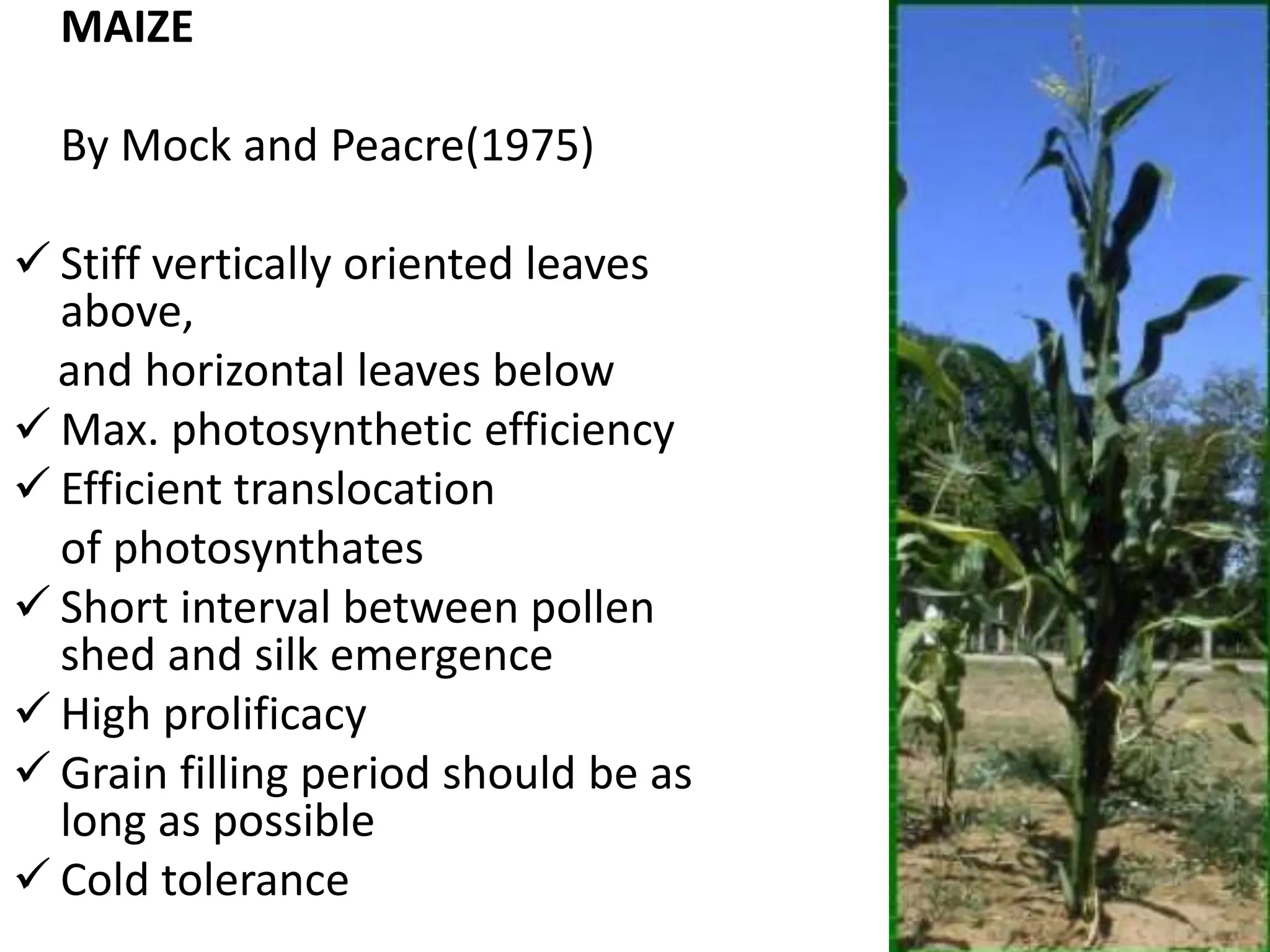
MAIZE
By Mock and Peacre(1975)
 Stiff vertically oriented leaves
above,
and horizontal leaves below
 Max. photosynthetic efficiency
 Efficient translocation
of photosynthates
 Short interval between pollen
shed and silk emergence
 High prolificacy
 Grain filling period should be as
long as possible
 Cold tolerance
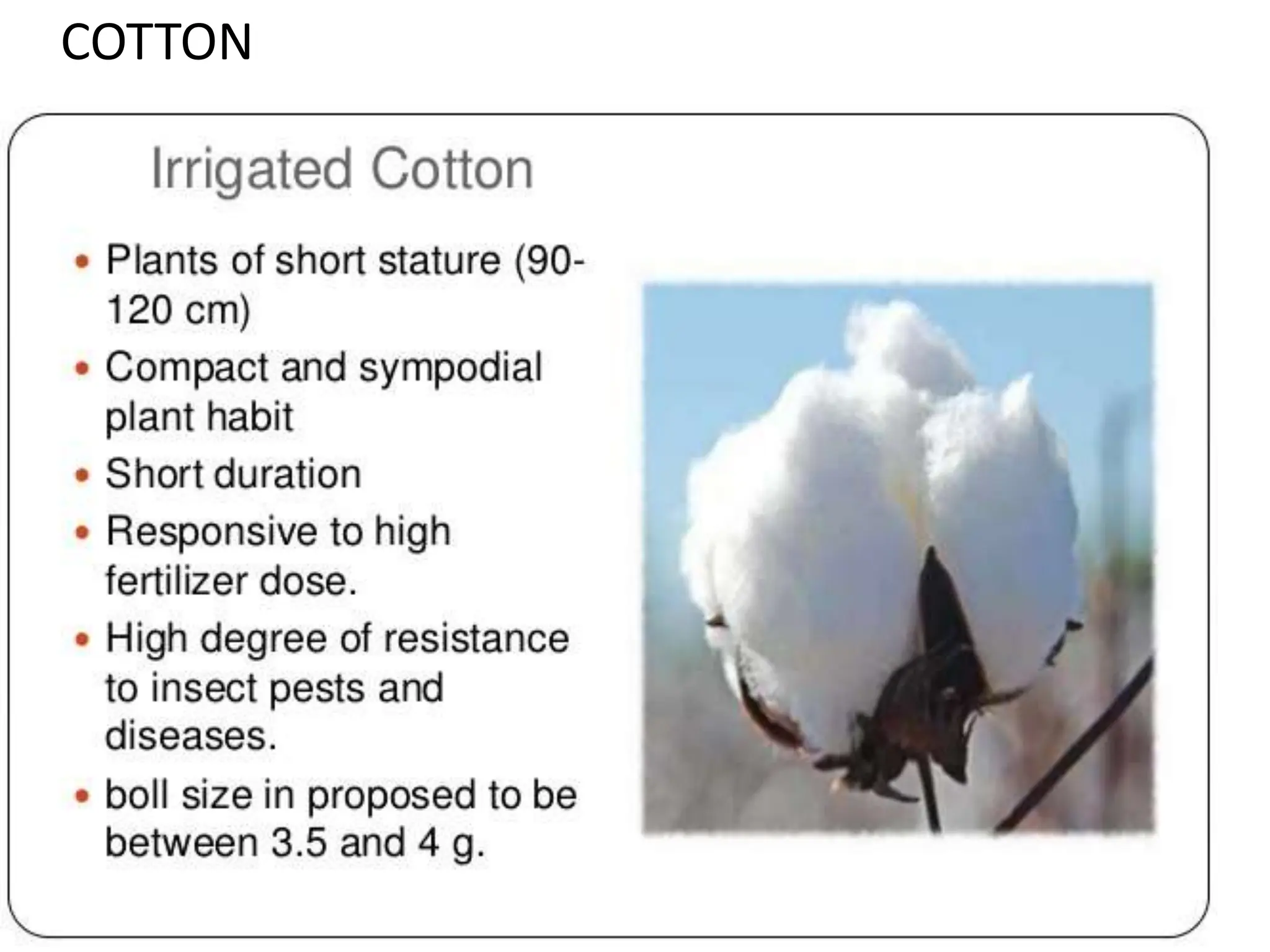
COTTON
PULSES
Determinate plant type
Erect and upright plant
Early vigour, early flowering and synchronous
maturity
Pod bearing from well above the soil surface
More pods/plant & no. of seeds/pod
Hgh Harvest Index
Yield stability
STEPS IN IDEOTYPE BREEDING
• Development of conceptual Model
• Selection o base model
• Incorporation of desirable traits
• Selection of Ideal Plant type
MERITS
• Effective method of enhancing yield. It exploits both morphological and
physiological variation.
• Provides solution to several problems at a time like disease, insect and
lodging resistance, maturity duration, yield and quality .
• Genes for specific traits can be introgressed from unimproved to
improved gene pool to develop desirable variability for the trait.
• Efficient method of developing cultivars for specific or environment.
• An effective method of breaking yield barriers through the use of
genetically controlled physiological variation for various characters
contributing towards higher yield.
LIMITATIONS OF IDEOTYPE BREEDING
• Incorporation of several desirable morphological and
physiological and disease resistance traits from different
sources into a single genotype is a difficult task.
• A slow method of cultivar development
• Changes with change in knowledge, new requirements,
national policy, etc.

CROP IDEOTYPE CONCEPT- WHEAT, BARLEY, MAIZE AND COTTON

  • 1.
    CROP IDEOTYPE CONCEPTAND ITS APPLICATIONS IN PLANT BREEDING Varsha p vengilat 2017600823
  • 2.
    • Alternative breedingstrategy. • Concept by Donald in 1968. • Literal meaning: ‘A form denoting an idea’ • Definition: A crop ideotype is a plant model, which is expected to yield a greater quantity or quality of grain, oil or other useful product when developed as a cultivar. • Synonyms: model plant type, ideal model plant type and ideal plant type.
  • 3.
    Types of ideotype •Isolation Ideotype- performs best when space planted. - lax, free tillering, leafy spreading plant in case of cereals. • Competition Ideotype- in gentically heterogenous populations. -tall, leafy, free tillering plant (cereals) • Crop Ideotype- Best at commercial crop densities; a poor competitor.
  • 4.
    Development of ideotypes Followingknowledge while developing ideotype: • Target area and target environment • Quality considerations • Current agronomic practices • Adequate information • Simulation models can be used as aids
  • 5.
    Characteristics of acrop ideotype • A weak competitor • Efficient in utilizing environmental resources • Sensitive to cultural practices • Include morphological and physiological characteristics that result in high harvest index • Should be grown in a weed free envt • Planned selection done for features of crop ideotype
  • 6.
    Ideotypes of selectedcrops RICE First introduced by Matsushima in 1957, later by Jennings. Ideotype for dwarf rice(By Chandler):  Shorter culm length.  Greater culm diameter  Lower relative internode elongation under  heavy nitrogen application  Short erect leaves,medium length  High tillering capacity  More panicles/m2
  • 7.
    WHEAT Proposed by Donald(1968) Shortstrong stem Erect leaves Few small leaves Large, erect ear Presence of awns Single culm Reduced height Photoperiod insensitivity Rust resistance etc.
  • 8.
    MAIZE By Mock andPeacre(1975)  Stiff vertically oriented leaves above, and horizontal leaves below  Max. photosynthetic efficiency  Efficient translocation of photosynthates  Short interval between pollen shed and silk emergence  High prolificacy  Grain filling period should be as long as possible  Cold tolerance
  • 9.
  • 11.
    PULSES Determinate plant type Erectand upright plant Early vigour, early flowering and synchronous maturity Pod bearing from well above the soil surface More pods/plant & no. of seeds/pod Hgh Harvest Index Yield stability
  • 12.
    STEPS IN IDEOTYPEBREEDING • Development of conceptual Model • Selection o base model • Incorporation of desirable traits • Selection of Ideal Plant type
  • 13.
    MERITS • Effective methodof enhancing yield. It exploits both morphological and physiological variation. • Provides solution to several problems at a time like disease, insect and lodging resistance, maturity duration, yield and quality . • Genes for specific traits can be introgressed from unimproved to improved gene pool to develop desirable variability for the trait. • Efficient method of developing cultivars for specific or environment. • An effective method of breaking yield barriers through the use of genetically controlled physiological variation for various characters contributing towards higher yield.
  • 14.
    LIMITATIONS OF IDEOTYPEBREEDING • Incorporation of several desirable morphological and physiological and disease resistance traits from different sources into a single genotype is a difficult task. • A slow method of cultivar development • Changes with change in knowledge, new requirements, national policy, etc.