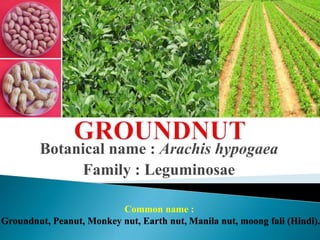
Botanical name : Arachis hypogaea
Family : Leguminosae
Common name :
Groundnut, Peanut, Monkey nut, Earth nut, Manila nut, moong fali (Hindi).
 Common name : Groundnut, Peanut, Monkey nut, Earth
nut, Manila nut,moong fali (Hindi).
 In Greek language ‘Arachis’ means legume and
‘hypogaea’ means below ground, referring to formation of
pods in the soil.
 Groundnut is an important oil and protein source to a large
portion of the population in Asia, Africa and the America.
 It is a self -pollinated, annual, herbaceous legume.
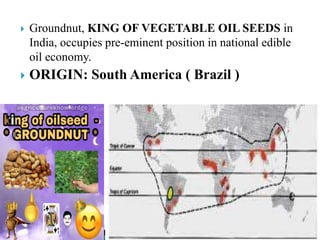
 Groundnut, KING OF VEGETABLE OIL SEEDS in
India, occupies pre-eminent position in national edible
oil economy.
 ORIGIN: South America ( Brazil )
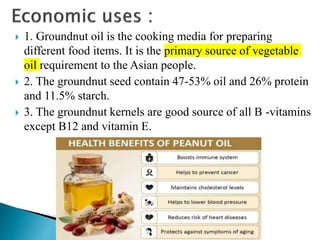
 1. Groundnut oil is the cooking media for preparing
different food items. It is the primary source of vegetable
oil requirement to the Asian people.
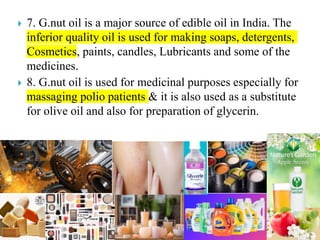
 2. The groundnut seed contain 47-53% oil and 26% protein
and 11.5% starch.
 3. The groundnut kernels are good source of all B -vitamins
except B12 and vitamin E.
 4. Groundnut kernels are rich in P, Ca & Mg including
micronutrients like Fe, Zn.
 5. Nearly 81% of the kernels are used for oil extraction
12% used for seed purpose
6% - raw materials
1% - exported in terms of Hand picked selections (HPS).
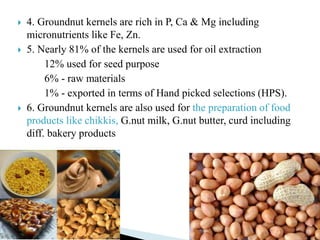
 6. Groundnut kernels are also used for the preparation of food
products like chikkis, G.nut milk, G.nut butter, curd including
diff. bakery products
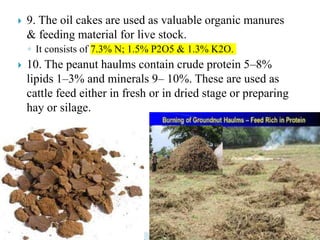
 7. G.nut oil is a major source of edible oil in India. The
inferior quality oil is used for making soaps, detergents,
Cosmetics, paints, candles, Lubricants and some of the
medicines.
 8. G.nut oil is used for medicinal purposes especially for
massaging polio patients & it is also used as a substitute
for olive oil and also for preparation of glycerin.
 9. The oil cakes are used as valuable organic manures
& feeding material for live stock.
◦ It consists of 7.3% N; 1.5% P2O5 & 1.3% K2O.
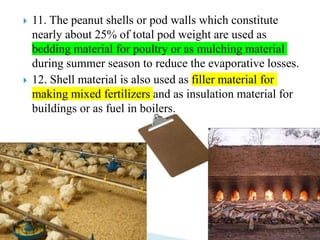
 10. The peanut haulms contain crude protein 5–8%
lipids 1–3% and minerals 9– 10%. These are used as
cattle feed either in fresh or in dried stage or preparing
hay or silage.
 11. The peanut shells or pod walls which constitute
nearly about 25% of total pod weight are used as
bedding material for poultry or as mulching material
during summer season to reduce the evaporative losses.
 12. Shell material is also used as filler material for
making mixed fertilizers and as insulation material for
buildings or as fuel in boilers.
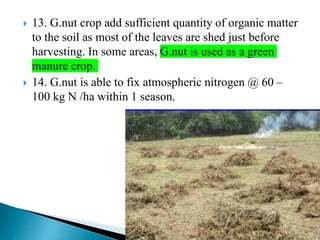
 13. G.nut crop add sufficient quantity of organic matter
to the soil as most of the leaves are shed just before
harvesting. In some areas, G.nut is used as a green
manure crop.
 14. G.nut is able to fix atmospheric nitrogen @ 60 –
100 kg N /ha within 1 season.
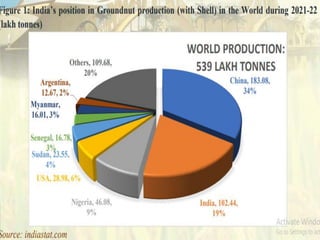
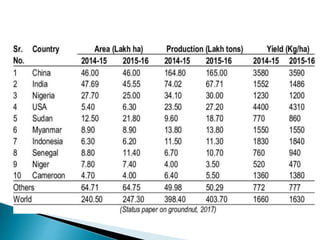
 Major groundnut producing countries are China, India,
Nigeria, USA, Indonesia, Argentina, Sudan, Senegal
and Myanmar.
 India ranks first in area and second in production
contributing to 40% of the area 36% of the world
production.
 G.nut accounts for 28% of the total area & 36% of total
oilseed production in the country.
Area Production Productivity
1. India 5.31 M .ha 7.57 M.t 1425 kg/ha
2. T.S 0.17 M .ha 0.33 M.t 1945 kg/ha
Global
Агеа: India > China > Nigeria
Production: China > India > Nigeria
India:
Area: AP > Gujarat > TN
Production: Gujarat > AP > TN
Productivity: Tamil Nadu (around 20 q/ha)
• Groundnut is cultivated in 2.0 lakh hectares across Telangana
region making it one of the major crops of the state.
• It is widely grown in Mahbubnagar, Warangal, Nalgonda and
Karimnagar Districts.
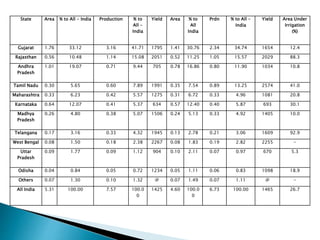
State Area % to All - India Production % to
All -
India
Yield Area % to
All
India
Prdn % to All -
India
Yield Area Under
Irrigation
(%)
Gujarat 1.76 33.12 3.16 41.71 1795 1.41 30.76 2.34 34.74 1654 12.4
Rajasthan 0.56 10.48 1.14 15.08 2051 0.52 11.25 1.05 15.57 2029 88.3
Andhra
Pradesh
1.01 19.07 0.71 9.44 705 0.78 16.86 0.80 11.90 1034 10.8
Tamil Nadu 0.30 5.65 0.60 7.89 1991 0.35 7.54 0.89 13.25 2574 41.0
Maharashtra 0.33 6.23 0.42 5.57 1275 0.31 6.72 0.33 4.96 1081 20.8
Karnataka 0.64 12.07 0.41 5.37 634 0.57 12.40 0.40 5.87 693 30.1
Madhya
Pradesh
0.26 4.80 0.38 5.07 1506 0.24 5.13 0.33 4.92 1405 10.0
Telangana 0.17 3.16 0.33 4.32 1945 0.13 2.78 0.21 3.06 1609 92.9
West Bengal 0.08 1.50 0.18 2.38 2267 0.08 1.83 0.19 2.82 2255 -
Uttar
Pradesh
0.09 1.77 0.09 1.12 904 0.10 2.11 0.07 0.97 670 5.3
Odisha 0.04 0.84 0.05 0.72 1234 0.05 1.11 0.06 0.83 1098 18.9
Others 0.07 1.30 0.10 1.32 @ 0.07 1.49 0.07 1.11 @ -
All India 5.31 100.00 7.57 100.0
0
1425 4.60 100.0
0
6.73 100.00 1465 26.7
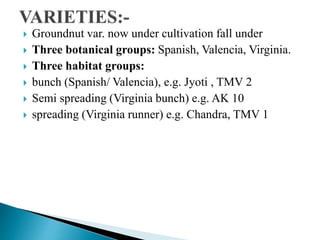
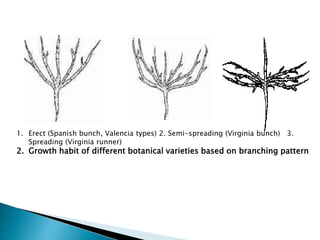
 Groundnut var. now under cultivation fall under
 Three botanical groups: Spanish, Valencia, Virginia.
 Three habitat groups:
 bunch (Spanish/ Valencia), e.g. Jyoti , TMV 2
 Semi spreading (Virginia bunch) e.g. AK 10
 spreading (Virginia runner) e.g. Chandra, TMV 1
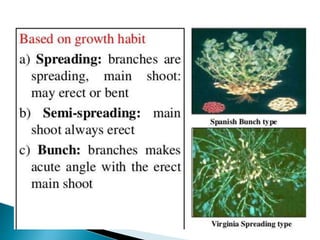
1. Erect (Spanish bunch, Valencia types) 2. Semi-spreading (Virginia bunch) 3.
Spreading (Virginia runner)
2. Growth habit of different botanical varieties based on branching pattern
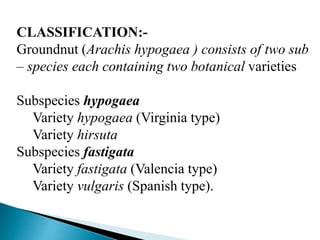
CLASSIFICATION:-
Groundnut (Arachis hypogaea ) consists of two sub
– species each containing two botanical varieties
Subspecies hypogaea
Variety hypogaea (Virginia type)
Variety hirsuta
Subspecies fastigata
Variety fastigata (Valencia type)
Variety vulgaris (Spanish type).
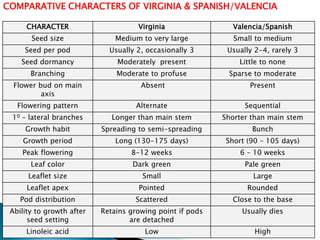
COMPARATIVE CHARACTERS OF VIRGINIA & SPANISH/VALENCIA
CHARACTER Virginia Valencia/Spanish
Seed size Medium to very large Small to medium
Seed per pod Usually 2, occasionally 3 Usually 2-4, rarely 3
Seed dormancy Moderately present Little to none
Branching Moderate to profuse Sparse to moderate
Flower bud on main
axis
Absent Present
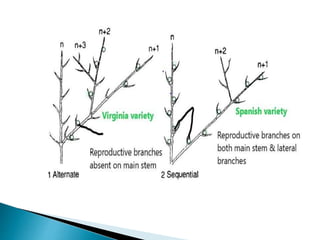
Flowering pattern Alternate Sequential
10 – lateral branches Longer than main stem Shorter than main stem
Growth habit Spreading to semi-spreading Bunch
Growth period Long (130-175 days) Short (90 – 105 days)
Peak flowering 8-12 weeks 6 – 10 weeks
Leaf color Dark green Pale green
Leaflet size Small Large
Leaflet apex Pointed Rounded
Pod distribution Scattered Close to the base
Ability to growth after
seed setting
Retains growing point if pods
are detached
Usually dies
Linoleic acid Low High
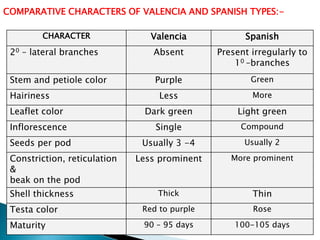
CHARACTER Valencia Spanish
20 – lateral branches Absent Present irregularly to
10 –branches
Stem and petiole color Purple Green
Hairiness Less More
Leaflet color Dark green Light green
Inflorescence Single Compound
Seeds per pod Usually 3 -4 Usually 2
Constriction, reticulation
&
beak on the pod
Less prominent More prominent
Shell thickness Thick Thin
Testa color Red to purple Rose
Maturity 90 – 95 days 100-105 days
COMPARATIVE CHARACTERS OF VALENCIA AND SPANISH TYPES:-
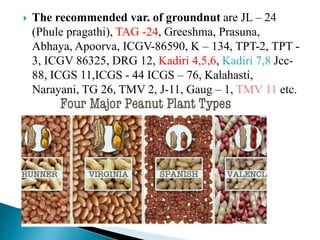
 The recommended var. of groundnut are JL – 24
(Phule pragathi), TAG -24, Greeshma, Prasuna,
Abhaya, Apoorva, ICGV-86590, K – 134, TPT-2, TPT -
3, ICGV 86325, DRG 12, Kadiri 4,5,6, Kadiri 7,8 Jcc-
88, ICGS 11,ICGS - 44 ICGS – 76, Kalahasti,
Narayani, TG 26, TMV 2, J-11, Gaug – 1, TMV 11 etc.
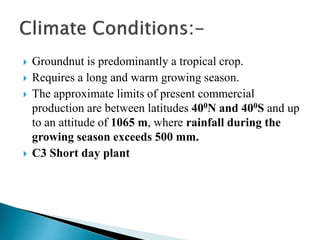
 Groundnut is predominantly a tropical crop.
 Requires a long and warm growing season.
 The approximate limits of present commercial
production are between latitudes 400N and 400S and up
to an attitude of 1065 m, where rainfall during the
growing season exceeds 500 mm.
 C3 Short day plant
 The crop can be grown successfully in places receiving a
minimum of 500 mm and a maximum of 1250 mm.
 From the productivity of groundnut in several countries, it is
evident that semi – arid and arid regions with 500 – 700 mm
rainfall during crop period are ideal for groundnut production.
 Soil temperature <180c delays emergence of seedlings.
 The embryo is killed above 540c.
 G.nut performs well in dry temperature range b/n 240c
& 330c. but it can survive up to 450c.
 Ideal temperature for reproductive stage is b/n 24–270c
 Rate of pod growth will be maximum b/n 300c & 340c.
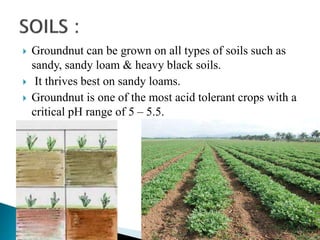
 Groundnut can be grown on all types of soils such as
sandy, sandy loam & heavy black soils.
 It thrives best on sandy loams.
 Groundnut is one of the most acid tolerant crops with a
critical pH range of 5 – 5.5.
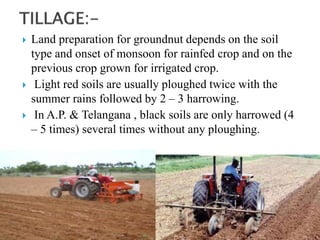
 Land preparation for groundnut depends on the soil
type and onset of monsoon for rainfed crop and on the
previous crop grown for irrigated crop.
 Light red soils are usually ploughed twice with the
summer rains followed by 2 – 3 harrowing.
 In A.P. & Telangana , black soils are only harrowed (4
– 5 times) several times without any ploughing.
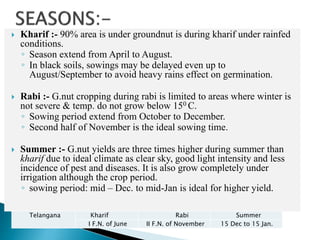
 Kharif :- 90% area is under groundnut is during kharif under rainfed
conditions.
◦ Season extend from April to August.
◦ In black soils, sowings may be delayed even up to
August/September to avoid heavy rains effect on germination.
 Rabi :- G.nut cropping during rabi is limited to areas where winter is
not severe & temp. do not grow below 150 C.
◦ Sowing period extend from October to December.
◦ Second half of November is the ideal sowing time.
 Summer :- G.nut yields are three times higher during summer than
kharif due to ideal climate as clear sky, good light intensity and less
incidence of pest and diseases. It is also grow completely under
irrigation although the crop period.
◦ sowing period: mid – Dec. to mid-Jan is ideal for higher yield.
Telangana Kharif Rabi Summer
I F.N. of June II F.N. of November 15 Dec to 15 Jan.
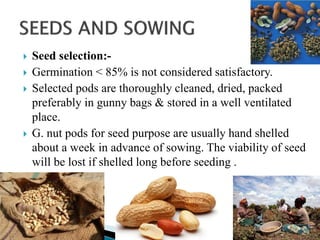
 Seed selection:-
 Germination < 85% is not considered satisfactory.
 Selected pods are thoroughly cleaned, dried, packed
preferably in gunny bags & stored in a well ventilated
place.
 G. nut pods for seed purpose are usually hand shelled
about a week in advance of sowing. The viability of seed
will be lost if shelled long before seeding .
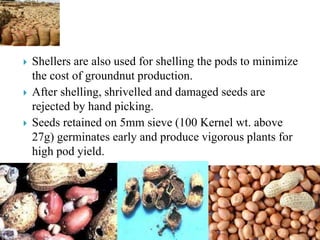
 Shellers are also used for shelling the pods to minimize
the cost of groundnut production.
 After shelling, shrivelled and damaged seeds are
rejected by hand picking.
 Seeds retained on 5mm sieve (100 Kernel wt. above
27g) germinates early and produce vigorous plants for
high pod yield.
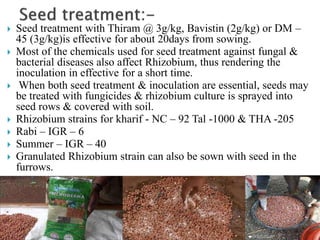
 Seed treatment with Thiram @ 3g/kg, Bavistin (2g/kg) or DM –
45 (3g/kg)is effective for about 20days from sowing.
 Most of the chemicals used for seed treatment against fungal &
bacterial diseases also affect Rhizobium, thus rendering the
inoculation in effective for a short time.
 When both seed treatment & inoculation are essential, seeds may
be treated with fungicides & rhizobium culture is sprayed into
seed rows & covered with soil.
 Rhizobium strains for kharif - NC – 92 Tal -1000 & THA -205
 Rabi – IGR – 6
 Summer – IGR – 40
 Granulated Rhizobium strain can also be sown with seed in the
furrows.
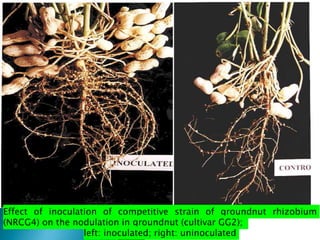
Effect of inoculation of competitive strain of groundnut rhizobium
(NRCG4) on the nodulation in groundnut (cultivar GG2);
left: inoculated; right: uninoculated
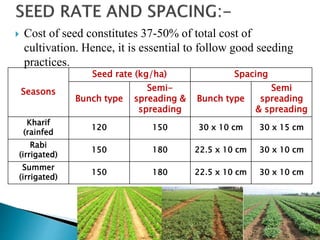
 Cost of seed constitutes 37-50% of total cost of
cultivation. Hence, it is essential to follow good seeding
practices.
Seasons
Seed rate (kg/ha) Spacing
Bunch type
Semi-
spreading &
spreading
Bunch type
Semi
spreading
& spreading
Kharif
(rainfed
120 150 30 x 10 cm 30 x 15 cm
Rabi
(irrigated)
150 180 22.5 x 10 cm 30 x 10 cm
Summer
(irrigated)
150 180 22.5 x 10 cm 30 x 10 cm
Kharif:- drilling or dropping seed in plough furrows at 5 -7 cm soil
depth.
Rabi & summer: - Dropping seed in plough furrow at 4 – 5 cm soil
depth.
Depth:-
In light, soils, the seeds are sown to a depth of 5 -7 cm and in
heavier soils to a depth of 4 -5 cm
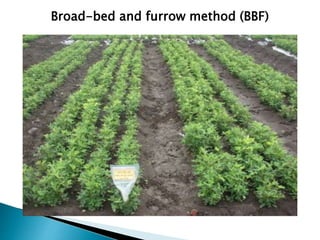
Broad-bed and furrow method (BBF)
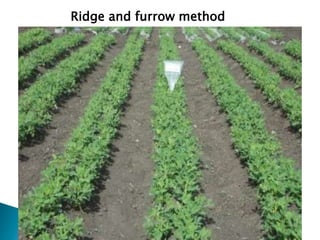
Ridge and furrow method
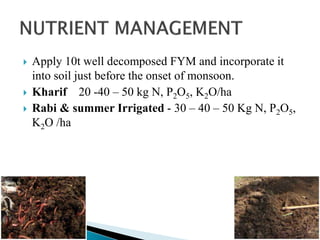
 Apply 10t well decomposed FYM and incorporate it
into soil just before the onset of monsoon.
 Kharif 20 -40 – 50 kg N, P2O5, K2O/ha
 Rabi & summer Irrigated - 30 – 40 – 50 Kg N, P2O5,
K2O /ha
NUTRIENT MANAGEMENT
For every tonne of pods & 2 t of haulms about 63 N, 11 P2O5, 46 K2O,
27 cao & 14 Mgo kg/ha are removed by the groundnut crop. A
balanced fertilizer programme with particular emphasis on p, k, ca &
mg is essential for opt. yield.
Apply 10t well decomposed FYM and incorporate it into soil just
before the onset of monsoon.
Nitrogen:-
Around 200 kg N/ha can be fixed under ideal conditions. Number of
cowpea cross inoculation group strains are available as NC-92 & TAL
1000, THA 205.
In general, 20 kg N /ha –rainfed G.nut
30 Kg N/ha – in 2 equal splits at seeding & 30 DAS –
irrigated crop.
However the nitrogen fixation process of plant starts working at about
20-30 days after sowing, when the nodule apparatus is fully formed.
Till that time to meet the requirement for plant growth, an initial
boost as starter dose of 10 kg/ha is necessary for rainfed groundnut.
Depending on the number of nodules, another 10 kg/ha at 30 DAS
can be top dressed depending on the rainfall.
Nitrogen should be preferably applied in the form of Ammonium
Sulphate as it also supplies the sulphur.
Phosphorus:-
It promotes root growth and multiplication of Rhizobium.
phosphurus is applied when the available phosphorus is < 35 kg/ha
Opt. doses are
Rainfed – 40 kg P2O5 /ha irrigated – 50 kg P2O5/ha
Single super phosphate is the best source as it contains 16% P2O5,
19.5% Ca & 12.5% Sulphur along with some traces of Zn & other
micronutrients traces. Therefore response to SSP is higher than with
DAP at equal nutrient basis.
Phosphobacteria as Pseudomonas striata and Bacillus polymixa
solubilises the native phosphorus and recorded 13-20% increase in
groundnut yield.
Mychorhizal fungi inoculations have been beneficial in field tests in
India and quantification of yield benefits are yet to be made in terms
of phosphorus fertilizer economy and production.
Potassium:-
Response is observed only when the available potassium in soil is <
150 kg/ha.
For rainfed groundnut - 40 kg/ha
For irrigated crop - 50 kg K2O/ha provided N is applied at
recommended rate
Calcium & sulphur: -
These two nutrients are absorbed by pegs & developing pods and the
common source of supply is gypsum.
 Adequate calcium is essential in root and pod zones for yield and quality of
kernels. Calcium deficiency leads to unfilled pods called pops and
darkening of plumules of embryo.
 Sulphur is highly essential as it is directly involved in the biosynthesis of
oil. It improves nodulation of Rhizobium and prevents the premature leaf
fall & increase the pod & oil yield.
 Ca & S are supplied to crop through cao or gypsum & it has been observed
to increase the yield by more than twice depending on its availability in the
soil.
 Gypsum application @ 500 kg/ha near pegging zone as top dressing at
flowering (30 DAS) appears to be ideal .
 If heavy rains occur within 2 weeks after application then a second lighter
application of gypsum is necessary around 3 weeks after first application.
K: Ca: Mg ratio :-
 G. nut is sensitive to imbalanced nutrient supply. The K:C:Mg ratio is more
important than the total amount.
 Increase in conc. of Mg in nutrient solution decrease K uptake by G. nut &
also decreases Ca uptake.
 There is a mutual antagonistic effect on the uptake of K, Ca & Mg.
 The ideal ratio is 4 : 4 : 2
Zinc, Boron & Iron:-
• ZINC: Zn def. is common on sandy & sandy loam soils. The
critical limit of available Zn in soil is <0.6 ppm.
• Application of Znso4 @ 2 kg /ha once in 2 years corrects the def
iciency. If it is observed in standing crop, foliar application of
0.2% ZnSO4 along with 0.2% lime can correct the deficiency.
• BORON: ‘B’ def. leads to HOLLOW HEART. Deficiency has been
reported in light soils of Punjab & T.N.
• The threshold level of boron is 0.25 ppm.
• Deficiency can be corrected by soil application of 5–10 kg/ha of
boron. In standing crop, corrected by 0.1% borax spray.
• IRON: Iron chlorosis is largely due to its reduced availability in the
soil. Immobilization of iron in the soil may be due to high levels
of lime, high PH (>7.6) or high levels of bicarbonates in soil or
irrigation.
• spraying of ferrous sulphate mixed with 1% of ammonium citrate
around 50 DAS corrects iron deficiency.
In Andhra Pradesh
Kharif 20 -40 – 50 kg N, P2O5, K2O/ha
Rabi & summer Irrigated -- 30 – 40 – 50 Kg N, P2O5, K2O /ha
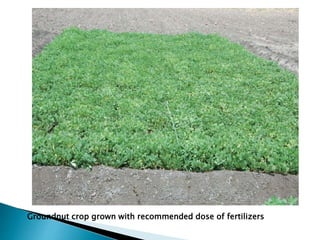
Groundnut crop grown with recommended dose of fertilizers
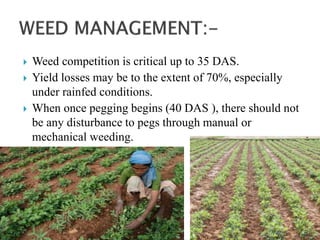
 Weed competition is critical up to 35 DAS.
 Yield losses may be to the extent of 70%, especially
under rainfed conditions.
 When once pegging begins (40 DAS ), there should not
be any disturbance to pegs through manual or
mechanical weeding.
 Hand weeding is done twice, first around 20 DAS &
2nd at about 35 DAS.
 Inter cultivation usually starts around 10 days after
emergence & continues up to 35 DAS at 7– 10 days
interval till pegging begins.
 Cost effective weed management under rainfed
conditions is, repeated intercultivations (harrowing) up
to 35 DAS followed by hand weeding.
 A mixture of oxadiazon & Dinoseb each @ 1.7 kg /ha gives
excellent control of weeds besides reducing stem rot in G.nut.
 Fluazifop (150 – 250 g) is a promising post herbicide for controlling
grasses, particularly cynodon dactylon, 35 – 40 DAS
 Pre-plant incorporation of Fluchloralin @ 1.25 – 1.5 kg/ha
 Pre-emergence application of Pendimethalnin @0.6-1.5 kg/ha or
Alachlor @ 1.5-2.0 kg/ha. followed by one intercultivation and one
hand weeding will effectively control the weeds.
 Wherever, pre-emergence herbicides could not apply, weeds can be
controlled by post-emergence herbicides by spraying Imazethaphyr
@ 750 ml/ha or Quizalofop ethyl @ 1.0 l/ha at 20 DAS when the
weeds are at 2 leaved stage.
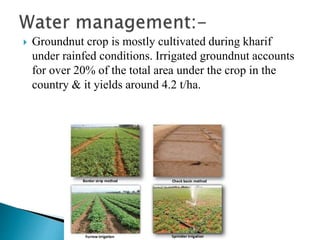
 Groundnut crop is mostly cultivated during kharif
under rainfed conditions. Irrigated groundnut accounts
for over 20% of the total area under the crop in the
country & it yields around 4.2 t/ha.
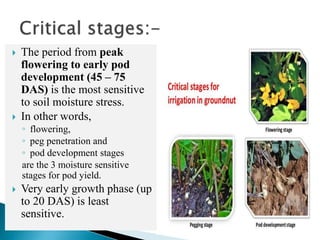
 The period from peak
flowering to early pod
development (45 – 75
DAS) is the most sensitive
to soil moisture stress.
 In other words,
◦ flowering,
◦ peg penetration and
◦ pod development stages
are the 3 moisture sensitive
stages for pod yield.
 Very early growth phase (up
to 20 DAS) is least
sensitive.
 On sandy loam soils, scheduling irrigations at 25% DASM
throughout the growth period results in high pod yield.
 Irrigating the crop at
 25% DASM – from pegging to early pod development
 50% DASM – at other stages appear to be ideal for high
WUE without significant reduction in pod yield.
 An IW/CPE ratio of 1.0 at moisture sensitive stages and 0.6
during other stages leads to high WUE.
 The water requirement of groundnut, on an average ranges
b/n 450 & 650 mm & WUE is 0.6 to 0.8 kg /m3 (pod yield
per unit of water evapo transpired ).
 If irrigation water is not limiting, then a total of 8 irrigations
are adequate for optimal yield.
 pre –sowing irrigation followed by an irrigation at 25 DAS,
4 irrigations at 10 days interval & final two irrigations at 15
days interval.
 At times of deficit supplies, an irrigation at 25 DAS
followed by 2 at 15 days interval b/n 45 & 75 DAS appears
to be minimum requirement & it can minimise yield losses
due to soil moisture stress.
 The first irrigation is given at 25 DAS to create moisture
stress in the soil which is desirable.
 to get the good root system.
 to reduce excessive vegetative growth.
 Encourage the better nodulation
 Induce heavy flowering in a single flush (synchronous
flowering)
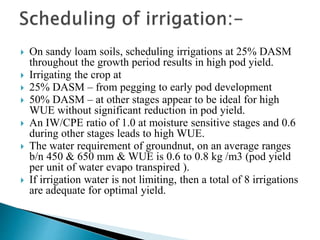
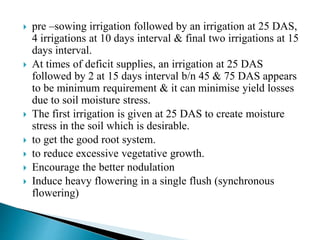
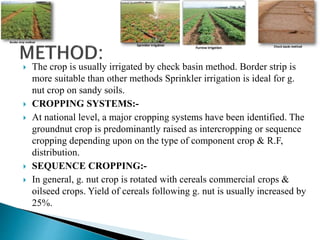
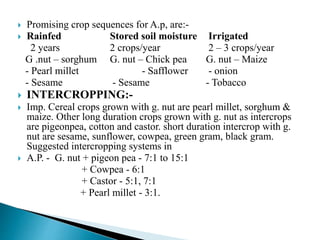
 The crop is usually irrigated by check basin method. Border strip is
more suitable than other methods Sprinkler irrigation is ideal for g.
nut crop on sandy soils.
 CROPPING SYSTEMS:-
 At national level, a major cropping systems have been identified. The
groundnut crop is predominantly raised as intercropping or sequence
cropping depending upon on the type of component crop & R.F,
distribution.
 SEQUENCE CROPPING:-
 In general, g. nut crop is rotated with cereals commercial crops &
oilseed crops. Yield of cereals following g. nut is usually increased by
25%.
 Promising crop sequences for A.p, are:-
 Rainfed Stored soil moisture Irrigated
2 years 2 crops/year 2 – 3 crops/year
G .nut – sorghum G. nut – Chick pea G. nut – Maize
- Pearl millet - Safflower - onion
- Sesame - Sesame - Tobacco
 INTERCROPPING:-
 Imp. Cereal crops grown with g. nut are pearl millet, sorghum &
maize. Other long duration crops grown with g. nut as intercrops
are pigeonpea, cotton and castor. short duration intercrop with g.
nut are sesame, sunflower, cowpea, green gram, black gram.
Suggested intercropping systems in
 A.P. - G. nut + pigeon pea - 7:1 to 15:1
+ Cowpea - 6:1
+ Castor - 5:1, 7:1
+ Pearl millet - 3:1.
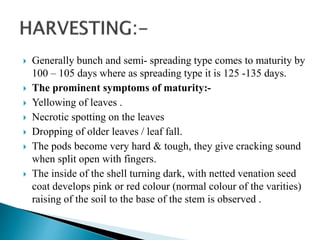
 Generally bunch and semi- spreading type comes to maturity by
100 – 105 days where as spreading type it is 125 -135 days.
 The prominent symptoms of maturity:-
 Yellowing of leaves .
 Necrotic spotting on the leaves
 Dropping of older leaves / leaf fall.
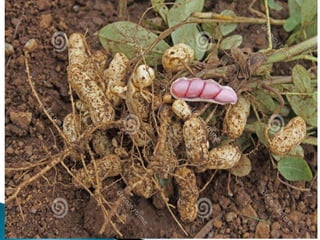
 The pods become very hard & tough, they give cracking sound
when split open with fingers.
 The inside of the shell turning dark, with netted venation seed
coat develops pink or red colour (normal colour of the varities)
raising of the soil to the base of the stem is observed .
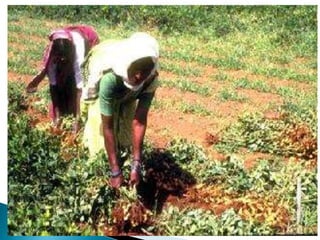
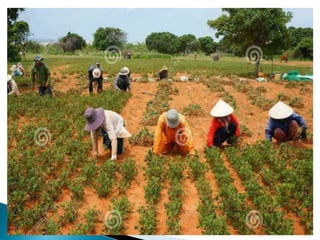
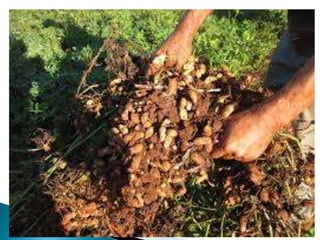
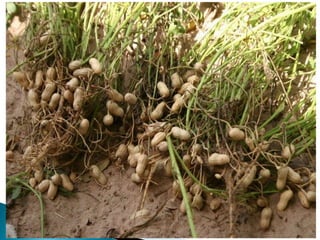
 Generally harvesting is done by pulling or lifting the
plants from the soil with pods intact. If soil moisture is
adequate, then hand pulling. If soil is dry, tractor or
bullock drawn blades are used for lifting the vines with
pods.
 Harvesting before maturity reduces yield & oil % &
seeds are highly susceptible to afflotoxins. If delayed,
results in increased incidence of stem rot, weakening of
gynophore/peduncle & some of the pods may remain in
soil itself at the time of harvesting.
 Stripping: - The process of separating pods from
haulms in bunch type, if vines are still green, plants is
knocked against a cross bar to dislodge the pods.
 The most common method is stripping pods with hand.
At the time of harvest, pods usually have moisture
content around 40 – 50% & hence need to be dried to
10% moisture content for safe storage.
 Drying should be done rapidly to prevent fungal
moulding
 Sun drying is the usual method of drying.
 Summer g. nut should be dried in shade to prevent loss
of viability, if it is for seed purpose.
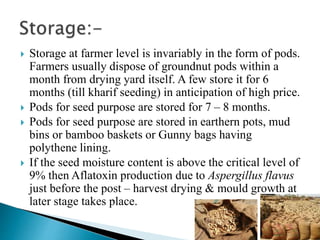
 Storage at farmer level is invariably in the form of pods.
Farmers usually dispose of groundnut pods within a
month from drying yard itself. A few store it for 6
months (till kharif seeding) in anticipation of high price.
 Pods for seed purpose are stored for 7 – 8 months.
 Pods for seed purpose are stored in earthern pots, mud
bins or bamboo baskets or Gunny bags having
polythene lining.
 If the seed moisture content is above the critical level of
9% then Aflatoxin production due to Aspergillus flavus
just before the post – harvest drying & mould growth at
later stage takes place.
 Groundnut kernel yield is the product of pod number, number
of kernels per pod and weight of kernels. Kernels per pod vary
from 1-5, pods per plant from 5-105 and 100 kernel weight
from 28 – 62 g (ICRISAT 1987). There is a high positive
correlation between the number of mature pods and pod yield.
 Yield:-
 Rainfed: - 10 – 15 q/ha
 Irrigated: - 20 – 25 q/ha.
 Harvest Index : The harvest index in groundnut varies
between 0.35 and 0.50 in groundnut.
 Quality of groundnut is largely determined by volume weight
of pods, shelling %, 100 kerenel weight, oil content, free
fatty acid content, colour of pods & testa colour.
 1) Volume weight of pods:-
 It is the wt. per unit vol. of pods, which indicates maturity &
development of kernels when the pods are disposed by
volume.
 Small pods have high volume weight than those of bigger
pods .
 The avg. 100 pod weight varies from 73g (7 MV – 2 ,
Spanish bunch) to 107 g (M -13- Virginia runner) Volume
weight is influenced by RF distribution at pod development
& Ca & S in pod zone.
 2) Shelling percentage:- Shelling – separation of
kernels from pods.
 It is the % of kernels to pods by weight.
 It ranges from 68% in M13 to 76% in TMV-2.
 Irrigated crop has lower shelling % than that of rainfed
crop.
 It depends on thickness of the shell, development of
kernel & following pattern during the crop period.
 It is influenced by genotype, Rainfall distribution & Ca
in pod zone.
 3)100 Kernel weight:-
 It is an indication of proper kernel development.
 Average 100 kernel weight ranges from 30 g (TMV 2) to 78 g (in
M13).
 It is a varietal character with marginal influence of RF
distribution, nutrient management & ability of translocation of
photosynthates from source to sink.
 4) Oil content :-
 It generally ranges from 48 – 51 %
 It depends on temperature during first 3 weeks of pod
development, maturity of kernels which is influenced by RF
during development stage & ‘S’ content in soil root zone.
 Virgina runners have higher oil content than Spanish bunch types.
 5) Oil quality :- The free fatty acid content in oil will
decide the shelf life of oil. Higher the free FA content
lesser is the quality & faster is the deterioration of oil
quality.
 Oil etracted from runner type have best quality due to
higher concentration of TOCOPHEROL.
 The ratio of saturated to unsaturated fatty acid also
decide oil quality. The ratio of oleic acid to linoleic acid
should be > 1.6 to have long shelf life.
 Colour of pods and testa of kernel:-
 Attractive colour of the pod & testa gets higher price in the
markets especially for direct consumption. In general, light
golden yellow colour of pods are preferred & fetch more
price in market. Kernels with pink , rose or light brown testa
are preferred.
 Grading :-
 For easy marketing of pods & kernels the grading is done.
Pods are graded into 3 categories & kernels into 4 categories
based on size.
 PODS KERNELS
 1) Large/bold 1) Extra large
 2) Medium size 2) Large
 3) small size 3) Jumbo(shrivelled)
 4) Splits(ill filled)
 EXPORT POTENTIAL:-
 HPSK & G.nut oil cake are exported to other countries.
But in recent years export of these products are
drastically reduced due to increase afflatoxin load in
the products & increasing demestic demand.
 China is the largest exporter of HPS kernels followed
by USA & india.
 The Indian share for the export of Hps is only 2%
 G. nut cake is a good veg. protein & poultry feed. India
is exporting large quantity of GN cake in western
countries till 1980. Later on the export of G.nut cake
was significantly reduce d due to higher levels of
Aflatoxins.

groundnut cultivation practices and quality parameters.pptx

  • 1.
    Botanical name :Arachis hypogaea Family : Leguminosae Common name : Groundnut, Peanut, Monkey nut, Earth nut, Manila nut, moong fali (Hindi).
  • 2.
     Common name: Groundnut, Peanut, Monkey nut, Earth nut, Manila nut,moong fali (Hindi).  In Greek language ‘Arachis’ means legume and ‘hypogaea’ means below ground, referring to formation of pods in the soil.  Groundnut is an important oil and protein source to a large portion of the population in Asia, Africa and the America.  It is a self -pollinated, annual, herbaceous legume.
  • 3.
     Groundnut, KINGOF VEGETABLE OIL SEEDS in India, occupies pre-eminent position in national edible oil economy.  ORIGIN: South America ( Brazil )
  • 4.
     1. Groundnutoil is the cooking media for preparing different food items. It is the primary source of vegetable oil requirement to the Asian people.  2. The groundnut seed contain 47-53% oil and 26% protein and 11.5% starch.  3. The groundnut kernels are good source of all B -vitamins except B12 and vitamin E.
  • 5.
     4. Groundnutkernels are rich in P, Ca & Mg including micronutrients like Fe, Zn.  5. Nearly 81% of the kernels are used for oil extraction 12% used for seed purpose 6% - raw materials 1% - exported in terms of Hand picked selections (HPS).  6. Groundnut kernels are also used for the preparation of food products like chikkis, G.nut milk, G.nut butter, curd including diff. bakery products
  • 6.
     7. G.nutoil is a major source of edible oil in India. The inferior quality oil is used for making soaps, detergents, Cosmetics, paints, candles, Lubricants and some of the medicines.  8. G.nut oil is used for medicinal purposes especially for massaging polio patients & it is also used as a substitute for olive oil and also for preparation of glycerin.
  • 7.
     9. Theoil cakes are used as valuable organic manures & feeding material for live stock. ◦ It consists of 7.3% N; 1.5% P2O5 & 1.3% K2O.  10. The peanut haulms contain crude protein 5–8% lipids 1–3% and minerals 9– 10%. These are used as cattle feed either in fresh or in dried stage or preparing hay or silage.
  • 8.
     11. Thepeanut shells or pod walls which constitute nearly about 25% of total pod weight are used as bedding material for poultry or as mulching material during summer season to reduce the evaporative losses.  12. Shell material is also used as filler material for making mixed fertilizers and as insulation material for buildings or as fuel in boilers.
  • 9.
     13. G.nutcrop add sufficient quantity of organic matter to the soil as most of the leaves are shed just before harvesting. In some areas, G.nut is used as a green manure crop.  14. G.nut is able to fix atmospheric nitrogen @ 60 – 100 kg N /ha within 1 season.
  • 10.
     Major groundnutproducing countries are China, India, Nigeria, USA, Indonesia, Argentina, Sudan, Senegal and Myanmar.  India ranks first in area and second in production contributing to 40% of the area 36% of the world production.  G.nut accounts for 28% of the total area & 36% of total oilseed production in the country. Area Production Productivity 1. India 5.31 M .ha 7.57 M.t 1425 kg/ha 2. T.S 0.17 M .ha 0.33 M.t 1945 kg/ha
  • 12.
    Global Агеа: India >China > Nigeria Production: China > India > Nigeria India: Area: AP > Gujarat > TN Production: Gujarat > AP > TN Productivity: Tamil Nadu (around 20 q/ha) • Groundnut is cultivated in 2.0 lakh hectares across Telangana region making it one of the major crops of the state. • It is widely grown in Mahbubnagar, Warangal, Nalgonda and Karimnagar Districts.
  • 14.
    State Area %to All - India Production % to All - India Yield Area % to All India Prdn % to All - India Yield Area Under Irrigation (%) Gujarat 1.76 33.12 3.16 41.71 1795 1.41 30.76 2.34 34.74 1654 12.4 Rajasthan 0.56 10.48 1.14 15.08 2051 0.52 11.25 1.05 15.57 2029 88.3 Andhra Pradesh 1.01 19.07 0.71 9.44 705 0.78 16.86 0.80 11.90 1034 10.8 Tamil Nadu 0.30 5.65 0.60 7.89 1991 0.35 7.54 0.89 13.25 2574 41.0 Maharashtra 0.33 6.23 0.42 5.57 1275 0.31 6.72 0.33 4.96 1081 20.8 Karnataka 0.64 12.07 0.41 5.37 634 0.57 12.40 0.40 5.87 693 30.1 Madhya Pradesh 0.26 4.80 0.38 5.07 1506 0.24 5.13 0.33 4.92 1405 10.0 Telangana 0.17 3.16 0.33 4.32 1945 0.13 2.78 0.21 3.06 1609 92.9 West Bengal 0.08 1.50 0.18 2.38 2267 0.08 1.83 0.19 2.82 2255 - Uttar Pradesh 0.09 1.77 0.09 1.12 904 0.10 2.11 0.07 0.97 670 5.3 Odisha 0.04 0.84 0.05 0.72 1234 0.05 1.11 0.06 0.83 1098 18.9 Others 0.07 1.30 0.10 1.32 @ 0.07 1.49 0.07 1.11 @ - All India 5.31 100.00 7.57 100.0 0 1425 4.60 100.0 0 6.73 100.00 1465 26.7
  • 15.
     Groundnut var.now under cultivation fall under  Three botanical groups: Spanish, Valencia, Virginia.  Three habitat groups:  bunch (Spanish/ Valencia), e.g. Jyoti , TMV 2  Semi spreading (Virginia bunch) e.g. AK 10  spreading (Virginia runner) e.g. Chandra, TMV 1
  • 17.
    1. Erect (Spanishbunch, Valencia types) 2. Semi-spreading (Virginia bunch) 3. Spreading (Virginia runner) 2. Growth habit of different botanical varieties based on branching pattern
  • 18.
    CLASSIFICATION:- Groundnut (Arachis hypogaea) consists of two sub – species each containing two botanical varieties Subspecies hypogaea Variety hypogaea (Virginia type) Variety hirsuta Subspecies fastigata Variety fastigata (Valencia type) Variety vulgaris (Spanish type).
  • 19.
    COMPARATIVE CHARACTERS OFVIRGINIA & SPANISH/VALENCIA CHARACTER Virginia Valencia/Spanish Seed size Medium to very large Small to medium Seed per pod Usually 2, occasionally 3 Usually 2-4, rarely 3 Seed dormancy Moderately present Little to none Branching Moderate to profuse Sparse to moderate Flower bud on main axis Absent Present Flowering pattern Alternate Sequential 10 – lateral branches Longer than main stem Shorter than main stem Growth habit Spreading to semi-spreading Bunch Growth period Long (130-175 days) Short (90 – 105 days) Peak flowering 8-12 weeks 6 – 10 weeks Leaf color Dark green Pale green Leaflet size Small Large Leaflet apex Pointed Rounded Pod distribution Scattered Close to the base Ability to growth after seed setting Retains growing point if pods are detached Usually dies Linoleic acid Low High
  • 21.
    CHARACTER Valencia Spanish 20– lateral branches Absent Present irregularly to 10 –branches Stem and petiole color Purple Green Hairiness Less More Leaflet color Dark green Light green Inflorescence Single Compound Seeds per pod Usually 3 -4 Usually 2 Constriction, reticulation & beak on the pod Less prominent More prominent Shell thickness Thick Thin Testa color Red to purple Rose Maturity 90 – 95 days 100-105 days COMPARATIVE CHARACTERS OF VALENCIA AND SPANISH TYPES:-
  • 22.
     The recommendedvar. of groundnut are JL – 24 (Phule pragathi), TAG -24, Greeshma, Prasuna, Abhaya, Apoorva, ICGV-86590, K – 134, TPT-2, TPT - 3, ICGV 86325, DRG 12, Kadiri 4,5,6, Kadiri 7,8 Jcc- 88, ICGS 11,ICGS - 44 ICGS – 76, Kalahasti, Narayani, TG 26, TMV 2, J-11, Gaug – 1, TMV 11 etc.
  • 23.
     Groundnut ispredominantly a tropical crop.  Requires a long and warm growing season.  The approximate limits of present commercial production are between latitudes 400N and 400S and up to an attitude of 1065 m, where rainfall during the growing season exceeds 500 mm.  C3 Short day plant
  • 24.
     The cropcan be grown successfully in places receiving a minimum of 500 mm and a maximum of 1250 mm.  From the productivity of groundnut in several countries, it is evident that semi – arid and arid regions with 500 – 700 mm rainfall during crop period are ideal for groundnut production.
  • 25.
     Soil temperature<180c delays emergence of seedlings.  The embryo is killed above 540c.  G.nut performs well in dry temperature range b/n 240c & 330c. but it can survive up to 450c.  Ideal temperature for reproductive stage is b/n 24–270c  Rate of pod growth will be maximum b/n 300c & 340c.
  • 26.
     Groundnut canbe grown on all types of soils such as sandy, sandy loam & heavy black soils.  It thrives best on sandy loams.  Groundnut is one of the most acid tolerant crops with a critical pH range of 5 – 5.5.
  • 27.
     Land preparationfor groundnut depends on the soil type and onset of monsoon for rainfed crop and on the previous crop grown for irrigated crop.  Light red soils are usually ploughed twice with the summer rains followed by 2 – 3 harrowing.  In A.P. & Telangana , black soils are only harrowed (4 – 5 times) several times without any ploughing.
  • 28.
     Kharif :-90% area is under groundnut is during kharif under rainfed conditions. ◦ Season extend from April to August. ◦ In black soils, sowings may be delayed even up to August/September to avoid heavy rains effect on germination.  Rabi :- G.nut cropping during rabi is limited to areas where winter is not severe & temp. do not grow below 150 C. ◦ Sowing period extend from October to December. ◦ Second half of November is the ideal sowing time.  Summer :- G.nut yields are three times higher during summer than kharif due to ideal climate as clear sky, good light intensity and less incidence of pest and diseases. It is also grow completely under irrigation although the crop period. ◦ sowing period: mid – Dec. to mid-Jan is ideal for higher yield. Telangana Kharif Rabi Summer I F.N. of June II F.N. of November 15 Dec to 15 Jan.
  • 29.
     Seed selection:- Germination < 85% is not considered satisfactory.  Selected pods are thoroughly cleaned, dried, packed preferably in gunny bags & stored in a well ventilated place.  G. nut pods for seed purpose are usually hand shelled about a week in advance of sowing. The viability of seed will be lost if shelled long before seeding .
  • 30.
     Shellers arealso used for shelling the pods to minimize the cost of groundnut production.  After shelling, shrivelled and damaged seeds are rejected by hand picking.  Seeds retained on 5mm sieve (100 Kernel wt. above 27g) germinates early and produce vigorous plants for high pod yield.
  • 31.
     Seed treatmentwith Thiram @ 3g/kg, Bavistin (2g/kg) or DM – 45 (3g/kg)is effective for about 20days from sowing.  Most of the chemicals used for seed treatment against fungal & bacterial diseases also affect Rhizobium, thus rendering the inoculation in effective for a short time.  When both seed treatment & inoculation are essential, seeds may be treated with fungicides & rhizobium culture is sprayed into seed rows & covered with soil.  Rhizobium strains for kharif - NC – 92 Tal -1000 & THA -205  Rabi – IGR – 6  Summer – IGR – 40  Granulated Rhizobium strain can also be sown with seed in the furrows.
  • 32.
    Effect of inoculationof competitive strain of groundnut rhizobium (NRCG4) on the nodulation in groundnut (cultivar GG2); left: inoculated; right: uninoculated
  • 33.
     Cost ofseed constitutes 37-50% of total cost of cultivation. Hence, it is essential to follow good seeding practices. Seasons Seed rate (kg/ha) Spacing Bunch type Semi- spreading & spreading Bunch type Semi spreading & spreading Kharif (rainfed 120 150 30 x 10 cm 30 x 15 cm Rabi (irrigated) 150 180 22.5 x 10 cm 30 x 10 cm Summer (irrigated) 150 180 22.5 x 10 cm 30 x 10 cm
  • 34.
    Kharif:- drilling ordropping seed in plough furrows at 5 -7 cm soil depth. Rabi & summer: - Dropping seed in plough furrow at 4 – 5 cm soil depth. Depth:- In light, soils, the seeds are sown to a depth of 5 -7 cm and in heavier soils to a depth of 4 -5 cm
  • 35.
  • 36.
  • 37.
     Apply 10twell decomposed FYM and incorporate it into soil just before the onset of monsoon.  Kharif 20 -40 – 50 kg N, P2O5, K2O/ha  Rabi & summer Irrigated - 30 – 40 – 50 Kg N, P2O5, K2O /ha
  • 38.
    NUTRIENT MANAGEMENT For everytonne of pods & 2 t of haulms about 63 N, 11 P2O5, 46 K2O, 27 cao & 14 Mgo kg/ha are removed by the groundnut crop. A balanced fertilizer programme with particular emphasis on p, k, ca & mg is essential for opt. yield. Apply 10t well decomposed FYM and incorporate it into soil just before the onset of monsoon. Nitrogen:- Around 200 kg N/ha can be fixed under ideal conditions. Number of cowpea cross inoculation group strains are available as NC-92 & TAL 1000, THA 205. In general, 20 kg N /ha –rainfed G.nut 30 Kg N/ha – in 2 equal splits at seeding & 30 DAS – irrigated crop. However the nitrogen fixation process of plant starts working at about 20-30 days after sowing, when the nodule apparatus is fully formed. Till that time to meet the requirement for plant growth, an initial boost as starter dose of 10 kg/ha is necessary for rainfed groundnut. Depending on the number of nodules, another 10 kg/ha at 30 DAS can be top dressed depending on the rainfall. Nitrogen should be preferably applied in the form of Ammonium Sulphate as it also supplies the sulphur.
  • 39.
    Phosphorus:- It promotes rootgrowth and multiplication of Rhizobium. phosphurus is applied when the available phosphorus is < 35 kg/ha Opt. doses are Rainfed – 40 kg P2O5 /ha irrigated – 50 kg P2O5/ha Single super phosphate is the best source as it contains 16% P2O5, 19.5% Ca & 12.5% Sulphur along with some traces of Zn & other micronutrients traces. Therefore response to SSP is higher than with DAP at equal nutrient basis. Phosphobacteria as Pseudomonas striata and Bacillus polymixa solubilises the native phosphorus and recorded 13-20% increase in groundnut yield. Mychorhizal fungi inoculations have been beneficial in field tests in India and quantification of yield benefits are yet to be made in terms of phosphorus fertilizer economy and production. Potassium:- Response is observed only when the available potassium in soil is < 150 kg/ha. For rainfed groundnut - 40 kg/ha For irrigated crop - 50 kg K2O/ha provided N is applied at recommended rate
  • 40.
    Calcium & sulphur:- These two nutrients are absorbed by pegs & developing pods and the common source of supply is gypsum.  Adequate calcium is essential in root and pod zones for yield and quality of kernels. Calcium deficiency leads to unfilled pods called pops and darkening of plumules of embryo.  Sulphur is highly essential as it is directly involved in the biosynthesis of oil. It improves nodulation of Rhizobium and prevents the premature leaf fall & increase the pod & oil yield.  Ca & S are supplied to crop through cao or gypsum & it has been observed to increase the yield by more than twice depending on its availability in the soil.  Gypsum application @ 500 kg/ha near pegging zone as top dressing at flowering (30 DAS) appears to be ideal .  If heavy rains occur within 2 weeks after application then a second lighter application of gypsum is necessary around 3 weeks after first application. K: Ca: Mg ratio :-  G. nut is sensitive to imbalanced nutrient supply. The K:C:Mg ratio is more important than the total amount.  Increase in conc. of Mg in nutrient solution decrease K uptake by G. nut & also decreases Ca uptake.  There is a mutual antagonistic effect on the uptake of K, Ca & Mg.  The ideal ratio is 4 : 4 : 2
  • 41.
    Zinc, Boron &Iron:- • ZINC: Zn def. is common on sandy & sandy loam soils. The critical limit of available Zn in soil is <0.6 ppm. • Application of Znso4 @ 2 kg /ha once in 2 years corrects the def iciency. If it is observed in standing crop, foliar application of 0.2% ZnSO4 along with 0.2% lime can correct the deficiency. • BORON: ‘B’ def. leads to HOLLOW HEART. Deficiency has been reported in light soils of Punjab & T.N. • The threshold level of boron is 0.25 ppm. • Deficiency can be corrected by soil application of 5–10 kg/ha of boron. In standing crop, corrected by 0.1% borax spray. • IRON: Iron chlorosis is largely due to its reduced availability in the soil. Immobilization of iron in the soil may be due to high levels of lime, high PH (>7.6) or high levels of bicarbonates in soil or irrigation. • spraying of ferrous sulphate mixed with 1% of ammonium citrate around 50 DAS corrects iron deficiency. In Andhra Pradesh Kharif 20 -40 – 50 kg N, P2O5, K2O/ha Rabi & summer Irrigated -- 30 – 40 – 50 Kg N, P2O5, K2O /ha
  • 42.
    Groundnut crop grownwith recommended dose of fertilizers
  • 43.
     Weed competitionis critical up to 35 DAS.  Yield losses may be to the extent of 70%, especially under rainfed conditions.  When once pegging begins (40 DAS ), there should not be any disturbance to pegs through manual or mechanical weeding.
  • 44.
     Hand weedingis done twice, first around 20 DAS & 2nd at about 35 DAS.  Inter cultivation usually starts around 10 days after emergence & continues up to 35 DAS at 7– 10 days interval till pegging begins.  Cost effective weed management under rainfed conditions is, repeated intercultivations (harrowing) up to 35 DAS followed by hand weeding.
  • 45.
     A mixtureof oxadiazon & Dinoseb each @ 1.7 kg /ha gives excellent control of weeds besides reducing stem rot in G.nut.  Fluazifop (150 – 250 g) is a promising post herbicide for controlling grasses, particularly cynodon dactylon, 35 – 40 DAS  Pre-plant incorporation of Fluchloralin @ 1.25 – 1.5 kg/ha  Pre-emergence application of Pendimethalnin @0.6-1.5 kg/ha or Alachlor @ 1.5-2.0 kg/ha. followed by one intercultivation and one hand weeding will effectively control the weeds.  Wherever, pre-emergence herbicides could not apply, weeds can be controlled by post-emergence herbicides by spraying Imazethaphyr @ 750 ml/ha or Quizalofop ethyl @ 1.0 l/ha at 20 DAS when the weeds are at 2 leaved stage.
  • 46.
     Groundnut cropis mostly cultivated during kharif under rainfed conditions. Irrigated groundnut accounts for over 20% of the total area under the crop in the country & it yields around 4.2 t/ha.
  • 47.
     The periodfrom peak flowering to early pod development (45 – 75 DAS) is the most sensitive to soil moisture stress.  In other words, ◦ flowering, ◦ peg penetration and ◦ pod development stages are the 3 moisture sensitive stages for pod yield.  Very early growth phase (up to 20 DAS) is least sensitive.
  • 48.
     On sandyloam soils, scheduling irrigations at 25% DASM throughout the growth period results in high pod yield.  Irrigating the crop at  25% DASM – from pegging to early pod development  50% DASM – at other stages appear to be ideal for high WUE without significant reduction in pod yield.  An IW/CPE ratio of 1.0 at moisture sensitive stages and 0.6 during other stages leads to high WUE.  The water requirement of groundnut, on an average ranges b/n 450 & 650 mm & WUE is 0.6 to 0.8 kg /m3 (pod yield per unit of water evapo transpired ).  If irrigation water is not limiting, then a total of 8 irrigations are adequate for optimal yield.
  • 49.
     pre –sowingirrigation followed by an irrigation at 25 DAS, 4 irrigations at 10 days interval & final two irrigations at 15 days interval.  At times of deficit supplies, an irrigation at 25 DAS followed by 2 at 15 days interval b/n 45 & 75 DAS appears to be minimum requirement & it can minimise yield losses due to soil moisture stress.  The first irrigation is given at 25 DAS to create moisture stress in the soil which is desirable.  to get the good root system.  to reduce excessive vegetative growth.  Encourage the better nodulation  Induce heavy flowering in a single flush (synchronous flowering)
  • 50.
     The cropis usually irrigated by check basin method. Border strip is more suitable than other methods Sprinkler irrigation is ideal for g. nut crop on sandy soils.  CROPPING SYSTEMS:-  At national level, a major cropping systems have been identified. The groundnut crop is predominantly raised as intercropping or sequence cropping depending upon on the type of component crop & R.F, distribution.  SEQUENCE CROPPING:-  In general, g. nut crop is rotated with cereals commercial crops & oilseed crops. Yield of cereals following g. nut is usually increased by 25%.
  • 51.
     Promising cropsequences for A.p, are:-  Rainfed Stored soil moisture Irrigated 2 years 2 crops/year 2 – 3 crops/year G .nut – sorghum G. nut – Chick pea G. nut – Maize - Pearl millet - Safflower - onion - Sesame - Sesame - Tobacco  INTERCROPPING:-  Imp. Cereal crops grown with g. nut are pearl millet, sorghum & maize. Other long duration crops grown with g. nut as intercrops are pigeonpea, cotton and castor. short duration intercrop with g. nut are sesame, sunflower, cowpea, green gram, black gram. Suggested intercropping systems in  A.P. - G. nut + pigeon pea - 7:1 to 15:1 + Cowpea - 6:1 + Castor - 5:1, 7:1 + Pearl millet - 3:1.
  • 52.
     Generally bunchand semi- spreading type comes to maturity by 100 – 105 days where as spreading type it is 125 -135 days.  The prominent symptoms of maturity:-  Yellowing of leaves .  Necrotic spotting on the leaves  Dropping of older leaves / leaf fall.  The pods become very hard & tough, they give cracking sound when split open with fingers.  The inside of the shell turning dark, with netted venation seed coat develops pink or red colour (normal colour of the varities) raising of the soil to the base of the stem is observed .
  • 58.
     Generally harvestingis done by pulling or lifting the plants from the soil with pods intact. If soil moisture is adequate, then hand pulling. If soil is dry, tractor or bullock drawn blades are used for lifting the vines with pods.  Harvesting before maturity reduces yield & oil % & seeds are highly susceptible to afflotoxins. If delayed, results in increased incidence of stem rot, weakening of gynophore/peduncle & some of the pods may remain in soil itself at the time of harvesting.
  • 59.
     Stripping: -The process of separating pods from haulms in bunch type, if vines are still green, plants is knocked against a cross bar to dislodge the pods.  The most common method is stripping pods with hand. At the time of harvest, pods usually have moisture content around 40 – 50% & hence need to be dried to 10% moisture content for safe storage.  Drying should be done rapidly to prevent fungal moulding  Sun drying is the usual method of drying.  Summer g. nut should be dried in shade to prevent loss of viability, if it is for seed purpose.
  • 60.
     Storage atfarmer level is invariably in the form of pods. Farmers usually dispose of groundnut pods within a month from drying yard itself. A few store it for 6 months (till kharif seeding) in anticipation of high price.  Pods for seed purpose are stored for 7 – 8 months.  Pods for seed purpose are stored in earthern pots, mud bins or bamboo baskets or Gunny bags having polythene lining.  If the seed moisture content is above the critical level of 9% then Aflatoxin production due to Aspergillus flavus just before the post – harvest drying & mould growth at later stage takes place.
  • 61.
     Groundnut kernelyield is the product of pod number, number of kernels per pod and weight of kernels. Kernels per pod vary from 1-5, pods per plant from 5-105 and 100 kernel weight from 28 – 62 g (ICRISAT 1987). There is a high positive correlation between the number of mature pods and pod yield.  Yield:-  Rainfed: - 10 – 15 q/ha  Irrigated: - 20 – 25 q/ha.  Harvest Index : The harvest index in groundnut varies between 0.35 and 0.50 in groundnut.
  • 62.
     Quality ofgroundnut is largely determined by volume weight of pods, shelling %, 100 kerenel weight, oil content, free fatty acid content, colour of pods & testa colour.  1) Volume weight of pods:-  It is the wt. per unit vol. of pods, which indicates maturity & development of kernels when the pods are disposed by volume.  Small pods have high volume weight than those of bigger pods .  The avg. 100 pod weight varies from 73g (7 MV – 2 , Spanish bunch) to 107 g (M -13- Virginia runner) Volume weight is influenced by RF distribution at pod development & Ca & S in pod zone.
  • 63.
     2) Shellingpercentage:- Shelling – separation of kernels from pods.  It is the % of kernels to pods by weight.  It ranges from 68% in M13 to 76% in TMV-2.  Irrigated crop has lower shelling % than that of rainfed crop.  It depends on thickness of the shell, development of kernel & following pattern during the crop period.  It is influenced by genotype, Rainfall distribution & Ca in pod zone.
  • 64.
     3)100 Kernelweight:-  It is an indication of proper kernel development.  Average 100 kernel weight ranges from 30 g (TMV 2) to 78 g (in M13).  It is a varietal character with marginal influence of RF distribution, nutrient management & ability of translocation of photosynthates from source to sink.  4) Oil content :-  It generally ranges from 48 – 51 %  It depends on temperature during first 3 weeks of pod development, maturity of kernels which is influenced by RF during development stage & ‘S’ content in soil root zone.  Virgina runners have higher oil content than Spanish bunch types.
  • 65.
     5) Oilquality :- The free fatty acid content in oil will decide the shelf life of oil. Higher the free FA content lesser is the quality & faster is the deterioration of oil quality.  Oil etracted from runner type have best quality due to higher concentration of TOCOPHEROL.  The ratio of saturated to unsaturated fatty acid also decide oil quality. The ratio of oleic acid to linoleic acid should be > 1.6 to have long shelf life.
  • 66.
     Colour ofpods and testa of kernel:-  Attractive colour of the pod & testa gets higher price in the markets especially for direct consumption. In general, light golden yellow colour of pods are preferred & fetch more price in market. Kernels with pink , rose or light brown testa are preferred.  Grading :-  For easy marketing of pods & kernels the grading is done. Pods are graded into 3 categories & kernels into 4 categories based on size.  PODS KERNELS  1) Large/bold 1) Extra large  2) Medium size 2) Large  3) small size 3) Jumbo(shrivelled)  4) Splits(ill filled)
  • 67.
     EXPORT POTENTIAL:- HPSK & G.nut oil cake are exported to other countries. But in recent years export of these products are drastically reduced due to increase afflatoxin load in the products & increasing demestic demand.  China is the largest exporter of HPS kernels followed by USA & india.  The Indian share for the export of Hps is only 2%  G. nut cake is a good veg. protein & poultry feed. India is exporting large quantity of GN cake in western countries till 1980. Later on the export of G.nut cake was significantly reduce d due to higher levels of Aflatoxins.