SYSTEMATICS
 Scientific Name: Glycine max.
 Family : leguminoseae
 Chromosome No. : 2n = 2x = 40
2
TAXONOMY.
 Botanical name :Glycine max.
 Order :Fabales
 Family :Fabaceae
 Sub-family :Faboideae
 Genus Glycine
 Tribe :Phaseoleae
 Sub-tribe :Faboideae
 Species :max
3
INTRODUCTION
Soybean is the major legume crop of the
World in terms of total production.
Soybean seeds contain 40% protein and
20% oil on dry basis.
4
ORIGIN
 This crop originated in china and is
currently grown in 35 countries of the world.
 United states is the largest producers
followed by Brazil, China, and Argentina.
5
USES OF SOYBEAN
1. SOYBEAN MEAL
A.FEED.
Poulatry feed; livestock feeds; fish food.
B.SOYFLOUR.
(1)Edible uses.
Bakery ingredents; noodles; meat products,
confections.
(2) Industrial uses:
Adhesive, plywood, insecticidal spray, texture
paints, nutrients, antibiotics ,beer and ale. 6
Contd…..
 2. SOYBEAN OIL.
 A.EDIBLE USES.
 Cooking oils; coffee whiteners creamers.
 B.TECHNICAL USES.
 Disinfectants; electrical insulation; insecticides;
pesticides; fungicides; herbicides; soaps.
7
Contd….
It is most popularly used in china in the
name of soy foods such as tofu, miso,
temph,etc.
To the chinese, the soybean was know
as “meat of the fields”.
Because it produces about three times
more protein than rice, wheat, or
maize. 8
Contd….
The plant serves as good souce of
nitrogen by fixing about 50kg per
hectare.
It has become the major source of
edible vegetable oils.
9
CYTOLOGY
Glycine is the only genus where species
have diploid chromosome number of
40 and 80 but not 20.
The large number of chromosomes,
small size,and similarity of the
chromosome have often discouraged
cytological investgation in soybean.
10
RELATED SPECIES OF SOTBEAN.
 A.SUBGENUS GLYCINE.
 Glycine clandestine.
 G.tomentella
 B.SUBGENUS SOJA.
 G.soja
 G.max
11
FLORAL BIOLOGY
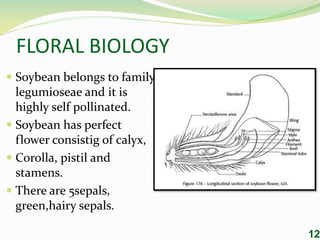
 Soybean belongs to family
legumioseae and it is
highly self pollinated.
 Soybean has perfect
flower consistig of calyx,
 Corolla, pistil and
stamens.
 There are 5sepals,
green,hairy sepals.
12
Contd…
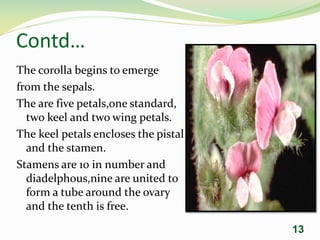
The corolla begins to emerge
from the sepals.
The are five petals,one standard,
two keel and two wing petals.
The keel petals encloses the pistal
and the stamen.
Stamens are 10 in number and
diadelphous,nine are united to
form a tube around the ovary
and the tenth is free.
13
Contd…
 The pistle has a single ovary with generally
two or three ovules,a long style and stigma.
 The stigma is slightly hairy and covered by
the Keel.
 Fruit is a legume.
14
SELFING AND CROSSING TECHNIQUES
 Equipments required.
 Dissecting forceps.
 Needles.
 Paper clips.
 Cover bags.
15
Selfing
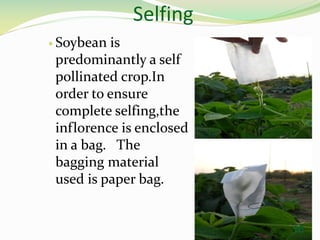
 Soybean is
predominantly a self
pollinated crop.In
order to ensure
complete selfing,the
inflorence is enclosed
in a bag. The
bagging material
used is paper bag.
16
Anthesis
17
Starts in morning around 6 am and
continues till 11 am.
Maximum flower opening – 11am to 5 pm.
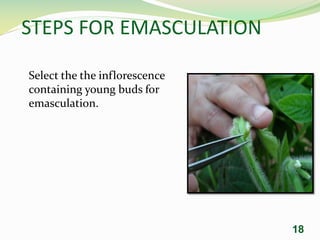
STEPS FOR EMASCULATION
Select the the inflorescence
containing young buds for
emasculation.
18
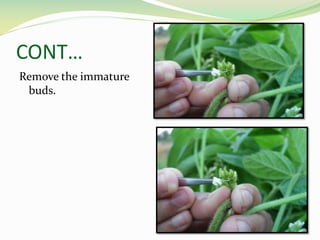
CONT…
Remove the immature
buds.
19
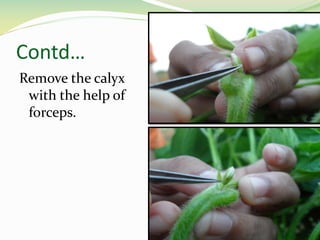
Contd…
Remove the calyx
with the help of
forceps.
20
21
Contd…
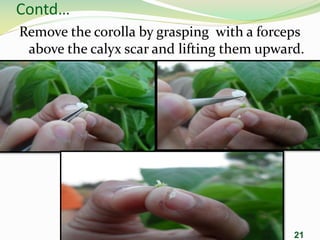
Remove the corolla by grasping with a forceps
above the calyx scar and lifting them upward.
Contd…..
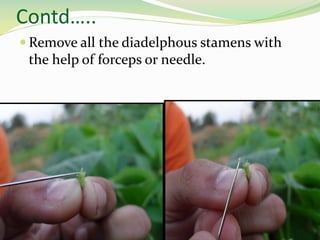
 Remove all the diadelphous stamens with
the help of forceps or needle.
22
STEPS OF POLLINATION.
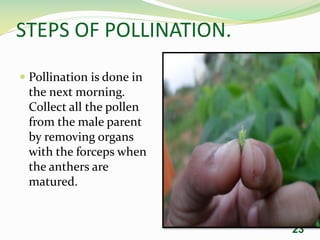
 Pollination is done in
the next morning.
Collect all the pollen
from the male parent
by removing organs
with the forceps when
the anthers are
matured.
23
Contd…..
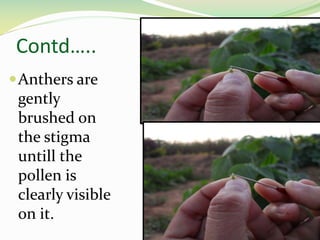
Anthers are
gently
brushed on
the stigma
untill the
pollen is
clearly visible
on it.
24
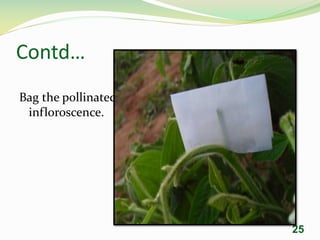
Contd…
Bag the pollinated
infloroscence.
25
Contd…
 Attach the tag with the following information.
 Objective.
 Date of emasculation.
 Date of pollination
 Name of the breeder
26
Research centers.
 AICRP on soybean headquater located in G.B.
PANT university of agriculture was shifted to Indore
with the establishment of NRC on soybean at Indore
in 1986.
 INTERNATIONAL SOYBEAN
PROGRAMME(INTSOY).
 It was stated in 1973 and sponsored by United states
Agency for international development is a
programme of the University of Illonois at urbana-
champaign.
27
Cont…
 Progamme activities:
 Research
 Testing and breeding programmes.
 Publications
 Regional and international conferences.
 Training courses and study programme.
28
Sources of soybean seeds.
 Directorate of soybean : Indore.
 National seed project : Bangalore and Dharwad.
 Activities :crop breeding , crop protection , crop
production.
 Varieties grown in B’LORE NSP:
 MAUS -2, KARUNE, MACS-450,KB -
79,HARDEE,KHSB-2.
 JS-335,JS-93-05.
29

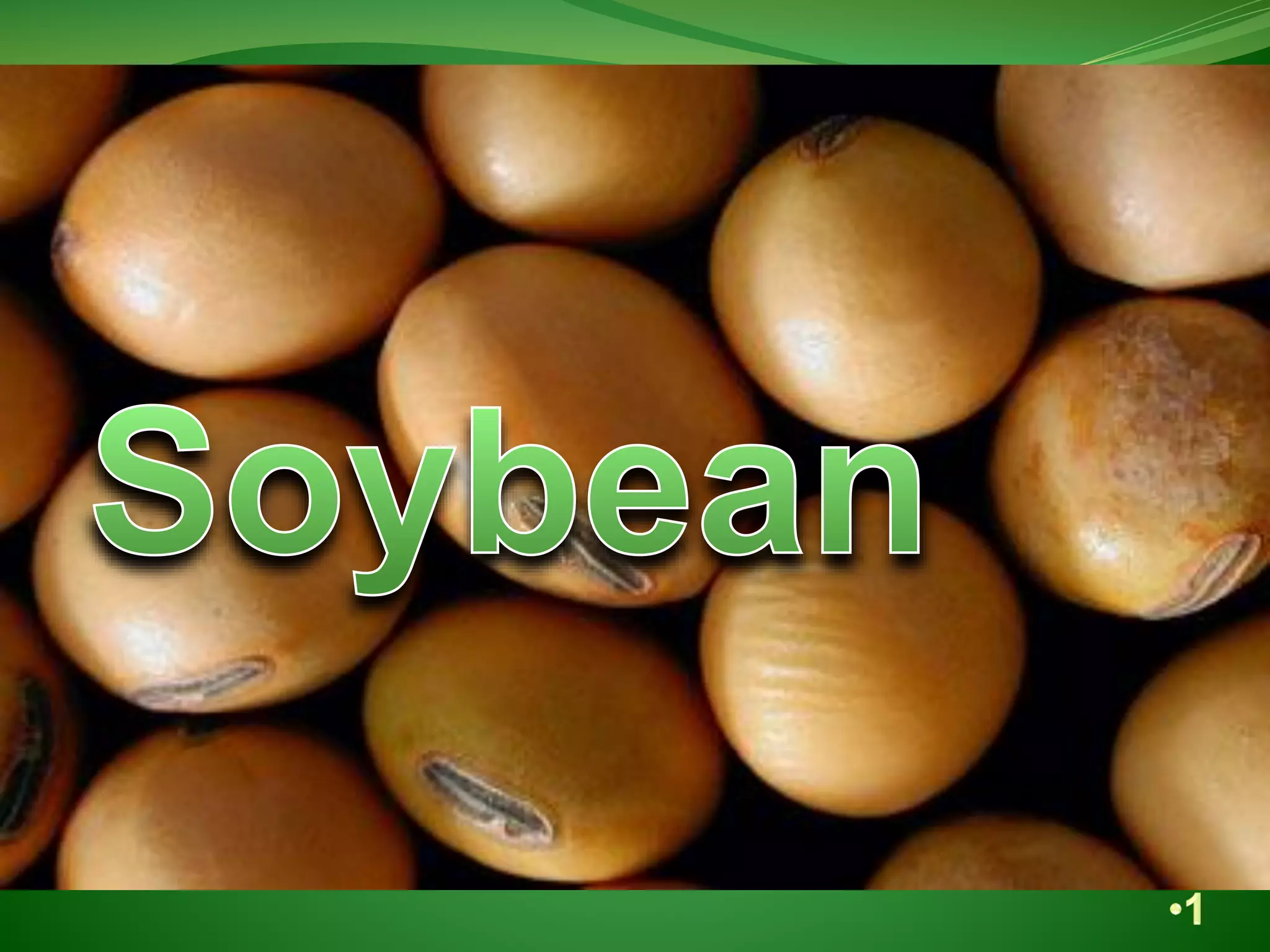
Soyabean

  • 2.
    SYSTEMATICS  Scientific Name:Glycine max.  Family : leguminoseae  Chromosome No. : 2n = 2x = 40 2
  • 3.
    TAXONOMY.  Botanical name:Glycine max.  Order :Fabales  Family :Fabaceae  Sub-family :Faboideae  Genus Glycine  Tribe :Phaseoleae  Sub-tribe :Faboideae  Species :max 3
  • 4.
    INTRODUCTION Soybean is themajor legume crop of the World in terms of total production. Soybean seeds contain 40% protein and 20% oil on dry basis. 4
  • 5.
    ORIGIN  This croporiginated in china and is currently grown in 35 countries of the world.  United states is the largest producers followed by Brazil, China, and Argentina. 5
  • 6.
    USES OF SOYBEAN 1.SOYBEAN MEAL A.FEED. Poulatry feed; livestock feeds; fish food. B.SOYFLOUR. (1)Edible uses. Bakery ingredents; noodles; meat products, confections. (2) Industrial uses: Adhesive, plywood, insecticidal spray, texture paints, nutrients, antibiotics ,beer and ale. 6
  • 7.
    Contd…..  2. SOYBEANOIL.  A.EDIBLE USES.  Cooking oils; coffee whiteners creamers.  B.TECHNICAL USES.  Disinfectants; electrical insulation; insecticides; pesticides; fungicides; herbicides; soaps. 7
  • 8.
    Contd…. It is mostpopularly used in china in the name of soy foods such as tofu, miso, temph,etc. To the chinese, the soybean was know as “meat of the fields”. Because it produces about three times more protein than rice, wheat, or maize. 8
  • 9.
    Contd…. The plant servesas good souce of nitrogen by fixing about 50kg per hectare. It has become the major source of edible vegetable oils. 9
  • 10.
    CYTOLOGY Glycine is theonly genus where species have diploid chromosome number of 40 and 80 but not 20. The large number of chromosomes, small size,and similarity of the chromosome have often discouraged cytological investgation in soybean. 10
  • 11.
    RELATED SPECIES OFSOTBEAN.  A.SUBGENUS GLYCINE.  Glycine clandestine.  G.tomentella  B.SUBGENUS SOJA.  G.soja  G.max 11
  • 12.
    FLORAL BIOLOGY  Soybeanbelongs to family legumioseae and it is highly self pollinated.  Soybean has perfect flower consistig of calyx,  Corolla, pistil and stamens.  There are 5sepals, green,hairy sepals. 12
  • 13.
    Contd… The corolla beginsto emerge from the sepals. The are five petals,one standard, two keel and two wing petals. The keel petals encloses the pistal and the stamen. Stamens are 10 in number and diadelphous,nine are united to form a tube around the ovary and the tenth is free. 13
  • 14.
    Contd…  The pistlehas a single ovary with generally two or three ovules,a long style and stigma.  The stigma is slightly hairy and covered by the Keel.  Fruit is a legume. 14
  • 15.
    SELFING AND CROSSINGTECHNIQUES  Equipments required.  Dissecting forceps.  Needles.  Paper clips.  Cover bags. 15
  • 16.
    Selfing  Soybean is predominantlya self pollinated crop.In order to ensure complete selfing,the inflorence is enclosed in a bag. The bagging material used is paper bag. 16
  • 17.
    Anthesis 17 Starts in morningaround 6 am and continues till 11 am. Maximum flower opening – 11am to 5 pm.
  • 18.
    STEPS FOR EMASCULATION Selectthe the inflorescence containing young buds for emasculation. 18
  • 19.
  • 20.
    Contd… Remove the calyx withthe help of forceps. 20
  • 21.
    21 Contd… Remove the corollaby grasping with a forceps above the calyx scar and lifting them upward.
  • 22.
    Contd…..  Remove allthe diadelphous stamens with the help of forceps or needle. 22
  • 23.
    STEPS OF POLLINATION. Pollination is done in the next morning. Collect all the pollen from the male parent by removing organs with the forceps when the anthers are matured. 23
  • 24.
    Contd….. Anthers are gently brushed on thestigma untill the pollen is clearly visible on it. 24
  • 25.
  • 26.
    Contd…  Attach thetag with the following information.  Objective.  Date of emasculation.  Date of pollination  Name of the breeder 26
  • 27.
    Research centers.  AICRPon soybean headquater located in G.B. PANT university of agriculture was shifted to Indore with the establishment of NRC on soybean at Indore in 1986.  INTERNATIONAL SOYBEAN PROGRAMME(INTSOY).  It was stated in 1973 and sponsored by United states Agency for international development is a programme of the University of Illonois at urbana- champaign. 27
  • 28.
    Cont…  Progamme activities: Research  Testing and breeding programmes.  Publications  Regional and international conferences.  Training courses and study programme. 28
  • 29.
    Sources of soybeanseeds.  Directorate of soybean : Indore.  National seed project : Bangalore and Dharwad.  Activities :crop breeding , crop protection , crop production.  Varieties grown in B’LORE NSP:  MAUS -2, KARUNE, MACS-450,KB - 79,HARDEE,KHSB-2.  JS-335,JS-93-05. 29