SEED PRODUCTION
TECHNOLOGY OF
SUNFLOWER
SCIENTIFIC NAME : Helianthus annus
FAMILY : Asteraceae or Compositae
CHROMOSOME NUMBER : 17
 Sunflower is a common oilseed of India with wider utility.
 It is used as a source of edible oil, and as raw material for agro -based
industry.
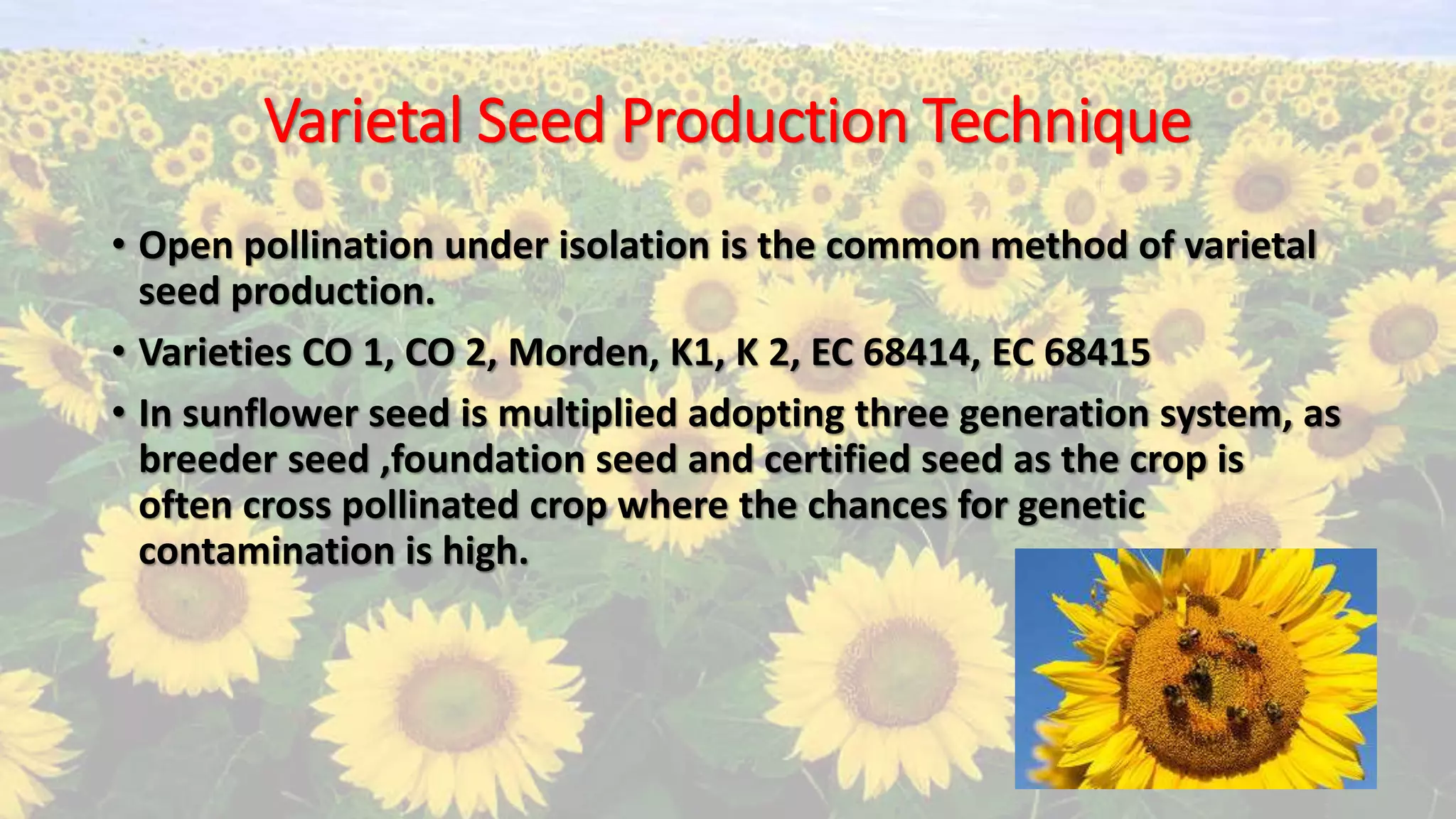
 It is a cross pollinated crop, insects (honey bees) are the pollinating
agents.
 The crop has got two types of flowers viz. ray and disc florets. Seeds
set in disc florets which are bisexual but exhibit self incompatibility
due to protoandrous nature of the flower.
Area, Production And Productivity
• In India, Sunflower cultivation occupies about 1.48 M
Ha area
• Average yield 0.6 MT/acre.
• In terms of productivity, Bihar leads with 1402 kg/ha
followed by Tamil Nadu with 1328.7 kg, although both the
states have less than 25000 hectares under the crop which
is mostly irrigated.
Botany Of Flower
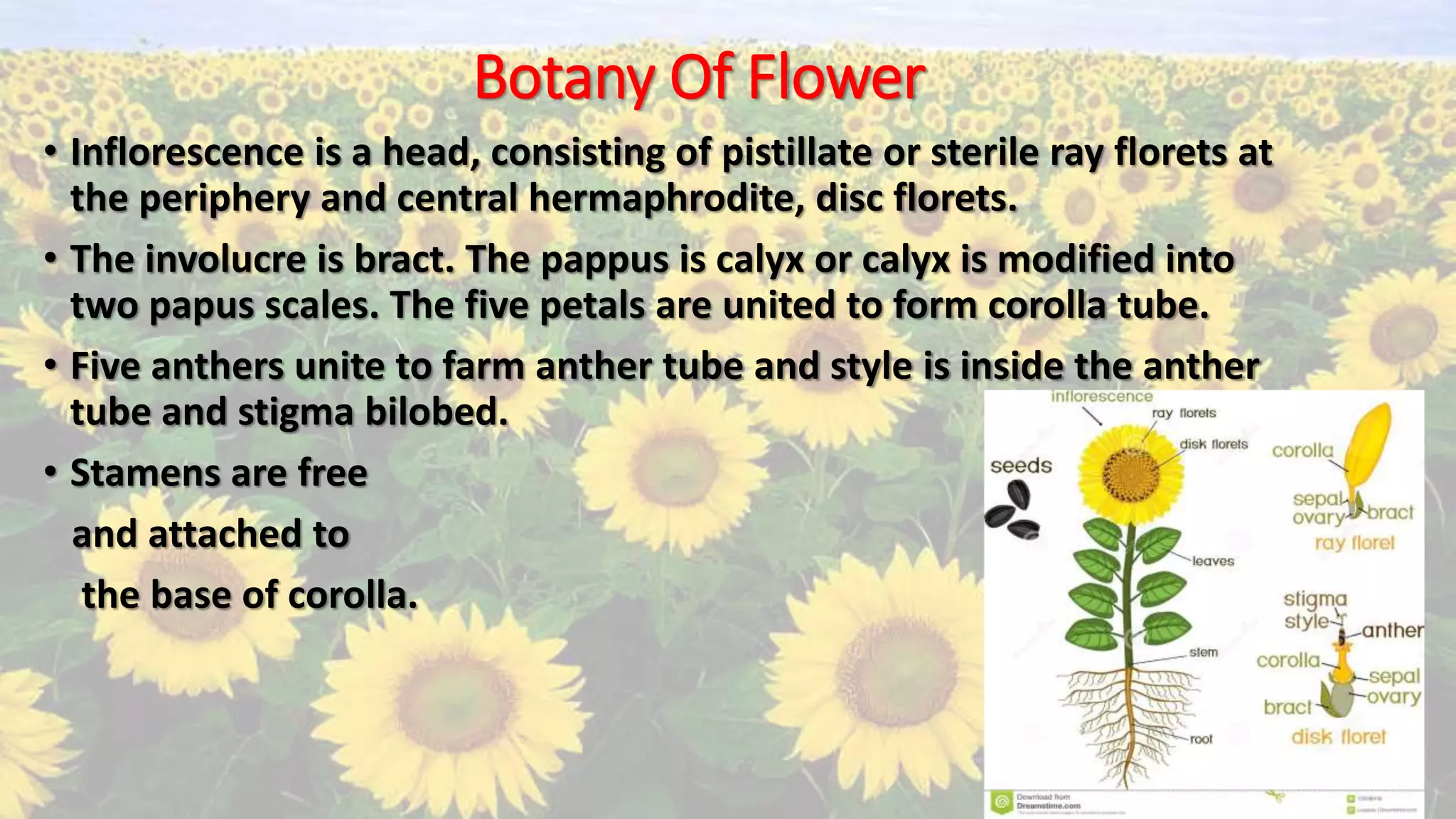
• Inflorescence is a head, consisting of pistillate or sterile ray florets at
the periphery and central hermaphrodite, disc florets.
• The involucre is bract. The pappus is calyx or calyx is modified into
two papus scales. The five petals are united to form corolla tube.
• Five anthers unite to farm anther tube and style is inside the anther
tube and stigma bilobed.
• Stamens are free
and attached to
the base of corolla.
Anthesis And Pollination
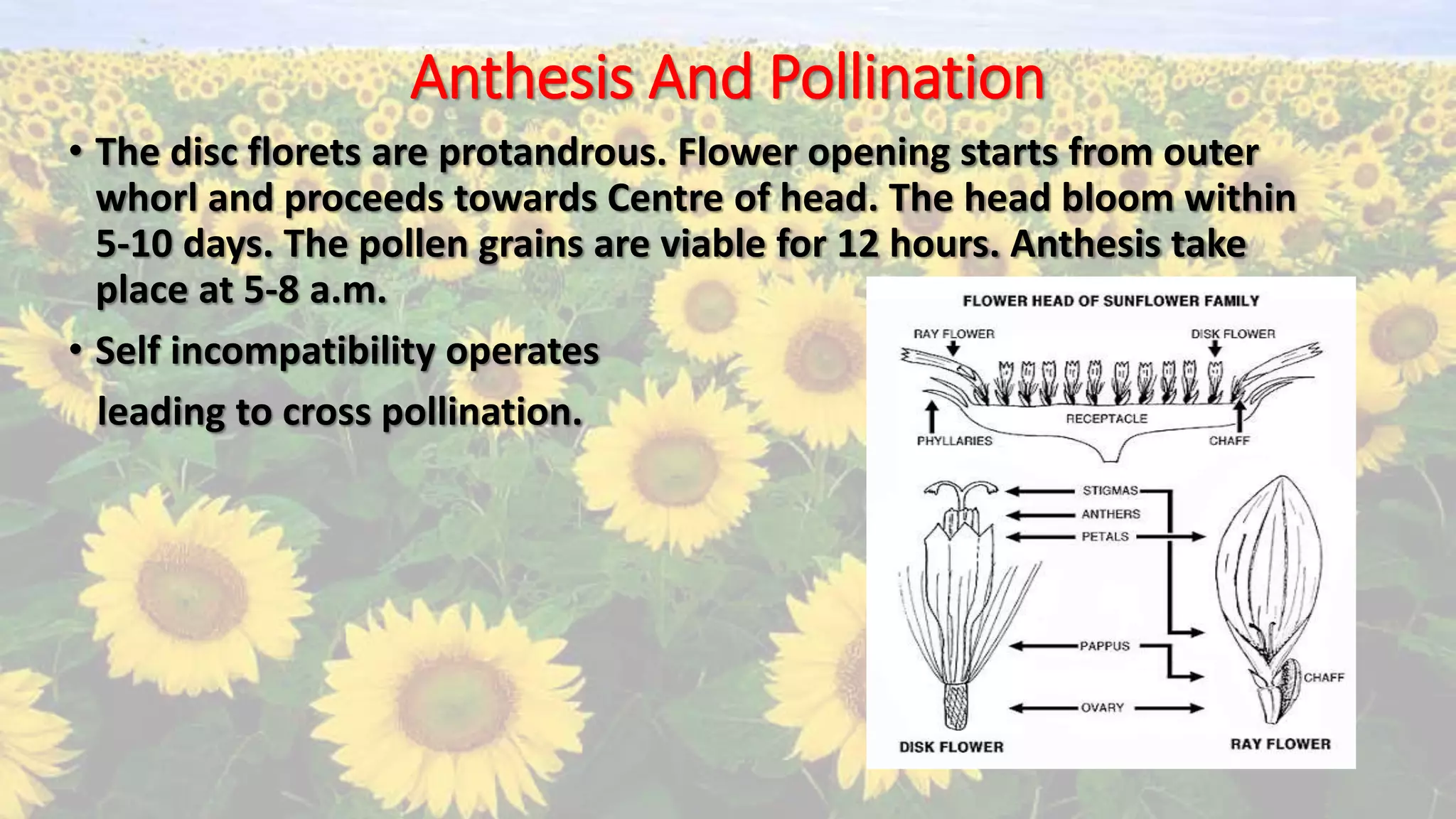
• The disc florets are protandrous. Flower opening starts from outer
whorl and proceeds towards Centre of head. The head bloom within
5-10 days. The pollen grains are viable for 12 hours. Anthesis take
place at 5-8 a.m.
• Self incompatibility operates
leading to cross pollination.
Varietal Seed Production Technique
• Open pollination under isolation is the common method of varietal
seed production.
• Varieties CO 1, CO 2, Morden, K1, K 2, EC 68414, EC 68415
• In sunflower seed is multiplied adopting three generation system, as
breeder seed ,foundation seed and certified seed as the crop is
often cross pollinated crop where the chances for genetic
contamination is high.
Varietal Renovation Method (Pustovit Model)
• In open pollinated variety, selection of superior
plants are made based on the quality characters viz.,
plant yield, 100 seed weight and oil content.
• The selected plants are harvested separately
• Then they are raised in rows individually Seeds from
promising plants are collected and this form the
super-elite seeds
Causes for ill filled seed
A. Pollination
• It is a cross pollinated crop, normally the insect activity is less. For
increasing the insect activity bee hives should be kept in the seed
production plot in adequate quantities. The insect activity depends on
the pollution and insecticides application. If insect activity is less that
leads to poor seed setting and formation of ill filled seeds.
B. Development of axillary flowers
• Normally the axillary flowering takes place during the summer because
of the high intensity of light. So these type of axillary buds receive the
nutrients and assimilate whereas the main head does not get the
required quantity of assimilates for seed set there by ill fillings occurs.
C. Self incompatibility
• Presence of self incompatibility in sunflower also leads to poor seed set and ill filled
seeds.
Season And Land Requirement
• April to May is highly suitable for irrigated seed crop. The flowering
should not coincide either with rain or high RH as it will wash out the
pollen and the maturation should coincide with dry weather.
• Three to four ploughing and disking's are sufficient
for preparing the land.
• Soil should be moist at least 10cm deep before sowing and this condition
necessitates good soaking rains or irrigation before sowing.
• The land should be fertile and problem soils will lead to low pollen
fertility and will adversely affect the quality and the seed set will be poor.
• The previous crop should not be the same crop to avoid the occurrence of
volunteer plants and if to be the same crop it has to be the same variety
and should be certified and has to be accepted for certification.
• The field should not have any volunteer plants.
Field Standards (Isolation)
Sunflower field should be isolated from contaminants as follows.
In sunflower differential blooming dates for modifying the isolation distance
is not permitted
Contaminants
Fields of other varieties
and the same variety not
confirming to varietal
purity requirements for
certification and wild
sunflower
Foundation seeds (meters)
400m
Certified seeds(meters)
200m
Seed and sowing
• For production of foundation seed, breeder seed is used as the base
material ,while for certified seed, foundation seed should be used as
the base material.
• The seed used should be from authenticated source with tag and
bill.
• The required seed rate will be 8-10kg /ha or 3-4kg/ acre. (Morden
80kg/ha)
• The seeds are sown at a spacing of 30 x10 cm for the variety morden
and at a spacing of 60x20 cm for other varieties and are dibbled at a
depth of 2-4cm.
• In the main field seeds are sown either in ridges and furrows or
under beds and channels.
Presowing seed treatment
• The seeds are given with any one of the seed treatment or in
combination.
• Fresh seeds of sunflower exhibit physiological dormancy which
could be broken by soaking the seeds in 300ppm ethrel for 8h or
0.5% KNO3 for 16h. Moist hydration of seed with water for 24h
followed by dry dressing with thiram @2g kg-1 of seed improved
the productivity of the seed.
• Seeds are soaked in 2% ZnSO4 for 12h with a seed to solution ratio
of 1:0.06 and are dried back to their original moisture content of 8-
9% This management could be used both for dryland agriculture as
well as gardenland.
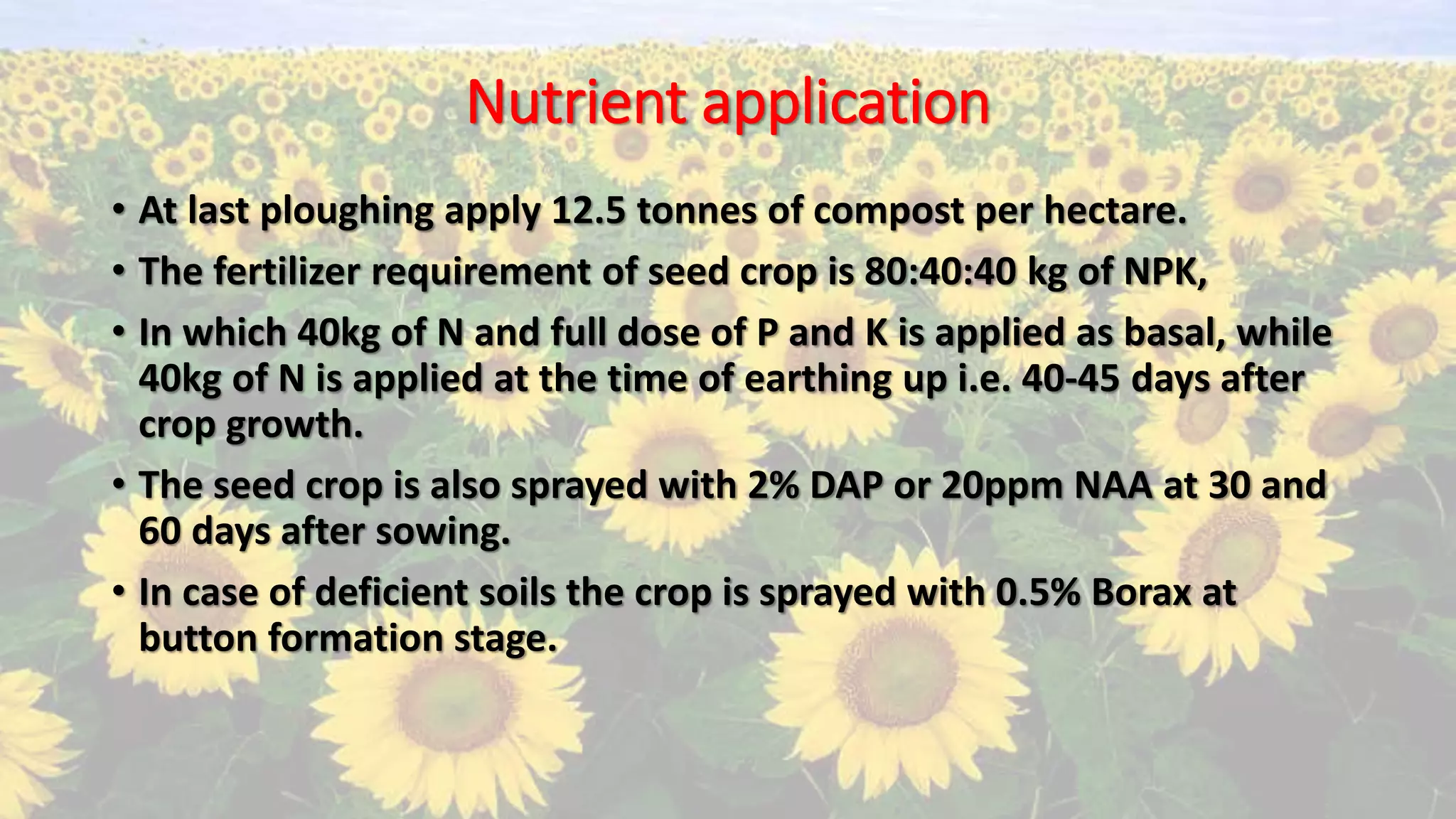
Nutrient application
• At last ploughing apply 12.5 tonnes of compost per hectare.
• The fertilizer requirement of seed crop is 80:40:40 kg of NPK,
• In which 40kg of N and full dose of P and K is applied as basal, while
40kg of N is applied at the time of earthing up i.e. 40-45 days after
crop growth.
• The seed crop is also sprayed with 2% DAP or 20ppm NAA at 30 and
60 days after sowing.
• In case of deficient soils the crop is sprayed with 0.5% Borax at
button formation stage.
Weeding
• Apply of fluchloralin@ 2l/ha as pre-emergence herbicide to control
the growth of weeds up to 20-25 days.
• One hand weeding is done at the time of button stage to keep the
field free of weeds.
• Weeding after head formation stage is not economical.
• On organic production, 2 hand weeding at seedling stage and other
at boot leaf formation will keep the field weed free.
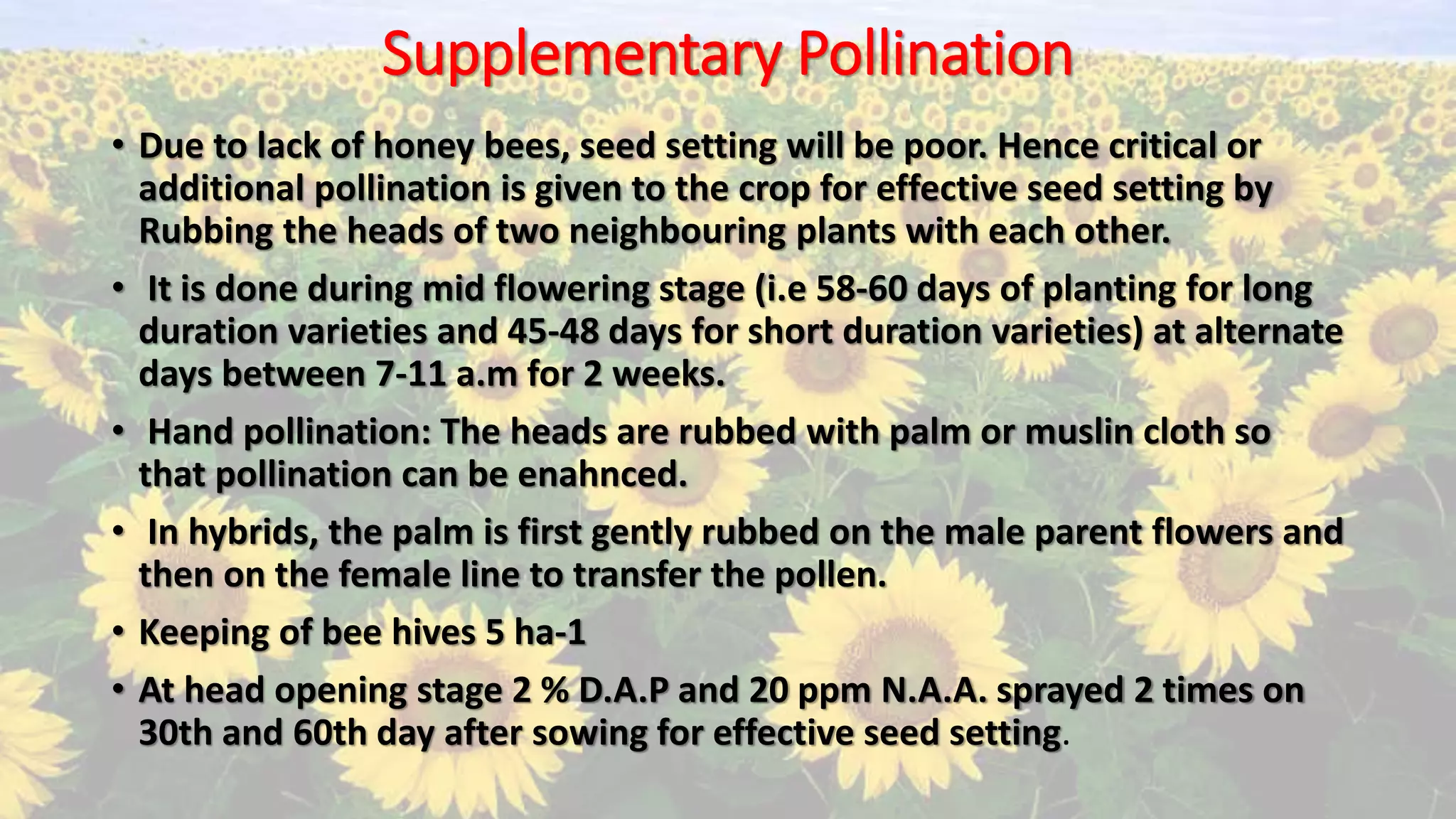
Supplementary Pollination
• Due to lack of honey bees, seed setting will be poor. Hence critical or
additional pollination is given to the crop for effective seed setting by
Rubbing the heads of two neighbouring plants with each other.
• It is done during mid flowering stage (i.e 58-60 days of planting for long
duration varieties and 45-48 days for short duration varieties) at alternate
days between 7-11 a.m for 2 weeks.
• Hand pollination: The heads are rubbed with palm or muslin cloth so
that pollination can be enahnced.
• In hybrids, the palm is first gently rubbed on the male parent flowers and
then on the female line to transfer the pollen.
• Keeping of bee hives 5 ha-1
• At head opening stage 2 % D.A.P and 20 ppm N.A.A. sprayed 2 times on
30th and 60th day after sowing for effective seed setting.
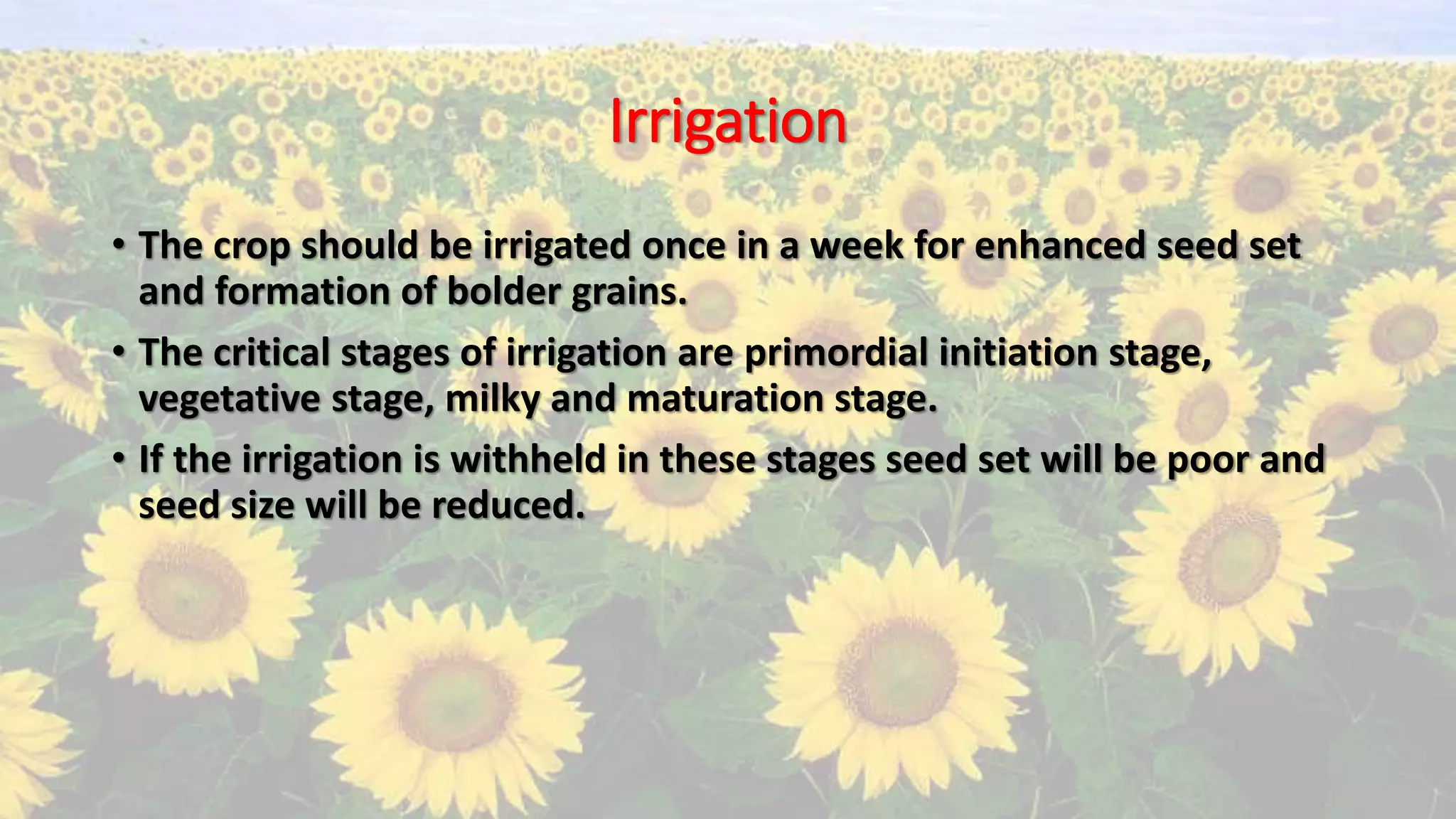
Irrigation
• The crop should be irrigated once in a week for enhanced seed set
and formation of bolder grains.
• The critical stages of irrigation are primordial initiation stage,
vegetative stage, milky and maturation stage.
• If the irrigation is withheld in these stages seed set will be poor and
seed size will be reduced.
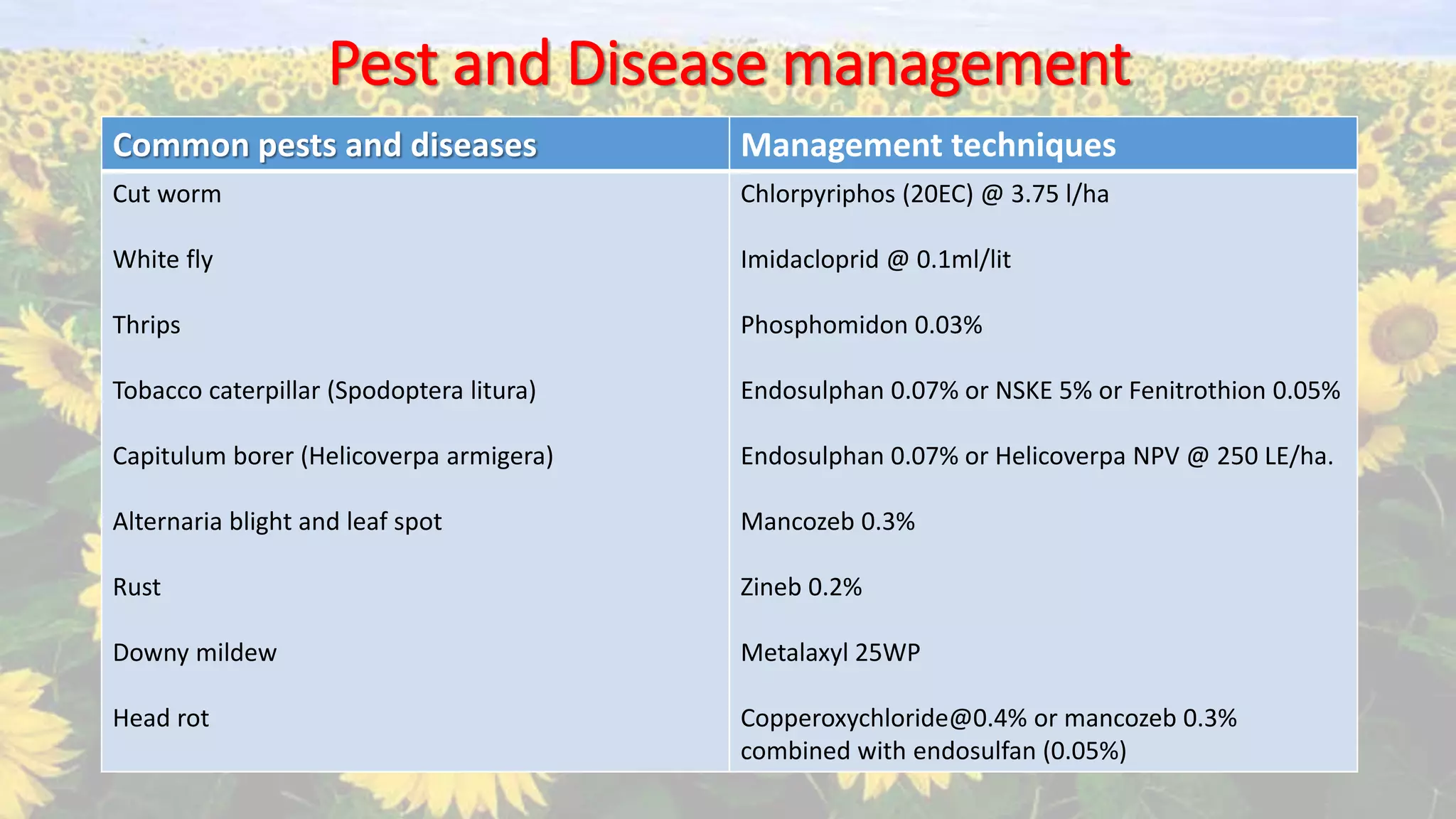
Pest and Disease management
Common pests and diseases Management techniques
Cut worm
White fly
Thrips
Tobacco caterpillar (Spodoptera litura)
Capitulum borer (Helicoverpa armigera)
Alternaria blight and leaf spot
Rust
Downy mildew
Head rot
Chlorpyriphos (20EC) @ 3.75 l/ha
Imidacloprid @ 0.1ml/lit
Phosphomidon 0.03%
Endosulphan 0.07% or NSKE 5% or Fenitrothion 0.05%
Endosulphan 0.07% or Helicoverpa NPV @ 250 LE/ha.
Mancozeb 0.3%
Zineb 0.2%
Metalaxyl 25WP
Copperoxychloride@0.4% or mancozeb 0.3%
combined with endosulfan (0.05%)
White fly Thrips Tobacco Caterpillar
Alternaria Blight Rust Downey Mildew
Rouging
•Plants rogued from their vegetative phase
to harvesting, based on plant, height, head
size, branching habit, number of heads and
colour of seeds.
Field standards
Factor Foundation seed Certified seeds
Off types at and after flowering 0.10 % 0.20 %
Objectionable weed
Plants affected by downy mildew
Plants infested with orabanche
None
0.050 %
None
None
0.50 %
None
Seed Certification
Number of Inspections:
• A minimum of three inspections shall be made as follows:
1. The first inspection shall be made before flowering on
order to verify isolation, volunteer plants, and other relevant
factors,
2. The second inspection shall be made during flowering to
check isolation, offtypes and other relevant factors
3. The third inspection shall be made at maturity and prior
to harvesting to verify true nature of plant and other
relevant factors
Harvesting
• Change of thalamus color from green to yellow is the visual
symptom of physiological maturation.
• Heads are harvested as once over harvest.
Threshing and Drying
• The earheads are dried under sun and threshed with fliable stick for
extraction of seeds The moisture content of seed at the time of
threshing will be 15-18%.On large scale production sunflower
threshers are used, but care should be given to avoid mechanical
damage, which in turn will reduce the seed quality and storability.
• The seeds are dried to 8=10 % moisture content either under sun or
adopting mechanical driers for long term storage as the seeds is
orthodox in nature.
Seed treatment and Packing
• The seeds are infested with several storage pests, to protect against
these pests the seeds are given protective treatment with bavistin
@2g/kg of seed.
• Seeds are packed in gunny bag for short term storage while in HDPE
and polylined gunny bag for long term storage.
Storage Of Seeds
• The treated seed can be stored up to 10 months provided
the seeds are not infected with storage pests.
• Seed can be stored up to 2 years if the seeds are packed in
moisture containers and are stored at low temperature .
• The godown should be kept clean as the possibility of
secondary infestation with Trifolium (red flour weevil ) is
much in these crop.
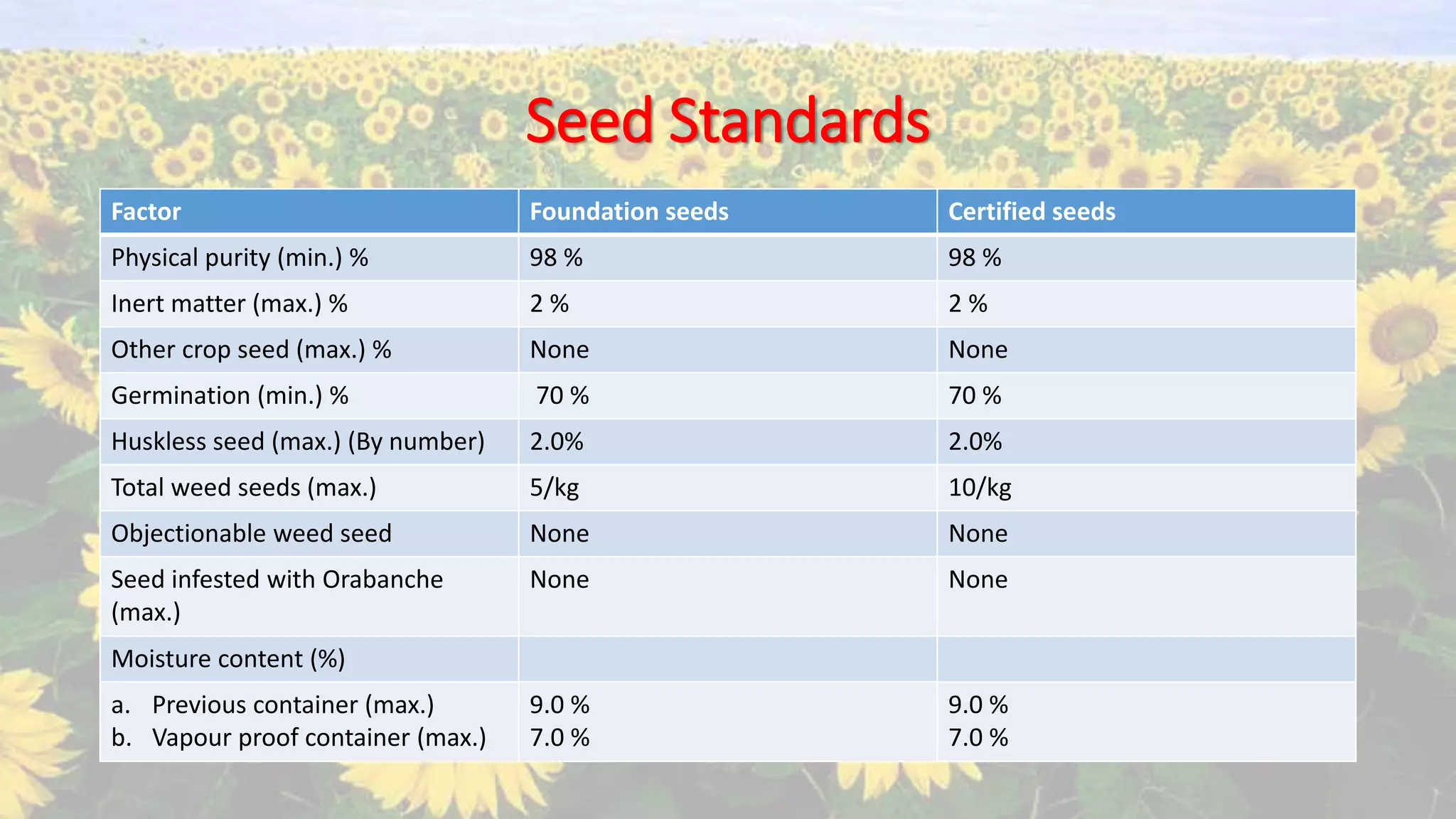
Seed Standards
Factor Foundation seeds Certified seeds
Physical purity (min.) % 98 % 98 %
Inert matter (max.) % 2 % 2 %
Other crop seed (max.) % None None
Germination (min.) % 70 % 70 %
Huskless seed (max.) (By number) 2.0% 2.0%
Total weed seeds (max.) 5/kg 10/kg
Objectionable weed seed None None
Seed infested with Orabanche
(max.)
None None
Moisture content (%)
a. Previous container (max.)
b. Vapour proof container (max.)
9.0 %
7.0 %
9.0 %
7.0 %
Hybrid Seed Production In Sunflower
• Hybrids are produced by employing cytoplasmic genetic male
sterility.
• The male sterile female and male parents are raised in BSH 3, 1:6,
KBSH 1, 1:4 ratio under 400 m isolation.
• Seeds are produced by transferring the pollen of male parent to the
female parent with the help of honeybees reared at 5 hives / ha.
Hybrids
• BSH -1 = CMS 234 A x RHA 274
• KBSH 1 = " x 6 DI
• MSFH 1 = MHS 71 x MHR 48
• MSFH 8
• MSFH -17
• TCSH 1 = CMS 234 A x RHA 272
Season
June - July, October – November
Isolation Distance
• Foundation seed : 600 m
• Certified seed : 400 m
Seeds And Sowing
• Seeds are sown in ridges and furrows
• Seed rate : Female 12 kg /ha and Male 4 kg/ha.
Spacing
• 60 x 30 cm (hybrids)
• Planting ratio : 8:1 or 4:1
• Border row : two
Manures and fertilizers Compost :
• 12.5 t/ha
• NPK : 60:45:45 kg /ha
Supplementary Pollination
• 1. As in varieties In hybrids, the palm is first gently rubbed on the
male parent flowers and then on the female line to transfer the
pollen.
• 2. Keeping of bee hives 5 ha-1 .
Roguing
Plants are rogued based on plant height, head size and colour of seeds
during pre-flowering stage upto harvest.
Field Standards
Foundation seeds Certified seeds
Off types 0.1 % 0.2%
Harvesting
The change of head colour from green to lemon yellow is the
indication of physiological maturity. The heads are harvested separately
first in male and then in female.
Drying, processing and others – as in varieties
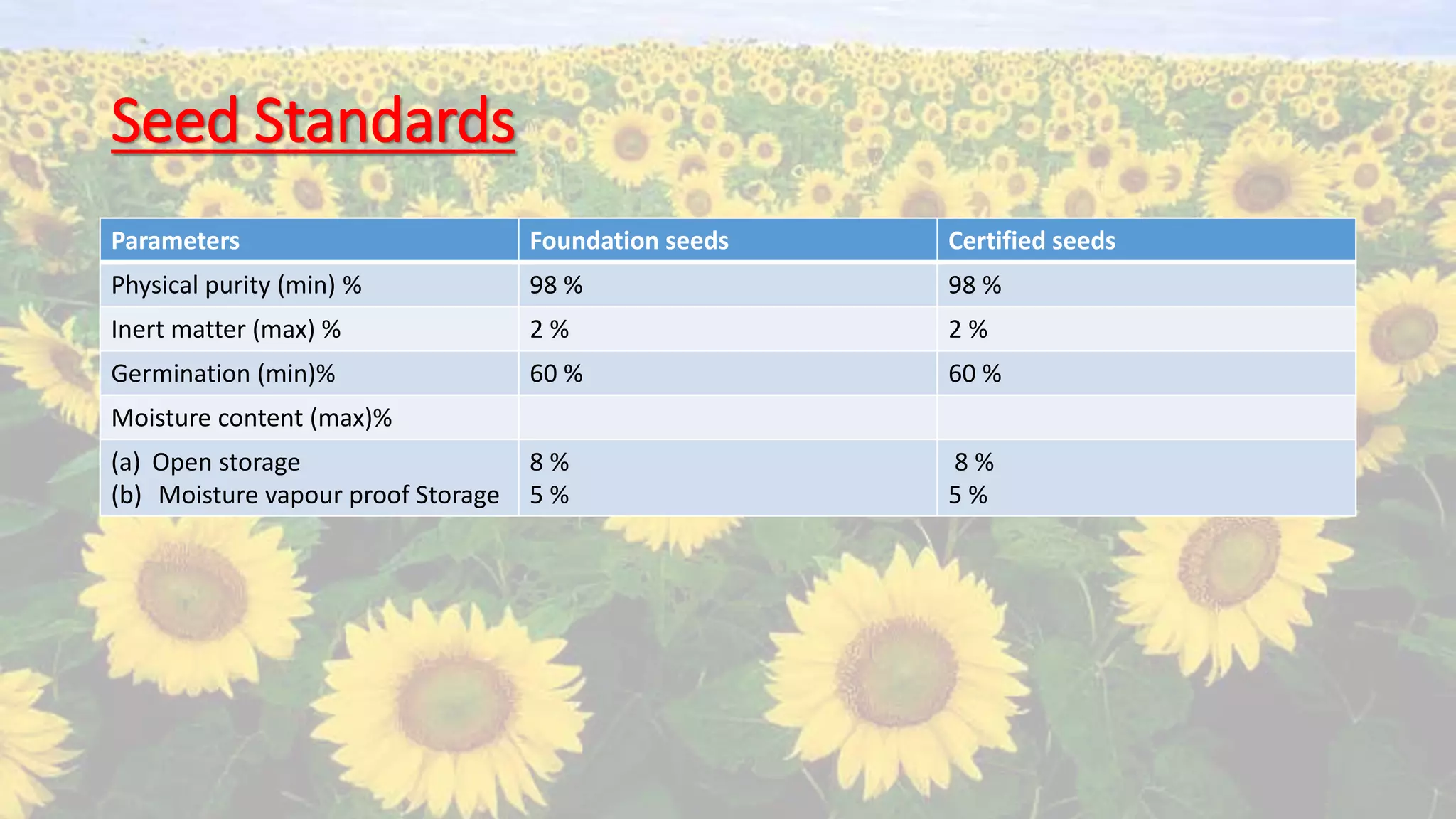
Seed Standards
Parameters Foundation seeds Certified seeds
Physical purity (min) % 98 % 98 %
Inert matter (max) % 2 % 2 %
Germination (min)% 60 % 60 %
Moisture content (max)%
(a) Open storage
(b) Moisture vapour proof Storage
8 %
5 %
8 %
5 %
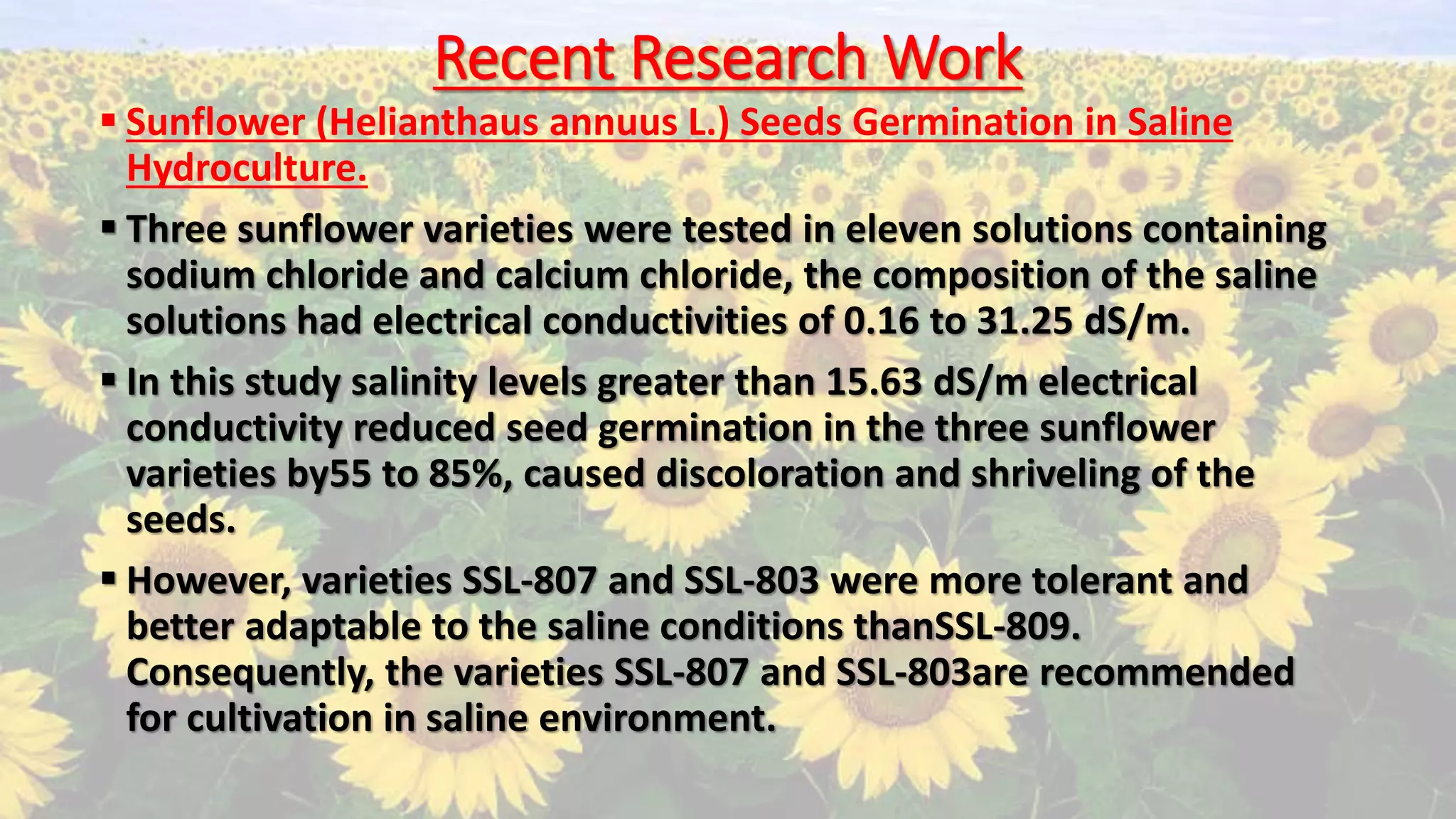
 Sunflower (Helianthaus annuus L.) Seeds Germination in Saline
Hydroculture.
 Three sunflower varieties were tested in eleven solutions containing
sodium chloride and calcium chloride, the composition of the saline
solutions had electrical conductivities of 0.16 to 31.25 dS/m.
 In this study salinity levels greater than 15.63 dS/m electrical
conductivity reduced seed germination in the three sunflower
varieties by55 to 85%, caused discoloration and shriveling of the
seeds.
 However, varieties SSL-807 and SSL-803 were more tolerant and
better adaptable to the saline conditions thanSSL-809.
Consequently, the varieties SSL-807 and SSL-803are recommended
for cultivation in saline environment.
Recent Research Work
THANK YOU
UID : 111718012047
111718012042

Sunflower seed production

  • 1.
  • 2.
    SCIENTIFIC NAME :Helianthus annus FAMILY : Asteraceae or Compositae CHROMOSOME NUMBER : 17  Sunflower is a common oilseed of India with wider utility.  It is used as a source of edible oil, and as raw material for agro -based industry.  It is a cross pollinated crop, insects (honey bees) are the pollinating agents.  The crop has got two types of flowers viz. ray and disc florets. Seeds set in disc florets which are bisexual but exhibit self incompatibility due to protoandrous nature of the flower.
  • 3.
    Area, Production AndProductivity • In India, Sunflower cultivation occupies about 1.48 M Ha area • Average yield 0.6 MT/acre. • In terms of productivity, Bihar leads with 1402 kg/ha followed by Tamil Nadu with 1328.7 kg, although both the states have less than 25000 hectares under the crop which is mostly irrigated.
  • 4.
    Botany Of Flower •Inflorescence is a head, consisting of pistillate or sterile ray florets at the periphery and central hermaphrodite, disc florets. • The involucre is bract. The pappus is calyx or calyx is modified into two papus scales. The five petals are united to form corolla tube. • Five anthers unite to farm anther tube and style is inside the anther tube and stigma bilobed. • Stamens are free and attached to the base of corolla.
  • 5.
    Anthesis And Pollination •The disc florets are protandrous. Flower opening starts from outer whorl and proceeds towards Centre of head. The head bloom within 5-10 days. The pollen grains are viable for 12 hours. Anthesis take place at 5-8 a.m. • Self incompatibility operates leading to cross pollination.
  • 6.
    Varietal Seed ProductionTechnique • Open pollination under isolation is the common method of varietal seed production. • Varieties CO 1, CO 2, Morden, K1, K 2, EC 68414, EC 68415 • In sunflower seed is multiplied adopting three generation system, as breeder seed ,foundation seed and certified seed as the crop is often cross pollinated crop where the chances for genetic contamination is high.
  • 7.
    Varietal Renovation Method(Pustovit Model) • In open pollinated variety, selection of superior plants are made based on the quality characters viz., plant yield, 100 seed weight and oil content. • The selected plants are harvested separately • Then they are raised in rows individually Seeds from promising plants are collected and this form the super-elite seeds
  • 8.
    Causes for illfilled seed A. Pollination • It is a cross pollinated crop, normally the insect activity is less. For increasing the insect activity bee hives should be kept in the seed production plot in adequate quantities. The insect activity depends on the pollution and insecticides application. If insect activity is less that leads to poor seed setting and formation of ill filled seeds. B. Development of axillary flowers • Normally the axillary flowering takes place during the summer because of the high intensity of light. So these type of axillary buds receive the nutrients and assimilate whereas the main head does not get the required quantity of assimilates for seed set there by ill fillings occurs. C. Self incompatibility • Presence of self incompatibility in sunflower also leads to poor seed set and ill filled seeds.
  • 9.
    Season And LandRequirement • April to May is highly suitable for irrigated seed crop. The flowering should not coincide either with rain or high RH as it will wash out the pollen and the maturation should coincide with dry weather. • Three to four ploughing and disking's are sufficient for preparing the land. • Soil should be moist at least 10cm deep before sowing and this condition necessitates good soaking rains or irrigation before sowing. • The land should be fertile and problem soils will lead to low pollen fertility and will adversely affect the quality and the seed set will be poor. • The previous crop should not be the same crop to avoid the occurrence of volunteer plants and if to be the same crop it has to be the same variety and should be certified and has to be accepted for certification. • The field should not have any volunteer plants.
  • 10.
    Field Standards (Isolation) Sunflowerfield should be isolated from contaminants as follows. In sunflower differential blooming dates for modifying the isolation distance is not permitted Contaminants Fields of other varieties and the same variety not confirming to varietal purity requirements for certification and wild sunflower Foundation seeds (meters) 400m Certified seeds(meters) 200m
  • 11.
    Seed and sowing •For production of foundation seed, breeder seed is used as the base material ,while for certified seed, foundation seed should be used as the base material. • The seed used should be from authenticated source with tag and bill. • The required seed rate will be 8-10kg /ha or 3-4kg/ acre. (Morden 80kg/ha) • The seeds are sown at a spacing of 30 x10 cm for the variety morden and at a spacing of 60x20 cm for other varieties and are dibbled at a depth of 2-4cm. • In the main field seeds are sown either in ridges and furrows or under beds and channels.
  • 12.
    Presowing seed treatment •The seeds are given with any one of the seed treatment or in combination. • Fresh seeds of sunflower exhibit physiological dormancy which could be broken by soaking the seeds in 300ppm ethrel for 8h or 0.5% KNO3 for 16h. Moist hydration of seed with water for 24h followed by dry dressing with thiram @2g kg-1 of seed improved the productivity of the seed. • Seeds are soaked in 2% ZnSO4 for 12h with a seed to solution ratio of 1:0.06 and are dried back to their original moisture content of 8- 9% This management could be used both for dryland agriculture as well as gardenland.
  • 13.
    Nutrient application • Atlast ploughing apply 12.5 tonnes of compost per hectare. • The fertilizer requirement of seed crop is 80:40:40 kg of NPK, • In which 40kg of N and full dose of P and K is applied as basal, while 40kg of N is applied at the time of earthing up i.e. 40-45 days after crop growth. • The seed crop is also sprayed with 2% DAP or 20ppm NAA at 30 and 60 days after sowing. • In case of deficient soils the crop is sprayed with 0.5% Borax at button formation stage.
  • 14.
    Weeding • Apply offluchloralin@ 2l/ha as pre-emergence herbicide to control the growth of weeds up to 20-25 days. • One hand weeding is done at the time of button stage to keep the field free of weeds. • Weeding after head formation stage is not economical. • On organic production, 2 hand weeding at seedling stage and other at boot leaf formation will keep the field weed free.
  • 15.
    Supplementary Pollination • Dueto lack of honey bees, seed setting will be poor. Hence critical or additional pollination is given to the crop for effective seed setting by Rubbing the heads of two neighbouring plants with each other. • It is done during mid flowering stage (i.e 58-60 days of planting for long duration varieties and 45-48 days for short duration varieties) at alternate days between 7-11 a.m for 2 weeks. • Hand pollination: The heads are rubbed with palm or muslin cloth so that pollination can be enahnced. • In hybrids, the palm is first gently rubbed on the male parent flowers and then on the female line to transfer the pollen. • Keeping of bee hives 5 ha-1 • At head opening stage 2 % D.A.P and 20 ppm N.A.A. sprayed 2 times on 30th and 60th day after sowing for effective seed setting.
  • 16.
    Irrigation • The cropshould be irrigated once in a week for enhanced seed set and formation of bolder grains. • The critical stages of irrigation are primordial initiation stage, vegetative stage, milky and maturation stage. • If the irrigation is withheld in these stages seed set will be poor and seed size will be reduced.
  • 17.
    Pest and Diseasemanagement Common pests and diseases Management techniques Cut worm White fly Thrips Tobacco caterpillar (Spodoptera litura) Capitulum borer (Helicoverpa armigera) Alternaria blight and leaf spot Rust Downy mildew Head rot Chlorpyriphos (20EC) @ 3.75 l/ha Imidacloprid @ 0.1ml/lit Phosphomidon 0.03% Endosulphan 0.07% or NSKE 5% or Fenitrothion 0.05% Endosulphan 0.07% or Helicoverpa NPV @ 250 LE/ha. Mancozeb 0.3% Zineb 0.2% Metalaxyl 25WP Copperoxychloride@0.4% or mancozeb 0.3% combined with endosulfan (0.05%)
  • 18.
    White fly ThripsTobacco Caterpillar Alternaria Blight Rust Downey Mildew
  • 19.
    Rouging •Plants rogued fromtheir vegetative phase to harvesting, based on plant, height, head size, branching habit, number of heads and colour of seeds.
  • 20.
    Field standards Factor Foundationseed Certified seeds Off types at and after flowering 0.10 % 0.20 % Objectionable weed Plants affected by downy mildew Plants infested with orabanche None 0.050 % None None 0.50 % None
  • 21.
    Seed Certification Number ofInspections: • A minimum of three inspections shall be made as follows: 1. The first inspection shall be made before flowering on order to verify isolation, volunteer plants, and other relevant factors, 2. The second inspection shall be made during flowering to check isolation, offtypes and other relevant factors 3. The third inspection shall be made at maturity and prior to harvesting to verify true nature of plant and other relevant factors
  • 22.
    Harvesting • Change ofthalamus color from green to yellow is the visual symptom of physiological maturation. • Heads are harvested as once over harvest.
  • 23.
    Threshing and Drying •The earheads are dried under sun and threshed with fliable stick for extraction of seeds The moisture content of seed at the time of threshing will be 15-18%.On large scale production sunflower threshers are used, but care should be given to avoid mechanical damage, which in turn will reduce the seed quality and storability. • The seeds are dried to 8=10 % moisture content either under sun or adopting mechanical driers for long term storage as the seeds is orthodox in nature.
  • 24.
    Seed treatment andPacking • The seeds are infested with several storage pests, to protect against these pests the seeds are given protective treatment with bavistin @2g/kg of seed. • Seeds are packed in gunny bag for short term storage while in HDPE and polylined gunny bag for long term storage.
  • 25.
    Storage Of Seeds •The treated seed can be stored up to 10 months provided the seeds are not infected with storage pests. • Seed can be stored up to 2 years if the seeds are packed in moisture containers and are stored at low temperature . • The godown should be kept clean as the possibility of secondary infestation with Trifolium (red flour weevil ) is much in these crop.
  • 26.
    Seed Standards Factor Foundationseeds Certified seeds Physical purity (min.) % 98 % 98 % Inert matter (max.) % 2 % 2 % Other crop seed (max.) % None None Germination (min.) % 70 % 70 % Huskless seed (max.) (By number) 2.0% 2.0% Total weed seeds (max.) 5/kg 10/kg Objectionable weed seed None None Seed infested with Orabanche (max.) None None Moisture content (%) a. Previous container (max.) b. Vapour proof container (max.) 9.0 % 7.0 % 9.0 % 7.0 %
  • 27.
    Hybrid Seed ProductionIn Sunflower • Hybrids are produced by employing cytoplasmic genetic male sterility. • The male sterile female and male parents are raised in BSH 3, 1:6, KBSH 1, 1:4 ratio under 400 m isolation. • Seeds are produced by transferring the pollen of male parent to the female parent with the help of honeybees reared at 5 hives / ha.
  • 28.
    Hybrids • BSH -1= CMS 234 A x RHA 274 • KBSH 1 = " x 6 DI • MSFH 1 = MHS 71 x MHR 48 • MSFH 8 • MSFH -17 • TCSH 1 = CMS 234 A x RHA 272
  • 29.
    Season June - July,October – November Isolation Distance • Foundation seed : 600 m • Certified seed : 400 m Seeds And Sowing • Seeds are sown in ridges and furrows • Seed rate : Female 12 kg /ha and Male 4 kg/ha.
  • 30.
    Spacing • 60 x30 cm (hybrids) • Planting ratio : 8:1 or 4:1 • Border row : two Manures and fertilizers Compost : • 12.5 t/ha • NPK : 60:45:45 kg /ha
  • 31.
    Supplementary Pollination • 1.As in varieties In hybrids, the palm is first gently rubbed on the male parent flowers and then on the female line to transfer the pollen. • 2. Keeping of bee hives 5 ha-1 . Roguing Plants are rogued based on plant height, head size and colour of seeds during pre-flowering stage upto harvest.
  • 32.
    Field Standards Foundation seedsCertified seeds Off types 0.1 % 0.2% Harvesting The change of head colour from green to lemon yellow is the indication of physiological maturity. The heads are harvested separately first in male and then in female. Drying, processing and others – as in varieties
  • 33.
    Seed Standards Parameters Foundationseeds Certified seeds Physical purity (min) % 98 % 98 % Inert matter (max) % 2 % 2 % Germination (min)% 60 % 60 % Moisture content (max)% (a) Open storage (b) Moisture vapour proof Storage 8 % 5 % 8 % 5 %
  • 34.
     Sunflower (Helianthausannuus L.) Seeds Germination in Saline Hydroculture.  Three sunflower varieties were tested in eleven solutions containing sodium chloride and calcium chloride, the composition of the saline solutions had electrical conductivities of 0.16 to 31.25 dS/m.  In this study salinity levels greater than 15.63 dS/m electrical conductivity reduced seed germination in the three sunflower varieties by55 to 85%, caused discoloration and shriveling of the seeds.  However, varieties SSL-807 and SSL-803 were more tolerant and better adaptable to the saline conditions thanSSL-809. Consequently, the varieties SSL-807 and SSL-803are recommended for cultivation in saline environment. Recent Research Work
  • 35.
    THANK YOU UID :111718012047 111718012042