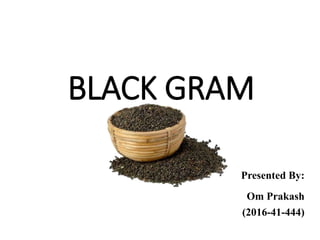
BLACK GRAM
Presented By:
Om Prakash
(2016-41-444)
INTRODUCTION
• Blackgram or Urdbean (Vigna mungo (L.) Hepper) is
known by various names in India. It is cultivated in
different seasons in India i.e., in kharif as a mixture with
cereals, pigeonpea, etc. in rabi and zaid as pure culture.
• About 70% of world’s blackgram production comes from
India. India is the world’s largest producer as well as the
largest consumer of blackgram.
TAXANOMIC STATUS
Scientific Name- Vigna mungo L
• Systematic Position;
Kingdom :Plantae
Division :Spermatophyte
Sub-division :Angiosperm
Class :Dicotyledon
Family :Fabaceae
Sub-family :Papilionaceae
Genus :Vigna
Sub-genus :Ceratoropis
Species :mungo
ORIGIN
• De Candole(1986) is of opinion that Black Gram has
originated in India as is seen form vedic literarure.
• Zukovskji (1962) has reported that Black gram
originated from Vigna sublobata which grows wild
from India to Indonesia.
• So Vigna sublobata is the progenitor of Black gram
(Vigna mungo)
CLASSIFICATION
Vigna mungo is subdivided into two species;
i. Vigna mungo var. viridis : The seeds of this
species are of small in size and green in
colour. In this group, the varieties have
longer maturirty period. Chromosome
number is 2n=24.
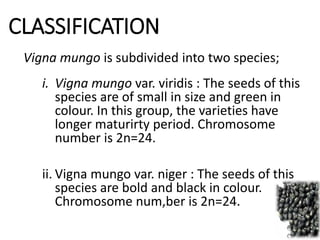
ii. Vigna mungo var. niger : The seeds of this
species are bold and black in colour.
Chromosome num,ber is 2n=24.
SOME VARITIES, HYBRIDS,
SELECTIONS AND MUTANTS
Type Examples
Varities LGB-17, OBG 17, WB-108, ADT-1, etc.
Hybrids TAU-2, KM-1, KM-2, ADT-2, Pusa-1, etc.
Selection CO-1, CO-2, CO-3, T-9, Mash 414, etc.
Mutants Vamban 2, CO-4
VARIETIES
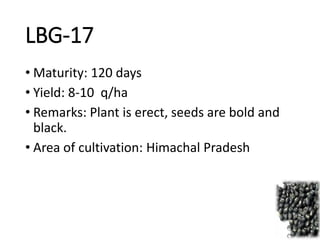
LBG-17
• Maturity: 120 days
• Yield: 8-10 q/ha
• Remarks: Plant is erect, seeds are bold and
black.
• Area of cultivation: Himachal Pradesh
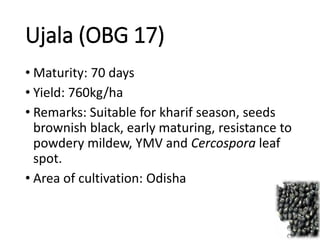
Ujala (OBG 17)
• Maturity: 70 days
• Yield: 760kg/ha
• Remarks: Suitable for kharif season, seeds
brownish black, early maturing, resistance to
powdery mildew, YMV and Cercospora leaf
spot.
• Area of cultivation: Odisha
HYBRIDS
TAU-2
• Centre Responsible For Developing: BARC,
Bombay
• Pedigree: T-9 x U-196
• Year Of Release: 1993
• Average Yield: 10 q/ha
• Days To Maturity: 70days
• Other Information: Suited for partially
shaded condition in coconut garden
during rabi season in southern region.
KBG-512
• Centre Responsible For Developing: Kovilpatti,TNAU
• Pedigree: CO-3 x US-131
• Year Of Release: 1996
• Average Yield: 7.7 q/ha
• Days To Maturity: 70-75days
• Reaction To Major Insect Pest And Disease:
Tolerant to leaf spot disease and stem fly.
•Other Information: Area of adaptability is
Tamil Nadu
SELECTION
CO-2
• Selected Variety From: P-166
• Year of release and Place: 1975 in TNAU
• Yield: 5-8 q/ha
• Maturity: 65 days
• Other Information: Seeds are bold and black
colour, suitable variety for multiple cropping
T-9
• Selected Variety From: Local material
• Year of release and Place: 1948 in Bareilly, UP
• Yield: 8-10 q/ha
• Maturity: 85-90 days
• Other Information: Dwarf and semi erect with
dark green leaves and hairy pods. Seeds
medium bold and black in colour. Suitable for
cultivation for summer and spring season.
MUTANTS
Vamban 2
• Mutant of T-9
• Year of release and Place: 1997 in TNAU
• Yield: 8.2 q/ha
• Maturity: 70 days
• Other Information: Resistance to YMV.
CO-4
• Induced mutant of CO-1
• Year of release and Place: 1978 in TNAU
• Yield: 60 q/ha
• Maturity: 70 days
• Other Information: Seeds bold and black in
colour.
Black gram

Black gram

  • 1.
    BLACK GRAM Presented By: OmPrakash (2016-41-444)
  • 2.
    INTRODUCTION • Blackgram orUrdbean (Vigna mungo (L.) Hepper) is known by various names in India. It is cultivated in different seasons in India i.e., in kharif as a mixture with cereals, pigeonpea, etc. in rabi and zaid as pure culture. • About 70% of world’s blackgram production comes from India. India is the world’s largest producer as well as the largest consumer of blackgram.
  • 3.
    TAXANOMIC STATUS Scientific Name-Vigna mungo L • Systematic Position; Kingdom :Plantae Division :Spermatophyte Sub-division :Angiosperm Class :Dicotyledon Family :Fabaceae Sub-family :Papilionaceae Genus :Vigna Sub-genus :Ceratoropis Species :mungo
  • 4.
    ORIGIN • De Candole(1986)is of opinion that Black Gram has originated in India as is seen form vedic literarure. • Zukovskji (1962) has reported that Black gram originated from Vigna sublobata which grows wild from India to Indonesia. • So Vigna sublobata is the progenitor of Black gram (Vigna mungo)
  • 5.
    CLASSIFICATION Vigna mungo issubdivided into two species; i. Vigna mungo var. viridis : The seeds of this species are of small in size and green in colour. In this group, the varieties have longer maturirty period. Chromosome number is 2n=24. ii. Vigna mungo var. niger : The seeds of this species are bold and black in colour. Chromosome num,ber is 2n=24.
  • 6.
    SOME VARITIES, HYBRIDS, SELECTIONSAND MUTANTS Type Examples Varities LGB-17, OBG 17, WB-108, ADT-1, etc. Hybrids TAU-2, KM-1, KM-2, ADT-2, Pusa-1, etc. Selection CO-1, CO-2, CO-3, T-9, Mash 414, etc. Mutants Vamban 2, CO-4
  • 7.
  • 8.
    LBG-17 • Maturity: 120days • Yield: 8-10 q/ha • Remarks: Plant is erect, seeds are bold and black. • Area of cultivation: Himachal Pradesh
  • 9.
    Ujala (OBG 17) •Maturity: 70 days • Yield: 760kg/ha • Remarks: Suitable for kharif season, seeds brownish black, early maturing, resistance to powdery mildew, YMV and Cercospora leaf spot. • Area of cultivation: Odisha
  • 10.
  • 11.
    TAU-2 • Centre ResponsibleFor Developing: BARC, Bombay • Pedigree: T-9 x U-196 • Year Of Release: 1993 • Average Yield: 10 q/ha • Days To Maturity: 70days • Other Information: Suited for partially shaded condition in coconut garden during rabi season in southern region.
  • 12.
    KBG-512 • Centre ResponsibleFor Developing: Kovilpatti,TNAU • Pedigree: CO-3 x US-131 • Year Of Release: 1996 • Average Yield: 7.7 q/ha • Days To Maturity: 70-75days • Reaction To Major Insect Pest And Disease: Tolerant to leaf spot disease and stem fly. •Other Information: Area of adaptability is Tamil Nadu
  • 13.
  • 14.
    CO-2 • Selected VarietyFrom: P-166 • Year of release and Place: 1975 in TNAU • Yield: 5-8 q/ha • Maturity: 65 days • Other Information: Seeds are bold and black colour, suitable variety for multiple cropping
  • 15.
    T-9 • Selected VarietyFrom: Local material • Year of release and Place: 1948 in Bareilly, UP • Yield: 8-10 q/ha • Maturity: 85-90 days • Other Information: Dwarf and semi erect with dark green leaves and hairy pods. Seeds medium bold and black in colour. Suitable for cultivation for summer and spring season.
  • 16.
  • 17.
    Vamban 2 • Mutantof T-9 • Year of release and Place: 1997 in TNAU • Yield: 8.2 q/ha • Maturity: 70 days • Other Information: Resistance to YMV.
  • 18.
    CO-4 • Induced mutantof CO-1 • Year of release and Place: 1978 in TNAU • Yield: 60 q/ha • Maturity: 70 days • Other Information: Seeds bold and black in colour.