

LAB BIOSECURITY
Asif Nawaz
Department Of Microbiology
ABBOTTABAD UNIVERSITY OF SCIENCE &
TECHNOLOGY
LAB BIOSAFETY TO BIOSECURITY
The Laboratory biosafety emphasizes the use of good
microbiological practices, appropriate containment equipment,
proper facility design, operation/maintenance and
administrative considerations to minimize the risk of worker
injury or illness.
In following these recommendations, the risk to the
environment and surrounding community-at-large is also
minimized. It is necessary to expand this traditional approach to
biosafety through laboratory biosecurity measures.
LAB BIOSAFETY Vs BIOSECURITY
“Laboratory biosafety” is the term used to describe the
containment principles, technologies and practices that are
implemented to prevent unintentional exposure to
pathogens and toxins, or their accidental release.
“Laboratory biosecurity” refers to institutional and personal
security measures designed to prevent the loss, theft,
misuse,
diversion or intentional release of pathogens and toxins.
LAB BIOSAFETY TO BIOSECURITY
Effective biosafety practices are the very foundation of
laboratory biosecurity activities.
Through risk assessments, performed as an integral part of an
institution’s biosafety programme, information is gathered
regarding the type of organisms available, their physical
location, the personnel who require access to them, and the
identification of those responsible for them.
This information can be used to assess whether an institution
possesses biological materials that are attractive to those who
may wish to use them improperly.
LAB BIOSECURITY
Laboratory biosecurity may be addressed through the
coordination of administrative, regulatory and physical security
procedures and practices implemented in a working
environment that utilizes good biosafety practices, and where
responsibilities and accountabilities are clearly defined.
Biosafety and laboratory biosecurity are complementary. In
fact, the implementation of specific biosafety activities already
covers some biosecurity aspects.
The systematic use of appropriate biosafety principles and
practices reduces the risk of accidental exposure and paves the
way for reducing the risks of VBM loss, theft or misuse.
Laboratory biosecurity should be built upon a firm foundation
of good laboratory biosafety.
Definitions
Accountability
Accountability ensures that valuable biological materials (VBM) are controlled
and traced as intended, by formally associating the specified materials with the
individuals who provide oversight and are held responsible for them.
Bioethics
The study of the ethical and moral implications of biological discoveries,
biomedical advances, and their applications as in the fields of genetic
engineering and drug research.
Biological laboratory A facility within which microorganisms, their components
or their derivatives are collected handled and/or stored. Biological laboratories
include clinical laboratories, diagnostic facilities, regional and/national
reference centres, public health laboratories, research centres (academic,
pharmaceutical, environmental, etc.) and production facilities (manufacturers
of vaccines, pharmaceuticals, large scale GMOs, etc) for human, veterinary and
agricultural purposes.
Biorisk
The probability or chance that a particular adverse event (accidental infection
or unauthorized access, loss, theft, misuse, diversion or intentional release),
possibly leading to harm, will occur.
Definitions
Biorisk assessment
The process to identify acceptable and unacceptable risks (embracing
biosafety risks (risks of accidental infection) and laboratory biosecurity
risks (risks of unauthorized access, loss, theft, misuse, diversion or
intentional release)) and their potential consequences.
Biorisk management
The analysis of ways and development of strategies to minimize the
likelihood of the occurrence of biorisks. The management of biorisk
places responsibility on the facility and its manager (director) to
demonstrate that appropriate and valid biorisk reduction (minimization)
procedures have been established and are implemented.
A biorisk management committee should be established to assist the
facility director in identifying, developing and reaching biorisk
management goals.
Definitions
Code of conduct, code of ethics, code of practice
Non-legislated guidelines which one or more organizations and
individuals voluntarily agree to abide by, that set out the
standard of conduct or behavior with respect to a particular
activity.
Hazard
A danger or source of danger; the potential to cause harm.
Threat
The likelihood for an adverse event to occur, as an expression of
intention to inflict evil, injury, disruption or damage.
Definitions
Valuable biological materials (VBM)
Biological materials that require administrative oversight,
control, accountability, and specific protective and
monitoring measures in laboratories to protect their
economic and historical value, and/or the population from
their potential to cause harm. VBM may include pathogens
and toxins, as well as non-pathogenic organisms, vaccine
strains, foods, genetically modified organisms (GMOs), cell
components, genetic elements, and extraterrestrial
samples.
Laboratory biosecurity measures are based on a comprehensive
programme of accountability for VBM that includes:
1. Regularly updated inventories with storage locations,
2. Identification and selection of personnel with access,
3. Plans of use of VBM,
4. Clearance and approval processes,
5. Documentation of internal and external transfers within and
between facilities, and of any
6. Inactivation and/or disposal of the material.
Institutional laboratory biosecurity protocols should
include how to handle breaches or near-breaches in
laboratory biosecurity including:
1. Incident notification (Breakage, Theft, Discrepancy etc.)
2. Reporting protocols (Documentation),
3. Investigation reports (Committees),
4. Recommendations and remedies, and
5. Oversight and guidance through the biosafety committee.
COMMONALITIES AND CONFLICTS:
LABORATORY BIOSAFETY VS LABORATORY BIOSECURITY
Commonalities
Good laboratory biosafety practices reinforce and strengthen
laboratory biosecurity systems.
Appropriate levels of biosafety may be achieved through carefully
designed and implemented work practices.
The biosafety recommendations outlined in LBM3 provide clear levels
of protection for VBM. For example self-closing doors, restricted access,
physical separation from traffic areas, break-resistant windows and an
emergency response plan may all be common to both biosafety and
laboratory biosecurity.
COMMONALITIES AND CONFLICTS:
LABORATORY BIOSAFETY VS LABORATORY BIOSECURITY
Commonalities
LBM3 also advocates a “reliable and adequate electricity supply and
emergency lighting” as well as a “stand-by generator”. While this helps
to ensure the function of critical biosafety equipment (ventilation
systems, biological safety cabinets, autoclaves, etc.), it also supports
components of physical security systems that may depend on electrical
supply.
COMMONALITIES AND CONFLICTS:
LABORATORY BIOSAFETY VS LABORATORY BIOSECURITY
Commonalities
According to LBM3, the review of research protocols falls under
the responsibilities of the biosafety officer and the biosafety
committee, by delegation of the director of the facility.
This includes risk assessments in consultation with local
authorities, national regulatory bodies and the community for
sensitive protocols under discussion. Adding the review of laboratory
biosecurity to the existing biosafety mandate for biosafety
committees represents a major change and an additional
responsibility.
LABORATORY BIOSAFETY VS LABORATORY BIOSECURITY
Conflicts
In the absence of careful implementation, various aspects
of biosafety may conflict with laboratory biosecurity.
For example, controls that reduce unauthorized access
might also hinder an emergency response by fire or rescue
personnel.
Mechanisms need to be established that allow entry by
emergency responders but ensure uninterrupted and
constant laboratory biosecurity, control, accountability and
traceability of VBM.
Likewise, staff members must be able to quickly and
safely exit a laboratory during an emergency without at the
same time allowing unrestricted access to sensitive VBM.
LABORATORY BIOSAFETY VS LABORATORY BIOSECURITY
Conflicts
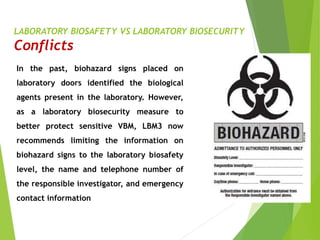
In the past, biohazard signs placed on
laboratory doors identified the biological
agents present in the laboratory. However,
as a laboratory biosecurity measure to
better protect sensitive VBM, LBM3 now
recommends limiting the information on
biohazard signs to the laboratory biosafety
level, the name and telephone number of
the responsible investigator, and emergency
contact information

Biosafety & biosecurity lab biosecurity

  • 1.
    LAB BIOSECURITY Asif Nawaz DepartmentOf Microbiology ABBOTTABAD UNIVERSITY OF SCIENCE & TECHNOLOGY
  • 2.
    LAB BIOSAFETY TOBIOSECURITY The Laboratory biosafety emphasizes the use of good microbiological practices, appropriate containment equipment, proper facility design, operation/maintenance and administrative considerations to minimize the risk of worker injury or illness. In following these recommendations, the risk to the environment and surrounding community-at-large is also minimized. It is necessary to expand this traditional approach to biosafety through laboratory biosecurity measures.
  • 3.
    LAB BIOSAFETY VsBIOSECURITY “Laboratory biosafety” is the term used to describe the containment principles, technologies and practices that are implemented to prevent unintentional exposure to pathogens and toxins, or their accidental release. “Laboratory biosecurity” refers to institutional and personal security measures designed to prevent the loss, theft, misuse, diversion or intentional release of pathogens and toxins.
  • 4.
    LAB BIOSAFETY TOBIOSECURITY Effective biosafety practices are the very foundation of laboratory biosecurity activities. Through risk assessments, performed as an integral part of an institution’s biosafety programme, information is gathered regarding the type of organisms available, their physical location, the personnel who require access to them, and the identification of those responsible for them. This information can be used to assess whether an institution possesses biological materials that are attractive to those who may wish to use them improperly.
  • 5.
    LAB BIOSECURITY Laboratory biosecuritymay be addressed through the coordination of administrative, regulatory and physical security procedures and practices implemented in a working environment that utilizes good biosafety practices, and where responsibilities and accountabilities are clearly defined. Biosafety and laboratory biosecurity are complementary. In fact, the implementation of specific biosafety activities already covers some biosecurity aspects. The systematic use of appropriate biosafety principles and practices reduces the risk of accidental exposure and paves the way for reducing the risks of VBM loss, theft or misuse. Laboratory biosecurity should be built upon a firm foundation of good laboratory biosafety.
  • 6.
    Definitions Accountability Accountability ensures thatvaluable biological materials (VBM) are controlled and traced as intended, by formally associating the specified materials with the individuals who provide oversight and are held responsible for them. Bioethics The study of the ethical and moral implications of biological discoveries, biomedical advances, and their applications as in the fields of genetic engineering and drug research. Biological laboratory A facility within which microorganisms, their components or their derivatives are collected handled and/or stored. Biological laboratories include clinical laboratories, diagnostic facilities, regional and/national reference centres, public health laboratories, research centres (academic, pharmaceutical, environmental, etc.) and production facilities (manufacturers of vaccines, pharmaceuticals, large scale GMOs, etc) for human, veterinary and agricultural purposes. Biorisk The probability or chance that a particular adverse event (accidental infection or unauthorized access, loss, theft, misuse, diversion or intentional release), possibly leading to harm, will occur.
  • 7.
    Definitions Biorisk assessment The processto identify acceptable and unacceptable risks (embracing biosafety risks (risks of accidental infection) and laboratory biosecurity risks (risks of unauthorized access, loss, theft, misuse, diversion or intentional release)) and their potential consequences. Biorisk management The analysis of ways and development of strategies to minimize the likelihood of the occurrence of biorisks. The management of biorisk places responsibility on the facility and its manager (director) to demonstrate that appropriate and valid biorisk reduction (minimization) procedures have been established and are implemented. A biorisk management committee should be established to assist the facility director in identifying, developing and reaching biorisk management goals.
  • 8.
    Definitions Code of conduct,code of ethics, code of practice Non-legislated guidelines which one or more organizations and individuals voluntarily agree to abide by, that set out the standard of conduct or behavior with respect to a particular activity. Hazard A danger or source of danger; the potential to cause harm. Threat The likelihood for an adverse event to occur, as an expression of intention to inflict evil, injury, disruption or damage.
  • 9.
    Definitions Valuable biological materials(VBM) Biological materials that require administrative oversight, control, accountability, and specific protective and monitoring measures in laboratories to protect their economic and historical value, and/or the population from their potential to cause harm. VBM may include pathogens and toxins, as well as non-pathogenic organisms, vaccine strains, foods, genetically modified organisms (GMOs), cell components, genetic elements, and extraterrestrial samples.
  • 10.
    Laboratory biosecurity measuresare based on a comprehensive programme of accountability for VBM that includes: 1. Regularly updated inventories with storage locations, 2. Identification and selection of personnel with access, 3. Plans of use of VBM, 4. Clearance and approval processes, 5. Documentation of internal and external transfers within and between facilities, and of any 6. Inactivation and/or disposal of the material.
  • 11.
    Institutional laboratory biosecurityprotocols should include how to handle breaches or near-breaches in laboratory biosecurity including: 1. Incident notification (Breakage, Theft, Discrepancy etc.) 2. Reporting protocols (Documentation), 3. Investigation reports (Committees), 4. Recommendations and remedies, and 5. Oversight and guidance through the biosafety committee.
  • 12.
    COMMONALITIES AND CONFLICTS: LABORATORYBIOSAFETY VS LABORATORY BIOSECURITY Commonalities Good laboratory biosafety practices reinforce and strengthen laboratory biosecurity systems. Appropriate levels of biosafety may be achieved through carefully designed and implemented work practices. The biosafety recommendations outlined in LBM3 provide clear levels of protection for VBM. For example self-closing doors, restricted access, physical separation from traffic areas, break-resistant windows and an emergency response plan may all be common to both biosafety and laboratory biosecurity.
  • 13.
    COMMONALITIES AND CONFLICTS: LABORATORYBIOSAFETY VS LABORATORY BIOSECURITY Commonalities LBM3 also advocates a “reliable and adequate electricity supply and emergency lighting” as well as a “stand-by generator”. While this helps to ensure the function of critical biosafety equipment (ventilation systems, biological safety cabinets, autoclaves, etc.), it also supports components of physical security systems that may depend on electrical supply.
  • 14.
    COMMONALITIES AND CONFLICTS: LABORATORYBIOSAFETY VS LABORATORY BIOSECURITY Commonalities According to LBM3, the review of research protocols falls under the responsibilities of the biosafety officer and the biosafety committee, by delegation of the director of the facility. This includes risk assessments in consultation with local authorities, national regulatory bodies and the community for sensitive protocols under discussion. Adding the review of laboratory biosecurity to the existing biosafety mandate for biosafety committees represents a major change and an additional responsibility.
  • 15.
    LABORATORY BIOSAFETY VSLABORATORY BIOSECURITY Conflicts In the absence of careful implementation, various aspects of biosafety may conflict with laboratory biosecurity. For example, controls that reduce unauthorized access might also hinder an emergency response by fire or rescue personnel. Mechanisms need to be established that allow entry by emergency responders but ensure uninterrupted and constant laboratory biosecurity, control, accountability and traceability of VBM. Likewise, staff members must be able to quickly and safely exit a laboratory during an emergency without at the same time allowing unrestricted access to sensitive VBM.
  • 16.
    LABORATORY BIOSAFETY VSLABORATORY BIOSECURITY Conflicts In the past, biohazard signs placed on laboratory doors identified the biological agents present in the laboratory. However, as a laboratory biosecurity measure to better protect sensitive VBM, LBM3 now recommends limiting the information on biohazard signs to the laboratory biosafety level, the name and telephone number of the responsible investigator, and emergency contact information