

BIOSECURITY
AND
PROTOCOLS IN BIOSECURITY
Supervisor – Dr. K. Rajamohan (Asst. professor)
Member – Dr. P. Balabaskar (Asso. professor)
– Dr. R. Anandan (Asst. Professor)
N. H. SHANKAR REDDY
1st Ph.D, Plant Pathology
Annamalai University
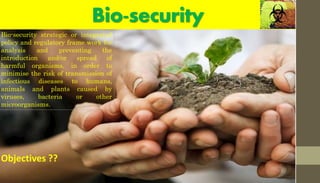
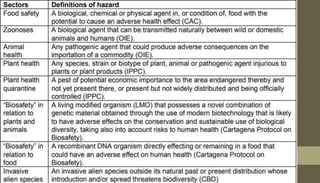
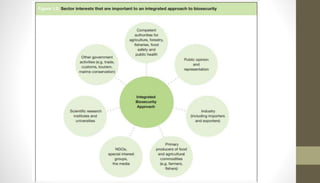
Bio-security
Bio-security strategic or integrated
policy and regulatory frame work for
analysis and preventing the
introduction and/or spread of
harmful organisms, in order to
minimise the risk of transmission of
infectious diseases to humans,
animals and plants caused by
viruses, bacteria or other
microorganisms.
Objectives ??
History of biosecurity
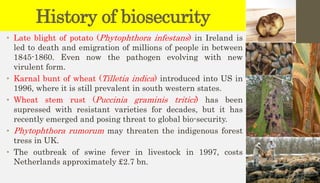
• Late blight of potato (Phytophthora infestans) in Ireland is
led to death and emigration of millions of people in between
1845-1860. Even now the pathogen evolving with new
virulent form.
• Karnal bunt of wheat (Tilletia indica) introduced into US in
1996, where it is still prevalent in south western states.
• Wheat stem rust (Puccinia graminis tritici) has been
supressed with resistant varieties for decades, but it has
recently emerged and posing threat to global bio-security.
• Phytophthora rumorum may threaten the indigenous forest
tress in UK.
• The outbreak of swine fever in livestock in 1997, costs
Netherlands approximately £2.7 bn.
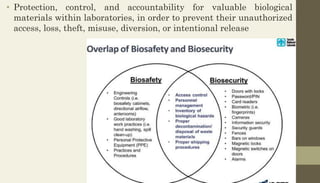
• Protection, control, and accountability for valuable biological
materials within laboratories, in order to prevent their unauthorized
access, loss, theft, misuse, diversion, or intentional release
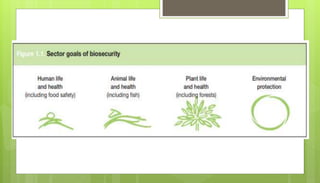
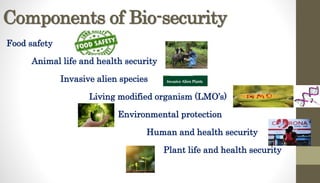
Components of Bio-security
Food safety
Animal life and health security
Invasive alien species
Living modified organism (LMO’s)
Environmental protection
Human and health security
Plant life and health security
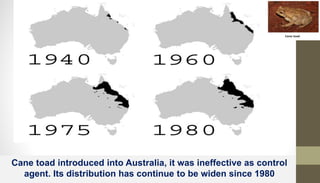
Cane toad introduced into Australia, it was ineffective as control
agent. Its distribution has continue to be widen since 1980
Some factors influencing biosecurity
• Globalization
• New agricultural production and food processing technologies
• Increased trade in food and agricultural products
• Legal obligations for signatories of relevant international
agreements
• Increasing travel and movement of people across borders
• Scarcity of technical and operational resources
• High dependence of some countries on food imports
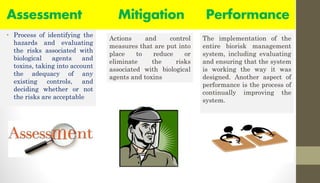
Bio-risk Management: the AMP Model
Bio-risk management = Assesment,
Mitigation,
Performance
Assessment Mitigation Performance
• Process of identifying the
hazards and evaluating
the risks associated with
biological agents and
toxins, taking into account
the adequacy of any
existing controls, and
deciding whether or not
the risks are acceptable
The implementation of the
entire biorisk management
system, including evaluating
and ensuring that the system
is working the way it was
designed. Another aspect of
performance is the process of
continually improving the
system.
Actions and control
measures that are put into
place to reduce or
eliminate the risks
associated with biological
agents and toxins
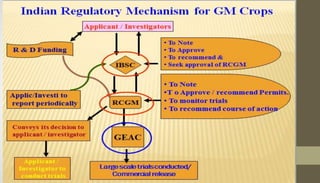
IBSC
Institutional Bio- Safety Committee
• Institutional Bio-safety Committee for the recombinant
DNA research to review all “Research projects that entail
cloning and/or transformations and infections and/or
expression of genes in eukaryotic or prokaryotic
organisms as well as handling of infectious organisms”
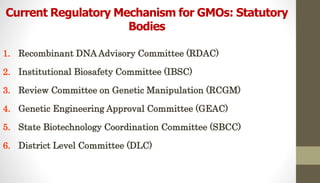
Current Regulatory Mechanism for GMOs: Statutory
Bodies
1. Recombinant DNA Advisory Committee (RDAC)
2. Institutional Biosafety Committee (IBSC)
3. Review Committee on Genetic Manipulation (RCGM)
4. Genetic Engineering Approval Committee (GEAC)
5. State Biotechnology Coordination Committee (SBCC)
6. District Level Committee (DLC)
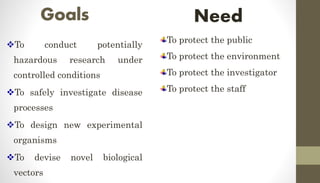
Goals
To conduct potentially
hazardous research under
controlled conditions
To safely investigate disease
processes
To design new experimental
organisms
To devise novel biological
vectors
Need
To protect the public
To protect the environment
To protect the investigator
To protect the staff
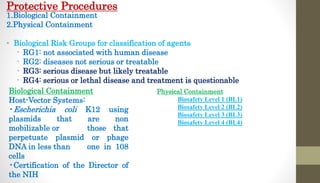
Protective Procedures
1.Biological Containment
2.Physical Containment
• Biological Risk Groups for classification of agents
• RG1: not associated with human disease
• RG2: diseases not serious or treatable
• RG3: serious disease but likely treatable
• RG4: serious or lethal disease and treatment is questionable
Biological Containment
Host-Vector Systems:
•Escherichia coli K12 using
plasmids that are non
mobilizable or those that
perpetuate plasmid or phage
DNA in less than one in 108
cells
•Certification of the Director of
the NIH
Physical Containment
Biosafety Level 1 (BL1)
Biosafety Level 2 (BL2)
Biosafety Level 3 (BL3)
Biosafety Level 4 (BL4)
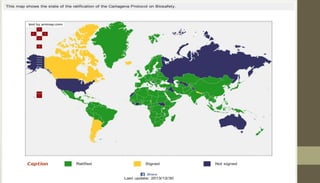
Cartagena Protocol on Biosafety
• The Cartagena Protocol on Biosafety to the
Convention on Biological Diversity is an international
treaty governing the safe transfer, handling, and use
of living modified organisms (LMOs) resulting from
modern biotechnology from one country to another.
• It was named in honor of Cartagena, Colombia, where
it was originally scheduled to be concluded and
adopted.
Objectives
To contribute to ensuring an adequate level of protection in the field of
the safe transfer, handling and use of 'living modified organisms
resulting from modern biotechnology' that may have adverse effects on
the conservation and sustainable use of biological diversity, taking also
into account risks to human health, and specifically focusing on
transboundary movements
Scope
The protocol applies to transboundary movement, transit, handling
and use of all LMOs that may have adverse effects on the conversation
and sustainable use of biological diversity, taking also into account
risk to human health.
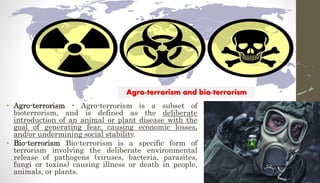
• Agro-terrorism - Agro-terrorism is a subset of
bioterrorism, and is defined as the deliberate
introduction of an animal or plant disease with the
goal of generating fear, causing economic losses,
and/or undermining social stability.
• Bio-terrorism Bio-terrorism is a specific form of
terrorism involving the deliberate environmental
release of pathogens (viruses, bacteria, parasites,
fungi or toxins) causing illness or death in people,
animals, or plants.
Agro-terrorism and bio-terrorism
Orion of agro-terrorism
• Least studied - little considered - Bioweapons against agriculture -
theoretical consideration in most nations
• 1990s accepted by many policy makers (US) -probable attack on
human population
• Hundreds of potential pathogens, realistically only a few dozen
are considered viable
• Livestock - widely susceptible than crops to pathogens
Threats of agro-terrorism
• The presence (or rumor) of certain pests or diseases in a country can
quickly stop all exports of a commodity, and can take months or
years to resume.
• The demand for certain types of food may decline based on which
products are targeted in the attack (e.g., dairy, beef, pork, poultry,
grains, fruit, or vegetables), while demand for other types of food
may rise due to food substitutions.
• Economic crises in the agricultural and food industries, loss of
confidence in government, and possibly human casualties.
• Humans could be at risk in terms of food safety or public health,
especially if the chosen disease is transmissible to humans
(zoonotic).
Results of an agroterrorism
• Major economic crises in the agricultural & Food industries
• Loss of confidence in government
• Need not cause human casualties for it to be effective or to
cause large scale economic consequences
• Humans - risk in food safety or public health
• Especially - disease zoonotic
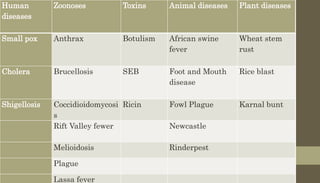
Human
diseases
Zoonoses Toxins Animal diseases Plant diseases
Small pox Anthrax Botulism African swine
fever
Wheat stem
rust
Cholera Brucellosis SEB Foot and Mouth
disease
Rice blast
Shigellosis Coccidioidomycosi
s
Ricin Fowl Plague Karnal bunt
Rift Valley fewer Newcastle
Melioidosis Rinderpest
Plague
Lassa fever
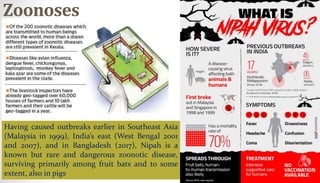
Zoonoses
Having caused outbreaks earlier in Southeast Asia
(Malaysia in 1999), India’s east (West Bengal 2001
and 2007), and in Bangladesh (2017), Nipah is a
known but rare and dangerous zoonotic disease,
surviving primarily among fruit bats and to some
extent, also in pigs
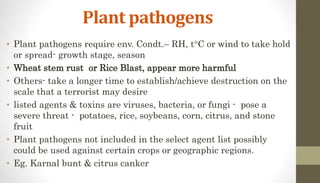
Plant pathogens
• Plant pathogens require env. Condt.– RH, tC or wind to take hold
or spread- growth stage, season
• Wheat stem rust or Rice Blast, appear more harmful
• Others- take a longer time to establish/achieve destruction on the
scale that a terrorist may desire
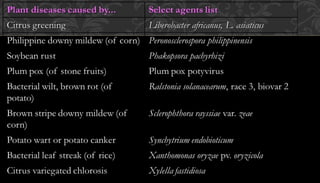
• listed agents & toxins are viruses, bacteria, or fungi - pose a
severe threat - potatoes, rice, soybeans, corn, citrus, and stone
fruit
• Plant pathogens not included in the select agent list possibly
could be used against certain crops or geographic regions.
• Eg. Karnal bunt & citrus canker
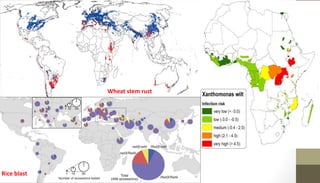
Wheat stem rust
Rice blast
Feature of use biological weapons against
farms and crops
 It has capability to infects and destroys crops, resulting
famine for human & live stock
 It has capability to produce poisonous yield
 Destroy the crops related industries
 Economic consequences
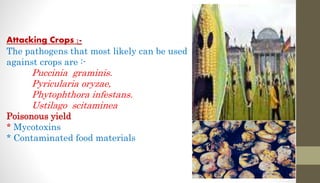
Attacking Crops :-
The pathogens that most likely can be used
against crops are :-
Puccinia graminis.
Pyricularia oryzae,
Phytophthora infestans.
Ustilago scitaminea
Poisonous yield
* Mycotoxins
* Contaminated food materials
Chemical Weapons
• During the Vietnam War, the U.S. used Agent Orange
to destroy foliage, affecting some crops
• In 1978, the Arab Revolutionary Council poisoned
Israeli oranges with mercury, injuring at least 12
people & reducing orange exports by 40%
• 1997- attack by Israeli settlers - sprayed pesticides on
grapevines - two Palestinian villages, destroying -
17,000 metric tons of grapes
• Cattle cakes were made by a London soap maker and
sent to Porton in weekly batches of 250,000 . A simple
machine injected 0.05ml of a 1010 ml anthrax
suspension into each cake and the cake was sealed
and dried
• One type of attack scenario envisaged a massive single raid by 1250 aircraft
each with 9 – 10 boxes of cakes which would be disseminated over a 18 to 20
minute run at 200mph.
• Armies have used pests to destroy the food supplies of other nations—such as
the Nazis rearing millions of Colorado potato beetles for use against England
During the Cold War.
• US military planned a facility to produce 100 million yellow-fever-infected
mosquitoes a month
• Asian long horned beetle, which first appeared in 1996 and the emerald ash
borer, found in 2002, together have the potential to destroy more than $700
billion worth of forests, according to the US Department of Agriculture
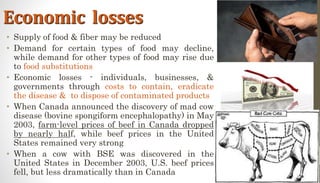
Economic losses
• Supply of food & fiber may be reduced
• Demand for certain types of food may decline,
while demand for other types of food may rise due
to food substitutions
• Economic losses - individuals, businesses, &
governments through costs to contain, eradicate
the disease & to dispose of contaminated products
• When Canada announced the discovery of mad cow
disease (bovine spongiform encephalopathy) in May
2003, farm-level prices of beef in Canada dropped
by nearly half, while beef prices in the United
States remained very strong
• When a cow with BSE was discovered in the
United States in December 2003, U.S. beef prices
fell, but less dramatically than in Canada
Predictive measures prevent agro-terrorism
Predictive measures
• Intelligence measures (identify
potential threats; understand
motivations; predict behavior)
• Monitoring programs
(detect/track specific
pathogens/diseases)
• Establishment of laboratories to
research the most-virulent
diseases
• International counter
proliferation treaties, protocols,
and agreements
• Creation of agent-specific
resistance in livestock
Response measures
• Early detection of exotic/ foreign
pathogenic agents and prediction of
disease dispersion patterns
• Early containment procedures
• Epidemiology and treatment
• Depopulation and carcass disposal
• Diplomatic/ legal/ economic/
political responses
• Compensation and insurance
• Education and training
• Public awareness and outreach
programs
• Vaccine and pharmaceutical
stockpiling
Comeback system……
1. Efficient surveillance system, with rapid communication systems
2. Rapid diagnostics for plant and animal diseases
3. Rapid-action forces for damage control must be created. India needs to
develop databases for all pathogens affecting important crops of the country.
4. Ensure the distribution of life-sustaining food to all sectors of society during
times of scarcity
5. Legal system must be able to deter, apprehend, and punish offenders
6. India must develop capabilities in i-forensics
7. An interactive system of government officials and social workers can
improve food, water hygiene and detect & report anything amiss
8. International cooperation is important for information exchange and
extraditing bioterrorists
9. Continued development of disease-resistant varieties
10. Critically assess genetically modified (GM) crops for their profitability and
sustainability
Previous agreements, understandings and
proposals
1. Biosafety and the Convention
2. Biosecurity and the Convention
3. Past proposals on biosecurity
4. Building biosafety and biosecurity capacity
BIOSAFETY AND BIOSECURITY ACTIVITIES
OUTSIDE THE CONVENTION
• American Biological Safety Association (ABSA)
• Asia-Pacific Biosafety Association (A-PBA)
• European Biological Safety Association (EBSA)
• Food and Agriculture Organization (FAO)
• International Biosafety Working Group (IBWG)
• International Veterinary Biosafety Workgroup (IVBWG)
• Organization for Economic Cooperation and Development (OECD)
• UN Environment Programme (Global Environment Facility) (UNEP-
GEF)
• World Health Organization (WHO)
• World Organization for Animal Health (OIE)
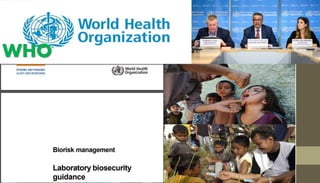
WHO
WTO in Bio-security
• World trade
organization
(WTO) was formed
in January 1, 1995
and headquarters
in Geneva,
Switzerland. It is
an international
organization
which regulates
and liberalizes
international
trade.
Objectives
• To promote new world trade agreement and multilateral trade.
• Improve the standard of living of people in the member countries
and speed up economic development.
• To ensure optimum utilization of world resources.
• To protect environment.
Agreement on applications of Sanitary and
Phytosanitary Measures (WTO-SPS agreement)
• The WTO-SPS agreement
“restricts the use of unjustified
sanitary and phytosanitary
(SPS) measures for the purpose
of trade protection.
• World Trade Organization
(WTO) Agreement on the
Application of Sanitary and
Phytosanitary Measures (SPS
Agreement), which adopted
them in 1995 as the benchmark
for all international sanitary and
phytosanitary measures.
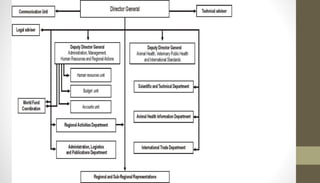
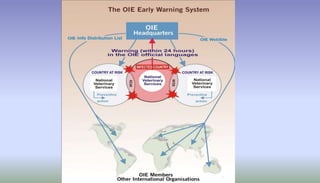
World Organization for
Animal Health (OIE)
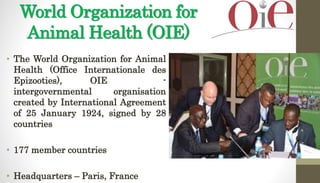
• The World Organization for Animal
Health (Office Internationale des
Epizooties), OIE -
intergovernmental organisation
created by International Agreement
of 25 January 1924, signed by 28
countries
• 177 member countries
• Headquarters – Paris, France
Mission
• To ensure transparency in global animal disease situation
• To collect, analyse, disseminate veterinary scientific
information
• To provide expertise and international solidarity in control
of animal diseases
• To safeguard world trade by publishing health standards for
international trade of animal and animal products
Current Risks
• Globalisation & climate change – increasing the risks of
events of emerging and emerging highly pathogenic animal
diseases & zoonoses
• Two billion passenger movements per year
• 75% of emerging diseases zoonotic
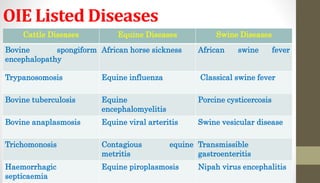
OIE Listed Diseases
Cattle Diseases Equine Diseases Swine Diseases
Bovine spongiform
encephalopathy
African horse sickness African swine fever
Trypanosomosis Equine influenza Classical swine fever
Bovine tuberculosis Equine
encephalomyelitis
Porcine cysticercosis
Bovine anaplasmosis Equine viral arteritis Swine vesicular disease
Trichomonosis Contagious equine
metritis
Transmissible
gastroenteritis
Haemorrhagic
septicaemia
Equine piroplasmosis Nipah virus encephalitis
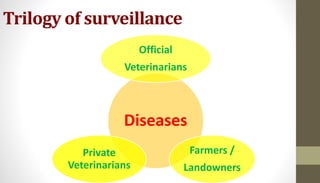
Trilogy of surveillance
Diseases
Official
Veterinarians
Farmers /
Landowners
Private
Veterinarians
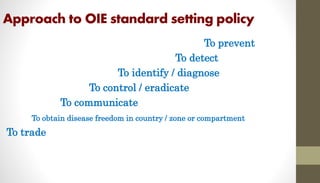
Approach to OIE standard setting policy
To prevent
To detect
To identify / diagnose
To control / eradicate
To communicate
To obtain disease freedom in country / zone or compartment
To trade
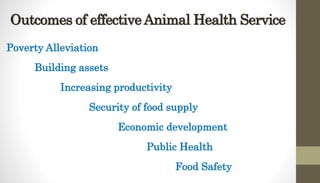
Outcomes of effective Animal Health Service
Poverty Alleviation
Building assets
Increasing productivity
Security of food supply
Economic development
Public Health
Food Safety
NO FOOD
NO LIFE
Be the REVANANT of you
own life

Biosecurity

  • 1.
    BIOSECURITY AND PROTOCOLS IN BIOSECURITY Supervisor– Dr. K. Rajamohan (Asst. professor) Member – Dr. P. Balabaskar (Asso. professor) – Dr. R. Anandan (Asst. Professor) N. H. SHANKAR REDDY 1st Ph.D, Plant Pathology Annamalai University
  • 2.
    Bio-security Bio-security strategic orintegrated policy and regulatory frame work for analysis and preventing the introduction and/or spread of harmful organisms, in order to minimise the risk of transmission of infectious diseases to humans, animals and plants caused by viruses, bacteria or other microorganisms. Objectives ??
  • 4.
    History of biosecurity •Late blight of potato (Phytophthora infestans) in Ireland is led to death and emigration of millions of people in between 1845-1860. Even now the pathogen evolving with new virulent form. • Karnal bunt of wheat (Tilletia indica) introduced into US in 1996, where it is still prevalent in south western states. • Wheat stem rust (Puccinia graminis tritici) has been supressed with resistant varieties for decades, but it has recently emerged and posing threat to global bio-security. • Phytophthora rumorum may threaten the indigenous forest tress in UK. • The outbreak of swine fever in livestock in 1997, costs Netherlands approximately £2.7 bn.
  • 5.
    • Protection, control,and accountability for valuable biological materials within laboratories, in order to prevent their unauthorized access, loss, theft, misuse, diversion, or intentional release
  • 6.
    Components of Bio-security Foodsafety Animal life and health security Invasive alien species Living modified organism (LMO’s) Environmental protection Human and health security Plant life and health security
  • 7.
    Cane toad introducedinto Australia, it was ineffective as control agent. Its distribution has continue to be widen since 1980
  • 11.
    Some factors influencingbiosecurity • Globalization • New agricultural production and food processing technologies • Increased trade in food and agricultural products • Legal obligations for signatories of relevant international agreements • Increasing travel and movement of people across borders • Scarcity of technical and operational resources • High dependence of some countries on food imports
  • 12.
    Bio-risk Management: theAMP Model Bio-risk management = Assesment, Mitigation, Performance
  • 13.
    Assessment Mitigation Performance •Process of identifying the hazards and evaluating the risks associated with biological agents and toxins, taking into account the adequacy of any existing controls, and deciding whether or not the risks are acceptable The implementation of the entire biorisk management system, including evaluating and ensuring that the system is working the way it was designed. Another aspect of performance is the process of continually improving the system. Actions and control measures that are put into place to reduce or eliminate the risks associated with biological agents and toxins
  • 16.
    IBSC Institutional Bio- SafetyCommittee • Institutional Bio-safety Committee for the recombinant DNA research to review all “Research projects that entail cloning and/or transformations and infections and/or expression of genes in eukaryotic or prokaryotic organisms as well as handling of infectious organisms”
  • 17.
    Current Regulatory Mechanismfor GMOs: Statutory Bodies 1. Recombinant DNA Advisory Committee (RDAC) 2. Institutional Biosafety Committee (IBSC) 3. Review Committee on Genetic Manipulation (RCGM) 4. Genetic Engineering Approval Committee (GEAC) 5. State Biotechnology Coordination Committee (SBCC) 6. District Level Committee (DLC)
  • 20.
    Goals To conduct potentially hazardousresearch under controlled conditions To safely investigate disease processes To design new experimental organisms To devise novel biological vectors Need To protect the public To protect the environment To protect the investigator To protect the staff
  • 21.
    Protective Procedures 1.Biological Containment 2.PhysicalContainment • Biological Risk Groups for classification of agents • RG1: not associated with human disease • RG2: diseases not serious or treatable • RG3: serious disease but likely treatable • RG4: serious or lethal disease and treatment is questionable Biological Containment Host-Vector Systems: •Escherichia coli K12 using plasmids that are non mobilizable or those that perpetuate plasmid or phage DNA in less than one in 108 cells •Certification of the Director of the NIH Physical Containment Biosafety Level 1 (BL1) Biosafety Level 2 (BL2) Biosafety Level 3 (BL3) Biosafety Level 4 (BL4)
  • 23.
    Cartagena Protocol onBiosafety • The Cartagena Protocol on Biosafety to the Convention on Biological Diversity is an international treaty governing the safe transfer, handling, and use of living modified organisms (LMOs) resulting from modern biotechnology from one country to another. • It was named in honor of Cartagena, Colombia, where it was originally scheduled to be concluded and adopted.
  • 24.
    Objectives To contribute toensuring an adequate level of protection in the field of the safe transfer, handling and use of 'living modified organisms resulting from modern biotechnology' that may have adverse effects on the conservation and sustainable use of biological diversity, taking also into account risks to human health, and specifically focusing on transboundary movements
  • 25.
    Scope The protocol appliesto transboundary movement, transit, handling and use of all LMOs that may have adverse effects on the conversation and sustainable use of biological diversity, taking also into account risk to human health.
  • 27.
    • Agro-terrorism -Agro-terrorism is a subset of bioterrorism, and is defined as the deliberate introduction of an animal or plant disease with the goal of generating fear, causing economic losses, and/or undermining social stability. • Bio-terrorism Bio-terrorism is a specific form of terrorism involving the deliberate environmental release of pathogens (viruses, bacteria, parasites, fungi or toxins) causing illness or death in people, animals, or plants. Agro-terrorism and bio-terrorism
  • 29.
    Orion of agro-terrorism •Least studied - little considered - Bioweapons against agriculture - theoretical consideration in most nations • 1990s accepted by many policy makers (US) -probable attack on human population • Hundreds of potential pathogens, realistically only a few dozen are considered viable • Livestock - widely susceptible than crops to pathogens
  • 30.
    Threats of agro-terrorism •The presence (or rumor) of certain pests or diseases in a country can quickly stop all exports of a commodity, and can take months or years to resume. • The demand for certain types of food may decline based on which products are targeted in the attack (e.g., dairy, beef, pork, poultry, grains, fruit, or vegetables), while demand for other types of food may rise due to food substitutions. • Economic crises in the agricultural and food industries, loss of confidence in government, and possibly human casualties. • Humans could be at risk in terms of food safety or public health, especially if the chosen disease is transmissible to humans (zoonotic).
  • 31.
    Results of anagroterrorism • Major economic crises in the agricultural & Food industries • Loss of confidence in government • Need not cause human casualties for it to be effective or to cause large scale economic consequences • Humans - risk in food safety or public health • Especially - disease zoonotic
  • 32.
    Human diseases Zoonoses Toxins Animaldiseases Plant diseases Small pox Anthrax Botulism African swine fever Wheat stem rust Cholera Brucellosis SEB Foot and Mouth disease Rice blast Shigellosis Coccidioidomycosi s Ricin Fowl Plague Karnal bunt Rift Valley fewer Newcastle Melioidosis Rinderpest Plague Lassa fever
  • 33.
    Zoonoses Having caused outbreaksearlier in Southeast Asia (Malaysia in 1999), India’s east (West Bengal 2001 and 2007), and in Bangladesh (2017), Nipah is a known but rare and dangerous zoonotic disease, surviving primarily among fruit bats and to some extent, also in pigs
  • 34.
    Plant pathogens • Plantpathogens require env. Condt.– RH, tC or wind to take hold or spread- growth stage, season • Wheat stem rust or Rice Blast, appear more harmful • Others- take a longer time to establish/achieve destruction on the scale that a terrorist may desire • listed agents & toxins are viruses, bacteria, or fungi - pose a severe threat - potatoes, rice, soybeans, corn, citrus, and stone fruit • Plant pathogens not included in the select agent list possibly could be used against certain crops or geographic regions. • Eg. Karnal bunt & citrus canker
  • 36.
  • 37.
    Feature of usebiological weapons against farms and crops  It has capability to infects and destroys crops, resulting famine for human & live stock  It has capability to produce poisonous yield  Destroy the crops related industries  Economic consequences
  • 38.
    Attacking Crops :- Thepathogens that most likely can be used against crops are :- Puccinia graminis. Pyricularia oryzae, Phytophthora infestans. Ustilago scitaminea Poisonous yield * Mycotoxins * Contaminated food materials
  • 39.
    Chemical Weapons • Duringthe Vietnam War, the U.S. used Agent Orange to destroy foliage, affecting some crops • In 1978, the Arab Revolutionary Council poisoned Israeli oranges with mercury, injuring at least 12 people & reducing orange exports by 40% • 1997- attack by Israeli settlers - sprayed pesticides on grapevines - two Palestinian villages, destroying - 17,000 metric tons of grapes • Cattle cakes were made by a London soap maker and sent to Porton in weekly batches of 250,000 . A simple machine injected 0.05ml of a 1010 ml anthrax suspension into each cake and the cake was sealed and dried
  • 40.
    • One typeof attack scenario envisaged a massive single raid by 1250 aircraft each with 9 – 10 boxes of cakes which would be disseminated over a 18 to 20 minute run at 200mph. • Armies have used pests to destroy the food supplies of other nations—such as the Nazis rearing millions of Colorado potato beetles for use against England During the Cold War. • US military planned a facility to produce 100 million yellow-fever-infected mosquitoes a month • Asian long horned beetle, which first appeared in 1996 and the emerald ash borer, found in 2002, together have the potential to destroy more than $700 billion worth of forests, according to the US Department of Agriculture
  • 41.
    Economic losses • Supplyof food & fiber may be reduced • Demand for certain types of food may decline, while demand for other types of food may rise due to food substitutions • Economic losses - individuals, businesses, & governments through costs to contain, eradicate the disease & to dispose of contaminated products • When Canada announced the discovery of mad cow disease (bovine spongiform encephalopathy) in May 2003, farm-level prices of beef in Canada dropped by nearly half, while beef prices in the United States remained very strong • When a cow with BSE was discovered in the United States in December 2003, U.S. beef prices fell, but less dramatically than in Canada
  • 42.
    Predictive measures preventagro-terrorism Predictive measures • Intelligence measures (identify potential threats; understand motivations; predict behavior) • Monitoring programs (detect/track specific pathogens/diseases) • Establishment of laboratories to research the most-virulent diseases • International counter proliferation treaties, protocols, and agreements • Creation of agent-specific resistance in livestock Response measures • Early detection of exotic/ foreign pathogenic agents and prediction of disease dispersion patterns • Early containment procedures • Epidemiology and treatment • Depopulation and carcass disposal • Diplomatic/ legal/ economic/ political responses • Compensation and insurance • Education and training • Public awareness and outreach programs • Vaccine and pharmaceutical stockpiling
  • 43.
    Comeback system…… 1. Efficientsurveillance system, with rapid communication systems 2. Rapid diagnostics for plant and animal diseases 3. Rapid-action forces for damage control must be created. India needs to develop databases for all pathogens affecting important crops of the country. 4. Ensure the distribution of life-sustaining food to all sectors of society during times of scarcity 5. Legal system must be able to deter, apprehend, and punish offenders 6. India must develop capabilities in i-forensics 7. An interactive system of government officials and social workers can improve food, water hygiene and detect & report anything amiss 8. International cooperation is important for information exchange and extraditing bioterrorists 9. Continued development of disease-resistant varieties 10. Critically assess genetically modified (GM) crops for their profitability and sustainability
  • 44.
    Previous agreements, understandingsand proposals 1. Biosafety and the Convention 2. Biosecurity and the Convention 3. Past proposals on biosecurity 4. Building biosafety and biosecurity capacity
  • 45.
    BIOSAFETY AND BIOSECURITYACTIVITIES OUTSIDE THE CONVENTION • American Biological Safety Association (ABSA) • Asia-Pacific Biosafety Association (A-PBA) • European Biological Safety Association (EBSA) • Food and Agriculture Organization (FAO) • International Biosafety Working Group (IBWG) • International Veterinary Biosafety Workgroup (IVBWG) • Organization for Economic Cooperation and Development (OECD) • UN Environment Programme (Global Environment Facility) (UNEP- GEF) • World Health Organization (WHO) • World Organization for Animal Health (OIE)
  • 46.
  • 47.
    WTO in Bio-security •World trade organization (WTO) was formed in January 1, 1995 and headquarters in Geneva, Switzerland. It is an international organization which regulates and liberalizes international trade.
  • 48.
    Objectives • To promotenew world trade agreement and multilateral trade. • Improve the standard of living of people in the member countries and speed up economic development. • To ensure optimum utilization of world resources. • To protect environment.
  • 49.
    Agreement on applicationsof Sanitary and Phytosanitary Measures (WTO-SPS agreement) • The WTO-SPS agreement “restricts the use of unjustified sanitary and phytosanitary (SPS) measures for the purpose of trade protection. • World Trade Organization (WTO) Agreement on the Application of Sanitary and Phytosanitary Measures (SPS Agreement), which adopted them in 1995 as the benchmark for all international sanitary and phytosanitary measures.
  • 50.
    World Organization for AnimalHealth (OIE) • The World Organization for Animal Health (Office Internationale des Epizooties), OIE - intergovernmental organisation created by International Agreement of 25 January 1924, signed by 28 countries • 177 member countries • Headquarters – Paris, France
  • 51.
    Mission • To ensuretransparency in global animal disease situation • To collect, analyse, disseminate veterinary scientific information • To provide expertise and international solidarity in control of animal diseases • To safeguard world trade by publishing health standards for international trade of animal and animal products
  • 53.
    Current Risks • Globalisation& climate change – increasing the risks of events of emerging and emerging highly pathogenic animal diseases & zoonoses • Two billion passenger movements per year • 75% of emerging diseases zoonotic
  • 54.
    OIE Listed Diseases CattleDiseases Equine Diseases Swine Diseases Bovine spongiform encephalopathy African horse sickness African swine fever Trypanosomosis Equine influenza Classical swine fever Bovine tuberculosis Equine encephalomyelitis Porcine cysticercosis Bovine anaplasmosis Equine viral arteritis Swine vesicular disease Trichomonosis Contagious equine metritis Transmissible gastroenteritis Haemorrhagic septicaemia Equine piroplasmosis Nipah virus encephalitis
  • 55.
  • 56.
    Approach to OIEstandard setting policy To prevent To detect To identify / diagnose To control / eradicate To communicate To obtain disease freedom in country / zone or compartment To trade
  • 58.
    Outcomes of effectiveAnimal Health Service Poverty Alleviation Building assets Increasing productivity Security of food supply Economic development Public Health Food Safety
  • 61.
    NO FOOD NO LIFE Bethe REVANANT of you own life