

Conventional methods for
identification and characterization
of pathogenic bacteria
Bhoj R Singh
Principal Scientist and Head
Division of Epidemiology, ICAR-IVRI, Izatnagar-243122
Presented at: 10 day (14-23 March 2022) online training
program on “Safety, Security and Quality Assurance of
Food: Recent Updates”, NDVSU, Jabalpur (MP)
16-03-2022 1
Need for identification of bacteria in
through conventional system
• All bacteria can’t be identified by automated systems.
• New bacteria and biotypes can’t be identified by
automated systems.
• We need pure cultures to identify even the for the
automated systems.
• To characterize for pathogenicity assays we need pre
cultures.
• Every laboratory can’t afford automated systems (even
ICAR-IVRI don’t have one)
16-03-2022 2
What is identification of bacteria?
• It is a systematic process using multiple techniques to
narrow down on the identity (type) of bacteria to species,
subspecies, biotypes/ biovar, strain level.
• The process chooses tests depending on the target bacteria
to be studied or the purpose of the investigation.
16-03-2022 3
Methods of identification of bacteria
• Conventional: Require culturable (Cultivable) live
bacteria, based on growth, biochemical chracteristics
(carbon source utilization, fermenatation etc), Gram
staining and morphology.
• Automated bacteria identification systems: Based on basis
of carbon source utilization and or fatty acid (lipid
profiling) analysis. Require culturable (Cultivable) live
bacteria
• Molecular: Genomics/ proteomic/ lipid profiling, can be
done using viable, culturable, non-viable, non-cultivable
and traces of bacteria.
16-03-2022 4
Automated bacterial identification systems based on
Conventional phenotypic identification system
• EZ-Fluo System (Maxcell Systems Pvt. Ltd.); Patho Sure (Microbial Detection
Kits, Aps Lifetech), Tecta B16 Automated Microbiology Detection System
(GenNext Lab Technologies Pvt. Ltd)
• BACT/ALERT® 3D (BioMerieux), ipvMicrobe from (imageProVision
Technology): : Used for detecting the presence or absence of microorganisms in
Blood & sterile body fluids replaces TSB/ thioglycollate medium, blood agar plates
etc.
• MIS 6.2 (Microbial Identification system, MIDI, Inc, ISA): Uses Fatty acid methyl
ester analysis (MIS) by gas chromatography (GC-FAME).
• Microbial ID and characterization system (Toshniwal Technologies Pvt. Ltd.) :
Use of carbon source metabolic ‘fingerprints’ in order to identify more than 1900
species of bacteria, yeasts and filamentous fungi.
• Soleris Automated Rapid Microbiology
• Auto Microbial ID AST System (Analytical Technologies Limited)
• BACTEC System & BD-Phoenix 100 ID/AST v5.51 from BBL Difco
• Biomerieux Vitek 2
• VITEK® MS is an automated mass spectrometry microbial identification system
that uses Matrix Assisted Laser Desorption Ionization Time-of-Flight (MALDI-TOF)
technology.
• Most commonly used: API/ID32 v3.1; Phoenix 100 ID/AST v5.51; AVITEK 2 v7.01;
VITEK MS Knowledge Base v2.0/v3.0
16-03-2022 5
Conventional identification of bacteria
• This process is combination of microscopic (cell shape, size,
Gram stain reaction, acid fast reaction, special structure
like capsule, flagella, endospore, granules etc.), growth in
different broth and on solid media (colony shape, size,
consistency, colour, edge, swarm, motility, pellicle,
sediment etc.) and biochemical (fermentation, use as sole
carbon source, demaination, decarboxylation, oxidase,
catalase, gelatinase, urease etc.) methods.
16-03-2022 6
Pathogenic Bacteria
• The bacteria which cause one or other disease/ lesions due
to pathogenesis induced by them.
• To classify or identify a bacterial isolate as pathogen needs:
– Its characterization using techniques for putative
virulence markers (phenotypic and genotypic).
– Proving the pathogenic potential and pathogenicity in a
suitable biological models/ hosts to establish Evans
postulates (Not only Koch postulate).
16-03-2022 7
Conventional Techniques to identify
pathogenic bacteria
• Many similar methods are used for different bacteria but
methodology can’t be generalized for all due to their
growth patterns at different temperature, oxygen tension
and osmotic requirements.
• Besides common techniques a few are specific for different
bacteria.
• Bacterial load is crucial for most of the pathogens, just
identification is not enough.
• Only those can be cultivated in laboratory on synthetic
media or cell culture or animal models can be identified
and characterized by conventional methods.
16-03-2022 8
Common media used for selective enrichment
of pathogenic bacteria
Bacteria Selective Enrichment broth
Bacillus cereus BPW heated to pasteurize after inoculation
Campylobacter jejuni Selective enrichment medium (ATB)
Clostridium botulinum TPGY broth media, Egg meat medium fortified with 1% additions of yeast extract, ammonium sulfate,
and glucose (FEM medium)
Clostridiumperfringens Thioglycollate medium (fluid) , iron-milk medium
Cronobacter sakazaki Cronobacter sakazaki enrichment broth
Escherichia coli Enterobacteriaceae enrichment broth, MacConkey broth
Listeria monocytogenes Al-Zoreky-Sandine Listeria medium [ASLM] ; University of Vermont Medium (UVM) containing
acriflavin and naladixic acid; Fraser broth with acriflavin, naladixic acid and esculin; Listeria
Enrichment broth (LEB, FDA BAM formulation) containing the selective agents acriflavin, naladixic
acid and the antifungal agent cycloheximide
Salmonella spp. Tetrathionate broth Rappaport Vassiliadis medium, Selenite broth
Shigella spp. Shigella broth with 0.5mg/L novobiocin
Staphylococcus spp. BHI with 10% NaCL
Vibrio spp. Alkaline peptone water (APW), Glucose salt teepol (or sodium dodecylsulphate) broth (GSTB)
Yersinia enteeocolitica ICT or TTC Broth (contains irgasan or triclosan)
Brucella spp. BHI broth
Burkholderia spp. Burkholderia broth
Pseudomonas Dettol broth, BHI broth
16-03-2022 9
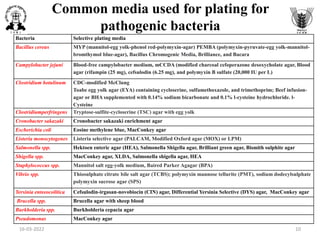
Common media used for plating for
pathogenic bacteria
Bacteria Selective plating media
Bacillus cereus MYP (mannitol-egg yolk-phenol red-polymyxin-agar) PEMBA (polymyxin-pyruvate-egg yolk-mannitol-
bromthymol blue-agar), Bacillus Chromogenic Media, Brilliance, and Bacara
Campylobacter jejuni Blood-free campylobacter medium, mCCDA (modified charcoal cefoperazone desoxycholate agar, Blood
agar (rifampin (25 mg), cefsulodin (6.25 mg), and polymyxin B sulfate (20,000 IU per L)
Clostridium botulinum CDC-modified McClung
Toabe egg yolk agar (EYA) containing cycloserine, sulfamethoxazole, and trimethoprim; Beef infusion-
agar or BHA supplemented with 0.14% sodium bicarbonate and 0.1% l-cysteine hydrochloride. l-
Cysteine
Clostridiumperfringens Tryptose-sulfite-cycloserine (TSC) agar with egg yolk
Cronobacter sakazaki Cronobacter sakazaki enrichment agar
Escherichia coli Eosine methylene blue, MacConkey agar
Listeria monocytogenes Listeria selective agar (PALCAM, Modified Oxford agar (MOX) or LPM)
Salmonella spp. Hektoen enteric agar (HEA), Salmonella Shigella agar, Brilliant green agar, Bismith sulphite agar
Shigella spp. MacConkey agar, XLDA, Salmonella shigella agar, HEA
Staphylococcus spp. Mannitol salt egg-yolk medium, Baired Parker Agagar (BPA)
Vibrio spp. Thiosulphate citrate bile salt agar (TCBS); polymyxin mannose tellurite (PMT), sodium dodecylsulphate
polymyxin sucrose agar (SPS)
Yersinia enteeocolitica Cefsulodin-irgasan-novobiocin (CIN) agar, Differential Yersinia Selective (DYS) agar, MacConkey agar
Brucella spp. Brucella agar with sheep blood
Burkholderia spp. Burkholderia cepacia agar
Pseudomonas MacConkey agar
16-03-2022 10
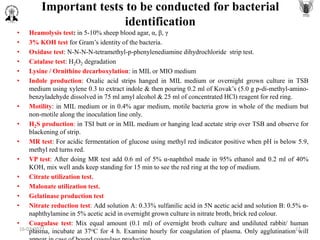
Important tests to be conducted for bacterial
identification
• Heamolysis test: in 5-10% sheep blood agar, α, β, γ
• 3% KOH test for Gram’s identity of the bacteria.
• Oxidase test: N-N-N-N-tetramethyl-p-phenylenediamine dihydrochloride strip test.
• Catalase test: H2O2 degradation
• Lysine / Ornithine decarboxylation: in MIL or MIO medium
• Indole production: Oxalic acid strips hanged in MIL medium or overnight grown culture in TSB
medium using xylene 0.3 to extract indole & then pouring 0.2 ml of Kovak’s (5.0 g p-di-methyl-amino-
benzyladehyde dissolved in 75 ml amyl alcohol & 25 ml of concentrated HCl) reagent for red ring.
• Motility: in MIL medium or in 0.4% agar medium, motile bacteria grow in whole of the medium but
non-motile along the inoculation line only.
• H2S production: in TSI butt or in MIL medium or hanging lead acetate strip over TSB and observe for
blackening of strip.
• MR test: For acidic fermentation of glucose using methyl red indicator positive when pH is below 5.9,
methyl red turns red.
• VP test: After doing MR test add 0.6 ml of 5% α-naphthol made in 95% ethanol and 0.2 ml of 40%
KOH, mix well ands keep standing for 15 min to see the red ring at the top of medium.
• Citrate utilization test.
• Malonate utilization test.
• Gelatinase production test
• Nitrate reduction test: Add solution A: 0.33% sulfanilic acid in 5N acetic acid and solution B: 0.5% α-
naphthylamine in 5% acetic acid in overnight grown culture in nitrate broth, brick red colour.
• Coagulase test: Mix equal amount (0.1 ml) of overnight broth culture and undiluted rabbit/ human
plasma, incubate at 37oC for 4 h. Examine hourly for coagulation of plasma. Only agglutination will
16-03-2022 11
16-03-2022 12
16-03-2022 13
16-03-2022 14
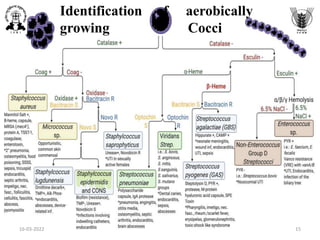
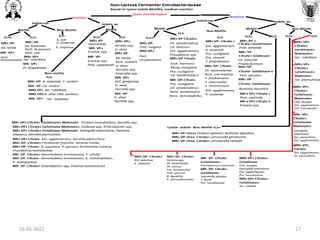
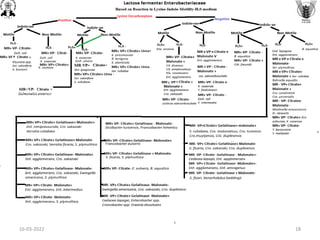
Identification of aerobically
growing Cocci
16-03-2022 15
16-03-2022 16
16-03-2022 17
16-03-2022 18
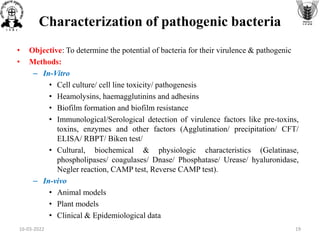
Characterization of pathogenic bacteria
• Objective: To determine the potential of bacteria for their virulence & pathogenic
• Methods:
– In-Vitro
• Cell culture/ cell line toxicity/ pathogenesis
• Heamolysins, haemagglutinins and adhesins
• Biofilm formation and biofilm resistance
• Immunological/Serological detection of virulence factors like pre-toxins,
toxins, enzymes and other factors (Agglutination/ precipitation/ CFT/
ELISA/ RBPT/ Biken test/
• Cultural, biochemical & physiologic characteristics (Gelatinase,
phospholipases/ coagulases/ Dnase/ Phosphatase/ Urease/ hyaluronidase,
Negler reaction, CAMP test, Reverse CAMP test).
– In-vivo
• Animal models
• Plant models
• Clinical & Epidemiological data
16-03-2022 19
CAMP and Reverse CAMP test
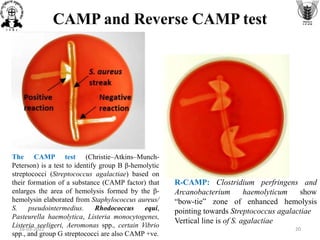
R-CAMP: Clostridium perfringens and
Arcanobacterium haemolyticum show
“bow-tie” zone of enhanced hemolysis
pointing towards Streptococcus agalactiae
Vertical line is of S. agalactiae
The CAMP test (Christie–Atkins–Munch-
Peterson) is a test to identify group B β-hemolytic
streptococci (Streptococcus agalactiae) based on
their formation of a substance (CAMP factor) that
enlarges the area of hemolysis formed by the β-
hemolysin elaborated from Staphylococcus aureus/
S. pseudointermedius. Rhodococcus equi,
Pasteurella haemolytica, Listeria monocytogenes,
Listeria seeligeri, Aeromonas spp., certain Vibrio
spp., and group G streptococci are also CAMP +ve.
16-03-2022 20
In-vitro tests for pathogen characterization
• Coagulase test is used to differentiate Staphylococcus aureus, S. cornubiensis, S.
delphini, S. hyicus, S. intermedius, S. pseudintermedius, S. schleiferi ssp. coaggulans
(positive) producing coagulase, from other staphylococci like S. epidermidis and S.
saprophyticus etc. which do not produce coagulase and are called as Coagulase
Negative Staphylococcus (CoNS).
• Bacitracin susceptibility, a polypeptide antibiotic from Bacillus subtilis var Tracy
(0.04 IU - 0.05 IU) sensitivity is used for identification of bacitracin susceptible β-
hemolytic Group A streptococci (S. pyogenes) from β-hemolytic non-Group A
streptococci (resistant). The test can be used as the sole test for diagnosing GAS
infections in place of costly sero-grouping.
• India Ink degradation assay (Behera et al., 2013): Done for determining virulence
of several Gram negative bacteria through growing them in BHI Broth or TSB
containing 10% of filter sterilized India Ink. Incubate for at 37°C and check at 6h
interval up to 48 h for degradation of the dye (decolouration).
• Coomassie brilliant blue (CBB) binding assay: : Done for determining virulence
of several Gram-negative bacteria (Aeromonas spp., Flavobacterium spp., Vibrio
spp., Edwadsiella spp., Pseudomonas spp., Escherichia coli, Salmonella spp. &
Shigella spp.) by Cipriano and Bertolini (1988) method, adding CBB-R250 MS to a
final concentration of 0.01% in Tryptic soy agar medium and incubate in anaerobic
condition for 24 h at 37°C and observe for blue colonies is positive.
• Dnase test (for Staphylococcus aureus ssp. aureus, S. caprae, S. cornubiensis, S.
hyicus, S. intermedius, S. pseudintermedius).
• Serotyping: Useful in identification of serotypes often specific to certain
pathologies.
16-03-2022 21
• MLEE: Multilocus enzyme-electrophoresis: Used in pathotyping.
• Lipid profiling: Used in pathotyping.
• Protein profiling: PAGE, SDS-PAGE, Two dimensional and three dimensional
protein profiling. Used in pathotyping.
• Mucoid strains of group A Streptococcus: Ability to produce hyaluronic acid
capsule indicated by the mucoid colony morphology, is associated with their ability
to cause acute rheumatic fever.
• The Quellung reaction, (Neufeld reaction), is a biochemical reaction in which
antibodies bind to the bacterial capsule of Streptococcus, it is gold standard
method for pneumococcal capsular serotyping.
• Biofilm formation: High biofilm formation has been associated with virulence in
mice. This test has been used by a range of pathogens like Candida spp.,
Pseudomonas spp., Burkholderia spp., and other microbes associated with chronic
muosal and serosal infection.
• Osmotic stress tolerance tested through growth in presence of varying
concentration salt: Candida tropicalis growing in media with 15% salt are shown to
be more virulent and drug resistant.
• Surface anionicity measured through adhesion to DEAE-Sepharose (Singh &
Sharma, 2001): Higher surface anionicity of bacteria have been associated with
their increased virulence.
• Surface hydrophobicity assay (Singh & Sharma, 2001) measured through n-
Hexadecane binding of bacteria is shown associated with virulence.
• Congo Red dye binding assay: Done in the same way as CBBB assay, but
incubation is aerobic and observations are made for appearance of brick red
colonies to estimate invasive potential.
16-03-2022 22
• Elastase: 1% Elastin powder from bovine neck ligament is poured inagar plates. Colonies were
inoculated onto the surface of the agar and incubated for 48 h at 37°C. The plates are kept at room
temperature for up to 5d. Clearing of the opaque medium around the inoculum spot represented a
positive test.
• Fibrinolysin: Fibrinogen mixed with nutrient agar (280 mg per 100 ml) inoculated with the test bacteria
and incubated for 48 h at 37°C. Clear zones around the growth with >2 mm diameter indicates the lysis
of human fibrinogen.
• Gelatinase: Either gelatin medium (Nutrient broth with 1% gelatin) or a gelatin strip of x-ray film of
approximately 3 mm by 20 mm was placed over TSB broth. Inoculate the test bacteria for 48 h at 37oC ,
observe for removal of the gelatin coating from the surface of the x-ray film strip or liqufication of
gelatin medium as evidence of a positive test.
• Hyaluronidase: Hyaluronic acid from human umbilical cord incorporated into nutrient agar and test
bacteria is spot inoculated onto the surface. Incubate for 48 h at 37°C. Then the surface of the plate is
flooded with 2N acetic acid. After 10 min, clearing around the inoculum spot is evidence of a positive
test.
• Lecithinase: Egg yolk (50 per cent) medium made in agar base. Test organisms are spot inoculated onto
the surface of the agar and incubated for 72 h at 37°C. A white precipitate beneath the inoculum spot is a
positive test.
• Lipase: Trypticase soy agar plates supplemented with 1 per cent tween 80 (polyoxyethylene sorbitan
monooleate) is inoculated onto the surface and incubated for 72 h at 37°C. The appearance of a turbid
halo around the inoculum spot indicates a positive test.
• Proteinase: Skim milk agar added into dialysed brain heart infusion broth base is surface inoculated and
incubated for 72 h at 37’C. A zone of clearing around the inoculum spot is an evidence of a positive test.
• Bile solubility assay: For differentiation of enterococci and streptococci. Touch the test colony with a
loopful of 2% sodium desoxycholate (pH 7.0), incubate at 37oC for 30 min, colonies of pneumococci
will disappear leaving a spot of a-haemolysis.
16-03-2022 23
• α, β & γ hamolysis (for Staphylococcus, Streptococcus and other bacteria)
• Haemolysin typing: Different haemolysins affect the pathogenesis in different
host. Bacteria producing different haemolysins affecting different types of RBS
(washed/ unwashed) from different sources (Chicken/ duck/ cattle/ buffalo/ pig/
human of different blood groups) are shown to be associated with host specificity
and virulence.
• Haem-agglutinins affecting different types of RBS (tanned/ fresh) from different
sources (Chicken/ duck/ cattle/ buffalo/ pig/ human of different blood groups) are
shown to be associated with host specificity.
• Macrophage survival assays: The survival of pathogens in macrophages of
different origin have been associated with host and predilection site specificity.
• Assays of Phagocytosis: Phagocytes of blood origin, tissue origin can be used.
• Hela-Cell invasion assay: for determining invasiveness of Shigella and other
bacteria.
• Vero-Cell & HEp-2 Cells assay: for enterotoxicity and cytotoxicity assays.
• MDBK/ MDCK/ Enterocyte cells, colonic adenocarcinoma cell line Caco-2
toxicity assays.
• BEAS-2B, a epithelial cell line & HEK293 cells : For differential adhesion assays
• Caco-2 & HT29 cell: For adhession assays
Semi in-vitro assays
16-03-2022 24
• Real host pathogenicity assays: rarely used.
• Mouse/ guinea pig/ rat/ rabbit Lethality/ pathogenicity studies: Better to use inbred lines.
• Embryonated egg/ Chicken embryo pathogenicity/ lethality assay: Better to use SPF inbred line of
chick embryos.
• Nematodes Models:
– Caenorhabditis elegans is emerging as a facile and economical model host for the study of
evolutionarily conserved mechanisms of microbial pathogenesis and innate immunity.
– Galleria mellonella (wax worm) larva is a useful host organism to study GAS pathogenesis
specially those associated with human necrotizing fasciitis.
• Drosophila pathogenicity: Many mammalian pathogenic bacteria and fungi can infect and cause
disease in simple non-vertebrate hosts, such as the fruit fly Drosophila melanogaster.
• Sereny test in guinea pig eye: for determining invasiveness of Shigella and other bacteria.
• RLIL (Rabbit ligated ileal loop assay): for enterotoxins
• Mouse paw edema test: for enterotoxins
• Infant mouse assay: for heat stable toxins of E. coli
• Plant Arabidopsis thaliana (short generation time, small size that limited the requirement for growth
facilities, and prolific seed production through self-pollination): It has been used as model for a
variety of plant pathogens including fungi, bacteria, phytoplasma, virus, viroid, nematode,
parasites but some human pathogens like pseudomonads and Burkholderia have also been tested on
it.
• Seed germination model: Mostly moong bean and maize sprouts have been used for determining
cytotoxicity of Salmonella.
• Garlic and onion roots kinking assay: Test is shown to be sensitive models for cytotoxic and
mutagenic potential of several microbes
In-Vivo tests
16-03-2022 25
• None on the Earth (host or the pathogen) is omniscient,
omnipotent & Everlasting.
• Neither you nor me can learn all the techniques nor we can
remembers all the details.
• Nothing is static in the word thus in the biological sphere including
microbes.
• In microbiology, facts are not visible all the time with naked eyes
but impact can be observed and felt using special techniques.
• Life system is complex irrespective of the shape and size of an
organism.
• Microbes usually unicellular perform all necessary activities to
survive and disperse their genome (expand) to acquire and keep
hold on one or more niche.
• Only few microbes are harmful rest are either friends or indifferent.
Friends and indifferent microbes behave in the said way by the time
we not invade their niche once we cross the limits they are also
revengeful and capable to harm us.
• Practice makes one perfect.
Conclusion
16-03-2022 26

Conventional methods for identification and characterization of pathogenic bacteria

  • 1.
    Conventional methods for identificationand characterization of pathogenic bacteria Bhoj R Singh Principal Scientist and Head Division of Epidemiology, ICAR-IVRI, Izatnagar-243122 Presented at: 10 day (14-23 March 2022) online training program on “Safety, Security and Quality Assurance of Food: Recent Updates”, NDVSU, Jabalpur (MP) 16-03-2022 1
  • 2.
    Need for identificationof bacteria in through conventional system • All bacteria can’t be identified by automated systems. • New bacteria and biotypes can’t be identified by automated systems. • We need pure cultures to identify even the for the automated systems. • To characterize for pathogenicity assays we need pre cultures. • Every laboratory can’t afford automated systems (even ICAR-IVRI don’t have one) 16-03-2022 2
  • 3.
    What is identificationof bacteria? • It is a systematic process using multiple techniques to narrow down on the identity (type) of bacteria to species, subspecies, biotypes/ biovar, strain level. • The process chooses tests depending on the target bacteria to be studied or the purpose of the investigation. 16-03-2022 3
  • 4.
    Methods of identificationof bacteria • Conventional: Require culturable (Cultivable) live bacteria, based on growth, biochemical chracteristics (carbon source utilization, fermenatation etc), Gram staining and morphology. • Automated bacteria identification systems: Based on basis of carbon source utilization and or fatty acid (lipid profiling) analysis. Require culturable (Cultivable) live bacteria • Molecular: Genomics/ proteomic/ lipid profiling, can be done using viable, culturable, non-viable, non-cultivable and traces of bacteria. 16-03-2022 4
  • 5.
    Automated bacterial identificationsystems based on Conventional phenotypic identification system • EZ-Fluo System (Maxcell Systems Pvt. Ltd.); Patho Sure (Microbial Detection Kits, Aps Lifetech), Tecta B16 Automated Microbiology Detection System (GenNext Lab Technologies Pvt. Ltd) • BACT/ALERT® 3D (BioMerieux), ipvMicrobe from (imageProVision Technology): : Used for detecting the presence or absence of microorganisms in Blood & sterile body fluids replaces TSB/ thioglycollate medium, blood agar plates etc. • MIS 6.2 (Microbial Identification system, MIDI, Inc, ISA): Uses Fatty acid methyl ester analysis (MIS) by gas chromatography (GC-FAME). • Microbial ID and characterization system (Toshniwal Technologies Pvt. Ltd.) : Use of carbon source metabolic ‘fingerprints’ in order to identify more than 1900 species of bacteria, yeasts and filamentous fungi. • Soleris Automated Rapid Microbiology • Auto Microbial ID AST System (Analytical Technologies Limited) • BACTEC System & BD-Phoenix 100 ID/AST v5.51 from BBL Difco • Biomerieux Vitek 2 • VITEK® MS is an automated mass spectrometry microbial identification system that uses Matrix Assisted Laser Desorption Ionization Time-of-Flight (MALDI-TOF) technology. • Most commonly used: API/ID32 v3.1; Phoenix 100 ID/AST v5.51; AVITEK 2 v7.01; VITEK MS Knowledge Base v2.0/v3.0 16-03-2022 5
  • 6.
    Conventional identification ofbacteria • This process is combination of microscopic (cell shape, size, Gram stain reaction, acid fast reaction, special structure like capsule, flagella, endospore, granules etc.), growth in different broth and on solid media (colony shape, size, consistency, colour, edge, swarm, motility, pellicle, sediment etc.) and biochemical (fermentation, use as sole carbon source, demaination, decarboxylation, oxidase, catalase, gelatinase, urease etc.) methods. 16-03-2022 6
  • 7.
    Pathogenic Bacteria • Thebacteria which cause one or other disease/ lesions due to pathogenesis induced by them. • To classify or identify a bacterial isolate as pathogen needs: – Its characterization using techniques for putative virulence markers (phenotypic and genotypic). – Proving the pathogenic potential and pathogenicity in a suitable biological models/ hosts to establish Evans postulates (Not only Koch postulate). 16-03-2022 7
  • 8.
    Conventional Techniques toidentify pathogenic bacteria • Many similar methods are used for different bacteria but methodology can’t be generalized for all due to their growth patterns at different temperature, oxygen tension and osmotic requirements. • Besides common techniques a few are specific for different bacteria. • Bacterial load is crucial for most of the pathogens, just identification is not enough. • Only those can be cultivated in laboratory on synthetic media or cell culture or animal models can be identified and characterized by conventional methods. 16-03-2022 8
  • 9.
    Common media usedfor selective enrichment of pathogenic bacteria Bacteria Selective Enrichment broth Bacillus cereus BPW heated to pasteurize after inoculation Campylobacter jejuni Selective enrichment medium (ATB) Clostridium botulinum TPGY broth media, Egg meat medium fortified with 1% additions of yeast extract, ammonium sulfate, and glucose (FEM medium) Clostridiumperfringens Thioglycollate medium (fluid) , iron-milk medium Cronobacter sakazaki Cronobacter sakazaki enrichment broth Escherichia coli Enterobacteriaceae enrichment broth, MacConkey broth Listeria monocytogenes Al-Zoreky-Sandine Listeria medium [ASLM] ; University of Vermont Medium (UVM) containing acriflavin and naladixic acid; Fraser broth with acriflavin, naladixic acid and esculin; Listeria Enrichment broth (LEB, FDA BAM formulation) containing the selective agents acriflavin, naladixic acid and the antifungal agent cycloheximide Salmonella spp. Tetrathionate broth Rappaport Vassiliadis medium, Selenite broth Shigella spp. Shigella broth with 0.5mg/L novobiocin Staphylococcus spp. BHI with 10% NaCL Vibrio spp. Alkaline peptone water (APW), Glucose salt teepol (or sodium dodecylsulphate) broth (GSTB) Yersinia enteeocolitica ICT or TTC Broth (contains irgasan or triclosan) Brucella spp. BHI broth Burkholderia spp. Burkholderia broth Pseudomonas Dettol broth, BHI broth 16-03-2022 9
  • 10.
    Common media usedfor plating for pathogenic bacteria Bacteria Selective plating media Bacillus cereus MYP (mannitol-egg yolk-phenol red-polymyxin-agar) PEMBA (polymyxin-pyruvate-egg yolk-mannitol- bromthymol blue-agar), Bacillus Chromogenic Media, Brilliance, and Bacara Campylobacter jejuni Blood-free campylobacter medium, mCCDA (modified charcoal cefoperazone desoxycholate agar, Blood agar (rifampin (25 mg), cefsulodin (6.25 mg), and polymyxin B sulfate (20,000 IU per L) Clostridium botulinum CDC-modified McClung Toabe egg yolk agar (EYA) containing cycloserine, sulfamethoxazole, and trimethoprim; Beef infusion- agar or BHA supplemented with 0.14% sodium bicarbonate and 0.1% l-cysteine hydrochloride. l- Cysteine Clostridiumperfringens Tryptose-sulfite-cycloserine (TSC) agar with egg yolk Cronobacter sakazaki Cronobacter sakazaki enrichment agar Escherichia coli Eosine methylene blue, MacConkey agar Listeria monocytogenes Listeria selective agar (PALCAM, Modified Oxford agar (MOX) or LPM) Salmonella spp. Hektoen enteric agar (HEA), Salmonella Shigella agar, Brilliant green agar, Bismith sulphite agar Shigella spp. MacConkey agar, XLDA, Salmonella shigella agar, HEA Staphylococcus spp. Mannitol salt egg-yolk medium, Baired Parker Agagar (BPA) Vibrio spp. Thiosulphate citrate bile salt agar (TCBS); polymyxin mannose tellurite (PMT), sodium dodecylsulphate polymyxin sucrose agar (SPS) Yersinia enteeocolitica Cefsulodin-irgasan-novobiocin (CIN) agar, Differential Yersinia Selective (DYS) agar, MacConkey agar Brucella spp. Brucella agar with sheep blood Burkholderia spp. Burkholderia cepacia agar Pseudomonas MacConkey agar 16-03-2022 10
  • 11.
    Important tests tobe conducted for bacterial identification • Heamolysis test: in 5-10% sheep blood agar, α, β, γ • 3% KOH test for Gram’s identity of the bacteria. • Oxidase test: N-N-N-N-tetramethyl-p-phenylenediamine dihydrochloride strip test. • Catalase test: H2O2 degradation • Lysine / Ornithine decarboxylation: in MIL or MIO medium • Indole production: Oxalic acid strips hanged in MIL medium or overnight grown culture in TSB medium using xylene 0.3 to extract indole & then pouring 0.2 ml of Kovak’s (5.0 g p-di-methyl-amino- benzyladehyde dissolved in 75 ml amyl alcohol & 25 ml of concentrated HCl) reagent for red ring. • Motility: in MIL medium or in 0.4% agar medium, motile bacteria grow in whole of the medium but non-motile along the inoculation line only. • H2S production: in TSI butt or in MIL medium or hanging lead acetate strip over TSB and observe for blackening of strip. • MR test: For acidic fermentation of glucose using methyl red indicator positive when pH is below 5.9, methyl red turns red. • VP test: After doing MR test add 0.6 ml of 5% α-naphthol made in 95% ethanol and 0.2 ml of 40% KOH, mix well ands keep standing for 15 min to see the red ring at the top of medium. • Citrate utilization test. • Malonate utilization test. • Gelatinase production test • Nitrate reduction test: Add solution A: 0.33% sulfanilic acid in 5N acetic acid and solution B: 0.5% α- naphthylamine in 5% acetic acid in overnight grown culture in nitrate broth, brick red colour. • Coagulase test: Mix equal amount (0.1 ml) of overnight broth culture and undiluted rabbit/ human plasma, incubate at 37oC for 4 h. Examine hourly for coagulation of plasma. Only agglutination will 16-03-2022 11
  • 12.
  • 13.
  • 14.
  • 15.
  • 16.
  • 17.
  • 18.
  • 19.
    Characterization of pathogenicbacteria • Objective: To determine the potential of bacteria for their virulence & pathogenic • Methods: – In-Vitro • Cell culture/ cell line toxicity/ pathogenesis • Heamolysins, haemagglutinins and adhesins • Biofilm formation and biofilm resistance • Immunological/Serological detection of virulence factors like pre-toxins, toxins, enzymes and other factors (Agglutination/ precipitation/ CFT/ ELISA/ RBPT/ Biken test/ • Cultural, biochemical & physiologic characteristics (Gelatinase, phospholipases/ coagulases/ Dnase/ Phosphatase/ Urease/ hyaluronidase, Negler reaction, CAMP test, Reverse CAMP test). – In-vivo • Animal models • Plant models • Clinical & Epidemiological data 16-03-2022 19
  • 20.
    CAMP and ReverseCAMP test R-CAMP: Clostridium perfringens and Arcanobacterium haemolyticum show “bow-tie” zone of enhanced hemolysis pointing towards Streptococcus agalactiae Vertical line is of S. agalactiae The CAMP test (Christie–Atkins–Munch- Peterson) is a test to identify group B β-hemolytic streptococci (Streptococcus agalactiae) based on their formation of a substance (CAMP factor) that enlarges the area of hemolysis formed by the β- hemolysin elaborated from Staphylococcus aureus/ S. pseudointermedius. Rhodococcus equi, Pasteurella haemolytica, Listeria monocytogenes, Listeria seeligeri, Aeromonas spp., certain Vibrio spp., and group G streptococci are also CAMP +ve. 16-03-2022 20
  • 21.
    In-vitro tests forpathogen characterization • Coagulase test is used to differentiate Staphylococcus aureus, S. cornubiensis, S. delphini, S. hyicus, S. intermedius, S. pseudintermedius, S. schleiferi ssp. coaggulans (positive) producing coagulase, from other staphylococci like S. epidermidis and S. saprophyticus etc. which do not produce coagulase and are called as Coagulase Negative Staphylococcus (CoNS). • Bacitracin susceptibility, a polypeptide antibiotic from Bacillus subtilis var Tracy (0.04 IU - 0.05 IU) sensitivity is used for identification of bacitracin susceptible β- hemolytic Group A streptococci (S. pyogenes) from β-hemolytic non-Group A streptococci (resistant). The test can be used as the sole test for diagnosing GAS infections in place of costly sero-grouping. • India Ink degradation assay (Behera et al., 2013): Done for determining virulence of several Gram negative bacteria through growing them in BHI Broth or TSB containing 10% of filter sterilized India Ink. Incubate for at 37°C and check at 6h interval up to 48 h for degradation of the dye (decolouration). • Coomassie brilliant blue (CBB) binding assay: : Done for determining virulence of several Gram-negative bacteria (Aeromonas spp., Flavobacterium spp., Vibrio spp., Edwadsiella spp., Pseudomonas spp., Escherichia coli, Salmonella spp. & Shigella spp.) by Cipriano and Bertolini (1988) method, adding CBB-R250 MS to a final concentration of 0.01% in Tryptic soy agar medium and incubate in anaerobic condition for 24 h at 37°C and observe for blue colonies is positive. • Dnase test (for Staphylococcus aureus ssp. aureus, S. caprae, S. cornubiensis, S. hyicus, S. intermedius, S. pseudintermedius). • Serotyping: Useful in identification of serotypes often specific to certain pathologies. 16-03-2022 21
  • 22.
    • MLEE: Multilocusenzyme-electrophoresis: Used in pathotyping. • Lipid profiling: Used in pathotyping. • Protein profiling: PAGE, SDS-PAGE, Two dimensional and three dimensional protein profiling. Used in pathotyping. • Mucoid strains of group A Streptococcus: Ability to produce hyaluronic acid capsule indicated by the mucoid colony morphology, is associated with their ability to cause acute rheumatic fever. • The Quellung reaction, (Neufeld reaction), is a biochemical reaction in which antibodies bind to the bacterial capsule of Streptococcus, it is gold standard method for pneumococcal capsular serotyping. • Biofilm formation: High biofilm formation has been associated with virulence in mice. This test has been used by a range of pathogens like Candida spp., Pseudomonas spp., Burkholderia spp., and other microbes associated with chronic muosal and serosal infection. • Osmotic stress tolerance tested through growth in presence of varying concentration salt: Candida tropicalis growing in media with 15% salt are shown to be more virulent and drug resistant. • Surface anionicity measured through adhesion to DEAE-Sepharose (Singh & Sharma, 2001): Higher surface anionicity of bacteria have been associated with their increased virulence. • Surface hydrophobicity assay (Singh & Sharma, 2001) measured through n- Hexadecane binding of bacteria is shown associated with virulence. • Congo Red dye binding assay: Done in the same way as CBBB assay, but incubation is aerobic and observations are made for appearance of brick red colonies to estimate invasive potential. 16-03-2022 22
  • 23.
    • Elastase: 1%Elastin powder from bovine neck ligament is poured inagar plates. Colonies were inoculated onto the surface of the agar and incubated for 48 h at 37°C. The plates are kept at room temperature for up to 5d. Clearing of the opaque medium around the inoculum spot represented a positive test. • Fibrinolysin: Fibrinogen mixed with nutrient agar (280 mg per 100 ml) inoculated with the test bacteria and incubated for 48 h at 37°C. Clear zones around the growth with >2 mm diameter indicates the lysis of human fibrinogen. • Gelatinase: Either gelatin medium (Nutrient broth with 1% gelatin) or a gelatin strip of x-ray film of approximately 3 mm by 20 mm was placed over TSB broth. Inoculate the test bacteria for 48 h at 37oC , observe for removal of the gelatin coating from the surface of the x-ray film strip or liqufication of gelatin medium as evidence of a positive test. • Hyaluronidase: Hyaluronic acid from human umbilical cord incorporated into nutrient agar and test bacteria is spot inoculated onto the surface. Incubate for 48 h at 37°C. Then the surface of the plate is flooded with 2N acetic acid. After 10 min, clearing around the inoculum spot is evidence of a positive test. • Lecithinase: Egg yolk (50 per cent) medium made in agar base. Test organisms are spot inoculated onto the surface of the agar and incubated for 72 h at 37°C. A white precipitate beneath the inoculum spot is a positive test. • Lipase: Trypticase soy agar plates supplemented with 1 per cent tween 80 (polyoxyethylene sorbitan monooleate) is inoculated onto the surface and incubated for 72 h at 37°C. The appearance of a turbid halo around the inoculum spot indicates a positive test. • Proteinase: Skim milk agar added into dialysed brain heart infusion broth base is surface inoculated and incubated for 72 h at 37’C. A zone of clearing around the inoculum spot is an evidence of a positive test. • Bile solubility assay: For differentiation of enterococci and streptococci. Touch the test colony with a loopful of 2% sodium desoxycholate (pH 7.0), incubate at 37oC for 30 min, colonies of pneumococci will disappear leaving a spot of a-haemolysis. 16-03-2022 23
  • 24.
    • α, β& γ hamolysis (for Staphylococcus, Streptococcus and other bacteria) • Haemolysin typing: Different haemolysins affect the pathogenesis in different host. Bacteria producing different haemolysins affecting different types of RBS (washed/ unwashed) from different sources (Chicken/ duck/ cattle/ buffalo/ pig/ human of different blood groups) are shown to be associated with host specificity and virulence. • Haem-agglutinins affecting different types of RBS (tanned/ fresh) from different sources (Chicken/ duck/ cattle/ buffalo/ pig/ human of different blood groups) are shown to be associated with host specificity. • Macrophage survival assays: The survival of pathogens in macrophages of different origin have been associated with host and predilection site specificity. • Assays of Phagocytosis: Phagocytes of blood origin, tissue origin can be used. • Hela-Cell invasion assay: for determining invasiveness of Shigella and other bacteria. • Vero-Cell & HEp-2 Cells assay: for enterotoxicity and cytotoxicity assays. • MDBK/ MDCK/ Enterocyte cells, colonic adenocarcinoma cell line Caco-2 toxicity assays. • BEAS-2B, a epithelial cell line & HEK293 cells : For differential adhesion assays • Caco-2 & HT29 cell: For adhession assays Semi in-vitro assays 16-03-2022 24
  • 25.
    • Real hostpathogenicity assays: rarely used. • Mouse/ guinea pig/ rat/ rabbit Lethality/ pathogenicity studies: Better to use inbred lines. • Embryonated egg/ Chicken embryo pathogenicity/ lethality assay: Better to use SPF inbred line of chick embryos. • Nematodes Models: – Caenorhabditis elegans is emerging as a facile and economical model host for the study of evolutionarily conserved mechanisms of microbial pathogenesis and innate immunity. – Galleria mellonella (wax worm) larva is a useful host organism to study GAS pathogenesis specially those associated with human necrotizing fasciitis. • Drosophila pathogenicity: Many mammalian pathogenic bacteria and fungi can infect and cause disease in simple non-vertebrate hosts, such as the fruit fly Drosophila melanogaster. • Sereny test in guinea pig eye: for determining invasiveness of Shigella and other bacteria. • RLIL (Rabbit ligated ileal loop assay): for enterotoxins • Mouse paw edema test: for enterotoxins • Infant mouse assay: for heat stable toxins of E. coli • Plant Arabidopsis thaliana (short generation time, small size that limited the requirement for growth facilities, and prolific seed production through self-pollination): It has been used as model for a variety of plant pathogens including fungi, bacteria, phytoplasma, virus, viroid, nematode, parasites but some human pathogens like pseudomonads and Burkholderia have also been tested on it. • Seed germination model: Mostly moong bean and maize sprouts have been used for determining cytotoxicity of Salmonella. • Garlic and onion roots kinking assay: Test is shown to be sensitive models for cytotoxic and mutagenic potential of several microbes In-Vivo tests 16-03-2022 25
  • 26.
    • None onthe Earth (host or the pathogen) is omniscient, omnipotent & Everlasting. • Neither you nor me can learn all the techniques nor we can remembers all the details. • Nothing is static in the word thus in the biological sphere including microbes. • In microbiology, facts are not visible all the time with naked eyes but impact can be observed and felt using special techniques. • Life system is complex irrespective of the shape and size of an organism. • Microbes usually unicellular perform all necessary activities to survive and disperse their genome (expand) to acquire and keep hold on one or more niche. • Only few microbes are harmful rest are either friends or indifferent. Friends and indifferent microbes behave in the said way by the time we not invade their niche once we cross the limits they are also revengeful and capable to harm us. • Practice makes one perfect. Conclusion 16-03-2022 26